Article Contents:
- Picture frames and molding: what it is and when you specifically need a frame
- When it's more cost-effective to buy frame molding by the meter
- When it's better to take a ready-made picture frame
- Which picture frames are most commonly purchased
- Wooden frame molding - the top choice
- Frame molding for standard sizes
- Frame molding for non-standard pictures
- Frame molding for custom frames
- Wooden picture frame molding: why it's the strongest commercial option
- An appearance that cannot be forged
- Durability measured in decades
- Status and value of the artwork
- Possibilities for classic and contemporary art
- When to use molding by the meter and when to use a ready-made frame
- How to choose wooden molding by width, profile, and style
- For small paintings and miniatures
- For large canvases
- For classical painting
- For posters and graphics
- For modern interiors
- Picture frame for canvas, poster, embroidery, and reproduction: what's the difference
- Canvas painting (on stretcher)
- Poster and paper artwork
- Embroidery
- Icon
- Reproduction
- Carved wooden picture frame: a separate story
- How a gallery wall with wooden frames works
- What determines the price of a wooden picture frame
- Material: oak or beech
- Profile width
- Carving complexity and relief depth
- Finish: for painting or with final coating
- Order volume: retail or wholesale
- Custom made
- Where to buy wooden picture frames and what to consider before ordering
- Measure the artwork precisely
- Decide on the purchase format
- Choose the profile before ordering
- Calculate the footage with a margin
- Specify the finish
- Place an order at STAVROS
- Wooden moldings for interiors: when the frame becomes part of the design
- About the Company STAVROS
- FAQ: common questions about wooden picture frames

Imagine: a magnificent painting on the wall — and next to it, a bland plastic frame from a mass-market store. That's it. The impression is ruined. Not by the painting — by the frame. This is a harsh truth known to anyone who has ever seriously engaged in interior design: a work is worth exactly as much as its framing. A wooden picture frame is not a secondary detail. It's the first thing the eye sees before reaching the image itself.
Picture frames and moldings — this is a category where craft and art, function and aesthetics, tradition and modernity converge. In this guide, we'll cover everything without unnecessary words: how to choose a wooden frame, the difference between linear meter and ready-made frames, how not to make mistakes with profile and width, what affects the price, and where to buy picture frames made from solid wood.



Picture frames and moldings: what they are and when you specifically need a frame
The word 'molding' — from the unit of measurement 'linear meter' — refers to any profile wood products sold by the meter and used for finishing and decoration. This is a broad family: baseboards, moldings, cornices, casings, glazing beads, friezes, and — as one of the key types — wooden picture frames.
The wooden picture frame itself is a profile strip with a rabbet (inner quarter) into which the glass, painting, and backboard are inserted. The profile shape determines how the frame looks from the outside: its width, relief height, and decorative character — smooth, figured, carved.




When it's more cost-effective to buy frames by the meter
Linear meter purchase means buying molding profile cut to size, from which a frame is then assembled to specific dimensions. This is the optimal option when:
-
need a frame of a non-standard format (e.g., 73×107 cm);
-
need several frames with the same profile but different sizes;
-
you work as an artist, designer, or framer and want a batch of frames from the same material;
-
full customization is important: your own profile, your own finish, your own cross-section.
Buy wooden molding by the meterfrom oak or beech at STAVROS means getting a profile with precise geometry, tolerance ±0.1 mm per linear meter, made from dry selected wood with a moisture content of 8–12%.
Our factory also produces:




When it's better to get a ready-made picture frame
If you have a standard format (A4, A3, 30×40, 40×60 — market classics) and the task is simple — to frame a poster, reproduction, or small photo — a ready-made frame is more convenient: no need to cut, assemble, or sand. Buy, insert, hang.
But as soon as the work goes beyond the standard — in size, style, weight, and value of the piece — buying by the meter becomes the only correct choice.
Get Consultation
Which picture moldings are bought most often
The wooden molding market is diverse, but demand clusters around several scenarios.
Wooden molding is the top choice
Wood is the only material for molding that combines all the necessary qualities: texture, weight, durability, and the possibility of any finish from patination to gilding. That is whywooden picture moldingit remains the main choice for both private collectors and galleries, museums, and designers.
In the STAVROS catalog, wooden moldings start from 180 rubles per linear meter (simple smooth profiles) and go up to 6,060 rubles and above (series K-104 — complex multi-level carved profiles). The material is solid oak and beech of Russian and European origin.
Molding for standard sizes
For works up to 60×80 cm, which make up the majority of retail purchases, medium-width profiles (30–60 mm), smooth or with moderate relief, are suitable. This is the most popular range: inexpensive, versatile, and looks good in most interiors.
Molding for non-standard paintings
Large canvases from 80 cm and above require appropriate framing: a wide profile (60–120 mm), dense wood, and reliable corner joints that can support the weight of the structure. For significant works — oil paintings, expensive reproductions, original graphics — it is not worth saving on the profile.
Molding for custom frames
When working with non-standard formats, custom projects, and interiors with individual character, wooden molding frames are ordered to be made according to specific dimensions and drawings. STAVROS fulfills such orders under the condition of a production run — with complete freedom regarding profile, wood species, and finish.
Wooden picture molding: why it is the strongest commercial option
Why, among all materials — plastic, metal, MDF, polyurethane foam — does wood hold the leading position in the professional and premium segment? The question is rhetorical, but the answer should be formulated clearly.
An appearance that cannot be counterfeited
The natural texture of wood is a living pattern, of which there are no two identical samples. Oak with large pores and pronounced annual rings, beech with a fine, uniform structure and a soft pinkish hue — each species has its own character. No photo-printed plastic, no imitation film provides the tactile and visual sensation that real solid wood carries.
In oblique light, the wooden profile plays with shadows in the relief — every curl of the carving, every ledge of the profile gains depth. This effect is unattainable on artificial materials.
Durability measured in decades
Woodensolid wood molding for pictureswith proper care, serves for 30–50 years without loss of properties. Frames made from oak profiles in European galleries are used for 80–100 years without replacement. This is a one-time investment — unlike cheap analogues that yellow, crack, and lose shape within a few years.
The status and value of the artwork
A proper wooden frame literally increases the perceived value of a painting. This is a well-known psychological effect: a work in a massive carved oak frame is perceived by the viewer as more valuable and significant than the same work in a plastic frame. For collectors and gallerists, this is fundamental.
Possibilities for classic and contemporary art
Wooden molding is a material beyond styles. A thin, smooth beech profile in white matte enamel is ideal for conceptual photography in a minimalist interior. A wide carved profile with an oak patina is for old master paintings in a classic study. Both are made of wood. Just different profiles and finishes.
When you need molding by the meter and when you need a ready-made picture frame
This is not a technical question, but a question of the use case.
Meterage is needed if:
-
non-standard size of the work (especially painting on canvas or a non-standard stretcher);
-
a batch of frames of the same profile but different sizes is needed;
-
you are a molding craftsman and work on a constant flow of orders;
-
a specific profile is required for an author's project;
-
It is important that the frame and interior trim—moldings, baseboards—match in profile and wood species.
A ready-made frame is more convenient if:
-
the format is standard and well-known (A4, A3, 30×40, 40×50);
-
you lack the tools and skills for self-assembly;
-
you need it quickly and without extra steps—buy and hang;
-
the purpose is decorative, not for collection.
In professional settings—interior design, furniture manufacturing, gallery practice—they almost always work with linear footage. This provides maximum freedom and precision of fit.
| Criterion | Footage | Ready-made frame |
|---|---|---|
| Non-standard sizes | ✓ | ✗ |
| Quick installation | ✗ | ✓ |
| Unique profile | ✓ | ✗ |
| Batch Orders | ✓ | Limited |
| Minimum Skills | ✗ | ✓ |
| Maximum Profile Selection | ✓ | Limited |
How to Choose a Wooden Moulding by Width, Profile, and Style
The Main Practical Section. This is where many get lost: too many options, unclear series, different profiles. Let's break it down practically.
For Small Pictures and Miniatures
Formats up to 30×40 cm are works that appear on the wall as a detail, not a dominant feature. Here, a narrow profile is needed: from 15 to 35 mm. A wide frame literally 'swallows' a small painting, overwhelming its scale. A smooth or minimally milled profile is optimal. Finish — under light varnish or subtle patination.
Series K-034 (from 230 rub./m) or K-125 (from 270 rub./m) from the STAVROS catalog are good examples in this range.
For Large Canvases
Works from 60×80 cm and larger are already of architectural scale. The profile width here can and should be from 50 to 120 mm. The larger the canvas, the greater the 'buffer zone' created by a wide frame — a visual pause between the artwork and the wall. This is not just aesthetics: a wide wooden profile carries additional structural weight and holds the construction under significant loads.
Series K-066 (from 2,580 rub./m), K-104 (from 6,060 rub./m) — this is already the level of executive halls and galleries.
For classical painting
Oil painting in the academic tradition — landscape, portrait, still life — requires a frame with character. A figured or carved oak profile with a walnut or wenge finish, or patinated to resemble old gold. Width — from 50 mm. Profiles with 'steps' work well — multi-level transitions between planes create a sense of depth.
For posters and graphics
A poster, print, or original graphic is a work that most often calls for a light, modern framing. A narrow smooth profile 20–35 mm in white or black enamel is the most common solution. Beech under white enamel is ideal: its fine-pored structure gives a perfectly even painted surface without spotting.
For modern interiors
A modern interior and a wooden frame are not contradictory. You just need to choose the right profile. A minimalist flat plank 20–30 mm made of beech in matte enamel, a thin 'offline' profile with a single bevel, a frame made of light ash — all of this fits organically into high-tech, Scandinavian style, and modern classic.
Molding for canvas, poster, embroidery, and reproduction: what's the difference
It's not just semantics. Different types of works impose different requirements on the frame's construction — and therefore, on the profile.
Painting on canvas (on stretcher)
Painting on canvas is stretched on a wooden stretcher 15–40 mm thick. The frame's rabbet must accommodate this stretcher: sufficient rabbet depth — at least 15 mm, and for massive stretchers from 30 mm — correspondingly more. Choose profiles with a deep rabbet. Glass, as a rule, is not used — an oil painting needs to breathe.
For such an application in the catalogSTAVROS wooden baguetteit is important to specify the rabbet depth when ordering.
Poster and paper artwork
A poster under glass is the simplest option. Needed: a profile with a moderate rabbet (10–15 mm for 2 mm glass + mat board + backing), a lightweight construction. A mat between the poster and the glass is advisable: it prevents the paper from sticking to the glass in humid conditions.
Embroidery
Embroidery on canvas requires a mandatory mat: it hides the edges of the canvas, creates a clean frame around the design, and prevents the embroidery from sagging. Mat width — from 40 to 60 mm depending on the format. Frame profile — moderate, 30–50 mm, subdued, so as not to distract from the handcrafted work. Light tinting or white finish.
Icon
Icons are traditionally framed in a kiot — a special box-frame — or in a wide molding with patina and gilding. For icons, not only aesthetics are important, but also the protective function: solid oak more reliably preserves the artwork in the long term. Decoration — patination, application of gold into the recesses of the carving, tinting in dark walnut.
Reproduction
Art reproduction (print on paper or canvas) is the most common object for framing. The rule here is simple: the level of framing should correspond to the level of perceived value of the artwork. A cheap print in an expensive carved frame is nonsense. A high-quality reproduction by a major master deserves a serious wooden profile.
Carved wooden picture frame molding: a separate story
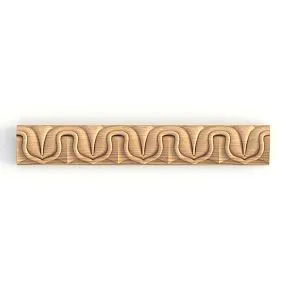
Carving on wooden molding is what distinguishes framing from a craft product. When a master milling machine operator or wood carver creates an ornament on the profile—a plant curl, a geometric meander, an acanthus leaf—the molding ceases to be just a strip and becomes an architectural statement.
Carved wooden skirtingin application to picture frames—this is the highest level of framing. Such a profile is appropriate:
-
in classic interiors with stucco and dark wood;
-
when decorating 19th–20th century paintings;
-
in representative spaces—offices, meeting rooms, ceremonial halls;
-
in private galleries and collections where representation is important.
In the STAVROS catalog, carved profiles of series K-001, K-012, K-066, K-104 represent different levels of complexity: from moderate relief to deep multi-level carving. All are made from solid oak or beech, with 3D milling and manual finishing.
How a gallery wall with wooden frames works
One molding is the framing of one painting. Several frames are already a composition. And a thoughtfully designed gallery wall made of wooden frames is an interior statement that speaks more about the owner's taste than any expensive furniture.
Basic principles that work:
Profile unity. Frames made from the same wooden profile in different sizes are the most reliable way to make a multi-format hanging visually cohesive. Frames that differ in size but share the same profile create a sense of a series, set, or collection.
Contrast with the background. Dark oak on a white wall is a strong contrasting accent. Light beech on a warm ochre wall is a soft integration. The wall color and wood tone should work in tandem.
Intervals. The standard gap between frames in a gallery-style hanging is 5–10 cm. More than that, and the frames 'scatter.' Less, and it becomes cramped. Uniformity of intervals is the main rule of order.
Eye level. The visual center of the main artwork should be at a height of 150–160 cm from the floor with standard ceilings. This is not a rule; it's physiology: the eye level of a standing person.
Read more about howwooden picture frame molding for interiorworks in gallery and residential spaces, covered in thematic materials on the STAVROS website.
What determines the price of a wooden picture frame molding
The price range in the STAVROS catalog — from 180 to 6,060 rubles per linear meter — is confusing until you understand the logic. And it is simple and clear.
Material: oak or beech
Oak is harder, heavier, denser, and more textured. It is also more expensive, on average by 15–25%, compared to beech of a similar profile. Beech is softer to work with, ideal for painting, and slightly cheaper. Both are solid wood and both are durable.
Profile width
This is the most obvious factor: a linear meter of an 80 mm wide profile contains 2.5–3 times more material than a 30 mm profile. The price increases proportionally to the width.
Complexity of carving and depth of relief
A simple smooth profile means minimal milling time and minimal price. Each additional level of relief, each ornament, means additional passes of the cutter, additional time, and additional tooling. The carved profile K-104 is not 26 times more expensive than K-034 'just because'—it's a 26-fold difference in labor intensity and manufacturing complexity.
Finish: for painting or with a final finish
An unfinished blank is the most affordable option, implying further independent processing. An item with tinting, patina, varnishing, or imitation gilding is a ready-to-install product with a corresponding markup for the work.
Order volume: retail or wholesale
Retail purchase of one linear meter and a wholesale order of 50 meters have different prices. STAVROS works with both formats, offering loyalty programs and special conditions to wholesale clients (designers, furniture manufacturers, frame workshops).
Custom manufacturing
A non-standard profile, unique ornament, atypical cross-section—this is custom production with an individual cost calculation. The minimum order quantity is confirmed with the manager. The result is a profile that is unique on the market.
Where to buy wooden picture frames and what to look for before ordering
Final block — purchase practice. No theory, only what's important to do before placing an order.
Measure the product accurately
Inner frame size = image size + 1–2 mm gap. For canvas on stretcher — account for stretcher thickness and choose a profile with appropriate rabbet depth (at least 15 mm, better 20–25 mm).
Decide on the purchase format
Meterage — if non-standard size or a series is needed. Ready-made frame — if standard and without assembly.
Choose a profile before ordering
Browse the catalog, pay attention to profile width and relief type. For paintings up to 40×60 — up to 50 mm. For large canvases — from 60 mm. Carving — for classic and representative spaces. Smooth profile — for modern interiors and posters.
Calculate meterage with margin
Frame perimeter + 15–20% for cutting waste. For a rectangular frame 50×70 cm: perimeter = (50+70)×2 = 240 cm = 2.4 m. Plus margin 0.4 m = minimum 2.8 m of molding.
Clarify the finish
If you're planning to paint it yourself — choose 'unfinished/for painting'. If you need a finished product — check the availability of specific options in the catalog or when ordering.
Place your order at STAVROS
The entire listed assortment — wooden picture frame moldings,Carved Trim, moldings and profiles made from solid oak and beech — is available in the STAVROS catalog. Retail, wholesale, custom manufacturing, delivery across Russia and CIS, pickup in Moscow and St. Petersburg.
Phone: 8 (800) 555-46-75 (toll-free within Russia).
Wooden interior millwork: when the frame becomes part of the design
One of the most interesting shifts in modern interior design is the use of wooden picture frame molding not just as a frame for a specific artwork, but as an independent architectural element.
Wooden frames made from picture frame molding, applied directly to the wall without any painting inside, are a powerful design technique. An empty frame structures the plane, creates rhythm, adds depth without a single image. This works especially well in bedrooms above the headboard, in hallways, in offices with plain light-colored walls.
solid oak and beech wood trim— is a unified system for the entire interior: from picture frames to baseboards, from door casings to cornice belts. When all the wooden outlines of a room are made from the same material and similar profiles — the interior gains a tectonic integrity that is felt physically.
For those who want to delve deeper into the application of wooden millwork in interior projects, we recommend exploring the materials in the section How to choose wooden picture frame molding and use it in interior design— specific application scenarios are analyzed in detail there.
About the company STAVROS
STAVROS is a Russian manufacturer of wooden picture frame moldings, carved millwork, and decorative solid wood products, operating since 2002. The company started with the restoration of palace interiors — among the projects: the Hermitage, the Alexander Palace, the Konstantinovsky Palace in Strelna.
Today, STAVROS is a full-cycle woodworking production facility in St. Petersburg. Wood drying to 8–12%, four-sided planing machines of German production, 3D milling with manual finishing, geometric tolerance of ±0.1 mm per linear meter. Control at every stage — from board selection to final sanding.
STAVROS's range includes over 50 series of wooden picture frame molding from 180 to 15,490 rubles per linear meter, carved millwork, moldings, baseboards, cornices, architraves, and structural products. Working with private retail clients, designers and manufacturers wholesale, and custom project manufacturing. Showrooms in Moscow and St. Petersburg. Delivery across Russia and the CIS.
FAQ: popular questions about wooden picture frame molding
What is picture frame molding millwork?
These are profiled wood products (millwork) used for making frames for paintings, mirrors, posters, and other artworks. 'Millwork' means they are sold by the linear meter and cut to a specific size. Wooden picture frame molding is one type of picture frame millwork.
How is wooden picture frame molding better than plastic or MDF?
Natural wood surpasses any synthetic alternatives in durability (30–50 years vs. 5–10), visual quality (living texture that cannot be imitated), repairability (can be sanded and repainted), eco-friendliness, and in its ability to form real perceived value of the artwork for the viewer.
How to choose the width of a frame for a painting?
Focus on size: up to 30×40 cm — 20–35 mm, 40–60 cm — 35–55 mm, 60–100 cm — 50–80 mm, larger — from 70 mm and above. Additionally, consider the style of the artwork and interior: classic requires a wider and richer profile, modern minimalism — narrow and concise.
Is glass needed in a frame for an oil painting?
No. Oil painting does not require protective glass — the canvas 'breathes,' and glass would disrupt this process. For watercolors, graphics, photographs, and posters, glass is necessary.
What is wooden frame molding by the meter?
This is linear profile in cut form — 2–3 meters long — from which a craftsman independently assembles a frame of the required size. Sold by linear meters, it allows creating frames of any format. Ideal for non-standard paintings, custom projects, and professional workshops.
Can I order a wooden baguette in my own sizes?
Yes. STAVROS performs manufacturing according to individual drawings and technical specifications, provided there is a production run. Terms and deadlines are clarified with the manager by phone 8 (800) 555-46-75.
How many meters of frame molding are needed for one frame?
The perimeter of the frame (sum of all sides) plus 15–20% waste allowance for miter cutting. For a 50×70 cm frame: (50+70)×2 = 240 cm + allowance ≈ 2.8 linear meters minimum.
Which frame to choose for a classic oil painting?
Wide profile 50–100 mm made of solid oak, with shaped or carved relief, finish — walnut or wenge tinting, patination, or imitation gilding. Series K-066, K-104, K-001 from the STAVROS catalog are good options in this direction.
Is wooden molding suitable for framing a mirror?
Yes, it is one of the key applications. For a mirror, sufficient rabbet depth (for thick mirror glass), reliable corner construction, and appropriate profile scale are important. A mirror in a solid wood frame is an interior object, not just a utilitarian item. More details — in the material molding for mirrors and panels.
How to care for wooden picture frames?
Dry wiping with a soft cloth — regularly. Damp wiping — with a well-wrung cloth, without excessive wetting. Refinishing (oil-wax or varnish) — every 5–10 years. Avoid direct sunlight for extended periods and sharp humidity fluctuations. With proper care, oak profile maintains its appearance for decades.