Article Contents:
- Hardware as art: why details make all the difference
- Functionality above all: what makes hardware indispensable
- Hinges: invisible guardians of longevity
- Guides: smoothness and reliability of movement
- Lift mechanisms: innovations for upper cabinets
- Furniture handles: functionality and aesthetics
- How to choose the ideal hardware store: key criteria
- Assortment: variety as a sign of professionalism
- Product quality: guarantee of longevity
- Professional consultation: knowledge as value
- Convenience of location and operating hours: accessibility as priority
- Types of hardware stores: advantages and features
- Specialized Stores: Professional Approach
- Construction hypermarkets: convenience and accessibility
- Online stores: unlimited choice
- Wholesale bases: advantageous for professionals
- How to find the ideal hardware store address: practical tips
- Online search: efficient and fast
- Professional recommendations: verified addresses
- Exhibitions and specialized events: new contacts
- Check before visiting: save time
- How to make hardware purchase as efficient as possible
- Preparation for purchase: key to success
- Communication with consultant: get maximum information
- Quality check on-site: avoid disappointments
- Cost optimization: sensible savings
- Trends and Innovations in the World of Furniture Hardware
- Smart hardware: technologies of the future already today
- Ecology and sustainability: care for the planet
- Minimalism and hidden solutions: aesthetics of clean lines

In a world where every detail matters, hardware plays the role of an invisible hero, determining not only the functionality but also the longevity of any piece of furniture. Perfectly functioning hinges, silent closers, elegant handles, and reliable fasteners — these are not mere details, but fundamental elements that determine whether your furniture will delight you for years or become a source of constant annoyance. Finding Store address where you can buy hardware high-quality hardware is a task requiring careful attention and understanding of which specific components are needed for your particular project.







Hardware as Art: Why Details Decide Everything
Imagine a luxurious solid oak kitchen set with perfectly fitted fronts, crafted by the best artisans. Now imagine that it is fitted with cheap hinges that squeak every time they are opened, and unreliable guides causing drawers to become misaligned. All the elegance of expensive furniture is instantly diminished due to poor-quality hardware. That is why professionals in the furniture industry pay such close attention to selecting components.




Functionality above all: what makes hardware indispensable
Hardware is not just decorative elements, but complex mechanisms ensuring proper furniture operation. Each component performs its unique function, without which even the most beautiful furniture becomes useless.
Our factory also produces:



Hinges: invisible guardians of longevity
Hinges are the joints of furniture, enabling door movement. Modern hinges are complex engineering structures designed with various opening types and load considerations in mind.
Dowel hinges revolutionized the furniture industry. Their unique design allows adjusting the door position in three planes, ensuring perfect front alignment. The standard dowel diameter is 35 mm, depth 12-13 mm. Quality models withstand up to 200,000 opening-closing cycles without losing functionality.
Hinges with damping mechanisms are equipped with a special mechanism that slows down the door movement in the last centimeters before closing. This not only prevents slamming and damage to the fronts, but also creates a premium-quality furniture feel. The damping force in modern models is adjustable, allowing you to set the closing speed according to the door's weight.
Corner hinges are specially designed for non-standard constructions. They allow doors to open at angles of 90°, 135°, or 165°, which is especially important for corner cabinets and complex furniture compositions. These hinges have a reinforced structure and can withstand increased loads.
Hidden hinges are completely concealed when the door is closed, creating an elegant minimalist look. They are mounted on the ends of the door and cabinet, requiring high precision during installation, but the result is worth the effort — your furniture will look flawless.
Get Consultation
Guides: smoothness and reliability of movement
Guides determine how comfortable drawers will be to use. Their quality affects not only ease of operation but also the longevity of the entire structure.
Ball-bearing guides provide smooth movement thanks to ball bearings. They support loads up to 45-50 kg and have a long service life (up to 50,000 cycles). Standard lengths range from 250 to 700 mm, allowing you to select the optimal option for any drawer.
Hidden-mount guides are installed under the drawer bottom, remaining invisible from the outside. They create the impression that the drawer floats in the air, which looks especially effective in modern interiors. The load capacity of such guides reaches 60 kg, and full extension ensures access to all contents of the drawer.
Tandem guides consist of two parallel mechanisms, ensuring exceptional stability and preventing misalignment even under uneven loads. They are ideal for wide drawers (from 800 mm) and can support weights up to 80 kg.
Push-to-open systems allow drawers to be opened with a simple press on the front, without using handles. This not only creates a minimalist design but also simplifies furniture use when hands are occupied or dirty. The mechanism activates upon pressing any part of the front and provides drawer extension by 50-70 mm, after which it can be fully opened manually.
Lift mechanisms: innovations for upper cabinets
Lift mechanisms transform ordinary hinged doors of upper cabinets into convenient lift systems that do not occupy space when opened and provide easy access to contents.
Gas lift mechanisms operate using gas springs that compensate for the weight of the front, making it practically weightless. They allow the door to be fixed in any position and provide smooth closing without additional effort. Load capacity varies from 1 to 18 kg, allowing you to select the optimal option for any front.
Folding lift mechanisms allow the front to fold when opening, minimizing the space required above the cabinet. They are ideal for rooms with low ceilings or limited space. Such mechanisms support fronts weighing up to 15 kg and provide an opening angle up to 110°.
Parallel lift mechanisms lift the front parallel to the cabinet body, creating a modern look and ensuring maximum access to contents. They are equipped with soft-close systems and adjustable opening force, allowing you to customize the mechanism to the specific weight of the front (from 3 to 20 kg).
Furniture handles: functionality and aesthetics
Handles are not just a functional element, but also an important design detail capable of completely changing the appearance of furniture.
Handle-eyes — a classic option that never goes out of style. They are ergonomic, easy to use, and available in a wide range of sizes (from 32 to 320 mm). The center-to-center distance (distance between mounting hole centers) is a key parameter when selecting such handles.
Button handles and push-button handles — a compact solution for small furniture. They protrude minimally from the front surface, making them ideal for narrow passages and children’s rooms. The standard diameter of buttons ranges from 20 to 40 mm, allowing you to select the optimal option for any front.
Profile handles are integrated into the top or bottom of the front, creating a minimalist look. They are available in various lengths (from 40 to 2000 mm) and can be cut to the required size. Such handles are especially popular in modern kitchens and wardrobe systems.
Inset handles are formed by recessing into the front, creating an elegant and restrained look. They do not protrude beyond the front, preventing accidental snagging of clothing and making furniture safer, especially in high-traffic areas.
How to choose the ideal hardware store: key criteria
Find Store address where you can buy hardware high-quality — a task requiring careful attention. Not all retail outlets are the same, and the right choice can significantly affect the quality of your furniture project.
Assortment: variety as a sign of professionalism
A professional hardware store should offer a wide range of products covering all aspects of furniture manufacturing. This allows you to select optimal solutions for any project and style.
Full assortment means having all categories of hardware: from basic hinges and guides to specialized mechanisms for specific types of furniture. A good store will offer you no fewer than 5-7 options in each category, allowing you to choose the optimal price-to-quality ratio.
Representation of various brands is an important indicator of professional approach. The store should work with several manufacturers in each category, giving customers the option to choose and compare. The presence of both premium European brands and quality Asian manufacturers indicates a balanced approach to forming the assortment.
The relevance of the offer is determined by the presence of modern solutions and market novelties. The furniture industry is constantly evolving, and a professional store must stay abreast of innovations and promptly include them in its assortment. The presence of such systems as electronic closers, wireless charging stations, integrated lighting indicates that the store is keeping pace with the times.
Specialized solutions for different types of furniture (kitchens, wardrobes, children’s, office furniture) should be presented in sufficient volume. Each type of furniture has its own characteristics and requires specific hardware, and a professional store must take this into account.
Product quality: guarantee of longevity
Hardware quality directly affects the durability and functionality of furniture. A professional store should offer products meeting high quality standards.
Product certification is the first sign of quality. All hardware must have certificates of compliance with international and national standards. Especially important are ISO 9001 (quality management system) certificates and ecological certificates for materials in contact with food or used in children's furniture.
Warranty obligations must be clearly stated and documented. Quality hardware typically has a warranty ranging from 1 year to lifetime, depending on type and manufacturer. The presence of an extended warranty indicates the manufacturer's confidence in its product.
Wear resistance testing is an important indicator of the quality of mechanical components. Hinges and guides must withstand tens of thousands of opening-closing cycles without loss of functionality. A professional store should provide information about the results of such tests.
Materials used determine the durability and reliability of hardware. Quality hinges and guides are made from high-strength steel with anti-corrosion coating; handles are made from durable alloys or natural materials with protective treatment. The store should provide detailed information about materials and their properties.
Professional consultation: knowledge as value
One of the main advantages of a specialized hardware store is the presence of qualified consultants who can help select optimal solutions for a specific project.
Consultants' technical expertise should cover all aspects of hardware application. They must not only know product characteristics but also understand furniture construction principles, properties of various materials, and installation techniques. A professional consultant will ask you questions about the project type, materials, expected loads, to propose the optimal solution.
Individual approach to each client is a sign of high service level. The consultant should consider your specific needs, budget, and aesthetic preferences, rather than simply offering the most expensive options. They should be ready to explain the advantages and disadvantages of different solutions, assist with calculating the required amount of hardware, and suggest alternatives if a specific item is unavailable.
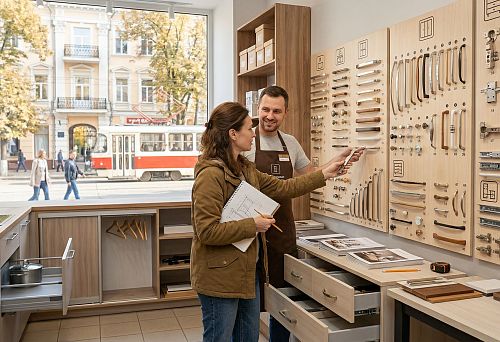
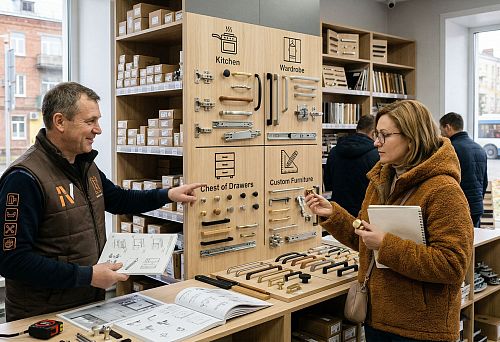
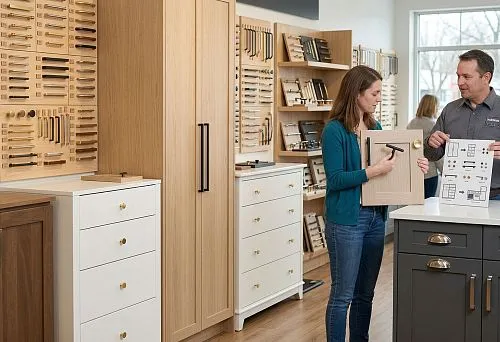
Demonstration stands allow you to see hardware in action and evaluate its functionality. A professional store should have samples of main hardware types installed on demonstration structures, so customers can test their operation, assess smoothness of movement, reliability of fixation, and other parameters.
Educational materials (catalogs, instructions, videos) should be accessible to customers. They help better understand the specifics of hardware installation and operation, which is especially important for those planning to install it themselves. A professional store should provide such materials free of charge or for a nominal fee.
Convenience of location and operating hours: accessibility as a priority
Store address where you can buy hardware Should be convenient to visit, and operating hours should meet customer needs.
Transport accessibility is determined by the presence of convenient access roads, parking, and proximity to public transport. The ideal option is a store located in an area with good transportation infrastructure, which is especially important when purchasing heavy or bulky items.
Operating hours should consider the needs of different customer groups. A professional store usually operates for no less than 12 hours a day, including weekends, allowing customers to visit during working hours, after work, or on weekends.
The availability of pre-booking consultations is a sign of customer-oriented approach. This is especially important for complex projects requiring detailed discussion and selection of non-standard solutions. A professional store should offer this service so that customers can receive full consultations without rushing and at a convenient time for them.
The presence of a branch network in different districts of the city or region increases store accessibility for customers. This is especially important in large cities, where moving from one district to another may take significant time. The ideal option is a network of stores with a unified inventory system, allowing customers to quickly find the required item at the nearest branch.
Types of hardware stores: advantages and features
There are several types of retail outlets where you can purchase furniture hardware, and each has its own features, advantages, and disadvantages.
Specialized stores: professional approach
Specialized furniture hardware stores are places where you can find the most comprehensive selection and receive professional consultation.
Wide assortment is the main advantage of such stores. They offer all categories of hardware, from basic to specialized, in various price segments. You can find standard solutions for typical projects as well as exclusive models for designer furniture.
Professional consultants will help you select optimal solutions for your project. They know the specifics of using different types of hardware, can calculate the required quantity, and advise on installation nuances. This is especially valuable for complex projects or non-standard constructions.
Demonstration samples allow you to see hardware in action and evaluate its functionality. You can test the smoothness of guide movement, the reliability of hinge fixation, and handle usability, helping you make an informed choice.
Related products (fasteners, tools, installation templates) are usually also available in the assortment. This allows you to purchase everything needed for installation in one place, saving time and effort.
Construction hypermarkets: convenience and accessibility
Large construction hypermarkets also offer furniture hardware, although their selection is usually limited to basic models.
Convenient location is one of the main advantages of such stores. They are usually located in easily accessible areas, have large parking lots and convenient access roads, which is especially important when purchasing large quantities of goods.
The ability to purchase everything needed in one place is another advantage of hypermarkets. Here you can buy not only hardware, but also materials for furniture manufacturing (MDF, plywood, solid wood), tools, fasteners, and finishing materials.
Long operating hours (often 24/7 or until late night) allow customers to visit the store at a convenient time, which is especially valuable for those working on furniture projects during their free time.
Regular promotions and special offers make purchases more cost-effective. Hypermarkets often hold seasonal sales, offer discounts on bulk purchases, or provide bonuses for loyal customers.
Online stores: unlimited choice
Online shopping is becoming an increasingly popular way to purchase furniture hardware, and this is not surprising — online stores offer a vast selection of products with delivery directly to your door.
Extensive assortment is the main advantage of online stores. Here you can find products from various manufacturers, including rare and specialized items that are difficult to find in regular stores. You can choose from thousands of items without leaving home.
Convenience of comparing prices and characteristics of different models. Online catalogs usually contain detailed descriptions, technical specifications, photos, and video reviews, allowing you to make an informed decision without physical contact with the product.
Access to reviews from real customers helps assess the quality and functionality of hardware. You can learn about the advantages and disadvantages of specific models, installation and usage features, which is especially valuable when choosing expensive or complex mechanisms.
Home delivery eliminates the need to transport purchases yourself. This is especially convenient when ordering large quantities or heavy items. Many online stores offer various delivery options (courier, postal service, transport companies), allowing you to choose the optimal way to receive your order.
Wholesale bases: advantageous for professionals
For professional furniture manufacturers and large projects, wholesale bases for furniture hardware may be the optimal option.
Significantly lower prices when purchasing in bulk — the main advantage of wholesale bases. Savings can range from 20% to 50% compared to retail prices, which is especially important for commercial projects where every ruble counts.
The ability to receive direct shipments from manufacturers ensures not only lower prices but also authenticity guarantees. You receive hardware directly from official distributors, without intermediaries and markups.
Professional technical support — another advantage of wholesale bases. Here, specialists work who are well-versed in the specifics of applying various types of hardware in industrial furniture production. They can offer optimal solutions for specific technological processes and production lines.
The ability to order non-standard items for a specific project. Wholesale bases usually have established connections with manufacturers and can organize the production of hardware according to individual specifications, which is especially important for unique or large-scale projects.
How to find the ideal hardware store address: practical tips
Search addresses of stores where you can buy hardware may be a challenging task, especially if you are encountering the need to purchase furniture components for the first time. Here are several practical tips that will help you find the perfect place to shop.
Online search: efficient and fast
The Internet provides numerous tools for searching for hardware stores in your city or region.
Search engines (Google, Yandex) — the simplest way to start searching. Simply enter the query "furniture hardware store" and your city’s name, and you will receive a list of nearby retail outlets. Pay attention to reviews and ratings, which are often displayed directly in the search results.
Maps and geolocation services (Google Maps, Yandex Maps) will help you find stores in a specific district of the city. You can see their location on the map, plan a route, check operating hours and contact information. Many services also display photos of the store and visitor reviews.
Specialized directories and reference guides (2GIS, Directory of Organizations) contain more detailed information about stores, including product range, payment methods, parking availability, and other important details. They often offer filters for more precise searches, such as by type of hardware or price segment.
Social networks and forums can be a source of valuable information about hardware stores. Members of furniture communities and groups often share their purchasing experiences, recommend trusted locations, and warn against unscrupulous sellers. Don’t hesitate to ask questions — experienced craftsmen are usually eager to share information.
Recommendations from professionals: verified addresses
The opinion of professionals in the furniture industry can be invaluable when choosing a hardware store.
Furniture manufacturers often have established relationships with suppliers of quality hardware. If you have acquaintances working in the furniture industry, don’t hesitate to ask for their advice — they may recommend trusted stores with good price-to-quality ratios.
Interior designers can also suggest addresses of stores where you can purchase quality hardware. They often work with various suppliers and know where to find both standard and exclusive solutions for specific projects.
Construction crews and private craftsmen have practical experience working with various types of hardware and can recommend stores where reliable, time-tested components are sold. Their advice is especially valuable if you plan to install hardware yourself.
Professional associations and unions of furniture makers often publish lists of recommended suppliers and distributors. Such recommendations are usually based on the collective experience of association members and are worthy of trust.
Trade shows and specialized events: new contacts
Furniture trade shows and specialized events — an excellent opportunity to meet new hardware suppliers and discover interesting offers.
International and national furniture and hardware trade shows are regularly held in major cities. These events feature both well-known brands and new market players offering innovative solutions. Attending such trade shows not only allows you to find suppliers but also to stay updated on the latest trends in furniture hardware.
Master classes and seminars for furniture makers are often organized by hardware manufacturers or their distributors. Participating in such events allows you not only to gain new knowledge but also to establish direct contacts with suppliers, learn about promotions and special offers.
Open house events at showrooms and demonstration centers allow you to see hardware in action, evaluate its functionality and quality. Such events are usually accompanied by specialist consultations and special offers for visitors.
Networking events for representatives of the furniture industry — another way to find reliable hardware suppliers. Communicating with colleagues in your field helps exchange experience, learn about trusted stores, and establish useful contacts.
Verification before visiting: saving time
Before heading out to the location found address of the store where you can buy hardwareIt is worth conducting a small preparatory work to make the visit as effective as possible.
Call the store and inquire about the availability of the items you are interested in. This is especially important for rare or specialized hardware, which may not always be in stock. Meanwhile, you will be able to assess the competence of the staff through the phone conversation.
Study the store's website (if it exists) — this will help you form a preliminary understanding of the assortment, prices, and operating conditions. Many stores publish online catalogs, price lists, and information about current promotions, allowing you to plan your purchases in advance.
Check reviews of the store on independent platforms (Google, Yandex, specialized forums). Pay attention not only to the overall rating, but also to specific comments, especially those concerning product quality, staff competence, and honesty in business.
Clarify delivery and payment terms, especially if you plan a large purchase. Some stores offer free delivery for orders above a certain amount or special terms for wholesale buyers. Knowing these details will help you optimize your expenses.
How to make purchasing hardware as effective as possible
Visiting a hardware store can be more productive if you prepare in advance and follow a certain strategy.
Preparation for purchase: the key to success
Proper preparation for visiting a hardware store will help you save time and money, as well as avoid common mistakes.
Prepare a detailed list of required hardware, specifying quantities, sizes, and technical specifications. This is especially important for complex projects requiring many different components. Organize the list by categories (hinges, guides, handles, etc.) for easier searching in the store.
Prepare drawings or sketches of your furniture project. They will help the consultant better understand your needs and suggest optimal solutions. If you have photos of the desired result or examples of similar furniture, bring them along — visual materials significantly simplify communication.
Determine your budget for hardware and decide on which elements you can save on, and where it is better not to economize. For example, choose high-quality guides with soft-close mechanisms for frequently used drawers, and simpler hinges for rarely opened cabinets.
Study the basic technical parameters of the hardware you plan to purchase. Knowing such characteristics as the load capacity of guides, hinge opening angle, or handle center-to-center distance will help you make an informed choice and communicate effectively with the consultant.
Communication with the consultant: getting maximum information
A qualified consultant can become your main helper in choosing optimal hardware, but for this, it is necessary to build communication correctly.
Clearly state your needs and expectations. Tell the consultant about your project, materials you plan to use, expected loads, and aesthetic preferences. The more complete information you provide, the more accurate recommendations you will receive.
Ask specific questions about technical characteristics, installation, and operation of the hardware. Do not hesitate to clarify unclear points — a professional consultant should patiently and clearly explain complex technical aspects.
Ask the consultant to demonstrate the hardware operation on samples or demonstration stands. This will allow you to assess smooth operation, secure fixation, ease of use, and other important parameters that cannot be determined from photos or descriptions.
Discuss alternative options and possible compromises. If the desired hardware is unavailable or does not meet certain parameters, ask the consultant to suggest alternatives or solutions. Often, you can find more affordable options that do not compromise on functionality compared to expensive brands.
Quality check on-site: avoiding disappointments
Before purchasing hardware, it is advisable to conduct a basic quality check to avoid unpleasant surprises during installation.
Visual inspection allows you to identify obvious defects: cracks, chips, uneven coating, signs of corrosion. Pay attention to the quality of assembly, absence of burrs and sharp edges, and evenness of coating.
Assessing materials will help determine the durability of the hardware. Metal parts should be made of quality alloys with anti-corrosion coating; plastic components should be made of strong engineering plastic resistant to UV and mechanical impacts.
Checking completeness is especially important for complex mechanisms consisting of several parts. Ensure that the kit includes all necessary fasteners, adjustment screws, caps, and other components required for installation.
Cost optimization: sensible savings
Cost optimization: sensible economy
Purchasing quality hardware does not necessarily have to be expensive — there are several ways to optimize expenses without compromising quality.
Wholesale purchases allow you to get significant discounts, especially if you are buying a large quantity of similar hardware. Many stores offer progressive discount systems depending on the purchase volume, starting from 5-10% for small batches up to 30-40% for large orders.
Seasonal sales and special promotions are an excellent opportunity to purchase quality hardware at reduced prices. Many stores hold sales at the end of a season, before new collections arrive, or in connection with holidays. Keep track of announcements of such events on store websites or subscribe to their newsletters.
Loyalty programs and cumulative discounts are beneficial for regular customers. If you frequently purchase hardware for various projects, it is worth registering in the loyalty program of your favorite store — this will allow you to receive personalized offers, bonuses, and additional discounts.
Bulk purchases often cost less than buying individual components. Many stores offer ready-made hardware sets for standard furniture constructions (kitchen sets, sliding wardrobes, closet systems) at special prices. Such sets usually include all necessary elements in optimal quantities and with guaranteed compatibility.
Trends and innovations in furniture hardware
The world of furniture hardware is constantly evolving, offering increasingly sophisticated and innovative solutions. Knowing current trends will help you make a choice that remains relevant for many years.
Smart hardware: technologies of the future are already here today
Integration of digital technologies into furniture hardware is one of the most prominent trends of recent years.
Electronic opening systems allow controlling access to cabinet and drawer contents using a smartphone, fingerprint, or voice commands. Such systems provide not only convenience but also additional security, especially for cabinets containing valuable items or potentially hazardous objects.
Automatic opening systems activate upon approaching a person or a light touch on the facade. They are especially convenient in kitchens, where hands are occupied or dirty, and in bathrooms, where minimizing contact with surfaces is important for hygiene reasons.
Integrated lighting is embedded into the hardware and activates when a cabinet or drawer is opened. Modern LED systems consume minimal energy but provide optimal illumination of contents, which is especially important for deep cabinets and drawers. Some models allow adjusting brightness and color temperature of light depending on time of day or mood.
Programmable systems allow configuring hardware operation according to individual user preferences. For example, you can program different opening speeds for different family members, set time-based access restrictions for children, or create operation scenarios depending on time of day.
Ecology and sustainable development: care for the planet
The ecological trend has also affected furniture hardware production, offering solutions that minimize harm to the environment.
Hardware made from recycled materials is becoming increasingly popular. Modern technologies allow creating high-quality items from secondary raw materials, not inferior in characteristics to traditional counterparts. Such hardware has a smaller carbon footprint and contributes to waste reduction.
Biodegradable components are used for non-critical hardware elements. They are made from plant-based materials (corn starch, cellulose, soy proteins) and naturally decompose without harming the environment after their service life.
Energy-efficient production has become a standard for responsible manufacturers. They implement technologies minimizing energy consumption and emissions during production, use renewable energy sources, and optimize logistics chains to reduce transportation emissions.
Eliminating toxic materials and coatings makes hardware safer not only for the environment but also for user health. Modern manufacturers replace traditional galvanic coatings with more eco-friendly alternatives, exclude phthalates, formaldehyde, and other potentially hazardous substances from the composition.
Minimalism and hidden solutions: the aesthetics of clean lines
Modern design trends favor clean lines and absence of visible functional elements, reflected in the trend toward concealed hardware.
Handle-free opening systems allow creating furniture with perfectly smooth facades. Push-to-open mechanisms activate with a light touch on the facade, while electronic systems use remote controls or motion sensors. Such solutions not only look modern but also simplify furniture maintenance, as less dust accumulates on smooth surfaces.
Concealed hinges are fully integrated into furniture construction, remaining invisible when the door is closed. They ensure clean lines and create an impression of furniture monolithism. Modern concealed hinges do not lag behind traditional models in functionality, providing smooth movement and secure door latching.
Integrated handles are formed through a special facade construction or embedded into its edge. This solution preserves functionality while causing minimal visual disruption to the design. Integrated handles can be made from the same material as the facade or contrast with it, creating interesting design accents.
Concealed guides are mounted under the drawer bottom, remaining invisible from the outside. They create an impression that the drawer floats in the air, which looks especially effective in modern interiors. Such guides ensure smooth movement and full drawer extension, making them not only aesthetic but also functional.