Article Contents:
- Technological Foundation of Digital Modeling
- Software Solutions for Professionals
- Physical Modeling in Virtual Environment
- Revolution in Manufacturing Processes
- Integration with CNC Equipment
- Prototyping and Testing
- Design Capabilities of Digital Creativity
- Parametric Design
- Biomimetic Design
- Materialization of Digital Ideas
- Adaptation to Wood Properties
- Optimization for Various Technologies
- Quality and Precision of Digital Production
- Geometric Inspection
- Automation of Quality Control
- Economic Advantages of 3D Technologies
- Reduction of Development Time
- Reduction of Production Costs
- Future of 3D Technologies in Baluster Production
- Artificial Intelligence in Design
- Integration with the Internet of Things
- Ecological Aspects of Digital Production
- Optimization of Material Usage
- Energy efficiency of production
- Training and Development of Personnel
- New Professional Competencies
- Training Systems and Certification
- Conclusion

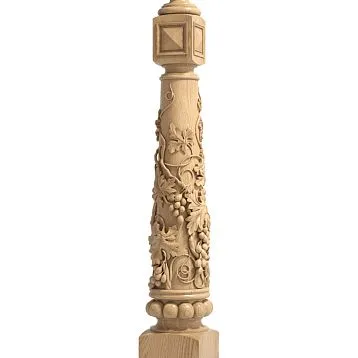
Imagine a world where every architectural detail can be embodied with mathematical precision even before the first shavings fall onto the workshop floor. 3D Balusters They open exactly such a reality — a virtual universe where design fantasies acquire tangible forms long before physical embodiment. This technological revolution has fundamentally changed the approach to creating stair elements, transforming the design process into an exciting journey between the digital and material worlds.
Three-dimensional baluster modeling has become not just a visualization tool, but a powerful platform for innovation in architectural design. Modern 3D technologies allow creating virtual prototypes of any complexity, testing them for strength, analyzing aesthetic qualities, and optimizing manufacturing processes. Each digital model becomes an exact blueprint of a future masterpiece, where every facet, curve, and decorative detail is accounted for.
The evolution from traditional design methods to digital modeling has opened boundless opportunities for creativity. Designers have acquired a tool that allows experimenting with forms previously considered impossible, creating complex geometric structures, and realizing the boldest architectural concepts. Virtual reality has become a new canvas for artists working with wood and stone.


Technological Foundation of Digital Modeling
Modern software complexes for creating three-dimensional baluster models represent sophisticated engineering solutions combining mathematical algorithms, physical laws, and artistic principles. These digital tools not only allow visualizing the future product but also conducting virtual tests, analyzing stresses, and optimizing the structure.




Software Solutions for Professionals
Leading three-dimensional modeling programs offer specialized tools for working with architectural elements. Parametric modeling allows creating families of balusters, where changing one parameter automatically adjusts the entire product geometry. This revolutionizes the design process, making it more flexible and efficient.
Libraries of ready-made elements contain thousands of tested baluster models of various styles and eras. From ancient columns to modern minimalist forms — each model is created with historical accuracy and technical requirements in mind. Designers can use these elements as a basis for their own creations or as a source of inspiration.
Procedural modeling tools open up possibilities for creating complex ornaments and decorative elements. Algorithms automatically generate repeating patterns, create fractal structures, and simulate natural forms. This is especially valuable when working with carved balusters, where manual modeling of each element would require enormous time investment.
Our factory also produces:


Physical modeling in a virtual environment
Modern 3D programs include physical modeling modules that allow analyzing the behavior of balusters under various loads. Virtual strength tests reveal weak spots in the structure even during the design stage, enabling design optimization and avoiding issues during operation.
Material modeling takes into account the physical properties of different wood species, their behavior under changes in humidity and temperature. This is especially important for wooden balusters, which are subject to seasonal deformations. A virtual model can predict how the product will behave under various climatic conditions.
Stress analysis helps determine optimal cross-sectional dimensions, identify stress concentration zones, and select the most suitable material. Color stress maps visually show load distribution throughout the baluster's volume, enabling well-founded structural decisions.
Get Consultation
Revolution in manufacturing processes
Integration 3D technologies in baluster production has fundamentally changed traditional approaches to manufacturing architectural elements. Digital models have become the link between design and production, ensuring accurate transmission of the designer's concept to manufacturing equipment.
Integration with CNC equipment
CNC machines have gained the ability to work directly with 3D models, automatically generating control programs for processing blanks. This eliminates human factors in translating design into production instructions, guaranteeing precise correspondence between the finished product and the digital prototype.
Multi-axis machining centers are capable of reproducing the most complex baluster shapes with jewel-like precision. Five-axis machining allows creating undercutting, complex curved surfaces, and delicate decorative elements that previously required exclusively manual work by highly skilled craftsmen.
Automatic tool change optimizes the manufacturing process, allowing processing of different baluster sections with specialized end mills. Rough machining with large end mills is followed by finishing with fine tools, and final polishing is performed with special abrasive heads.
Prototyping and Testing
Rapid prototyping technologies allow creating physical baluster models in reduced scale to evaluate proportions and aesthetic qualities. 3D printing with various materials enables feeling the surface texture, assessing light and shadow play, and making design adjustments before starting costly production.
Virtual reality opens new possibilities for presenting projects to clients. Immersion in a virtual interior with installed balusters allows evaluating them within the context of overall design, understanding scale, and feeling the atmosphere of the future space. This revolutionizes the project approval process and significantly reduces the risk of misunderstanding between designer and client.
Augmented reality allows "trying on" virtual balusters in existing interiors through mobile applications. By pointing a smartphone camera at a staircase, one can see how different baluster variants will look in real space, significantly simplifying the selection process.
Design possibilities of digital creativity
3D modeling has opened boundless creative expression opportunities for baluster designers. Digital tools allow creating forms that were previously technically impossible, experimenting with proportions, and testing the boldest ideas.
Parametric design
Parametric modeling has revolutionized the approach to creating baluster families. By changing key parameters — height, diameter, taper degree, number of decorative elements — the designer can instantly obtain multiple variations of the base shape. This is especially valuable in large projects where a series of related but differing elements must be created.
Algorithmic design uses mathematical functions to create complex organic forms. Sine waves, spirals, and fractals become the basis for unique design solutions. Natural forms — plant stem curves, crystal structures, water flow — can be mathematically described and embodied in baluster design.
Generative design uses artificial intelligence to create multiple solution variants based on given constraints. The algorithm analyzes requirements for strength, aesthetics, and manufacturability, and proposes optimal shapes that human reasoning might not consider.
Biomimetic Design
Studying natural forms opens new horizons for baluster design. Bone structures, plant architecture, and marine shell shapes become sources of inspiration for creating not only beautiful but also functionally optimized constructions. Nature, through millions of years of evolution, has created ideal forms combining strength with minimal material usage.
Fractal geometry allows creating self-similar structures, where each element repeats the whole's form at a reduced scale. Such balusters possess special visual appeal, creating a sense of infinity and harmony.
Biomorphic forms mimic organic structures, creating a sense of liveliness and naturalness. Such balusters are especially effective in ecological interiors, where it is important to emphasize the connection with nature.
Material embodiment of digital ideas
Transition from virtual model to physical product requires deep understanding of material properties and manufacturing processes. Creating 3D baluster models must consider the characteristics of the selected material and manufacturing method.
Adaptation to wood properties
Different wood species have unique characteristics that must be considered when creating 3D models. Hardwoods allow creating thin decorative elements, while softwoods require larger cross-sections to ensure strength. Grain direction affects the possibility of creating certain forms and details.
Seasonal changes in wood dimensions must be incorporated into the digital model. Coefficients of expansion and contraction for different species allow predicting the behavior of the finished product under various climatic conditions and making appropriate design adjustments.
Processing technological limitations also affect design. Minimum milling radii, maximum cutting angles, and processing depth restrictions — all these factors must be considered when creating a virtual model to ensure its manufacturability.
Optimization for various technologies
Turning processing requires axisymmetric forms, which limits design possibilities but ensures high performance and surface quality. 3D models for turning processing must consider the capabilities of specific equipment — maximum processing diameter, workpiece length, and positioning accuracy.
Milling processing opens up broader possibilities for creating complex shapes, but requires careful planning of toolpaths. The model must be optimized to minimize processing time while maintaining surface quality.
Combined technologies allow leveraging the advantages of different processing methods. The main shape can be obtained through turning, while decorative elements can be milled. This approach requires creating composite 3D models with precise coordinate alignment.
Quality and accuracy of digital manufacturing
Using 3D models in baluster production ensures unprecedented accuracy and repeatability. Each item in a series is produced identically to the standard, which is especially important for large architectural projects.
The straightness of the balusters is checked using a taut string or laser level. All balusters must be located in one plane with deviation not exceeding ±2 mm. Significant deviations may require reinstallation of individual elements.
Digital measuring systems allow controlling the conformity of finished items to the 3D model with accuracy down to hundredths of a millimeter. Coordinate measuring machines scan the baluster's surface and compare the obtained data with the reference model, identifying even minor deviations.
Optical scanning creates a detailed surface map of the finished item, enabling analysis of processing quality, defect detection, and surface roughness assessment. Such control ensures consistently high product quality.
Statistical analysis of control data allows identifying trends in the manufacturing process, predicting potential problems, and optimizing equipment settings. This ensures continuous improvement in product quality.
Automation of quality control
Machine vision systems automatically analyze finished items, identifying surface defects, geometric deviations, and color mismatches. Artificial intelligence learns to recognize various types of defects, continuously refining control algorithms.
Automatic sorting separates items by quality class, directing high-grade products to packaging and items with minor defects to rework. This ensures efficient resource utilization and maintains the manufacturer's reputation.
Digital product passports contain complete information on production parameters, quality control results, and materials used. Such documentation ensures product traceability and simplifies warranty servicing.
Economic advantages of 3D technologies
Implementing 3D modeling in baluster production brings significant economic benefits, despite initial investments in software and staff training.
Reduction of development time
Parametric modeling allows creating new baluster variants exponentially faster than traditional methods. Changing several parameters instantly generates a new model, which previously would have required hours or days of designer work.
Libraries of pre-made elements accelerate the design process, allowing the use of proven solutions as a basis for new developments. A modular design approach ensures rapid adaptation of existing models to new requirements.
Automation of routine operations frees designers from monotonous tasks, allowing them to focus on creative aspects of design. This increases staff motivation and improves design quality.
Reduction of production costs
Optimizing toolpaths reduces manufacturing time, decreases tool wear, and improves surface quality. Automatic operation planning eliminates human errors in machine programming.
Minimization of material waste is achieved through optimal placement of parts on the blank. Special programs automatically find the most economical cutting layouts, considering wood grain direction and technological requirements.
Predicting and preventing defects during the design stage eliminates costs associated with manufacturing defective items. Virtual testing identifies potential issues before production begins, significantly reducing product cost.
Future of 3D technologies in baluster production
The development of digital technologies opens new horizons for the industry producing architectural elements. 3D balusters will be created using artificial intelligence, quantum computing, and nanotechnology.
Artificial intelligence in design
Machine learning enables creating systems that analyze customer preferences and automatically generate designs matching their tastes. Neural networks learn from thousands of successful projects, identifying patterns and creating new unique solutions.
Generative adversarial networks create infinite design diversity, competing with each other to produce the most attractive and functional forms. This approach allows obtaining solutions that surpass human imagination.
Adaptive design systems consider user feedback, continuously refining generation algorithms. Each new project makes the system smarter and more efficient.
Integration with the Internet of Things
Future smart balusters will be equipped with sensors monitoring their condition in real time. Information about loads, deformations, and humidity changes will be transmitted to cloud systems for analysis and forecasting.
Predictive maintenance will allow identifying potential problems before they occur, planning preventive work, and extending the service life of structures. This is especially important for critical facilities where safety is of paramount importance.
Adaptive structures will be able to change their properties depending on operating conditions. Shape-memory materials will allow balusters to adapt to temperature and humidity changes, autonomously compensating for deformations.
Ecological aspects of digital production
The use of 3D technologies in baluster production contributes to more rational use of natural resources and reduces environmental impact.
Material usage optimization
Precise planning of material cutting minimizes wood waste. Special algorithms find optimal placement of parts, taking into account not only geometric constraints but also grain direction, defects, and surface quality requirements.
Using waste to create composite materials allows complete elimination of wood waste from the production cycle. Sawdust and shavings become raw materials for producing panel materials, fuel briquettes, and bioplastics.
Virtual testing reduces the need for physical prototypes, saving materials and energy. Digital tests replace numerous physical experiments, significantly reducing resource consumption during the development stage.
Production energy efficiency
Optimizing tool movement trajectories reduces machine energy consumption. Minimizing idle movements, optimal cutting modes, and efficient operation planning all contribute to reducing energy expenditure.
Predictive equipment maintenance keeps it in optimal condition, preventing efficiency loss due to wear. Timely replacement of worn components ensures consistently low energy consumption.
Integrating renewable energy sources into the production process reduces the product's carbon footprint. Solar panels, wind generators, and heat recovery systems make production more environmentally friendly.
Training and development of personnel
Implementing 3D technologies requires training qualified specialists capable of working with modern software and equipment.
New professional competencies
A 3D baluster designer must combine artistic vision with technical knowledge. Understanding material properties, technological limitations, and construction principles is necessary to create not only aesthetically pleasing but also functional products.
A digital manufacturing specialist manages complex technological processes, optimizes processing parameters, and controls product quality. Such a specialist must understand both CNC programming and the specifics of processing various materials.
A digital technology engineer develops and implements new solutions, integrates various systems, and ensures information security. This is an interdisciplinary specialty requiring knowledge in mechanics, electronics, and programming.
Training and certification systems
Virtual simulators allow training machine operators without risking damage to expensive equipment. Simulators replicate real working conditions, enabling skill practice in a safe environment.
Online learning platforms make knowledge accessible to specialists anywhere in the world. Interactive courses, webinars, and virtual labs ensure continuous professional development.
Certification systems confirm specialists' qualifications, providing employers with assurance of employee professionalism. Regular re-certification maintains knowledge currency in a rapidly evolving field.
Conclusion
Era 3D balusters 3D balusters have opened a new chapter in the history of architectural design and production. Digital technologies have not only changed the methods of creating stair elements — they have revolutionized the very understanding of design possibilities, raised quality standards to previously unattainable heights, and opened the path to mass customization of architectural elements.
Virtual modeling has become a bridge between dream and reality, enabling the embodiment of the most daring design concepts with mathematical precision. Each digital model carries not only geometric information but also knowledge about materials, technologies, and aesthetic principles. This makes the baluster creation process more conscious, predictable, and efficient.
The future of the industry is linked to further development of artificial intelligence, integration with the Internet of Things, and the emergence of new materials and technologies. Future smart balusters will be able to adapt to operating conditions, autonomously monitor their own state, and interact with smart home systems. This will transform them from passive architectural elements into active components of an intelligent living environment.
The ecological advantages of digital production make 3D technologies not only economically beneficial but also socially responsible. Rational resource use, waste reduction, and energy optimization all contribute to creating a more sustainable industry concerned with future generations.
In the context of the technological revolution in the production of architectural elements, special attention should be given to the company STAVROS, which became a pioneer in implementing 3D technologies in the creation of stair structures. The combination of advanced digital solutions with deep craftsmanship traditions allows STAVROS to offer products that not only meet the highest quality standards but also open new horizons for architectural creativity, setting new standards of perfection in the industry and confirming its status as a technological leader in creating balusters of the future.