












































































Article Contents:
- Baroque-Style Bedroom: A Theater for Two
- Bed: The Centerpiece of the Composition
- Nightstands: Symmetry is Essential
- Chest of Drawers: The Vertical of Luxury
- Dressing Table and Mirror: The Woman's Domain
- Wardrobe: Architectural Volume
- Textiles: Framing the Furniture
- Wall and Ceiling Decor: The Frame for the Furniture
- Living Room: The Reception Space
- Sofa and Armchairs: Upholstered Furniture as Sculpture
- Coffee Table: The Center of Attraction
- Console: A Vertical Accent
- Display Cabinet or Sideboard: Showcasing Valuables
- Wall Panels and Moldings: The Architecture of Walls
- Ceiling and Lighting: The Celestial Vault
- Dining room: the ritual of dining
- Dining Table: The Center of the Feast
- Chairs: A Formal Set
- Buffet: Storage and Display
- Serving Cart: Mobility
- Dining Room Decor: Frames for Table Setting
- Comprehensive Approach: Why Unity of Source is Important
- Ornamental Unity
- Unity of Material and Finish
- Proportional Consistency
- Time and Nerve Savings
- Professional Support
- Materials and Technologies: Tradition and Modernity
- Carving: CNC and Hand Finishing
- Gilding: Techniques and Effects
- Upholstery: Fabrics and Fillers
- Hardware: Decorative and Reliable
- Color Solutions: From Opulent to Restrained
- Classic palette: royal colors
- Light Palette: Airy Baroque
- Contrast Palette: Dramatic Effect
- Lighting: Multi-Level System
- Central Chandelier: Main Source
- Wall Sconces: Local Lighting
- Hidden Lighting: Accents
- Frequently Asked Questions
- Can a Baroque Interior Be Created in a Regular Apartment?
- How Much Does It Cost to Furnish a Room in Baroque Style?
- How to Care for Baroque-Style Furniture?
- Can Furniture Be Custom-Made to Order?
- Does Baroque Combine with Modern Technology?
- How Long Does Solid Wood Furniture Last?
- Conclusion: Baroque as a Lifestyle
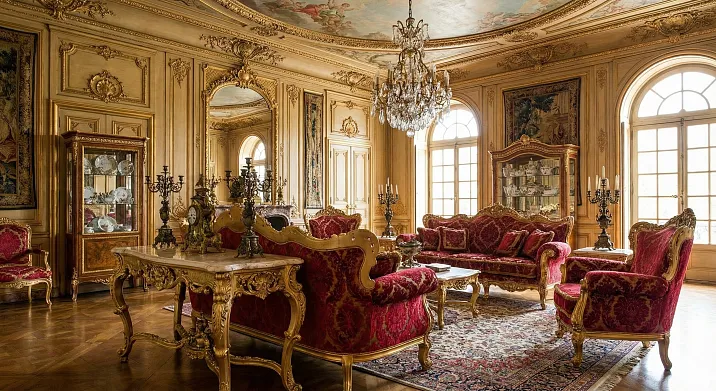
Baroque does not tolerate half-measures. You either immerse yourself completely in its luxurious essence, or you create eclectic chaos where a carved Baroque-style armchair gets lost against minimalist walls, where a gilded mirror frame looks like an accidental guest among modern furniture.The Splendor of Baroqueunfolds only when every element of the interior speaks the same language:Furniture in Baroque styledecorative wall overlays, ceiling moldings, carved door frames, stucco, textiles — all are parts of a single symphony where every instrument knows its part.
How to create such an interior? Not by collecting items from different sources, hoping they will accidentally match in style, but by working with comprehensive solutions whereClassic Furnitureandinterior decorationare created in a unified aesthetic, where forms echo each other, where the patterns on carved legs are repeated on furniture overlays and wall moldings. STAVROS offers exactly this approach: furniture and decor from one era, from one workshop, crafted by masters who understand Baroque not as a set of techniques, but as a philosophy of space where a person should feel not in an apartment, but in a palace.
Let's consider specific solutions for the bedroom, living room, dining room — rooms where Baroque manifests itself in all its fullness. Not theoretical discussions about style, but practical compositions: what furniture, what decor, how they combine into a single whole, creating not a museum reconstruction of the 18th century, but a modern living space where the luxury of Baroque is adapted to the demands of the 21st century.


Bedroom in Baroque Style: A Theater for Two
The bedroom is the most intimate space in the home, but in Baroque even intimacy is theatrical. The bed becomes a throne, the dresser a work of art, the mirror a portal to another world. Here, one does not sleep — here, one reigns, even if the kingdom is small and confined to the four walls of an ordinary apartment.




Bed: The Centerpiece
Classic Furniturein the bedroom begins with the bed, and in Baroque it dominates. A tall carved headboard is not just a backrest but a vertical accent 150-180 cm high, adorned with carving featuring botanical motifs: acanthus leaves, grapevines, rosettes, rococo scrolls. The carving can be openwork, creating lightness and airiness in the massive form, or solid, relief, where the pattern protrudes 3-5 cm, creating deep shadows.
The footboard in Baroque is also significant. Low but carved, it completes the composition, creates a frame within which lie the mattress, bedding, and decorative pillows. The bed legs — curved, cabriole, or turned, massive — lift the structure off the floor, preventing it from appearing squat.
Material — solid oak or beech, wood that holds carving well, does not chip, and ages nobly. Finish — natural staining that emphasizes the wood grain, or gilding on carved elements — selective, on protruding parts of the ornament, creating light accents.
Our factory also produces:


Nightstands: Symmetry is Mandatory
Baroque loves pairing. Two nightstands on either side of the bed are not just functional elements but an architectural frame that enhances the significance of the central object. The nightstands should repeat the stylistic features of the bed: if the headboard has acanthus carving, the nightstand fronts should have similar carving, albeit on a smaller scale.
The shape of the bedside tables is not rectangular, but a volume with curved lines: a convex front (bombé), wavy sides, a profiled tabletop with a carved edge. The legs are curved, echoing the legs of the bed. The hardware consists of bronze or brass handles in the form of lion heads, leaves, and scrolls—not modern minimalist hardware, but decorative hardware that is itself an element of the ornament.
Get Consultation
Chest of drawers: the vertical of luxury
A chest of drawers in a Baroque bedroom is a tall piece, 120-140 cm high, with 4-5 tiers of drawers, decorated with carved overlays on the fronts, with a marble or wooden tabletop on which decorative vases, boxes, and candlesticks are placed. The drawer fronts may have central carved overlays—medallions with floral ornamentation—or corner overlays at the four corners of each front.
The carving on the chest of drawers should echo the carving on the bed, but not duplicate it literally. If the bed headboard features large acanthus leaves, the chest of drawers may have smaller ones, but in the same style. This creates a visual connection without monotony.
Gilding on the carved elements of the chest of drawers is a technique that makes the furniture precious. Not solid painting, but selective gilding: only the protruding parts of the carving, while the recesses remain in the natural color of the wood or are stained darker. This creates contrast, depth, and the effect of antique furniture where the gilding has partially worn off.
Dressing table and mirror: the feminine domain
A dressing table is a place where functionality and decorativeness are equal. A tabletop with pull-out drawers for cosmetics, a mirror in a carved frame, placed on the tabletop or hung on the wall above it. The table legs are curved, carved, echoing the legs of the bed and bedside tables.
A mirror in a Baroque frame is an independent work of art. The frame is 15-20 cm wide, carved, with floral ornamentation, gilding, and cartouches at the corners. The shape of the mirror is oval or rectangular with an arched top, not a simple rectangle. The size is large, 80x120 cm or more, to reflect a significant part of the room and create an effect of doubling the space.
Wardrobe: an architectural volume
If space allows, a wardrobe is included in the bedroom—massive, with two or three doors, reaching up to the ceiling, with carved cornices at the top, a plinth at the bottom, and carved overlays on the doors. The doors can be solid wood or partially glazed—stained glass or clear glass with a carved frame inside the door.
The carving on the wardrobe is not only overlays but also architectural elements: pilasters on the sides of the doors, carved cornices, pediments. A wardrobe in Baroque style is a mini-palace, architecture in miniature, where every detail has structural significance.
Textiles: framing the furniture
Furniture in a Baroque bedroom does not exist separately from textiles. The bedspread is made of heavy fabric with gold threads, brocade, velvet, or jacquard with large patterns. Decorative pillows—many of them, of different sizes, with tassels and embroidery. Curtains are heavy drapes with valances, tiebacks, and fringe, in the same color scheme as the bedspread.
The color palette of a Baroque bedroom is rich: burgundy, emerald, sapphire blue, gold, ivory. Not pastel shades, but deep, royal colors that create a sense of luxury.
Wall and ceiling decor: the frame for the furniture
interior decorationThe walls of the bedroom feature moldings that create panels, inside which there may be wallpaper with damask patterns, textile wall covering, or a painted surface. The moldings are profiled, 5-8 cm wide, made of wood or polyurethane, painted white, cream, or stained to resemble wood.
The ceiling is not smooth but features stucco: a ceiling cornice around the perimeter, a rosette in the center from which a chandelier hangs. A Baroque chandelier is crystal, multi-armed, with pendants and gilded metalwork. Additional lighting includes sconces on either side of the bed, in carved frames, with fabric shades.
Living room: the reception space
A Baroque living room is a formal room for receiving guests, where taste and wealth are displayed. Here, furniture is not merely functional—it is representative and must impress.
Sofa and armchairs: upholstered furniture as sculpture
Furniture in Baroque styleThe centerpiece of the living room is a set of upholstered furniture: a three-seater sofa and two armchairs, forming a seating area. The frames are made of solid wood, carved, with curved armrests and carved cabriole legs. The backs are high, with a carved crest at the top that protrudes above the upholstery.
Upholstery is luxurious fabric: velvet in deep colors (burgundy, emerald, sapphire), jacquard with gold threads, tapestry with complex patterns. The upholstery may feature button tufting (capitonné)—a technique where the fabric is pulled in with buttons, creating a diamond-shaped relief. This adds volume, making the surface not flat but sculptural.
Pillows on the sofa are decorative, with tassels, embroidery, in contrasting colors or matching the upholstery. These are not functional sleeping pillows, but decorative elements that complete the composition.
Coffee table: the center of attraction
In front of the sofa is a coffee table, low, on carved legs, with a tabletop made of marble, wood with inlay, or glass in a carved frame. The shape is oval, round, or rectangular with wavy edges, not strict geometry. There may be an additional shelf under the tabletop for magazines and books.
The table is the functional center of the seating area, but in Baroque style, it is also a decorative accent. Carved legs, gilded details, a marble tabletop with veining—this is not just a place for a coffee cup, but a work of art.
Console: a vertical accent
Along one of the living room walls, a console is placed—a narrow, tall table with a depth of 35-45 cm, a length of 120-180 cm, on curved or carved legs, with a tabletop made of marble or solid wood. Above the console is a large mirror in a carved, gilded frame or a painting in a similar frame.
On the console tabletop, decorative objects are arranged: vases, candlesticks, clocks, sculptures. This is an exhibition that creates a visual center on the vertical surface of the wall, attracts the eye, and structures the space.
Display cabinet or sideboard: showcasing valuables
If the living room is combined with a dining area or is sufficiently spacious, a display cabinet is included—a glass-fronted cabinet for displaying tableware, crystal, porcelain, and collectibles. A Baroque display cabinet is a tall piece, often with curved glass (bombé), featuring carved elements on the cornice and plinth, and interior lighting.
The cabinet glass may be edged with gold leaf or decorated with engraving. The back panel of the cabinet is mirrored, doubling the visible number of items and creating depth.
Wall panels and moldings: wall architecture
Living room walls are decorated with moldings that create rectangular or square panels. Inside the panels—wallpaper with damask patterns, textile wall upholstery, or painted surfaces in a contrasting color.Furniture decorWall decoration may include carved appliqués—corner elements at panel corners and central medallions.
Wall color palette is light (cream, ivory, light gray) so that dark wood furniture and bright textiles stand out against it. Moldings are white, cream, or gilded, contrasting with the wall background.
Ceiling and lighting: the celestial vault
The living room ceiling is the fifth wall, which in Baroque cannot be empty. The perimeter ceiling cornice is wide, 15-20 cm, profiled, with ornamentation. In the center of the ceiling—a plaster rosette 80-120 cm in diameter, from which a chandelier hangs.
The chandelier is the central lighting element, made of crystal, with numerous pendants, gilded or patinated metalwork, and candle-shaped arms. Additional lighting includes wall sconces in carved frames and floor lamps on carved bases next to armchairs.
Dining room: ritual of dining
The Baroque dining room is a place where food becomes a ceremony, where table setting is an art, and where furniture creates the frame for this ritual.
Dining table: the center of the feast
A Baroque dining table is large, oval or rectangular, 200-280 cm long, 100-120 cm wide, on massive carved legs or a central support with carved elements. The tabletop is made of solid wood, stained, polished to a shine, or with inlay.
The table may be extendable: the central part separates, an additional leaf is inserted, increasing the length by 50-80 cm. The extension mechanism is hidden, so the table appears monolithic from the outside.
Table legs are carved, with acanthus leaves, volutes, and gilded details. The apron may be connected by a carved stretcher, which structures the space under the table, preventing it from being empty.
Chairs: a formal set
Around the table—a set of chairs, 6-8-10 pieces, depending on the table size and family. Baroque chairs are not just seats but armchairs with armrests (for end seats, for the head of the family) and without (for other seats). Backs are high, carved, with a crest on top, and upholstery in the central part.
Chair upholstery should match the upholstery of the living room soft furniture if the dining and living areas are combined, or be in the same color palette. Fabric—velvet, jacquard, embossed leather. Seats are soft, with spring blocks, ensuring comfort during long meals.
Chair legs repeat the form of the table legs, creating unity in the suite. These are not disparate items but a set where each element is stylistically and compositionally linked to the others.
Sideboard: storage and display
Along one of the dining room walls, a sideboard is placed—a massive piece 180-220 cm high, 150-200 cm wide, with a lower part of closed cabinets with drawers, and an upper part as a display cabinet with glass doors. The sideboard is for storing tableware, linens, and cutlery, but also for displaying the best dinner services, crystal, and porcelain.
Carving on the sideboard is abundant: carved appliqués on doors, carved cornice, carved pilasters on the sides, carved plinth. Gilding on the protruding carved elements creates preciousness, turning the sideboard from a utilitarian storage piece into a decorative furniture item.
Inside the display part of the sideboard—a mirrored back panel, glass or wooden shelves, lighting (spotlights or LED strips) that illuminates the displayed items, creating a museum exhibition effect.
Serving cart: mobility
An additional element in the dining room is a serving cart on wheels, small, two- or three-tiered, used for bringing dishes to the table and clearing used plates. In Baroque, even this utilitarian item is decorative: carved edges on shelves, carved handles, gilded details.
Dining room decor: frames for table setting
Dining room walls are decorated similarly to the living room: moldings creating panels, wallpaper or painted surfaces inside panels, carved appliqués. Color palette is warm, appetite-stimulating: golden, cream, terracotta, with accents of burgundy, green.
Ceiling—with cornice and rosette, from which a chandelier hangs over the table. Chandelier placement is critical: it must hang exactly over the center of the table, illuminating it evenly, creating the focal point of the composition.
Additional lighting includes wall sconces and lighting for the sideboard display. Overall light level is high, so the table setting, dishes, and faces of those seated are clearly visible.
Comprehensive approach: why unity of source matters
Is it possible to assemble a Baroque interior from items purchased from different manufacturers? Theoretically—yes. Practically—it is a path to stylistic cacophony, where the carving on the bed does not match the carving on the chest of drawers, where wall moldings have a profile that conflicts with furniture leg profiles, where wood color varies from piece to piece, creating patchiness instead of harmony.
The Splendor of Baroqueis revealed when all elements are created within a unified coordinate system, when ornaments echo each other, when proportions are harmonized, when materials match. STAVROS offers such a system:Classic Furnitureandinterior decorationfrom a single collection, where designers initially conceived furniture and decor as parts of a unified ensemble.
Ornamental Unity
Carved overlays on furniture facades repeat motifs used in decorative wall overlays, moldings, and ceiling plasterwork. The acanthus leaf on a bed headboard echoes the acanthus on the ceiling cornice. The rosette on a dresser door is repeated in the center of the ceiling rosette. This is not literal copying, but variations on a theme, where the base motif is developed and adapted to the scale and function of the element.
Unity of Material and Finish
All wooden elements—furniture, moldings, overlays—are made from the same wood species (oak, beech) or stained in a unified color palette. Gilding is applied using a single technique: selective gilding of protruding parts of the carving, with the same gold shade (yellow, red, white). This creates material unity, where each element is perceived as part of a whole.
Proportional harmony
The width of wall moldings correlates with the width of furniture cornices. Furniture height is coordinated with the height of wall panels. The size of carved overlays on furniture is proportional to the size of overlays on walls. This proportionality is not accidental—it is the result of design where the designer sees the interior as a whole, not as separate items.
Saving Time and Nerves
By purchasing furniture and decor from a single manufacturer, you eliminate the risk of mismatched styles, colors, and proportions. There's no need to search for moldings that will suit already purchased furniture, no need to match wood colors, no need to travel to different stores. Everything is in one place, everything is coordinated, everything is ready for installation.
Professional Support
STAVROS provides not just a product catalog, but also professional consultation: designers help assemble a set of furniture and decor for a specific room, calculate the required amount of moldings, cornices, overlays, and offer visualizations of the future interior. This is not the sale of individual items, but turnkey interior design.
Materials and Technologies: Tradition and Modernity
Furniture in Baroque stylefrom STAVROS is created from solid oak and beech—species used in the 18th century, valued for their strength, ability to hold carving, and beauty of grain. But wood processing is modern: chamber drying to 8-10% moisture content, which prevents warping; CNC cutting of complex elements, ensuring precision; manual finishing of carving by craftsmen, preserving the vitality and individuality of each element.
Carving: CNC and Manual Finishing
Complex three-dimensional carving—acanthus leaves, volutes, cartouches—is created on CNC machines using digital models. This ensures precision, repeatability, and the ability to create mirrored elements for paired furniture pieces. But after the machine, the carving is finished by hand: the craftsman removes technological tool marks, emphasizes edges, and creates transitions between planes. This is a combination of technology and craftsmanship, where the machine does the main work, and the human adds soul.
Gilding: Techniques and Effects
Gilding on STAVROS furniture is performed using several techniques, depending on the desired effect. Classic gilding with gold leaf—thin sheets of gold are applied to a prepared surface, creating a mirror-like shine. Patinated gilding—gold paint is applied to protruding parts of the carving, partially wiped away, creating an aged effect. Gilding with imitation gold leaf—imitation gold using metallic foil, a more affordable alternative to gold leaf, providing a similar effect.
Upholstery: Fabrics and Fillers
Upholstery for soft furniture—velvet, jacquard, tapestry—fabrics used in Baroque. But the filler is modern: high-density polyurethane foam, independent spring blocks, ensuring comfort and durability. Tufting is done by hand, each button is individually pulled, creating an even relief.
Hardware: Decorative and Reliable
Handles, hinges, decorative keyholes on furniture—brass, bronze, with patina, styled to resemble antique hardware. But the mechanisms are modern: soft-close mechanisms that close doors smoothly and silently; ball-bearing drawer slides that allow heavy dresser drawers to be opened with one finger. Decorative form combines with modern functionality.
Color Solutions: From Opulent to Restrained
Baroque is associated with bright, saturated colors: burgundy, emerald, sapphire, gold. But modern interpretations of Baroque also allow for more restrained palettes, where luxury is expressed not through color, but through form, texture, and material quality.
Classic Palette: Royal Colors
Dark wood (walnut, dark oak) combined with burgundy velvet upholstery, golden accents on carving, and cream walls. This is a traditional Baroque palette, creating a sense of palace luxury and solemnity. Suitable for spacious rooms with high ceilings, where darkness does not feel oppressive but creates intimacy within a large space.
Light Palette: Airy Baroque
Light wood (whitewashed oak, natural beech) combined with light upholstery (cream, light gray, pale pink), white or cream walls, and golden accents. This is a lighter version of Baroque, preserving carving and forms but changing the color temperature, making the interior brighter and airier. Suitable for smaller rooms, modern apartments where ceiling height is limited.
Contrast Palette: Dramatic
Black or dark brown furniture combined with white or light gray walls, bright upholstery (emerald, sapphire), and golden accents. This is a modern interpretation where contrast enhances drama, making the interior graphic and memorable. Requires boldness and a sense of proportion to prevent contrast from turning into dissonance.
Lighting: Multi-Level System
A Baroque interior requires abundant lighting, but not flat lighting—rather, multi-level lighting where light creates depth, emphasizes carving, and creates shadows and highlights on the gilding.
Central chandelier: main source
A crystal multi-arm chandelier in the center of the room is the primary light source. It should be large, proportionate to the space: for a room of 20-25 sq.m — a chandelier with a diameter of 80-100 cm. Crystal pendants refract light, creating highlights on the ceiling and walls. Candle-shaped arms, even when using LED bulbs, preserve the stylistic integrity.
Wall sconces: local light
Sconces on the walls, installed symmetrically relative to the room's central axis, create local lighting: by the mirror, on either side of the bed, near armchairs. Baroque sconces are carved, gilded, with textile shades or crystal pendants, echoing the central chandelier.
Hidden lighting: accents
Hidden LED lighting inside display cases, under cornices, behind moldings creates soft, diffused light that emphasizes the architecture without being obtrusive. This is a modern technique adapted to a classic interior: the fixtures are hidden, only the light is visible, enhancing the volume and depth of the decor.
Frequently asked questions
Can a Baroque interior be created in a regular apartment?
Yes, but with adaptation. Full-fledged Baroque requires high ceilings (from 3 meters), large areas. In a standard apartment with 2.7 m ceilings, a lighter version is used: furniture with Baroque forms but on a smaller scale, a light color palette, a moderate amount of decor. The main thing is to preserve the key features: carving, curved lines, quality materials.
How much does it cost to furnish a room in Baroque style?
The cost depends on scale, materials, level of carving. A bedroom set (bed, two nightstands, dresser, vanity) made of solid oak with carving and gilding — from 500,000 to 1,500,000 rubles. A living room (sofa, two armchairs, coffee table, console) — from 600,000 to 2,000,000 rubles. A dining room (table, 8 chairs, sideboard) — from 700,000 to 2,500,000 rubles. Wall and ceiling decor (moldings, cornices, overlays) — from 100,000 to 500,000 rubles per room.
How to care for Baroque-style furniture?
Solid wood furniture requires regular care: wiping with a soft, dry cloth to remove dust, using wax-based polishes to maintain shine, avoiding direct sunlight which fades the finish. Gilding is sensitive to moisture and abrasives — wipe only with a dry, soft cloth. Upholstery is cleaned with a vacuum using a soft brush attachment; stains are removed with special textile cleaners.
Can furniture be ordered according to an individual project?
Yes, STAVROS fulfills individual orders: furniture to the customer's dimensions, with a choice of wood species, individual carving patterns, and upholstery fabric selection. A sketch is developed, agreed upon with the customer, and then manufactured. The production time for custom furniture is from 6 to 12 weeks, depending on complexity.
Does Baroque combine with modern technologies?
Yes, a modern Baroque interior includes built-in technology: televisions in carved frames or hidden behind sliding furniture panels, audio systems, air conditioners concealed within the decor. Lighting is controlled by dimmers, smart home systems. Technologies are present but do not dominate visually; they serve comfort without destroying the style.
How long does solid wood furniture last?
Furniture made of solid oak or beech, with proper care, lasts for decades, often outliving several generations of owners. Oak is one of the most durable species, resistant to humidity and mechanical damage. Carving does not lose its clarity; gilding may partially wear off, but this creates a patina, an aging effect, which is valued in classic furniture.
Conclusion: Baroque as a lifestyle
The Splendor of BaroqueBaroque is not a style chosen casually, by fashion, because 'it's trendy now.' It is a conscious choice of people who value luxury, craftsmanship, beauty of form, who want their home to be not just comfortable but impressive, not just functional but aesthetically rich. Baroque requires space, investment, attention to detail — but in return, it provides an interior that does not become outdated, that pleases the eye every day, that becomes the backdrop for a life worthy of hosting important events.
Classic Furnitureandinterior decorationBaroque from STAVROS is not an imitation, not a stylization 'like Baroque,' but genuine products created using traditional technologies, from natural materials, with carving executed by masters who understand the essence of the style. Each item is the result of design where proportions, ornamentation, and compatibility with other elements of the collection are considered.
The comprehensive approach offered by STAVROS eliminates the need to assemble an interior piece by piece, hoping the elements will match. Furniture and decor from one collection are initially designed as parts of a single ensemble, where forms echo each other, materials are unified, and every detail is in its place. The bedroom, living room, and dining room are furnished not with disparate items but with sets where the bed is connected to the nightstands, the sofa to the armchairs and console, the table to the chairs and sideboard.
Materials — solid oak and beech, high-quality fabrics, gilding, bronze hardware — are an investment in longevity, ensuring the furniture will serve for decades without losing beauty or functionality. This is not a disposable purchase to be replaced in five years, but an acquisition for a lifetime, often for several generations.
Technologies used by STAVROS — CNC machining for precision, hand finishing for vitality, modern fillers for comfort, transformation mechanisms for functionality — represent a fusion of tradition and innovation, where the external form is classic, and the internal construction is modern, reliable, and well-thought-out.
Color solutions offered by STAVROS cover both the traditional Baroque palette with rich colors and gold, and modern interpretations with light tones, where luxury is expressed through quality, not brightness. This allows adapting Baroque to different spaces, tastes, and interior concepts.
Lighting that complements a Baroque interior — chandeliers, sconces, hidden lighting — creates a multi-level lighting environment where light not only illuminates but also emphasizes carving, creates highlights on gilding, forms shadows that give volume to the decor. This is a thoughtful system where each light source has its role.
STAVROS company has over twenty years of experience in creating Baroque furniture from solid wood.classic furnitureandinterior decorThis is full-cycle production: from design development to manufacturing, from material selection to finishing. This is a team of designers, engineers, master carvers, joiners, upholsterers who work on each project, investing professionalism, experience, and love for the craft.
STAVROS works with private clients, creating interiors for houses and apartments where Baroque becomes the frame for family life. Works with designers and architects, providing them with tools for project realization — furniture and decor collections, the possibility of custom manufacturing, professional support at all stages. Works with commercial projects — hotels, restaurants, banquet halls — where Baroque creates an atmosphere of prestige, luxury, where the interior becomes part of the brand.
ChoosingFurniture in Baroque styleandFurniture decorBy choosing Baroque from STAVROS, you are not just choosing furnishings. You are choosing a lifestyle where beauty is no less important than functionality, where quality is valued above cheapness, where the interior is not a backdrop but an active participant in life, influencing mood, self-perception, and the impression your home makes on guests and on yourself.
Baroque is a style for those who are not afraid of luxury, who understand that beauty requires investment—not only financial but also emotional and intellectual—who are ready to live in a space that demands attention, care, and respect. It is not a simple style, not an easy one, not for everyone. But for those who choose it, Baroque becomes not a decoration but the essence of the home, its soul, its character.
STAVROS helps create such a home by providing everything needed: furniture, decor, consultations, support, professionalism, and experience. From idea to implementation, from sketch to the installation of the last molding—STAVROS accompanies the project, guaranteeing a result that will exceed expectations, that will become a source of pride, joy, and satisfaction for many years. CreateThe Splendor of Baroquein your home together with STAVROS—a company that turns wood into art and interiors into masterpieces.


