Article Contents:
- Overlays: The Language of Carving on Furniture Surfaces
- Anatomy of a Decorative Overlay
- Symmetry and Composition
- Ornamental Motifs
- Rosettes: The Circular Symmetry of Perfection
- Architecture of a Rosette
- Application in Furniture Decoration
- Hardware: Functional Beauty
- Wooden Handles: Touching Beauty
- Legs: The Foundation of Character
- Complete Solutions: Harmony of Many
- Advantages of the Complete Approach
- Modular Systems
- Styling: From Classic to Modern
- Classicism and neoclassicism
- Baroque and Rococo
- Provence and Country Style
- Modern and Art Nouveau
- Minimalism and Scandinavian style
- Frame Materials
- Oak: Strength and Texture
- Beech: Density and Uniformity
- Ash, Walnut, and Exotic Woods
- Quality of Carving
- Installation and mounting: technical nuances
- Adhesive Joining
- Mechanical Fastening
- Installing Handles
- Leg Installation
- Restoration and Renewal: A Second Life for Furniture
- Renewal Concept
- Restoration Stages
- Stylistic Adaptation
- Comprehensive Design: From Furniture to Interior
- Style Unity
- Color Harmony
- Balusters and Pilasters
- Author's Collections and Custom Orders
- Custom Design
- Adaptation to Project
- STAVROS: Workshop of Furniture Art
- Philosophy of Quality
- Breadth of Assortment
- Wooden Legs and Handles
- Rosettes and Sets
- Individual approach
- Accessibility and logistics
- Tradition and Innovation
- Conclusion: Decor as Philosophy

Furniture in a home is not merely functional objects. It is the character of a space, a reflection of the owner's taste, silent witnesses to domestic stories. And what transforms an ordinary wardrobe into a work of art? What makes a chest of drawers an object of admiration, and a table a focal point? The answer is simple yet complex: details. Furniture decoration items can bring about a true revolution in an interior, without requiring major rearrangements or significant investments.
Imagine two absolutely identical wardrobes from the same collection. One remains as it came off the assembly line—solid, quality, but faceless. The second receives carved overlays on its fronts, elegant wooden handles, turned legs, decorative corner elements. And now it is no longer just a wardrobe—it is a furniture composition, filled with meaning, history, character. This is precisely the magic of furniture decorations: they transform the mass-produced into the unique, the serial into the exclusive.
decorative inlays for furniturehave become one of the most sought-after elements in modern interior design. They allow for the restoration of antique furniture, preserving its soul while updating its appearance. They provide the ability to adapt new furniture to the specific style of a room. They open up space for creativity, turning the owner into a co-author of their own home's design.


Overlays: The Language of Carving on Furniture Surfaces
When we talk about furniture decoration items, the first thing that comes to mind is carved overlays. These wooden elements, often no larger than a palm, possess an amazing ability to change the visual perception of an entire piece.




Anatomy of a Decorative Overlay
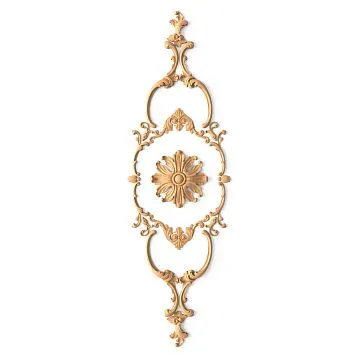
What is an overlay in the context of furniture decor? It is a three-dimensional wooden element with carved relief, which is attached to a flat surface—a wardrobe front, a drawer front, a door panel, a wall panel. Unlike integrated decor, which is carved directly from the solid wood of the furniture part, an overlay is a separate element, created specifically for subsequent mounting.
This approach offers a colossal advantage. First, an overlay can be made from a more valuable wood species than the main furniture, creating interesting texture combinations. Second, overlays can be changed, updating the furniture's appearance without replacing the pieces themselves. Third, overlays allow for adding decor to existing furniture that originally lacked it.
Carved furniture decorvaries in carving depth, pattern complexity, size, and shape. Flat overlays have a relief depth of 3-5 mm—this is delicate decor, creating a subtle play of light and shadow. Medium-relief overlays with a carving depth of 10-15 mm already have a pronounced volume, noticeable from any angle. Sculptural overlays with a carving depth of 20-30 mm or more become three-dimensional objects, almost separate works of decorative and applied art.
Our factory also produces:


Symmetry and Composition
Overlays can be symmetrical and asymmetrical. Symmetrical elements are ideal for centering a composition—they are placed in the middle of a front, door, panel, creating a balanced, classic look. Such overlays often feature plant motifs, developing from a central point evenly in both directions: acanthus leaves, symmetrical scrolls, floral rosettes.
Asymmetrical overlays are elements with directed movement. A grapevine leaning to one side, a bird in flight, a curved branch. Such elements are used in pairs—left and right versions, mirror images. They are placed on the sides of a central element or in corners, creating a dynamic, lively composition.
Corner overlays are a special category. They have an L-shaped or fan-shaped form and are specifically designed for decorating corners—frames, panels, door leaves.carved wooden inlaysof corner configuration are not just decorative but also functional—they visually strengthen the corner, making it more protected, finished.
Get Consultation
Ornamental motifs
What does the carving on furniture overlays tell us? The language of ornament is rich and polysemous. Plant motifs dominate in classical decor. Acanthus—an elegant Mediterranean leaflet with carved edges—symbolizes vitality, growth, nobility. Grapevine with clusters—a sign of abundance, fertility, joy of life. Oak leaves with acorns—an image of strength, longevity, reliability. Roses, lilies, tulips—each flower carries its own symbolism and emotional charge.
Geometric ornaments—meanders, braids, rosettes—reflect a different aesthetic. This is the mathematics of beauty, rhythm and order embodied in wood. Such patterns are universal; they work in both classical and more modern interiors, where organic forms might seem excessive.
Narrative overlays are rarer but make the greatest impression. Putti—cute winged infants, popular in Baroque decor. Mascarons—stylized human faces, often with grotesque features. Animals, birds, mythological creatures—each such element turns furniture into a bearer of history, myth, cultural code.
Rosettes: The Circular Symmetry of Perfection
If overlays are linear elements, thencarved wooden rosettesare point accents of radial symmetry. A rosette is a round or polygonal element with an ornament developing from the center to the periphery.
Architecture of a Rosette
The center of a rosette is the compositional core from which all other elements radiate. The center can be convex—in the form of a dome, sphere, cone. Or concave—funnel-shaped, creating a depth effect. From the center radiate petals, rays, scrolls—elements that create a radial rhythm.
The number of rays matters. Four-rayed rosettes create a cross-shaped structure—strict, static. Six-rayed ones are more dynamic, resembling a snowflake or flower. Eight-rayed ones are complex, rich, Baroque. Rosettes can have one tier of petals or several, creating a multi-layered, deep composition.
The size of rosettes varies from miniature 5-8 cm in diameter to large-scale 30-50 cm and more. Small rosettes are used as point accents—in the center of a panel, at the intersection of moldings, in corners. Large ones become independent compositional centers, dominants of a front.
Application in Furniture Decor
On furniture, rosettes are placed at key points. The center of a wardrobe door, the upper part of a chest of drawers front, corners of a furniture board, junction points of elements—everywhere an accent is needed, to emphasize structure, add completeness.
Rosettes combine beautifully with overlays, creating complex multi-component compositions. A central rosette is surrounded by symmetrical overlays on the sides. Corner rosettes are connected by linear overlays, forming a frame structure. Such solutions turn a simple furniture front into a true decorative panel.
Rosettes are especially striking on dark wood or painted surfaces. The relief creates a play of light and shadow that changes throughout the day depending on the lighting. In the morning, with side lighting, the rosette looks particularly voluminous and graphic. During the day, with diffused light, it is softer, more delicate. In the evening, with artificial light, you can specifically direct the lamp to emphasize the beauty of the carving.
Hardware: Functional Beauty
Furniture decoration items are not limited to purely decorative elements. Hardware — handles, legs, supports — are ornaments that are both functional and aesthetic.
Wooden Handles: Touching Beauty
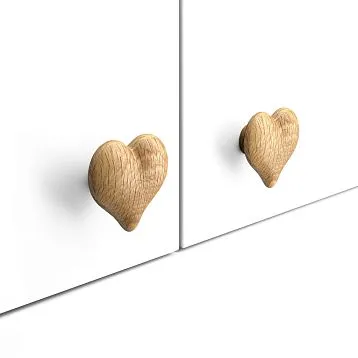
wooden hardwarebegins with handles. This is the only furniture element we touch daily, several times a day. The tactile qualities of a handle are of great importance for the overall perception of the furniture.
Wooden furniture handles are warm to the touch, unlike metal ones. They are pleasant to the hand, especially in cold weather. The texture of the wood, its slight roughness or smoothness after polishing — all this creates a special connection with the object.
The shape of wooden handles varies from the simplest — cylinder, sphere, cone — to complex sculptural ones. Handles shaped like twigs, fruits, animals, abstract figures. Carved handles with ornaments that repeat the decor of the overlays on the same piece of furniture create stylistic unity.
The size of the handle must correspond to the size of the furniture. On a massive cabinet, a miniature handle will get lost and look disproportionate. On an elegant nightstand, a large handle will be excessive, overwhelming. The rule is simple: the larger the furniture, the more expressive the hardware should be.
Legs: The Foundation of Character
If handles are points of contact, thenPrecision furniture legsare the foundation, the base that determines the visual mass and character of the furniture. Legs are the boundary between the furniture and the floor, and their shape determines whether the object seems heavy or light, solid or airy.
Short, massive legs create a sense of stability and reliability. The furniture seems to grow into the floor, becoming an extension of it. Such legs are suitable for large items — cabinets, dressers, chests — in classic, rustic, Scandinavian interiors.
Tall, thin legs, on the contrary, lighten the furniture visually. Space, air appears between the floor and the lower part of the object. Such furniture seems to float, elegant. Tall legs are typical for Baroque, Rococo, Empire styles, and for modern furniture in the spirit of mid-century modern.
The shape of the legs is a separate topic. Straight, conical legs are laconic and universal. Baluster-shaped legs with expansions and constrictions are classic, traditional. Cabriole — curved legs in the shape of the letter S — are elegant, refined, typical of French furniture. Turned legs with complex reliefs of alternating spheres, disks, cylinders are decorative, suitable for luxurious interiors.
The material of the legs usually matches the material of the main furniture, but can also contrast. Light furniture on dark legs, dark on light — such combinations create additional graphic quality and emphasize the structure of the object.
Complete Solutions: Harmony of Many
Individual elements are good, but a truly impressive result comes from usingfurniture decoration sets. These are sets where all components — overlays, rosettes, corner elements — are stylistically coordinated, executed in a single ornamental key.
Advantages of the integrated approach
When you purchase a decoration set, you get a ready-made compositional solution. You don't need to guess whether the chosen elements match each other, are proportional, or create a holistic image. Everything has already been thought out and selected by professional designers.
A set usually includes a central element — a large symmetrical overlay or rosette. Paired side elements — mirrored overlays, placed symmetrically relative to the center. Corner elements for perimeter decoration. Sometimes additional small details — decorative nails, plugs, connecting strips.
Such a set allows you to decorate an entire piece of furniture — a cabinet facade, a dresser door, a bed headboard panel — in a unified key. Or to create a series of items with repeating decor, which unites disparate furniture into a suite.
Modular systems
A more flexible solution is modular decoration systems. These are sets of elements that can be combined in various variations, creating unique compositions. Linear overlays with compatible ends, connecting in any sequence. Corner elements that allow forming frames of any size. Central and intermediate modules from which an ornamental frieze of the required length is assembled.
The modular approach gives creative freedom. You are not limited by a ready-made solution, but create your own composition, adapted to the specific task, dimensions, and proportions of your furniture.
Stylistic Range: From Classic to Modern
Furniture decoration items must correspond to the overall style of the interior. Let's consider how furniture decor works in different stylistic contexts.
Classicism and neoclassicism
Classical style requires strict symmetry, precise proportions, noble ornamentation. Floral motifs — acanthus, laurel, oak leaves. Architectural elements — rosettes, garlands, meanders. Restrained color palette — natural wood of valuable species, white and cream enamels, gilding as an accent.
Overlays in the classical style have a clear structure, readable relief, symmetrical composition. They are not overloaded with details, but each detail is worked out with jewelry precision. Such decor requires quality wood and masterful execution — any carelessness will be noticeable.
Neoclassicism softens the strictness of classicism, allows more freedom. Proportions can be slightly violated to create dynamics. Ornamentation is simplified, becomes more graphic. Colors can be bolder — gray, graphite, deep blue, even black.
Baroque and Rococo
Baroque aesthetics is maximalism, theatricality, excess of decor. Furniture in the Baroque style is abundantly decorated with carving, gilding, inlay.Carved furniture decorBaroque is deep, sculptural, almost three-dimensional.
Baroque ornaments are dynamic, full of movement. Scrolls, volutes, intertwinings, grotesques. Putti and angels, mascaron with expressive faces, an abundance of fruits and flowers. Every centimeter of the surface can be decorated—Baroque does not tolerate emptiness.
Rococo is a frivolous, playful version of Baroque. Forms become more graceful, ornament smaller and more whimsical. Favorite motifs are shells, rocaille scrolls, asymmetrical compositions. Colors are pastel—pink, blue, mint, lavender. Gilding is more delicate, often patinated.
Provence and country
Rustic styles value simplicity, naturalness, and casual grace. There is decoration here, but it is not loud or ostentatious. Overlays with simple floral motifs—wildflowers, ears of grain, sprigs of lavender. Handles of simple shapes, often painted or patinated, with an aged effect.
A characteristic feature of Provençal decor is the effect of time. Artificial aging, wear, traces of paint in the recesses of carving, patina. Such furniture looks as if it has served more than one generation, holding family stories.
Colors are natural, sun-bleached—white, cream, gray-blue, lavender, olive. Wood is usually covered with matte paint, worn down to the base in places. Carved decor is minimal but expressive—a few delicate overlays, simple handles, possibly a paneled structure of the fronts.
Art Nouveau and Art Nouveau
Art Nouveau rejects the straight lines and symmetry of classicism, preferring smooth, flowing forms inspired by nature. Floral motifs in Art Nouveau are stylized, decorative—irises, water lilies, winding stems, female figures with long hair.
Overlays in the Art Nouveau style have a characteristic wavy, asymmetrical composition. Lines are soft, without sharp transitions. Carving can be either relief or flat, almost graphic. Colors are natural but saturated—emerald, eggplant, mustard, terracotta.
Hardware in the Art Nouveau style often has organic forms—curved, reminiscent of plant stems, waves, animal silhouettes. Metal hardware can be combined with wooden inlays, creating an interesting combination of materials.
Minimalism and Scandinavian style
At first glance, minimalism and decor are incompatible concepts. But that's not the case. Minimalist decor exists, it just follows different principles. No ornament, no carving. Form is the decor.
Handles in minimalism are simple geometric shapes. Cylinders, cubes, rectangular rails. The material can be contrasting—light handles on dark furniture, dark on light. Or tone-on-tone, where the handle barely stands out, becoming part of the surface.
Minimalist legs are also geometric—straight, conical, sometimes metal. Precision of proportions is important—even a millimeter deviation will disrupt the harmony.
Scandinavian style allows a little more softness. Forms can be rounded, organic. Wood is usually light—pine, birch, ash—natural or whitewashed. Hardware is delicate, not drawing unnecessary attention, but high-quality, pleasant to the touch.
Materials and quality: the foundation of durability
The beauty of decor depends not only on form but also on material. Furniture decoration items are made from various types of wood, each with its own characteristics.
Oak: Strength and Texture
Oak is a classic choice for furniture decor. It is a hard, dense wood with a pronounced texture—open pores, contrasting annual rings. Oak is strong, resistant to moisture and mechanical damage, making it ideal for load-bearing elements—legs, handles.
The color of oak varies from light yellow to dark brown depending on the treatment method. Natural oak has a warm honey hue. Bog oak, aged in water, acquires a dark, almost black color with a silvery sheen. Stained oak can have any shade—from walnut to wenge.
The texture of oak is well emphasized by transparent coatings—oil, varnish. Open pores create a tactile surface, pleasant to the touch. In carved decor, the texture adds depth, making the relief more lively and dynamic.
Beech: density and uniformity
Beech is another popular wood for furniture decor. Beech wood is dense, hard, but more uniform than oak. Pores are fine, barely noticeable, texture is delicate. This makes beech ideal for fine carving, where detail is important.
The color of beech is light, pinkish or grayish. When steamed, it acquires a rich pink-brown hue. Beech takes stains well, accepting any tones, allowing for decor in any color palette.
Beech is sensitive to humidity—it can deform slightly with fluctuations. Therefore, beech decor is recommended for use in rooms with a stable climate, avoiding bathrooms and kitchens with poor ventilation.
Ash, Walnut, and Exotics
Ash is similar in hardness to oak but has a lighter, cooler color. The texture is pronounced, with a beautiful pattern. Ash is popular in Scandinavian and modern design, where its light, clean color is valued.
Walnut is a premium wood with a rich chocolate color and noble texture. Walnut wood is dense, processes beautifully, and polishes to a mirror shine. Walnut decor looks luxurious, suitable for high-status interiors.
Exotic woods—wenge, teak, mahogany—are used less frequently due to high cost but create a unique effect. Dark, almost black wenge with contrasting veins. Oily teak, resistant to any conditions. Reddish mahogany with a satin surface.
Quality of Carving
Material is the foundation, but the quality of execution determines the final result. Quality carving is a clear, clean relief without chips or tear-outs. Smooth transitions between levels, without steps. Thorough sanding of all surfaces, including the recesses of the ornament.
Hand carving is valued higher than machine carving, but modern CNC milling technologies allow for the highest precision and repeatability. The best manufacturers combine technologies—the main relief is created by machine, final finishing and detailing are done by hand.
Correct installation of a wooden balustrade is the key to its longevity, safety, and aesthetic appearance. This process requires a professional approach and attention to numerous technical details.
Beautiful decor must be properly installed. Let's consider the main methods of attaching furniture decorations.
Adhesive bonding
Most overlays and rosettes are attached with adhesive. Special high-strength PVA wood glue or polyurethane adhesive is used. The surface must be clean, degreased, and dry.
Apply the adhesive to the back surface of the overlay in a thin, even layer. Press the overlay into place and adjust its position. Then secure the overlay with clamps or apply weight until the adhesive is completely dry—typically 24 hours.
Excess adhesive that seeps out along the edges should be immediately wiped away with a damp cloth. Once dried, hardened adhesive is difficult to remove and can ruin the appearance.
Mechanical fastening
Large, load-bearing elements may be additionally secured with screws or dowels. Screws are driven from the back, from the side of the furniture panel, to conceal the fasteners. Alternatively, they can be countersunk into the overlay from the front, with the holes filled with wooden plugs matched to the grain.
Dowels—wooden pins—provide a hidden, strong connection. Corresponding holes are drilled in the overlay and base, and the dowel is glued in, creating a rigid bond.
Installing handles
Furniture handles are usually attached with screws or bolts. Hole marking must be precise—even minimal misalignment is noticeable to the eye and spoils the impression.
For symmetrical items—paired cabinet doors, dresser drawers—use a template. This is a cardboard or plywood plate with holes corresponding to the handle fasteners. By applying the template to each door, you ensure identical placement of all handles.
Leg installation
Precision furniture legsLegs are attached to the bottom of the furniture via a mounting plate or directly with screws. It is important to ensure the leg is strictly vertical and that the load is evenly distributed.
For heavy furniture, reinforced fasteners are used—metal brackets, overlay plates. Some legs are equipped with adjustable feet, allowing compensation for floor unevenness and ensuring stability.
Restoration and renewal: giving furniture a second life
One of the main advantages of furniture decorations is the ability to renew old furniture without radical remodeling.
Renewal concept
You have a solid Soviet-era cabinet—sturdy, functional, but hopelessly outdated in appearance. It's a shame to throw it away, but you don't want to leave it as is. The solution is decorative renewal.
Remove the old hardware. If the furniture is painted, decide whether repainting is needed or if a light refresh is sufficient. Plan the placement of decorative elements—central overlays on the doors, corner elements around the perimeter, new handles, and possibly legs to replace the old squat ones.
Restoration stages
Surface preparation is a key stage. Old paint or varnish should be matted by sanding for better adhesion. The surface is cleaned of dust and primed.
If repainting is planned, choose high-quality furniture paint. Modern water-based enamels are eco-friendly, dry quickly, and create a durable finish. Chalk paints can be used, providing a velvety matte surface popular in Provençal and vintage styles.
Decorative installation is carried out after the paint is completely dry. Overlays, rosettes, and new handles transform the furniture beyond recognition. What was once a nondescript cabinet becomes a stylish piece worthy of a place in a modern interior.
Stylistic adaptation
Restoration is an opportunity to change the style of furniture. A simple dresser, painted white and adorned with classic rosettes and gilded handles, transforms into a piece for a neoclassical interior. The same dresser, painted mint with artificial distressing and simple wooden handles, becomes Provençal.
Dark furniture with carved overlays and massive handles suits a classic study. Light furniture with simple geometric handles suits a Scandinavian bedroom. The same base item, but with different decor, creates different looks.
Comprehensive design: from furniture to interior
Furniture decorations do not exist in isolation. They are part of an overall interior concept where all elements are interconnected.
Style Unity
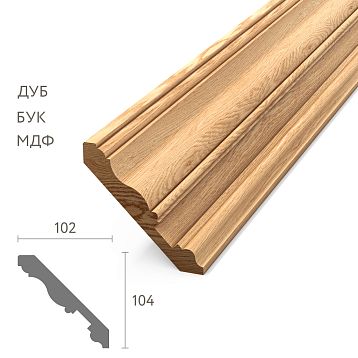
If your furniture is adorned with plant overlays featuring acanthus leaves, it is logical to use similar motifs in other interior elements.Moldings and cornicesMoldings on walls and ceilings can feature similar patterns. Picture and mirror frames can echo the shapes of furniture overlays.
Such stylistic unity creates a cohesive, well-thought-out interior where every detail serves the overall idea. This does not mean everything must be identical, but the visual language—forms, proportions, patterns—should be coordinated.
Color Harmony
Wooden decor can be natural, stained, or painted. The choice depends on the overall color scheme of the interior.
In an interior dominated by natural materials, decor in natural wood tones is logical. But pay attention to tonality—warm golden tones of oak or walnut go well together but may clash with cool gray tones of ash.
Painted decor offers more freedom. White overlays are universal and suit any interior. Black creates a graphic, modern effect. Colored overlays—from pastels to saturated hues—allow for creating accents that support the room's color scheme.
Balusters and Pilasters
Wooden Balusters and Pilasters— these are architectural elements that can complement furniture decor, creating a cohesive spatial composition. If furniture is adorned with carved overlays featuring a specific pattern, staircase balusters or doorway pilasters can echo these motifs.
Such integration of furniture and architectural decor creates an especially luxurious, well-thought-out interior, characteristic of classical styles — Baroque, Empire, Classicism.
Author Collections and Custom Orders
Standard catalogs offer a wide selection, but sometimes something unique is needed, created specifically for a particular task.
Custom design
If you have furniture with non-standard proportions or a special design concept, you can order custom-made decor based on an individual sketch. Modern technologies allow for the realization of practically any idea.
The process begins with a sketch — a drawing or 3D model of the future element. The pattern, dimensions, wood species, and processing method are discussed. A prototype is created — the first sample, which is evaluated and adjusted if necessary. After approval, production begins.
Custom decor is more expensive than mass-produced items, but the result fully matches your vision, making the interior truly unique.
Adaptation to project
Even standard catalog items can be adapted. Changing the size, mirroring, combining several elements into a single composition. Professional manufacturers offer such services, helping to create the perfect solution for each project.
STAVROS: A Workshop of Furniture Art
When it comes to high-quality furniture ornamentation, STAVROS holds a leading position in the Russian market. This is not just a manufacturer of decorative elements, but a true workshop where traditions of woodworking art are combined with modern technologies.
Philosophy of Quality
STAVROS works exclusively with solid noble woods — oak, beech, ash. No imitations, no MDF with laminate. Only real wood, carefully selected, properly dried, and professionally processed.
Each element undergoes multi-stage quality control. From selecting the blank to final packaging — compliance with standards is monitored at every stage. Geometry, carving precision, sanding quality, absence of defects — everything is checked twice and three times.
Breadth of Assortment
The STAVROS catalog includes over 400 models of carved overlays in various styles and sizes. From miniature elements for decorating boxes to large-scale panels for furniture facades. Symmetrical and asymmetrical, classic and modern, simple and luxurious — everyone will find a solution for their task.
A special pride is the 'Summer Garden' collection, created by STAVROS artists. This is an authorial interpretation of Baroque carving, where traditional floral motifs have received a modern reading. Lively, expressive, dynamic elements of this collection are versatile — they work in both classic and eclectic interiors.
Wooden Legs and Handles
STAVROS offers an extensive collection of furniture legs — over 50 models of various shapes and styles. From simple conical to intricately carved, from miniature for light furniture to massive for large pieces. Legs with metal tips and casters for mobile furniture.
Wooden handles are presented in dozens of variations — classic, modern, carved, turned. Various lengths, shapes, styles. All handles are carefully sanded, pleasant to the touch, functional, and beautiful.
Rosettes and Sets
The STAVROS collection of carved rosettes includes over 80 models. From minimalist geometric to richly ornamented Baroque. Diameters from 50 to 500 mm, flat and three-dimensional, with various motifs — floral, geometric, architectural.
Ready-made decor sets simplify the creation of harmonious compositions. The set includes all necessary elements for decorating a furniture facade, selected by professional designers. All that remains is to correctly position and secure them.
Individual Approach
STAVROS works not only with retail customers but also with designers, architects, and furniture manufacturers. For large projects, custom decor based on individual sketches, adaptation of standard models, and development of unique solutions are possible.
Professional consulting support helps make the right choice. STAVROS specialists will answer questions, help calculate the required quantity of elements, and suggest the optimal installation method.
Availability and logistics
STAVROS products are available through an online store with a convenient search and filtering system. Detailed photos, precise dimensions, and thorough descriptions help make an informed choice.
Delivery is organized throughout Russia. Own warehouses in Moscow and St. Petersburg ensure the availability of popular items and fast shipping. Careful packaging guarantees that fragile carved elements will arrive in perfect condition.
Tradition and Innovation
STAVROS combines respect for the traditions of woodworking craftsmanship with the use of modern technologies. High-precision CNC equipment ensures impeccable geometry and repeatability. However, final finishing, quality inspection, and packaging are performed manually by experienced craftsmen.
This approach guarantees a result where technological perfection does not kill the living soul of the product. Every overlay, every handle remains a work of applied art, not a faceless industrial product.
Conclusion: Decor as a Philosophy
Furniture decorations are more than just beautiful details. They represent a philosophy of attitude towards objects, the home, and life itself. By choosing quality decor and paying attention to details, we create a space that brings daily joy, inspires, and makes you want to live in it.
Furniture with thoughtful decor lasts longer. Not because overlays make it physically stronger, but because it doesn't become tiresome. A unique, beautiful item is not rushed to the landfill at the first opportunity for an update. It becomes part of the home, an element of its history.
Working with decor develops taste, a sense of proportion, and an understanding of materials. Even if you start with a simple update of an old dresser, you gradually come to understand more subtle matters—how composition works, why one element harmonizes with its surroundings while another looks alien.
And finally, creating beauty is simply pleasant. Seeing a faceless object transform under your hands into a home decoration, feeling the texture of wood, admiring the play of light on the relief of carving—all this provides a special pleasure that cannot be bought for any amount of money.
Let furniture decorations become your allies in creating the home of your dreams. And STAVROS will gladly provide everything necessary to bring even the boldest ideas to life.