












































































Article Contents:
- Boiserie: return of French classicism
- Historical roots: from Versailles to modernity
- Why boiserie is back in trend: psychology and aesthetics
- Modern adaptation: simplification without loss of essence
- Oak and beech: material basis of boiserie
- Oak: monumentality and prestige
- Beech: lightness and modernity
- Boiserie details: moldings, panels, rosettes
- Polyurethane moldings: elegance without weight
- Ceiling Cornices: Completing the Vertical Line
- Ceiling rosettes: central accents
- Door and window frames: polyurethane where wood is difficult
- Decorative elements: consoles, pilasters, cartouches
- Scenarios for different rooms
- Living room: grandeur and comfort
- Office: focus and respectability
- Bedroom: intimacy and refinement
- Composition and color: rules of harmony
- Rule of three parts: vertical hierarchy
- Golden section: proportions of panels
- Color strategies: from monochrome to contrast
- Lighting: revealing relief
- Conclusion: French chic is accessible
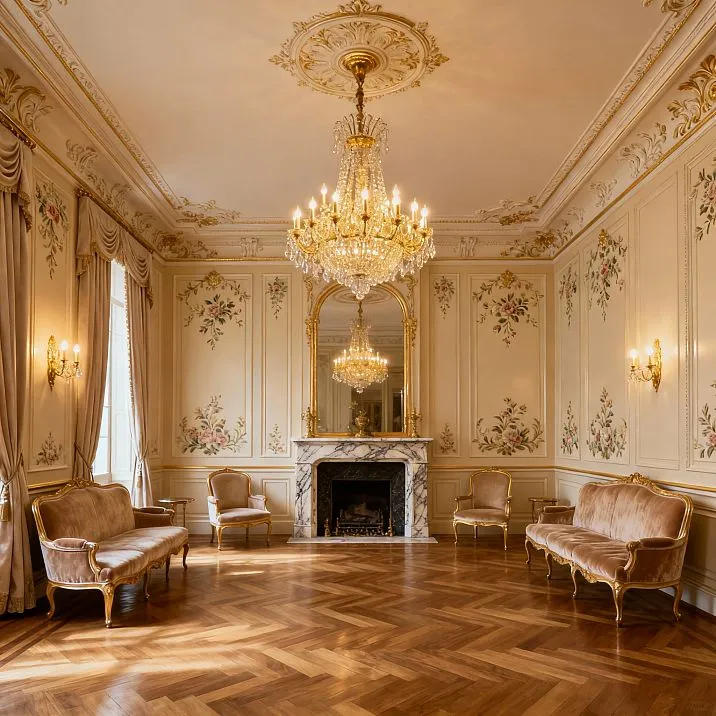
Boiserie made of wood- embodiment of French elegance of the 17th-18th centuries, wooden carved panels that turned palace walls into works of art. Today, this is not a museum artifact, but a current solution for creating interiors with character, history, and refinement.Oak boiserie- returns traditions of monumentality, hardness, expressive texture.Beech boiserie- adds lightness, modernity while preserving historical form.polyurethane moldings- complements wooden grandeur, creating ceiling decoration, cornices, rosettes without the weight and cost of plaster moldings.Moldings made of polyurethane- frame wooden panels, creating a framed structure, classical geometry, and compositional completeness. The synthesis of natural wood and technological polyurethane creates interiors where historical authenticity combines with modern practicality, French chic with accessible implementation.


Boiserie: return of French classicism
The concept of boiserie (from French 'boiserie' - wooden work) denotes a system of wooden panels covering walls from floor to ceiling or partially, with mandatory framed-panel structure, molding frames, often with carved decoration. This is not merely wooden wall cladding, but an architectural system with canons, proportions, and element hierarchy.




Historical roots: from Versailles to modernity
Boiserie reached its peak in France in the 17th-18th centuries under Louis XIV and Louis XV. The Palace of Versailles demonstrates the highest examples - panels made of oak and walnut, painted in white, cream, light blue with mandatory gilded protruding elements. The framed structure divided walls into rectangular sections, each with a central panel, framed by carved moldings.
The functions of boiserie were numerous. Practical - insulation of stone castle walls, soundproofing, hiding irregularities of masonry. Social - demonstration of wealth, status, taste of the owner. Aesthetic - creation of architectural integrity, where walls, doors, furniture, fireplaces are united by a common decorative language. Psychological - boiserie made large palace halls visually more comfortable, dividing emptiness into manageable sections.
The 20th century rejected boiserie as outdated opulence. Modernism with its smooth white walls and minimal decoration seemed an antithesis to carved wood. But the 21st century is bringing boiserie back in a new interpretation. Neoclassicism, modern classicism, eclecticism use boiserie as a means to create character, individuality, connection with history while preserving the functionality of modern space.
Our factory also produces:


Why boiserie is back in trend: psychology and aesthetics
Modern open floor plans create a deficit of privacy, intimacy, coziness. Large empty walls psychologically feel cold and unwelcoming. Boiserie structures walls, creating scale proportional to human size. Panel height of 100-150 centimeters corresponds to human height, creating a comfortable viewing zone.
The tactile quality of wood contrasts with the coldness of concrete, glass, metal in modern architecture. Touching a wooden panel gives a sense of warmth, naturalness, connection to the organic world. For people spending days in offices with glass walls, boiserie at home is a return to tactile comfort.
Uniqueness opposes mass production. Mass-produced IKEA furniture and standard apartment layouts create uniform housing. Boiserie is a way to create a unique space. Each installation is individual - panel sizes, quantities, configurations are adapted to a specific room. Two interiors with boiserie will never be identical.
Investment attractiveness is also important. Well-executed boiserie increases property value by 15-25 percent. Buyers of premium real estate value detail, craftsmanship, use of natural materials. Apartments with boiserie sell faster and at higher prices than standard apartments with painted walls.
Get Consultation
Modern adaptation: simplification without loss of essence
Historical boiserie covered walls completely, from floor to ceiling. Modern adaptation often limits itself to the lower part of the wall, 100-180 centimeters high - the English variant wainscot. This reduces cost, labor intensity, and visually does not overload rooms with ceilings 2.5-2.7 meters (compared to 3.5-4 meters of palace halls).
Carved decoration is simplified. Instead of multi-figure baroque compositions - minimalist molding profiles, minimal carving or its complete absence. Panel geometry creates visual interest without excessive detail. For modern interiors, restrained boiserie is more organic than lavish historical versions.
Color palette expands. Historically - white, cream, pastel tones with gold. Modernly - natural wood without staining, dark tones (graphite, black), even bright colors for eclectic interiors. Wood is stained or left natural depending on the concept - staining for classicism and Provence, natural for Scandinavian and eco interiors.
Combination with modern materials enriches possibilities. Wooden boiserie panels with polyurethane framing, glass or mirror inserts, leather panels create hybrid solutions where historical form is filled with modern content.
Oak and beech: material basis of boiserie
The choice of wood species for boiserie determines durability, aesthetics, cost. Oak and beech are proven species over centuries, optimal for creating panels serving generations.
Oak: monumentality and prestige
Oak boiserie- classic choice following historical tradition. French and English boiserie of the 17th-18th centuries were predominantly made of oak. Density 690-750 kg/m³, hardness 3.7-4.0 on Brinell ensures resistance to mechanical damage, preservation of profile clarity for decades.
Expressive oak texture with large vessels creating contrasting dark stripes turns each panel into a visual object. Radial cut demonstrates medullary rays - shimmering pattern, especially effective under side lighting. For living rooms, offices, formal rooms, radial-cut oak is a premium choice.
Oak color ranges from golden-brown to dark brown (when stained) creating a warm, solid atmosphere. Dark stained oak for offices, libraries, male spaces. Medium natural oak for living rooms, dining rooms, universal zones. Light bleached oak for bedrooms, modern interiors where airiness is important.
Oak's biostability - tannin content 6-8 percent - creates natural protection against mold and fungi. Even in humid conditions, oak boiserie does not suffer from biological agents with minimal protective treatment. For ground floors of country houses, rooms with variable humidity, oak is more reliable than other species.
Oak boiserie construction traditionally is framed-panel. Massive oak frame with 80-120 mm cross-section forms the panel perimeter. Panel - central flat or relief part - may be oak plywood, thinner solid wood, even MDF, veneered oak. Panel is inserted into frame groove with 5-7 mm gap, allowing wood to react to humidity changes without deforming the entire panel.
Beech: lightness and modernity
Beech boiserie- choice for interiors where lightness, uniform texture, modern interpretation of classic form are important. Natural beech color, 3-4 tones lighter than oak, creates visual expansion of space, lightness, airiness.
Uniform beech texture without contrasting elements provides a calm visual background. For modern interiors where minimalism of details is valued, beech is visually preferable to more active oak. Fine-grained structure allows achieving perfectly smooth surface after sanding - critical for lacquered boiserie with glossy or semi-gloss finish.
Beech staining is uniform due to homogeneous structure. Beech boiserie stained in white, light gray, pastel tones (pink, blue, mint) while preserving visible texture - popular solution for Provence, Scandinavian, neoclassical interiors. Oak stains less uniformly - large vessels absorb more, creating unevenness.
Beech flexibility after steaming allows creating curved boiserie elements. Arched openings framed by bent beech moldings without joints. Rounded panel corners instead of straight ones. For interiors with abundant curved lines, beech is more technologically feasible than oak, which bends worse and requires complex fixtures.
Beech's drawback - higher hygroscopicity, absence of tannins. Beech boiserie requires quality protective treatment - 3-4 layer lacquering or special oils with water-repellent additives. With proper protection, it lasts as long as oak. For dry living spaces with stable humidity 40-60 percent, beech is reliable.
Boiserie details: moldings, panels, rosettes
Moldings - profiled strips framing panels, create boiserie's framed structure. Molding width 50-100 mm depending on room and panel scale. Profile ranges from simple rounded edges for modern boiserie to complex multi-step profiles with beads, rosettes, flutes for classical.
Panels - central parts of panels - can be flat, relief, carved. Flat panel made of oak or beech plywood 6-10 mm thick creates a calm surface, emphasizing wood texture. Relief panel with routered ornament adds depth, play of light and shadow. Carved with hand or machine carving - maximum decorative value, cost, uniqueness.
Rosettes - round or oval decorative elements in centers of large panels - classic boiserie accent. Diameter 150-300 mm, ornament from simple concentric circles to lavish floral compositions. Wooden rosettes are cut on CNC machines or by hand - expensive but authentic. Polyurethane rosettes are glued onto panels - affordable, visually similar to wooden ones from over one meter away.
Skirting boards and bases - lower parts of boiserie 15-25 cm high - create visual foundation, protect lower wall zones from mechanical damage. Skirting profile matches panel moldings - repeating elements link lower and upper composition. Material - same oak or beech as panels.
Polyurethane molding: elegance without weight
polyurethane moldingsIn interiors with boiserie, it serves as ceiling decoration, additional architectural accents, elements where wood is excessively expensive or functionally suboptimal.
Ceiling cornices: finishing the vertical
Walls are covered with boiserie, the ceiling remains a separate plane. The transition between wooden walls and painted ceiling requires architectural finishing — a ceiling cornice.Moldings made of polyurethaneWidth of 12–20 centimeters around the perimeter of the room creates this boundary.
The cornice profile matches the boiserie moldings. If panel moldings have two scrolls and a ridge between them, the ceiling cornice should have a similar profile — recognizable kinship despite scale difference. For classical boiserie — complex cornices with multi-tiered relief. For modern — simple with one or two scrolls.
Painting the cornice creates various effects. A white cornice on a white ceiling with natural oak boiserie — classic contrast of dark lower and light upper zones. Cornice painted in wood tone — monochromatic harmony, visual continuation of boiserie onto the ceiling. Contrasting color cornice (gold, black) — accentuating boundaries, theatricality.
Lighting behind the cornice enhances the effect. An LED strip hidden between the cornice and ceiling provides soft diffused glow, reflected off the ceiling. The cornice visually floats, making the ceiling appear higher. In rooms with low ceilings (2.5–2.7 meters), lighting compensates for height deficiency.
Ceiling Rosettes: Central Accents
A chandelier in the center of a living or dining room with boiserie requires framing — a ceiling rosette. A polyurethane rosette with a 60–100 cm diameter and ornament matching the boiserie style creates compositional completeness. For classical boiserie — lush rosettes with botanical decoration. For neoclassical — restrained with geometric patterns.
The rosette may repeat motifs of wooden rosettes in panels, creating vertical continuity — wooden below, polyurethane above, but related ornament. Or it may be contrasting — simple panels without carving, an ornate ceiling rosette as the sole decorative accent. Strategy depends on desired effect — harmony or contrast.
Rosette size is proportional to the room and chandelier. A 25 m² living room with a 70 cm diameter chandelier — an 80–90 cm rosette is optimal. A 15 m² dining room with a 50 cm chandelier — a 60–70 cm rosette. The rosette should be noticeable but not overpower the chandelier — diameter 10–20 cm larger than the chandelier.
Door and window frames: polyurethane where wood is difficult
Arched openings between rooms with boiserie are framed with polyurethane elements replicating the arch’s curvature. Wood bends difficultly, requires steaming; polyurethane softens, bends easily. An arch 1.2 meters wide, 60 cm radius, is framed with a 10–12 cm wide polyurethane molding, painted to match wood or contrast.
Upper parts of tall windows and doors (architraves, pediments) with complex shapes are made of polyurethane. Semi-circular architraves above doors, framed with polyurethane moldings with botanical ornament. Triangular pediments above windows with polyurethane rosettes in the center. For wood, such elements are labor-intensive; polyurethane reproduces them via molding.
Exterior window frames on the facade made of polyurethane harmonize with interior boiserie, creating a link between exterior and interior. Facade polyurethane is frost-resistant, moisture-resistant, UV-stabilized, serving decades without maintenance. Visual connection between exterior and interior frames enhances the sense of thoughtful, cohesive home design.
Decorative Elements: Consoles, Pilasters, Cartouches
Consoles — short projecting elements under shelves or cornices, creating an illusion of support — made of polyurethane, lightweight, easy to install. A shelf above a fireplace in a room with boiserie is supported by two 20 cm high polyurethane consoles, painted to match wood. Visually create architectural logic, practically decorative.
Pilasters — vertical elements imitating columns — placed in corners of rooms with boiserie, creating vertical structure, classical order. Height from floor to ceiling, width 8–12 cm, with base and capital. Painted white or contrasting to wood, pilasters structure corners, divide walls into sections.
Cartouches — oval decorative shields with scrolls along edges — placed above doors, fireplaces, upper parts of panels as accents. Size 200–400 mm, ornament botanical or heraldic. A monogram, coat of arms, or painting may be in the center. Polyurethane cartouches are lightweight, glued without risk of detachment.
Scenarios for Different Rooms
Boiserie adapts to room functions, scales, styles, creating individual solutions for each space type.
Living room: grandeur and comfort
Living room 30 m², rectangular 6x5 m, ceilings 2.8 m — classic scenario for boiserie. Wall behind the sofa — accent wall, covered with oak boiserie from floor to 180 cm height. Framing structure — three vertical panels 150 cm high, 70 cm wide, spaced 30 cm apart.
Panel frames made of oak moldings 80 mm wide, profile with two scrolls. Flat oak dados, oiled in natural tone. In the center of each dado, a polyurethane rosette 200 mm in diameter with botanical ornament, painted to match oak. Oak skirting 20 cm high with complex profile completes the lower part of the composition.
Side walls of the living room are painted warm beige. Polyurethane moldings form three horizontal bands at 50, 100, and 150 cm heights, dividing the walls. Moldings are white, profile matches oak boiserie moldings. Windows framed with 100 mm wide white polyurethane casings.
White ceiling with 15 cm wide polyurethane cornice around perimeter. Cornice profile complex, repeats boiserie molding motifs. Center of ceiling — polyurethane rosette 90 cm in diameter with lush ornament, painted white. Classical chandelier on bronze frame with crystal pendants.
Classic furniture — sofa with oak frame, beige velvet upholstery. Two matching armchairs beside the sofa, oak coffee table with carved legs. Persian rug under the coffee table. Heavy beige drapes with gold ornament. Living room demonstrates French elegance while preserving comfort.
Office: Focus and Respectability
Office 18 m², square 4.2x4.2 m, ceilings 2.7 m — masculine space requiring seriousness. Boiserie covers all four walls from floor to 160 cm height. Dark walnut in wenge, almost black, matte finish under oil. Framing structure — panels 120 cm high, 90 cm wide, spaced 20 cm vertically.
Oak moldings 60 mm wide, simple profile with one scroll — minimalism suited for serious space. Raised dados with routered concentric rectangles — geometry instead of botanical motifs. Polyurethane rosettes absent — excessive decoration inappropriate.
Above boiserie, walls are covered with dark brown leather or leather wallpaper with fine texture. Leather adds tactile quality, luxury, masculine ruggedness. 60 mm wide white polyurethane molding at the boundary between wood and leather creates contrast, emphasizing the boundary.
Ceiling with oak beams of 100x150 mm section running across the office with a spacing of 120 centimeters. Between the beams, the ceiling is painted dark gray. Polyurethane cornice around the perimeter is absent — the beams provide sufficient structure. Lighting is built-in between the beams plus a desk lamp on the table with a brass base.
Desk made of solid oak, full wall width, 2.4 meters. Brown leather chair with high back. Oak bookshelves reaching the ceiling with glazed doors. Parquet floor in oak with inlay. Minimalist or absent rug under the chair. The office is maximally wooden, dark, focused — a space for work, contemplation, decision-making.
Bedroom: Intimacy and elegance
Bedroom 20 square meters, rectangular 5x4 meters, ceiling height 2.6 meters — private space requiring softness and coziness. The wall behind the bed headboard is covered with oak boiserie panels 140 centimeters high, matching the wall width. Light natural oak, oiled, creates warmth without the heaviness of dark oak.
Frame structure — two horizontal rows of panels. Lower row 60 cm high, upper row 60 cm, with horizontal molding between them. Each row consists of three square panels 60x60 cm with 15 cm intervals. Molding in oak, 50 mm wide, profile with a rounded edge and a beveled edge — elegant, uncluttered.
Panels with light relief — central part slightly recessed by 5 mm, creating delicate play of light and shadow. Polyurethane moldings absent — oak texture is self-sufficient. Oak skirting board 15 cm high with simple profile.
Other walls painted in soft peach or light pink — warm pastel tones for the bedroom. White polyurethane moldings 50 mm wide form tall vertical frames around windows and doors. Inside the frames, same peach color or wallpaper with delicate floral pattern.
White ceiling with 10 cm wide polyurethane cornice — medium, non-dominant. Simple profile. Small elegant chandelier with fabric shades, providing soft diffused light. Additional wall sconces above the bed for reading.
Bed with soft oak headboard upholstered in pastel-toned fabric. Nightstands in oak with simple design. Chest of drawers in oak against the opposite wall. Abundant textiles — quilted coverlet, numerous decorative cushions, light linen curtains in peach tone. Soft fluffy beige rug. Bedroom is gentle, feminine, inviting for rest.
Composition and color: rules of harmony
Successful boiserie with polyurethane molding follows classical composition rules adapted to modern context.
Rule of three parts: vertical hierarchy
Wall divided vertically into three parts — lower (boiserie), middle (painted or wallpapered), upper (cornice or frieze). Classical proportions 1:2:0.5 for 270 cm high wall — boiserie 110 cm, middle zone 135 cm, cornice 25 cm. Creates visual stability — massive base, lightness toward the top.
Modern adaptation varies proportions. For low ceilings 250–260 cm, boiserie limited to 90–100 cm, not overloading verticality. For high ceilings 300+ cm, boiserie rises to 150–180 cm. Rule — boiserie occupies 30–50% of wall height, no more, otherwise space appears visually low.
Golden section: panel proportions
Rectangular boiserie panels follow the golden section — width to height ratio 1:1.618. Panel 60 cm wide has height 97 cm (rounded to 100 cm). Eye perceives such proportion as harmonious. Square panels are static, calm. Panels elongated in golden section — dynamic, elegant.
Panel placement also follows rhythm. Three panels on wall placed with equal intervals — rhythm creates predictability, comfort. Panels of different sizes alternate in pattern — large, small, large — creates complex rhythm, visual richness. Random placement without system creates chaos, discomfort.
Color strategies: from monochrome to contrast
Natural strategy — wood in natural color, polyurethane white. Classic combination, emphasizing wood texture, creating contrast between warm and cool, natural and artificial. For interiors valuing naturalness, this strategy is optimal.
Monochromatic strategy — wood and polyurethane painted in one color. White boiserie, white molding — completely white space with relief creating play of light and shadow. For Scandinavian, minimalist interiors, monochromatic creates purity, freshness, visual expansion of space.
Contrast strategy — dark wood, white molding or vice versa. Graphic, clear structure, modern. Dark oak boiserie, white ceiling cornices and sockets create dramatic contrast, suitable for offices, libraries, masculine spaces.
Pastel strategy — wood painted in pastel tone, molding white or close pastel. Peach boiserie, white molding for bedrooms. Mint boiserie, light green molding for children’s rooms. Softness, gentleness, French charm.
Patina strategy — base color with contrasting patina applied to raised relief parts. White boiserie with gold patina — palace luxury. Beige with dark brown patina — aging effect. Patination adds depth, complexity, historical authenticity.
Lighting: revealing relief
Directed light reveals boiserie and molding relief maximally. Wall sconces placed above boiserie with downward light along the wall create long shadows from moldings, emphasizing relief. For evening lighting, directed sconces create dramatic atmosphere.
Ceiling spotlights directed at boiserie at 30–45 degree angle, highlighting wood texture, relief of panels. Each panel is individually lit, becoming an object. For gallery effect, transforming walls into exhibition.
Backlit cornice — LED strip between cornice and ceiling — provides soft diffused reflected light, visually raising the ceiling. Cornice appears to float, space seems higher. For low rooms, this is a compensating technique.
Central chandelier in classic polyurethane socket provides general lighting, revealing the entire composition. Supplementary table lamps, floor lamps create local light for functional zones — reading, working. Multi-level lighting with dimming capability adapts space to time of day and activity.
Conclusion: French chic is accessible
CombinationBoiserie made of woodandpolyurethane moldingCreates interiors with French accent — refined, thoughtfully designed, historically rooted.Oak boiserieBrings monumentality, prestige, expressiveness of texture.Beech boiserieprovide brightness, modernity, and flexible forms.Moldings made of polyurethanecomplete the composition, frame, and create ceiling decor without the heaviness of plaster.
Adapting historical boiseries to modern realities — simplifying decoration, varying heights, expanding color palettes — makes them relevant for today’s interiors. The combination of natural wood and technologically advanced polyurethane optimizes budget without sacrificing aesthetic effect. Wood where tactile quality, prestige, and durability are critical. Polyurethane where lightness, moisture resistance, and accessibility of complex forms matter.
Composition rules — three-part division, golden ratio, rhythm — create harmony. Color strategies ranging from natural to patinated provide tools for any style. Lighting reveals relief, creates atmosphere, and adapts space to the rhythms of life.
An investment in boiseries pays off for decades of aesthetic pleasure, increased property value, and uniqueness of space. Your home deserves French chic — elegance that never goes out of style, beauty that becomes part of family history.


