












































































Article Contents:
- Choosing wood species: the foundation of unity
- Oak: classic and noble
- Beech: warmth and uniformity
- Ash: lightness and modernity
- Pine and spruce: budget choice
- Tone: precise shade matching
- Natural wood: the gold of texture
- Stained wood: selecting the stain
- Painted wood: monochrome
- Frame shape: from minimalism to baroque
- Simple straight frame: modernity
- Profile frame: classic with details
- Carved frame: baroque and luxury
- Oval and round frames: romance and softness
- Frame size: proportions relative to the dresser
- 60-80% rule
- Composition of multiple frames
- Picture inside the frame: what to insert
- Oil or acrylic painting
- Graphics, lithographs, engravings
- Photographs
- Textile, embroidery, panel
- Mirror: function plus decor
- Additional decor: enhancing the wood theme
- Decorative overlays on dresser fronts
- Moldings on the wall around the frame
- Consoles, shelves, cornices
- Lighting: illuminating the frame and dresser
- Picture Lamps
- Table Lamps on a Dresser
- Hidden Lighting
- Composition Examples: From Bedroom to Living Room
- Bedroom: Dresser and Picture Above the Headboard
- Living Room: Console and Triptych
- Hallway: Dresser and Mirror
- Study: Sideboard and Portrait
- Frequently Asked Questions
- Can I use an MDF frame with wood veneer instead of solid wood?
- What to do if the dresser handles are already made of a different wood species?
- What is the optimal frame profile width?
- Is a mat needed between the picture and the frame?
- How much does a set cost: frame + handles in a unified palette?
- Can I make a frame myself from molding?
- How to care for a wooden frame?
- Is it necessary to hang the picture strictly centered above the dresser?
- Is a wood palette suitable for modern interiors?
- What to do if the wall above the dresser is occupied by a heating radiator?
- Conclusion: Wood as the Language of Interior Design
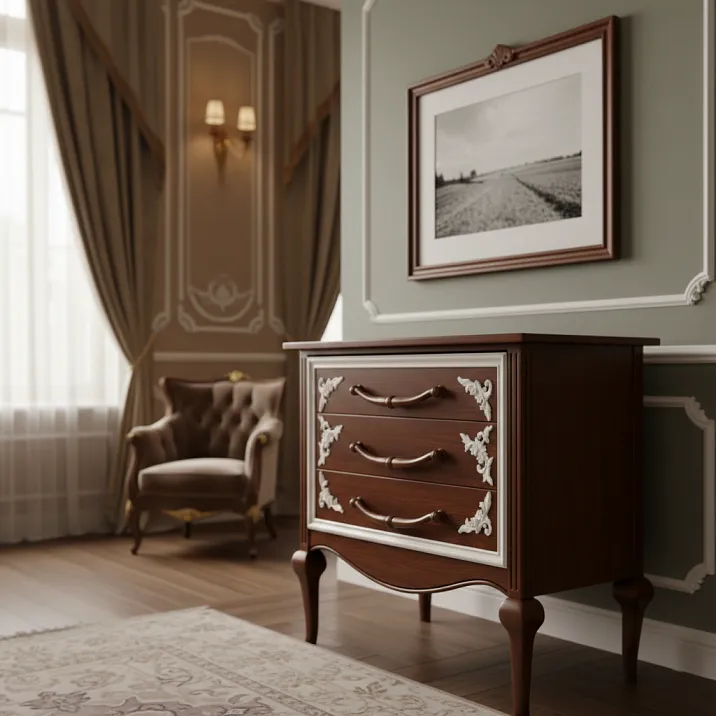
The wall above the dresser is not empty space, but a canvas for composition. A picture in a wooden frame, hanging above a dresser withwooden handles, creates a vertical axis, linking the furniture and the wall into a single ensemble. But this only works under one condition: the wood of the frame and the wood of the handles must speak the same language — match in species, tonality, and character of finish. Whenframe for a paintingis made of solid oak with a natural stain, and the dresser handles are from the same oak in the same tonality, the eye perceives this as material unity. The dresser and the picture cease to be separate objects, becoming parts of a single composition, where wood is the main character, uniting everything around itself.
Why is the wood palette specifically important? Because wood is a living material, possessing texture, warmth, and tactility. A metal frame and wooden handles are a contrast of materials, which can work in industrial interiors but destroys unity in classic, Scandinavian, and eco-styles. A plastic frame imitating wood and real wooden handles are a lie that the eye and hand perceive instantly (plastic is cold, smooth, weightless; wood is warm, textured, dense). Only wood with wood creates a true kinship, especially when it's the same species — oak with oak, beech with beech, ash with ash.
Decorating the wall above the dresser in a unified wood palette is a principle applicable to any space: bedroom, living room, hallway, study. Wherever there is a horizontal furniture surface (dresser, console, sideboard, cabinet) and a vertical wall plane above it, an opportunity arises to create a connection through wood.wooden framebecomes a visual bridge between the wall and the furniture, anddecor for furniturein the form of handles, overlays, moldings enhances this connection, creating a multi-layered composition.


Choosing the Wood Species: The Foundation of Unity
The first and main step is to decide on the wood species that will become the basis of the composition.




Oak: Classic and Noble
Oak is the king among woods. Hardness 3.7-4.0 on the Brinell scale, coarse-grained texture with contrasting annual rings, natural golden-brown hue. Oak is ideal for classic, neoclassical, English interiors, where monumentality, weight, and history are valued.
When choosing an oak chest of drawers (or a chest of drawers with oakwooden handles), frame for a paintingshould also be oak. The texture of oak is unique and cannot be confused with other species even after staining. Large pores, expressive rays (radial cut of oak gives a characteristic moiré pattern) — these features are readable from a distance, creating a visual connection between the frame and handles.
Oak takes stain well: walnut stain gives a noble medium-brown tone, wenge stain gives a dark brown almost black, bleaching gives a gray-white aged look. But even with staining, the texture remains visible, which is critical for compositional unity.
Our factory also produces:


Beech: warmth and uniformity
Beech is a medium-hardness wood (3.5 on the Brinell scale), with a fine-pored, uniform texture and a natural pinkish hue. Beech is visually softer in character than oak, suitable for modern interiors, Scandinavian style, Provence.
Beech handles on a chest of drawers require a beech frame. Mixing beech with oak (beech handles + oak frame) creates a textural dissonance: the uniform pattern of beech conflicts with the contrasting pattern of oak. Even if the shades are close, the difference in texture is noticeable to a professional and intuitively perceived by a non-specialist as 'something is off'.
Beech takes paint well, it is often painted white, gray, pastel tones for Scandinavian and Provence interiors. Painted beech handles and a painted beech frame (in the same color on the RAL or NCS scale) create perfect unity.
Get Consultation
Ash: lightness and modernity
Ash is a light wood with a soft but expressive texture, similar to oak but less contrasting. Ash is associated with northern, Scandinavian interiors, where naturalness and minimalism are valued.
Ash handles + ash frame — harmony for light, airy interiors. Ash is rarely stained, more often left in a natural light golden hue, coated with oil or matte varnish to emphasize the texture.
Pine and spruce: budget choice
Pine and spruce are soft coniferous species, inexpensive, widely available, but with pronounced knots, resin channels, and uneven texture. These species are suitable for rustic style, country, rustic, where deliberate roughness of the material is part of the aesthetic.
Pine handles and a pine frame work if the interior is built on the principle of rough, unpolished wood. But for classic or modern interiors, pine is too simplistic — it's better to choose oak or beech.
Tone: exact shade matching
Wood species is the first level of unity. Tone is the second, no less important.
Natural wood: the gold of texture
If handles and frame are made of natural wood without staining (coated only with oil or clear varnish), the shade is determined by the species. Oak — golden-brown, beech — pinkish-beige, ash — light golden.
Even within the same species, the shade varies depending on the age of the tree, growing conditions, part of the trunk (sapwood is lighter than heartwood). Solution: order handles and frame from one manufacturer from the same batch of wood. This guarantees the closest possible shade match.
Stained wood: stain selection
Stain changes the color of wood but keeps the texture visible. Popular stains:
-
Walnut — medium-brown with a reddish undertone, classic, warm.
-
Wenge — dark brown, almost black, strict, modern.
-
Bleached oak — gray-white, aged, Scandinavian, Provence.
-
Mahogany — red-brown, luxurious, Victorian, colonial.
Critical: handles and frame must be stained with the same stain from the same brand. Different stain manufacturers give different shades under the same name (walnut from Teknos is not equal to walnut from Sayerlack). A difference of half a tone to a full tone is noticeable to the eye, especially when the frame and chest of drawers are side by side.
If handles are already installed on the chest of drawers, and the frame is ordered later, you need to provide the craftsman with a sample of the handle (close-up photo with a Pantone or RAL color scale) to select the closest possible shade.
Painted wood: monochrome
Paint completely hides the texture, creating a smooth colored surface. White painted handles and a white painted frame — a classic of Scandinavian style and Provence. Black — the graphics of loft and minimalism. Gray, pastel — modern classic.
For painted wood, catalog matching is important: both parts (handles and frame) are painted in the same color according to the RAL or NCS system. Even a slight deviation (RAL 9003 instead of RAL 9010 — both 'white', but with different degrees of warmth) creates a visual mismatch.
Frame shape: from minimalism to baroque
Shapewooden framesdefines the style of the composition and should echo the shape of the handles.
Simple straight frame: modernity
Rectangular frame with a profile width of 4-7 cm, no decor, with a simple bevel or rounding of the inner edge. Such a frame suits modern interiors, Scandinavian style, minimalism. If the handles on the dresser are also simple (oval brackets or straight bars without threading), stylistic unity arises through conciseness.
A simple frame made of light oak or beech, oiled, costs 8000-15000 rubles for a 50×70 cm size. This is an affordable but effective option, especially for reproductions of graphics, photographs, and posters.
Profile frame: classic with details
Profile frame — width 6-10 cm, with a shaped cross-section (fillets, bevels, roundings, steps). The profile creates a play of light and shadow, adds volume, makes the frame noticeable. Suitable for neoclassicism, classic interiors, transitional styles.
If the handles on the dresser have slight relief (rounded edges, bevels), the profile frame supports this theme. Price for 50×70 cm — 15000-30000 rubles depending on the complexity of the profile and wood species.
Carved frame: baroque and luxury
Carved frame 10-20 cm wide with a plant ornament (acanthus leaves, scrolls, rosettes, garlands) — for luxurious baroque, empire, rococo, Victorian style interiors. The carving makes the frame an art object; the painting becomes a museum-level work.
Carved handles on the dresser (with leaves, scrolls) echo the carving on the frame, creating a thematic connection. Important: the ornament does not have to be identical, but the motif should match (leaves on the frame — leaves on the handles, scrolls on the frame — scrolls on the handles).
Price for a carved 60×80 cm frame made of oak with hand-finished carving — 50000-120000 rubles depending on complexity. This is an investment, but the result is a composition that looks like an antique.
Oval and round frames: romance and softness
Oval frame — for portraits, miniatures, romantic subjects. Round frame — for modern graphic works, abstractions. If the dresser has soft, rounded shapes (panelled fronts, rounded knob handles), an oval frame supports the softness of the lines.
Oval and round frames are more complex to manufacture (bent elements, segment gluing), therefore they are 30-50% more expensive than rectangular ones of the same size.
Frame size: proportions relative to the dresser
Sizepicture framesshould be proportional to the size of the dresser and the wall above it.
60-80% Rule
The width of the frame should be 60-80% of the width of the dresser. A dresser 100 cm wide requires a frame 60-80 cm wide. A 90 cm frame looks too wide, overpowering. A 40 cm frame is too small, gets lost.
The height of the frame is determined by the height of the wall above the dresser. If the dresser is 80 cm high, the wall to the ceiling (2.7 m standard) — 190 cm. The optimal frame height is 60-90 cm, leaving 50-65 cm of wall above and below the frame. This is balanced.
Composition of several frames
An alternative to one large frame is a composition of three or four small frames, arranged symmetrically or asymmetrically. Three 30×40 cm frames, aligned horizontally, occupy the same 100 cm width as one 80×100 cm frame, but create a different rhythm — discrete, not monolithic.
All frames in the composition should be made from the same wood species, in the same tonality, with the same profile (all simple or all carved). A mix (one simple, one carved) destroys unity.
Picture inside the frame: what to insert
The frame is the framing, but the content is also important. What to hang above the dresser?
Oil or acrylic painting
A classic choice is an oil painting on canvas or acrylic on canvas/cardboard. The subject depends on the interior style: landscape for classic and Provence, abstraction for modern styles, still life for country and rustic interiors.
A painting in a wooden frame is a traditional combination, tested for centuries. Important: the color palette of the painting should include shades that echo the tonality of the wood. If the frame and handles are made of dark walnut, a painting dominated by dark brown, golden, burgundy tones will support the wood palette. A painting in cool blue tones will create contrast, which can work but requires caution.
Graphics, lithographs, engravings
Black-and-white or monochrome graphics in a wooden frame — a contrasting but elegant combination. Graphics do not compete with wood in color but emphasize its warmth and texture.
For graphics, simple or profile frames made of light wood (natural oak, beech, ash) are suitable. A dark frame can overwhelm the graphics if they lack powerful expression.
Photographs
Author's photographs (landscapes, portraits, still lifes) in large format (50×70, 60×80 cm) in a wooden frame are a modern trend, especially in Scandinavian and loft interiors.
A photo in a wooden frame requires a mood match: a nature photograph (forest, mountains, sea) in a natural wood frame creates harmony. An urban photograph (architecture, streets) in a dark stained frame creates a contrast of material (warm wood) and subject (cold city), which can be interesting.
Textiles, embroidery, panels
An embroidered panel, tapestry, or lace in a wooden frame is suitable for Provence, country, or boho styles. Wood adds nobility to the handicraft, elevating it from a hobby level to an art level.
Textiles in a frame require a mat (an inner frame made of cardboard or fabric, creating a border between the work and the frame). A mat in neutral tones (white, beige, gray) does not conflict with the wood.
Mirror: function plus decor
A mirror in a wooden frame above a chest of drawers is a classic, especially if the chest is used as a vanity. The mirror expands the space, reflects light, and adds functionality.
A wooden frame for the mirror and wooden drawer pulls on the chest follow the same logic of unity as for a painting. Moreover, the mirror reflects the chest itself, and if the reflection shows pulls made of the same wood as the frame, a visual play occurs, doubling the effect of unity.
Additional decor: enhancing the wood theme
decor for furniture in the form of overlays, moldings, rosettes enhances the wood theme, linking the chest, frame, and wall into a single composition.
Decorative overlays on the chest of drawers' fronts
If the chest has flat, undecorated fronts, wooden overlays (oval, rectangular, carved) add volume and style. Overlays made from the same wood species as the pulls and frame enhance material unity.
Overlays sized 15×25 cm in the center of a drawer front, with carving that echoes the carving on the frame, create a compositional link. The eye reads the ornament on the frame, transfers to the ornament on the overlays, and perceives them as parts of a single artistic concept.
Moldings on the wall around the frame
Wooden moldings (narrow decorative strips 20-40 mm wide) can be glued to the wall around the frame, creating an additional frame. Moldings made from the same wood as the frame visually enlarge the frame, making it more monumental.
Technique: the frame hangs on the wall, and a rectangle of moldings is glued around it at a distance of 5-10 cm from the frame's edge. The moldings are painted the color of the wall or left in the wood's natural color—the latter enhances the wood theme.
Consoles, shelves, cornices
A wooden console or shelf installed below the frame (between the frame and the chest) or above the frame adds a third horizontal level of wood. An oak console between an oak frame and a chest with oak pulls creates a triple repetition of the material, establishing a powerful unity.
Small decor can be arranged on the console: wooden boxes, candlesticks, vases, books. The wood of the console and the decor supports the overall palette.
Lighting: illuminating the frame and chest
Light is critical for perceiving the wood palette. Proper lighting reveals the wood's texture, emphasizes its tonality, and enhances the connection between elements.
Picture lights
Special lights for illuminating paintings—narrow lamps on a bracket, attached to the wall above the frame or to the frame's top edge. Directed top-down light reveals the painting's subject and the frame's texture.
For wooden compositions, warm light (2700-3000K) is optimal, as it emphasizes the golden and brown shades of wood. Cold light (4000K and above) makes wood look gray and kills its warmth.
Lights with wooden elements (base, bracket made from the same wood as the frame and pulls) enhance unity. Metal lights (brass, bronze) also work, adding contrast.
Table lamps on the chest
One or two table lamps on the chest's top surface illuminate the space from bottom to top, creating soft, diffused light. If the lamp bases are wooden (made of oak, beech), they become another element of the wood composition.
Lamp shades are better in neutral tones (white, beige linen or cotton) so as not to compete with the wood in color.
Hidden lighting
An LED strip glued to the wall behind the frame (if the frame hangs with a 2-3 cm gap from the wall) creates a glowing, backlit effect. Warm LED light emphasizes the frame's outline, making it appear to float.
LED strip under the dresser countertop (if the dresser is on legs with a 10-15 cm gap from the floor) illuminates the floor, creates a sense of lightness, and visually lightens bulky furniture.
Composition examples: from bedroom to living room
Let's consider specific spaces where the wood palette works.
Bedroom: dresser and painting above the headboard
A low chest of drawers, 120 cm wide and 75 cm high, stands against the wall in the bedroom. It has four drawers, each with an oval pull handle 128 mm long made of solid oak, finished in walnut stain and coated with semi-matte varnish.
Above the dresser on the wall hangs an 80×100 cm painting (oil landscape) in a carved frame, 12 cm wide, made of oak, walnut stain, carving — acanthus leaves and scrolls. The frame and handles share the same tonality, the oak grain is visible in both. There is 20 cm of wall between the dresser and the frame, enough for visual separation but close enough for connection.
Additionally: bedside tables with handles of the same profile and stain, a wooden walnut headboard. The entire bedroom is built on a wood palette, the painting in its frame is the culmination of the theme.
Living room: console and triptych
A narrow console, 100 cm wide, 35 cm deep, 80 cm high, stands against the wall in the living room. One drawer, a vertical bar pull handle, 200 mm long, made of ash, natural light stain, oil finish.
Above the console, a composition of three 30×40 cm frames, arranged horizontally with 5 cm intervals. The frames contain black-and-white photographs (cityscapes). The frames are simple, rectangular, profile width 5 cm, natural ash, oil finish — matching the handle.
Total composition width (three frames + two intervals) — 100 cm, exactly the width of the console. Symmetry, material unity (ash), stylistic purity (minimalism, Scandinavian style).
Hallway: dresser and mirror
A hallway dresser, 90 cm wide, three drawers, round knob handles, 40 mm diameter, made of beech, bleached stain (grey-white), matte lacquer.
Above the dresser, an oval mirror 60×80 cm in a frame 8 cm wide, made of beech, bleached stain, simple profile with a bevel. The mirror reflects the entrance door, visually expanding the hallway.
The bleached beech of the handles and frame creates lightness, airiness, which is critical for small hallways. Dark wood (walnut, wenge) would feel oppressive in a small space, bleached wood lightens it.
Study: sideboard and portrait
A sideboard in the study, 140 cm wide, 200 cm high, four doors and two drawers. Handles — vertical strap pulls, 180 mm long, made of oak, stained (dark brown), glossy lacquer. Decorative overlays on the doors — carved rosettes, 15 cm diameter, made of the same stained oak.
Above the sideboard, an oil portrait 70×90 cm (ancestor in uniform, 19th century) in a carved frame, 15 cm wide, made of oak, staining identical to the handles, carving — laurel leaves and military symbolism. The portrait is a family heirloom, the frame is new but made to look antique.
Stained oak creates an atmosphere of library-like seriousness, historical depth. The portrait and sideboard are perceived as an ensemble inherited from great-grandfathers, although the sideboard was bought in an antique shop, the frame was custom-made in a workshop.
Frequently Asked Questions
Can I use an MDF frame with wood veneer instead of solid wood?
Yes, if the budget is limited. MDF with oak or beech veneer looks similar to solid wood, especially from a distance. But there are nuances: veneer is a thin slice of wood (0.6-1.5 mm) glued onto MDF. The grain is visible, but it lacks the depth and tactile feel of solid wood. If the handles are solid wood, an MDF frame — the difference will be felt to the touch. It works for visual unity, but not for tactile unity.
What to do if the handles on the dresser are already made of a different wood species?
Three options: 1) Replace the handles with new ones, made of the same wood species as the future frame. 2) Order a frame to match the existing handles. 3) Use a painted frame in a color close to the shade of the handles (paint hides the wood species, leaving only color as a connection). The first option is optimal if the handles are inexpensive and easy to change.
What frame profile width is optimal?
For small paintings (30×40, 40×50 cm) — 4-6 cm. For medium (50×70, 60×80 cm) — 6-10 cm. For large (80×100, 100×120 cm) — 10-15 cm. A narrow frame on a large painting looks flimsy, a wide frame on a small one overwhelms the painting.
Is a mat needed between the painting and the frame?
For graphics, watercolors, photos — a mat is desirable, it creates breathing room, prevents the artwork from pressing against the frame. For oil or acrylic paintings — a mat is usually not used, the canvas is stretched on a stretcher and fits into the frame's rabbet. Mat color — white, beige, grey, not competing with the wood.
How much does a set cost: frame + handles in a unified palette?
A ready-made simple 60×80 cm oak frame — 15,000-25,000 rubles. Four 128 mm long strap pull handles in oak — 1,600-3,200 rubles (400-800 rubles each). Total from 16,600 to 28,200 rubles. A carved frame + carved handles — from 55,000 to 130,000 rubles depending on complexity.
Can I make a frame myself from molding?
Yes, if you have carpentry skills. Molding (wooden profile for frames) is sold by the linear meter. For a 60×80 cm frame, you need about 3 linear meters of molding. Oak molding costs 600-1500 rubles per meter. Total 1800-4500 for materials. Needed: a miter box for cutting 45-degree angles, wood glue, corner clamps, a stapler or nails for fastening. Difficulty: precision of cuts (a 1-degree error will create a gap in the corner), strength of the glue bond.
How to care for a wooden frame?
Wipe with a dry, soft cloth once a month. Avoid wet cleaning (water can get under the frame and damage the artwork). Renew oil finish every 2-3 years (remove the frame, apply a thin layer of oil, let it absorb, wipe off excess, hang back). Lacquer finish does not require renewal for 7-10 years.
Is it necessary to hang a picture strictly centered above a dresser?
Not necessary, but desirable for classic interiors. In modern interiors, asymmetry is acceptable: the picture is shifted left or right, with additional decor (clock, sconce, shelf) on the opposite side of the wall. But asymmetry requires an understanding of balance, otherwise it looks like a mistake.
Is a wood palette suitable for modern interiors?
Yes, if the wood is laconic. Simple frames made of light wood (ash, whitewashed oak) + simple bar handles — this is Scandinavian minimalism, which is a variant of modern style. Wood + white walls + minimal decor = modernity without coldness.
What to do if the wall above the dresser is occupied by a heating radiator?
Hang the frame above the radiator (if wall height allows) or shift the composition to an adjacent wall. Hanging a picture above a hot radiator is not allowed — temperature fluctuations and dry air are detrimental to painting and wood (the frame will dry out, crack).
Conclusion: Wood as the language of interior
A wood palette is not just a choice of material. It is a philosophy where wood becomes the connecting language of space. WhenWooden handles the dresser andframe for a painting the item above it are made from the same wood species, in the same tonality, with the same processing philosophy — they cease to be separate objects and become words in the same sentence. The dresser speaks of functionality and storage, the picture — of beauty and art, but both speak the language of oak, beech, or ash, and this language makes them parts of a single statement.
Decorating the wall above a dresser in a unified wood palette is accessible to everyone. Astronomical budgets are not needed — just an understanding of the principles (wood species, tonality, style) and attention to detail. Replacing plastic handles with wooden ones, ordering a frame from the same species — these simple actions create an effect that changes the perception of the entire space.
This is not about fashion, not about trends that will pass in a year or two. It's about eternal values: natural materials, tactile honesty, visual harmony. Wood serves for decades without losing beauty, and over the years acquires a patina that adds nobility.wooden frame After 20 years, it looks better than on the day of purchase — wood lives, breathes, ages with dignity. Plastic after 20 years yellows, cracks, looks pitiful.
STAVROS is a company that has been creating wooden interior elements for over 20 years, understanding the philosophy of the wood palette and embodying it in its products. Since 2002, STAVROS has been producing picture and mirror frames, furniture handles, decorative overlays, moldings — all from solid oak and beech, all at its own factory in St. Petersburg, all with the understanding that wood is not just a material, but the language in which an interior speaks.
The STAVROS collection includes over 40 models of picture and mirror frames: from simple rectangular ones (profile width 4-6 cm, price from 8000 rubles for 50×70 cm) to complex carved ones (width 12-18 cm, Baroque carving, price from 60000 rubles for 80×100 cm). Over 80 models of furniture handles: from round knobs 30 mm in diameter (from 280 rubles) to long vertical bars 400 mm (from 1800 rubles). Over 400 models of decorative overlays to enhance the wood theme.
Each STAVROS product is created on CNC machines with subsequent manual finishing. Frames are milled from solid wood (for small sizes) or glued from segments with grain matching (for large sizes). Carving is done by 3D milling based on a digital model, then a master carver manually refines the details, removes milling steps, adds liveliness to the lines. Handles are turned (for round and oval profiles) or milled (for rectangular bars), sanded in five stages from 80 to 600 grit.
Staining and finishing: STAVROS uses professional stains from Teknos and Sayerlack (Finland, Italy) with 12 standard shades and the possibility of custom matching. Finish — natural Osmo oil (emphasizes texture, remains tactile) or Sayerlack polyurethane varnish (creates a protective film, provides sheen from matte 10% to semi-gloss 50%).
Comprehensive selection service: the client sends a photo of the dresser with handles (or specifies the handle model from the STAVROS catalog), describes the task (what picture they want to hang, size, style). STAVROS designers select a frame that perfectly matches the handles in species, tonality, style. The client receives a visualization (photomontage with their dresser and the proposed frame), can adjust the choice, approve, and order.
Custom production: if the catalog does not have a frame of the required size, STAVROS will manufacture it individually. Any size (minimum 20×30 cm, maximum 200×300 cm), any shape (rectangular, oval, round, shaped), any profile (from the catalog or based on client sketch). Lead time 3-6 weeks, price calculated individually (20-40% higher than catalog price for a similar size).
STAVROS logistics is reliable: frames are packed in wooden crates or reinforced cardboard boxes with foam inserts protecting the corners. Handles — in individual bags with bubble wrap. Shipping via transport companies (PEK, Delovye Linii, SDEK) throughout Russia and CIS. For Moscow and St. Petersburg — courier delivery with lifting. Cargo insurance included.
STAVROS prices are honest: a simple 60×80 cm oak frame — from 18000 rubles, a profiled one — from 28000, a carved one — from 65000. Oak handles: knobs — from 420 rubles, 128 mm pulls — from 680, 200 mm vertical bars — from 980. This is 1.3-1.7 times lower than European manufacturers (Germany, Italy, France) with quality that often surpasses imports (Russian masters are traditionally strong in wood carving).
Choosing STAVROS, you get not just a frame and handles, but a system for creating a wood palette for your interior. A system where every element is thought out, verified, connected to others through material, form, spirit. A system that turns the wall above a dresser from empty space into a composition worthy of a museum hall. And STAVROS provides all the tools for this transformation — all that remains is your desire to create a space where wood sings in unison.


