Article Contents:
- Why wood: advantages of wooden handles
- Tactile comfort
- Naturalness and eco-friendliness
- Uniqueness of each element
- Durability and Repairability
- Aesthetic value
- Compatibility
- Types of wooden furniture handles
- Handle-eyes (handle-rails)
- Button Handles
- Handle-plates (inset)
- Ring-shaped handles
- Integrated handles (profiled)
- Wood species for furniture handles
- Oak: the standard of strength
- Ash: light strength
- Beech: uniform classic
- Walnut: elite beauty
- Birch: light accessibility
- Exotic species: veneer, teak, mahogany
- Ergonomics of wooden handles
- Diameter and profile of handle-eyes
- Handle projection
- Shape and curves
- Surface texture
- Design and styles of wooden handles
- Classic and neoclassic
- Scandinavian Style
- Provence and Country Style
- Minimalism and modernity
- Loft and Industrial
- Modern
- Installation of furniture handles
- Marking
- Drilling Holes
- Fastening
- Care for wooden handles
- Where to buy wooden furniture handles
- Manufacturers of furniture hardware
- Specialized stores for furniture hardware
- Construction Hypermarkets
- Online stores
- Carpentry Workshops
- Conclusion: touch creates connection
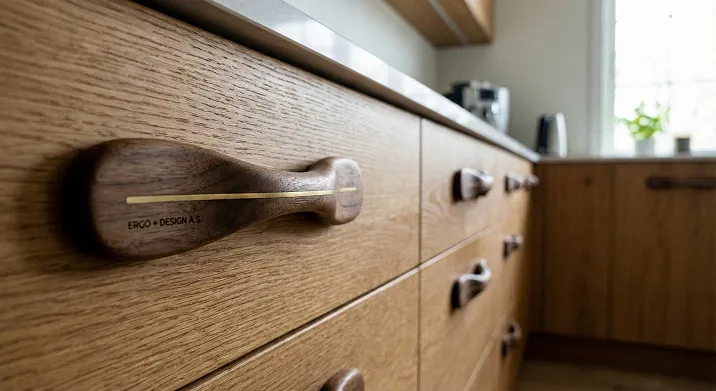
Open the kitchen cabinet door. Your palm rests on the handle. Warm wood, smooth surface with barely perceptible texture, perfect curve, following the shape of your fingers. This is not just a functional element. It is a tactile point of contact with the furniture, a detail you touch dozens of times a day. And every touch should be pleasant.
Now look at the furniture from afar. A solid oak chest, classic design. And on each drawer —Wooden furniture handlematching the tone and texture of the chest, becoming an organic part of the whole. Handles do not shout about themselves, but without them, furniture would be incomplete, lacking character. They create style, highlight quality, add individuality.
Furniture Handlesmade of wood — this is more than hardware. It is an element connecting functionality with aesthetics, ergonomics with design, mass production with exclusivity. Properly chosen wooden handles can transform standard furniture, add soul to a typical kitchen, create a unique character for interior design.
This article is a professional guide to the world of wooden furniture handles from a specialist with fifty years of experience in furniture, wood, and ergonomics. We will examine handle types from buttons to brackets, discuss wood species and their effect on tactile sensation, explain how shape determines comfort, show how to choose handles to match interior style from classic to minimalism, and provide recommendations for installation and care.
Ready to learn how a detail creates perfection? Dive into the world of wooden handles.



Why wood: advantages of wooden handles




Tactile Comfort
Wood is a material created by nature for touch. Unlike metal (which is cold in winter, hot in summer, slippery when sweaty) or plastic (which always feels artificial to the touch), wood has a comfortable temperature close to human skin temperature. A wooden handle does not burn or chill, and is pleasant to the touch in any season.
The texture of wood creates a gentle grip on the palm — the hand does not slip, and the grip is secure even with wet hands (relevant for kitchens). A smooth, polished surface of oak or ash is pleasant, silky — you want to touch it again and again.
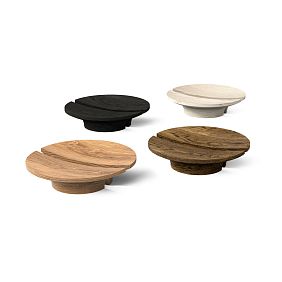
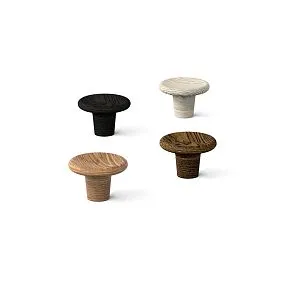
Our factory also produces:



Naturalness and eco-friendliness
Wood is an eco-friendly material, emitting no harmful substances, and does not cause allergies. Unlike plastic (which may emit phenols when heated) or low-quality metal (with nickel, causing allergies), wood is completely safe for health. This is especially important for kitchens and children's rooms, where eco-friendliness is critical.
The scent of wood — a subtle, pleasant aroma of forest, resin, nature. It is imperceptible, yet subconsciously creates an atmosphere of coziness, naturalness, and connection with nature.
Get Consultation
Uniqueness of each element
Even in mass production, each wooden handle is unique. The texture of wood — the pattern of growth rings, the direction of fibers, color transitions — is unique. Two handles from the same batch will be similar, but not identical. This adds individuality and liveliness to furniture, distinguishing it from mass-produced, faceless production.
In handcrafted work, uniqueness is even stronger. A carved handle, cut by a master, is absolutely unique — a piece of applied art.
Durability and repairability
Hardwood species (oak, ash, beech) are strong, resistant to wear, and last for decades. A wooden handle made of oak will outlive the furniture itself — it can be moved to a new chest, cabinet, or kitchen.
In case of damage (scratches, dents), a wooden handle is easy to restore — sand it down, reapply oil or varnish. A metal handle with chipped chrome or a plastic one with cracks can only be discarded.
Over time, wood develops a noble patina — a slight darkening, polishing from hands, a unique character. An old wooden handle becomes even more beautiful, unlike metal (which tarnishes and oxidizes) or plastic (which fades and yellows).
Aesthetic value
Wood is associated with quality, naturalness, prestige. Furniture with wooden handles is perceived as more expensive, higher quality, and made with care, compared to plastic or cheap metal handles.
The texture of wood adds visual depth, warmth, liveliness. An interior with wooden elements (parquet, furniture, handles, decor) feels cozier, more harmonious, than an interior made of synthetic materials.
Combination versatility
Wood combines with any materials — with metal (wood + brass inserts, wood + steel elements), ceramic, stone, fabric, leather. This allows creating rich textured compositions and unique design solutions.
Types of wooden furniture handles
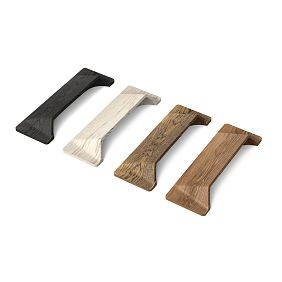
Bracket handles (rail handles)
The most common type. P-shaped or arched form — two mounting points on the furniture, with a protruding part between them, which is grasped.
Shape: straight horizontal (classic bracket), arched (smooth curve), wavy (S-shaped), angular (L-shaped for corner drawers).
Sizes: center-to-center distance (distance between mounting hole centers) — from 64 mm (miniature for small drawers) to 800 mm (large for wide cabinets, kitchen fronts). Most popular sizes — 96, 128, 160, 192, 256, 320 mm.
Profile: round (diameter 10–30 mm — comfortable grip, classic look), oval (more ergonomic than round, less pressure on palm), rectangular (modern minimalist), decorative (with curves, relief).
Advantages: comfortable grip with the whole palm (or several fingers), secure mounting (two points), versatility (suitable for drawers, doors, any furniture), wide variety of sizes and shapes.
Applications: kitchen fronts, chests, cabinets, wardrobes, drawers, tables with drawers — anywhere where doors need to be opened or drawers pulled out.
Price: wooden brackets from oak, center-to-center 128 mm — 400–1200 rubles each, 256 mm — 800–2500 rubles each (depends on species, profile, finish).
Button Handles
Round, oval, or decorative button protruding from furniture by 20-50 millimeters. One mounting point (screw is screwed into the center of the button).
Shape: round (classic), oval, mushroom-shaped (widening upward), square, rectangular, decorative (carved, multi-faceted).
Sizes: diameter 25-60 mm (larger furniture requires larger buttons), protrusion height 20-50 mm.
Advantages: compactness (do not protrude far, do not obstruct passage), aesthetics (look like decorative elements, embellish furniture), ease of installation (single hole), suitable for small drawers (where a bracket won't fit or would be bulky).
Disadvantages: less convenient for heavy doors (need to pull by fingertips — less convenient than gripping a bracket with the whole palm), weight limitation (one mounting point withstands less load than two).
Application: small drawers of chests, side tables, cabinets; light cabinet doors; decorative elements (buttons on buffets, display cases as decoration).
Price: oak wooden buttons with 40 mm diameter — 200-700 rubles each (depends on shape, carving, finish).
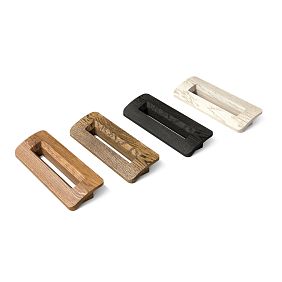
Inset handles (recessed)
Recess carved into the top or bottom of the front panel, forming a cavity into which fingers are inserted to open. The handle does not protrude above the furniture surface — it is inset.
Construction: surface-mounted bowl (wooden element shaped like a bowl, attached to the front panel from below), routed bowl (recess directly carved into the front panel — no wooden handle needed, but the recess is often decorated with a wooden overlay).
Sizes: length 80-200 mm, recess depth 15-40 mm.
Advantages: minimalist appearance (handle does not protrude, front panel looks flat and clean), do not obstruct passage (no risk of catching clothing or bags), modern style.
Disadvantages: less convenient than brackets (need to insert fingers into the recess and pull — not everyone likes it), not suitable for vertical doors (bowl works only on horizontal elements — drawers, hinged doors).
Application: modern minimalist kitchens, Scandinavian-style furniture, Japanese interiors (where minimalism and absence of protruding elements are valued).
Price: oak wooden bowls 128 mm long — 300-900 rubles each.
Ring handles
Ring (round or oval), suspended from a small rose, mounted on furniture. Classic element of antique furniture, chests from the 18th-19th centuries.
Construction: rose (round or decorative plate mounted to the front panel), ring (hangs freely on the rose, can be wooden or metal).
Sizes: ring diameter 60-120 mm, rose diameter 40-80 mm.
Advantages: classic noble appearance (associated with antiques, palace furniture), comfortable grip (ring can be grasped with the whole palm or several fingers).
Disadvantages: protrude far (ring hangs down 50-80 mm), may obstruct or rattle when moving, not suitable for modern minimalist interiors (too decorative).
Application: classic chests, buffets, baroque, empire, Victorian-style furniture; Provence, country-style furniture (with aged effect).
Price: wooden roses with metal rings — 500-1500 rubles each, fully wooden (rare) — 800-2500 rubles each.
Integrated handles (profiled)
Handle that is part of the front panel construction — protruding edge, special profile, to which one can grasp.
Construction: front panel has a protruding part (strip, profile), which is grasped to open. Wooden handle is a routed or glued element continuing the front panel.
Advantages: minimalist appearance (handle is not separate from the front panel, forms a single unit), modernity, convenience (can be grasped anywhere along the handle's length).
Disadvantages: complex manufacturing (requires precise routing or carpentry work), design limitation (handle shape is determined by front panel shape).
Application: modern minimalist kitchens, high-tech style furniture, Scandinavian minimalism, Japanese style.
Price: integrated handles are usually manufactured together with front panels to order and are not sold separately.
Wood species for furniture handles
Oak: the standard of strength
Oak — a hard, dense wood (density 700 kg/m³), the king of furniture production. Oak handles are the standard of quality, strength, and longevity.
Advantages: maximum strength (can withstand any load, do not break or crack), longevity (last decades without loss of quality), expressive texture (clear growth rings, beautiful pattern), noble shades (from light straw to dark brown depending on staining), prestige (oak is associated with quality and luxury).
Tactility: oak is dense, smooth after polishing, pleasant to the touch. The texture is felt by fingers (light roughness from pores), creating grip with the palm.
Application: handles for premium furniture, classic kitchens, chests, oak solid wood cabinets (handles matching the furniture color).
Price: oak handle-eyes with 128 mm center-to-center — 600–1500 rubles per piece, oak knobs with 40 mm diameter — 300–800 rubles per piece.
Ash: light strength
Ash — similar in hardness to oak (density 700 kg/m³), but lighter with a grayish tint. Texture is expressive, similar to oak, but softer and calmer.
Advantages: strength comparable to oak, visually lighter (light tones create a sense of lightness and airiness), stains well, price 15–25% lower than oak.
Tactility: similar to oak — dense, smooth, pleasant.
Application: handles for modern and Scandinavian interiors (light tones), ash furniture, light-colored kitchens.
Price: ash handle-eyes with 128 mm center-to-center — 500–1200 rubles per piece.
Beech: uniform classic
Beech — dense wood (density 650 kg/m³) with fine, uniform texture, pink or yellowish-white color.
Advantages: sufficient strength, fine uniform texture (creates a calm, uniform appearance without large contrasts), stains and paints well (uniform structure ensures even coloring), price 30–40% lower than oak.
Tactility: beech is smooth, silky after polishing, very pleasant to the touch. Texture is almost imperceptible (fine pores), surface appears uniform.
Application: handles for mid-range classic furniture, painted handles (beech is ideal for painting), beech furniture.
Price: beech handle-eyes with 128 mm center-to-center — 400–1000 rubles per piece.
Walnut: elite beauty
Walnut — premium wood, beautiful texture with brown tones and wavy lines, medium hardness (density 600–650 kg/m³).
Advantages: unique texture (each handle is an artwork with an unmistakable pattern), noble brown tones (from light brown to chocolate), prestige (walnut is one of the most valuable furniture materials).
Tactility: walnut is dense but not hard, smooth, warm to the touch. Texture is expressive, felt by fingers.
Application: handles for elite furniture, classic interiors, offices, libraries, walnut furniture.
Price: walnut handle-eyes with 128 mm center-to-center — 1000–2500 rubles per piece.
Birch: light accessibility
Birch — medium-hardness wood (density 650 kg/m³), light, with fine uniform texture, common in Russia and Scandinavia.
Advantages: affordable price (40–50% cheaper than oak), light color (from white to cream), uniform texture (good for painting and staining), traditional for Russian and Scandinavian furniture.
Tactility: birch is smooth, pleasant, but less dense than oak (surface slightly softer, porous).
Application: handles for Scandinavian interiors, light furniture, budget projects, painted handles.
Price: birch handle-eyes with 128 mm center-to-center — 300–800 rubles per piece.
Exotic woods: wenge, teak, mahogany
Exotic tropical species — very hard, with unique shades and textures.
Wenge: dark chocolate-black color, large contrasting texture, very hard. For modern luxury interiors, contrasting compositions.
Teak: golden-brown color, oily texture (teak contains natural oils making it moisture-resistant), very durable. For colonial and yacht-style furniture.
Mahogany (red wood): reddish-brown color, noble texture, traditional species for luxury furniture. For classic luxurious interiors.
Price: handles from exotic species 1200-3500 rubles/piece (exclusive segment).
Ergonomics of wooden handles
Ergonomics — the science of comfort, how the shape of an object corresponds to the form and movements of the human body. For furniture handles, ergonomics is critical — you touch them dozens of times a day; an uncomfortable handle creates discomfort and hand fatigue.
Handle bracket diameter and profile
Round brackets: optimal diameter for comfortable grip — 18-25 mm. Less than 18 mm — presses on fingers (thick door, requires strong pulling, thin handle digs into fingers). More than 25 mm — inconvenient to grip (palm cannot close around handle, weak grip).
Oval brackets: more ergonomic than round ones. An oval with dimensions 20×30 mm distributes pressure over a larger palm area, applies less pressure, more comfortable for prolonged use (relevant for kitchens, where cabinets are frequently opened).
Rectangular brackets: less ergonomic (sharp edges may press), but visually more modern and minimalist. Require rounded corners (minimum radius of 3-5 mm).
Handle projection
Projection — distance from the front surface to the center of the handle, determining grip comfort.
For brackets: optimal projection 30-40 mm (enough to fit four fingers around the handle without touching the front with knuckles). Less than 25 mm — fingers press against the front (uncomfortable, painful with strong grip). More than 50 mm — handle protrudes far (obstructs, catches clothing).
For knobs: optimal projection 25-35 mm (enough to grip with fingertips without touching the front). Less than 20 mm — difficult to grip. More than 40 mm — knob protrudes, obstructs.
Shape and curves
Anatomical curves: best brackets have a slight curve matching the palm shape (gentle arch upward or S-profile). This creates ideal hand fit, evenly distributes load, reduces fatigue.
Straight brackets: universal, suitable for gripping with either hand (left or right), but less ergonomic than anatomical ones.
Surface texture
Smooth polished: visually attractive, pleasant to the touch, but may be slippery with wet hands. Optimal for chests and bedroom/living room wardrobes (where hands are usually dry).
Matte (oil, wax): creates slight roughness, improves grip on palm. Optimal for kitchens (where hands are often wet) and bathrooms.
Textured (brushed): surface with emphasized texture (soft fibers removed, hard ones remain — creating relief). Provides maximum grip, but less smooth. Suitable for loft and rustic interiors.
Design and styles of wooden handles
Classicism and neoclassicism
Classic handles: decorative brackets with curves, knobs, relief; knobs with threading (vegetal motifs, rosettes); ring-shaped handles on carved rosettes. Species — oak, walnut, mahogany. Finish — natural lacquer (highlighting texture) or toning in dark noble tones (walnut, stained oak), sometimes gold patina.
Sizes: medium and large (brackets between centers 128-256 mm, knobs diameter 40-60 mm) — classic style values monumentality.
Neoclassic: simplified classic forms (rounded brackets without excessive relief, simple knobs), often light (white oak, bleached ash) or painted white or light gray. Sizes medium (brackets 96-160 mm, knobs 35-50 mm).
Scandinavian style
Simple minimalist handles — straight or slightly curved round or oval brackets, small round knobs. Species — light (birch, ash, light oak). Finish — natural oil (highlighting texture, creating matte surface) or white paint.
Sizes: small and medium (brackets 64-128 mm, knobs 25-40 mm) — Scandinavian style values simplicity and lightness.
Features: ergonomics, functionality, absence of ornamentation, naturalness.
Provence and country
Handles from natural wood with emphasized texture, simple shapes (straight brackets, round or oval knobs), often with aging effects (scratches, patina, cracks). Species — pine, linden, oak. Finish — white or pastel paint (cream, beige, blue, lavender, olive) with artificial aging (patina, scratches on protrusions), or natural oil with wax effect.
Sizes: medium (brackets 96-160 mm, knobs 35-50 mm).
Features: coziness, romanticism, vintage charm, connection to nature.
Minimalism and modernity
Sizes: often large (brackets 160-800 mm — long horizontal strips across the full width of the facade), or conversely very small (miniature buttons, almost invisible).
Sizes: large, bulky (brackets 160-320 mm, buttons 50-70 mm) — loft appreciates bulkiness and industrial style.
Features: minimalism, clean lines, absence of decoration, functionality.
Loft and industrial
Rough wooden handles — thick round-profiled brackets (diameter 25-40 mm), heavy buttons, sometimes from unplaned boards with preserved bark and knots. Species — oak, beech. Finish — dark oil or staining (dark walnut, wenge, black), often brushing (emphasizing texture), partial burning (creates a black relief pattern).
Features: brutality, bulkiness, industrial style, deliberate roughness.
Characteristics: brutality, massiveness, industrial style, deliberate roughness.
Modern
Smooth curved lines, asymmetry, organic shapes (resembling natural forms — branches, leaves, waves). Brackets with wavy bends, buttons shaped like stylized flowers or leaves. Species — walnut, oak, exotic. Finish — natural lacquer or toning in mid-tones.
Sizes: medium (brackets 128-192 mm, buttons 40-60 mm).
Features: smoothness, organic nature, absence of straight lines and sharp angles.
Mounting furniture handles
Marking
For brackets: determine the center-to-center distance of your handle (measure the distance between mounting hole centers on the handle). Mark two points on the facade with the same distance between them. Use a template (cardboard with two holes at the required distance) or a ruler and pencil. Check for levelness (points must be on the same horizontal line — use a level or ruler).
For buttons: mark one point at the center of the location where the button will be installed.
Installation height: for drawers — usually centered vertically; for doors — at a convenient grip height (typically 100-120 cm from the floor for upper kitchen cabinets, 80-100 cm for lower ones).
Drilling holes
Drill bit diameter: equal to the handle screw diameter (usually 4-5 mm for standard furniture screws). If the facade is thick (over 20 mm), you can drill a hole 0.5-1 mm larger than the screw diameter (the screw fits freely without splitting the wood).
Depth: through-hole (drill through the facade — the screw passes through the facade and is screwed into the handle’s thread from the inside). Or blind hole (drill to the depth of the screw length minus the handle thickness — the screw is screwed into the facade, and the handle is held by the screw).
Technique: drill perpendicular to the surface (use a guide or drill press for accuracy). Drill carefully from the front side to avoid chipping (place a wooden board under the facade — when the drill bit exits, it will enter the board, preventing chipping on the back side of the facade).
Fastening
For brackets: insert screws into the holes from the inside of the facade, slide the handle onto the screws from the front, and tighten the nuts (supplied with the handle) or screw the screws into the handle’s thread (depending on the construction). Tighten, but do not over-tighten (wood may crack).
For buttons: insert the screw into the hole from the inside, screw the button onto the screw from the front. Tighten.
Check: the handle should sit firmly, not wobble or rotate. If there is play, tighten the screws.
Care for wooden handles
Regular cleaning: wipe once a week with a dry soft cloth, removing dust and dirt.
Wet cleaning: wipe once a month with a slightly damp (well wrung out) cloth and a mild cleaning agent (liquid soap, wood cleaner). Do not soak excessively (especially in the kitchen — water may get into the joint between the handle and facade, causing wood swelling).
Protection from grease (for kitchen use): on the kitchen, handles quickly accumulate grease (from hands, cooking vapors). Use a grease remover (special furniture cleaner or vinegar solution 1:10), wipe the handles, then dry thoroughly.
Finish renewal: after 5-10 years (for lacquer) or 3-5 years (for oil) the finish wears out — dulls, scratches, and in places wears off. For lacquered handles — lightly sand with fine-grit sandpaper (320-400 grit), removing the top layer, apply fresh lacquer with a brush, let dry. For oiled handles — clean off dirt, wipe with white spirit (degrease), apply oil with a cloth, let absorb 15-30 minutes, wipe off excess, let dry 12-24 hours.
Repair: minor scratches — mask with a wax pencil in wood tone or a touch-up marker; deep scratches — fill with wood putty in matching tone, sand smooth, then apply lacquer or oil.
Where to buy wooden furniture handles
Furniture hardware manufacturers
Wooden furniture handleBuy directly from the manufacturer — lower price (no intermediaries), wide selection of models, species, finishes, possibility to order custom handles based on sketches.
Specialized furniture hardware stores
Stores selling hinges, guides, handles, and other hardware. Wide selection, can see and feel in person, evaluate ergonomics.
Construction hypermarkets
Leroy Merlin, OBIS, MaxiDom have furniture hardware sections with handles. Medium selection (standard models), medium prices, convenient immediate purchase.
Online stores
Extremely wide selection, convenient ordering, delivery. Minus — can’t feel (tactility is critical for handles). Study photos from different angles, read descriptions of dimensions and ergonomics, order samples.
Carpentry workshops
For exclusive hand-carved handles — contact master carvers. Individual design, uniqueness, handmade. Production time 2–6 weeks, price is high (carved handle 1500–5000+ rubles per piece).
Conclusion: touch creates connection
A furniture handle is the point of contact between a person and an object. Dozens of touches per day. And each touch should be pleasant, comfortable, evoking positive emotions.
A wooden handle creates this connection. Warm wood, smooth surface, perfect curve, unique texture — everything works for comfort and enjoyment of use. Furniture with wooden handles becomes not just a functional object, but part of a cozy home, a space with soul.
Company STAVROS — leading manufacturerfurniture handlesMade from solid wood with over 25 years of experience, we offer professional solutions for any furniture and style: solid wood handles in oak, ash, beech, walnut — over 100 models of all sizes, from miniature 64 mm to massive 800 mm, all profiles — round, oval, rectangular, shaped, anatomical with curves, classic, modern, minimalist, loft, rustic; button handles — over 80 models with diameter from 25 to 60 mm, all shapes — round, oval, mushroom-shaped, square, shaped, carved, smooth, textured; inset handles — 30 models, 80–200 mm long, for modern minimalist kitchens; ring handles — classic with wooden rose petals and metal or wooden rings for antique furniture, chests, buffets; hand-carved handles — unique elements with plant and geometric ornaments per individual sketches — price 1500–5000 rubles per piece.
All STAVROS handles are made from premium-grade solid wood with 8–12% moisture content after long-term kiln drying (guarantee of dimensional stability, absence of warping, cracking). Production is carried out on modern 3D milling equipment with CNC, ensuring perfect accuracy of ergonomic profiles (tolerance no more than 0.1 mm), smooth surface without roughness or burrs. Each handle undergoes multi-stage manual sanding (5 stages with sandpaper from grit 120 to 400), creating a silky surface pleasant to the touch.
Handle finishing is done with premium-grade professional compounds: natural Osmo Biofa oils are absorbed into the wood, enhancing the texture, creating a matte silky surface, providing protection against moisture and dirt, renewed every 5–8 years; German Hesse Lignal and Italian Sirca lacquers create a durable, long-lasting coating (lasts 10–15 years) with even gloss — glossy, semi-gloss, matte; staining with hundreds of shades from light bleached oak to black ebony; painting with enamels in any RAL color — white, black, gray, colored; patination — artificial aging for Provence, country styles; brushing and texturing for loft, rustic interiors.
STAVROS provides a full range of services: professional designer consultation to help select handles matching your furniture style and ergonomic requirements, precise calculation of required handle quantities for kitchen, chest, cabinet, complete hardware kit (screws, nuts, washers — everything included), templates for drilling hole marking to simplify installation, detailed instructions with photos and videos, custom handle manufacturing in any size and shape per customer’s sketches — delivery time 2–6 weeks. Official 2-year warranty on all solid wood handles — we guarantee absence of manufacturing defects, warping, cracking, coating delamination.
Visit stavros.ru, browse the catalog with detailed photos, technical descriptions, ergonomic characteristics, order samples to test tactile quality at home, arrange delivery across Russia, or visit our showroom in Moscow where you can touch dozens of handle models, evaluate ergonomics and texture, receive professional consultations — and add perfection, comfort, individuality to your furniture with details that create pleasure from every touch, every day, for decades to come.