Article Contents:
- Wooden hardware: nature's warm touch
- Why wood?
- Where to use a wooden handle?
- How to choose a wooden handle: wood types and shapes
- MDF skirting: the invisible hero of a perfect interior
- What is MDF and why is it not a compromise?
- Types of MDF skirting: find your format
- Combining styles: wood + MDF = perfect pair
- Scandinavian lightness
- Modern classicism
- Eco-Style: Nature in an Urban Apartment
- Minimalism: less is more
- Practice: how to install and combine these elements
- Installing Wooden Handles
- Installing MDF skirting
- Painting MDF skirting
- Budget: calculating real savings
- Calculation example for a two-room apartment
- Where to buy quality items affordably
- Care and durability: an investment for years
- Care for wooden handles
- Caring for MDF skirting
- Eco-friendliness: caring for family health
- Natural wood - the key to a healthy atmosphere
- MDF: debunking myths
- Coatings and paints: choosing safe options
- Stylistic nuances: when wood is appropriate and when it's not
- Where wood is irreplaceable:
- Where to be cautious:
- Q&A: dispelling doubts
- Aren't wooden handles too fragile for intensive use?
- Can Wooden Handles Be Installed on Bathroom Furniture?
- Won't white MDF skirting turn yellow over time?
- Is it difficult to install MDF skirting yourself?
- Can MDF skirting be repainted to another color?
- How do oak handles differ from beech handles?
- Do wooden handles need to be coated with oil or varnish?
- Conclusion: small details make a big difference
- Why choose STAVROS?
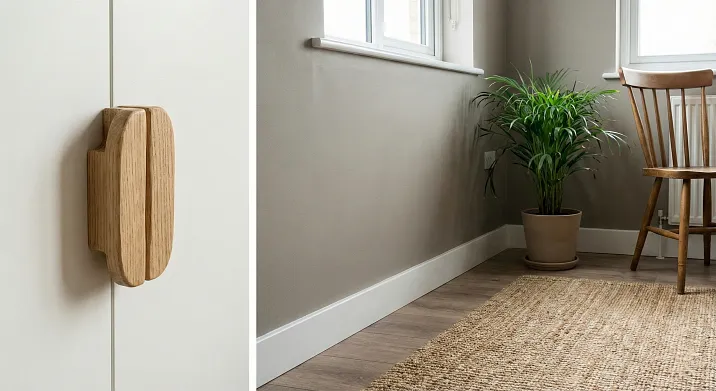
Why do some apartments look expensive and stylish, while others—despite significant investment—seem bland and random? The secret isn't in the price of materials, but in the ability to place the right accents. When the budget is limited but the soul craves beauty and eco-friendliness, two inconspicuous heroes of modern renovation come to the rescue:Wooden handleand MDF skirting boards. They might seem like small details. But precisely these elements can breathe life into an interior, provide a sense of natural warmth, and give the space a finished look.
Apartment renovation is always a balance between desires and possibilities. You want natural materials, but solid oak throughout the entire space costs a fortune. You want tactile pleasure, but ceramic tiles are cold and impersonal. And this is where wooden furniture handles and MDF skirting boards open up incredible opportunities: they are affordable, eco-friendly, look noble, and allow for the creation of unique style combinations. Let's explore how to skillfully use these elements so your home becomes not just a living space, but a place where you want to linger.


Wooden hardware: the warm touch of nature
Imagine: you return home after a long day, open a cabinet—and your fingers glide over a smooth, warm surface. Not cold metal, not slippery plastic, but natural wood. This small pleasure repeats dozens of times a day and subtly shapes your attitude toward your home. Wooden handles are not just functional elements; they are a philosophy of comfort.




Why wood?
In an era of total synthetics, returning to natural materials is not a tribute to fashion but a conscious need. Wood "breathes"; it is alive. It has texture, a unique pattern of growth rings, a light aroma. When you chooseWooden handlesfor your furniture, you literally bring a piece of the forest into your home. And this is not a metaphor—wood possesses amazing properties:
-
Antistatic: wood does not accumulate electricity, does not attract dust
-
Pleasant temperature: unlike metal, wooden products are always comfortable to the touch
-
Hypoallergenic: natural wood is safe for children and allergy sufferers
-
Durability: properly treated wood lasts for decades
-
Uniqueness: there are no two absolutely identical wooden elements
But can't you just buy plastic handles "wood-look"? You can. But you'll feel the difference instantly. Imitation remains imitation—cold, lifeless, devoid of the energy that realWooden items.
Our factory also produces:


Where to use a wooden handle?
The scope of application for wooden handles is broader than it might seem at first glance. They fit organically into a wide variety of projects:
Kitchen sets—here, a solid wood handle becomes an accent that unites modern appliances and traditional coziness. Wooden hardware looks especially advantageous on light-colored fronts—white, cream, pastel. The contrast of warm wood and cool white creates a graphic quality that designers highly value.
Dressers and wardrobes in the bedroom—here, tactility is important. When you open a drawer in the dim light of early morning, it's pleasant to touch not sharp metal but a rounded wooden surface. It's a small detail, but it's precisely such details that make up the quality of life.
Children's furniture—safety and eco-friendliness. Children touch everything, put things in their mouths, explore. Wooden handles contain no toxic additives, emit no harmful substances, and have no sharp edges. And most importantly—they teach a child to value natural, authentic things.
Bathroom—yes, even here! With proper treatment with oil or varnish, wood withstands humidity excellently. A wooden handle on an oak or beech cabinet transforms a utilitarian bathroom into a small spa.
Get Consultation
How to choose a wooden handle: wood types and shapes
Not every wood is suitable for furniture hardware. Dense hardwoods—oak and beech—are ideal. Why exactly these?
Oak—the king among trees. Hard, durable, with expressive texture. An oak handle withstands intensive use, does not deform, does not crack. Over time, oak does not lose its nobility—on the contrary, it acquires a special charm. The color palette of oak ranges from light honey to dark brown, allowing you to choose a shade for any interior.
Beech—a lighter and more uniform wood. Beech is easier to work with, so complex shapes are created from it. Beech handles are ideal for Scandinavian interiors, where minimalism and natural simplicity are valued. Moreover, beech is cheaper than oak, which is important for budget renovations.
As for shapes, the modern industry offers a huge variety. The STAVROS company's assortment includes classic rails, round knobs, oval shells, triangular geometric elements. Which one to choose?
-
For classic interiors: brackets, rails, rounded shapes
-
For minimalism: rectangular planks, thin lines
-
For Scandinavian style: round knobs, simple ovals
-
For eco-style: unvarnished handles with natural texture
Important point: wooden handles can be purchased either painted or in their natural state. If you plan to change the interior color scheme in the future, choose handles that are paintable or coated with clear oil—they are easy to update.
MDF Skirting Board: The Invisible Hero of a Perfect Interior
Now let's talk about what is rarely paid attention to when planning a renovation—skirting boards. Meanwhile, it is preciselyMDF Skirting Boardthat completes the look of a room, hides imperfections, protects walls from damage, and—importantly—creates a visual frame that 'holds' the entire space.
What is MDF and Why is it Not a Compromise?
MDF is not just a 'cheap substitute for wood.' It is a high-tech material made from fine wood fibers under high pressure and temperature. The result is a homogeneous board free from natural wood defects: knots, cracks, and structural inconsistencies.
Why is MDF Wooden Skirting a Smart Choice for a Budget Renovation?
Geometric stability—solid wood has a life of its own: it dries out, swells from moisture, and changes shape. MDF is stable. Install the skirting board—and it will remain straight for years.
Affordability—MDF skirting costs several times less than solid oak, while being practically indistinguishable in appearance after painting or laminating.
Eco-friendliness—modern MDF boards of class E1 or E0 contain minimal formaldehyde and are safe for living spaces.
Variability—— is a horizontal element that frames the room at the bottom of the walls where the wall meets the floor. Skirting boards perform several functions: they hide the technological gap between the wall and floor covering (necessary for thermal expansion), protect the lower part of the wall from mechanical damage, create visual completion, and may conceal wiring.allows for the realization of any designer's idea, to select the perfect shade to match the walls or floor.
Types of MDF Skirting Boards: Find Your Format
Skirting boards vary in height, profile, and finish type. How not to get confused in this diversity?
By height:
-
60-70 mm—for compact rooms with ceilings up to 2.7 meters. Visually, they do not overload the space and are suitable for modern minimalist interiors.
-
80 mm—the golden mean. A universal option for most apartments. Such aMDF skirting board 80reliably protects the wall, while not looking bulky.
-
100-120 mm—for high ceilings and representative spaces. A wide skirting board creates an effect of nobility, emphasizing the status of the room.
By profile:
-
Straight—ideal for high-tech and minimalism. Clean lines, no reliefs.
-
With a chamfer—an elegant bevel of the upper edge softens the transition from wall to skirting board.
-
Figurative—with classic coves and relief. A choice for traditional interiors.
Finishing:
-
Laminated—covered with a film that imitates wood. Ready for installation, does not require additional processing.
-
Painted—factory-painted in basic colors (white, black, brown).
-
Paint-ready—primed surface, ready for any color application. Maximum creative freedom!
Combining Styles: Wood + MDF = Perfect Pair
Now for the most interesting part—how to combine wooden handles and MDF skirting boards into a single composition? How to make a budget renovation look expensive and well-thought-out?
Scandinavian Lightness
Scandinavian style is a cult of simplicity, light, and naturalness. Here, white color dominates, diluted with natural textures. How to incorporate our elements?
-
ChooseWhite MDF Skirting Board—it visually expands the space, creating a sense of airiness.
-
Add wooden handles made of light beech with natural oil finish — they will add warmth.
-
Floor — light laminate or engineered wood in bleached oak color.
-
Furniture — white or light gray fronts with minimalist wooden knob handles.
Result: a light, airy space with natural accents. Budget-friendly? Yes. Stylish? Absolutely!
Modern classic
Classics never go out of style, but its modern interpretation is not baroque luxury, but restrained elegance. How to create such an interior?
-
Baseboards 100-120 mm high with a slight relief, painted in the wall color — create an effect of architectural integrity.
-
Wooden bracket handles made of oak with varnish coating — will emphasize the nobility of the furniture.
-
Color palette — beige, cream, soft gray with accents of dark wood.
-
Additional elements: wooden Casings in the same tone as the handles, possibly decorative MoldingsIn interiors, they function as connecting elements between
Such an interior looks expensive and respectable, although its foundation is affordable materials.
Eco-style: nature in an urban apartment
Eco-style — maximum natural materials, natural colors and textures. Here, a wooden handle and MDF baseboard feel right at home.
-
MDF baseboard for painting, tinted in the color of natural wood — creates the effect of wooden trim around the perimeter.
-
Wooden handles without coating or with natural oil — show all the beauty of the wood grain.
-
Floor — dark laminate or parquet with a pronounced wood pattern.
-
Walls — shades of green, sandy, terracotta. Live plants are a must!
-
Additions: wooden rails on the walls, woven baskets, natural textiles.
Such an apartment becomes an oasis of calm amidst the urban hustle.
Minimalism: less is more
Minimalism is a philosophy of liberation from the unnecessary. Here, every element must be functional and aesthetic at the same time.
-
MDF baseboard 60-70 mm with a straight profile, painted in the wall color — almost invisible, but performs its function.
-
Wooden bar handles of simple geometric shape, painted black or white — strictness and conciseness.
-
Color palette — black, white, gray, possibly one natural accent.
-
Furniture — smooth fronts without excess, built-in storage systems.
Here, the quality of execution is important: every detail is visible, and a poorly fitted baseboard or crooked handle will immediately catch the eye.
Practice: how to install and combine these elements
Theory is good, but how to move to practice? Let's look into installation and finishing.
Installation of wooden handles
Installing a wooden handle — a simple process but requiring precision. You will need:
-
Ruler or tape measure
-
Level (laser or bubble)
-
Drill with a thin drill bit
-
Screwdriver or power drill
-
Marking pencil
Step 1: Determine the optimal handle placement. For upper cabinets — near the bottom edge of the door, for lower ones — near the top. For drawers — in the center.
Step 2: Mark the spots. If the handle has two mounting points, measure the distance between the holes. Use a level to ensure the marks are strictly horizontal.
Step 3: Drill the holes. The drill bit diameter should be slightly smaller than the screw diameter. Important: drill from the front side to avoid laminate chipping on the exit.
Step 4: Insert the screws from the back side and screw on the handle. Do not overtighten — the wood may crack.
Pro tip: If installing many handles at once (e.g., on a kitchen set), make a template from cardboard or thin plywood. This speeds up the work and ensures uniform placement of all elements.
MDF skirting board installation
Installing skirting boards requires more attention, but with the right approach, even a beginner can handle it.
Preparation:
-
Clean the wall and floor from dust and debris
-
Check the wall evenness — if there are significant irregularities, it's better to level them with putty
-
Bring the skirting boards into the room 1-2 days before installation so the material acclimatizes
Attachment methods:
-
Adhesive method — suitable for perfectly even walls. Use liquid nails or mounting adhesive. Pros: fast, no visible fasteners. Cons: difficult to dismantle, not suitable for uneven walls.
-
Clip (cleat) mounting — a universal method. First, special brackets are attached to the wall, then the skirting board snaps onto them. Pros: can be removed and put back, hidden fastening. Cons: more expensive, requires more time.
-
Screws — traditional method. The skirting board is screwed through to the wall. Pros: reliable, suitable for uneven walls. Cons: screw heads are visible (they will need to be masked).
Working with corners:
Corners are the most difficult part of installation. For a quality joint, you need a miter saw or a good miter box. The cut is made at a 45° angle. Important: first measure the actual angle of the room — it may differ from the standard 90°!
After cutting, dry-fit the elements, check the joint. If necessary, adjust with sandpaper. Small gaps can be filled with acrylic sealant matching the skirting board color.
Painting MDF skirting board
If you boughtPaintable skirting board, a lot of possibilities open up for you. When to paint — before or after installation? There is no consensus, both methods have a right to exist.
Painting before installation:
Pros: convenient to paint all sides, no risk of staining the wall or floor.
Cons: the paint can be damaged during installation, joints will need to be touched up.
Painting after installation:
Pros: all joints and defects are immediately visible, they can be puttied and painted over. The final appearance is more uniform.
Cons: need to protect the floor and wall with painter's tape, inconvenient to paint relief areas.
Paint selection:
-
Acrylic — optimal for living spaces. Odorless, dries quickly, forms an elastic film.
-
Alkyd — more durable, but dries slowly and has a strong odor.
-
Polyurethane — maximum wear resistance, for high-traffic areas.
Painting technology:
-
If painting after installation, tape off the joint with the wall and floor with painter's tape.
-
Apply primer (if the skirting board is not primed). Let it dry.
-
Apply the first coat of paint thinly, with a roller or brush. Move along the skirting board to avoid drips.
-
After drying (usually 2-4 hours), apply the second coat.
-
For a perfect result, you can add a third coat.
-
Carefully remove the painter's tape before the paint is completely dry.
Color solutions:
-
In the color of the walls — the baseboard 'dissolves,' making the space appear taller.
-
In the color of the floor — visually expands the room.
-
Contrasting — the baseboard becomes a decorative element. Black on a white background is a minimalist classic.
-
Accent — a bright color for creative personalities (but be careful, trends change).
Budget: calculating real savings
Let's be honest: how much does it cost to beautifully renovate an apartment using wooden handles and MDF baseboards? And how much cheaper is it than premium alternatives?
Calculation using a two-room apartment as an example
Initial Data:
-
Area: 55 m²
-
Perimeter: approximately 30 meters (accounting for doorways)
-
Kitchen set: 12 doors and 6 drawers
Option 1: Premium (solid oak + expensive baseboard)
-
Solid oak baseboard 80 mm: 30 m × 1200 rub/m = 36,000 rub
-
Premium oak handles: 18 pcs × 800 rub = 14,400 rub
-
Installation: 15,000 rub
-
Total: 65,400 rub
Option 2: Reasonable (MDF + STAVROS wooden handles)
-
MDF baseboard 80 mm for painting: 30 m × 300 rub/m = 9,000 rub
-
Paint and consumables: 2,000 rub
-
Beech wooden handles: 18 pcs × 400 rub = 7,200 rub
-
DIY installation: 0 rub (or 8,000 rub if hiring a professional)
-
Total: 18,200 rub (or 26,200 rub with installation)
Savings: from 39,200 to 47,200 rubles!
At the same time, the visual difference will be minimal, especially if the baseboard is painted well and the handles are treated with oil or varnish. Almost 50 thousand rubles — that's additional household appliances, a good sofa, or quality textiles. That is, the money saved on baseboards and handles can be invested in other interior elements.
Where to buy quality and inexpensive
When it comes to elements such asFurniture handles woodenand MDF baseboards, it's important to find a reliable supplier. STAVROS specializes in the production ofof solid woodoak, beech, and MDF. All products are manufactured on modern equipment with adherence to wood drying and processing technologies.
Advantages of buying from the manufacturer:
-
Warehouse program — no need to wait for production, shipping from 1 day
-
Orders from 1 piece — convenient for small projects or test purchases.
-
Wide assortment — 32 models of handles in various shapes, numerous skirting board profiles.
-
Quality wood — moisture content 8±2%, which guarantees product stability.
-
Delivery across Russia — to any region, including Moscow, Saint Petersburg, and remote cities.
Care and durability: an investment for years.
Buying quality materials is half the job. It's important to care for them properly so they last for many years.
Care for wooden handles
Wood is a living material and needs care:
-
Regular wiping — wipe handles once a week with a slightly damp soft cloth. Do not use abrasives!
-
Coating renewal — if handles are oiled, you can refresh the coating once every year or two. Lightly sand the surface with fine sandpaper (P320-P400), remove dust, apply a thin layer of wood oil. After 15-20 minutes, wipe off excess.
-
Protection from moisture — if handles are installed in the bathroom or kitchen near the sink, ensure water does not stagnate on the surface. Wipe splashes immediately.
-
Avoid aggressive chemicals — chlorine-containing products, solvents, acetone can damage the protective coating and ruin the wood.
MDF skirting board care
Painted skirting boards are low-maintenance, but a few rules should be followed:
-
Dry or slightly damp cleaning — use microfiber or a soft cloth. Avoid excessive wetting.
-
Protection from mechanical damage — a vacuum with a hard brush, careless furniture movement can leave scratches. Be careful when cleaning.
-
Touch-up — if chips or scratches appear, they are easy to mask. Sand the damaged area, apply primer, then paint matching the main coating color.
-
Moisture protection — if the skirting board is installed in the bathroom or kitchen, check the seal of the joints. Water should not get under the skirting board.
With proper care, wooden handles and MDF skirting boards will last 10-15 years or longer, maintaining an attractive appearance.
Eco-friendliness: caring for family health
In the modern world, more and more people are thinking about the eco-friendliness of their homes. Synthetic materials emit volatile compounds, plastic accumulates static electricity, cheap furniture made from chipboard 'leaks' formaldehyde. How to avoid these problems?
Natural wood — the key to a healthy atmosphere
Wooden handle— is not just beautiful, it's safe. Oak and beech do not emit toxic substances, are hypoallergenic, and have natural antiseptic properties. Wood 'breathes,' participating in the natural regulation of indoor humidity.
MDF: debunking myths
Many people fear MDF, considering it 'chemical.' This is a misconception. Quality MDF of class E1 or E0 contains minimal amounts of binding resins — less than many natural materials. Moreover, after painting, the board is completely sealed, and any, even theoretically possible, emissions are eliminated.
Important: buy materials from trusted manufacturers, request quality certificates. STAVROS company uses only certified raw materials that meet European safety standards.
Coatings and paints: choosing safe ones
Even the most eco-friendly materials can be ruined by toxic paint. For interior work, choose:
-
Water-based acrylic paints — solvent-free, virtually odorless
-
Oils and waxes for wood — natural compositions based on linseed oil, beeswax
-
Eco-friendly varnishes — with markings 'for children's toys' or 'for food contact'
Avoid cheap paints with a strong odor, old-style alkyd compositions, nitro varnishes. Health is more important.
Stylistic nuances: when wood is appropriate, and when it is not
Wooden elements are universal, but they also have limits of application. Let's honestly discuss where they work 100%, and where it's worth looking for alternatives.
Where wood is irreplaceable:
-
Eco-interiors — here wood is an absolute must-have
-
Scandinavian style — without light wood it is unthinkable
-
Country, Provence — rustic styles require natural materials
-
Modern classic — wood adds nobility
-
Children's rooms — eco-friendliness and safety
Where to be cautious:
-
Hi-tech — here metal, glass, plastic dominate. Wood may stand out from the concept (although as a contrasting accent — quite appropriate)
-
Futurism — natural materials go against the idea of 'space-age future'
-
Industrial style (loft) — here wood is used, but in a rough, untreated form. An elegant beech handle may seem too 'homely'
However, rules are made to be broken. A competent designer can incorporate wooden elements even into hi-tech, creating an interesting mix of styles.
Questions and answers: dispelling doubts
Aren't wooden handles too fragile for intensive use?
No, if the right species is chosen. Oak and beech are hardwoods; they withstand much greater loads than it seems. Handles made from these species last for decades under intensive use. The main thing is proper installation: do not overtighten the screws to avoid splitting the wood.
Can wooden handles be installed on bathroom furniture?
Yes, but with caveats. The wood must be treated with a moisture-resistant composition — oil, varnish, or wax. Avoid constant contact with water. If the handle is installed on a cabinet away from the shower area — there will be no problems.
Won't a white MDF baseboard turn yellow over time?
Quality paint does not yellow. Yellowing is possible if cheap alkyd enamel was used or if the baseboard is installed in a place with constant exposure to ultraviolet light (for example, under a window on the sunny side). Acrylic paints and polyurethane enamels retain color for years.
Is it difficult to install MDF baseboard yourself?
If you have minimal skills with tools — no. You will need: a miter saw or miter box, a drill (if attaching with screws), a level, a tape measure. The most difficult part is neatly cutting the corners. If you are not confident in your abilities, invite a professional — installing baseboard in a two-room apartment takes 4-6 hours of work.
Can MDF baseboard be repainted a different color?
Of course! This is one of the main advantagesMDF skirting boards for painting. If you get tired of the color — just lightly sand the surface, apply primer and a new coat of paint. The baseboard will be like new!
How do oak handles differ from beech handles?
Oak is darker, with a more pronounced texture, harder and more expensive. Beech is lighter, with a uniform structure, easier to work with, cheaper. In terms of strength, both species are excellent for furniture hardware. The choice depends on the interior's color scheme and budget.
Do wooden handles need to be coated with oil or varnish?
It depends on the condition you bought them in. If the handles already have a factory finish — additional treatment is not needed. If you bought unfinished handles — yes, they definitely need protection. Oil gives a matte surface and emphasizes the wood grain. Varnish creates a glossy protective film.
Conclusion: small details make a big difference
Let's end where we began: with the question of why some interiors are memorable while others are not. It's all in the details. In what you feel when you touchwooden handle. In how the baseboard neatly frames the space, creating a sense of completeness. In how natural materials create a special atmosphere that can't be bought with money—it can only be created.
A budget renovation doesn't mean sacrificing beauty and quality. It's about knowing how to prioritize, choosing reasonable alternatives without compromising on what matters most.Wooden baseboardMDF fronts and handles made of solid oak or beech are not a compromise but a thoughtful solution that saves money while creating an interior you'll love living in.
Start small. Order a few handles, try installing them yourself. Choose a baseboard, paint it your favorite color. You'll see how the space transforms. How a cold, impersonal apartment turns into a warm home. And you'll understand: you don't need to spend millions to live beautifully. Sometimes, a few well-chosen accents are enough.
Why choose Stavros?
When it comes to creating your dream home, every element matters. For over 20 years, STAVROS has specialized in producing high-qualityproducts made from solid wood and MDF. The production facilities in St. Petersburg are equipped with modern European equipment, ensuring products that meet the strictest quality standards.
In the STAVROS range, you'll find over 4000 items: fromfurniture handlestobaseboards—moldingtocrown moldings. All products are made from select oak and beech wood, dried to an optimal moisture content of 8±2%, guaranteeing product stability throughout their entire lifespan.
Advantages of working with STAVROS:
-
Warehouse program with shipping from 1 day
-
Order from 1 piece
-
Delivery throughout Russia and CIS countries
-
Professional technical support
-
Quality guarantee on all products
-
Custom manufacturing of non-standard products
When you choose STAVROS, you're not just choosing materials—you're choosing a reliable partner in creating a home that will bring you joy for years to come. A home where every detail is thoughtfully designed, where naturalness isn't a luxury but the norm, where quality is felt in every touch.
Start transforming your interior today—discover the world of natural materials and thoughtful design with STAVROS!