












































































Article Contents:
- Rosette as an architectural principle
- Centrality and symmetry
- Scale and perception
- Flat and three-dimensional carving
- Ceiling rosettes: composition centers
- Ceiling rosette under a chandelier
- Rosettes in coffered ceilings
- Rosettes in ceiling corners
- Wall rosettes: panel and framing centers
- Furniture rosettes: corner and central accents
- Corner rosettes on facades
- Central rosettes on facades
- Rosettes on furniture legs and pilasters
- Rosettes on drawer fronts
- Door rosettes: decoration of panels and frames
- Rosettes in the center of panels
- Rosettes in door panel corners
- Rosettes on door casings
- Rules for scaling rosettes
- Rule of viewing distance
- Rule of proportion to the framed surface
- Rule of size hierarchy
- Combining rosettes with other decorative elements
- Rosettes and moldings: framing and center
- Rosettes and cornices: vertical coordination
- Rosettes and carved appliqués: ornamental interplay
- Rosettes and pilasters: capitals and bases
- Materials and manufacturing technologies for decorative rosettes
- Solid wood rosettes
- Threaded MDF rosettes
- Polyurethane Rosettes
- Material selection based on application
- Installation and finishing of wooden rosettes
- Surface Preparation
- Adhesive mounting
- Combined installation: adhesive + fasteners
- Finishing after installation
- Frequently Asked Questions
- What diameter rosette to choose for a ceiling height of 3 meters?
- Can rosettes be used in modern minimalist interiors?
- How to secure a heavy wooden rosette to the ceiling?
- Should all rosettes in an interior be identical?
- How to combine wooden rosettes with polyurethane moldings?
- Can wooden rosettes be patinated?
- Where should wooden rosettes not be used?
- How to calculate the number of rosettes for a room?
- How much do quality wooden rosettes cost?
- Where to buy wooden rosettes for interiors?
- Conclusion: rosette as a philosophy of accent
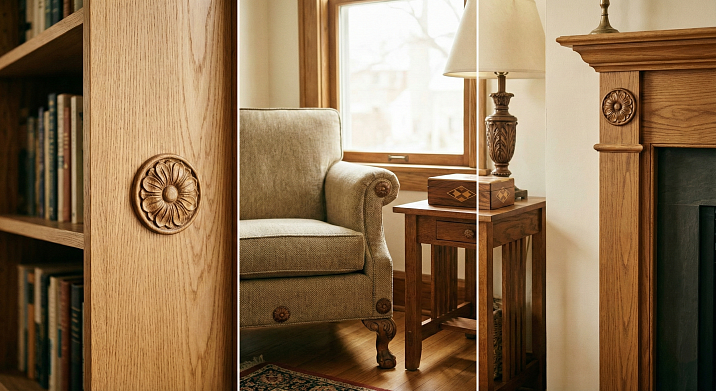
Accent. A point that draws the eye, organizes the space around it, and transforms a neutral surface into a composition. In classical interiors, this accent becomes the rosette—a carved decorative element, most often round or oval in shape, with a symmetrical pattern.Decorative RosettesWooden rosettes are not just decoration; they are a compositional center, a reference point around which the visual logic of the ceiling, wall, or furniture facade is built.
Why rosettes specifically? Because they possess centrality—the pattern radiates from the center to the edges, creating a visual emanation that attracts attention. Because they are compact—they occupy a small area but create a powerful visual effect. Because they are universal—suitable for ceilings, walls, furniture, doors, and stairs, creating stylistic unity across diverse applications.
In this article, we will explore the world of wooden rosettes: where to use them, how to scale them, and how to combine them with other elements. We will see how a single small rosette transforms a ceiling, how corner rosettes on furniture turn a simple facade into a work of art, and how rosettes on doors create a visual connection with the architecture. We will discuss the rules that turn a decorative element into a tool for creating harmony.



Rosette as an architectural principle
The rosette is an ancient decorative motif, known since the era of Ancient Egypt, where a stylized lotus flower adorned temples, tombs, and pharaohs' furniture. The Greeks transformed the lotus into acanthus, the Romans added palmettes, the Byzantines complicated the ornament, turning the rosette into a symbol of heavenly perfection. In Gothic cathedrals, stone rosettes (round windows with intricate tracery) became dominant features of facades, points of light organizing the space.




Centrality and symmetry
A rosette is built from the center. This distinguishes it from borders, friezes, and moldings, which are linear and develop along an axis. A rosette is a point from which the ornament radiates outward, creating circular symmetry.
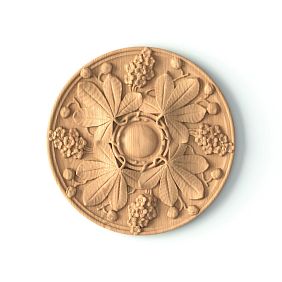
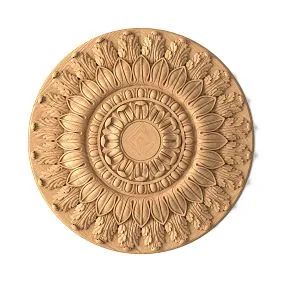
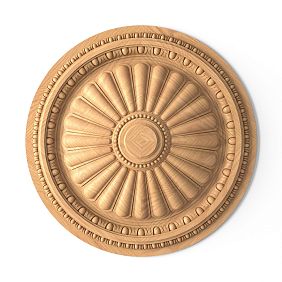
The center of a rosette can be simple (a circle, sphere, bud) or complex (a multi-petaled flower, intertwined scrolls). Elements radiate from the center: petals, leaves, volutes, scrolls, arranged symmetrically relative to radii. The number of elements is often a multiple of numbers with symbolic meaning: 4 (cardinal directions), 6 (harmony), 8 (infinity), 12 (completeness).
The centrality of a rosette makes it an ideal accent. The eye automatically fixes on the center, perceives the symmetry, and senses completeness and harmony. A rosette does not require additions—it is self-sufficient, but works excellently in compositions where it becomes a focal point.
Our factory also produces:



Scale and perception
Rosettes can be miniature (30-60 mm in diameter) or monumental (300-600 mm and larger). Scale determines application and perception.
Small rosettes are details, accents on furniture, corners, and doors. They are viewed from a close distance (0.5-2 meters), revealing the nuances of carving and the fineness of workmanship. Small rosettes create a sense of jewelry-like quality, sophistication, and attention to detail.
Medium rosettes (diameter 100-200 mm) are universal and work at a distance of 2-4 meters. They are used on walls, doors, and large furniture fronts. Medium rosettes are visible, recognizable, create an accent without overloading the space.
Large rosettes (diameter 250-600 mm) are architectural elements, centers of ceiling compositions, and dominants of wall panels. They are perceived from a distance of 4-8 meters, where the overall shape and silhouette are seen without distinguishing small carving details. Large rosettes create monumentality, solemnity, and a palatial scale.
Get Consultation
Flat and three-dimensional carving
Rosettes are made using two carving techniques:
Bas-relief carving — the ornament protrudes above the background by 3-8 mm. The background is cut away, and the ornament remains on the original plane or slightly protrudes. Bas-relief rosettes are light, delicate, and suitable for interiors where decor should be noticeable but not dominant.
Three-dimensional (deep-relief) carving — the ornament protrudes by 10-25 mm or more, with elements modeled in volume and worked from all sides. Three-dimensional rosettes are heavy (visually and physically), dramatic, create deep shadows, and a rich play of light. Suitable for Baroque, Empire styles where opulence is valued.
The choice of technique depends on the interior style and viewing distance. On a ceiling 3.5-4 meters high, a bas-relief rosette gets lost — deep carving is needed to create contrasting shadows. On a furniture front viewed from a meter away, bas-relief carving is sufficient to appreciate the details.
Rosettes on the ceiling: centers of compositions
The ceiling is the fifth wall, often forgotten in decoration. Meanwhile, it is the ceiling that completes the space, creates a sense of height or intimacy, emptiness or fullness. A ceiling rosette is a classic technique that transforms a bland plane into an architectural object.
Ceiling rosette under a chandelier
The most common use of a large rosette is the center of the ceiling where a chandelier hangs. The rosette frames the chandelier's mounting point, visually enhances its presence, and creates a transition between the massive light fixture and the ceiling plane.
Without a rosette, the chandelier seems to hang in a void; its mounting looks technical, not decorative. The rosette creates a pedestal, a base from which the chandelier grows organically. The rosette's ornament (acanthus leaves, petals, scrolls) visually supports the chandelier's decor (if it is classic with botanical motifs).
The diameter of a ceiling rosette under a chandelier is determined by the size of the light fixture and the ceiling height. Rule: the rosette diameter is 0.5-0.7 of the chandelier's diameter (measured at the outermost points of the arms). If the chandelier is 80 cm in diameter, the rosette is 40-55 cm. Smaller — the rosette gets lost under the chandelier; larger — it extends beyond the edges, creating dissonance.
For high ceilings (from 3.5 meters), rosettes should be larger: diameter 50-80 cm, carving depth 20-30 mm. For standard ceilings (2.7-3.2 meters) — diameter 35-60 cm, depth 12-20 mm. Proportions are critical: a too-large rosette on a low ceiling feels oppressive and visually lowers the plane even further.
Rosettes in coffered ceilings
A coffered ceiling is a system of recessed panels (coffers) framed by beams or moldings. A classic technique for decorating coffers is placing a rosette in the center of each. Rosettes transform coffers from technical elements into decorative ones, adding richness and rhythm.
The size of rosettes in coffers depends on the size of the coffers themselves. Rule: the rosette diameter is 0.4-0.6 of the coffer's width. If a coffer is 60x60 cm, the rosette diameter is 25-35 cm. The rosette should be visible but not touch the coffer's frame, leaving margins at the edges.
All rosettes in a coffered ceiling are identical (same ornament, same size), creating a regular rhythm. Exception — the central coffer (under the chandelier), where the rosette can be larger and more complex, establishing a hierarchy: the main rosette in the center, secondary ones around the perimeter.
The ornament of rosettes in coffers should be coordinated with the profile of the framing beams or moldings. If moldings have acanthus, rosettes have acanthus. If moldings have geometric ornamentation, rosettes are geometric. This creates stylistic unity and a thoughtful composition.
Rosettes in ceiling corners
Less common but effective: rosettes are placed in ceiling corners (at the junction of walls and ceiling), creating corner accents. This is characteristic of Baroque and Rococo interiors, where decor is abundant and fills all available surfaces.
Corner ceiling rosettes are usually smaller than the central one (diameter 20-40 cm) but expressive enough to be noticed. The ornament can be identical to the central rosette (repeating the motif) or complementary (supplementary but different).
Corner rosettes visually connect walls and ceiling, soften the right angle, and create a transition. They are often combined with a ceiling cornice: the rosette is placed above the cornice or partially on it, linking the horizontal line of the cornice with the ceiling plane.
Rosettes on walls: centers of panels and frames
Wall panels (rectangular or square frames made of moldings) often have an empty center — just a painted or wallpapered surface. A rosette in the center of a panel turns it into a finished composition and creates a focal point.
The size of a wall rosette depends on the panel size. Rule: the rosette diameter is 0.15-0.25 of the length of the panel's shorter side. If a panel is 80x120 cm, the rosette diameter is 12-20 cm. The rosette should not dominate; it is an accent, not the entire composition.
Wall rosettes are often placed above fireplaces, above console tables, above bed headboards — in places where the gaze naturally lingers. The rosette enhances the compositional significance of this zone, making it the center of the room.
The ornament of wall rosettes is coordinated withfurniture decor: if furniture has carved overlays with acanthus leaves, wall rosettes also have acanthus. If furniture has geometric motifs, rosettes are geometric. This creates a visual connection between furniture and architecture.
Sockets on Furniture: Corner and Central Accents
Furniture is the main area of application for small sockets. Here they perform two functions: decorative (they adorn the facade, add detailing) and compositional (they organize the plane, create accents, hide joints).
Corner sockets on facades
A classic technique: sockets are placed in the corners of rectangular furniture facades (cabinet doors, dresser drawers, panels). Four sockets in the corners create a visual frame, turning a simple rectangle into a framed composition.
Corner sockets are usually small: 30-60 mm in diameter. They should not dominate; their task is to accentuate the corners, to create completeness. The ornament of corner sockets is often simplified: a simple flower, a four-petal rosette, a geometric shape (quatrefoil, circle with a cross).
Corner sockets can be recessed (set into the thickness of the facade, creating a recess) or applied (glued onto the surface, creating relief). Recessed sockets create a shadow accent, applied ones create a light accent (the protruding relief catches the light).
Corner sockets are especially effective on cabinet doors with panels. A panel is the recessed part of a door, framed by a molding. Sockets are placed on the molding, in the corners, visually enhancing the framing, creating a transition from the molding to the panel.
Central sockets on facades
A large socket in the center of a furniture facade creates a compositional core, a point to which all lines converge. Central sockets are characteristic of monumental furniture: cabinets, buffets, secretaries, dressers.
Diameter of a central socket on furniture: 80-150 mm. It should be noticeable, but not overload the facade. The ornament is detailed: multi-petal flowers, acanthus compositions, intertwined scrolls, symmetrical relative to the center.
Central sockets are often combined with other elementsof furniture decor: vertical carved appliqués on the sides of the facade, horizontal friezes at the top and bottom. The socket is the center, the appliqués are the rays radiating from it, creating a cross-shaped or star-shaped composition.
A central socket can hide a keyhole (a socket with a hole in the center for a key) or simply be decorative. Combining function and decoration is a classic principle of quality furniture.
Sockets on furniture legs and pilasters
Furniture legs and pilasters (vertical decorative elements imitating columns) are often finished with sockets. A socket is placed on the capital (the top end of a pilaster) or in the upper part of a leg, where it connects to the furniture body.
Such sockets are small (diameter 25-50 mm), often square or rectangular in shape (to fit into the cross-section of the leg or pilaster). The ornament can be floral (a flower rosette) or geometric (a star rosette, a cross rosette).
Sockets on pilaster capitals create an architectural quality, referencing classical orders, where the capital is adorned with ornamentation. This turns furniture into small-scale architecture, subject to the same compositional laws as buildings.
Sockets on drawers
Drawer fronts are an ideal field for sockets. Drawers are usually smaller than doors, their fronts are more intimate, and a socket here is perceived as larger, more significant.
A socket can be placed in the center of a drawer front (a single composition) or in the corners (if the drawer is wide, two sockets on each side of the handle). A central socket is often combined with a handle: the socket serves as a decorative appliqué, from the center of which a bracket or ring handle emerges.
Drawers of a dresser, arranged one above the other, can have sockets of the same size (creating a vertical rhythm) or decreasing from bottom to top (creating a pyramidal composition, where the bottom drawer is the base, the top one is the apex).
Sockets on doors: decoration of panels and frames
Doors are vertical planes that require decoration no less than walls. Sockets on doors create accents, organize the plane, and connect the door with the interior architecture.
Sockets in the center of panels
Paneled doors (with recessed panels framed by moldings) are ideal for placing sockets. A socket in the center of each panel turns the door into a series of framed compositions.
Size of sockets on door panels: 60-100 mm (depends on the panel size). If a door has two vertical panels, the sockets are identical, placed symmetrically at the same height. If there are four panels (two at the top, two at the bottom), the top sockets can be smaller than the bottom ones, or all can be the same.
The ornament of door sockets is coordinated with theinterior decor of the room: wall moldings, ceiling rosettes, furniture appliqués. This creates stylistic unity, where the door does not fall out of the overall composition but is organically integrated into it.
Sockets in the corners of a door leaf
Alternative placement: rosettes in the corners of the door leaf (usually in the upper corners, at the junction of the vertical and horizontal door framing). Corner rosettes on doors function similarly to corner rosettes on furniture—they create visual framing and accentuate the corners.
Corner door rosettes are small (40-70 mm in diameter), often square or diamond-shaped (to fit into the corner). They can be surface-mounted or recessed, depending on the door construction.
Rosettes on door architraves
Architraves (doorway trims) can also be decorated with rosettes. Rosettes are placed in the upper corners of the architrave (at the junction of the vertical and horizontal strips) or in the center of the top horizontal strip.
Rosettes on architraves are larger than those on the door leaf (80-120 mm in diameter), as architraves are viewed from a greater distance. The ornament can be more lavish and detailed, creating a sense of grandeur at the entrance.
Rosettes on architraves are particularly effective in formal interiors, where doors are not just a technical element but an architectural focal point, framed, decorated, and transformed into a portal.
Rosette scaling rules
Scale is a critical parameter. A rosette that is too small gets lost and fails to fulfill its compositional function. One that is too large overwhelms and clutters the space. How to choose the correct size?
Perception distance rule
The rosette diameter should be 1/20 to 1/30 of the distance from which it is viewed. For a rosette on a 3-meter-high ceiling (perception distance from floor to ceiling), the rosette diameter: 3000 mm / 25 = 120 mm. For a 4-meter ceiling: 4000 / 25 = 160 mm.
If a rosette is on a furniture facade viewed from 1.5 meters away, the diameter: 1500 / 25 = 60 mm. For a wall panel at 2.5 meters: 2500 / 25 = 100 mm.
This is a basic rule, adjusted depending on style. Baroque allows for larger rosettes (coefficient 1/20), minimalism requires smaller ones (1/30 and above).
Proportion rule relative to the framed surface
The rosette should relate to the size of the surface it decorates. For round rosettes in rectangular frames (panels, raised panels, coffers):
-
Rosette diameter = 0.4-0.6 of the frame width (for square or nearly square surfaces)
-
Rosette diameter = 0.3-0.5 of the frame width (for elongated rectangles)
For oval rosettes, the rule is more complex: the long axis of the oval can be 0.5-0.7 of the length of the framed surface, the short axis—0.3-0.5 of the width.
Size hierarchy rule
If several rosettes are used in an interior (ceiling, wall, furniture), they should be hierarchical: the main rosette is the largest, secondary ones are smaller, details are even smaller.
Typical hierarchy:
-
Ceiling rosette under a chandelier: diameter 400-600 mm
-
Rosettes in ceiling corners or coffers: diameter 200-350 mm
-
Rosettes on wall panels: diameter 100-200 mm
-
Central rosettes on furniture: diameter 80-150 mm
-
Corner rosettes on furniture: diameter 30-60 mm
Scale step between levels: 1.5-2 times. A ceiling rosette is 2 times larger than a wall rosette, a wall rosette is 1.5 times larger than a central furniture rosette, which is 2 times larger than a corner one. This creates a smooth gradation and a readable hierarchy.
Combining rosettes with other decorative elements
A rosette rarely exists in isolation. It is part of a system: moldings, cornices, overlays, pilasters, friezes. How to combine rosettes with these elements to create harmony?
Rosettes and moldings: frame and center
Moldings create frames, rosettes are the centers within frames. This is a classic pair: a rectangular panel made of moldings on a wall with a rosette in the center. Or a round rosette on a ceiling surrounded by a circular molding (a concentric circle framing the rosette).
The molding profile and the rosette carving style must be coordinated. If the moldings have ogees and beads (classical profile), rosettes should have acanthus leaves, petals (classical ornament). If the moldings have chamfers (minimalist profile), rosettes should be geometric, simplified.
The thickness of the molding and the depth of the rosette carving must be comparable. If the molding protrudes from the wall by 15 mm, the rosette should have a carving depth of 10-20 mm. If the molding is flat (3-5 mm), the rosette should be bas-relief (5-8 mm).
Rosettes and cornices: vertical coordination
The ceiling cornice is the horizontal line that finishes the walls. The ceiling rosette is the center of the ceiling. The cornice and rosette must be stylistically unified: the cornice ornament (dentils, modillions, acanthus consoles) echoes the rosette ornament (acanthus leaves, scrolls).
If the cornice has floral decor, the rosette should be floral. If the cornice is geometric (meanders, braids), the rosette should be geometric. Dissonance arises when the cornice is lavish Baroque and the rosette is minimalist geometric — the styles conflict.
Rosettes and carved appliqués: ornamental interplay
Furniture decor often includes carved appliqués — elongated decorative elements (vertical, horizontal, corner). Rosettes and appliqués must have coordinated ornamentation: the same leaves, the same scrolls, the same level of detail.
A classic technique: a central rosette on a furniture facade, from which vertical carved appliqués extend (symmetrically left and right), with horizontal appliqués above and below. The rosette ornament contains the same elements as the appliqués, but organized centrally, not linearly.
This creates the impression that all the decor is part of a single carved composition, broken into elements for ease of production and installation, but conceived as a whole.
Rosettes and pilasters: capitals and bases
Pilasters (decorative columns on walls or furniture) have capitals (upper terminations) and bases (lower). Capitals are often adorned with rosettes: a flat rosette on the frontal plane of the capital, creating a focal point.
The style of the rosette on the capital is determined by the pilaster order. Doric pilaster (simple, austere) — geometric, simple rosette. Ionic (elegant, with volutes) — floral, graceful rosette. Corinthian (lavish, with acanthus) — complex, multi-element rosette.
The rosette on the pilaster capital visually completes the vertical line, creating a stopping point for the eye. Without a rosette, the capital may seem unfinished, especially if it is simple, without abundant decor.
Materials and manufacturing technologies for decorative rosettes
The quality of a rosette is determined by its material and technology. Solid Wood Items of oak or beech is the benchmark, but alternatives exist.
Solid wood rosettes
Solid oak and beech are traditional materials for carved rosettes. Oak (density 700-800 kg/m³) is hard, durable, with expressive grain, and holds carving details well. Beech (density 650-700 kg/m³) is softer, more uniform, easier to carve, and cheaper.
Solid wood rosettes are manufactured using a combined technology: the basic shape is cut on a CNC machine (milling based on a 3D model), details are finished manually by a carver (undercutting, modeling volumes, removing tool marks).
Advantages of solid wood: durability (centuries), repairability (chips and cracks can be restored), noble aging (wood darkens, acquires patina), eco-friendliness. Disadvantages: high price, weight (large rosettes are heavy), sensitivity to humidity (requires stable climate).
MDF rosettes with carving
MDF (medium-density fiberboard) is a composite material, easily milled, stable (does not shrink or swell). MDF rosettes are cut on CNC machines, primed, and painted.
Advantages of MDF: low price (2-3 times cheaper than solid wood), dimensional stability, ability to create highly complex forms (milling without limitations). Disadvantages: lack of wood grain (requires painting), lower strength (carving details are more fragile), eco-friendliness is debatable (binding resins in composition).
Polyurethane rosettes
Polyurethane is a polymer material used to cast decorative elements. Polyurethane rosettes are lightweight, inexpensive, moisture-resistant, and easy to install (adhesive only, no additional fasteners).
Advantages of polyurethane: minimal price, lightness (do not load the structure), moisture resistance (can be used in bathrooms), variety of forms. Disadvantages: artificiality (no wood texture), fragility (easily damaged by impact), impossibility of restoration (broken parts can only be replaced).
Material selection depending on application
Forclassic furniture — only solid wood. The furniture will last for decades; rosettes must be adequate in terms of durability and nobility of material.
For ceilings in living rooms — solid wood or MDF (depending on budget). Polyurethane is acceptable if the style is transitional, not strictly classical.
For walls — any material, but solid wood is preferable at eye level (where the rosette can be touched, appreciated tactilely). Polyurethane is acceptable above eye level (2-2.5 meters), where tactile contact is impossible.
For doors — solid wood or MDF. Polyurethane on doors looks cheap, as doors are subject to frequent contact; the lightness and fragility of polyurethane are noticeable.
Installation and finishing of wooden rosettes
Quality installation is half the success. An incorrectly installed rosette, even the most beautiful one, will ruin the impression.
Surface preparation
The surface (ceiling, wall, furniture front) must be level, clean, and dry. If the rosette is mounted on a painted surface, the paint must be durable and not peeling. If on wallpaper — the wallpaper must be firmly glued, preferably non-woven or vinyl (paper may peel under the weight of the rosette).
Marking is critical: the center of the rosette must exactly coincide with the intended point (center of the ceiling, center of a panel, center of a furniture front). Use measuring tools: tape measure, level, plumb line. Mark the center with a pencil, check symmetry relative to the edges of the surface.
Adhesive mounting
The main method of attaching rosettes is adhesive. For wooden rosettes, woodworking PVA glues (for furniture) or polymer mounting adhesives (liquid nails, acrylic adhesives) are used for ceilings and walls.
Adhesive is applied to the back of the rosette (evenly or in dots, depending on size). The rosette is pressed against the surface, aligned with the markings, and held for 30-60 seconds (the adhesive's initial setting time). For large, heavy rosettes, additional fixation is required: painter's tape (applied in a cross pattern over the rosette onto the surface, holds until the adhesive fully dries) or temporary supports.
Excess adhesive that squeezes out around the edges of the rosette is removed immediately with a damp cloth before it dries. After the adhesive dries (12-24 hours), installation is complete.
Combined installation: adhesive + fasteners
For rosettes on furniture (especially on doors subject to vibration), adhesive installation is supplemented with mechanical fasteners: small headless nails (finish nails) or screws (countersunk, filled, become invisible).
Fasteners are screwed/hammered into recesses in the carving where they are visually hidden. After installation, the holes are filled with wood-colored filler, sanded, and become unnoticeable.
Finishing after installation
If the rosette is made of unfinished solid wood, after installation it is painted along with the surface (ceiling, wall, furniture). If the surface is white, the rosette is primed and painted white. If the surface has a wood grain, the rosette is stained (to change color) and coated with varnish or oil (for protection).
A classic technique: the rosette is painted the color of the surface, but the carving is patinated with a contrasting shade (dark patina in the recesses on a light base, or gold patina on a white base). Patina emphasizes the relief, adds volume, and visually enhances the carving.
Frequently asked questions
What diameter rosette to choose for a ceiling 3 meters high?
For a 3-meter ceiling, the optimal diameter for a central rosette under a chandelier is: 350-500 mm. If the style is Baroque or Empire — closer to 500 mm; if Neoclassical or transitional — 350-420 mm. Rosettes in coffers or ceiling corners should be smaller: 200-300 mm.
Can rosettes be used in modern minimalist interiors?
Yes, but the rosettes should be geometric, simplified. Circles with concentric grooves, squares with diagonal lines, simple stars without floral decoration. Size smaller than in classical interiors. Color monochrome (white, gray, black), without gilding or patina.
How to secure a heavy wooden rosette to the ceiling?
Use a combined method: strong mounting adhesive (liquid nails for heavy structures) + mechanical fasteners (screws driven through the rosette into the ceiling, countersunk into recesses in the carving, filled). For ceiling rosettes with a diameter over 400 mm and weight over 1 kg, fasteners are mandatory.
Should all rosettes in an interior be identical?
Not necessarily identical, but definitely coordinated: one carving style, one ornament (or variations of one ornament), one level of detail. Sizes vary (hierarchy: ceiling rosettes larger than wall rosettes, wall rosettes larger than furniture rosettes), but the visual language is unified.
How to combine wooden rosettes with polyurethane moldings?
After painting, the difference in materials is unnoticeable. The main thing is to coordinate the styles: if the moldings have classical profiles (ogees, beads), wooden rosettes with classical ornament (acanthus, petals). Color identical, finish identical (matte or glossy for both).
Can wooden rosettes be patinated?
Yes, patina is a classic way to emphasize carving. Dark patina (brown, black) is applied into the recesses of the carving; the raised parts remain light. Gold patina adds luxury, used in Baroque, Empire styles. Patina is applied after the base coat (paint, stain), then excess is wiped off, leaving only in the recesses.
Where should wooden rosettes not be used?
In rooms with high humidity (bathrooms, saunas, pools), wooden rosettes without special treatment deteriorate quickly (swell, crack, mold). For such rooms, use polyurethane rosettes. Exception — wooden rosettes with moisture-resistant treatment (oil-wax for damp rooms, yacht varnish).
How to calculate the number of rosettes for a room?
One central accent (ceiling rosette under a chandelier) is mandatory. Additional: one rosette per each large wall panel (if panels exist), corner ceiling rosettes (4 pieces, if the ceiling is high and the style is Baroque), rosettes on doors (centered on each panel). Do not overload: better fewer, but larger and more expressive.
How much do quality wooden rosettes cost?
Rosettes made of solid oak or beech: from 180 to 2400 rubles per piece (data from the catalog, the range depends on size and carving complexity). Small simple rosettes (diameter 40-60 mm) — 180-350 rubles. Medium detailed ones (diameter 100-150 mm) — 450-800 rubles. Large complex ones (diameter 250-400 mm) — 1200-2400 rubles. Custom carved rosettes based on a sketch — from 3000 rubles.
Where to buy wooden rosettes for interior?
Contact specialized manufacturers working with solid wood, who have catalogs of classic ornaments. Check the quality of carving (clarity of details, absence of chips, surface smoothness), wood species (oak and beech are preferable), possibility of custom manufacturing (if non-standard sizes or ornaments are needed).
Conclusion: rosette as the philosophy of accent
Interior is a space organized by attention. The gaze moves not chaotically, but along a route set by accents.Decorative RosettesWooden rosettes are a tool for creating these accents, points that gather the gaze, organize the composition, turning a neutral surface into an event.
A rosette on the ceiling under a chandelier makes the ceiling not an empty plane, but a compositional element completing the space from above. A rosette in the center of a wall panel turns the panel into a picture framed by moldings. A rosette on a furniture facade makes the furniture not a utilitarian object, but a piece of applied art.
Point accents are not decoration, but structuring. They create hierarchy: main and secondary, center and periphery, dominant and background. Without accents, the interior is flat, monotonous, the gaze slides without finding a stopping point. With accents, space gains depth, rhythm, drama.
Solid Wood ItemsOak and beech are materials worthy of accents that should last for decades. Wooden rosettes do not fade, do not lose shape, do not look cheap after five years. They age nobly, acquiring a patina of time, becoming witnesses to the history of the house, the family.
Rules of scaling, combining with other elements, placement — these are not limitations, but tools. Knowing the rules, you create harmony. Ignoring them, you get chaos, where rosettes either get lost or conflict with the space.
interior decorationClassical interior is a language with which space speaks to a person. Rosettes are the words of this language, short but capacious. Moldings are sentences building the structure. Cornices are paragraphs completing the thought. Together they create the text of the interior, which can be read, understood, felt.
The company STAVROS has been creatingFurniture decorand architectural elements from solid oak and beech for over two decades. The STAVROS catalog features over 70 models of wooden carved rosettes — from miniature corner ones (diameter 30 mm) to monumental ceiling ones (diameter 600 mm), from simple geometric to complex floral compositions.
Each STAVROS rosette is made from selected wood, dried to 8-10% moisture, processed on modern CNC machines, and finished by hand by master carvers. Carving details are clear, deep, symmetrical — critical for ornament perception. The surface is sanded to smoothness, ready for any type of finish: oil, wax, varnish, stain, paint, patina, gilding.
STAVROS offers round, oval, square, rectangular rosettes — for any applications: ceilings, walls, furniture, doors. Ornaments cover all classic styles: acanthus leaves and palmettes for neoclassicism, lush floral compositions for baroque, strict rosettes for empire, simplified geometric for transitional styles.
STAVROS works with both private clients (designers, owners of country houses, restorers of antique furniture) and furniture factories, architectural bureaus, construction companies. Manufacturing rosettes based on individual sketches is possible — for unique projects where standard solutions are not suitable.
In addition to rosettes, STAVROS produces a full range of elements for creatingclassic furnitureand classic interiors: moldings, cornices, pilasters, balusters, carved overlays, corner elements, friezes, brackets. All elements are coordinated in style, material, finish, allowing for creating holistic projects from furniture to architecture.
Choosing STAVROS products means choosing quality tested by time, craftsmanship passed down from generation to generation, attention to detail that turns material into art. You invest in elements that will outlive fashions, trends, seasons, remaining relevant, beautiful, valuable for decades.
Rosettes are points that gather space. Choose them consciously, place them thoughtfully, combine them harmoniously. Then your interior will gain what distinguishes quality space from a random set of objects — accents that organize the gaze, create composition, turning a house into a work of art where every detail is in its place, every point knows why it is here.


