Article Contents:
- History of carving: from temple capitals to furniture overlays
- Antiquity: the birth of classical ornaments
- Renaissance: the return of antiquity
- Baroque: the apogee of opulence
- Classicism: a return to strictness
- Art Nouveau: nature as a source
- Classical ornaments: a dictionary of carved forms
- Acanthus leaf: the king of carving
- Grapevine: a symbol of abundance
- Rosette: the center of composition
- Cartouche: a frame for content
- Palmette: a fan of leaves
- Geometric carving: rhythm and order
- Carving technologies: from chisel to CNC
- Hand carving: craftsmanship and uniqueness
- Machine carving: precision and repeatability
- CNC milling: the technology of the future
- Combined method: optimal balance
- Wood species for carving: from linden to walnut
- Linden: softness and pliability
- Oak: hardness and expressiveness
- Beech: uniformity and stability
- Walnut: nobility and contrast
- Application of carving in interiors: from furniture to architecture
- Furniture facades: the main field for carving
- Cornices and friezes: crowning elements
- Doors and panels: architectural scale
- Frequently asked questions about wood carving
- How does hand carving differ visually from machine carving?
- Does the carving require special treatment and protection?
- How to choose a carving style for a modern interior?
- How Much Does Carved Decor Cost?
- Can carving be added to finished furniture?
- Conclusion: Art Accessible to Everyone from STAVROS

Touch the carved overlay — feel the relief of leaves, the curves of stems, the depth of recesses under your fingers.Wood carving for furnituretransforms a plane into sculpture, adds volume where there was only surface, creates a play of light and shadow, movement and drama. This ancient craft, having survived millennia, is now being reborn thanks to CNC technology, which allows reproducing the most complex ornaments with precision to tenths of a millimeter while preserving the living warmth of wood.
Why is carving still in demand in the era of minimalism and smooth facades? Because humans are drawn to handcrafted complexity, to detailing that rewards a careful gaze. A smooth surface is perceived in a second — a carved one reveals itself gradually, each time showing new details. The ornament tells a story — about plants that grew in the ancient Mediterranean, about masters who carved temple capitals, about traditions passed down from generation to generation. Carved furniture and interiors are not just beautiful; they are a connection to cultural heritage, a dialogue with the past, embodied in wood.




History of carving: from temple capitals to furniture overlays
Wood carving is older than writing. When humans learned to work stone and metal, wood was already carved — idols, totems, home decorations. Archaeological finds demonstrate carved wooden artifacts five to six thousand years old. Egyptian sarcophagi, Scandinavian longships, Russian izbas — everywhere carving played not only a decorative but also a sacred, protective role.




Antiquity: the birth of classical ornaments
Ancient Greece and Rome created an ornamental language still used today. The acanthus leaf — a stylization of the real Mediterranean plant Acanthus mollis with carved serrated edges — became a universal motif. Corinthian capitals crowning columns were covered with acanthus leaves, creating a lush completion of the order. The palmette — a stylized fan-shaped palm leaf — adorned friezes, cornices, vases. The meander — an endless ribbon with rectangular bends — framed panels, created borders.
These ornaments were carved in stone and wood. Wood carving adorned temples, public buildings, and furniture of wealthy citizens. Roman triclinia — dining couches — had carved legs with acanthus leaves, griffins, dolphins. After the fall of Rome, antique motifs faded into the background for a thousand years, surviving only in Byzantium.
Our factory also produces:


Renaissance: the return of antiquity
The Renaissance brought back antique ornaments, reinterpreting them through the prism of Christian culture. Italian masters of the 15th-16th centuries studied Roman ruins, sketched capitals, friezes, and transferred motifs to furniture. Cassone — Italian dowry chests — were covered with carvings of acanthus leaves, putti, garlands. Chairs, tables, beds turned into architectural objects with pilasters, cornices, pediments.
The Northern Renaissance in Germany, the Netherlands, and France added Gothic motifs — pointed arches, openwork interlacing, figurative scenes. German Schranks were covered with multi-figure compositions — biblical subjects, allegories, portraits. The carving was deep, high-relief, almost sculptural.
Get Consultation
Baroque: the apogee of opulence
The 17th-18th centuries — the Baroque era — brought carving to the extreme degree of decorativeness. French, Italian, and German masters created furniture entirely covered with carving — acanthus leaves curled, intertwined, formed endless volutes. Putti — winged infants — frolicked among garlands of flowers and fruits. Masks, trophies, shells, cartouches filled every centimeter of the surface.
Gilding emphasized every curve of the carving. Gold leaf was applied to gesso — a chalk primer that smoothed the wood, creating a perfectly even base. The carving became a golden sculpture, playing in the light of candles and chandeliers.Classic FurnitureBaroque required months of work by carvers, gilders, and joiners.
Classicism: a return to strictness
The late 18th century brought a reaction to Baroque excess. Neoclassicism returned to antique strictness and symmetry. Carving became more restrained — acanthus leaves simplified, volutes straightened, compositions submitted to geometry. Ornaments were localized — they did not cover the entire surface but accentuated key zones: the center of a chair back, corners of a chest of drawers, capitals of pilasters.
Empire — the Napoleonic version of classicism — added military motifs: eagles, trophies, laurel wreaths, crossed swords. Egyptian elements — sphinxes, lotuses, hieroglyphs — entered the ornamental vocabulary after Napoleon's Egyptian campaign.Furniture decorEmpire is majestic, monumental, symbolic.
Art Nouveau: nature as a source
The late 19th — early 20th century created a new ornamental language, breaking with antiquity. Art Nouveau drew inspiration directly from nature — not stylized acanthus leaves, but real irises, lilies, poppies. Lines became fluid, asymmetrical, organic. Art Nouveau carving imitated a living plant — a stem twists, leaves unfurl, buds open.
Female profiles with flowing hair, woven into plant ornamentation — a characteristic motif of Art Nouveau. The carving is smooth, without sharp boundaries, creating a sense of movement and growth. The relief depth is moderate — 5-10 millimeters, sufficient to create volume without overloading the composition.
Classical ornaments: a dictionary of carved forms
Understanding classical ornaments is necessary for the conscious use of carving. Each ornament has a history, meaning, and rules of application.
Acanthus leaf: the king of carving
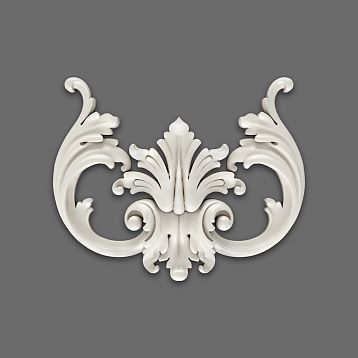
Acanthus is the most common motif in the history of carving. A stylization of a real Mediterranean plant with large carved leaves. In carving, acanthus is conveyed through characteristic elements: leaves with deep cuts forming serrations; S-shaped curves of leaf blades; scrolls at the leaf tips; a central vein from which lateral veins radiate.
There are various variations of acanthus. Greek acanthus is flatter, more graphic, with clear lines. Roman acanthus is more voluminous, lush, with deep relief. Byzantine acanthus is simplified, stylized, almost geometric. Renaissance acanthus is a return to Roman lushness with added details. Baroque acanthus is extremely voluminous, sinuous, and dynamic.
Acanthus leaves are used in capitals, cornices, overlays, rosettes, and cartouches. They can be symmetrical—mirror reflections about an axis—or asymmetrical, creating movement. The carving depth varies from 5 millimeters for delicate overlays to 30-40 millimeters for monumental cornices.
Grapevine: symbol of abundance
Grapes are an ancient symbol of fertility, abundance, and the joy of life. In Christian culture, grapes are associated with the Eucharist, the blood of Christ. In secular culture—with winemaking, feasting, and celebration. Carving with grapes includes several elements: grape leaves with characteristic serrated edges and carved lobes; clusters of berries, either volumetric or in low relief; winding vine stems creating a dynamic rhythm; tendrils curling into spirals.
Grape carving is used in the decor of dining rooms, wine cellars, wine libraries, and restaurants.interior decorationCarving with grapes creates an atmosphere of hospitality and abundance. On furniture, grapes adorn sideboards, cabinets, tables—everything related to feasting and food storage.
The style of grape carving varies. Classical—symmetrical garlands with large clusters. Baroque—sinuous vines, intertwining leaves, an abundance of berries. Art Nouveau—asymmetrical compositions, naturalistic rendering of leaves and clusters, flowing lines of stems.
Rosette: the center of the composition
A rosette is a round or polygonal ornament with radial symmetry, repeating the structure of a flower. A central point from which petals, leaves, or rays radiate. Rosettes can be simple—4-8 petals, minimal relief—or complex, multi-tiered, with dozens of elements.
The diameter of rosettes varies from 40 millimeters for small accents to 300-500 millimeters for large central elements. The relief depth ranges from 3 millimeters for low-relief to 20-30 millimeters for high-relief.
Rosettes are used as central accents on furniture fronts, doors, and wall panels. They attract the eye, creating a focal point of the composition. The placement of a rosette is strictly centered—at the intersection of symmetry axes. The area surrounding the rosette is free from other active elements—it must dominate.
The style of rosettes is determined by the shape of the petals, the complexity of the composition, and the depth of the relief. Classical rosettes are symmetrical, strict, and geometric. Baroque rosettes are lush, multi-tiered, and voluminous. Art Nouveau rosettes are asymmetrical, naturalistic, with curved petals.
Cartouche: a frame for content
A cartouche is a decorative frame surrounding a coat of arms, monogram, inscription, or date. The shape of a cartouche varies from a simple oval to a complex composition with scrolls, ribbons, and garlands. Baroque cartouches are especially lavish—asymmetrical volutes, draperies, putti, crowns, and trophies surround the central field.
The size of cartouches ranges from 100×150 millimeters for small monograms to 500×700 millimeters for large coats of arms. The relief depth is significant—15-30 millimeters, so the cartouche dominates the plane.
Cartouches are used on furniture to indicate the owner, date of manufacture, or function of the item. On a cabinet front, a cartouche with the owner's monogram. On a chair back—the date of manufacture or a symbolic image. In interiors, cartouches frame inscriptions, commemorative plaques, and heraldic shields.
Palmette: a fan of leaves
A palmette is a stylized palm leaf, opened like a fan. An ancient motif widely used in Greek and Roman architecture. The palmette has a central leaf, from which lateral leaves symmetrically radiate, decreasing in size towards the edges. The number of leaves ranges from three to fifteen.
Palmettes are used in borders, friezes, and cornices, creating rhythmic repetition. A single palmette serves as a central accent on an overlay, capital, or the keystone of a frieze. The size of palmettes ranges from 30 millimeters in height for small borders to 300 millimeters for large accents.
The style of palmettes has evolved. Greek palmette—strict, geometric, low-relief. Roman palmette—more voluminous and detailed. Renaissance palmette—a return to antique strictness. Baroque palmette—curved leaves, dynamic relief. Neoclassical palmette—simplification, a return to Greek geometry.
Geometric carving: rhythm and order
Geometric carving is based on the repetition of simple shapes—triangles, rhombuses, circles, stars. This is the oldest type of carving, characteristic of folk art, where complex plant motifs were inaccessible due to a lack of samples or skills.
Triangular-notched carving is the most common type of geometric carving. Triangular depressions are cut with a sharp knife, which, when repeated, form complex patterns—radiations, rosettes, chains, borders. The depth of the notches is 2-5 millimeters, with sharp edges creating a play of light.
Geometric carving is used in folk furniture, country styles, and ethnic interiors. It is laconic, graphic, and does not require gilding or painting—natural wood, coated with oil or wax, is sufficient. The combination of geometric and plant carving creates a contrast of simplicity and complexity.
Carving technologies: from chisel to CNC
Methods of creating carvings have evolved from entirely manual to high-tech, but each has its place in modern production.
Hand carving: craftsmanship and uniqueness
Hand carving is the work of a master carver with chisels, knives, and gouges. The carver sees a piece of wood, envisions the future ornament, outlines it with a pencil or charcoal, and begins carving. First, the main volume is roughly shaped with coarse chisels, removing excess material. Then, medium chisels are used to work out the main forms—leaves, petals, volutes. Finally, small chisels and knives carve the details—leaf veins, serrated edges, petal texture.
Hand carving is unique—each element differs slightly, there is the breath of a living hand, the individuality of the master. The carver adapts to the wood—avoids a knot, uses beautiful grain, adjusts carving depth depending on the hardness of the layers. The creation time is significant—a complex overlay of 200×300 millimeters requires 10-20 hours of the master's work.
The cost of hand carving is high due to the payment for skilled carvers' labor and the uniqueness of the product. Hand carving is used for exclusive projects, restoration of historical objects, and custom furniture where uniqueness and artistic value are important.
Machine carving: precision and repeatability
Copy milling machines allow reproducing carvings from a master pattern. The pattern—hand-carved by a master—is mounted on the machine. A probe traces the pattern, reading the relief, and the milling cutter repeats the probe's movement, cutting a copy on the workpiece. Copying accuracy is high, repeatability is absolute—dozens of identical elements.
Copying machines are limited to bas-relief carving—relief depth no more than 10-15 millimeters. For high-relief carving with undercuts, through holes, and complex volumes, copying machines are not suitable. Production time—1-3 hours per element depending on complexity.
The cost of machine carving is 2-3 times lower than hand carving but requires creating a pattern—the first product is made by hand. This is justified for mass production—dozens to hundreds of identical elements for commercial projects, hotels, restaurants.
CNC milling: the technology of the future
Computer Numerical Control (CNC) milling machines revolutionized the production of carved decor. A three-dimensional model is created in a computer program—a designer models the ornament, sets relief depth, and detailing. The program generates the milling cutter's movement trajectory, considering tool diameter, cutting depth, and feed rate.
The machine executes the program—the milling cutter moves along three, four, or five axes, cutting relief with accuracy to tenths of a millimeter. The most complex forms, unachievable by hand, are reproduced easily. Production time depends on complexity—a simple overlay 30-60 minutes, a complex one 2-4 hours.
CNC limitation—minimum milling cutter radius, usually 3-6 millimeters. Finer details—thin lines, sharp angles—are impossible. The surface after milling has a characteristic relief from tool passes, requiring sanding. To eliminate these limitations, a combined method is used.
Combined method: optimal balance
Combining CNC and manual finishing yields optimal results. The CNC machine cuts 80-90% of the volume—main forms, large details, overall relief. Then a carver manually finishes—adds small details the machine cannot cut, trims sharp edges, creates textures, individualizes the product.
Production time is less than with fully hand carving—the machine does the main work quickly. Quality is higher than with purely machine carving—manual finishing adds liveliness and detailing. Cost is moderate—lower than fully hand carving, higher than purely machine carving.
Solid Wood ItemsProducts with combined carving combine technological efficiency, artistry, and affordability. This is the standard for modern production of carved decor for both mass and individual projects.
Wood species for carving: from linden to walnut
The choice of wood species is critical for carving quality—hardness, texture, and wood color affect technology and results.
Linden: softness and pliability
Linden is the traditional species for fine openwork carving. Soft, homogeneous light cream-colored wood cuts easily with sharp tools, allowing creation of the smallest details—element thickness of 2-3 millimeters holds without breaking. Linden is used for iconostasis carving, where jewel-like precision and complex forms are required.
Linden's disadvantage—low strength, susceptibility to dents and damage. Linden carving on furniture subject to use wears out quickly. Therefore, linden is used for decor not experiencing mechanical loads—wall panels, friezes, ceiling rosettes, decor of furniture upper zones.
Staining linden is necessary—the natural light color looks unexpressive. Stains, patinas, and gilding emphasize relief and create depth. White enamel with gilding is a classic solution for linden carving in Rococo and Baroque styles.
Oak: hardness and expressiveness
Oak is hard, dense wood with expressive texture. Cutting oak is harder than linden—requires more effort, extremely sharp tools, and carver experience. But oak carving is strong, durable, and withstands mechanical loads. Oak is suitable for furniture, doors, stair balusters—elements subject to use.
Oak texture—large pores, contrasting annual rings—creates an additional decorative effect. Carving on oak is visually enriched by texture, becoming multi-layered. Toning oak with stains enhances contrast—dark pores on a light background or vice versa.
Oak color varies from light honey to dark brown depending on toning and wood age. Bog oak—almost black, with noble centuries-old patina—is used for status furniture and interiors.
Beech: Uniformity and Stability
Beech—medium hardness, homogeneous structure, pinkish hue. Beech cuts well, better than oak, worse than linden. Beech carving has clear edges, details don't chip, forms hold shape. Beech is suitable for mid-price furniture where quality is needed without the premium price of oak or walnut.
Beech texture is fine-pored, homogeneous, without a pronounced pattern. This allows the carving relief to dominate without competing with texture. Toning beech gives an even color without stains—good for painting in light tones.
Beech is hygroscopic—absorbs moisture, changes dimensions with humidity fluctuations more than oak or ash. Beech carving requires stable conditions—air humidity 40-60%, temperature 18-24 degrees Celsius. In rooms with humidity fluctuations, beech can deform.
Walnut: nobility and contrast
Walnut is a premium species with dark wood of noble chocolate shades. Texture is expressive—contrasting layers, beautiful grain patterns. Walnut cuts excellently—medium hardness, no chipping, details hold shape. Walnut carving looks luxurious even without staining—natural oil emphasizes wood beauty.
Walnut price is high—1.5-2 times more expensive than oak, 3-4 times more expensive than beech. Walnut carving is a sign of premium furniture, exclusive interiors. Walnut is used for studies, libraries, representative rooms where status is important.
Toning walnut is rarely used—the natural color is self-sufficient. Sometimes darkening with stains is applied to enhance contrast or patination to create an antique effect. Walnut polishes well to a gloss but is often oiled to preserve tactile feel.
Application of Carving in Interior Design: From Furniture to Architecture
Carved decor is appropriate on numerous interior elements, creating stylistic unity.
Furniture Fronts: The Main Canvas for Carving
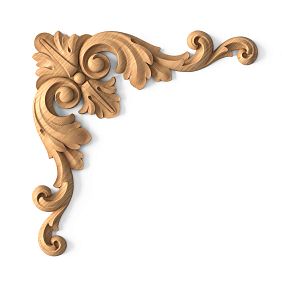
Cabinet doors, dresser fronts, sideboard doors, and secretary desks are traditional places for carved overlays. A central rosette on the front draws the eye and creates a focal point. Corner overlays frame the panel and emphasize its borders. Extended friezes along the top or bottom edge of the front create a horizontal rhythm.
The amount of carving is determined by style. Baroque furniture features maximum carving, with the entire surface covered in ornamentation. Classical furniture has carving localized at key points. A modern interpretation of classicism uses minimal carving, with one or two overlays as accents.
The composition of overlays on a front follows symmetry. The central axis of the front and symmetrical placement of elements. If there is one overlay, it is strictly on the axis. If there are two, they are mirror-symmetrical. Four overlays form a rectangle symmetrical about both axes.
Cornices and Friezes: Crowning Elements
Furniture cornices—horizontal elements crowning cabinets, sideboards—are often adorned with carving. A carved frieze beneath the cornice creates an additional decorative layer. The frieze ornament—repeating palmettes, rosettes, acanthus leaves—creates a rhythmic composition.
The depth of carving on friezes is moderate—5-10 millimeters—so as not to overload the upper part of the furniture. The frieze width is 40-100 millimeters depending on the furniture height. The length corresponds to the width of the carcass; the frieze can be solid or consist of repeating sections.
The color of friezes is coordinated with the furniture carcass. A frieze matching the carcass color creates a monochrome solution. A contrasting frieze—dark on a light carcass, light on a dark one—emphasizes the division. A gilded frieze on natural wood is a classic Baroque solution.
Doors and Panels: Architectural Scale
Interior doors with carved overlays become architectural accents. Overlays on the door leaf follow the same logic as furniture ones—symmetrical compositions, central and corner elements. The size of door overlays is larger than furniture ones—200-400 millimeters, corresponding to the scale of the door.
Wall panels with carving create a luxurious interior. Carved paneling, friezes, and borders cover walls with ornamentation. The scale of the carving is larger than furniture carving—relief depth of 10-20 millimeters, element size of 300-600 millimeters—to be legible from a distance.
Ceiling rosettes—round carved elements in the center of the ceiling, framing a chandelier—are the culmination of a room's carved decor. The diameter of ceiling rosettes is 500-1500 millimeters, with a relief depth of 15-30 millimeters. The rosette ornament features radial symmetry with acanthus leaves, palmettes, and flowers.
Frequently Asked Questions about Wood Carving
How does hand carving differ visually from machine carving?
Hand carving has liveliness, slight variations, and individuality. Each leaf differs slightly in shape, the relief depth varies, and there are tool marks that create texture. Machine carving is absolutely identical in repetition, with even relief and precise details. CNC carving has characteristic cutter marks—parallel lines on the surface that require sanding.
To an inexperienced eye, the differences are unnoticeable, especially after finishing. A professional sees the master's hand in hand carving and mechanical precision in machine carving. Combined carving blends base precision with lively details, optimal for most projects.
Does carving require special treatment and protection?
Carving requires more thorough processing than a smooth surface. Sanding carving is a delicate process. Sandpaper doesn't reach into recesses—special tools are used: sanding cords, sponges, brushes. It's important not to smooth the carving edges, preserving the clarity of details.
Coating for carving—oil, wax, varnish. Oil soaks into the wood, emphasizes the grain, accumulates in the recesses of the carving, creating tonal transitions. Wax creates a soft sheen and tactile comfort. Varnish forms a protective film, provides durability, but can flood fine details—it is applied in thin layers with intermediate drying.
Patination of carving—applying pigment into recesses—enhances the relief. Dark patina on light wood emphasizes depth. Light patina on dark wood creates an antique effect, as if dust of ages has accumulated in the recesses. Gilding is applied to the raised parts of the carving, creating a play of gold and wood.
How to choose a carving style for a modern interior?
Modern interiors do not exclude carving but require restraint. Minimalist carving—simple geometric shapes, low relief, laconic ornaments. One or two carved overlays as accents, not covering the entire surface.
A modern interpretation of classicism allows traditional ornaments—acanthus, palmettes—but simplified and stylized. The contrast of smooth planes and localized carving creates visual interest without overload.
Author's carving—abstract forms, natural motifs, individual compositions—makes an interior unique. This could be a stylized tree, waves, geometric abstraction—anything that aligns with the project concept and the owner's taste.
How much does carved decor cost?
Cost depends on technology, wood species, size, and complexity. A simple 100×100 mm overlay made of linden, CNC carving—from 800-1500 rubles. The same overlay made of oak—1500-2500 rubles. Made of walnut—3000-5000 rubles.
A complex 200×300 mm overlay with combined carving (CNC + hand finishing)—5000-12000 rubles depending on wood species and detailing. Fully hand-carved overlay of the same size—15000-30000 rubles.
Serial production reduces cost—a batch of 10-20 identical overlays costs 20-30% less than custom ones. Ready-made overlays from a catalog are 30-50% cheaper than custom ones—no need for model development or creating a CNC program.
Can carving be added to finished furniture?
Yes, decorating finished furniture with carved overlays is a common practice. Overlays are selected to match the furniture's style, color, and size. The surface of the facade is degreased, the overlay is attached with glue, and if necessary, secured with thin nails.
It is important that the facade is sufficiently strong and even. Veneered or wood-veneered facades are excellent—smooth surface, good glue adhesion. Film-covered facades require preliminary preparation—the film is removed at the attachment point, exposing the base.
After installing the overlays, the furniture can be tinted or painted entirely, creating a monochromatic solution. Or leave the overlays natural on a painted facade, creating contrast. Patination, gilding of overlays adds decorativeness.
Conclusion: Art accessible to everyone from STAVROS
Wood carving—the oldest craft, creating beauty for millennia—is accessible today thanks to modern technology. From classical acanthus leaves to author's compositions, from the work of master craftsmen to CNC precision—carved decor transforms ordinary furniture and interiors into works of art, rich with history, tradition, and individuality.
STAVROS is a leading manufacturer of carved decor from solid wood with over twenty years of experience. The production base in St. Petersburg is equipped with modern multi-axis CNC milling centers, allowing the creation of carvings of any complexity with precision to tenths of a millimeter. A hand-carving workshop, where experienced carvers work, refines machine-made blanks, adding vitality and uniqueness.
The STAVROS catalog features over three hundred models of carved overlays, rosettes, friezes, cartouches from natural solid oak, beech, ash, walnut, linden. Classical ornaments—acanthus leaves, grapevines, palmettes, geometric patterns—in various variations and sizes. Style collections—Baroque, Classicism, Art Nouveau, Provence—allow selecting decor that precisely matches the interior concept.
Custom production is STAVROS's specialty. Designers create three-dimensional models based on your sketches, considering dimensions, style, and application features. Programmers develop control programs for CNC machines. Carvers refine products by hand, adding details that the machine cannot cut. The result is unique carving, existing as a single piece or in a limited series.
The combined production method used by STAVROS ensures the optimal balance of quality, speed, and price. The basic relief is cut on CNC machines, ensuring precision and repeatability. Final refinement is done by hand, adding individuality and vitality. This allows offering high-quality carved decor at reasonable prices, accessible not only for exclusive but also for serial projects.
STAVROS works with private clients, interior designers, furniture factories, construction companies, and restorers across Russia and abroad. Consultative support at all stages—from concept to installation. Specialists help select carved elements matching the interior style, calculate quantities, create placement diagrams, and prepare recommendations for installation and finishing.
Logistics ensures delivery of carved decor with a guarantee of preservation for each element. Packaging is multi-layered—protection from moisture, impacts, vibration. Showrooms in Moscow and St. Petersburg allow viewing carving samples, assessing detailing quality, feeling the wood texture, and receiving professional consultation.
Choosing STAVROS means choosing craftsmanship traditions, modern technology, quality of natural solid wood, richness of choice, and professional support. Create interiors where the ancient art of wood carving finds new life, where classical ornaments coexist with author's compositions, where every detail is carved with respect for the material and tradition. Wood carving is not a museum exhibit, but a living art that makes your home unique, filled with beauty created by hands and mind, wood and time.