Article Contents:
- What exactly you're buying: a wall panel, not a set of individual slats
- Which slatted wall panels to buy: MDF or oak
- When to buy MDF
- When to buy oak
- What constructions exist for slatted wall panels
- Rigid panels on MDF backing
- Flexible wall panels on fabric base
- Panels made of half-round battens
- Which wall panel profile to buy
- What dimensions, spacing and gaps to consider before buying wall panels
- Which wall panels to buy for different rooms
- living room
- for the bedroom
- For hallway and corridor
- For office, meeting room, restaurant, hotel
- Buy panels for painting or with natural finish
- How to calculate the number of wall panels before purchase
- What to know about installation before ordering
- What determines the price of slatted wall panels
- Mistakes before buying slatted wall panels
- Where to buy slatted wall panels
- About the Company STAVROS
- FAQ: Answers to Popular Questions
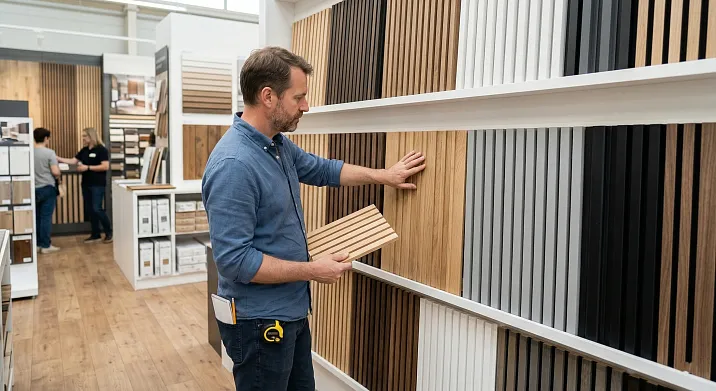
Purchase is the point where a beautiful magazine image turns into a specific set of parameters. Or doesn't turn, if approached carelessly. Beforebuy slatted wall panelsand place an order, you need to answer several questions that determine everything: what exactly you're getting - a rigid panel or flexible, MDF for painting or solid oak, rectangular profile or semicircular, for an entire wall or for an accent zone. The answer to each of these questions significantly changes the final result.
Buying slatted wall panels isn't difficult. Buying the right ones - that's the challenge. This article is a practical navigator: from analyzing constructions and materials to calculating module quantities and mistakes that turn a good idea into costly rework.



What exactly you're buying: a wall panel, not a set of individual slats
The difference between 'buying slats and installing them' and 'buying a ready-made slatted panel' isn't just convenience. These are fundamentally different results.
When installing slats individually on a wall, all control of spacing, gaps, straightness and parallelism falls on the installer. In practice this means: each slat needs to be leveled separately, maintain the specified gap, control parallelism with the previous one - across the entire wall height. On a small area this is feasible. On a wall 4-6 meters wide - it's serious work, and errors accumulate by the finish.
A ready-made slatted wall panel is a module where slats are already fixed to a backing with precise factory spacing. You install an entire module, secure it to the wall - and the pattern is already set. Joints between adjacent modules continue the pattern without shifting. The wall geometry is predictable from the first module.
This approach provides three tangible advantages:
-
Installation speed - instead of positioning slats individually, you work with large modules.
-
Geometric precision—step and gap are set by manufacturing, not by a craftsman's hand.
-
Predictable outcome—the final wall pattern matches what you saw in the catalog.
That's why when choosing wall slat panels, it's better to buy them in a ready-made modular format—especially if you want a result, not an experiment.




Which wall slat panels to buy: MDF or oak
This is the first and most important question when purchasing. Not because one material is better than the other, but because they solve different problems. Mixing them up means getting something you don't need.
Our factory also produces:
When to buy MDF
MDF is an engineered material with a perfectly uniform structure. Density—750–850 kg/m³. The surface is milled with precision to tenths of a millimeter. The key property of MDF for interior applications is neutrality: it has no inherent pattern, no pores, and no color influence on the finish coating.
It makes sense to buy MDF wall slat panels when:
-
You need precise color. Painting according to the RAL or NCS catalog on MDF reproduces without deviations. Buying wall panels in RAL for a designer's project—this is MDF in 100% of cases.
-
You need a monochrome look. A panel matching the wall color: relief is present, but there's no color break. This is a technique that only works with paintable MDF.
-
Geometric stability is important. MDF has no natural variability, does not react to seasonal humidity changes under normal conditions, and maintains its shape.
-
You need flexibility for the future. The MDF surface can be repainted directly on the wall without dismantling.
-
Style—minimalism, neoclassicism, contemporary. Clean lines, precise shades, graphic relief.
Buying white MDF wall slat panels is the most popular solution for neoclassical and light modern interiors.
Get Consultation
When to buy oak
Buying wall panels made of oak means choosing a material with a living wood grain pattern, tactile quality, and the ability to age gracefully. Oak with a density of 700–750 kg/m³ is one of the strongest hardwood species for interior finishing.
It's correct to buy solid wood wall slat panels when:
-
You need a natural texture. The living grain of oak cannot be reproduced with film or veneer.
-
Tactile quality is important. The open-pore surface under oil—this is the physical sensation of naturalness, which no synthetic material possesses.
-
You need durability with repairability. Buying oak wall panels means buying a material that can be sanded, refreshed, and have its coating changed without dismantling.
-
Style—Scandinavian, Japandi, loft, organic minimalism, eco.
-
The interior is built on natural materials—stone, linen, leather, metal.
A crucial point: buying solid wood wall panels for an interior where there is already a lot of wood (floor, doors, furniture) is a risk of overload. Either all wooden elements are coordinated by species and tone, or the wall is better covered with neutral MDF.
What constructions are available for wall slat panels
Construction is not a technical detail for a building protocol. It's a parameter that determines where and how the panel can be physically installed. A mistake here—a rigid panel on a column or a flexible one where precise geometry is needed—means rework or costly waste.
Rigid panels on MDF backing
Basic construction for straight, flat surfaces. Slats are fixed on an MDF backing with precise spacing. The module is rigid, holds its shape well, and is quickly mounted on a flat base—using adhesive or finishing nails.
It's correct to buy rigid wall slat panels for: main walls in residential and commercial spaces, TV zones, ceiling areas (with frame mounting), furniture fronts, and wardrobe systems. This is the standard and most common format.
Limitation: a rigid module does not wrap around curves. A curved wall, column, or arched opening—this requires a different construction.
Flexible wall panels on fabric backing
The slats are mounted on a fabric base with sufficient clearance for bending. The module bends along a radius—wrapping around a column, passing through an arch, navigating a rounded corner without pattern breaks or slat deformation.
Buy flexible wall panels where a rigid module physically doesn't fit. The result with proper application is a surface without visible seams, a continuous slat pattern through the bend. It looks like custom manufacturing, though in fact it's a standard product of correct construction.
Buying panels for radius walls from rigid modules is a mistake. Deformation, gaps, unevenness. Only flexible construction.
Panels made of half-round molding strips
The third type—classified by profile, but by its behavior in space deserves separate mention. The rounded cross-section of the slat creates a fundamentally different play of light and shadow: soft, without sharp shadows, warm. Buying panels made of half-round molding strips is the right choice for rooms that require a delicate, pliable surface, not strict architectural graphics. Bedroom, children's room, home library, cozy living room.
Which wall panel profile to buy
Profile is how your wall will look under specific lighting in your specific room. Not 'just beautiful,' but 'like this—in your light, with your layout.'
Rectangular profile—strict, architectural. Sharp edges create clear shadow in the gaps. With side lighting, each protrusion gives a precise dark line—the surface acquires a graphic, disciplined pattern. Suitable for minimalism, neoclassicism, loft, offices, meeting rooms. Natural oak with a rectangular profile under matte oil is one of the most 'mature' interior looks.
Half-round profile—soft, delicate. Shadows are smooth, without sharp boundaries. The wall looks warmer and more alive. For living spaces with a domestic character: bedroom, living room with a warm atmosphere, children's room. In commercial interiors with a natural language—hotel, restaurant with a cozy character.
Trapezoidal profile—a dynamic option between two extremes. The cross-section widening towards the backing creates an expressive, complex shadow—more active than a half-circle, softer than a rectangle. Loft, commercial spaces, accent zones with a rich architectural task.
Slat width and spacing. Besides the profile, the ratio of slat width and the gap between them influences the character of the surface. Thin slats with moderate spacing—rich, saturated rhythm. Wide slats with large spacing—airiness, monumentality. For small rooms: thin profile, moderate spacing—do not overload the wall with the scale of the relief.
How not to buy too active a relief for a small room: look at the sample not in isolation, but in the context of the area. In a room of 10–12 sq.m., a large active rhythm overwhelms the space. Slats with wide spacing are appropriate in large areas—there they create a monumental look, not a feeling of overload.
Which dimensions, spacing, and gap to consider before buying wall panels
Calculation before ordering is not bureaucracy. It's protection from the 'one module short' situation, which occurs significantly more often than one would like.
Four parameters you need to know about the panel before buying:
| Parameter | What it is | Why it's important |
|---|---|---|
| Module width | Horizontal panel size | Determines the number of modules across the wall width |
| Module height | Vertical size | Should match the wall height or be a multiple of it |
| Slat width | Molding strip cross-section | Affects the density of the rhythm and the scale of the relief |
| Gap between slats | Distance between planks | Visually changes the density of the pattern |
Vertical or horizontal orientation is another selection parameter determined by the room's geometry. Vertical draws the eye upward—the wall appears taller. Horizontal expands—suitable for narrow spaces or when you need to visually widen an end wall.
Calculating the number of modules — the formula is simple:
-
Wall width × height (or part of it) = area.
-
Minus the area of door and window openings.
-
Plus 10–15% for cutting and joints.
-
Divide by the area of one module.
-
Round up to the nearest whole number.
Example: a wall 3.6 × 2.7 m = 9.72 sq.m. + 15% = 11.2 sq.m. A module 0.3 × 2.7 m = 0.81 sq.m. Required: 11.2 / 0.81 = 13.8 → order 14 modules.
A surplus is mandatory. Slatted panels are not roll material. If one module is insufficient, ordering an additional one from another batch carries the risk of differences in tone or pattern pitch. Better to have one extra module than one missing.
Accent zone or full wall — this is also a choice with calculation consequences. A full wall is calculated as a whole. An accent zone (e.g., only behind the sofa) — according to its actual dimensions with a surplus for perimeter trimming.
Which wall panels to buy for different rooms
For the living room
The living room is a space whereslatted wall panels for an accent wallwork most convincingly. The wall behind the sofa or the TV area is the architectural center of the entire room. Here, both MDF in dark or neutral tones and oak with oil finish are appropriate.
Buying slatted wall panels for the living room with integrated LED lighting along the upper perimeter is a popular scenario, providing soft diffused lighting and emphasizing the surface relief. Rectangular or trapezoidal profile — for a strict look. Semicircular — for a warm, cozy character.
Size matters: in a living room of 20 sq.m. or more, wide slats with expressive spacing are appropriate. In smaller living rooms — a thin profile, moderate gap.
For the bedroom
The bedroom is about silence and soft relief. Buying slatted wall panels for the bedroom should prioritize semicircular profiles and neutral warm tones. The wall behind the bed headboard is the main focal point of the space; it determines whether the room feels like a place of rest or a showcase.
Finish for the bedroom: oil for natural oak or matte enamel on MDF. No gloss — only matte and satin finishes. Hidden LED lighting along the panel perimeter in the bedroom creates a 'hotel effect,' perceived as an expensive solution with moderate investment.
For the hallway and corridor
The hallway sets the first impression. Here, buying slatted wall panels for the hallway in vertical orientation literally means 'making the corridor taller.' For a narrow long corridor — horizontal installation on the end wall will visually stop the perspective and make the space proportionate.
Practical argument: the lower part of the wall (~120 cm) in slatted design is significantly more resistant to mechanical contact than a painted surface. For the hallway — varnish or hard oil: a more durable coating against moisture from clothing.
For office, meeting room, restaurant, hotel
Commercial spaces are a different level of requirements: higher load, longer service life, stricter image demands.
Buying slatted wall panels for the office means organizing the space through surface rhythm. The wall behind the manager's desk, the wall in the meeting room, reception cladding — all this conveys the company's level without words. Oak with matte varnish or dark MDF in anthracite — two poles of commercial application.
Buying slatted wall panels for the restaurant is the right choice for zoning the dining hall, creating accent walls behind the bar counter, booth finishing. Natural oak in the restaurant under warm lighting creates a warm atmosphere unattainable with synthetic materials.
Buying slatted wall panels for the hotel is a key task when designing lobbies, rooms, corridors. Here, flexible panels for columns and radius interior elements are especially appropriate — creating the effect of expensive custom finishing without custom production.
Buy panels for painting or with natural finish
This question clarifies the material choice and introduces an additional dimension — finish processing.
Buying MDF wall panels for painting is the most flexible scenario. The panel is supplied primed or already with a base coating. You paint in any tone from the NCS or RAL catalog — and achieve the desired shade with code precision. In the future — repainting without dismantling.
Buy pre-painted wall panels — a ready-made solution when the shade is already selected at the factory. Convenient for large orders: all modules are painted in a uniform tone from a single production batch — no discrepancies between batches.
Buy dark slatted wall panels — anthracite, graphite, black — one of the strongest visual solutions for TV zones, commercial spaces, men's offices. A dark panel 'absorbs' the surface, creating depth and weight.
Natural oak under oil or varnish — a different logic. Here, color is dictated by nature: golden natural tone, Scandinavian gray under tinting, warm honey, dark wenge. Each of these shades preserves the wood grain pattern — this is a fundamental difference from paint.
When exactly to choose painting by RAL/NCS, and when natural oak — a simple rule: if you need an exact corporate or project color — MDF. If you need a living natural surface with character — oak under oil or tinting.
How to calculate the number of wall panels before purchase
This block is one of the most practically important. Despite the simplicity of the formula, errors in calculating the quantity occur regularly — and always at an undesirable moment.
Full wall:
-
Measure the width and height.
-
Subtract the area of openings — doors, windows.
-
Add 15% for cutting, joints, complex corners.
-
Divide by the area of one module.
-
Round up.
Accent zone:
-
Measure only the part of the wall you are covering with panels.
-
Add 10% for perimeter trimming.
-
Calculate the number of modules similarly.
Multiple walls:
-
Calculate each wall separately.
-
Sum them up.
-
Calculate the reserve from the total sum.
When additional reserve is needed:
-
If the wall has niches, protrusions, or complex corners — add up to 20%.
-
If the room has high ceilings (from 3 m) — modules may require additional height trimming.
-
For diagonal installation — add up to 25%: diagonal creates high waste for end cuts.
Do not buy 'by eye'. Article and batch matter: a module added later from another batch may differ in tone or step parameters. This is noticeable on an installed wall — and practically impossible to fix without complete dismantling.
What you need to know about installation before ordering
Installation is not the full topic of this article. But several things need to be understood before purchase, because they directly affect the choice of construction and panel format.
Flat wall (deviation up to 3–5 mm) — the panel is mounted with mounting adhesive or finish nails without preparation. Fast, precise, reliable.
Curved wall (deviation more than 5–10 mm) — a frame is needed. A metal or wooden batten is leveled independently of the wall condition. Panels are mounted on guides. An additional bonus: all wiring — wires, cables, pipes — is hidden in the gap between the frame and the wall.
Buy panels with backing — for cases when the wall is sufficiently flat, and installation time is critical. Rigid backing simultaneously serves as a load-bearing element and a leveling layer for minor irregularities.
Hidden fastening is important where the panel surface will not be repainted. Cleats or hidden clips hold the slat without visible fasteners. When installing with finish nails, small points are covered with putty and touched up.
Flexible panels are installed only with adhesive, following the surface shape. No framework on curved surfaces—the flexible module must adhere tightly to the substrate across its entire area.
How wall irregularities affect panel choice: with very uneven walls (variation over 15 mm), frame mounting with a rigid panel on underlayment is better. Adhesive mounting on such a wall won't provide tight adhesion, and the module will hold unreliably.
What determines the price of slatted wall panels
Transparent pricing explanation removes the main customer objection: 'why one costs this much, and another is twice as expensive.'
Material is the first factor. MDF is cheaper than solid oak. This is not a question of quality, but of material nature: oak is a living tree with labor-intensive processing, selection, and sorting. MDF is an industrial material with predictable cost.
Profile—complexity of milling. A standard rectangular batten is cheaper than a trapezoidal one with non-standard edges.
Construction—rigid panels are technologically simpler than flexible ones. Fabric backing with flexible solutions involves additional production costs.
Finish—a panel for painting is cheaper than a pre-painted one. Professional painting to an exact RAL/NCS color in production is a separate operation.
Module size—non-standard sizes for a project increase cost due to custom production.
Order volume—with large batches (from several dozen modules), the unit price decreases. If you are finishing several rooms or the entire project—calculate the total volume and clarify the terms.
Curved surfaces—flexible panels for non-standard geometry are more expensive than rigid ones by default. If the project is complex—this needs to be considered in the budget.
| Factor | Impact on price |
|---|---|
| MDF vs. oak | Oak is 30–80% more expensive |
| Standard vs. complex profile | +10–25% for non-standard |
| Rigid vs. flexible construction | Flexible is more expensive |
| For painting vs. pre-painted | Pre-painted is more expensive |
| Non-standard size | Custom price |
Mistakes before purchasing slatted wall panels
These mistakes occur regularly—and all are solvable if understood before ordering, not after installation.
First mistake: choosing based on photos without understanding the construction. A beautiful photo in a catalog is not specifications. What profile, what spacing, what underlayment material, rigid or flexible construction—none of these questions are visible in the picture. Request samples. View them in real lighting.
Second mistake: incorrect material. Chose MDF, but natural texture was needed. Took oak, but ended up wanting an exact RAL color. Determine the scenario before ordering: do you need texture or color?
Third mistake: wrong profile. Bought a rectangular batten for a bedroom—got a sharp graphic pattern where softness was needed. Bought a half-round for a strict business office—too cozy for a business environment. The profile is not a decorative detail, but the visual character of the space.
Fourth mistake: slat spacing not considered. Large spacing in a small room overwhelms the space. Fine spacing in a large hall gets lost and doesn't create the needed richness. Correlate the room scale with the slat spacing.
Mistake five: didn't calculate the modules. Bought without calculation, ended up one module short. Reordering risks mismatches. Always calculate with a margin.
Mistake six: used rigid panels on a curved wall. Physical result — deformation, poorly fitting joints, distortion of slat geometry on the bend. Only buy flexible wall panels, only fabric-backed.
Mistake seven: didn't think about lighting. A textured panel without proper lighting loses its purpose. The slat pattern comes alive in side or directional light. Plan lighting simultaneously with panel selection, not after installation.
Mistake eight: bought an unsuitable color without a sample. A monitor doesn't convey the real tone. MDF in the same RAL under different lighting — these are different surfaces. A sample is mandatory.
Where to buy slatted wall panels
The final reference point — a specific catalog with a full assortment.Wall slatted panelsThe STAVROS catalog features all key structural formats:
-
MDF for painting — for precise RAL/NCS colors, monochrome, and minimalist solutions.
-
Solid oak — for natural texture, tactile feel, and durability.
-
Rigid panels on MDF backing — for all flat surfaces: walls, ceilings, facades.
-
Flexible panels on fabric backing — for columns, arches, curved forms, non-standard architecture.
-
Panels made of half-round battens — for delicate soft relief and warm chiaroscuro.
In addition to slatted panels, the STAVROS catalog featuressolid wood millwork— skirting boards, moldings, and cornices that form a unified interior finishing system in the same material language. This is important for those who want a finished interior, not a collection of mismatched elements.
Solutions are available for residential projects of any scale — from one accent wall to a complete apartment renovation — and for commercial spaces: offices, restaurants, hotels, showrooms, meeting rooms.
About the company STAVROS
Wall panels are a material that must be backed by a production base capable of ensuring consistent quality batch after batch. This is not a declaration — it's a real purchasing condition that determines whether an installed wall will look as good in two years as on the day of installation.
STAVROS is a Russian manufacturer of MDF and solid wood products for interior finishing. The company produces slatted wall panels, wooden trim, cornices, moldings, and skirting boards — a full assortment for a unified interior finishing system without the need to source components from different suppliers.
The STAVROS production standard includes profile precision, uniform spacing in each module, backing geometry control, honest description of materials and their properties. Rigid and flexible constructions, MDF and solid oak, standard and non-standard formats — all are present in the assortment and documented in the catalog.
Delivery — throughout Russia. Selection consultations — before ordering. It is precisely this approach that makes the difference between a purchase that delivers the expected result and one that raises questions already at the installation stage.
FAQ: Answers to popular questions
What's better to buy — MDF or oak wall panels?
Depends on the task. MDF — for precise color, monochrome, modern clean relief. Oak — for living texture, tactile feel, durable natural look. Both options are professional solutions for different interior scenarios.
Can you buy wall panels and install them yourself?
On a flat wall — yes, with basic skills. Installation with adhesive or finish nails on a flat substrate doesn't require special qualifications. Frame installation and working with flexible panels on curved surfaces — a specialist is recommended.
Should panels be painted before or after installation?
Both options are practiced. Painting before installation — easier to treat edges and the back side. Painting after — more accurate color matching with surrounding surfaces. For repainting already installed panels — only after installation.
How long will slatted wall panels last?
MDF with careful use and periodic repainting — 10–15 years. Solid oak with proper coating and care — 20–40 years. If needed, oak can be renewed by sanding and applying a new layer of oil or varnish.
Can you buy wall panels for a bathroom?
Standard MDF — no. For high-humidity areas, moisture-resistant HMR-MDF is needed. Oak in a bathroom — only in dry zones with the use of moisture-resistant varnish coating.
How to choose slat spacing for a small room?
Thin slats with moderate spacing are optimal. Wide spacing overloads a small space. Guideline: slat width 20–40 mm, spacing 15–25 mm for rooms up to 15 sq.m.
Why is it important to purchase extra panels?
Ordering from another batch carries the risk of discrepancies in tone or spacing parameters. This is noticeable on an installed wall. A 10–15% surplus is standard practice when ordering any modular finishing materials.