Article Contents:
- Why Slatted Panels Never Have a Single Price
- Material of the Slats: The First Price-Determining Decision
- Structural Type and Its Impact on Price
- Slat Profile and Its Influence on Price
- Manufacturing Precision: The Invisible Parameter That Costs Money
- What's Included in the Cost of Slatted Panels: Price Structure
- Material cost
- Production Operations
- Quality Control
- Logistics and Storage
- Slatted Panel Price Ranges: Benchmarks for Comparison
- What makes up the real cost of the system
- Panels
- Trim: moldings, baseboards, accessory strips
- Installation materials
- Installers' work
- Lighting
- Price of slatted panels and investment efficiency coefficient
- Transformation costing one plane
- Service life: cost per year
- MDF repainting: free update after years
- How to correctly compare slatted panel prices from different manufacturers
- Step 1: Find out the MDF density
- Step 2: Find out the step accuracy
- Step 3: Clarify edge processing
- Step 4: Check for agreed linear footage
- Step 5: Check minimum shipment volume
- Step 6: Compare total system cost
- When slat panel prices seem low: five danger signals
- Signal 1: MDF density not specified
- Signal 2: No step accuracy in technical specifications
- Signal 3: No physical samples
- Signal 4: No agreed linear footage
- Signal 5: "Any deadlines, even tomorrow"
- Price of slatted panels by application type
- Accent wall in the living room
- Bedroom headboard wall
- Hallway and corridor
- Office and corporate space
- Restaurant and commercial space
- Slatted panels and related elements: total space cost
- When the price is fully justified: five situations
- How to plan a budget: practical algorithm
- About the Company STAVROS
- FAQ: answers to popular questions about slatted panel prices
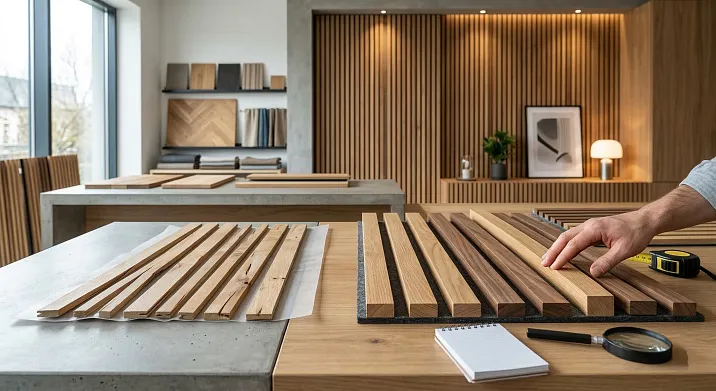
A conversation about the price of slatted panels is always a conversation about what exactly you are paying for. The market offers a range that at first glance seems unfairly wide: products that look similar in photos can vary in cost by two to three times. A buyer who chooses solely based on the bottom line of the price list risks getting something completely different from what they saw in the design project. A buyer who pays 'for the brand' without understanding the cost structure overpays senselessly.
This article is an honest conversation about what shapes the price of slatted panels, what components make up the cost per square meter of the finished system, how to distinguish a justified price from an inflated one and from dumping. And—most importantly—how to calculate not the price of the module, but the cost of the result.


Why the price of slatted panels is never a single one
First, it's important to understand: 'slat panel' is not a single product. It's a family of items with fundamentally different characteristics. Asking 'how much do slat panels cost' is about as informative as asking 'how much does a car cost.' The answer 'from 500 thousand to 15 million' is technically correct—but completely useless.
The price is formed by a combination of specific parameters. Let's break down each one.




Material of the slats: the first price-forming decision
MDF with a density of 750–850 kg/m³ is the basic material for slat panels in the economical and mid-price range. Homogeneous structure, perfect geometry, any RAL color. The material cost is lower than solid wood—while being a fully functional solution for most applications.
Cheapest—MDF with a density of 650 kg/m³ and below. On the price tag, it looks attractive. In practice—it's a loose material with swelling ends, poor fastening, and deformation with humidity changes. Saving 20–25% initially turns into a problem in 6–12 months.
Solid oak with a density of 700–750 kg/m³—a higher price level, justified by the natural properties of the material. Live wood grain texture, tactile open pore feel, uniqueness of each slat. This is a fundamentally different product—not better or worse than MDF, but different. For a natural interior character, there is no substitute.
Our factory also produces:



Structural type and its influence on price
Rigid panels on MDF backing—standard type, moderate cost. Slats are fixed on an MDF base. Standard format 0.6 × 2.4 m.
Flexible panels on fabric backing—more labor-intensive production, accordingly higher price. Justified for curved surfaces: columns, arches, radius partitions. Trying to save by buying a rigid panel for a curved surface is physically impossible—the module will simply break.
Acoustic panels with filling—the highest cost among all types. Structurally more complex, higher material consumption. Justified in meeting rooms, restaurants, conference halls.
Get Consultation
Profile of slats and its impact on price
Rectangular profile — the most technologically advanced in production, base cost. Semi-circular — requires additional processing for rounding edges, moderate markup. Trapezoidal — the most labor-intensive, the highest cost within a single production program.
Production accuracy: an invisible parameter that costs money
Slat pitch accuracy ≤ 0.5 mm — this is production control requiring calibrated equipment and regular checks. This costs money. A manufacturer that does not control pitch sells cheaper. But when installing several modules side by side, joints will be visible — and this is irreparable after installation.
Processed MDF substrate ends (primed or edge-banded) — this is a technological operation that costs money. Open ends are cheaper to produce. But MDF ends are hygroscopic: an open end swells, paint 'lifts'.
What is included in the cost of slatted panels: price structure
Understanding the structure allows for an informed assessment of the offer — and not to be deceived by either dumping or unjustified markup.
Material cost
MDF from European suppliers with a density of 750–850 kg/m³ is more expensive than domestic low-density MDF — this is the first component of the price difference. Solid oak with climatic drying to 8–10% is more expensive than undried — the second component. This is an objective material component of the cost.
Production operations
Milling the slat profile, pitch calibration, priming ends, applying coating (oil, varnish, powder coating), final inspection — each operation has a cost. A manufacturer that excludes part of the operations 'for the sake of price' sells cheaper. But sells a semi-finished product, not a finished item.
Quality control
A two-level quality control system — incoming raw material inspection and outgoing finished product inspection — is a structural cost. A manufacturer without quality control saves on this item. You save when purchasing. Losses begin after installation.
Logistics and storage
Slatted panels are long-sized, fragile goods. Proper storage (horizontally, on racks, in a climate-controlled warehouse), proper packaging for transportation — these are costs included in the price. A manufacturer without a climate-controlled warehouse stores under conditions that change the moisture content of MDF and solid wood. The result — deformed products upon delivery.
Price ranges for slatted panels: benchmarks for comparison
Exact numbers in an article about price are a risky move: the market changes, exchange rates fluctuate. But price ranges in relative terms are a practical benchmark.
| Level | Material | Characteristic | For whom |
|---|---|---|---|
| Lower | MDF 600–680 kg/m³ | Loose material, unstable spacing | Temporary solutions, risk of problems |
| Medium | MDF 750–800 kg/m³ | Stable step, processed ends | Residential properties, offices |
| Above average | MDF 800–850 kg/m³, solid oak | High precision, full coverage | Quality residential properties |
| Premium | Solid oak with hand processing | Climate drying, hand processing | High-end properties |
Aim for medium and above-average levels for permanent housing and commercial properties. Lower level — only if you are aware of the risks and prepared for potential problems.
What makes up the real cost of the system
Here is the mistake almost everyone makes when choosing for the first time: they compare the price of the module, not the price of the system. These are fundamentally different values.
Cost of the slatted finishing system = panels + moldings + installation materials + labor (if installers are hired) + lighting.
Let's break down each item.
Panels
Standard module 0.6 × 2.4 m = 1.44 sq.m. Surface area in sq.m ÷ 1.44 = number of modules. Plus 15% reserve. This is the base cost.
Moldings: moldings, baseboards, additional slats
wooden moldingalong the upper edge of the panel field — linear meters along the length of each surface.solid wood baseboardorMDF Skirting Boardalong the lower edge — the same linear meters.Additional slatfor corner transitions, slopes, and junctions to openings.
Mistake: buying panels without accounting for the cost of linear footage. The cost of molding and baseboard around the perimeter of each surface can amount to 15–25% of the cost of the panels themselves. Not accounting for this in the budget means ending up with an incomplete system or having to revise the budget during installation.
Installation materials
Installation adhesive (liquid nails, MDF panel adhesive), dowels, screws, finishing nails, acrylic sealant, base primer, painter's tape. For frame installation — metal CD 60×27 mm profile, UD-profile, straight hangers.
The cost of installation materials for an average living room is moderate, but it must be included in the budget as a separate line item.
Installers' labor
The cost of installation work varies depending on the region, complexity of the project (straight walls or non-standard geometry), and type of installation (adhesive or frame). For frame installation, it is higher due to greater labor intensity.
Important: the cost of labor does not depend on the quality of the panels. You pay the same for installing cheap and high-quality panels. This means: saving on panels does not proportionally reduce the total cost of the system — because the labor costs are the same.
Lighting
Directional spotlights or LED strips are an essential element of the system, without which the slatted relief does not work. The cost of lighting equipment is a separate budget line that cannot be ignored during the planning stage.
Price of slatted panels and the return on investment efficiency coefficient
The question 'how much does it cost?' only makes sense in conjunction with the question 'what do I get for this money?'. Let's look at slatted panels from the perspective of architectural investment efficiency.
Transformation at the cost of a single plane
One accent wall made of slatted panels typically consists of 6–10 modules plus perimeter trim. This is a localized investment that transforms the perception of the entire room. Neither re-planning, furniture replacement, nor changing the flooring offers such a ratio of 'intervention cost / visual result'.
Service life: cost per year
MDF panels, under normal humidity and proper care, last 15–20 years without losing their appearance. Oak panels have a virtually unlimited lifespan with a coating refresh every 3–5 years. If you divide the system cost by its service life, the cost per year of operation turns out to be very moderate. This is not an expense, but an investment.
Repainting MDF: free update after years
MDF panels can be repainted without dismantling. Light sanding + priming + new color — and the surface is refreshed. The cost of updating after 7–10 years: materials and a painter's labor. This is incomparably cheaper than any alternative finish. Essentially, you pay once for a system that can be updated for minimal money.
How to correctly compare slatted panel prices from different manufacturers
A direct 'head-on' comparison — price of module A versus price of module B — is an ineffective method. The correct comparison is by parameters.
Step 1: Find out the MDF density
Ask a direct question: 'What is the density of the MDF substrate and slats?' The answer should be numerical. Evasive answers like 'high-quality MDF' are not an answer. If the density is below 750 kg/m³, the price is irrelevant, the quality is inadequate.
Step 2: Determine step accuracy
"What is the guaranteed accuracy of the rail step?" Answer: ≤ 0.5 mm is standard. If the manufacturer doesn't know this parameter, they don't control it. Joints will be visible.
Step 3: Clarify end treatment
"Are the MDF substrate ends sealed during production?" Primed or with edge film is correct. Open ends are not.
Step 4: Check for coordinated trim range
A manufacturer without their own line of moldings, baseboards, and accessory rails forces you to assemble the system from different sources. This creates visual inconsistency and additional labor for matching. A unified production program is the criterion of a systematic manufacturer.
Step 5: Check minimum shipping quantity
For residential projects and private clients, shipping single pieces is critically important. A minimum quantity of 50 sq.m means the manufacturer only works with construction wholesalers, not with you.
Step 6: Compare total system cost
After parameters are determined, compare not the module price, but the total system cost: panels + molding + baseboard + accessory elements. Only this provides correct comparison.
When the price of slatted panels seems low: five danger signals
Signal 1: MDF density not specified
The manufacturer does not specify the MDF density in the characteristics — or specifies it vaguely. Reason: the density is below standard, and it is not profitable to indicate it.
Signal 2: No step accuracy in technical specifications
The parameter of slat step accuracy is missing in the documentation. Conclusion: the step is not controlled, joints when installing several modules will be visible.
Signal 3: No physical samples
"You can only look in the catalog." A conscientious manufacturer provides physical samples. Refusal or impossibility is a sign of unwillingness to demonstrate the real product.
Signal 4: No coordinated trim
"Order moldings and baseboards separately, we don't produce them." A manufacturer of slatted panels without trim is a manufacturer of semi-finished products. You will have to assemble the finishing system yourself.
Signal 5: Deadlines "any, even tomorrow"
Quality slatted panels are produced to order in compliance with the production cycle. 'Any volume in one day' for slatted panels 'in stock' — either leftover substandard goods or dumping at the expense of quality.
Price of slatted panels by application type
Different tasks require different solutions — and different budgets. Here are guidelines for typical applications.
Accent Wall in Living Room
Area of a typical accent wall: 10–14 sq.m. Number of modules: 8–11 pieces including spare. Molding and skirting: according to the width of the surface. The final cost of the system depends on the selected material grade and manufacturer.
Key advice: do not skimp on the precision of the step specifically for an accent wall. The wall behind the sofa is visible with every glance in its direction. Any defect in the joints here is catastrophic.
Bedroom headboard wall
Area: 6–9 sq.m. A more intimate space — solid oak can be considered if the budget allows. Semi-circular profile for a soft atmosphere. Natural material in the bedroom is a justified investment in environmental quality.
Hallway and corridor
Hallway — a zone of intensive mechanical impact. Moisture-resistant coating for MDF. Or oak with a matte varnish. Saving on coating quality here is a bad idea: scuffs and scratches in the hallway appear quickly.
Office and corporate space
Large areas — higher volume, lower unit cost (bulk order). MDF for painting in corporate RAL. Color stability for large batches is important. Installation — frame-based (for routing utilities in the technical gap).
Restaurant and commercial space
Acoustics is the most important parameter. Filling in the frame is justified by the budget: reducing reverberation directly affects guest comfort and the average check. The cost of a system with acoustic filling is higher — return on investment through guest experience quality.
Slatted panels and adjacent elements: total space cost
When planning comprehensive finishing with slatted panels, it is reasonable to consider all wooden elements of the space as a single system — and purchase them from one manufacturer.
Wooden moldings and cornicesframe the slatted field from above and set the architectural horizontal. In modern classic — a cornice with a profiled front surface, in minimalism — a simple molding.
solid wood baseboardnext to oak slats — the natural lower boundary of the system.MDF Skirting Boardin the same RAL for MDF systems — seamless color monolithicity.
Decorative Insertsin classic interiors create architectural frames around the slatted field. Vertical and horizontal framings turn a beautiful wall into a panel system with architectural weight.
Rafter panelsin a staircase flight work in dialogue withbalusters for staircasesfrom the same solid wood — a unified wooden architectural theme from the first floor to the last.
Furniture Handlesfrom coordinated material complete the system at the detail level. System quality is determined by its weakest link — and handles from another material can destroy a perfectly built wooden theme.
Purchasing all listed items from a single manufacturer is not just convenient. It guarantees matching tint, texture, and geometry of all elements. Different manufacturers offer different shades of 'oak' and different profile geometries. One production source means a monolithic system.
When the price is fully justified: five situations
Situation 1. An accent wall in the main room is a permanent residence. Saving on quality here is the worst decision. You will look at this wall thousands of times.
Situation 2. A commercial property with high traffic: a restaurant, hotel, Class A office. Wear resistance and appearance after three years define the property's reputation.
Situation 3. A staircase flight in a country house where wood is a recurring theme. Material inconsistency is immediately noticeable here.
Situation 4. A design project with an exact color solution according to RAL. Color deviation from a cheap manufacturer means non-compliance with the project.
Situation 5. A long-term investment in real estate. High-quality finishing is an argument for sale or rental. Cheap solutions that have lost their appearance are a counterargument.
How to plan a budget: a practical algorithm
Step 1. Identify all surfaces to be clad. Measure the area of each. Subtract openings.
Step 2. Calculate the number of modules: area ÷ 1.44 sq.m, round up, add 15%.
Step 3. Calculate linear footage: molding along the top edge of each surface (linear meters), baseboard along the bottom edge (linear meters), additional trim for corner transitions.
Step 4. Request pricing from the manufacturer — panels + full range of linear components. Compare the total system cost, not just the module price.
Step 5. Add the cost of installation materials (adhesive, fasteners, primer, sealant).
Step 6. For self-installation — only materials. When hiring installers — add labor costs.
Step 7. Plan the lighting budget as a separate line item.
Total amount — full system cost. Compare only this figure between manufacturers, not the price of a single module.
About the company STAVROS
Behind any price discussion always lies the question of who produces and how. Because the price of slatted panels, like any construction material, is always a question of what exactly stands behind it.
STAVROS — a Russian manufacturer of MDF and solid wood products for interior finishing and furniture production. Slatted panels of all structural types: rigid on MDF backing, flexible on fabric base. All profiles: rectangular, semicircular, trapezoidal. MDF from European suppliers with density of 750–850 kg/m³. Solid oak with climatic drying to 8–10%.
Slat spacing accuracy control ≤ 0.5 mm per batch. Two-level quality control system (Standard and Prestige). Manual processing of decorative elements. Closed backing ends. Complete coordinated system: moldings and cornices, solid wood and MDF baseboards, additional trims, decorative overlays, stair balusters, furniture handles, classic furniture. Over 4000 models. 20,000 modifications. 39 product groups.
Shipping from one piece. Delivery across all of Russia. Professional consultation: quantity calculation, system selection, installation and lighting recommendations — before placing an order.
FAQ: Answers to Common Questions About Slatted Panel Pricing
Why do slatted panels from different manufacturers vary so much in price?
Differences in material (MDF density, solid wood quality), manufacturing processes (precision of spacing, edge finishing, coating), and quality control systems. Products that look identical in photos can be fundamentally different in characteristics.
Are cheap slatted panels always bad?
Not always, but the risk is high. The lower price range often means MDF with density below 700 kg/m³ and inconsistent spacing. Acceptable for temporary solutions. Not advisable for permanent housing.
Is it worth paying extra for solid oak compared to MDF?
It's not an overpayment, but a choice of a different product. MDF offers precise color, uniformity, repaintability. Oak offers natural texture, tactile feel, and a living pattern. If you need natural expressiveness, there is no substitute. If you need precise color, MDF is the better choice.
Is it necessary to include a surplus when purchasing, and why does this affect the budget?
Yes, a 15% surplus is mandatory. Reordering from a different batch risks color mismatch. Including a surplus upfront is cheaper than redoing the system due to mismatches.
Why is it important to buy moldings together with the panels from the same manufacturer?
Different manufacturers offer different shades of 'oak' and varying profile geometries. Unified production guarantees visual consistency across all system elements.
How to determine if the price of slatted panels is justified?
Ask the manufacturer specific questions about MDF density, step accuracy, edge finishing, and the availability of coordinated linear footage. If you receive specific answers with numbers, the price is likely justified. If the answers are evasive, the price is lowered at the expense of characteristics.