Article Contents:
- Why the store brand is not equal to material quality
- What is important when choosing slat panels: seven criteria that work
- Base Density
- Geometric accuracy
- Edge quality
- Coating: type, thickness, adhesion
- Length and shape stability along the length
- Compliance of declared and actual characteristics
- Color stability in the batch
- How to evaluate decorative molding: what lies behind the price
- Material: density and composition of polyurethane
- Clarity of relief and detailing
- Profile Geometry
- Surface ready for painting
- Documentation and origin
- Can basic slatted panels be combined with strong stucco decor
- For which interiors is such a combination justified
- Residential premises with moderate loads
- Removable and temporary solutions
- Objects with high update frequency
- Children's rooms and teenage spaces
- Renovation Projects
- Main Mistakes When Choosing 'From Stock'
- First Mistake: Buying Based on Sample Color Under Store Lighting
- Second Mistake: Mixing Batches Without Checking Color Stability
- Third Mistake: Ignoring the Edge When Choosing Molding
- Fourth Mistake: Mismatch in Scale Between Molding and Panels
- Fifth Mistake: Buying Molding 'From Stock' Without Understanding the System
- Sixth Mistake: Ignoring the Humidity Conditions of the Room
- Seventh Mistake: Installing Molding Without Priming the Base
- Slatted Panels and Molding: How to Read an Interior That Works
- STAVROS: the assembly point for conscious choice
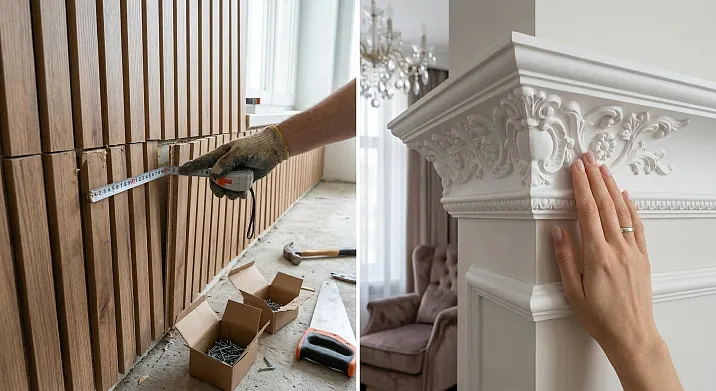
There is a moment many experience during renovation - the showcase moment. A large hall of a construction hypermarket, neat rows of samples, familiar logos on price tags, and the feeling that right here, among thousands of items on the shelves, lies the perfect interior solution. OBI slatted panels, samples from Leroy Merlin, plastic stands with decor - all this creates confidence in choice based not on material quality, but on trust in the store's sign. But the sign and quality are different categories. Always.
The question isn't whether panels in DIY chains are bad. The question is different: does the buyer understand what exactly they're taking, by what criteria they're evaluating, what they expect fromof slatted panelsafter one, three, five years of use. And do they even have a tool for this evaluation - or are they guided solely by price, the appearance of the sample under artificial store lighting, and the familiarity of the chain's brand.
This is exactly the question being examined here: how to choose finishes without being tied to the showcase, how to read material parameters, how to combine available basic solutions with strong molded decor - and whyDecorative stuccomade of polyurethane can radically change the perception of even the most modest slatted panel.



Why the store brand doesn't equal material quality
Large DIY chains operate on a mass offering model. Their task is to meet the needs of the widest possible audience, from a summer resident who needs to quickly cover a shed, to a city dweller starting apartment renovation. In this model, Leroy Merlin slatted panels or OBI slatted panels are just items in the assortment, not statements about quality. The chain doesn't bear image responsibility for a specific product the way a specialized manufacturer does.
What does this mean in practice? In the same store on adjacent shelves, there can be panels with MDF density of 680 kg/m³ and 820 kg/m³. The first will be noticeably lighter, will swell faster with humidity changes, and will deform after two or three seasons. The second will last significantly longer. The price tag may differ by 15-20%, and a buyer without special knowledge won't see the difference - the samples look identical, the lamination is similar, the packaging is neat.
The same with the coating. OBI slatted panels and analogs from other chains are most often covered with film - melamine or PVC laminate. The difference between these coatings is substantial: melamine film is cheaper but more fragile, peeling off faster with mechanical contact and moisture. PVC laminate is thicker, more elastic, more resistant to scratches and humidity. But on the showcase, both options look similar - they shine, imitate wood or neutral colors, and fit into the same price range.
You can buy decorative slatted panels quickly and with a relatively low entry threshold at a hypermarket. But 'buying quickly' and 'buying correctly' are not the same thing. The right choice begins with understanding what exactly you are evaluating, and this requires criteria—real, measurable, verifiable even in the store aisle or before ordering online.




What matters when choosing slatted panels: seven criteria that work
Before buyingslatted panels for walls, you need to understand what parameters the quality of this product is generally assessed by. The seven criteria listed below work universally—for any manufacturer, any chain, any price segment.
Our factory also produces:
Base density
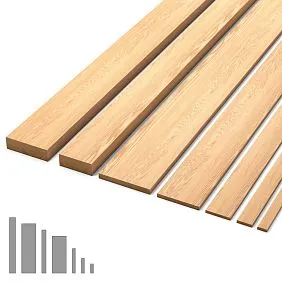
For MDF panels, the minimally acceptable density is 750 kg/m³. Anything lower is a material at risk of deformation due to humidity and temperature fluctuations. The best indicator is from 800 to 850 kg/m³: such density ensures shape rigidity, resistance to fastener insertion, and edge durability. Checking density without tools is simple: a panel of the same format should feel heavier than you expect. Lightness is always a sign of a loose structure.
Get Consultation
Geometric accuracy
Slatted panels work in a system: they are installed close to each other or with a specified gap, and any deviation in width or straightness of the slat has a cumulative effect on a large surface. Already by the third or fourth slat, a half-millimeter deviation from the nominal value will turn into a visible seam misalignment.MDF Slatted Wall Panelof good quality has deviations of no more than ±0.2 mm in width and a complete absence of twisting along the length. This is checked simply: take two panels from the same package and place them face to face—the gap along the entire length should be zero.
Edge quality
The edge is the most vulnerable spot of any slatted panel. It is the first to react to humidity, impacts, and temperature fluctuations. A good edge onMDF slatted panelor processed with an additional coating (acrylic paint, ABS edge), or has a dense, void-free laminate that is tightly adhered and wrapped around the edge. An unprotected open edge means a limited service life in any room with variable humidity.
Coating: type, thickness, adhesion
Melamine, PVC film, acrylic coating, veneer, painting — each type of coating has its own durability characteristics. Forslatted wall panelsin residential spaces, PVC laminate with a thickness of 0.3 mm or more, or an acrylic coating, is considered optimal. Thinner coatings wear out faster, lose color upon contact with household chemicals, and delaminate at joints under mechanical stress. You can check adhesion in the store by gently trying to lift a corner of the film with your fingernail: a good coating will not react.
Length and shape stability along the length
Buy slatted panels for wallsavailable in various formats — from 1200 mm to 3000 mm and longer. The longer the panel, the higher the requirements for the rigidity of the base: a long slat made of loose MDF will sag under its own weight even before installation. For panels 2500 mm or longer, the density of the base is critical, and the geometry must be flawless: any twisting along the length during installation on a frame will create visible waves on the wall.
Compliance of declared and actual characteristics
In the mass market segment, discrepancies between the technical characteristics stated on the packaging and the actual parameters of the material are not uncommon. The type of film, formaldehyde emission class, base density — all of this should be confirmed by documents that a conscientious seller provides upon request. The absence of certificates during retail sale is a cautionary signal, especially when it comes to products that come into contact with living spaces.
Color consistency within a batch
For large-scale wall finishing, it's important that all panels within a single project have the same shade. In the budget segment, batch-to-batch color variation is a common problem: two packages of the same article can show noticeable tone discrepancy.slatted wall panels for interior finishingfrom a reliable manufacturer ensure color consistency within a batch — this is important both for factory-applied finishes and for paintable panels.
How to evaluate decorative molding: what lies behind the price
Decorative stuccois a topic where the gap between expectations and reality is particularly common. Beautiful molding in a catalog photo and the molding delivered to an apartment can turn out to be completely different stories. The reason is that decorative polyurethane molding is produced in a very wide range of quality, and visually, cheap and expensive products are often indistinguishable at the purchase stage.
Material: density and composition of polyurethane
Polyurethane for producing molding decor comes in different densities. Soft, porous low-density polyurethane is cheap to produce but vulnerable: it easily deforms from accidental impact, loses relief clarity when heated, and breaks at corners during careless installation. Dense cast polyurethane is a material of a different class: rigid, stable, with clear relief detailing, resistant to mechanical stress. The difference in density is not visible to the eye but is felt by hand: a quality product does not dent or spring back when lightly pressed.
Relief clarity and detailing
ForBuy Molded Decorationthe correct criterion is not only the form but also the accuracy of its reproduction. Under good lighting — especially side, grazing light — quality polyurethane molding reads as clear, sharp lines, without material 'bleeding' into small relief details, without flash on edges, without sanded-down irregularities. Mass-produced molding from recycled material or with casting process violations has a 'blurry' relief: what should be sharp is softened, what should be deep is smoothed out. On a wall in a finished interior, this reads as an overall cheapness of the decor.
Profile geometry
Polyurethane moldings, cornices, and baseboards work in a system of joints: they connect at corners, join along straight lines, and interface with other elements. For a clean result, the profile geometry must be precise: without deviations in height, without twisting along the length, with parallel faces. A crooked profile at a joint creates a gap that cannot be filled with putty without losing aesthetics — this is an irreparable defect at the installation stage.
Surface for painting
QualityDecorative stuccoPolyurethane has a smooth, non-porous surface that accepts primer and paint evenly. The porous surface of cheap products requires multiple coats of primer, with small pores still visible under a thin layer of paint—especially under side lighting. For interiors with painted walls, this is particularly critical: molding should blend with the surface in texture, not stand out due to unevenness.
Documentation and origin
Forbuy molding decor in St. PetersburgIt is important to obtain products from a manufacturer working with certified materials. Polyurethane for interior applications must comply with sanitary and hygienic standards—not emit toxic compounds when heated, not contain secondary raw materials of unknown composition. A material compliance certificate is the minimum document that should be available.
Can basic slatted panels be combined with strong molding decor
This is one of the most interesting and practically significant questions in DIY finishing. The answer is yes, it can. But subject to several conditions, without which the result will turn into the opposite of what was intended.
Basicslatted panels for wallsfrom the budget segment is a geometrically organized surface. Slats set the rhythm, create relief, divide the plane into visually ordered stripes. This is not a premium material, but it is a structure—and structure serves as the foundation for any more complex decorative statement. That is why strong molding decor can be applied to such a base: moldings frame the slatted area, cornices decorate the transition to the ceiling, overlay elements accentuate key points on the wall.
But the principle of hierarchy applies here. Molding should dominate the base—not adapt to its flaws. If panels from the budget segment have geometric inaccuracies, unstable color, or weak edges—molding will not compensate for these defects but merely shift attention. And this only works while the interior is fresh: after a year or two, deformations of the base material will become noticeable, and they will be in direct proximity to quality molding decor, creating an even more painful contrast.
The correct combination logic is as follows: select a base material without critical defects—not necessarily premium, but with sufficient density, even geometry, and neat edges. Onto this base, installDecorative stuccohigh-quality molding—with clear relief, precise profile, and correct polyurethane density. Paint unites both elements into a single system. The result is an interior that looks significantly more expensive than the combined cost of the materials, because the quality of the molding elevates the perception of the entire surface.
This is not a designer secret—it is a principle of working with material hierarchy in space. Expensive on cheap works if the quality gap does not create visual dissonance. Quality plaster decor on even, stable base panels is a justified combination. Quality molding on deformed or color-unstable panels is money thrown away on good decor that the surroundings will ruin.
For which interiors is such a combination justified?
Not for every one. Understanding the context is part of making the right choice. There are situations in which combining affordableof slatted panelsand strong molding works brilliantly. And there are situations where it is inappropriate.
Residential spaces with moderate loads
Bedrooms, living rooms, studies, hallways in apartments—these are environments with relatively stable humidity and minimal mechanical loads on the walls. In such a context, basic slatted panels of normal quality last long, and it is precisely here that investing in quality plaster decor is fully justified.Slatted panels in interior designliving room, framed by quality moldings, create an interior effect incomparable to what each element provides separately.
Removable and temporary solutions
When the planning horizon is short — a rental apartment, a temporary residence, a space for rent — saving on basicslatted wall panelsis reasonable. However, even in such a context, quality stucco decoration on transitions and at key points elevates the perceived class of the space and increases its rental appeal. It works as a tool for rapid visual enhancement with a limited budget for basic materials.
Objects with high turnover frequency
Offices, showrooms, retail spaces that regularly update their interiors can use affordable basic panels as a replaceable element — and invest in permanent architectural elements: cornices, moldings, ceiling transitions. Here,Buy Moldingsonce for a long time — a rational strategy, and basic panels are changed as needed.
Children's rooms and teen spaces
Here the logic is reversed. Basic panels from the affordable segment are a sensible choice because a child's room changes with the child: what is liked at age five is not needed at twelve. But stucco decoration in a child's room is a delicate matter: simple, clear molding profiles create spatial structure without overloading it.decorative slatted wall panelsin such a room work as a neutral background, and stucco decoration sets the scale.
Projects 'for renovation'
Classical apartments in Soviet-era buildings, where the architecture itself has historical logic, are a special context. Here,Wall finishing with slatted panelsbasic segment materials plus quality moldings and cornices can create a 'new classic'—an interior that respects the building's architecture while speaking a modern language. It is in such projects that reasonable savings on panels and investment in moldings yield maximum returns.
Main mistakes when choosing 'based on availability'
The principle 'if it's in stock, I'll take it' is one of the most costly in the long run. Not in terms of shelf price, but in terms of total losses: on redoing, replacing, and expensive decor consumed by cheap base materials.
First mistake: buying based on sample color under store lighting
Lighting in a construction hypermarket is halogen or LED with high color temperature. It makes all finishes brighter, cleaner, and more contrasting. At home, under a different spectrum and intensity, the same sample looks different: darker, cooler, or warmer, sometimes completely unlike what seemed perfect in the store. Buying Leroy Merlin or OBI slatted panels 'by eye' in the sales area means risking color disappointment. Rule: always view the sample in the actual room conditions, under natural and planned artificial lighting.
Second mistake: mixing batches without checking color stability
A typical story: bought one batch, installed it, and bought more three weeks later. The shade turned out different—slightly, but noticeable under any lighting. Forslatted panels for wall finishingthis is especially painful on large surfaces, where the boundary between batches runs right through an accent zone. Solution: purchase all necessary volume at once, with a 10–15% reserve, from a single production batch.
Mistake three: ignoring the edge when selecting molding
Polyurethane molding with an unclear, slanted edge at the joint with another element creates a gap that cannot be filled without losing aesthetics. Putty kills the relief. Silicone sealant reads as a seam. The correct solution is moldings with a clear end, allowing a 'zero' joint without additional materials.
Mistake four: mismatch in the scale of molding and panels
A thin molding 15 mm high next to wide 120 mm slats is a disproportion. A massive cornice on a delicate slatted surface with narrow slats is another disproportion. Architectural decor should be proportionate to what it neighbors. Forslatted wall panels for interior finishingwith a slat spacing of 80–120 mm, the optimal molding is 40 to 80 mm high, depending on the room height.
Mistake five: buying molding 'as available' without understanding the system
Molding, cornice, baseboard, casing, rosette — these are not separate elements, but a system. When each is bought from different places, from different manufacturers, they may not match in profile, radius, height, or surface texture.Buy Molded DecorationCorrectly means taking the entire set from one line — then the profiles are coordinated, proportions are verified, joints work as a system, not as a random juxtaposition of elements.
Mistake six: ignoring the humidity regime of the room
Basic MDF without special edge or surface treatment is not for kitchens, not for bathrooms, not for hallways with an entrance door that lets in cold air in winter. Most slatted panels and Leroy Merlin slatted panels in the mass segment often lack a moisture-resistant base—this is important to understand when choosing for rooms with high or variable humidity.MDF Plank PanelsFor kitchens and hallways, they should have treated edges and a moisture-resistant coating.
Mistake seven: installing molding without priming the base
Decorative polyurethane molding is attached with mounting adhesive. Without priming the surface, adhesion decreases, especially on new plaster or a painted wall. After a few months, moldings start to 'peel off' at the joints—and this is not a defect of the molding, but an installation error. The rule: always prime the surface and the end of the product before applying adhesive.
Slatted panels and molding: how to read an interior that works
An interior done without being tied to a display starts with a different question. Not 'what is available?', but 'what result is needed and what materials will achieve it?'. This is a shift in selection logic—from reactive to project-based thinking.
Wooden slat panelsOr MDF slats—they are the rhythm of the wall. They set the visual frequency, create direction, organize the plane. Good panels do this precisely and consistently. Average ones do too, but with caveats.
Decorative stucco—is the architectural framework of the surface. It holds color fields, frames transitions, sets the scale. Good molding reads as part of the space. Bad molding reads as glued-on decor.
Together, they create what professionals call a 'cohesive interior': a space where every surface has a role, every element has a place, every material has a purpose. This is not about expense. It's about mindful choice.
And it is precisely here that basicSlatted wall panelsfrom the available segment can play a worthy role — if selected by criteria, not by availability, and if complemented with molded decor whose quality elevates the entire system to a higher level.
Installation of such a system is also part of the result.How to install slatted panelsand how to properly install moldings at joints — these are technical questions with specific answers that affect the final appearance no less than the quality of the materials themselves. Installation errors are not compensated by expensive material. Proper installation makes even modest materials work.
STAVROS: the assembly point for conscious choice
When the logic of finishing selection shifts from 'taking what's available' to 'taking what will deliver the desired result,' a need arises for a different type of offering — not a mass assortment with thousands of items, but a specialized catalog with clear expertise.
STAVROS is precisely such a position in the market.Rafter panelsin the STAVROS assortment — is a product with declared and actual technical parameters: base density, geometric precision, batch consistency, coating quality.Decorative stucco— polyurethane decor with clear relief, stable dimensions, and a surface ready for professional painting. Not a mass-market item on a hypermarket shelf, but a specialized product for those who understand what they are buying.
Buy molded decor in Saint Petersburgthrough STAVROS — is an opportunity to obtain a complete set of elements from one line: moldings, cornices, baseboards, overlay elements with coordinated profiles and proven polyurethane quality. For those building an interior based on logic, not on availability at the nearest hypermarket — this is a fundamental difference.
FAQ: Answers to Popular Questions
Can OBI slatted panels be combined with high-quality moldings from a specialized manufacturer?
Yes, provided that the base panels are of acceptable quality—with even geometry, stable color, and no deformations. High-quality molding elevates the perception of the entire wall but does not compensate for critical defects in the base material.
How to distinguish quality polyurethane from cheap polyurethane right in the store?
Gently squeeze the product with light finger pressure: quality dense polyurethane does not indent or leave a dent. Examine the relief under side lighting: a good product has clear lines, sharp details, without 'smearing' or smoothing.
Is it necessary to prime slatted panels before installing decorative molding nearby?
Priming is needed for the wall base, not for the panels. For polyurethane molding adhesive, the surface to which the product is glued—the wall or the panel edge—is primed.
Can budget slatted panels be painted the same color as the moldings?
Yes. But for laminated panels, a special adhesion primer is needed; otherwise, the paint will not adhere to the PVC film. Paint-ready panels are more convenient in this sense: they are already designed for painting.
What is more important with a limited budget: saving on panels or on molding?
Saving on panels is wiser, provided selection is based on quality criteria rather than minimum price. Molding made from quality polyurethane with clear relief and precise profile is the element where saving yields the most painful result in the final interior.
How to properly join slatted panels with moldings on an inside corner?
An inside corner for molding requires a 45-degree miter cut on each side. For tight fit, the corner surface must be even—without plaster drips or finishing steps. More about installation in theslatted panel installation guide.
Is there a difference between decorative molding for walls and for ceilings?
Functionally—no. Polyurethane products work on any surface. But for ceiling installation, the lightness of the product is important: a heavy profile on the ceiling requires a more reliable fastening system and longer holding during gluing. Quality polyurethane with normal density does not create problems in this case.