Article Contents:
- Why wood works deeper than just a finishing material
- What slats give to a wall that no other material provides
- What molding adds to this system
- When combining slats and wooden moldings is especially advantageous
- High ceiling — the main ally
- Long corridor or gallery
- Living room without a bright accent
- Office and Library
- How to build a composition on a long wall
- Principle of horizontal division
- Principle of vertical division with moldings
- How mirror symmetry works on a long wall
- How to use moldings for frames, inserts, and transitions
- Frame decor: panel wall breakdown
- Transition molding: how to connect different surfaces
- Wooden cornice as a system completion
- Combinations for neoclassicism, modern classicism, and minimalism
- Neoclassicism: complete system with clear hierarchy
- Modern classicism: balance between structure and lightness
- Minimalism: wood as the sole accent
- Scale and alignment mistakes: an honest breakdown
- First mistake: molding doesn't match the room's scale
- Second mistake: battens and moldings from different wood species without logic
- Third mistake: molding frames on a batten wall
- Fourth mistake: wooden cornice with moldings painted a different shade
- Fifth mistake: different widths of identical elements
- Sixth mistake: no allowance for solid wood acclimatization
- Wooden millwork in detail: what exists and how to choose
- Wooden cornice: from simple to complex
- Wooden skirting board: the base that holds the space
- Door architraves: the door as an architectural element
- Wooden frame moldings: panel breakdown without reconstruction
- Long wall in the living room: step-by-step solution logic
- Slatted panels on the ceiling with wooden moldings: a non-standard but powerful solution
- Practical table: slat + molding by styles
- STAVROS: wooden products as a unified system
- FAQ: answers to common questions
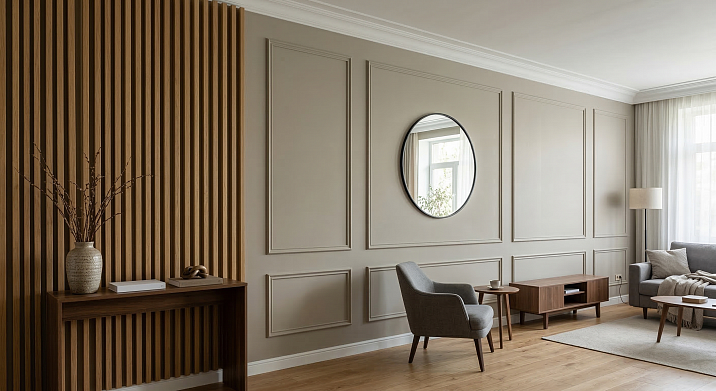
There is one paradox that everyone who works professionally with interiors encounters: the most expensive-looking spaces are often made from quite affordable materials. And vice versa – expensive surfaces sometimes look heavy-handed and pretentious. The difference is not in the price per square meter. The difference is in how the finishing elements relate to each other, how they are built into a system, and how this system communicates with the space.
slatted panels for wallscombined with wooden moldings – this is precisely the combination that, when applied skillfully, makes an interior visually more expensive than its budget. Not because it's 'fashionable' or 'beautiful' in an abstract sense. But because wood in different functions – rhythmic (slat) and contour (molding) – creates that material depth of space which the human eye perceives as quality.
Let's talk about this in detail, honestly, and with specifics.


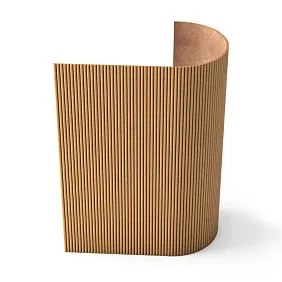
Why wood works deeper than just a finishing material
Wood is the only building material with a biography. Paint doesn't remember how old it is. Plaster is impersonal. Tile is the same at any point per meter. Wood carries within it the history of growth: annual rings, fibers, knots, medullary rays in a radial cut—all of these are not defects, but a document. Living testimony.
This is why a wooden surface is perceived differently than any imitation. The brain doesn't analyze—it feels. In a room with natural wood, a person relaxes faster. Orients themselves more easily. Perceives the space as lived-in, not as a decoration.
This is not lyricism—it's the physiology of perception. And this explains the sustained interest inwooden slatted panelsin a wide variety of stylistic contexts: from strict minimalism to soft classicism.




What does a slat give a wall that no other material does
A wall with a slatted panel is not just a 'finished' wall. It's a wall with an internal structure. Vertical slats create rhythm—a repeating motif that organizes the perception of the surface. The eye moves along this rhythm, not 'sticking' to one point. The space appears deeper because shadows in the gaps between the slats give visual volume.
Wall slat panels in interiorcreate what designers call 'architectural texture'—the character of a surface that works for the entire space as a whole, not for a separate decorative spot.
Our factory also produces:


What does molding add to this system
Wooden moldings— these are linear profiles that create contours, frames, transitions. If slats are musical rhythm, then molding is punctuation. Period, comma, dash. It tells the space: 'here it begins,' 'here it ends,' 'here is the boundary,' 'here is the transition.'
Wooden trim— cornices, baseboards, casings, moldings — combined with slatted panels create a natural system. One material, one surface character, one tonal logic. This unity is precisely what is visually perceived as quality.
Get Consultation
When combining slats and wooden moldings is especially advantageous
Not every interior equally benefits from this combination. There are situations where the 'slat + molding' pairing works with particular strength.
High ceiling — the main ally
With a ceiling from 2.85 m, the space has a vertical 'reserve' that requires architectural development. An empty high wall feels oppressive, creating a sense of vulnerability. A slatted panel on an accent wall with wooden moldings around the perimeter — this structures the vertical. The space becomes proportionate to the person.
With a ceiling of 3.0–3.5 m — a typical story for Stalin-era buildings, pre-revolutionary housing stock, new builds with custom height — a wooden cornice 95–120 mm together with a slatted wall 80–100 mm create a full-fledged architectural system without a single superfluous detail.
Long corridor or gallery
A narrow, long corridor is one of the most challenging tasks in residential interior design.Slatted panels in the hallway— with vertical installation visually 'lift' the corridor. A wooden molding-capital at a height of 120–140 cm from the floor divides the wall into lower and upper registers — the corridor ceases to be a 'tube' and becomes a sequence of architectural frames.
This is not a cosmetic technique. It is the management of spatial perception through surface division.
A living room without a bright accent
When a room lacks both bright color and expressive pattern—the space risks being 'nondescript.' Neutrality without structure is not minimalism, it is emptiness.decorative slatted wall panelson one wall with wooden molding frames on the others—this is a way to create character through structure, not through color.
Office and library
A space for mental work requires a special material context. Wood in a study is a historically stable solution. Dark oak, walnut, brushed solid wood—Wooden slat panelson the work wall or behind bookshelves, wooden moldings around the perimeter—create that sense of 'study weightiness' which is otherwise unattainable.
How to build a composition on a long wall
A long wall is a surface that requires horizontal organization. Without division, it turns into a 'plane' that feels oppressive. With division—into an architectural facade, behind which there is logic.
The principle of horizontal division
A wooden molding capital or a shelf installed at a height of 110–130 cm from the floor divides a long wall into two registers:
-
Lower register (below the molding) – the area of greatest mechanical contact. Slat panels are the ideal solution: resistant to accidental impacts, easy to wipe clean, and create a structural texture. Slat width 55–80 mm, vertical installation.
-
Upper register (from molding to ceiling) – a visual 'screen', a background. Neutral paint, plaster, thin molding frames. There should be no competition with the lower zone here.
This technique is a direct descendant of the historical paneled wall division in classic interiors. In a simplified form, it works in any style, including contemporary.
The principle of vertical division with moldings
On the same long wall, wooden moldings are placed vertically at equal intervals – creating 'pilasters' or 'panels'. Inside each panel – either slats or a neutral painted surface. The alternation 'slat – neutral – slat' creates a rhythm, where the slat panel is perceived not as a continuous covering, but as a series of accent inserts.
The spacing between vertical moldings should be calculated. Optimal: panel width 1.5–2 times greater than its height. That is, with a height from floor to capital of 110 cm – panel width 165–220 cm. Square 'panels' look static. Vertically elongated ones – light and dynamic.
How mirror symmetry works on a long wall
For a wall with a central element (TV, fireplace, painting), the molding division is built mirror-symmetrically relative to the center. Two equal panels on either side of the central element – one of the most stable classic principles. It works because symmetry is visual calm, and calm is perceived as quality.
Slats can occupy the side panels, leaving the central element on a neutral surface. Or vice versa: the central zone is slatted, the sides have molding frames. Depends on the style and on what is the main accent of the wall.
How to use moldings for frames, inserts, and transitions
Molding is the most underrated element in the arsenal of interior solutions. Most people think of it only as a 'strip under the ceiling.' Meanwhile, it is a tool with several independent applications.
Frame decor: panel wall division
Wooden molding with a width of 22–42 mm is mounted on a flat wall surface in rectangular contours—creating 'frames' without altering the surface itself. In combination withplank panels—this is one of the most elegant ways to create a connection between an accent slat wall and neutral walls.
On neutral walls, molding frames create an 'echo' of the slat wall structure: there—a rhythm of parallel slats; here—a rhythm of rectangular contours. Different languages, one logic.
Frame proportion: the optimal height-to-width ratio is 1.25:1 to 1.6:1 (vertically elongated rectangle). Square frames are acceptable in a strict geometric context. Horizontally elongated ones create a 'squatting' space effect, undesirable.
The distance between frames and from frames to the edges of the wall must be the same. This is the main condition: violating the symmetry of the offsets is immediately perceived as carelessness.
Transitional molding: how to connect different surfaces
When a slat panel and a neutral wall meet on the same horizontal axis, a transition element is needed. Vertical wooden molding—corner profile or flat—solves this task: it covers the joint, creates a clear boundary, and simultaneously continues the material language of wood.
Similarly, horizontal transitional molding works when changing height: a slat panel ends at a certain mark—the molding 'closes' the top end and becomes a visual 'cap' for the lower register.
Wooden cornice as the finishing touch of the system
Wooden trimIn the form of a ceiling cornice — the final stroke that transforms a set of elements into a system. The cornice, made from the same wood as the slat, creates material unity around the entire perimeter of the room.
Historically, a wooden cornice is a 'warmer' solution than its polyurethane counterpart. Tactilely, visually, aromatically — wood retains its nature even in the form of a profiled detail. In a bedroom, study, or nursery — a wooden cornice instead of a white polyurethane one — is a choice in favor of naturalness and uniqueness.
Combinations for neoclassicism, modern classicism, and minimalism
Three styles — three completely different combinations of the same basic elements.
Neoclassicism: a complete system with a clear hierarchy
Slats: dark radial-cut oak or walnut. Width 85–110 mm. Closed rhythm (spacing 30–45 mm). Oil finish. Applied on one accent wall — study, wall behind the sofa, library.
Moldings: wooden, from the same material or contrasting (white ash with dark oak). Horizontal capital molding at a height of 120 cm. Vertical moldings with spacing of 180–220 cm. Ceiling cornice with a soft ogee profile, 95–125 mm. Baseboard 100–130 mm.
Wooden products for this style should be substantial in scale — not pretentious, but proportionate to the ceiling height and room area. The gap between the scale of the details and the scale of the room is the main mistake in neoclassicism.
Tone: dark solid wood + white or light gray moldings. Or a unified warm natural tone of all wood against walls in warm white.
Classical furniture in this context is a direct ally. Furniture with wooden elements (legs, chair frames, armrests) echoes the wood of the walls—the interior gains internal coherence.
Modern classic: a balance between structure and lightness
This is the most popular style in Russian residential interiors—and the most demanding in terms of precision of proportions. Too heavy details—it veers into 'pomposity'. Too light—the character is lost.
Slats: natural oak or ash, medium widths 62–80 mm. Open or semi-open rhythm (spacing 55–75 mm). Oil or matte varnish.
Wooden moldings: moderate profile. Ceiling cornice 78–100 mm. Baseboard 88–108 mm. Molding frames on neutral walls—flat profile 22–32 mm. Door casings with moderate projection 62–78 mm.
Key principle: all wooden details—from one tonal group. Natural oak + wooden cornice made of natural oak. Or all white-painted wood. Mixing different wood tones in one room is a sign of a non-systematic solution.
Minimalism: wood as the sole accent
In a minimalist interior, wood is a privileged material. Precisely because everything else is neutral: white walls, monochrome surfaces, absence of ornament. Against this backdrop, one wooden slatted wall is a sufficient and powerful statement.
Slats: light oak, ash, thermally modified wood in a soft tone. Width 45–62 mm. Open rhythm, wide spacing.
Moldings: only a wooden baseboard 68–82 mm of straight profile and a door casing of straight profile 55–65 mm. No frame moldings. No cornices of complex profile. Minimalism requires minimal decor.
MDF Slatted Wall PanelPainted in minimalism — a special solution: the entire wooden system is painted in the same tone as the other surfaces. The slats cease to be 'wood' — they become texture. A monochrome slatted interior is one of the most refined formats of contemporary minimalism.
Scale and joining mistakes: an honest breakdown
This is a section worth reading especially carefully. This is where the reasons for most unsuccessful interiors with wood lie.
First mistake: molding does not match the scale of the room
A flat 15 mm molding in a room with a 3.2 m ceiling is an element that is not visible. It performs neither an architectural nor a decorative function. Just a strip that reads as a technical joint.
And the reverse situation: a massive 145 mm wooden cornice with a 2.55 m ceiling is an element that 'eats up' space, creating a feeling of crampedness.
Table of correct scale:
| Ceiling Height | Minimum cornice | Optimal cornice | Skirting board | Frame molding |
|---|---|---|---|---|
| 2.45–2.60 m | 55 мм | 62–72 mm | 65–80 mm | 16–20 mm |
| 2.65–2.80 m | 65 мм | 75–88 mm | 78–92 mm | 20–28 mm |
| 2.85–3.05 m | 78 мм | 88–108 mm | 90–112 mm | 24–35 mm |
| 3.10–3.40 m | 95 мм | 108–130 mm | 108–132 mm | 30–42 mm |
| 3.45–3.80 m | 115 мм | 130–155 mm | 125–148 mm | 38–50 mm |
Scale is not 'bigger = richer'. It is proportionality. A detail of the correct scale is unnoticeable—it is perceived as part of the space, not as a foreign object.
Second mistake: rails and moldings from different species without logic
Oak on the walls and pine in the moldings—this is not 'combination of species'. This is a visual conflict. Oak: dense, heavy, large texture. Pine: soft, resinous, fine texture. They speak different languages—material, not just visual.
If you want a two-tone interior—choose species that form a meaningful contrast: dark walnut + light ash, dark oak + white-painted maple. This works. A random combination of 'what was available'—does not work.
Third mistake: molding frames on a slatted wall
It is important to say this directly: molding frames on a surface already occupied by vertical slats—double emphasis in one place. Slats create one rhythm. Frames create another. They do not combine—they compete. Result: visual noise, not an architectural system.
Rule: a slatted surface is an accent in itself. Molding frames—on neutral surfaces, not on slatted ones.
Mistake four: wooden cornice painted a different tone than the moldings
Wooden cornice in a natural tone + painted white wooden baseboard + wooden architraves matching the slat tone = three different wooden solutions in one room without a coordinated logic.
A unified wooden space requires a unified tonal solution for all wooden trim. Exception: intentional contrast with a clear design rationale.
Mistake five: different widths of identical elements
Architraves on one door — 68 mm, on the adjacent one — 55 mm (from different batches or different manufacturers). This is a mistake that is immediately visible when looking down the hallway. A uniform profile and uniform width for all architraves within direct line of sight is a mandatory condition.
Mistake six: no allowance for solid wood acclimatization
Installation of batten panelsSolid wood without prior acclimatization is a source of deformations. The solid wood moves from one set of conditions (warehouse, transport) to another (a room with specific temperature and humidity). It needs 5–7 days with the heating on in the room where it will be installed. Solid wood moldings have the same requirements.
Wooden trim in detail: what exists and how to choose
Wooden trim— an extensive category with internal logic. Let's break it down by function.
Wooden cornice: from simple to complex
Straight profile (rectangular cross-section) — the most versatile. Works in minimalism, Scandinavian style, loft. Does not require complex miter cutting.
Profile with a chamfer — slightly more complex, creates a soft 'step' at the wall-ceiling transition.
Profile with a 'gooseneck' (smooth curve) — a classic transition profile. Pairs well with moderate-width natural wood slat panels.
Composite profile (shelf + gooseneck + profile) — only for high-ceilinged spaces with a corresponding style.
Main advice when choosing: the size of the cornice is determined by the ceiling height. The profile is determined by the style. This order cannot be changed.
Wooden baseboard: the foundation that grounds the space
Baseboard — an element with a dual function: it conceals the technical joint between floor and wall and creates a visual 'foundation' for the wall. The higher the room — the higher the baseboard should be, otherwise the wall appears to 'float' without support.
Straight baseboard (rectangular profile) — for minimalism. Baseboard with a bead (lower slanted part) — for transitional styles. Baseboard with a protruding shelf — for modern classic.
Standard widths: 68, 78, 88, 95, 108 mm. Baseboard 45–55 mm — only for temporary solutions or for budget spaces without slat panels.
Door casings: the door as an architectural element
A door casing transforms a door unit from a 'cut-out opening' into an architecturally designed portal. Without casing, even an expensive door looks technical. With the right casing, an ordinary door becomes part of the interior system.
The width of the casing should be proportional to the size of the door unit. Standard door 80 cm × 200 cm — casing 65–80 mm. Door 90 cm × 210 cm — 72–88 mm. Wide door 100–120 cm — 85–100 mm.
Wooden frame moldings: panel division without reconstruction
Wooden molding 20–40 mm for frame decoration on walls is one of the most 'cost-effective' elements in terms of cost/visual impact ratio. Several rectangles on a neutral wall, painted in the same tone as the wall (monochrome version) or in a contrasting tone (two-tone version) — transform the surface dramatically.
With a monochrome solution, the frames are almost invisible under direct lighting — but create a pronounced play of shadow under side lighting. This is an effect that changes throughout the day along with the movement of the sun.
Long wall in the living room: step-by-step solution logic
Consider a specific example — a wall in the living room 5.4 m × 2.75 m. TV zone in the center, free planes on the sides.
Step 1: Define the zones
Central zone — 1.8 m around the TV. Side zones — 1.8 m each on the left and right.
Step 2: Solution for the central zone
slatted panels for walls— natural oak, 65 mm slats, 60 mm spacing. Vertical installation. Withhidden lightingin the gaps.
Step 3: Delimiting zones with vertical moldings
A 32 mm wooden molding is installed vertically along the left and right edges of the slatted zone — from floor to ceiling. It covers the end of the slatted panel and creates a clear boundary between the slatted and neutral zones.
Step 4: Molding frames on the side zones
On each side zone — two vertically elongated frames made of 24 mm wooden molding. The molding tone matches the wall (monochrome) or the slat (for unity).
Step 5: Cornice, baseboard, door casings
An 88 mm wooden cornice with a soft ogee profile along the entire wall length. A 95 mm baseboard. 72 mm door casings — a unified profile.
Result: a five-meter wall is organized into a system with a clear center, symmetrical side fields, and a unified wooden language around the perimeter. It looks designed — because it is designed.
Slatted panels on the ceiling with wooden moldings: a non-standard, yet powerful solution
Batten panels for ceilings— a topic often avoided. In vain. A ceiling with wooden slats is the 'fifth dimension' of interior design. Especially when combined with wooden moldings along the perimeter of the ceiling transition.
A partial ceiling 'island' made of slatted panels above the dining area—instead of a conventional light fixture—creates zoning without partitions. A wooden ceiling molding frames this island, forming a 'frame' that highlights the zone as an independent space within the overall area.
Slatted panels with lightingOn the ceiling element—an LED strip in the gaps between the slats—works simultaneously as decorative and functional lighting. Warm diffused light through wood is one of the most atmospheric solutions for a dining room, living room, or spa bathroom.
Practical table: slat + molding by styles
| Style | Rail | Crown Molding | Skirting board | Frame molding | Casing |
|---|---|---|---|---|---|
| Minimalism | Light oak, 45–58 mm, oil | Straight 62–72 mm | Straight 68–80 mm | No | Straight 55–65 mm |
| Scandinavian | Ash/birch, 40–55 mm | Straight 60–72 mm | Straight 65–78 mm | No | Straight 52–62 mm |
| Modern Classic | Oak/ash, 62–82 mm | With gooseneck 80–102 mm | With protrusion 88–110 mm | 22–32 mm | With profile 64–78 mm |
| Neoclassical | Dark oak/walnut, 85–112 mm | Composite 100–130 mm | High 100–135 mm | 32–45 mm | Classic 78–98 mm |
| Loft | Thermowood, 70–100 mm | Straight or not | Straight 70–88 mm | No | Straight or not |
STAVROS: wood products as a unified system
If we talk aboutslatted wall panelsandwooden moldingsas a system — STAVROS produces both components within a unified material logic.
Slatted panels: solid oak, ash, thermo-wood, coated and paintable MDF — full range of widths and lengths for any room format.Types of slat panelsThe production program covers all stylistic contexts: from strict minimalism to pronounced neoclassicism.
Wooden items— moldings, cornices, baseboards, architraves, frame profiles — are made from the same wood species with the same surface treatment as the slats. Material unity of the entire system is not a marketing claim, but a production reality.
This has one practical consequence: STAVROS slat + STAVROS wooden cornice are not two separate products from two different places. This is a unified wooden ensemble where tone, texture, and scale are coordinated at the production level.
Samples before ordering. Calculation based on your data. Consultation on compatibility of the entire system. Delivery to any region.
A prestigious interior without visual coarseness is not a matter of budget. It's a matter of system. And this system is available.
FAQ: answers to frequently asked questions
Can slatted panels be combined with wooden moldings in a small room?
Yes, but with limitations. In a small room — only one slatted wall, narrow slats 40–52 mm, open rhythm, light tone. Cornice and baseboard — minimal scale. Molding frames — only with ceiling height not lower than 2.65 m. Otherwise, frames create visual tightness.
How to correctly select a wooden molding for an MDF slatted panel?
MDF Slatted Wall Panel— is not a living texture, but a decor. When painted in a unified tone — wooden molding under the same tone creates a monochrome system. With MDF with 'wood-like' decor — wooden molding from the same wood species or a close tone completes the illusion of naturalness.
Is a ventilation gap needed when installing wooden slatted panels?
Yes, absolutely.How to install slatted panelsSolid wood panels — only on battens with a 20–25 mm ventilation gap. Solid wood moves with changes in humidity, and without a gap, deformation is inevitable.
What wood tone is better for a small, dark room?
Light oak, ash, birch — anything that reflects light. Dark wood (bog oak, thermowood, walnut) — only with good lighting and sufficient space. In a small, dark room, dark slats create a 'cave-like' feeling, not coziness.
How to avoid a color mismatch between slatted panels and wooden moldings?
Order both products from the same manufacturer in the same batch. If that's not possible — order samples of both and compare them under your lighting. The tone of the same 'natural oak' can vary significantly between different manufacturers.
Can you installDIY slatted wall panelstogether with moldings?
Modular slatted panels — yes, with basic tools. Solid wood individual slats with battens — better with professional help. Wooden moldings are installed after the slats — using glue + a nail setter. This is quite doable as a DIY project with basic skills.