












































































Article Contents:
- The facade as the face of furniture: why the carcass is secondary
- How a slatted facade differs from a smooth one
- Where slatted panels are appropriate in furniture facades
- Built-in sliding wardrobes and walk-in closets
- Freestanding wardrobes
- Chests and Dressers
- Kitchen fronts
- Libraries and shelving with closed sections
- Which cabinets particularly benefit from a slatted structure
- Cabinets with large flat facades
- Cabinets made from budget materials
- Old cabinets requiring updating
- How polyurethane decor is used in furniture
- Overlay elements on facades
- Moldings as frames for facade sections
- Pilasters and cornices
- Key property of polyurethane for furniture
- Combining facade rhythm and decorative overlays
- Level one: slat rhythm
- Level two: accent decor
- How not to overload a facade
- What suits classic, neoclassical and eclectic styles
- Classic: strictness and symmetry
- Neoclassical: modern interpretation of tradition
- Eclectic: mixing languages
- Technical aspects: how slats are mounted on furniture facades
- Base for slats
- Mounting rails
- End treatment
- Final finishing
- Errors in overloading furniture facades
- First error: too much decoration on a small facade
- Second error: different decorative styles on one item
- Mistake three: mismatch between slat width and facade size
- Mistake four: incorrect wood species for the context
- Mistake five: low-quality polyurethane decor
- Practical scenarios: three cases with different tasks
- Case 1: Updating a Soviet-era sliding wardrobe
- Case 2: Built-in wardrobe in a neoclassical interior
- Case 3: Study library in Art Deco style
- Care for slatted facades with polyurethane decor
- Decor as an investment, not an expense
- Current trends in furniture facades 2025–2026
- Frequently Asked Questions (FAQ)
- STAVROS: furniture begins with the material
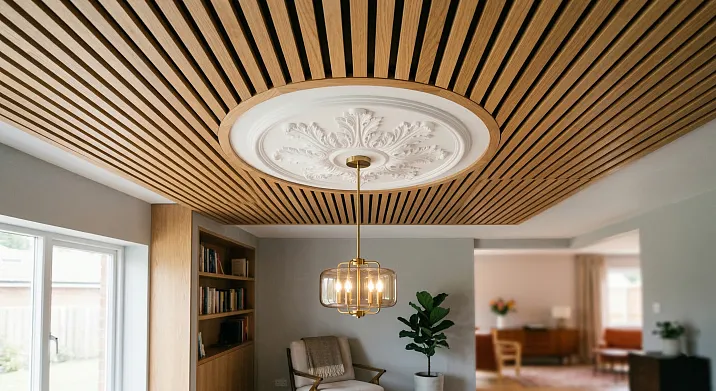
There are things that change the perception of space not by area or price—but by detail. A wardrobe front is one such detail. It occupies the vertical plane in the most noticeable place in the room, and how it is designed determines whether the wardrobe will be just furniture or become an architectural statement.Slatted panels for wardrobes—is one of the most precise tools for elevating an ordinary cabinet item to the level of a designer object. When combined withpolyurethane furniture decorthey form a front that looks more expensive than the cabinet, smarter than a box, and more interesting than the wall behind it.
This is not a theory about luxury renovation. It is a practice about how a correctly chosen front changes the interior of an entire room.


The front as the face of furniture: why the cabinet is secondary
When a buyer looks at a wardrobe, they see the front. The cabinet is merely a structural base hidden behind doors and side panels. This is why in professional furniture production there is a clear distinction: the cabinet carries the function, the front carries the image. Expensive Italian and German manufacturers have long mastered this principle: the same cabinet made of particleboard costs twice as much when fitted with fronts featuring expressive texture, proper ornamentation, and refined detail.
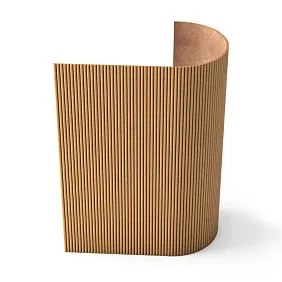
The slatted structure of the front is one of the most convincing visual techniques. Parallel vertical or horizontal slats create a rhythm that the human eye perceives as complexity, thoughtfulness, and expensive craftsmanship. Even if behind this front lies an ordinary particleboard box with shelves made of chipboard, the slatted surface does its job: it speaks of the owner's taste and the intention to make the interior authentic.




How does a slatted front differ from a smooth one?
A smooth front is neutral. It doesn't compete with the rest of the interior, doesn't set a rhythm, and doesn't create tension. It's a good choice for those who want the wardrobe to 'not get in the way.' But if the goal is to make the wardrobe part of the design, not just a functional box, the slatted structure solves this task with high efficiency.
Slats add three things that a smooth front lacks: texture, rhythm, and chiaroscuro. Texture makes the surface visually rich. Rhythm organizes perception—the eye moves vertically or horizontally depending on the direction of the slats. Chiaroscuro is the main effect: each slat casts a shadow on the adjacent one, and this interplay changes depending on the lighting angle, creating a lively, breathing surface.
Our factory also produces:

Where are slatted panels appropriate in furniture fronts?
A slatted structure is not a universal technique. It works in specific formats, with specific proportions, and in specific interior contexts. Understanding these conditions is the difference between a good result and a costly mistake.
Get Consultation
Built-in sliding wardrobes and walk-in closets
This is the most obvious and most rewarding context for a slatted front. A built-in wardrobe occupies an entire wall—from floor to ceiling—and is essentially an extension of the room's architecture. Slatted panels on the fronts of such a wardrobe transform it from a functional storage unit into a full-fledged architectural element of the wall.
Vertical layout works well here: slats running from bottom to top visually increase the ceiling height and make the wardrobe part of the vertical rhythm of the interior.Wooden slatted panels for a wardrobemade of oak or ash in such a context create the feeling that you're looking not at furniture, but at an element of the room's finish.
Freestanding wardrobes
A classic two- or three-door wardrobe with a slatted front is a piece that immediately stands out from the standard assortment. You want to look at such a wardrobe, you want to approach it closer. The slats make it resemble a piece of joinery art, even if the body is produced industrially from sheet material.
An important nuance: for a freestanding wardrobe, the scale of the slats is especially important. Narrow slats (20–30 mm) on a small 60 cm door create an overly saturated rhythm. The optimal slat width for a standard door is 40–60 mm with a spacing of 10–20 mm.
Commodes and cabinets
Horizontal slatted layout on low furniture — dressers, TV stands, bedside tables — creates an effect of Japanese furniture aesthetics: clean, laconic, with attention to detail. Horizontal slats on a low piece visually expand it, making it more monumental. This works especially well in living rooms and bedrooms in the wabi-sabi style, Scandinavian minimalism, or organic modernism.
Kitchen fronts
The kitchen is a complex context for wooden slatted fronts because wood requires protection from steam and grease. Nevertheless, lower cabinets with wooden slatted fronts, coated with high-quality oil or varnish, work excellently in kitchen spaces of Scandinavian and rustic character. Upper cabinets with slatted fronts create an interesting pattern on the upper half of the kitchen, echoing wooden countertops or shelves.
Libraries and shelving units with closed sections
In a library cabinet, some sections are closed with doors — and it is here that the slatted front works especially exquisitely. Through the gaps between the slats, the contents of the shelf — book spines, decorative objects — are visible, creating an effect of light mystery, where not everything is seen, but only a hint.
Which wardrobes particularly benefit from a slatted structure
Not every type of furniture is equally amenable to slatted transformation. There are several categories where this technique works with maximum effect.
Wardrobes with large flat fronts
A large flat surface without any relief is a visual void. If a cabinet has doors 60 cm wide and 210 cm high, the smooth surface of such a facade looks boring, cheap, and artificially neutral. A slatted structure immediately solves this problem: it fills the plane with rhythm, eliminates monotony, and makes a large facade interesting.
Cabinets made from budget materials
Paradoxically, it is the cheap LDF carcass with a slatted facade that looks the most convincing. The reason is simple: the slats completely obscure the visual information about the carcass material. The customer sees wood — natural texture, warmth, a living surface — and draws conclusions about quality and cost. A slatted facade is the most cost-effective way to increase the perceived value of furniture.
Old cabinets requiring updating
Restoring an old cabinet using slatted panels is a whole genre of interior DIY. The old facades are removed, slats are glued or screwed onto a base (MDF or plywood), the surface is stained or oiled — and an ordinary Soviet-era cabinet turns into a stylish item worthy of a modern interior.
It is important to understand:Wooden slat panels is a living material that requires proper preparation: acclimatization, treatment, correct fastening. Without this, the slats will warp, develop cracks in the glue, and lose their geometry.
How polyurethane decor is used in furniture
If slatted panels create rhythm and texture, then Polyurethane molding for furniture adds what slats inherently lack: ornamentation, classical detailing, a central focal point. These are two different languages, and the ability to speak both simultaneously is a sign of high design culture.
Overlay elements on facades
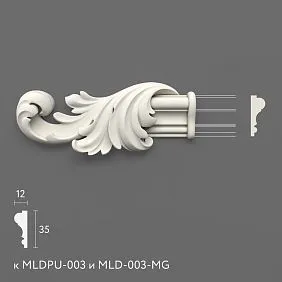
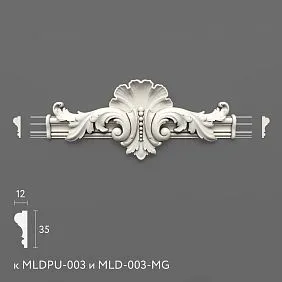
Polyurethane overlays — medallions, cartouches, corner ornaments, central rosettes — are mounted directly onto the door front over a smooth or slatted surface. This instantly gives the furniture a classic character. A polyurethane medallion in the center of a sliding wardrobe door transforms it from a modern minimalist piece into something reminiscent of traditional English joinery or Italian craftsmanship.
Moldings as frames for front sections
Polyurethane moldings — profiled trim elements — are used to create framed fronts. The molding is attached around the perimeter of the door, forming a frame around the central panel. The central panel can be smooth, milled, veneered, or — in our case — slatted. A frame made of polyurethane molding around a slatted panel is no longer just a front; it's a miniature architectural composition.
Pilasters and cornices
In classic wardrobe and cabinet furniture systemsdecoration for polyurethane furnitureincludes pilasters (vertical decorative columns) and cornices (top horizontal profile). A polyurethane pilaster installed between wardrobe sections visually breaks up a large front into architectural modules, similar to how columns divide a building facade. A polyurethane cornice along the top edge of the wardrobe gives it completeness and monumentality.
Key property of polyurethane for furniture
Polyurethane furniture decorpossesses a property critically important for furniture: it is not afraid of contact with surfaces made of different materials, does not react chemically with paints and varnishes, holds its shape excellently, and does not delaminate under normal temperature conditions. For furniture subjected to daily use — touches, vibrations from door openings, temperature fluctuations — this is the most important practical advantage.
Furthermore, polyurethane decor can be painted any color — from white to dark brown, from silver to matte black. This allows it to be integrated into any interior scenario without losing organicity.
Combining front rhythm and decorative overlays
This is where it gets really interesting. Slatted structure and polyurethane decor are not competitors or interchangeable elements. They are two levels of a single design system.
Level one: the rhythm of slats
Slats establish the basic rhythm of the facade. This is a repeating module that organizes the plane into movement. Rhythm is the first thing the eye perceives. Before seeing a detail, it sees the structure. A slatted surface immediately communicates: there is order here, there is rhythm, there is intent.
Level two: the accent of decor
Polyurethane decor is a disruption of the rhythm in a good sense. A medallion in the center of a slatted facade stops the gaze, creates a focal point. Corner ornaments mark the boundaries of the door. A cornice completes the movement from bottom to top. A pilaster divides sections. Each of these elements does not destroy the slatted rhythm—it organizes it, giving it architectural meaning.
The combination of the two levels works on the principle of jazz: there is a basic rhythm (slats) and there is improvisation (decor). The basic rhythm sets the structure, the improvisation sets the character.
How not to overload the facade
The most common mistake when combining slats and polyurethane decor is using too many elements simultaneously. Slats plus a medallion plus corner overlays plus a molding frame plus a cornice—this is not richness, it's chaos. Each element begins to compete with its neighbor, and the entire composition falls apart.
The golden rule: one active element per facade. If the facade is slatted—one polyurethane medallion or molding frame is enough. If the facade is framed by a molding frame—the slatted field inside the frame is already self-sufficient. Adding a central medallion is only worthwhile if the door is large enough (at least 70 cm in height and 50 cm in width) so that all elements have space between them.
What suits classic, neoclassical, and eclectic styles
The three most common styles in which slatted facades and polyurethane decor work differently require different approaches to proportions, ornamentation, and material.
Classic: Strictness and Symmetry
In a classic interior, furniture adheres to the laws of symmetry, proportion, and order. A slatted facade in the classic style always features vertical slats that imitate cast panels or column fluting. The slat width is moderate (40–60 mm), and the spacing is equal to the slat width or slightly less. The wood species used are dark oak, walnut, or cherry. The finish is oil or high-gloss lacquer.
Polyurethane molding for furniturePolyurethane decor is used abundantly in the classic style: molding frames, corner rosettes, central medallions with acanthus leaves or laurel wreaths. The polyurethane color is white, gold, or patinated silver. Everything should speak of tradition, artisanal precision, and respect for ornamental heritage.
Neoclassical: A Modern Interpretation of Tradition
Neoclassicism is classicism filtered through a modern lens. Here, there is less gold and more white. Fewer intricate ornaments, more clean profiles. The slatted facade in neoclassicism works with thinner slats (25–40 mm) and wider gaps—this creates a lighter, more airy surface than in traditional classicism.
Polyurethane decor in neoclassicism features minimalist moldings with simple profiles, small medallions with geometric patterns, and subtly protruding corner accents. The color is white to match the cabinet or a soft cream. Nothing excessive, but everything in its place.
Eclecticism: A Mix of Languages
Eclecticism is the freest and riskiest style in the context of furniture facades. Here, slats can be made of dark thermowood, while polyurethane decor is white or gold. Horizontal slats can be combined with vertical molding. Industrial metal in the framework and a classic polyurethane rosette can be used on a single piece.
Eclecticism works only when there is an internal logic behind the apparent freedom: one dominant style to which elements of another are added. If modernity dominates, classical decor is added as a quote, as irony. If classicism dominates, a modern detail introduces freshness without undermining the foundation.
Technical aspects: how battens are mounted on furniture fronts
Mounting batten panels on furniture fronts is technically simpler than mounting on walls or ceilings, but requires thoroughness and understanding of several key principles.
Base for battens
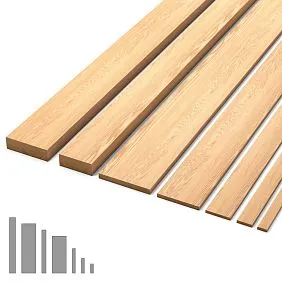
Battens are mounted on a base - most often MDF or plywood 16-18 mm thick. MDF is preferable to plywood for smooth surfaces: it is more even and accepts glue better. Plywood is stronger under load, so it is better to use it for heavy cabinet doors. The base must be absolutely flat and dry. Even a slight curvature of the base will be compensated by the battens, but only within certain limits - severe curvature cannot be corrected.
Plank mounting
Battens are fastened in two ways: with glue (finish parquet glue or wood glue like D3) and with hidden fasteners (clips). For furniture fronts, glue is most often used - it provides a thin and reliable seam without visible fasteners. Additional fixation with finish nails (2×25 mm) with countersunk heads solves the issue of clamping until the glue fully sets.
The spacing between battens should be the same along the entire height - this requires marking and a template. A deviation of even 1-2 mm is noticeable on the finished product and destroys the perception of an even rhythm.
Edge processing
The ends of the front - where the battens end and the base is visible. This is a critical point of quality. The ends are closed in several ways: with overlay battens, polyurethane molding, flexible wood veneer, or simply careful painting to match the color of the battens. A closed end is a sign of a finished product. An open end with visible batten cuts is a sign of incompleteness.
Final finishing
After mounting the battens, the entire surface is sanded with fine sandpaper (grit 180-240) along the grain. Then a finish coating is applied: oil, wax, varnish, or paint. Oil emphasizes the natural texture without creating a film. Varnish protects better but hides some of the tactile sensation. Paint (white, gray, graphite) completely changes the character of the batten - wood remains at the level of texture, but not color. White-painted battens are one of the most relevant trends in furniture fronts in recent years.
Furniture Front Overload Errors
Understanding mistakes is more valuable than any advice. We will talk about the most characteristic and painful miscalculations faced by those who work with batten fronts and polyurethane decor for the first time.
First mistake: too much decoration on a small front
A small cabinet door (40×60 cm) with a slatted surface, a molding frame, a central medallion, and corner overlays is overloaded. A small front cannot accommodate that much information. The eye doesn't have time to figure out what's important here and quickly gets tired. On small fronts, only one decorative level: either slats, or molding, or an overlay. Not all together.
Second mistake: different decorative styles on one item
An amazing paradox occurs: the owner, wanting to make the cabinet 'rich,' mounts slats in a Scandinavian spirit, baroque polyurethane medallions, and modern matte metal hardware on it simultaneously. The result is a stylistic conflict in which each element fights for attention and no one wins. The decorative style should be unified or, in the case of eclecticism, built on the principle of hierarchy.
Third mistake: mismatch between slat width and front size
A wide slat (80–100 mm) on a narrow door (45 cm) looks awkward — the slats barely fit in width, there are 4–5 of them, and the entire rhythm is lost. The optimal rule: the number of slats on a door should be at least 6–8 for the rhythm to be perceptible. For a door 45 cm wide, the optimal slat is 30–40 mm with a spacing of 8–12 mm.
Fourth mistake: wrong wood species for the context
Pine is an affordable, warm material, but with noticeable knots and resinousness. For a classic interior, pine slats look cheap. For rustic and country styles — perfect. Oak is noble, with a developed texture, suitable for modern and classic interiors. Ash is neutral, slightly beige, ideal for Scandinavian minimalism. Walnut is dark, heavy, for representative offices and classic bedrooms. The choice of wood species is not just about color, it's the character of the entire product.
Fifth mistake: poor-quality polyurethane decor
Cheap polyurethane is soft — it deforms under light pressure, loses shape when heated (for example, if the cabinet is near a radiator), yellows and cracks over time. High-quality polyurethane decor is dense, rigid, with clear edges of the ornament. Check when buying: press on the surface of the decor with your finger — it should not bend. The cut should be even, without bubbles or voids inside.
Practical Scenarios: Three Cases with Different Tasks
Case 1: Updating a Soviet-era Wardrobe
A large three-door wardrobe from Soviet-era stock, made of particleboard with smooth, dull-looking fronts. The task is to transform it without replacing the carcass.
Solution: Remove the old fronts, make new ones from 18 mm MDF, glue vertical light oak slats 40 mm wide with a 12 mm gap, finish with water-based oil. Each door gets a white polyurethane molding around the perimeter as a frame. The central door gets a small medallion with a simple ornament. All decorative surfaces are painted with white acrylic paint. Result: a wardrobe that looks like a piece from a Scandinavian-classic furniture brand.
Case 2: Built-in Walk-in Closet in a Neoclassical Interior
A floor-to-ceiling walk-in closet, 2.7 meters high, 4 meters wide. The task is to create furniture perceived as an architectural element of the wall.
Solution: Fronts made of MDF in the wall color (warm white NCS S 1002-Y), vertical slats made of painted MDF 30 mm wide with a 10 mm gap, matching the carcass color—a monochrome textured surface. Each door has a polyurethane molding with a classic profile, painted the same color. A polyurethane cornice along the top edge of the entire closet. Pilasters between sections in a classical order. Result: a walk-in closet indistinguishable from an architectural niche with molded panels.
Case 3: Study Library in Art Deco Style
A built-in library in a home study, the lower part with closed doors, the upper part with open shelves. The task is to create a prestigious, representative appearance.
Solution: Lower doors with horizontal slats made of thermowood 60 mm wide with a 20 mm gap—a graphic, almost metallic surface. Each door has a polyurethane medallion with a geometric Art Deco-style ornament, coated in matte gold. A polyurethane cornice with a geometric profile along the top edge of the lower block. Result: a library that looks more expensive than the apartment it's in.
Care for slatted facades with polyurethane decor
Proper care extends the life and beauty of furniture. A few practical rules.
Wooden slats coated with oil should be refreshed every 1–2 years — simply apply a thin layer of oil with a soft cloth. Slats coated with varnish need polishing once a year. Slats painted with paint are repainted as needed.
Polyurethane decor should be wiped with a damp cloth without abrasive cleaning agents. For stains — use a mild soap solution and immediately wipe dry. If the paint is damaged — perform local touch-up painting to match the main surface color.
Important: wooden facades do not tolerate direct water contact. Cabinets in bathrooms and near kitchen sinks require additional hydrophobic treatment or the use of WPC slats instead of solid wood.
Decor as an investment, not an expense
There is a common misconception: decor is superfluous. Furniture should be functional, and everything else is excess. This reasoning is correct for warehouse shelving and office storage systems. For living spaces, it kills the quality of the environment.
A person spends several hours at home every day — in the morning, evening, and on weekends. The quality of the visual environment directly affects well-being, mood, and the sense of value in one's own life. Furniture that is pleasant to look at, made beautifully and with intention — is an investment in quality of life.decoration for polyurethane furniture— is not a luxury or an extravagance. It is a tool for creating an environment where you want to be.
Slatted panels for cabinets are in the same category. They turn a functional item into an aesthetic object. And this transformation is worth every ruble invested in the right material.
Current Trends in Furniture Fronts 2025–2026
Designer fashion moves in cycles, but some trends become established for a long time — because they respond not to the moment, but to the deep-seated needs of a person.
Monochrome slatted fronts — slats painted to match the cabinet color, creating textural but not color contrast — are one of the most enduring trends in recent years. This solution works in any style and does not go out of fashion.
Mixed fronts — part of the door slatted, part smooth, separated by molding — are gaining popularity in neoclassical and modern classicism. This is a more complex solution requiring precise proportions, but delivering exceptional visual results.
Dark wood species on a light cabinet — thermowood or tinted oak on a white or cream cabinet — a graphic, modern, very strong technique. The slats become the main decor of the room, while the cabinet recedes into the background.
Natural oil finish without varnish — matte, tactile, alive. In an era of plastics and glossy laminates, a surface with a tangible texture is perceived as an exceptional value.
Frequently Asked Questions (FAQ)
Can slatted panels be installed on existing cabinets without removing the old fronts?
Yes, if the old fronts are flat, clean, and firmly attached. The slats are glued directly onto the old front with wood finish glue. However, this makes the door heavier — ensure the hinges can handle the additional weight.
What glue should be used for mounting slats on an MDF base?
Parquet glue on a water or polyurethane basis (D3/D4 according to EN 204). Avoid solvent-based glue — it can deform thin slats. Additional fixation — finish nails 1.6×35 mm with countersunk heads.
How to paint polyurethane decor already glued to the facade?
With water-based acrylic paint. Apply a thin layer of primer (universal acrylic), let it dry for 2 hours, then paint in 2–3 thin layers. Primer is important — without it, the paint will apply unevenly and may peel.
How often should the oil coating on wooden slats be renewed?
Every 1–2 years depending on intensity of use and room conditions. A sign that renewal is needed is loss of matte shine and a feeling of dryness on the surface.
What type of wood are slatted panels for cabinets most durable?
Oak and ash are the most durable in residential conditions. Thermowood surpasses them in dimensional stability. Pine is the least resistant to mechanical damage, but good in stable humidity conditions.
What size polyurethane medallion to choose for a cabinet door?
The diameter of the medallion should be 30–40% of the door width. For a door 60 cm wide — a medallion 18–24 cm in diameter. A medallion larger than half the door width looks overloaded.
Can slatted fronts be used in a children's room?
Yes, provided the coating is non-toxic (water-based oil, eco-friendly solvent-free varnish). Wood in a children's room creates a natural, warm atmosphere and withstands tactile contact well.
What is the difference between polyurethane decor and plaster molding in the context of furniture?
Polyurethane is 5–8 times lighter than plaster, which is critical for furniture. A plaster overlay on a cabinet door creates overload for the hinges. Polyurethane does not crumble from vibration when opening and closing doors. This makes it the only practical choice for furniture decor.
STAVROS: furniture begins with the material
Any interior object is first and foremost about the material. No matter how precisely the design is worked out, no matter how well-proportioned it is: if the material is of poor quality, the result will be disappointing. Wooden slats that warp after six months turn a beautiful concept into chaos. Polyurethane decor that yellows and cracks after a year makes furniture worse than it was before the 'improvement'.
STAVROS is a company that builds its reputation on material quality. Wooden slats undergo humidity, geometry, and texture control.Pogonazh iz massivaThese are slats with not a single unintended knot, not a single deviation from the stated cross-section. Polyurethane products are dense, with clear detailing, resistant to deformation, and compatible with any finishing coatings.
STAVROS understands a furniture facade as an architectural gesture. Here there areSlatted panels for wardrobesin a wide range of species and profiles, a full catalog offurniture decor made of polyurethane— from simple moldings to complex ornamental medallions — and full support in choosing a solution for a specific interior.
Furniture you're proud of starts with the right material choice. STAVROS makes that choice obvious.


