Article Contents:
- Raw Material Selection: Wood as the Foundation of Quality
- Quality Requirements for Wood Raw Materials
- Chamber Drying: The Precise Science of Moisture Management
- Conditioning and Stabilization After Drying
- Processing on High-Precision Equipment
- Sanding and Surface Preparation
- Assembly Without Compromise
- Documentation and Traceability
- Door Molding Production: Precision and Aesthetics
- Door Molding Kit Assembly
- Finishing Coatings: Protection and Decorative Appeal
- Staining and Toning
- Packaging and Logistics
- STAVROS Product Range
- Specialized products
- Molding and Furniture Integration: A Comprehensive Approach
- Frequently Asked Questions About Molding Production
- Conclusion: STAVROS Company – The Quality Standard in Molding Production
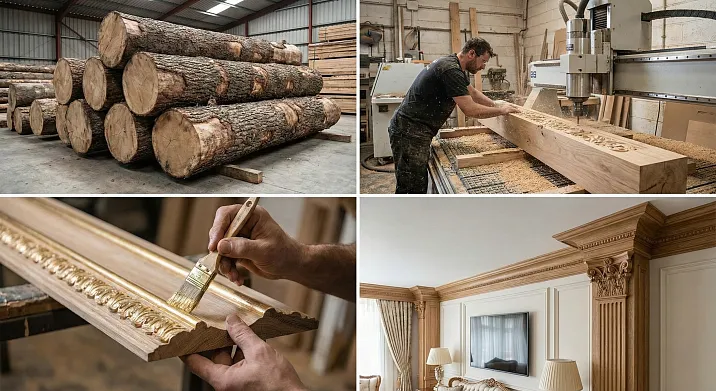
The quality of an interior is determined not only by the overall design concept but also by the precision in executing the details that form the completeness of the space.Trimming Items— baseboards, cornices, door casings, moldings, battens — act as connecting elements between architectural planes, creating transitions, accents, and frames. Their presence transforms a set of surfaces into a cohesive architectural composition.Production of trim elementsrepresents a complex technological process where each stage critically influences the final product quality. From selecting wood in the forest to packaging the finished item — dozens of operations, hundreds of control parameters, and numerous technological decisions determine whether the molding will become an interior decoration or a source of disappointment.
STAVROS specializes in producing moldings from solid natural wood and modern composite materials, offering professional builders, designers, and private clients products that meet the strictest quality standards. Years of experience working with noble wood species — oak, beech, ash — combined with modern high-precision equipment and a well-established quality control system enablemolding manufacturerto create products that last for decades, maintaining impeccable appearance and geometric precision. Understanding the entire production cycle helps the client make informed material choices, assess quality, and form realistic expectations for the products.


Raw Material Selection: Wood as the Foundation of Quality
The path to creating quality molding begins long before the production equipment starts — in the forests where the wood for future products grows. The choice of species is determined by technical characteristics, aesthetic qualities, and resource availability. Oak — the king among hardwoods — has a density of 700-800 kilograms per cubic meter, the highest hardness, and natural resistance to moisture and biological damage due to tannins in its structure. Its expressive texture with clear annual rings and medullary rays makes every meter of oak molding a unique natural work of art. The golden-brown color palette ranges from light honey to rich chocolate shades, creating a warm, noble atmosphere in the interior.
Beech competes with oak in strength characteristics, with a density of 680-720 kilograms per cubic meter and a uniform fine-pored structure. A distinctive feature of beech wood is the almost complete absence of contrasting annual ring patterns, creating a calm, visually homogeneous surface. The light pinkish hue of natural beech fills the space with soft warmth, perfectly matching Scandinavian and modern aesthetics. Beech's excellent workability allows for creating complex profiles with fine details that would be challenging in harder wood species.
Ash combines the mechanical strength of oak with light shades close to beech. Its density is 650-700 kilograms per cubic meter, yet the wood possesses exceptional elasticity and impact toughness. The contrasting texture with pronounced annual rings creates a dynamic, graphic pattern attractive for modern interiors. The light beige with grayish undertones of ash lacks the yellowness characteristic of oak, making it an optimal choice for cool color schemes.




Quality Requirements for Wood Raw Materials
The harvesting of wood for molding production follows strict requirements for the quality of the raw material. The timing of felling critically affects wood properties — winter harvesting is preferable because during this period the tree is dormant, moisture content is minimal, and the likelihood of fungal infection is reduced. The trunk diameter determines the possibility of obtaining wide boards without knots — for molding production, trees with a diameter of 40 centimeters or more are preferred, aged 80-120 years for oak, 60-80 years for beech and ash.
Log sawing is performed using various methods depending on the required material characteristics. Radial sawing — where the cutting plane passes through the heart of the trunk — yields the most stable wood with minimal tendency to deform, but is the least economical in terms of material yield. Tangential sawing — parallel to the bark — provides maximum yield, but the boards are more prone to warping. Semi-radial sawing represents a compromise between stability and economy, and this type of material is most often used in producing quality molding.
Sorting lumber based on the presence of wood defects — knots, cracks, resin pockets, rot, wormholes — separates the raw material into grades. First grade is practically free of visible defects or contains a minimal number of healthy, light-colored knots of small diameter. Second grade allows for more knots, minor cracks, and some color inconsistencies. Third grade may contain loose knots, through cracks, and traces of biological damage. For producing quality visible molding, primarily first grade is used; hidden structural elements may be made from second grade.
Our factory also produces:


Chamber Drying: The Precise Science of Moisture Management
Freshly cut wood contains 50-80 percent moisture relative to its own weight, making it unsuitable for producing millwork. During natural drying, the material loses moisture, shrinks in volume, and changes geometry. If this process occurs in a finished product already installed in an interior, deformations, cracking, joint separation, and coating delamination are inevitable. Kiln drying—a technological process for accelerated moisture removal from wood under controlled conditions—ensures achieving an optimal operational moisture content of 8-10 percent in a relatively short time without critical damage to the material.
Modern drying kilns are sealed chambers equipped with heating, humidification, ventilation, control, and parameter logging systems. Wood is stacked in piles with spacers between boards to ensure circulation of heated air around each piece. The drying schedule—a sequence of changes in temperature, relative air humidity, and air velocity—is individually tailored for each wood species, considering initial moisture content, material thickness, and final moisture requirements. Oak is dried at a temperature of 50-55 degrees Celsius with a gradual reduction in relative air humidity from 80-90 percent at the start to 30-40 percent at the end.
Moisture control during drying is carried out by periodically weighing control samples or using moisture meters that measure the electrical resistance of wood, which depends on moisture content. Under-drying the material leads to problems in finished products during use—warping, cracking, delamination as shrinkage continues. Over-drying makes wood brittle and prone to cracking upon subsequent humidification to equilibrium moisture content. The optimal final moisture content formolding products, intended for heated rooms, is 8-10 percent—this moisture content corresponds to the equilibrium state of wood at room temperature of 20-22 degrees and relative air humidity of 40-60 percent.
Get Consultation
Conditioning and Stabilization After Drying
Removing material from the drying kiln does not mean it is ready for immediate processing. Freshly dried wood is in a non-equilibrium state—a moisture gradient between surface and inner layers, internal stresses that arose during drying require time to relax. Conditioning—holding the dried material under normal atmospheric conditions of the production workshop for several days—allows the wood to stabilize, equalize moisture across its thickness, and relieve internal stresses. This stage is especially important for hardwoods—oak, beech, ash—where internal stresses are most significant.
Acclimatization of material under future operating conditions is an additional stage used for particularly critical products. If millwork is intended for rooms with non-standard climatic conditions—high humidity in bathrooms, low humidity in rooms with intensive heating—the material is held in conditions as close as possible to operational ones, achieving equilibrium moisture content specifically for these conditions. This approach guarantees minimal dimensional changes after installation but requires additional time and storage capacity, which is reflected in the cost.
Processing on High-Precision Equipment
The prepared material enters production workshops equipped with machines for various types of processing. Primary processing—planing and milling of base surfaces—creates precise planes and edges that serve as the foundation for subsequent operations. A thickness planer processes the wide planes of the workpiece, ensuring parallelism of opposite sides and precise thickness with a tolerance down to tenths of a millimeter. A jointer creates a perfectly flat base plane and an edge perpendicular to it. These operations are critical for obtaining a quality profile in subsequent stages—any unevenness or deviation in the base surfaces is replicated in the finished product.
Profiling—creating the decorative relief of millwork—is performed on four-sided planer-moulders or multi-spindle milling centers. A four-sided machine processes the workpiece from four sides in one pass, forming a complex profile with repeat accuracy from part to part within hundredths of a millimeter. Material feed speed, rotation speed of milling spindles, geometry, and sharpening of the tool are parameters that determine surface quality and process productivity. Too high a feed speed creates a rough surface with visible machining marks; too low reduces productivity and can lead to wood scorching from friction.
Milling knives—the main tool for creating the profile—are made from high-quality tool steel with carbide-tipped cutting edges. A set of knives for one profile can include from two to eight spindles, each processing a specific section of the profile. The precision of manufacturing and setting the knives determines the quality and uniformity of finished products. Regular knife sharpening—every few hundred linear meters of processing—maintains sharpness of cutting edges and processing quality. A dull tool does not cut but crushes wood fibers, creating a fuzzy surface unsuitable for finishing.
Polishing and surface preparation
After profiling, millwork undergoes sanding to remove minor processing defects and prepare the surface for applying protective coatings. Sanding is performed on specialized machines with profile sanding heads that replicate the geometry of the processed profile. Using flat sanding belts on profiled products is unacceptable—they smooth out the relief, blur the clarity of lines created by milling.
The sanding sequence includes rough processing with 80-100 grit abrasive to remove significant defects, intermediate sanding with 150-180 grit abrasive to level the surface, and finish processing with 220-240 grit abrasive to obtain a smooth surface ready for finishing. Each stage removes traces of the previous one, gradually improving surface quality. Attempting to reduce the number of sanding stages leads to visible scratches on the final surface, especially noticeable after applying transparent coatings.
Removing wood dust between sanding stages and after finish processing is critical for the quality of subsequent finishing. Dust remaining in pores and recesses of the profile creates coating defects and reduces adhesion of varnishes and paints. Industrial dust extraction systems with cyclone separators ensure effective air cleaning in production areas and simultaneously collect valuable secondary raw materials—wood dust and chips used for producing fuel briquettes or particleboard.
Multi-stage Quality Control
The quality control system permeates the entire production cycleproduction of molding products, starting from raw material acceptance and ending with packaging of finished products. Incoming inspection checks compliance of incoming material with technical requirements—wood species, grade, moisture content, presence of unacceptable defects. Moisture is measured with electronic moisture meters, and readings are recorded in the incoming inspection log. A batch of material with moisture content above 12 percent or below 6 percent is sent for additional drying or humidification and is not allowed into production until normative indicators are achieved.
Operational control is carried out during processing at each technological step. The first part after machine setup is checked especially thoroughly—all profile dimensions are measured, surface quality and geometric accuracy are verified. This part serves as a standard for the entire batch and is retained for periodic comparison during processing. The machine operator performs visual inspection of each part, identifying obvious defects—chips, scorch marks, missed machining. Questionable parts are passed to the quality control department inspector for detailed evaluation.
Final acceptance inspection of finished products verifies compliance of items with technical specifications and standards. Several samples are randomly selected from the batch and subjected to detailed measurement of all parameters—length, width, profile height, radii of curves, angles of inclination. Calipers, micrometers, specialized templates replicating the profile geometry are used. Visual inspection assesses surface cleanliness, presence of wood defects, finish quality for painted items. Only products that have passed all control stages are allowed for packaging and shipment to customers.
Documentation and Traceability
Each production batch is accompanied by documentation recording all production parameters—raw material batch number, date and drying schedule, equipment and tools used, control results at each stage. This system ensures full traceability of the product from finished goods back to the source material, allows analysis of potential defect causes, identification of systematic problems, and improvement of technological processes. In case of a customer complaint, the manufacturer can precisely determine at which stage the problem arose, whether it was a result of process violation or poor-quality raw material.
Statistical analysis of quality control data reveals trends and tendencies, warning of potential problems before they lead to mass defects. A gradual deterioration of any parameter—for example, an increase in profile size deviation—signals the need for tool sharpening, equipment adjustment, or verification of measuring instruments. Proactive quality management is more effective than reactive—preventing defects is cheaper than correcting them in finished products.
Door Millwork Production: Precision and Aesthetics
Door trim production requires particular dimensional accuracy and the highest surface quality, as these products are at eye level, subjected to frequent tactile contact, and play a key role in the perception of a door opening. Casing trims frame the door leaf, conceal the installation gap between the frame and wall, and create a visual transition between planes. Casing width is typically 60-90 millimeters, thickness—10-15 millimeters, profile varies from simple rounded forms to complex multi-stage compositions with carved elements.
Door jamb extensions—additional planks that widen the door frame when wall thickness exceeds the standard frame depth—must precisely match the main frame in color and texture. Extension width is selected individually for each opening; the standard range includes planks from 50 to 200 millimeters wide in 10-20 millimeter increments. Extension thickness corresponds to frame thickness—typically 28-32 millimeters—ensuring tight fit and visual unity of the door unit.
Thresholds complete the door opening at the bottom, create a barrier against drafts and acoustic permeability, and can serve as guides for sliding doors. Threshold material must have high wear resistance, as it is subjected to intensive mechanical impact from constant foot traffic through the doorway. Oak thresholds, due to the hardness of the wood, last decades without visible wear, while products made from softwoods or composite materials may require replacement after several years of use.
Door Millwork Set
A complete door millwork set includes all elements necessary for decorating a door opening in a unified style. Consistency of profile, color, and texture creates visual integrity, turning a utilitarian structure into an architectural element of the interior.Manufacturer of trim offers door trim collections where casing, extensions, thresholds, and baseboards are executed in a unified style, simplifying selection and guaranteeing harmonious results.
The possibility of manufacturing door millwork to custom sizes and profiles expands design possibilities. Non-standard casing width, unique profile shape, special requirements for color finishing—all this is realized within custom orders. The minimum production volume for custom profiles is usually 100-200 linear meters, which is related to costs for manufacturing special tooling and equipment setup.
Finishing Coatings: Protection and Decorative Appeal
Natural wood requires protection from moisture, ultraviolet radiation, mechanical damage, and contamination. The choice of coating type is determined by operating conditions, aesthetic preferences, and project budget. Oil coatings penetrate the wood structure, highlight the grain, and create a matte or satin surface. Oil does not form a surface film, preserves the tactile feel of the wood, and is easily renewed by local application. The disadvantage of oil coatings is relatively low resistance to moisture and dirt, requiring periodic renewal every 2-3 years for heavily used surfaces.
Wax compositions create a thin hydrophobic layer on the surface, protecting the wood from moisture more effectively than pure oil. Wax imparts a soft, silky sheen to the surface, pleasant to the touch and visually noble. Combined oil-wax coatings combine the penetrating protection of oil with the surface barrier properties of wax, providing comprehensive protection while preserving the natural appearance of the wood.
Varnish coatings create a durable protective film on the wood surface, providing maximum resistance to mechanical impact and moisture. Modern water-based polyurethane varnishes are environmentally safe, have no strong odor, and dry quickly. The degree of gloss varies from deep matte to high gloss, allowing for various visual effects. Matte varnishes preserve the natural look of the wood, glossy ones emphasize color depth and grain, creating a more formal appearance.
Painting and Staining
Opaque painting with enamels completely hides the wood grain, creating a uniform color surface. This option is relevant for moldings made from less decorative wood species, products with natural wood defects, and interiors where a specific color accent is required. The wide palette of enamels allows for any shade—from classic white to deep dark tones and bright accent colors.
Tinting with stains or colored oils changes the shade of the wood while preserving the visibility of the grain. This allows for imitation of expensive exotic species, creation of color variations of one species, and adaptation of the shade to match existing furniture or finishes. Oak is easily tinted in a wide range from light bleached to almost black ebony. Beech takes warm tones well—from natural pinkish to rich walnut and reddish mahogany.
Packaging and logistics
Finished products require reliable packaging that protects against damage during transportation and storage.Trimming Itemsare packaged in shrink film, forming compact bundles of standard length—usually 2.2-2.5 meters. The ends are protected with cardboard or plastic caps, preventing damage to the most vulnerable parts. The packaging marking contains complete product information—article number, wood species, profile, length, quantity, and production batch number.
Transportation of moldings requires compliance with certain conditions. Long-length cargo requires specialized transport with the ability to place products at full length without bending. Humidity and temperature in the vehicle must be controllable—sharp fluctuations can lead to condensation on the product surfaces and damage to the coating. Protection from mechanical damage is ensured by proper stacking of bundles, use of spacers, and securing the load to prevent shifting.
Warehouse storage requires dry, ventilated premises with controlled humidity. Bundles are stacked horizontally on pallets or racks; tilting or bending under their own weight is excluded. The warehouse accounting system ensures quick search of required items, stock rotation on a 'first in, first out' basis, and minimization of storage time. Efficient logistics allowsmolding manufacturerto fulfill orders in short timeframes, delivering products throughout Russia and CIS countries.
STAVROS Product Range
Baseboards of various profiles and sizes form the lower horizontal element of wall architectural design. Baseboard height varies from compact 40-50 millimeters for minimalist interiors to monumental 120-150 millimeters for classic spaces with high ceilings. The profile can be laconic—a simple rounding of the top edge—or complex multi-step with classic architectural elements—beads, coves, shelves. Material—solid oak, beech, ash, or MDF with various finishing options.
Cornices form the upper transition from wall to ceiling, creating the architectural crown of a room. Cornice width from 50 to 200 millimeters determines its degree of visual significance. Narrow cornices create a delicate line in the upper zone, wide ones form an expressive horizontal line, visually lowering the ceiling height. Cornice profiles are usually more complex than baseboard ones, include more architectural elements, and create a deeper play of light and shadow.
Moldings are universal decorative strips for framing panels, mirrors, paintings, and creating geometric compositions on walls and ceilings. Molding width is usually less than that of baseboards and cornices—from 20 to 80 millimeters—allowing for delicate decoration without visual overload. Profiles vary from minimalist rectangular-section strips to elegant classic forms with carved elements.
Specialized products
Strips and bars of various cross-sections serve as universal material for slatted walls, ceilings, furniture production, and joinery work. Cross-section varies from thin strips 10x10 millimeters to massive bars 60x60 millimeters. Length is standard—2-3 meters—or custom-made. The surface can be sanded or planed depending on the intended use.
Balusters for stairs and balcony railings are manufactured by turning on lathes or milling on multi-axis machining centers. Classic turned forms with alternating thickenings and thinnings create a traditional look; modern prismatic forms correspond to minimalist aesthetics. Baluster height is standardized—usually 900 millimeters for stair railings—or made to order.
Furniture legs of various styles and sizes expand possibilities for independent furniture making or updating. The catalog includes classic turned legs with carved elements, modern geometric forms, and minimalist cones. Leg height ranges from compact 50 millimeters for low items to full-size 700-800 millimeters for tables and consoles.
Integration of Moldings and Furniture: A Comprehensive Approach
Unity of materials and style between architectural design and furniture creates integrity in the interior solution.STAVROS furnitureFurniture made from the same wood species as the moldings naturally integrates into the space. Oak baseboards and trims harmonize with an oak table or shelving unit, beech strips on walls echo beech chairs, creating a visual connection between different elements of the setting.
The possibility of ordering moldings and furniture with a unified type of finish—identical tinting, type of varnish coating, degree of gloss—ensures maximum consistency. Discrepancies in shades and finishes, even when using the same wood species, disrupt harmony and create a feeling of a random set of elements. A professional approach involves planning all wooden interior elements as a single system.
Comprehensive solutions for certain types of spaces—classic studies, modern living rooms, Scandinavian bedrooms—include curated collections of moldings and furniture where all elements are coordinated in style, scale, and color scheme. The customer receives a ready-made solution, eliminating the need for independent selection, risks of mismatch, and time spent searching.
Frequently Asked Questions about Moldings Production
What is the difference between solid wood and MDF moldings?
Solid wood has natural grain, uniqueness of each item, the possibility of multiple surface renewals by sanding, environmental friendliness, and durability. MDF provides perfect geometric stability, uniformity of color and structure, the possibility of creating complex profiles unachievable in solid wood, and a more affordable price. The choice depends on priorities—the naturalness and prestige of solid wood or the practicality and economy of MDF.
What wood moisture content is optimal for moldings?
For rooms with normal climate—8-10 percent, which corresponds to equilibrium moisture content at a temperature of 20-22 degrees and relative air humidity of 40-60 percent. For damp rooms, the material should have a moisture content of 10-12 percent. Using under-dried material leads to shrinkage and deformation after installation; over-dried material leads to cracking upon humidification.
How to check the quality of moldings when purchasing?
Inspect the geometry—place several planks side by side, check the profile identity. Check moisture content with a moisture meter—should be 8-12 percent. Assess surface quality—there should be no fuzziness, chips, or burns. Check for absence of wood defects—through knots, cracks, rot. A qualityManufacturer of trimprovides certificates of conformity and a product warranty.
Can trim be painted after installation?
Yes, but painting before installation is preferable when all surfaces of the product are accessible. After installation, treating the back side, ends, and hard-to-reach areas of the profile becomes difficult. Factory finishing ensures uniform coating, professional quality, and durability guarantee. On-site painting requires thorough surface preparation, carefulness, and protection of adjacent surfaces from contamination.
How much trim should be ordered with a margin?
It is recommended to add 10-15 percent to the calculated length for trimming, possible cutting errors, and installation damage. For complex profiles with numerous joints, the margin may be 15-20 percent. Purchasing material from a single batch guarantees color and shade uniformity—trim from different batches may vary slightly, which will be noticeable after installation.
Conclusion: STAVROS Company is the quality benchmark in trim production
Production of trim elements—is a synthesis of traditional woodworking craftsmanship and modern high-precision processing technologies. Each stage of the production cycle critically influences the quality of the final product, and compromises at any stage inevitably affect the characteristics of the finished items. Selecting quality raw materials, proper drying, processing on modern equipment, and multi-stage quality control—these components define the difference between trim that will last for decades while maintaining impeccable appearance, and material that requires replacement after a few years of use.
STAVROS Company has specialized for many years in the production ofmolding productsfrom noble wood species, constantly investing in the development of production capacities, personnel training, and technology improvement. Modern software-controlled drying chambers, high-precision four-sided machines from leading European manufacturers, automated finishing lines, and a computerized quality control system—the technological equipment of the production meets world standards.
A wide product range—from classic baseboards and casings to specialized furniture elements—allows for the implementation of any interior projects using products from a single manufacturer. Guaranteed quality, stability of characteristics, the possibility of manufacturing items to individual parameters, professional consulting support, and prompt logistics—a comprehensive set of services that makes STAVROS a reliable partner for professional builders, interior designers, and demanding private clients.
ChoosingTrimming ItemsandSTAVROS furniture, you are investing in quality tested by time, in the beauty of natural materials, and in the reliability of production technologies. Create interiors worthy of admiration using products that embody the best traditions of woodworking and the advanced achievements of modern industry. Entrust your space to professionals, choose STAVROS—the trim manufacturer, where quality is not declared but guaranteed at every stage of production.