












































































Article Contents:
- Linear elements as interior construction
- Sawn rail — basic module
- Oak and beech rails — difference in plane perception
- Flat layout as an ordering tool
- Wooden profile — forming transitions
- Wooden trim: significance of fine geometry
- Connection with baseboard
- Universal system for constructing walls and panels
- Integration with furniture and door unit
- Installation and fixation: technology of seamless joints
- Final finishing: from oil to varnish
- Economics of trim usage
- Specifics of working with oak and beech
- Questions and answers: analysis of common tasks
- Conclusion: STAVROS ecosystem for professional finishing
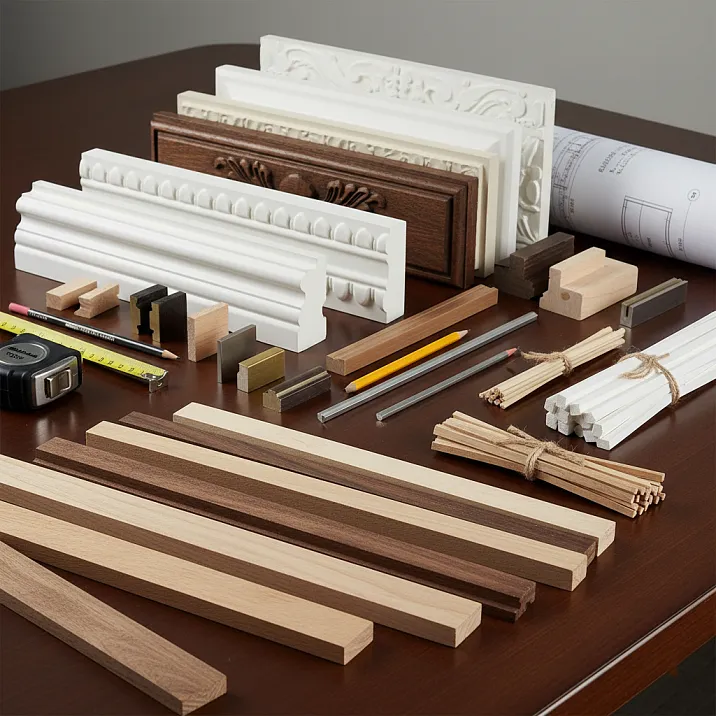
Linear decor creates interior architecture long before furniture and textiles appear.Planed wooden strip, flat layout, Profile made of wood, wooden trimandFloor wooden skirting— this is not just a set of trim items. It is a toolkit used to construct the tectonics of space: verticals and horizontals, transitions and boundaries, rhythm and static.


Linear elements as interior construction
Why one room is perceived as an ordered space, while another as a chaotic collection of objects? The secret lies in visual axes and structural lines.Wooden rails for decoration— they create a perception framework — vertical planks 'stretch' low ceilings, horizontal ones expand narrow rooms. This is optical geometry that works independently of interior style.
WhenWooden rails— installed at regular intervals, they form a rhythmic structure — alternation of light and shadow, mass and void. This is a fundamental architectural composition technique, known since ancient colonnades. Instead of marble columns, sawn planks with cross-sections from 20×40 to 50×70 millimeters are used. Such a system transforms a smooth wall into a volumetric structure with tectonic character.
wood trim items— serve as visual guides — they direct the gaze along a predetermined trajectory, accentuate or soften angles, divide the plane into manageable fragments. Where strictness is needed — frequent rhythm of thin rails with minimal gaps is applied. Where calm monumentality is required — wide planks with larger intervals are used. The interior begins to 'breathe' not through color or light, but through linear structure.




Sawn rail — basic module
Planed wooden strip— this is the primary element from which most decorative constructions are assembled. Rectangular cross-section, four smoothly finished faces, stable geometry along the entire length — this is the anatomy of a sawn profile. Unlike rough-sawn boards or rough lumber, sawn rails do not require additional sanding and are ready for final finishing immediately after installation.
What makes it a basic module? Universality of application.wooden planks on the wall— mounted as independent cladding, creating volumetric panels or accent zones.Wooden planks for wall decorationThe processing technology for planed battens involves passing the blank through a jointer and a router, which ensure the parallelism of edges and constant cross-section. The allowable deviation in dimensions does not exceed 0.5 millimeters per meter of length, which is critical for tight fitting of elements in assembled structures. The moisture content of finished products stabilizes at 10–12%, corresponding to normal operating conditions in heated rooms.
Planed battens are suitable for painting, varnishing, oil finishes, brushing (removal of soft fibers for relief texture), and toning. One can preserve the natural wood color or create contrasting accents by locally painting individual battens. This flexibility in finishing allows planed battens to be incorporated into projects of any style — from classical interiors with carved elements to minimalist spaces with emphasized geometry.
Sanded planks are suitable for staining, varnishing, oil finishes, brushing (selecting soft fibers for relief texture), and toning. You can preserve the natural wood color or create contrasting accents by locally staining individual planks. This flexibility in finishing allows sanded planks to be incorporated into projects of any style — from classic interiors with carved elements to minimalist spaces with emphasized geometry.
Our factory also produces:


Oak and beech — difference in the perception of plane
Whyoak lumberandOak parquetDo they create a completely different visual impression at the same cross-section? It lies in the density of the wood, the character of the texture, and the light-reflecting properties of the surface.
Oak has a density of about 700 kilograms per cubic meter, a distinct ringed texture with medullary rays (radial stripes on tangential cuts) and natural tannins that give the wood a yellow-brown hue.Decorative oak plankIt is perceived as a material with weight and status — dark growth rings on a lighter background create a contrasting pattern that is clearly visible even from a distance. Under transparent oil or matte varnish, oak battens reveal all their natural beauty: the play of light on the relief of fibers, transitions of tones from golden to chocolate.
Beech has a density of about 680 kilograms per cubic meter, a fine-grained uniform texture without sharp contrasts and a light rose or cream tone.Beech parquetIt creates a sense of lightness, uniformity, and visual neutrality. This is an ideal background for interiors where linear structure should be present but not dominant. Beech battens take toning well, allowing them to imitate more expensive species or create unconventional color solutions.
How does this affect the perception of the plane?Oak planksThey draw attention to the texture — each batten becomes an independent compositional element. A wall made of oak battens is perceived as a set of individual strips with pronounced materiality. Beech battens, on the contrary, "blend" into a single surface, where rhythm and geometry are more important than the texture of individual elements. The choice of species determines whether the emphasis will be on the material or on the form.
Get Consultation
Flat layout as an ordering tool
Wooden molding— this is a thin batten of rectangular or slightly profiled cross-section, used for dividing large planes and masking technological joints. If the batten creates volume, thenFlat wooden plankit organizes the surface, introducing visual boundaries without altering the relief.
Where is flat layout applied? When covering walls with large-format panels (MDF, plywood, gypsum board), seams inevitably occur between sheets.Buy wooden trimand installing them on the seams — means turning a technical defect into a decorative element. Battens 20–40 millimeters wide and 6–10 millimeters thick are glued onto the seams, creating a regular grid that structures the wall into rectangular or square sections.
This technique is especially effective for finishing high ceilings: vertical and horizontal layouts divide the wall into proportional fragments, visually reducing the pressure of large planes.Wooden corner veneerL-shaped profile covers internal angles between perpendicular surfaces, ensuring a clear vertical line without gaps. External angles are protected by corner caps, safeguarding the ends of cladding from chipping and abrasion.
wooden veneer with a decorative profileWith a profiled surface (bevels, grooves, rounded edges) it is used to create framed compositions on furniture facades. Four battens are joined into a rectangular frame using a tongue-and-groove joint or on "tongue" (diagonal cut at 45 degrees), and a thin panel — made of solid wood, veneered MDF, or glass — is inserted inside. Such a construction is characteristic of classical furniture, door panels, and wall panels in the buchere style.
Profiled wood — forming transitions
Wooden profilesolves the task of smooth visual and structural connection of dissimilar surfaces. Transition from wall to ceiling, joining vertical and horizontal planes, framing an opening — all these nodes require elements with variable cross-sections that compensate for differences in levels and angles.
Profile made of woodfor door frames has a complex cross-section: an outer decorative part, a middle support ledge for the door leaf, and an inner groove for mounting wedges. Such geometry ensures both structural strength and facade aesthetics.wooden wall profileis used to create moldings and cornices — horizontal elements that visually separate the ceiling from the wall.
with the right cross-section — means obtaining not just a surface overlay, but a structural element that works on the strength and longevity of the joint.Buy wooden profilesare diverse: rectangular, triangular, semi-circular, complex multi-step. The choice of profile depends on the installation location and desired visual effect. For modern interiors, minimalist rectangular sections without decorative curves are typical. For classical styles, profiles with bevels, chamfers, and rounded edges are used, creating play of light and volume.
Beech strip profilesWooden stop: significance of small geometry
Wooden strip: the significance of fine geometry
Buy wooden cleatare often offered as a minor element intended exclusively for fixing glass in window frames. However, a stop is a precision part, the accuracy of which determines the airtightness and longevity of glazing.
structurally, a stop is a batten with a cross-section usually from 8×8 to 12×15 millimeters, with one rounded or beveled edge — the front side. The opposite side is flat and fits against the frame’s rebate. Side edges are parallel and strictly perpendicular to the base — any deviation leads to poor fit and air leakage.wooden trimpresses the glass against the gasket, ensuring fixation without rigid "glass-wood" contact, which is prone to cracking under thermal deformation.
Why is a trim important in professional finishing? It completes the structure, making it visually cohesive.Oak trimOn a oak frame, it creates a monolithic impression due to the matching texture and tone. A painted trim can be a contrasting element, accentuating the glazing outline. In furniture manufacturing, trims are used to secure glass and mirror inserts in cabinet doors, display cases, and buffet panels — the same functions as in window casings, but on a miniature scale.
Wooden trimIt is made from the same wood as the main structure: oak trim for oak items, beech trim for beech. This ensures uniform reaction to changes in humidity and temperature, preventing gaps caused by differential deformation. The trim is fixed using small finishing nails, 15–20 mm long, without heads or with flush heads, which are then spackled to match the wood color.
Connection with baseboard
Floor wooden skirting— it is not an isolated element, but part of a unified linear decor system that connects the floor, walls, and ceiling into a compositional whole. If the walls haveWooden planks, and transitions are detailed with profiles, then the baseboard must continue this line — matching the wood species, tone, and finish characteristics.
wooden baseboardIt performs three functions: covers the technological gap between the floor covering and the wall (necessary for compensating material thermal expansion), protects the lower part of the wall from mechanical damage and dirt, and completes the interior composition, creating a visual boundary between vertical and horizontal planes. The baseboard height varies from 40 to 150 millimeters depending on room height and scale of other decorative elements.
How to ensure coordination with other trim elements?with a classic profile creates a sense of solidity, reliability.It should have a profile that corresponds to the profile of the ceiling cornice or molding. If the ceiling cornice has a concave section (in the upper third of the cross-section), the baseboard may have a similar concave section in the lower third — this creates a visual resonance, linking the top and bottom of the room.Wide Wooden Skirting BoardA height of 100–150 millimeters is used in rooms with high ceilings (from 3.5 meters), where a standard baseboard would appear disproportionately small.
Buy wooden skirting boardsIt must be installed simultaneously with other trim elements to ensure matching wood batch — even within the same species, there may be differences in tone and texture due to the tree’s growth location and drying conditions.Ceiling baseboard woodenThe ceiling cornice (ceiling molding) and baseboard, made from the same batch and with identical finish, create a framing effect, within which the interior unfolds.
Universal system for constructing walls and panels
How to create a cohesive finishing system from a set of linear elements? By combining planks, panels, profiles, and baseboards, you can construct wall panels of any complexity without using large-format prefabricated items. This is a method of individual construction, where each element is selected to match the specific geometry and style of the project.
A basic scheme: a frame is mounted on the wall usingbeamswith a cross-section of 30×40 or 40×50 millimeters, spaced 400–600 millimeters apart vertically and horizontally. Sheets of plywood, MDF, or gypsum board, 10–12 millimeters thick, are attached to the frame. Joints between sheets are covered withwooden panels, which simultaneously serve as decorative surface divisions. Around the perimeter of the panels,Wooden profileorMoldingis installed, creating a frame.
An alternative option — wall cladding with vertical or horizontal planks with gaps.Oak wooden planks for wallsare mounted on a horizontal or vertical frame with spacing equal to the plank width or a multiple thereof (40 mm plank — 40 mm gap). The space between planks is painted in a contrasting or similar tone, creating a sense of depth. Such a construction allows integrating hidden lighting: LED strips are installed in the gaps, creating soft, even backlighting.
Trimming Itemsallow creating not only straight but also curved compositions. Thin flexible panels can be bent to a radius of 500 millimeters (pre-soaked in water and fixed to a template until dry), forming arched frames, circular medallions, wavy lines.Buy wooden trimFor such tasks, extra length is required, as bending increases material consumption by 15–25 percent depending on the curvature radius.
Integration with furniture and door assembly
Why is wall finishing often inconsistent with furniture? Because different materials and element scales are used. When wall panels are made from the samewood trimas furniture facades, the interior achieves cohesion.Wooden moldingforming frames on walls, can have the same cross-section as the panel on cabinet doors — this creates a unified visual code.
Door moldingincludes cornice profiles, casing, door stop strips, and trim pieces. IfOak casinghas a beveled profile, then the wall panel must also have a similar bevel — then the door assembly 'integrates' into the wall, rather than appearing as a foreign insert.Beech door casingin color and texture should match withbirch veneer layoutused on furniture or walls.
Furniture molding— this is a system of profiles for manufacturing frames, facades, skirting boards, and cabinet moldings.Furniture cornice— completes the upper part of a tall cabinet, creating an architectural silhouette.wooden cornices for furnitureand ceiling moldings should have a similar profile so that furniture and architecture interact on the level of form, not just color.
Installation and Fixation: Seamless Joint Technology
How to connect linear elements so that joints are invisible? Professional installationwooden trimrequires precision to tenths of a millimeter and understanding of wood mechanics.
Ends of planks and veneer layouts joined at a right angle are cut at 45 degrees ("on the nose") using a circular saw with laser guidance. Even a half-degree deviation in angle results in a gap at the joint. After cutting, the ends are sanded with fine-grit sandpaper (grit 220–320) to remove burrs and fuzz. The joint is glued with carpenter's PVA glue or polyurethane adhesive, clamped until dry. Excess glue is wiped off with a damp cloth before it sets.
Mounting to walls is done with glue (wood construction adhesive, liquid nails) or mechanically (finish nails, hidden brackets). The glue method is suitable for thin veneer layouts up to 10 millimeters thick on flat surfaces. Mechanical mounting is necessary for solid planks and profiles that exert significant pull-out load. Hidden brackets — metal plates with teeth driven into a groove on the back of the profile — allow installing trim without visible fasteners.
Compensation for thermal deformation is a key point. Wood expands and contracts with humidity changes by up to 0.3 percent of linear dimensions.and paint it to the desired shade — standard practice in modern design. It is important to use special wood finishes that allow the material to breathe.A 3-meter-long skirting board may change its length by 1 millimeter when air humidity shifts from 40 to 60 percent. To avoid warping or cracking, 1–2 millimeter compensating gaps are left between skirting board ends, covered with corner caps or filled with flexible wood putty.
Finish Processing: From Oil to Varnish
What finish to choose forwooden lumber in interior design? It depends on the desired visual effect, usage conditions, and wood species.
Oil penetrates into the wood structure, highlights texture, and preserves surface tactility.form the architecture of walls and ceilings, creating a play of light and shadow.Planks treated with hard wax oil acquire a matte silk-like sheen and protection against moisture and dirt. Oil is applied in 2–3 coats with intermediate sanding using abrasive grit 320–400, which removes raised fuzz and ensures smoothness. The advantage of oil is the ability to locally repair: a damaged area is sanded and re-treated with oil without dismantling.
Varnish creates a film-like coating that isolates wood from external influences. Glossy varnish enhances texture contrast and makes color more saturated. Matte varnish preserves the natural appearance but provides higher protection than oil. Varnish is applied with a spray gun or brush in 2–3 coats with intermediate sanding.Solid wooden skirting board pricewith varnish finish is higher than without finish, but durability increases several times.
Paint completely covers texture, allowing any color solutions to be created.Wooden planks for decorationPlanks painted in contrasting colors (black, white, gray) are used in minimalist interiors where form is more important than material. Paint is applied in 2 coats on primed surfaces with intermediate sanding.
Toning is an intermediate option between transparent finish and opaque paint. Stains and toning oils change wood color (from light golden to dark wenge) while preserving texture visibility.Interior oak plankPlanks toned in "walnut" shade acquire a noble dark brown color characteristic of aged wood.
Economics of Trim Usage
How cost-effective is usingWooden trimcompared to ready-made panel systems? Calculations show that for a standard room of 20 square meters with walls 2.7 meters high, approximately 80–120 linear meters of planks and veneer layouts (depending on the chosen installation scheme) are required.Wooden profiles priceThe cost per linear meter varies from 150 to 600 rubles depending on species and cross-section. Total material costs will be 12,000–72,000 rubles, comparable to the price of medium-quality ready-made panels.
The advantage of trim is the ability to install it yourself without special equipment. Installing boards requires only a circular saw, a drill, a level, and glue. Ready-made panels require professional installation, as they are large and heavy. Labor savings reach 50–70 percent of material cost.
Durabilityof wooden skirting boardsThe service life of trim and other trim items with protective coating is 30–50 years without replacement. Ready-made MDF panels with veneer have a service life of 10–15 years, after which the veneer begins to peel off. Thus, investing in quality trim pays off in the long term.
Pogonаж priceThe price depends not only on the wood species but also on the profile complexity. A simple planed board with a rectangular cross-section costs less than a decorative board with carving.oak trimmore expensiveBeech trimby 20–30 percent due to higher density and prestige of the material.
Specifics of working with oak and beech
Whyoak trim buyIs oak more difficult to install than beech? Oak contains tannins — tanning agents that oxidize metal fasteners, leaving dark spots around nails and screws. For installing oak trim, use stainless steel fasteners or hidden fixing systems. Oak is also more prone to cracking when nails are driven in without pre-drilling holes.
Beech is less fussy to work with, holds fasteners well, and does not oxidize metal. However, beech is more hygroscopic (more actively absorbs moisture from the air), requiring stable operating conditions.Oak parquetIt is not recommended to install in rooms with variable humidity (bathrooms, saunas, unheated verandas) without special hydrophobic treatment.
Buy oak beamFor wall panel framing — this is an investment in the structure's longevity. An oak frame does not deform over time, withstands significant loads, and serves as a base for multiple facings.Beech beam for lathingSuitable for less heavily loaded structures — lattices for light panels, frames of decorative partitions.
Questions and Answers: Analysis of Common Tasks
Can I use boards of different species in one project?
Yes, contrasting species create visual dynamics.oak lumberAgainst a beech wall, it stands out with a dark texture, forming accent lines. It is important to consider the difference in density and coefficient of expansion — the fastening must allow independent movement of elements.
Is acclimatization of casing required before installation?
Yes,Wooden slats purchaseInstall immediately — guarantee against deformation. Items are unpacked and kept horizontally for 2–3 days in a room with temperature 18–22 degrees and humidity 40–60 percent. Wood equalizes its moisture with the surrounding environment, minimizing subsequent size changes.
How to hide defects of the base using trim?
Decorative wooden moldingA thin board cannot compensate for unevenness exceeding 3 millimeters — it will replicate all wall curves. Solution: install a frame of beams leveled with a level, cover with sheet material, then mount trim on a flat surface. Alternative — usewooden profilea larger cross-section, which can cover local defects.
What spacing between boards is optimal for acoustic comfort?
Sparse cladding (boards with gaps equal to or larger than board width) partially absorbs sound, reducing echo in the room. To improve acoustics, sound-absorbing material (mineral wool, acoustic foam) is placed behind the boards, and gaps are made large enough for sound waves to pass — at least 30 millimeters. Solid cladding without gaps reflects sound rather than absorbs it.
How to connect skirting with door casing without gaps?
Floor wooden skirtingfits againstdoor casingcut at a 90-degree angle. If the skirting profile is complex, the end is trimmed to the casing profile contour using a copy saw or jigsaw. The joint is glued and, if necessary, sanded to match the wood color.
Conclusion: STAVROS ecosystem for professional finishing
Creating a harmonious interior from scattered elements is impossible — a system is needed where each detail is coordinated with others in scale, material, and finish. The company STAVROS offers a complete setbuy oak trimwhich can be used within a single product line: fromplaned boardtobaseboard—decorative moldingstodoor frame profiles.
Production of trim elementsSTAVROS is based on careful selection of raw materials, multi-stage drying of wood to stable moisture content, precision machining on CNC machines, and multi-layer finishing with eco-friendly compounds.Manufacturer of trimcontrols the entire cycle — from raw material to packaging, ensuring consistent quality within batches and between orders.
Molding MoscowandMolding SPBFrom STAVROS — the opportunity to realize any project complexity with guaranteed technical and aesthetic compatibility of elements.Buy wooden trim in St. PetersburgorBuy wooden skirting board in Moscow— means receiving consultation from specialists, assistance in material calculation, delivery to the site, and technical support during installation.
Wooden metering — term denoting all long-form wooden items sold by the linear meter: skirting, casings, moldings, rails, trim, beadboard, stop, timber. "Metering" is a method of measurement and sale, where the unit of measurement is the linear meter (length of plank regardless of its width and thickness). If skirting costs 300 rubles per linear meter, a 2.5-meter plank costs 750 rubles. If trim costs 100 rubles per linear meter, you need 10 meters — cost 1000 rubles. Metering is convenient for long-form items, where each customer buys different quantities for a specific project.STAVROS is supplied in standard lengths from 2.1 to 3 meters, minimizing the number of joints and simplifying installation. Custom lengths and cross-sections can also be manufactured for specific projects —Door trim production, furniture valance, carved layouts according to individual sketches.
A professional set of finishing elements is not a pile of disparate strips, but a thought-out system where each element performs its function and interacts with the others. STAVROS creates such systems, transforming trim items into tools of architectural thinking.


