Article Contents:
- How to Calculate Square Meterage: Room Mathematics
- Basic Formula for Baseboards
- Allowance for Corners and Miter Cuts
- Calculation for Panel Molding on Wall Panels
- Calculation for Rafter Molding Structures
- Wood vs. Polyurethane Comparison: Price Table
- Baseboards
- Ceiling Baseboards (Crown Molding, Cornices)
- Panel Molding
- Planks
- Cost of work
- Impact of Profile and Height on Material Consumption
- Simple vs. Decorative Profile
- Height and Width: Material Volume
- Special Elements: Corners, End Caps
- Finishing and Repair Cycle in Budget
- Primary Finishing
- Service Life and Renewal
- Repairability
- Logistics: Weight, Packaging, Transportation
- Material Weight
- Packaging and Protection During Transport
- Transport for Remote Regions
- Typical Room Configurations and Their Costs
- Configuration 1: One-Room Apartment, 42 sq. m
- Configuration 2: Living Room with Bouclé, 4×5 meters
- Configuration 3: Rafter Molding Wall in Bedroom, 3×2.7 meters
- Optimization: Where to Save Without Losing Aesthetic
- Strategy 1: Combining Materials
- Strategy 2: Replacing Oak with Beech
- Strategy 3: Simplifying Profile
- Strategy 4: DIY Painting
- Strategy 5: Bulk Purchasing
- Strategy 6: Local Application of Expensive Solutions
- Final Estimate: Calculation Template
- Section 1: Measurements
- Section 2: Materials
- Section 3: Works
- Section 4: Additional Expenses
- Section 5: Total Amount
- FAQ: answers to common questions
- Conclusion: Estimate as a Tool for Decision-Making

Money loves accounting, and professional repair begins with an accurate estimate. When choosing between wooden and polyurethane trim, the decision is often made emotionally — whether you like wood or want to save money. But a professional approach requires calculations, figures, and understanding of the total cost of ownership for years ahead.Price of wooden skirting per meterThis is merely the tip of the iceberg. Underwater are reserves for trimming, work, covering, transport, and replacement cycles. We will break down each expense item, create a calculation system that will allow you to make a well-considered decision.


How to calculate square footage: Room geometry
The first step in creating an estimate is an accurate calculation of the required amount of material. An error here means either downtime (not enough material) or inefficient spending (buying excess).




Basic formula for baseboards
Baseboard runs along the perimeter of the room, abutting walls. The basic formula is simple:
Room perimeter = (Length + Width) × 2
Example: Room 4×5 meters
Perimeter = (4 + 5) × 2 = 18 meters
But this is the perimeter of the walls. From it, we must subtract door openings, where baseboard is not installed.
Net perimeter = Wall perimeter - Door opening width
Standard door opening — 80–90 cm. If the room has one door 90 cm wide:
Net perimeter = 18 - 0.9 = 17.1 meters
This is the amount of baseboard that will actually be installed. But you need to buy more.
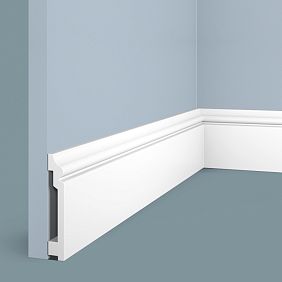
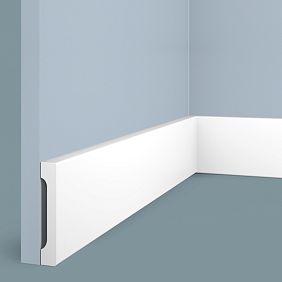
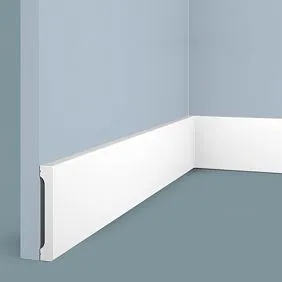
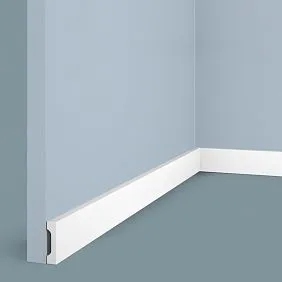
Our factory also produces:

Allowance for corners and trimming
When baseboards meet at corners, a 45-degree bevel cut (butt joint) is used. Each corner joint 'eats' material — a piece is cut at an angle, leaving a triangular scrap.
For an 80 mm wide baseboard, each corner joint consumes approximately 8 cm of material (baseboard width = hypotenuse length of the triangle when cut at 45 degrees). In a rectangular room, 4 corners × 2 joints per corner = 8 joints × 0.08 m = 0.64 meters of loss for corners.
Additionally, an allowance is needed for possible cutting errors, material defects, and fitting on uneven walls. Standard allowance — 10–15% of the net perimeter.
Final square footage = Net perimeter × 1.15
For our example: 17.1 × 1.15 = 19.7 meters. Round up to 20 meters.
Get Consultation
Calculation for wall panel layouts
The layouts on panel systems form a grid. You need to calculate the total length of all horizontal and vertical lines of this grid.
Example: wall 4×3 meters, panels 1×1.2 meters (4 panels horizontally, 3 vertically).
Horizontal layout lines:
-
Top boundary: 4 meters
-
Bottom boundary: 4 meters
-
Intermediate dividers between 3 rows: 2 lines × 4 meters = 8 meters
-
Total horizontal: 4 + 4 + 8 = 16 meters
Vertical layout lines:
-
Left boundary: 3 meters
-
Right boundary: 3 meters
-
Intermediate dividers between 4 columns: 3 lines × 3 meters = 9 meters
-
Total vertical: 3 + 3 + 9 = 15 meters
Total layout length: 16 + 15 = 31 linear meters
With 15% allowance (corners, trimming): 31 × 1.15 = 35.7 meters, rounded to 36 meters.
Calculation for lath structures
Laths are usually installed parallel (all vertical or all horizontal). The calculation depends on the installation spacing.
Example: vertical laths on a 3×2.7 meter wall (width × height), laths with 40×40 mm cross-section, spacing 80 mm (40 mm lath + 40 mm gap).
Number of laths = Wall width / Spacing = 3000 mm / 80 mm = 37.5 laths, rounded to 38 pieces
Length of each lath = Wall height = 2.7 meters
Total lath length: 38 × 2.7 = 102.6 linear meters
Allowance here is minimal (5%), as laths are cut to size without complex joints: 102.6 × 1.05 = 107.7 meters, rounded to 108 meters.
Comparison: wood vs polyurethane — price table
Now that the material quantities are calculated, we compare material costs. Prices are current as of early 2025 and may vary depending on region, manufacturer, and purchase volume.
Baseboards
| Type | Width (mm) | Wood pine (rub/m) | Wood beech (rub/m) | Wood oak (rub/m) | Polyurethane (rub/m) |
|---|---|---|---|---|---|
| Simple flat | 60-70 | 150-250 | 400-600 | 600-900 | 120-200 |
| Decorative | 80-100 | 250-400 | 600-900 | 900-1400 | 200-350 |
| Wide decorative | 120-150 | 400-600 | 900-1400 | 1400-2200 | 350-550 |
Ceiling moldings (crown, cornices)
| Type | Width (mm) | Wood pine (rub/m) | Wood beech (rub/m) | Wood oak (rub/m) | Polyurethane (rub/m) |
|---|---|---|---|---|---|
| Simple | 40-60 | 120-200 | 350-550 | 550-850 | 100-180 |
| Decorative | 60-100 | 200-350 | 550-900 | 850-1400 | 180-400 |
| Ornamented | 100-150 | 350-600 | 900-1500 | 1400-2400 | 400-900 |
Tiling
| Type | Width (mm) | Wood pine (rub/m) | Wood beech (rub/m) | Wood oak (rub/m) | Polyurethane (rub/m) |
|---|---|---|---|---|---|
| Flat | 10-20 | 60-100 | 150-250 | 250-400 | 50-100 |
| Flat | 30-40 | 100-180 | 250-400 | 400-650 | 100-180 |
| Decorative | 40-60 | 180-300 | 400-700 | 650-1100 | 180-350 |
Planks
| Cross-section (mm) | Wood pine (rub/m) | Wood beech (rub/m) | Wood oak (rub/m) |
|---|---|---|---|
| 20×40 | 80-140 | 220-350 | 350-550 |
| 30×40 | 120-200 | 300-480 | 480-750 |
| 40×40 | 160-260 | 380-600 | 600-950 |
| 40×60 | 200-320 | 480-750 | 750-1200 |
Polyurethane planks are almost not produced - for plank structures, wood or MDF is used.
Cost of work
Installation - a significant expense that cannot be ignored.
| Type of work | Wood (rubles/m) | Polyurethane (rub/m) |
|---|---|---|
| Installation of baseboard | 150-250 | 100-180 |
| Installation of ceiling molding | 200-350 | 120-200 |
| Installation of tiling | 180-300 | 120-200 |
| Installation of planks | 250-400 | - |
| Wood finishing | 120-200 | - |
| Painting with enamel | 150-250 | 100-180 |
Wooden trim is more expensive due to the greater weight of the material, the need for mechanical fastening (self-tapping screws, finishing nails), and more careful fitting of joints. Polyurethane is lighter, glued only, joints are simpler.
Impact of profile and height on cost
Not all trim items cost the same at equal length.Pogonаж priceIt depends on the complexity of the profile and the cross-section dimensions.
Simple vs. decorative profile
A simple flat molding (rectangular cross-section) is 40-80% cheaper than decorative (with moldings, coves, curves) due to manufacturing technology.
Flat profile is produced by simple planing on a four-sided machine - one pass, ready. Decorative requires milling - more complex processing, more time, more waste (more material is removed during milling).
For wooden items, profile complexity linearly affects price. For polyurethane, the effect is less (molding allows creating complex shapes without significant cost increase), but it exists - complex shapes require more expensive molds.
Height and width: material volume
The wider and thicker the profile, the more material per linear meter, the higher the price. But the dependence is not linear.
A 100 mm wide molding costs 1.5-1.7 times more than a 50 mm molding, not twice. This is because cost includes not only materials, but also processing, packaging, logistics - expenses weakly dependent on size.
For estimating, it's important to understand: choosing a wide molding instead of standard increases the budget by 30-50%, not 100%.
Special elements: corners, plugs
In addition to straight sections, special elements are needed for corners, ends, and joints.
For polyurethane, pre-made corner elements (internal and external 90-degree corners) are available. The price of a corner element is the same as 15-30 cm of straight profile. For a standard room (4 corners × 2 elements per corner) = 8 corner elements. If straight profile costs 300 rubles/m, corner element costs 60-90 rubles, total for corners 480-720 rubles.
For wood, pre-made corners are rare; corners are usually formed by beveling straight sections at 45 degrees. There are no additional material costs, but there are losses from trimming (accounted for in a 15% reserve).
End caps for wooden baseboards with cable channels - 30-60 rubles per piece. For a room with one door, 2 caps are needed.
Finishing and repair cycle in the budget
Initial material cost - not the whole truth. The cost of ownership over the service life is important.
Initial finishing
Wooden trim can be sold in three variants:
-
Unfinished - the cheapest, requires finishing (sanding, priming, varnishing, or painting) - adds 150-300 rubles/m to the cost
-
Varnished - 30-50% more expensive, but ready for installation
-
Painted with enamel - 40-60% more expensive, ready for installation
If you buy unfinished, you save on material but spend on finishing. If you buy ready-made, you pay more for material but save on labor.
Polyurethane is always sold unfinished (primed). Painting is mandatory - adds 100-250 rubles/m depending on profile complexity and number of layers.
Service life and renewal
Wooden trim from oak or beech lasts 40-80 years. After 15-20 years, surface renewal (resanding, new varnishing) may be needed - costs 30-40% of initial installation. After 30-40 years - second renewal. Total over 40 years: initial cost + 2 renewals × 35% = 170% of initial cost.
Polyurethane trim lasts 20-30 years. Renewal is problematic (sanding removes surface layer, revealing gray polyurethane). Replacement is usually needed after 20-30 years. Total over 40 years: initial cost + full replacement after 25 years = 200% of initial cost.
Considering long-term perspective, wooden trim may prove more economical with renewals.
Repairability
Local damage (deep scratch, chip, dent):
Wood - damaged area can be sanded, spackled, and locally repainted. Repair cost - 500-1500 rubles per area. Result - practically invisible restoration.
Polyurethane - spackling on polyurethane doesn't hold well and is more noticeable. Often, damaged area requires replacement (removal of 1-2 meters, installation of new). Cost - 1000-3000 rubles per area.
Logistics: weight, packaging, transport
Logistics - hidden expense often overlooked in estimates.
Material weight
One meter of wooden baseboard from oak, 80 mm wide, 18 mm thick, weighs about 850-950 grams. For a room with 18 meters of clean perimeter + 15% reserve = 20.7 meters, weight 17.6-19.7 kg.
One meter of polyurethane baseboard of the same width weighs 120-180 grams. 20.7 meters = 2.5-3.7 kg.
Weight difference - 6-fold. This affects:
-
Delivery cost (for remote regions, weight is critical)
-
Transportation ease (3 kg is easy to transport by car, 20 kg requires a truck or multiple trips)
-
Installation labor intensity (lighter material is easier to lift and hold)
Packaging and protection during transport
Wooden trim requires careful packaging. Boards are placed on rigid pallets with spacers between layers and wrapped with stretch film. Improper transportation may cause deformation (especially for long boards 2.5–3 meters).
Polyurethane is more resistant to transportation loads but is brittle to point impacts (may develop chips). Simpler packaging — cardboard boxes or film.
Packaging cost is usually included in the price, but when picking up yourself, you need to consider the need for careful transportation.
Transport for remote regions
For Moscow and St. Petersburg, delivery is usually included in the price or costs symbolically (500–1500 rubles). For remote regions, transportation may amount to 10–30% of the material cost.
Example: order of oak trim for 50,000 rubles, weight 80 kg, delivery to Yekaterinburg by transport company — 3,500–5,000 rubles. Order of polyurethane trim for 20,000 rubles, weight 15 kg, delivery — 1,200–1,800 rubles.
In a comparative estimate for remote regions, you must include the full cost of delivery.
Typical room configurations and their cost
To make the estimate specific, let’s consider typical rooms with exact cost calculations.
Configuration 1: One-room apartment 42 sq. m
Layout:
-
Room: 5×4 meters
-
Kitchen: 3×3 meters
-
Hallway: 2.5×1.8 meters
-
Bathroom: 2×2 meters
-
Ceiling height: 2.7 meters
Task: install baseboards throughout the apartment, ceiling moldings in the room and kitchen.
Baseboard calculation:
Perimeters:
-
Room: (5+4)×2 - 0.9 (door) = 17.1 m
-
Kitchen: (3+3)×2 - 0.8 (door) = 11.2 m
-
Hallway: (2.5+1.8)×2 - 0.9 (room door) - 0.8 (kitchen door) - 0.9 (entrance door) = 6 m
-
Bathroom: (2+2)×2 - 0.7 (door) = 7.3 m
Total clean perimeter: 17.1 + 11.2 + 6 + 7.3 = 41.6 m
With 15% allowance: 41.6 × 1.15 = 47.8 m, rounded to 48 m
Ceiling molding calculation:
-
Room: (5+4)×2 = 18 m
-
Kitchen: (3+3)×2 = 12 m
-
Total: 30 m, with 10% allowance (ceiling moldings join more easily) = 33 m
Wood estimate (oak):
Oak baseboard 80 mm decorative: 48 m × 1100 rub/m = 52800 rub
Oak ceiling molding 60 mm plain: 33 m × 700 rub/m = 23100 rub
Floor installation: 48 m × 200 rub/m = 9600 rub
Ceiling installation: 33 m × 250 rub/m = 8250 rub
Finishing (if not painted): (48+33) m × 150 rub/m = 12150 rub
Total wood: 105900 rubles
Polyurethane estimate:
Polyurethane baseboard 80 mm: 48 m × 280 rub/m = 13440 rub
Polyurethane ceiling molding 60 mm: 33 m × 150 rub/m = 4950 rub
Floor installation: 48 m × 140 rub/m = 6720 rub
Ceiling installation: 33 m × 150 rub/m = 4950 rub
Painting: (48+33) m × 120 rub/m = 9720 rub
Total polyurethane: 39780 rubles
Polyurethane savings: 66120 rubles (62% cheaper)
Configuration 2: Living room with boiserie, 4×5 meters
Task: create classic boiserie with wooden panels in the lower zone (height 110 cm), framed by wainscoting, polyurethane moldings in the middle zone, polyurethane ceiling cornice.
Calculation:
Wooden boiserie panels: perimeter (4+5)×2 = 18 m × 1.1 m height = 19.8 sq.m
MDF panels with oak veneer: 19.8 sq.m × 2500 rub/sq.m = 49500 rub
Wooden wainscoting for framing panels (grid of 4 fields of 4 m and 5 fields of 1.1 m):
Horizontal: (4+4+4) m = 12 m
Vertical: (1.1+1.1+1.1+1.1+1.1+1.1) m × 5 strips = 33 m
Total wainscoting: 45 m with 15% reserve = 52 m
Decorative oak wainscoting 40 mm: 52 m × 550 rub/m = 28600 rub
Polyurethane moldings in middle zone (3 vertical frames 80×120 cm):
(0.8+1.2)×2×3 = 12 m, with reserve = 14 m
Polyurethane molding 50 mm: 14 m × 250 rub/m = 3500 rub
Polyurethane ceiling cornice 100 mm: 18 m × 600 rub/m = 10800 rub
Panel installation: 19.8 sq.m × 800 rub/sq.m = 15840 rub
Wainscoting installation: 52 m × 200 rub/m = 10400 rub
Installing polyurethane molding: 14 m × 150 rub/m = 2100 rub
Installing cornice: 18 m × 180 rub/m = 3240 rub
Wood finishing: (19.8 sq.m to be treated as 60 linear m of panel perimeter + 52 m of layouts) × 150 rub/m = 16800 rub
Polyurethane painting: (14+18) m × 130 rub/m = 4160 rub
Total for living room: 144940 rubles
Alternative - fully polyurethane solution (imitation of panels using 3D polyurethane panels):
The cost would be around 80000 rubles, but loss of wood's materiality, tactile quality, and status.
Configuration 3: Recessed wall in bedroom, 3×2.7 meters
Task: vertical oak planks 40×40 mm, spacing 80 mm, on accent wall.
Calculation:
Number of planks: 3000 mm / 80 mm = 37.5, rounded to 38 pieces
Length of each: 2.7 m
Total length: 38 × 2.7 = 102.6 m, with 5% reserve = 108 m
Price of wooden stripOak 40×40: 108 m × 750 rub/m = 81000 rub
Lattice (40×40 beams, 4 horizontal pieces at 3 m each): 12 m × 450 rub/m = 5400 rub
9 mm acoustic felt: 3 m × 2.7 m = 8.1 sq.m × 800 rub/sq.m = 6480 rub
Installing lattice: 12 m × 100 rub/m = 1200 rub
Installing planks: 108 m × 300 rub/m = 32400 rub
Oiling the planks: 108 m × 180 rub/m = 19440 rub
Total for recessed wall: 145920 rubles
There are practically no polyurethane alternatives for recessed structures — this is a wooden territory.
Optimization: where to save without losing appearance
Smart optimization allows reducing the budget by 20-40% without visual losses.
Strategy 1: Combining materials
Wood where tactile quality and visibility matter (baseboards, lower wall zones, furniture elements). Polyurethane where material is not critical (ceiling elements, upper wall zones, decorative moldings).
Example for a one-room apartment:
-
Baseboard: oak (tactile zone) - 52800 rub
-
Ceiling baseboard: polyurethane (high, not touched) - 4950 rub
-
Savings vs. fully oak solution: 23100 - 4950 = 18150 rub
Strategy 2: Replacing oak with beech
Beech is 25-35% cheaper than oak with practically identical mechanical properties. Visually, the difference is imperceptible under painting or tinting.
Example for living room with boiserie:
-
Beech panels instead of oak: saving 30% on panels = 14850 rub
-
Beech wainscoting instead of oak: saving 30% = 8580 rub
-
Total savings: 23430 rub
Strategy 3: Simplifying the profile
Decorative profile is 40-60% more expensive than flat. If the interior style allows (minimalism, Scandinavian, modern), choosing flat profiles significantly reduces the budget without sacrificing quality.
Example for a one-room apartment:
-
Flat oak skirting board 80 mm instead of decorative: 700 rub/m instead of 1100 rub/m
-
Savings on 48 meters: 48 × 400 = 19200 rub
Strategy 4: DIY painting
Painting/varnishing - 15-25% of material + labor cost. If you have skills and time, you can save by painting yourself.
Required: compressor with spray gun (rent 1500 rub/day) or quality brushes and rollers, painting space, time (2-3 days with drying).
Savings for a one-room apartment (wooden solution): 12150 rub (labor) - 3000 rub (equipment rental and materials) = 9150 rub.
Strategy 5: Bulk purchases
When ordering large volumes (from 200 linear meters), manufacturers offer 10-20% discounts. If renovating multiple rooms or can team up with neighbors, savings are substantial.
Strategy 6: Local application of expensive solutions
It is not necessary to install beadboard walls or boiserie in all rooms. One accent wall with an expensive solution (oak planks, classic boiserie) + other walls simple (painted, with polyurethane moldings) create visual richness within a limited budget.
Final estimate: template for calculation
For self-calculation of the estimate, use the following structure:
Section 1: Measurements
-
Room perimeter: ______ m
-
Minus door openings: ______ m
-
Net perimeter: ______ m
-
15% allowance: ______ m
-
Final area: ______ m
Section 2: Materials
| Item Name | Quantity (m) | Price per m (rub) | Total (rub) |
|---|---|---|---|
| Baseboard | |||
| Ceiling molding | |||
| Layouts | |||
| Rails | |||
| Corner elements (pcs) | |||
| Other | |||
| Materials total: |
Section 3: Works
| Item Name | Quantity (m²) | Price per unit (RUB) | Total (rub) |
|---|---|---|---|
| Baseboard installation | |||
| Installation of tiling | |||
| Installation of planks | |||
| Panel installation | |||
| Finishing/coating | |||
| Work total: |
Section 4: Additional expenses
| Item Name | Total (rub) |
|---|---|
| Fasteners (screws, nails, glue) | |
| Spackle, sealants | |
| Primers, paints, varnishes | |
| Delivery | |
| Unexpected expenses (5-10%) | |
| Total additional: |
Section 5: Total amount
| Section | Total (rub) |
|---|---|
| Materials | |
| Works | |
| Additional expenses | |
| TOTAL: |
FAQ: answers to frequently asked questions
Why is polyurethane cheaper than wood by 2-3 times, but the difference in the final estimate is smaller?
Because the final estimate includes labor, covering, additional materials. Polyurethane installation is 30-40% cheaper, but painting is mandatory (for wood, varnishing is optional). As a result, the difference in the final estimate is 40-60%, not 200-300%.
Can you save money by buying second-grade wood instead of first-grade?
Yes, but with caveats. Second-grade wood allows for small knots and minor texture defects. Savings are 20-30%. Suitable for elements under covering paint (texture will be hidden). For lacquered elements, better to choose first-grade — defects will be visible.
Which is cheaper in the long run — wood or polyurethane?
Over a 30-40 year horizon and under the condition of renewing wooden elements (resanding, new coating every 15-20 years), wood may be comparable in cost to replacing polyurethane twice. But if the horizon is 10-15 years (typical repair cycle in modern apartments), polyurethane is more economical.
How to minimize waste when purchasing material?
Plan cutting to account for standard lengths (2000, 2400, 3000 mm). Use offcuts for short sections (near doors, in niches). Order material with a 10-15% reserve, but no more — excess reserve = wasted money.
Is delivery included in the material price?
It varies among sellers. Large manufacturers in Moscow and St. Petersburg often include city delivery. Regional suppliers usually charge delivery separately. When comparing prices, clarify delivery terms.
Can wooden trim be installed on uneven walls?
Yes, but with limitations. Small irregularities (3-5 mm) are compensated by adhesive. Larger ones (10+ mm) require wall leveling beforehand or using a frame system (studs, to which the trim is attached). Polyurethane is more flexible and better adapts to uneven surfaces.
What reserve should be made for future repairs?
It is recommended to purchase an additional 2-3 linear meters of each profile type and store them for potential replacement of damaged sections. In 5-10 years, the exact same profile may no longer be produced, and differences of 1-2 mm or another shade will be noticeable.
Is it worth saving money by installing it yourself?
If you have skills, tools (circular saw, level, drill), and time — yes. Savings on installation for a one-room apartment is about 18,000 rubles. However, mistakes by beginners (imprecise cuts, gaps at joints, crooked installation) can undermine expensive materials. If you lack experience — it’s better to hire professionals.
Conclusion: the estimate as a decision-making tool
An estimate is not just a list of numbers. It is a tool for making informed decisions, a map showing where money yields results and where it is wasted. Understanding the structure of costs and the impact of each factor on the final price allows you to consciously choose between oak and beech, wood and polyurethane, complex and simple profiles.
Main takeaway from the estimate workshop: there is no universal answer to 'what is cheaper'. For a short-term perspective (5-10 years), polyurethane is 40-60% cheaper. For a long-term perspective (30+ years), high-quality wood with updates may be comparable in cost. For maximum optimization, the best solution is a combination of materials, each working in its own efficiency zone.
For over 15 years, STAVROS has helped clients create accurate, transparent, realistic estimates for interior projects of any complexity. STAVROS’s unique approach is not just providing a price list, but creating a detailed estimate tailored to a specific project, taking into account all nuances: room layout, selected materials, installation methods, and finishing types.
STAVROS experts visit the site, make precise measurements, consider all room specifics (wall irregularities, number of corners, doorways, niches), create a 3D visualization of the future interior. Based on these data, a detailed estimate is formed, broken down by sections: materials (with exact square meters and reserve), work (with volume and rates), additional expenses (fasteners, finishing materials, delivery).
STAVROS estimate transparency is a key principle of operation. The client sees every item, understands what they are paying for, and can adjust decisions to optimize the budget. Want to replace oak with beech — you immediately see the savings. Want to simplify the profile — the estimate recalculates instantly. Want to combine wood and polyurethane — we show options and their costs.
Flexible pricing allows working with projects of different budgets — from economical solutions (pine, MDF, polyurethane) to premium (oak, complex profiles, hand carving). Bulk discounts for orders over 200 linear meters, loyalty programs for regular clients, installment payment options make cooperation with STAVROS beneficial.
Full-cycle work (from estimate to final cleaning) means the client receives a ready result, without worrying about coordinating different contractors, purchasing materials, or quality control. STAVROS handles all of this. Warranty on work — 3 years, warranty on materials — from the manufacturer (5-10 years for wood, 15-25 years for polyurethane).
Choosing STAVROS, you get not just materials and installation, but expertise, transparency, and responsibility. An estimate that accounts for every detail, down to the last self-tapping screw. Confidence that your allocated budget won’t be exceeded due to 'unexpected circumstances'. A result that meets expectations and serves for decades. Because professionalism begins with an accurate estimate, and an accurate estimate is the foundation of trust and successful projects.