Article Contents:
- Why the Ceiling is Important in Neoclassicism
- How the Ceiling Ties the Interior into a System
- The Principle of Hierarchy Instead of Quantity
- What to Choose: Only Cornice, Cornice with Rosette, or Full Set
- First Scenario: Only Cornice
- Second Scenario: Cornice Plus Rosette
- Third Scenario: Cornice, Rosette, and Frieze
- How to Select a Ceiling Cornice Based on Room Height
- Cornice width calculation formula
- Cornice profile for neoclassicism
- Cornice matching wall color or ceiling color
- Hidden lighting behind cornices
- How to choose a ceiling rosette for a chandelier
- How to calculate rosette diameter
- When a rosette is needed and when it is not
- Rosette ornament and coordination with cornice
- Rosette without ornament
- When a frieze and additional ceiling detailing are needed
- What is a frieze and how it works
- When a frieze is appropriate in neoclassicism
- Width and ornament of the frieze
- How to combine ceiling decor with walls and door portals
- Principle of a unified profile dictionary
- How the cornice relates to the height of wall moldings
- Rosette and chandelier as the axis of the room
- How to decorate the ceiling in a small apartment without overloading
- What definitely works
- What not to do in a small apartment
- Color of the ceiling and stucco
- Common mistakes when decorating a ceiling in neoclassical style
- Ready-made ceiling decor set or selection by elements
- Selection by elements
- Ready-made solution
- About the Company STAVROS
- Frequently Asked Questions
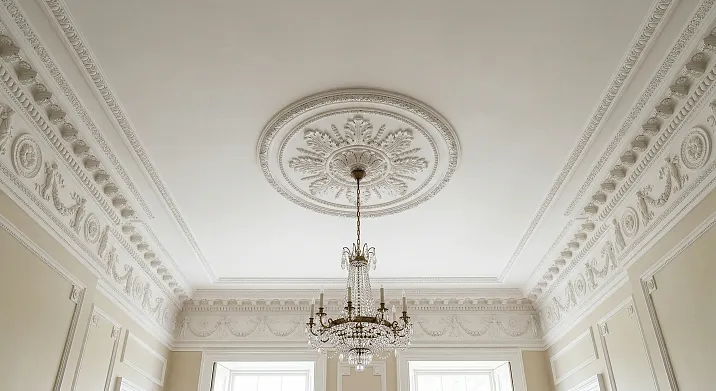
The walls are ready. The door portals are in place. The furniture is arranged. But as soon as you look up, the interior falls apart: a white empty plane without a single line, without transition, without structure. The ceiling doesn't finish the room; it simply exists.
This is a very common situation. The owners put enormous effort into decorating the walls, floor, furniture — and then stop in confusion before the ceiling. They don't want to turn it into a 'second Hermitage.' Leaving it bare feels like a waste of everything done below.
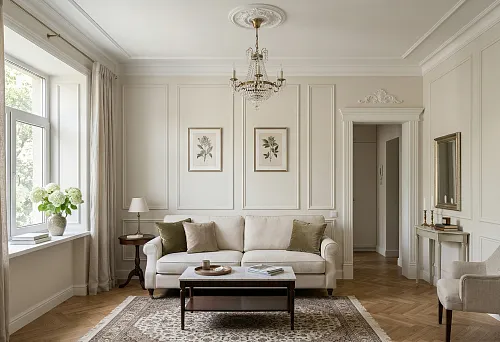
Between these extremes lies the neoclassical-style ceiling — not ceremonial, not lavish, but architecturally complete. A cornice around the perimeter, a rosette for the chandelier, and if needed — a delicate frieze. A system of three elements, each working towards the overall logic of the space.
This article is precisely about this system — and how to choose its correct proportions for an ordinary apartment.


Why the ceiling matters in neoclassicism
The ceiling is the upper boundary of space. A boundary we constantly see, even without realizing it. A pure white plane without a single architectural element is also a solution, but a default one. In neoclassicism, such a choice means a break in logic: the walls speak of architecture, the ceiling remains silent.




How the ceiling ties the interior into a system
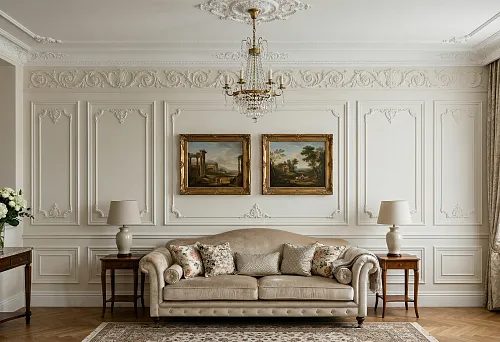
The cornice is where the wall meets the ceiling. Without it, this joint looks like a construction seam: technical, accidental. With a cornice, it becomes an architectural line that runs along the perimeter of the space and literally 'assembles' the room.
In neoclassicism, the cornice performs three functions at once. It creates a horizontal band that completes the wall. It visually 'raises' the ceiling—a properly selected profile visually increases the room's height. And it sets the scale for all ceiling decor: the rosette and frieze must relate to the cornice, not exist on their own.
The rosette in the center of the ceiling is an anchor. It gathers the gaze at the point from which light emanates and creates a sense of completeness: not a 'lightbulb on the ceiling,' but an architecturally designed lighting center of the room.
The frieze is a horizontal decorative band that can be placed just below the cornice or at the junction of the wall and ceiling zone. It is not a mandatory element, but when applied correctly, it adds depth and rhythm that cannot be achieved with a cornice alone.
Our factory also produces:


The principle of hierarchy over quantity
In modern neoclassicism, ceiling decor is built on the principle of hierarchy, not saturation. This means: each element is more important than the next. The cornice is basic, it is always present. The rosette is where there is a chandelier. The frieze is where space and height justify it.
It is precisely this logic—'do not add until the element's role is defined'—that distinguishes modern neoclassicism from historical. And it is precisely this logic that allows for creating beautiful ceilings in ordinary apartments with ceilings of 2.6–2.7 m, without turning them into heavy imitations of palace halls.
Get Consultation
What to choose: cornice only, cornice with a rosette, or a full set
Before choosing specific sizes and profiles, you need to decide on the scenario. The three main options differ in complexity and suitability for different situations.
First scenario: cornice only
The most concise and versatile option. A cornice around the perimeter of the room—and nothing more. The ceiling plane remains clean.
This works in the following cases:
-
interiors in the spirit of soft modern neoclassicism, where the main decor is concentrated on the walls;
-
lighting—recessed spotlights or a track system without a central chandelier;
-
a small room where additional ceiling decor would create a feeling of tightness;
-
ceilings 2.5–2.6 m—here, every extra element visually 'lowers' the already modest height.
One well-chosen Ceiling corniceAt the correct scale, it is a full-fledged solution for most standard apartments. It does not need to be supplemented 'just because that's the way it's done'.
Scenario two: cornice plus rosette
A classic solution for a room with a chandelier. The cornice creates the perimeter, the rosette creates the center. This pair works as a 'frame and focus' system: the frame holds the space at the edges, the focus gathers it in the center.
Appropriate in:
-
living rooms and dining rooms with a traditional central chandelier;
-
bedrooms where the chandelier is the main light source;
-
studies and libraries with ceiling heights from 2.7 m.
The main condition: the rosette must match the chandelier. The diameter of the rosette is 1.5–2 times the diameter of the chandelier's base. A rosette that is too small under a large chandelier looks like a random detail. A rosette that is too large under a small fixture looks like a disproportionate accent.
Scenario three: cornice, rosette, and frieze
This is a complete ceiling system for more formal or spacious interiors. The frieze adds horizontal detailing between the cornice and the clean ceiling plane — or between the cornice and the wall zone.
Appropriate in:
-
spacious living rooms from 25 m² with ceiling heights from 2.8–3 m;
-
halls and entrance areas;
-
dining rooms in country houses;
-
studies with parquet floors and library shelving.
For a standard city apartment with a 2.6 m ceiling — a full system (cornice + rosette + frieze) is rarely used and requires very delicate proportions of all three elements.
How to choose a ceiling cornice for the room height
This is the most important technical block — and this is where most people make mistakes. A cornice that is too large in an ordinary apartment 'eats up' the height and creates a feeling of an overhanging ceiling. One that is too narrow gets lost and fails to perform its architectural function.
Formula for calculating cornice width
A practical rule that works in most cases: cornice width is 3–5% of the ceiling height. This is not a strict standard, but a reliable starting point.
| Ceiling Height | Recommended cornice width | Cornice character |
|---|---|---|
| 2.5–2.6 m | 70–90 mm | Delicate, thin profile |
| 2.7–2.8 m | 80–100 mm | Moderate, classic profile |
| 2.8–3.0 m | 100–120 mm | Medium, more expressive |
| 3.0–3.5 m | 120–150 mm | Expressive, developed profile |
| from 3.5 m | 150–200 mm and more | Full-fledged architectural cornice |
These are guidelines, not a final verdict. The final choice is also influenced by the room area, wall decor saturation, and overall interior character.
Cornice profile for neoclassicism
For soft, modern neoclassicism — a smooth cornice or with minimal molding. Width 80–100 mm, projection 40–60 mm. This creates a readable horizontal line without heavy relief.
For a more pronounced classic look — a cornice with a stepped profile, with an ornamental band or a floral motif. Width 100–130 mm, projection 50–80 mm. Suitable for ceilings from 2.8 m.
A Baroque cornice with a developed projection of 80–100 mm and rich ornamentation — this is the scale of a country house or an apartment with a ceiling from 3.2 m. In a standard city apartment, such a cornice does not 'sound' like luxury, but 'presses' like a scale error.
Cornice matching the wall color or matching the ceiling color
The eternal question. Two principles:
A cornice matching the ceiling color (most often white) — this is a classic, safe solution. The cornice is perceived as an extension of the ceiling, softly descending onto the wall. Visually, this 'raises' the ceiling.
A cornice matching the wall color — this is a solution that visually 'lowers' the ceiling and makes it cozier. Used in high rooms where it's necessary to reduce the feeling of emptiness. In a standard apartment — a risk of losing height.
A monochrome solution (cornice matching the wall and ceiling color — when everything is painted in a single tone) — a modern technique, especially effective in restrained neoclassicism. The cornice is read through relief and chiaroscuro, not through color contrast.
Hidden lighting behind the cornice
This is one of the most elegant modern techniques. Behind the cornice, in a special shelf or recess, an LED strip is placed — and the ceiling receives soft diffused light, which emphasizes the relief of the cornice and creates a feeling of a 'floating' ceiling.
Cornices and moldings for paintingwith such lighting acquire a completely different dimension: the shadow from the relief is illuminated from below, creating volume and depth that are absent with ordinary overhead lighting.
Important limitation: cove lighting requires special installation preparation—an additional ledge or shelf in the drywall ceiling. This needs to be planned during the rough-in stage.
How to choose a ceiling medallion for a chandelier
A medallion is not just a decorative plate around the chandelier mounting point. In neoclassical style, it is the compositional center of the ceiling, an element that gathers the entire space around a single point. That is why its selection should be approached as systematically as choosing a cornice.
How to calculate medallion diameter
Practical rule: medallion diameter is 1/10 of the room length. For a 4 m long room—a medallion about 400 mm in diameter. For a 5 m room—about 500 mm.
Additional check: the visual diameter of the medallion should be larger than the diameter of the chandelier base, but not exceed it by three times. A medallion slightly larger in diameter than the chandelier base creates a 'framing' effect—exactly what is needed.
Polyurethane ceiling rosettesSTAVROS—catalog includes over 250 models: from minimalist 200 mm diameter to monumental 1800 mm diameter. For a standard apartment, the working range is 300–600 mm.
When a medallion is needed and when it is not
A medallion is needed where there is a central chandelier or pendant light. Without it, the light fixture mounting point remains exposed and looks like a construction joint.
A medallion is not needed where only recessed lights or a track system without a central source are used. In this case, it would be 'decor for decor's sake'—an element without function, which is unacceptable in neoclassicism.
Rosette ornament and coordination with the cornice
The style of the rosette relief must match the style of the cornice — this is a fundamental rule. If the cornice features a floral ornament (acanthus leaves, laurel branches, floral belt), then the rosette should contain related motifs. If the cornice is geometric — the rosette is geometric.
Inconsistency of ornaments is one of the main sources of visual chaos on the ceiling. A beautiful cornice and a beautiful rosette from different 'architectural languages' create a conflict that ruins the entire ceiling.
Rosette without ornament
In modern neoclassicism, rosettes with smooth stepped profiles — without ornament — are widely used. Concentric circles of different diameters, smoothly decreasing towards the center — this is a laconic, architectural image that pairs well with smooth cornices and restrained wall moldings.
SuchCeiling rosette— an ideal choice for soft neoclassicism, where there is no desire to delve into ornamental saturation, but there is a striving for architectural completeness.
When a frieze and additional ceiling detailing are needed
A frieze is a horizontal decorative belt that can be placed directly under the cornice, creating an additional rhythmic accent between the top horizontal line and the clean plane of the ceiling.
What is a frieze and how it works
In classical architecture, a frieze is part of the entablature (architrave, frieze, and cornice). In interiors, this is a simplified version: a narrow horizontal belt 50–100 mm wide with a geometric or floral ornament, which is mounted below the cornice.
A frieze adds depth and richness to the ceiling transition. It makes the cornice more solemn and creates a double horizontal rhythm—the first from the cornice, the second from the frieze. In tall, spacious rooms, this works powerfully. In small ones—it deprives the space of air.
When a frieze is appropriate in neoclassicism
A frieze is justified when several conditions coincide simultaneously:
-
ceiling height—at least 2.9–3.0 m;
-
room area—from 20–25 m²;
-
interior in a more pronounced, solemn version of neoclassicism;
-
cornice is sufficiently large (from 100–120 mm) so that the frieze does not compete with it but complements it.
If at least one of these conditions is not met—it is better to forgo the frieze. A cornice + rosette in the correct proportions is already a full-fledged architectural solution for the ceiling.
Width and ornament of the frieze
For neoclassicism—a frieze 50–80 mm wide with a geometric or restrained floral ornament. The ornament should not be larger than the cornice ornament—otherwise the details compete. The frieze always supports the cornice, not argues with it.
How to combine ceiling decor with walls and door portals
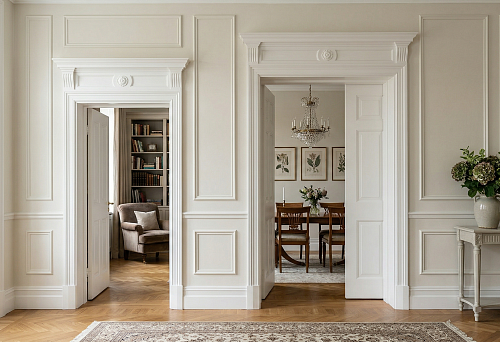
In neoclassicism, the ceiling does not exist in isolation—it is part of the overall architectural system. The cornice must coordinate with wall moldings, baseboards, door casings, and all other profiles in the interior.
Principle of a unified profile vocabulary
All decorative elements—ceiling cornice, wall moldings, door casings, baseboard—should belong to the same 'profile vocabulary'. This does not mean being identical, but rather having a related character of relief.
Smooth minimalist cornice + smooth wall moldings + delicate casings = cohesive modern neoclassicism. Cornice with floral ornament + wall moldings with floral corners + casings with classic profile = pronounced neoclassicism. Baroque cornice with developed ornament + smooth wall moldings + simple casings = architectural dissonance.
Polyurethane moldings and stuccoallow building coordinated systems of elements: cornices, moldings, baseboards, and casings in one collection have a related stylistic profile—this is what makes the interior cohesive.
How the cornice relates to the height of wall moldings
If there is a horizontal dividing molding on the walls (splitting the wall into upper and lower zones), its height should be related to the height of door openings and visually 'rhyme' with the cornice. These three horizontals—the cornice, dividing molding, and the upper lintel of the door portal—form the architectural grid of the space.
When all three horizontals are maintained in a unified scale and a unified profile style, the interior acquires an 'architectural grammar'—a sense of intentionality, order, and system.
Rosette and chandelier as the axis of the room
The ceiling medallion should always be positioned exactly along the axis of symmetry of the room — or along the axis of the zone it illuminates. Even a slight offset of the medallion from the center of the room is immediately noticeable and creates a sense of error.
In long or asymmetrical rooms, the ceiling medallion can be positioned along the axis of the relaxation zone (above the sofa, above the dining table), rather than the geometric center of the room. The main thing is that the medallion and chandelier 'anchor' the main zone, not just hang in a random spot.
How to design a ceiling in a small apartment without overloading it
A standard city apartment with a ceiling height of 2.5–2.6 m is the most sensitive context for ceiling decor. Here, the cost of a scale error is at its maximum.
What definitely works
A thin or medium cornice 70–90 mm, monochrome painting. A cornice matching the wall color or the ceiling color — in a small room, monochrome is preferable. A contrasting cornice in a low room visually 'lowers' the ceiling.
A ceiling medallion with a diameter of 300–450 mm. For a room of 15–20 m² with a 2.6 m ceiling, a 300–400 mm medallion is the correct scale. A 600–700 mm medallion here would dominate and feel oppressive.
No frieze. In rooms with ceilings up to 2.8 m, a frieze is an unnecessary element. It adds detailing that a small space cannot 'digest' without a feeling of crampedness.
A clean ceiling field. The empty space on the ceiling between the cornice and the medallion is not poverty, but an architectural principle. An unfilled plane creates a sense of spaciousness and airiness.
What not to do in a small apartment
-
A cornice with a projection of more than 60 mm — it literally protrudes into the room's space;
-
A rosette with a diameter of more than 500–550 mm in an area less than 18 m²;
-
A frieze with a ceiling height of less than 2.8 m — adds detailing where there is no space for it;
-
Decorative ceiling beams, coffers, intricate ornamentation across the entire ceiling surface — all of this is the scale of country houses with ceiling heights from 3.5 m.
Color of the ceiling and molding
In a small apartment, the only correct choice is a ceiling lighter than the walls or of the same light tone. Molding in the color of the ceiling (monochrome) or one or two tones lighter.
Colored molding on the ceiling (for example, gilded cornices on a white ceiling) — a technique that requires confidence and sufficient space. In a standard apartment, it almost always turns into a 'palatial' effect, which is exactly what one wanted to avoid.
Typical mistakes when decorating a ceiling in neoclassicism
A brief and honest list — not to intimidate, but to prevent.
A cornice too large for the ceiling height. The most common mistake. A 150 mm cornice with an 80 mm projection on a 2.6 m ceiling 'eats up' 10–12 cm of visual height and creates a feeling of cramped space.
The ceiling medallion is disproportionate to the chandelier. A small, neat chandelier under a medallion with a diameter of 800 mm creates a conflict of scale. The medallion becomes the main object on the ceiling instead of framing the chandelier.
The medallion and cornice ornaments are from different 'languages'. A geometric cornice and a floral medallion, a Baroque cornice and a minimalist stepped medallion—such combinations create visual tension that no other decor can relieve the interior from.
A frieze without sufficient height. A frieze with a ceiling height of 2.6–2.7 m creates a 'sandwich' of horizontal details that literally presses the ceiling down onto your head.
Decor covering most of the ceiling plane. The desire to fill the ceiling with ornamentation is one of the main fears of amateur designers. An empty white plane between the cornice and the medallion is not a mistake, but an intention.
Lack of connection between the ceiling and the walls. A rich cornice and bare walls without a single molding create a lack of coordination that makes the ceiling feel 'alien' in the space. Ceiling decor is always chosen as part of an overall system.
A ready-made set of ceiling decor or selection by elements
As with other elements of a neoclassical interior—the issue is not one of principle, but of context.
Selection by elements
Freedom in choosing each component, the ability to precisely match the required medallion diameter or a specific cornice profile—the advantages of independent selection are obvious.
But for the ceiling, this is particularly difficult. Coordinating the cornice, medallion, and, if needed, the frieze in terms of style, scale, and ornamentation is a task that requires good spatial thinking or experience working with decor. Uncoordinated elements 'from different manufacturers with a similar style' are a common source of problems.
Ready-made solution
Ceiling rosettes and moldingswithin the same collection have coordinated profiles, ornaments, and proportions. A cornice and rosette from the same series guarantee they will 'speak' the same architectural language.
For most users decorating a ceiling for the first time, a ready-made system reduces the risk of error. For a professional designer with a clear vision of the result — custom selection by elements.
About the company STAVROS
The ceiling is the finishing touch. After all the work with walls, portals, and floors, it is the cornice, rosette, and, if necessary, frieze that give the interior architectural completeness. And it is here that the quality of geometry is most important: a straight cornice line without sagging, a clean rosette relief without flash, precise profile cross-sections.
STAVROS is a Russian manufacturer of architectural decor. Cornices, ceiling rosettes, friezes, moldings, architraves, and baseboards made of MDF and polyurethane. Production in Russia, strict control of geometry and relief, a catalog for any heights and formats — from delicate profiles for small apartments to monumental cornices for country houses.
Full catalog —Polyurethane ceiling rosettes, cornices and moldingsof all profiles,ready-made solutions for ceiling stucco— on the STAVROS website.
If you have already decided on the ceiling and want to complete the wall system — read aboutwall moldings and overlays. If you need to design doorways in the same style — proceed to the article about framing doors with molding and trim. And if you still haven't decided on wall decor — a full breakdown of polyurethane moldings and plasterwork will help build the logic from the very beginning.
Frequently asked questions
Is a ceiling medallion needed for a chandelier in neoclassicism?
Yes, if there is a central chandelier or pendant light. The medallion covers the technical joint and creates an architectural focal point on the ceiling. If only recessed spotlights are used — a medallion is not needed.
Which cornice to choose for a 2.7 m ceiling?
Cornice width 80–100 mm, projection 45–60 mm. Profile — smooth or with a slight bevel for modern neoclassicism. Monochrome painting to match the ceiling or with a nuanced contrast to the walls.
Can ceiling molding be done in a small apartment?
Yes, with proper scale. Cornice 70–90 mm, rosette 300–450 mm, no frieze. Monochrome painting. Principle: the smaller the room, the more modest the profiles should be — but they must be present.
What is better: only a cornice or a cornice with a rosette?
Depends on the light fixture. If there is a central chandelier — add a rosette. If there is no central light fixture (only recessed spotlights or track lights) — a cornice is sufficient. A rosette without a chandelier is an element without a function.
When is a frieze appropriate?
With a ceiling height of 2.9–3.0 m, room area from 20–25 m² and a more pronounced, solemn character of neoclassicism. In a standard city apartment with a ceiling height of 2.6–2.7 m, a frieze is almost always excessive.
How to avoid overloading the ceiling with decor?
Work according to the principle of hierarchy: cornice — basic element, rosette — where there is a chandelier, frieze — only if justified by height and scale. Leave the ceiling field between the cornice and rosette clean. Monochrome painting of all elements is the safest choice.
How to coordinate the cornice with wall moldings?
All elements should belong to the same 'profile family': smooth cornice — smooth wall moldings — delicate trims. Or a classic profile everywhere. Mixing incompatible reliefs destroys the integrity of the interior.