












































































Article Contents:
- Why oak and beech are the basic standard of premium trim
- Oak and beech trim: operational differences, visual effect
- Buy oak trim: when maximum status and longevity are needed
- Oak and beech trim in Moscow and St. Petersburg: logistics, climate, storage
- Furniture trim from oak and beech: cornices, frames, facade profiles
- Oak and beech veneer: work on facade and wall surfaces
- Planks and beams: oak plank, interior oak plank, beech plank, oak beam and beech beam
- How to assemble a complete set of oak or beech for one object: from baseboards to furniture details
- Conclusion: STAVROS company — oak and beech as the standard of premium trim
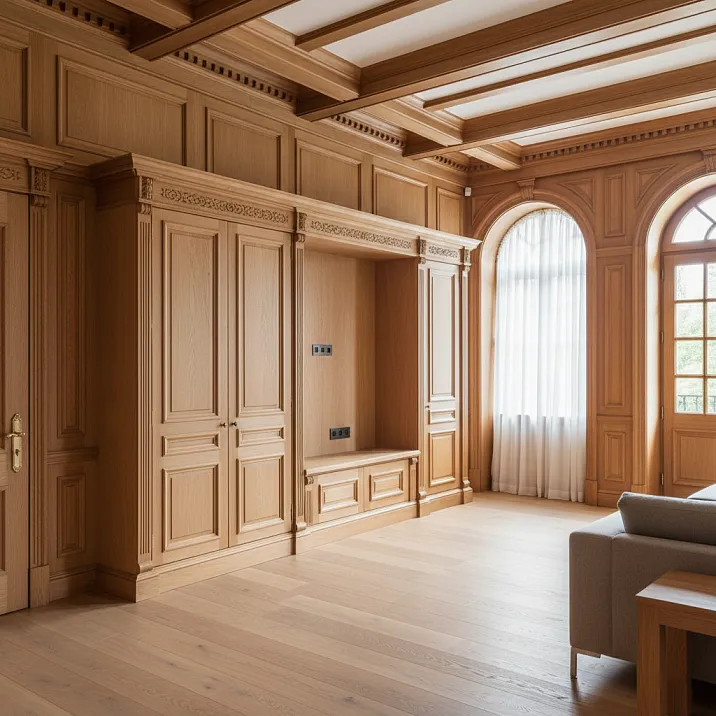
Oak and beech — not just tree species, but materials that define the class of interior.Oak Molding, Beech skirting boardsIt’s about visual value (texture visible and perceived as natural material), tactile quality (wood is warm to the touch, pleasant, alive), durability (hardwood species last decades without losing appearance), status (an oak or beech interior costs 2-3 times more than pine, signaling budget and attention to quality).Wooden trimSoftwood (pine, spruce) is suitable for budget projects under opaque paint, where texture is not visible. But if the interior is premium, if showcasing natural wood is important, if the project lasts decades — the choice is only between oak and beech.Wood TrimPremium class — only oak or beech, no third option.


Why oak and beech are the basic standard of premium trim
Oak — classic premium trim, a species used for centuries in European architecture, from medieval castles to modern residences. Oak hardness by Brinell 3.7–4.0 — this level means wood won’t scratch from accidental impacts, won’t dent under furniture, won’t wear from friction. Oak baseboards last 30–50 years without losing appearance, oak door casings last through several generations of doors, oak moldings remain perfect even when walls around them need repair. Oak texture is coarse-grained, with contrasting growth rings, transitioning from light areas (early wood, soft) to dark (late wood, hard). This texture is visible even on a narrow 20 mm strip, working as decoration, as a visual accent, as a sign of naturalness.
Oak color varies from light yellow (young, fast-growing oak) to dark brown (mature, slow-growing oak), depending on growing location (oak from cold climates is darker, from warm — lighter), and processing (oil darkens by 1–2 tones, lacquer almost doesn’t change, stain tones any color). This color variability is an advantage for designers (can match tone to specific projects), but a problem for purchasing (different batches of oak vary in tone, must order entire trim in one batch, otherwise discrepancies occur).oak trimRequires attention to detail: one species, but each batch is unique.
Beech — an alternative to oak, a balance of price and quality, a species for those who want hard wood without aggressive texture. Beech hardness 3.8 — slightly higher than oak, but the difference is insignificant, both materials are equally strong. Beech texture is fine-grained, uniform, without clearly defined growth rings. The wood is light, pink-beige, calm, neutral. Beech does not dominate texture (like oak), does not draw attention to itself, works as a background, highlighting other elements (furniture, decor, wall color).Beech skirting boardsSuitable for interiors where restraint is important, where wood should not shout, but create a warm, natural atmosphere.
Beech color is more stable than oak: pink-beige with minimal variations between boards from one batch. This simplifies purchasing (differences are minimal, even if part of trim is purchased later, tone discrepancies are insignificant). Beech is 30–50% cheaper than oak — a significant difference for large volumes (full trim for an apartment: baseboards, casings, moldings, planks — 200–300 linear meters, saving 20,000–50,000 rubles). But beech is more sensitive to humidity: at high humidity it may swell, at low — dry out and crack. Therefore, beech trim is unsuitable for bathrooms and saunas, but ideal for living rooms, bedrooms, offices, kitchens (provided normal ventilation).
Comparison of oak and beech: oak — for those who want expressive texture, status, maximum longevity (30–50 years), willing to pay premium price. Beech — for those who want hard wood, calm texture, balance of price and quality, longevity 20–30 years. Both materials are one order higher than pine in all parameters (strength, longevity, visual value). Choosing between oak and beech — choosing between two premium solutions, where there is no bad option, only nuances of style, budget, personal preferences. Pine — another category, budget segment, which does not compete with oak and beech in quality.




Oak and beech trim: operational differences, visual effect
Operational differences between oak and beech begin with moisture resistance. Oak contains tannins (tannic substances), making the wood resistant to water, fungi, mold. Oak trim can be used in humid rooms (bathroom, toilet, kitchen near sink) provided proper treatment (oil with water-repellent properties, yacht lacquer). Oak does not rot (tannins kill fungi), does not darken from moisture (color is stable), does not swell critically (minor expansion of 1–2%, imperceptible). Beech does not contain tannins, the wood is more hygroscopic (absorbs moisture more actively). Beech trim in humid rooms is risky: at constant humidity above 70%, beech may swell by 3–5%, deform, crack upon subsequent drying. Beech is suitable for dry rooms (humidity 40–60%), oak — universal.
Resistance to mechanical damage: oak and beech are equally hard (hardness by Brinell 3.7–4.0 for oak, 3.8 for beech), but oak is more elastic (it springs back upon impact, does not leave deep dents), beech is more rigid (under strong impact may chip rather than dent). For baseboards exposed to impacts (vacuum cleaner, furniture during rearrangement), oak is slightly better — dents on oak are less deep, easier to sand. For casings and moldings not exposed to impacts, the difference is insignificant. For wall planks that experience no mechanical loads, choice between oak and beech is purely aesthetic (texture), not operational.
Geometric stability: oak is more stable than beech under humidity fluctuations. An oak baseboard installed in winter (room humidity 30–40% due to heating) will not create large gaps in summer (humidity 50–60%), expansion is compensated by gaps during installation. A beech baseboard under the same conditions may create noticeable gaps (drying is more pronounced), requiring more precise gap calculation during installation. In regions with sharp humidity fluctuations (continental climate, cold dry winter indoors, humid summer), oak is preferable. In regions with stable humidity (marine climate, mild winters), both oak and beech are equally good.
Visual effect of oak: coarse-grained texture with contrasting rings creates an active, expressive pattern. Oak baseboard, casing, molding — these are not neutral elements, but accents that are visible and attract attention. Oak texture works on scale, on the weightiness of the interior: a room with oak trim appears more expensive, serious, substantial. Oak suits classic interiors (Baroque, Classicism, English style), where wood texture is part of decor, for neoclassicism (where oak is often painted, but texture shows through paint, creating depth), for loft (where oak is used untreated or minimally processed, emphasizing rawness). Oak is not suitable for minimalism (too active texture), for Scandinavian style (oak is dark, Scandinavian style requires light species).
Visual effect of beech: fine-grained, uniform texture creates a calm, neutral background. Beech baseboard, casing, molding — these are elements that do not dominate, do not draw attention, work as background, highlighting other elements (furniture, textiles, wall color). Beech texture works on lightness, on the airiness of the interior: a room with beech trim appears lighter, cleaner, more spacious. Beech suits Scandinavian style (light wood, minimal decor), modern style (neutral texture, emphasis on form rather than material), neoclassicism (where beech is often painted white or gray, texture does not interfere with paint). Beech is not suitable for heavy classical interiors (Baroque, Empire), where expressive oak or walnut texture is needed.
Our factory also produces:


On the wall, it creates a similar effect but visually lighter and calmer. The lettering layout does not dominate by texture (as with oak), but works as a subtle line that structures the wall without overloading it. Lettering layouts are often painted: white lettering on a light gray wall background creates graphic design (clear white frames on gray), black lettering on a white background creates contrasting graphic design (modern, contemporary).
oak trim buyNeeded in three cases: when status is important (oak interior — a signal of a high budget, attention to quality, long-term planning), when texture demonstration is important (transparent coating that reveals the full beauty of oak wood), when maximum durability is important (oak lasts 30-50 years without losing its appearance — an investment for decades). Oak molding is used in residences, premium suburban homes, high-end city apartments, where the owner does not compromise on materials, where every detail must be of the best quality. Oak molding is not a mass product — it is a niche solution for demanding clients.
When oak is justified maximally: oak parquet (if the floor is oak, skirting boards must also be oak — material unity is critical), oak doors (if doors are solid oak, door casings and frames must also be oak), oak furniture (if furniture is oak,Furniture molding— cornices, moldings — also oak). Mixing oak with other species under transparent coating is not allowed — texture differences are immediately noticeable, it looks like poor planning, like incorrect cost-saving. Under opaque paint (white, gray, black) species can be mixed (texture is hidden), but then the extra cost of oak is not justified — better to choose beech, which is cheaper.
Oak skirting board, height 100 mm, medium-complex profile — 600-900 rubles per linear meter (depends on grade: Grade B is cheaper, Grade A is more expensive, "Extra" is the most expensive). Oak door casing, width 70 mm, simple profile — 450-650 rubles per linear meter. Oak molding, width 80 mm, complex profile — 700-1000 rubles per linear meter.oak lumberSection 40×20 mm — 400-600 rubles per linear meter.Oak veneerWidth 30 mm, decorative profile — 300-500 rubles per linear meter.Oak beamSection 50×50 mm — 500-800 rubles per linear meter. Complete oak molding set for a 100 sq. meter apartment (skirting boards, door casings for 7 doors, wall moldings) — 150,000-250,000 rubles, which is 2-3 times more expensive than beech, and 4-5 times more expensive than pine. But this is an investment for 30-50 years, with an annual amortization of 3,000-5,000 rubles — a reasonable price for premium quality.
Durability of oak molding: oak skirting board installed today will look perfect in 20 years, when the floor covering (laminate, linoleum) has worn out and needs replacement. Oak door casings will last several generations of doors (interior doors last 15-20 years, oak casings — 30-50 years). Oak moldings will remain on walls when wallpaper is changed three times. This is long-term planning, when elements of the basic interior architecture (molding) are installed once and for all, while everything else (wall finishing, floor covering, furniture) changes over time. Oak molding is the architectural frame of the interior that does not become outdated.
Get Consultation
Oak molding in Moscow and St. Petersburg: logistics, climate, storage
Buy oak trim in St. Petersburg— St. Petersburg is a traditional center of wood processing, here dozens of molding manufacturers, high competition, prices are 10-15% lower than in Moscow. Oak in St. Petersburg is imported (from Europe — Germany, Poland, France; from the Caucasus — Krasnodar Krai, Adygea; from Central Russia — Voronezh, Tambov regions), but processed in St. Petersburg — traditions of wood processing, skilled craftsmen, modern equipment. The climate of St. Petersburg (humid, mild winters, cool summers) is favorable for storing oak molding: humidity is stable throughout the year (60-70%), oak does not dry out sharply in winter (as in Moscow), nor swell in summer. Manufacturers in St. Petersburg have experience working with oak, know the nuances of processing, drying, and storage.
Buy oak trim in Moscow— Moscow is the largest market for molding, high demand, many resellers, prices are 10-15% higher than in St. Petersburg (markup for logistics and the Moscow market). There are fewer manufacturers in Moscow than in St. Petersburg (in Moscow, production is moved to the outskirts — Korolev, Mytischi, Khimki due to high rental costs), but there are many warehouses with a wide assortment. The climate of Moscow (continental, cold winters, hot summers) creates fluctuations in humidity: in winter, in heated rooms, humidity drops to 30-40% (oak dries out), in summer it rises to 60-70% (oak swells). Oak molding purchased in Moscow requires careful storage until installation: do not store in unheated warehouses in winter, do not store outdoors in summer.
Logistics of oak molding: oak is heavy (density 700-750 kg/m³), a 2.5-meter skirting board weighs 3-4 kg, a set for an apartment (200-300 linear meters) weighs 250-400 kg. Delivery requires cargo transport (minimum Gazelle), careful loading and unloading (oak molding is strong, but long boards can break during careless handling). Packaging: boards are packed in stretch film in bundles of 10-20 pieces, laid horizontally on pallets (not vertically, otherwise boards will sag under their own weight). Delivery to St. Petersburg — 2,000-5,000 rubles (depends on volume and distance), to Moscow — 3,000-7,000 rubles, from St. Petersburg to Moscow — 8,000-15,000 rubles (600 km, 8-10 hours of travel). For large volumes (more than 300 linear meters), delivery is included in the price or offered with a significant discount.
Storage of oak molding until installation: store in a dry, heated room (humidity 40-60%, temperature 18-25°C), horizontally (on a flat surface, boards do not touch each other — spacers between layers), wrapped (stretch film protects from dust, moisture, mechanical damage). Do not store outdoors (even under a canopy — humidity fluctuations deform wood), do not store in unheated rooms in winter (low humidity causes drying and cracking), do not store vertically leaning against walls (long boards will sag). Storage time — no more than 2-3 months (under proper conditions, oak is stable, but long-term storage increases the risk of deformation). Acclimatization: after delivery of oak molding to the site (apartment, house), wait 3-5 days before installation — wood adapts to the humidity and temperature of the room, dimensions stabilize, installation proceeds without surprises (gaps are calculated correctly, boards will not dry out or swell after installation).
Oak molding for furniture: cornices, frames, facade profiles
Furniture moldingOak cornices are used in premium furniture, where showcasing natural wood is important, where furniture is not just a functional object but an interior element that must be status-oriented, durable, and beautiful. Oak cornices on top of cabinets, buffets, kitchen sets create a visual completion, "roof," which covers the body, making furniture an architectural object. Oak cornice has a complex profile (multi-step, with protrusions, recesses, rounded edges), width 80-150 mm, thickness 20-40 mm. The profile is cut on CNC routers (accuracy ±0.1 mm, repeatability identical on all boards), sanded (smooth surface, no scratches), coated with oil or lacquer (emphasizes oak texture, protects from moisture and dirt).
Oak bases (lower boards of furniture that visually "ground" the body, creating a transition from floor to furniture) have height 80-120 mm, profile similar to cornice (related forms, visual connection between top and bottom of furniture). Base protects the bottom of furniture from impacts (vacuum cleaner, feet, furniture during rearrangement), hides legs or void under the body, creates a visual base. Oak base is stronger than beech (oak is elastic, does not yield deep dents upon impact), longer-lasting than pine (pine base wears out in 5-10 years, oak base lasts 30-50 years). Base is mounted to furniture body with glue and self-tapping screws (from inside the body, screws are not visible), painted to match furniture color.
Oak frames on furniture facades transform flat MDF or plywood panels into framed-panel construction, which looks more expensive, complex, and interesting.Oak veneerFrames are glued around the perimeter of the facade, forming a frame 30-50 mm wide, decorative profile (bevel, rounding, groove). Inside the frame remains a flat panel, painted the same color or contrasting (white frame on gray facade, black on white). Oak frames are used in classical and neoclassical furniture, where detail and visual richness of forms are important. In modern furniture, oak frames are used less often (preferring flat facades without decoration), but remain relevant in premium segment (expensive kitchens, wardrobes).
Facade profiles from oak — these are special boards for finishing edges of furniture facades, ends of countertops, edges of shelves. End edge (board covering the end of countertop or shelf) protects the end from moisture (which penetrates the end faster than the face), from scratches, creates a visual completion (an end without edge looks unfinished, like a cut board). Oak edge is 3-5 mm thick, width equal to countertop thickness (26 mm, 38 mm, 50 mm), length custom-made (cut to countertop size). Edge is glued to countertop end (contact glue, clamped with clamps for 2-4 hours), sanded flush with the face, coated with oil or lacquer to match countertop. Oak edge lasts 20-30 years (does not peel, does not crack, does not lose appearance), plastic edge lasts 5-10 years (peels, cracks, yellows).
Beech furniture molding — an alternative to oak, 30-40% cheaper, but almost equally strong and durable. Beech cornices, bases, frames are used in mid- to high-end furniture, where price-to-quality balance is important. Beech is lighter than oak (pink-beige vs. yellow-brown), texture is calmer (uniform vs. contrasting), visually lighter (beech furniture appears lighter, airier). Beech furniture molding suits Scandinavian style (light wood, minimal decoration), modern furniture (neutral texture, emphasis on form).Beech trimOften painted (white, gray paint) — uniform texture accepts paint well, does not show contrasting spots.
Oak and beech molding: work on flat surfaces of facades and walls
Oak veneerOn wall surfaces, it creates relief, structure, breaks up a monotonous surface into sections. Framed panels on walls — a classic technique, where oak moldings form rectangular or square frames (perimeter 80×120 cm, 100×150 cm, proportions 1:1.5 or 1:1.8 — close to the golden ratio). Inside each frame — insert: patterned wallpaper, fabric, different color paint, mirror. Molding frames the insert, creates a transition from the main wall to the insert, works as a decorative line. Molding width 30-50 mm, decorative profile (bevel, rounding, groove), thickness 10-15 mm (protrudes from wall by 5-10 mm, creates relief, casts shadow). Oak molding under transparent lacquer or oil shows texture — large pores, contrasting rings work as decoration.
Buy oak veneerOn walls, it creates a similar effect, but visually lighter and calmer. Beech molding does not dominate texture (as oak does), works as a thin line that structures the wall, but does not overload. Beech molding is often painted: white molding on light-gray wall background creates graphic effect (clear white frames on gray), black molding on white background — contrasting graphic effect (modern, contemporary).
Beech trimThis is a rail with a profile (not rectangular, but rounded, beveled, or grooved), used for more decorative structures. Decorative oak rail not only creates relief but also plays with light and shadow (the profile casts shadows, enhancing volume).Beech strips for saleCheaper than oak (250-350 rubles per linear meter vs. 350-500 rubles for oak), significant savings for large volumes (for the wall in the example above, savings of 2,800-4,200 rubles).
Molding on furniture facades: oak or beech molding transforms flat MDF facade into framed-panel construction. Kitchen set with flat facades — modern style, minimalism, but visually plain and cheap. The same facades with glued moldings (frame around each facade, molding width 40-50 mm, decorative profile) — neoclassicism, visually more complex and expensive. Molding creates an illusion of framed-panel construction (though the facade is still a flat MDF panel), adds detail and visual richness. Oak moldings on facades under transparent lacquer (facade painted dark paint, moldings natural oak) create material contrast (wood + paint). Beech moldings on facades under white paint (facade and moldings painted white) create relief without material contrast (everything is white, only shadow from molding stands out).
— premium choice for lath construction, where showcasing natural wood texture is important. Vertical oak laths on walls (section 40×20 mm, 60×30 mm, installed from floor to ceiling with gaps 40-60 mm) create expressive relief, where oak texture is visible on each lath, works as decoration. Oak laths under transparent oil (oil darkens oak by 1-2 tones, emphasizes pores, rings) create warm, natural atmosphere, characteristic of eco-style, Scandinavian style with classical elements. Oak laths stained with dark stain (wenge, mocha, black oak) create brutal, contrasting background, characteristic of loft, industrial style.
oak lumber— this is a lath with profile (not rectangular, but with rounding, bevel, groove), used for more decorative constructions. Decorative oak lath creates not only relief, but also play of light and shadow (profile casts shadow, enhances volume).
Decorative oak plankConsultations for selecting oak or beech trim: STAVROS specialists will help prepare a complete specification for the project (baseboards, door casings, moldings, rails, furniture trim), calculate the required length, select profiles from one collection (guaranteeing visual unity), and agree on finish (transparent or opaque, which oil or varnish to use). Showrooms in St. Petersburg (Kushelovskaya Street) and Moscow: samples of oak and beech trim in all profiles.Interior oak plank— a general term for rails used indoors (not facade or structural). Interior oak rail is more carefully processed (finer sanding, better finish), has moisture 8-12% (for indoor spaces), stable at room temperature.
Oak rail price: 40×20 mm rail — 400-600 rubles per linear meter, 60×30 mm rail — 580-850 rubles per linear meter (depends on grade and processing). For covering a 4×2.7 meter wall with vertical 40×20 mm rails with 40 mm gap (rail+gap module = 80 mm, number of modules = 4000/80 = 50, length of each rail = 2.7 meters, total linear meters = 50×2.7 = 135, with 15% reserve = 155 meters) cost of oak rails = 155 × 500 (average price) = 77,500 rubles. Expensive, but a premium solution for decades; oak rails last 30-50 years without losing appearance, require no replacement.
Beech parquet— an alternative to oak, 30-40% cheaper, but nearly as strong. Beech rails are used in interiors where light wood without aggressive texture is desired: Scandinavian style (beech rails with white oil — light, warm, cozy), modern style (beech rails painted white or gray — neutral, graphic).Beech parquet for sale— can be 30-40% cheaper than oak (40×20 mm rail — 250-400 rubles per linear meter); for example, the above savings = 155 × (500-350) = 23,250 rubles — a significant difference.Solid beech parquet— has moisture 8-12%, processed with sanding, ready for painting or transparent finish.Oak parquet— stable at room temperature and humidity 40-60%, but not suitable for humid spaces (bathrooms, saunas).
Oak beam— a premium-class structural element used where not only strength but also visual value is important. Oak beams of 50×50 mm, 60×60 mm, 80×80 mm are used as framing for slat screens (if the framing is partially visible through gaps between rails, pine looks cheap, oak looks premium), as visible ceiling beams (loft, chalet, where beams are decorative, not load-bearing), as support posts in furniture (table legs, stands, where oak beam supports load and simultaneously serves as decoration).Buy oak beams— expensive (price from 500 to 800 rubles per linear meter for 50×50 mm section), but the extra cost is justified for visible structures.
Oak timber beam— an alternative to oak, 30-40% cheaper, nearly as strong.Beech beam for lathing— available in sections from 30×30 mm (for light structures, framing) to 80×80 mm (for support elements, beams). Beech beams hold screws more reliably than pine (do not split, do not chip when drilling), last 20-30 years (less than oak, but more than pine). Beech beams are used as framing for slat screens (if framing is visible, beech looks decent), as furniture frames (countertops on beech beam legs, shelves on beech frame), as support for shelves (beech beams withstand greater load, do not sag).
How to assemble a complete set of oak or beech trim for one object: from baseboards to furniture details
Complete oak trim set for a 100 sq. meter apartment, three rooms (living room, bedroom, office), kitchen, hallway, classic style with oak parquet, oak doors. Goal: all wooden elements from oak, same species, same tone (dark oil), coordinated profiles (all profiles from one collection, related shapes). Set composition:
Oak baseboards: height 100 mm, profile with two rounded edges, thickness 18 mm. Apartment perimeter (all rooms, hallway, kitchen) ≈ 80 meters (perimeter of 100 m² apartment is usually 40-50 meters, but with internal walls and protrusions — 80 meters). With 15% reserve = 92 meters. Price 700 rubles per linear meter, cost = 92 × 700 = 64,400 rubles.
Oak door casings: width 70 mm, profile similar to baseboard (two rounded edges), thickness 16 mm. Number of doors = 7 (living room, bedroom, office, kitchen, bathroom, toilet, entrance door). Set for one door = 5 planks of 2.2 meters = 11 meters. Seven doors = 77 meters. With 10% reserve = 85 meters. Price 600 rubles per linear meter, cost = 85 × 600 = 51,000 rubles.
Oak wall moldings (living room, office — walls with framed panels): width 60 mm, profile simplified version of baseboard (one rounded edge), thickness 14 mm. Length of moldings (vertical and horizontal lines forming frames) ≈ 40 meters (two walls in living room, one wall in office). With 15% reserve = 46 meters. Price 650 rubles per linear meter, cost = 46 × 650 = 29,900 rubles.
Oak rails (accent wall in bedroom behind headboard, vertical rails): section 40×20 mm, length 2.7 meters, wall width 3 meters, gap 40 mm, number of rails ≈ 38 pieces, linear meters = 38 × 2.7 = 103 meters. With 10% reserve = 113 meters. Price 500 rubles per linear meter, cost = 113 × 500 = 56,500 rubles.
Oak furniture trim (cornices and facades for kitchen set, built-in wardrobe in hallway): cornice width 100 mm, perimeter of top of kitchen and wardrobe ≈ 12 meters, with 10% reserve = 13 meters, price 800 rubles per linear meter, cost = 13 × 800 = 10,400 rubles. Facade moldings (perimeters of frames on 20 facades) ≈ 60 meters, with 10% reserve = 66 meters, price 400 rubles per linear meter, cost = 66 × 400 = 26,400 rubles.
Total cost of oak trim: 64,400 + 51,000 + 29,900 + 56,500 + 10,400 + 26,400 = 238,600 rubles. This does not include doors (door panels — separate expense), only trim (baseboards, casings, moldings, rails, furniture trim). Add installation (if hiring installers — 200-300 rubles per linear meter installed, total 80,000-120,000 rubles), finish (if painting or varnishing on-site — oil or varnish ≈ 30,000 rubles material + labor). Total cost of oak trim with installation and finish = 350,000-400,000 rubles. Expensive, but a premium solution for 30-50 years.
Complete beech trim set for the same apartment: prices are 30-40% lower, total cost of beech trim = 238,600 × 0.65 = 155,000 rubles (material), with installation and finish = 230,000-270,000 rubles. Savings compared to oak = 120,000-130,000 rubles — significant difference. But beech lasts 20-30 years (vs. 30-50 for oak), texture is less expressive (vs. contrasting oak). Choice depends on budget, style, personal preferences: oak for maximum status and longevity, beech for balanced price and quality.
Conclusion: STAVROS — oak and beech as standard premium trim
Oak Molding, Beech skirting boards, Wooden trim, Wood Trim— not just wooden planks. These are materials that define the interior class, last for decades, function as architectural framing of the space.oak trim— for those who want maximum status, expressive texture, durability of 30-50 years.oak trim buy— an investment that pays off because it does not require replacement after 10-15 years, unlike pine trim.Buy oak trim in St. Petersburg, Buy oak trim in MoscowTwo largest markets where full range of oak trim of all profiles, grades, and finishes is available.
— all types of moldings for walls, facades, doors.Baseboards, Casings, Moldings, rails, layouts, strips, Furniture molding. Oak veneer, Buy oak veneer, Beech trim, Beech strips for sale— structural elements for framing, beams, supports.Oak beam, Buy oak beams, Oak timber beam, Beech beam for lathing— all sections for slat structures on walls, partitions, screens.oak lumber, Decorative oak plank, Interior oak plank, Beech parquet, Beech parquet for sale, Solid beech parquet, Oak parquetSTAVROS Production: kiln-dried wood to moisture 8-12% (guarantee that trim will not dry out after installation), processing on Weinig equipment (Germany) — geometric accuracy ±0.3 mm, machine or hand-sanding (smooth surface, ready for painting or transparent finish), quality control at every stage (defect rejection, sorting by grade). Packaging in stretch film, delivery to St. Petersburg, Moscow, Russia. Warehouses in St. Petersburg and Moscow (standard oak and beech profiles in stock), custom production (individual profiles, non-standard length, minimum order 50 linear meters).
Consultations on selecting oak or beech trim: STAVROS specialists will help create a complete specification for the project (baseboards, casings, moldings, rails, furniture trim), calculate linear meters, select profiles from one collection (guarantee of visual unity), coordinate finish (transparent or opaque, which oil or varnish to use). Showrooms in St. Petersburg (Kushelovskaya Street) and Moscow: samples of oak and beech trim of all profiles.
Consultations on selecting oak or beech millwork: STAVROS specialists will help compile a complete specification for the project (baseboards, casings, moldings, battens, furniture millwork), calculate the footage, select profiles from one collection (ensuring visual unity), and coordinate the finish (transparent or opaque, which oil or varnish to use). Showrooms in St. Petersburg (Kushelevskaya Road) and Moscow: samples of oak and beech millwork of all profiles.


