












































































Article Contents:
- The evolution of baseboards: from utility to decorativeness
- Antiquity and the Middle Ages: the birth of architectural baseboards
- Renaissance and Baroque: baseboards as an architectural element
- Classicism: proportionality and restraint
- Modernism and minimalism: the reduction of baseboards
- Types of wooden baseboards: classification by height and profile
- By height: from delicate to monumental
- By profile: geometry of form
- The influence of baseboard height on furniture perception
- Low baseboard: furniture "floats"
- Medium baseboard: balance
- High baseboard: monumentality and support
- Very high baseboard: palatial solemnity
- Baseboard profile and stylistic correspondence
- Classic: figured profile and noble wood species
- Neoclassic: Reserved Elegance
- Provence and country: naturalness and patina
- Minimalism and Scandinavian style: simplicity of lines
- Loft and industrial: contrasts
- Baseboard materials: solid wood vs alternatives
- Solid wood: the quality standard
- MDF: stability and paintability
- Veneered MDF: imitation of solid wood
- Polyurethane: practicality and moisture resistance
- Color and tinting: coordination with furniture and floor
- Matching the floor: continuation of the horizontal line
- Matching the walls: continuation of the vertical line
- Contrasting: graphic accent
- Matching the furniture: material unity
- Baseboard installation: the technology of completion
- Preparation: wall evenness
- Corner cutting: joint precision
- Fastening: glue, nails, hidden fasteners
- Finishing: putty, painting
- Frequently Asked Questions
- What baseboard height is optimal for a standard apartment?
- Baseboard matching floor or wall color — which is correct?
- Can MDF be used instead of solid wood?
- How much does solid oak baseboard cost?
- How to coordinate baseboard with tall classic furniture?
- Conclusion: the foundation of beauty by STAVROS

The gaze glides over the interior from top to bottom — ceiling cornice with molding, walls with moldings, elegant furniture on curved legs, herringbone parquet, and where the wall meets the floor, a baseboard runs. Most don't notice it, perceiving it as a technical detail covering a gap. But an experienced designer knows:Wooden skirting boards— the foundation of visual composition, the lower accent that either completes the interior or ruins it. The wrong baseboard kills expensiveclassic furniture— a low plastic baseboard under a carved oak chest looks as absurd as sneakers under a tuxedo. The right baseboard —Pogonazh iz massivaof appropriate height, profile, wood species — creates visual support, connects furniture with architecture, turns the floor into a pedestal on which furniture gains presence.
Why is baseboard critical specifically in interiors with classic furniture? Because classic style requires completeness, proportionality, material unity.Classic Furnitureis massive, detailed, made from noble woods — oak, walnut, mahogany. It requires architectural surroundings — high ceilings, profiled cornices, wide doorways. And the baseboard must match this scale — not a thin 40-millimeter strip lost under a massive chest, but a 100-120-millimeter profiledSolid wood skirting boardfrom the same wood species as the parquet, creating visual solidity.




Baseboard evolution: from utility to decorativeness
Before analyzing types of modern baseboards, it's important to understand the historical evolution — where this element came from, how it changed, why in classic interiors it's more massive than in contemporary ones.




Antiquity and Middle Ages: birth of architectural baseboard
Ancient Greek and Roman temples didn't have baseboards in the modern sense — columns grew from the stylobate, a stone base. But the very idea of a plinth, a base differing from the main structure, was established then. A column stands on a base — a lower expanded element visually weighting the bottom, creating stability.
Medieval interiors — castles, palaces, wealthy homes — had stone floors and stone walls. There was no wooden baseboard. But the transition from floor to wall was framed with profiled stone — a protruding strip protecting the wall from impacts, moisture, creating architectural articulation.
Our factory also produces:


Renaissance and Baroque: baseboard as architectural element
The Renaissance revives ancient principles — the order system, proportions, profiling. Palace interiors receive wooden panels — boiserie — covering walls to a height of 1-2 meters. The bottom of the panels — the plinth — protrudes forward, creating a massive base. This is the ancestor of the high baseboard.
Baroque enhances decorativeness. The baseboard becomes carved, gilded, profiled with numerous curves, beads. Height increases to 150-200 millimeters — the baseboard transforms into an architectural detail comparable to cornices, architraves, pilaster capitals.interior decorationBaroque is total — every surface is decorated, the baseboard is no exception.
Get Consultation
Classicism: proportionality and restraint
Classicism of the 18th-19th centuries simplifies baroque excess, returning to antique rigor. The baseboard remains high — 100-140 millimeters — but the profile simplifies. Instead of many small details — several clear beads, curves creating a distinct, readable form.
Proportions are mathematically verified. Baseboard height relates to room height as 1:20 or 1:25. A room 3000 millimeters high gets a 120-150 millimeter baseboard. A 2500 millimeter room — 100-125 millimeter baseboard. This rule still applies in classic interiors.
Modernism and minimalism: reduction of baseboard
The 20th century brings modernism — rejection of ornament, minimization of decor, geometric simplicity. The baseboard shrinks to 50-70 millimeters, the profile simplifies to a rectangle. In radical minimalist interiors, the baseboard disappears entirely — the floor extends under the wall creating an illusion of a single plane, or the wall doesn't reach the floor forming a shadow gap — shadow baseboard.
Modern minimalist interiors often use narrow aluminum, MDF, or plastic skirting boards with a height of 40-60 millimeters. This is the opposite of classic style, whereWooden skirting boardssolid wood skirting boards with a height of 100-150 millimeters remain the standard.
Types of wooden skirting boards: classification by height and profile
Varietysolid wood skirting boardsis vast. Systematization helps choose the appropriate one for a specific interior.
By height: from delicate to monumental
Low skirting boards 40-60 millimeters — minimalism, Scandinavian style, modern interiors with low ceilings of 2400-2600 millimeters. The skirting board is delicate, does not attract attention, serves as a technical element. Suitable for light modern furniture on thin legs, where a massive skirting board would visually overload the bottom.
Medium skirting boards 60-80 millimeters — a universal category suitable for most interiors. Standard ceiling heights of 2700-2800 millimeters harmonize with skirting boards of 70-80 millimeters. Sufficient for classic furniture of medium massiveness — dressers, tables on straight legs. Does not dominate, but also does not get lost.
High European skirting boards 100-120 millimeters — classic, neoclassical, interiors with ceilings of 2900-3200 millimeters. The skirting board becomes an architectural element, creating visual solidity.Pogonazh iz massivaof such height is ideal for massiveclassic furniture— sideboards, cabinets, dressers with thick countertops, carved legs. Proportional to the furniture, creates visual support.
Monumental skirting boards 140-200 millimeters — palace interiors, rooms with ceilings from 3500 millimeters, ceremonial halls, mansion lobbies. A skirting board of such height turns into a plinth, an architectural base for walls. Requires appropriate furniture — antique cabinets, massive tables, monumental sideboards. Looks grotesque in a standard apartment.
By profile: geometry of form
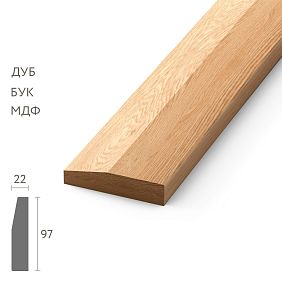
Rectangular profile — the simplest form, rectangular cross-section without rounding, coves. Minimalism, loft, Scandinavian style.Solid Wood Itemswith a straight profile emphasize the wood texture, geometricity. Height is usually 50-80 millimeters. Painted white, gray, natural wood.
Rounded profile (Euro skirting, 'sapozhok') — the upper part is rounded, the transition from vertical to horizontal is smooth. A classic European profile, popular since the 19th century. Rounding visually softens, creates elegance. Practical advantage — rounding forgives wall irregularities up to 2-3 millimeters, the skirting board fits tightly even with small deviations. Height 60-120 millimeters. Suitable for classic, neoclassical, Provence style.
Figural profile — a complex multi-step form with beads, coves, shelves. Baroque, Empire, Classicism.Wooden skirting boardswith a figural profile create volume, play of light and shadow, architectural detailing. Height 80-150 millimeters. Require a corresponding interior — profiled cornices, architraves, classic furniture with carving.
Carved profile — skirting board with applied or integrated carving — floral ornaments, geometry, meander. Exclusive interiors where every detail is unique.Pogonazh iz massivawith carving is made individually, coordinated with the carving of furniture, doors, panels. Expensive, labor-intensive, but creates unique expressiveness.
Skirting board with cable channel — a practical option where inside the skirting board there is a cavity for laying wires — electrical, internet, television. The external profile can be any — straight, rounded, figural. The back wall is removable, attached with clips. The cable channel allows preserving aesthetics by hiding wires, avoiding wall chasing.
Influence of skirting board height on furniture perception
heightskirting board solid woodradically changes the perception of furniture, the visual proportions of the room.
Low skirting board: furniture 'floats'
A skirting board with a height of 40-60 millimeters visually separates the floor from the wall with a minimal line. Furniture against the background of such a skirting board seems elevated, floating, light. This is good for modern furniture on high thin legs — tables, chairs, consoles, where the air under the furniture is part of the design.
But massiveClassic Furniturewith a low skirting board looks disproportionate. A dresser with a height of 900 millimeters, width of 1200 millimeters, placed against a wall with a 50-millimeter skirting board, seems detached from the architecture, hanging in space. The bottom of the dresser — a massive plinth with a height of 100-150 millimeters — does not agree with the thin skirting board. Visual dissonance.
Medium skirting board: balance
A skirting board of 70-80 millimeters creates balance for most interiors. Furniture of medium massiveness — tables, dressers, cabinets of standard proportions — harmonizes with such a skirting board. The bottom of the furniture is visually connected to the skirting board, does not get lost, but also does not dominate.
Solid Wood ItemsThis height is universal—suitable for transitional styles where classicism is softened by modernity. Neoclassicism, contemporary classic, Scandinavian style with classical accents—all are the territory of medium-height skirting.
High skirting: monumentality and support
A skirting of 100-120 millimeters creates visual solidity and architectural presence. The wall is perceived as standing on a massive plinth. Furniture against such a wall gains architectural support—the skirting becomes a pedestal on which the furniture is presented.
A massive oak chest of drawers, 950 millimeters high with a 120-millimeter plinth, against a wall with a 120-millimeter skirting creates visual harmony. The chest's plinth and the wall's skirting are commensurate, perceived as a unified base. The chest does not hang in space but stands firmly on a visual foundation.
A buffet 2200 millimeters high with a high skirting of 120-140 millimeters is perceived as an architectural element—a column growing from a base.Wooden skirting boardsThis height is essential in interiors with high ceilings, where furniture is large and monumental.
Very high skirting: palatial solemnity
A skirting of 150-200 millimeters transforms the wall into an architectural structure. The room gains solemnity and formality. The furniture must correspond—antique cabinets, massive tables, buffets with columns, carvings.
But in a standard apartment with 2700-millimeter ceilings, such skirting visually consumes height—the wall seems lower, the room more squat. The rule of proportion is violated—the skirting dominates, overwhelms.
Skirting profile and stylistic correspondence
Pogonazh iz massivamust coordinate with the style of furniture and interior.
Classic: figured profile and noble woods
A classic interior withclassic furniture—chests with carved legs, buffets with columns, tables on balusters—requires a figured, profiled skirting. A simple rectangular skirting looks alien, destroying stylistic unity.
The ideal profile is European with smooth roundings, several coves, beads. Height 100-120 millimeters for ceilings 2900-3200 millimeters. Material—solid oak, walnut, ash, coordinated with parquet. Finish—natural wood under varnish, tinted in warm tones, or painted in classic colors—cream, gray-beige with patina.
The skirting should echo cornices, architraves, moldings. If the ceiling cornice has a figured profile with beads—the skirting repeats the motif. If door architraves are profiled—the skirting coordinates. Unityinterior decorcreates integrity.
Neoclassicism: Reserved Elegance
Neoclassicism simplifies classical forms while preserving proportions.Wooden skirting boardsof neoclassicism are high 100-120 millimeters, but the profile is simpler—one or two beads, without excessive detailing. Finish often white, cream, light gray—a lightened palette characteristic of neoclassicism.
Neoclassical furniture—straight lines, restrained decor, light tones. The skirting supports this aesthetic—elegant but not excessive.Solid Wood Itemsare painted, texture is hidden—form, color, proportions are important.
Provence and country: naturalness and patina
Provence prefers medium skirting 70-90 millimeters with a classic rounded profile. Material—solid pine, oak. Finish white, cream, gray-blue with patina—wear creating the effect of a century-old history.Pogonazh iz massivais patinated by hand—dark paint applied in the profile recesses, emphasizing the relief.
Provence furniture—chests, buffets, tables—is painted in light tones with patina. The skirting repeats this treatment, creating material unity. Everything looks aged, lived-in, cozy.
Minimalism and Scandinavian style: simplicity of lines
Minimalism uses low 50-70 millimeter skirting with a straight or slightly rounded profile. Finish matte white—the skirting merges with the wall, becomes an extension of the vertical. Or natural light wood—bleached oak, ash—combines with light parquet.
Minimalist furniture is light, geometric, on thin legs. A massive figured skirting contradicts the philosophy of the style. A simpleSolid wood skirting boardof straight profile is delicate, does not compete with furniture, serves as a technical element.
Loft and industrial: contrasts
Loft combines rough industrial surfaces—concrete, brick—with wood and metal. The baseboard can be rough wood—an untreated 40-60 millimeter board coated with oil. Or, conversely, absent—the concrete floor extends under the brick wall without a transition.
Loft furniture is eclectic—industrial metal shelving coexists with vintage dressers.Wooden skirting boardsare used locally—where wooden flooring requires framing.
Baseboard materials: solid wood vs. alternatives
The choice of material determines durability, visual perception, tactile feel, and cost.
Solid wood: the benchmark of quality
Solid wood skirting boardOak—the benchmark for classic interiors. Oak is hard, with a density of 700-800 kg/m³, resistant to mechanical damage. The texture is expressive with large pores, color ranging from light beige to brown. Oak baseboards last for decades, darken with age, acquiring a patina of nobility.
Solid ash—light wood with a contrasting texture. AshPogonazh iz massivais modern, suitable for neoclassical and Scandinavian styles. Strength comparable to oak, price 10-20% lower.
Solid beech—uniform pinkish wood. Beech mills well, creating a crisp profile. Suitable for painted baseboards where the texture is hidden. 20-30% cheaper than oak.
Solid walnut—noble dark wood. WalnutSolid Wood Itemsis premium, expensive, used in exclusive projects.
Pine—soft, lightweight, cheap. Pine baseboards are easily damaged, not suitable for interiors where furniture is moved and contacts the baseboard. But for static areas—bedrooms, living rooms—acceptable, especially for painting.
MDF: stability and paintability
MDF baseboards are more stable than solid wood—they do not warp with humidity changes, do not crack. MDF mills well, creating complex profiles. Painted with enamel, creating a perfectly smooth surface in any color.
Disadvantage—lack of natural texture. MDF is a composite, devoid of wood's warmth. For classic interiors withclassic furnituresolid wood, MDF baseboards are visually poorer, though functionally acceptable.
Veneered MDF: imitation of solid wood
MDF baseboard, faced with oak or ash veneer, is visually indistinguishable from solid wood. Natural texture, composite stability. Price 30-40% lower than solid wood. A compromise solution for budget projects where a classic look is important.
Polyurethane: practicality and moisture resistance
Polyurethane baseboards are lightweight, moisture-resistant, flexible—they wrap around curved walls. Can be painted, imitate carved wood, plaster moldings. Suitable for bathrooms, kitchens, wet areas where solid wood swells.
But for living rooms, bedrooms withclassic furniturepolyurethane is alien—cold to the touch, sounds dull when tapped, looks artificial.Wooden skirting boardssolid wood create material unity with parquet and furniture.
Color and tinting: coordination with furniture and flooring
The color of the baseboard determines whether it blends with the floor and walls or contrasts, creating an accent.
Matching the floor: extending the horizontal line
A baseboard matching the floor color visually extends the flooring, raising it onto the wall. The floor appears larger, the room wider.Pogonazh iz massivafrom the same wood species as the parquet—oak to oak, ash to ash—with the same tint creates seamless unity.
This approach suits interiors where furniture is light or varied in color. The baseboard is neutral, does not compete with furniture, serves as a background.
Matching the wall color: continuing the vertical line
A skirting board matching the wall color visually increases the height of the room — the wall is not interrupted by a contrasting line but smoothly transitions to the floor. Often, skirting boards and walls are painted white, cream, gray —Solid Wood Itemspaint hides the texture, creating a monochrome look.
Suitable for interiors with dark floors and light walls. A white skirting board on dark oak parquet creates contrast, visually lifting the walls.
Contrasting: graphic accent
A contrasting skirting board — dark on a light floor, light on a dark one — creates a clear graphic line that frames the room.Wooden skirting boardsDark walnut on light ash parquet emphasizes the transition, creating structure.
Contrast is appropriate in classic interiors, where architectural articulation—frames, borders, boundaries—is fundamental. However, an excess of contrasts fragments the space, making it unsettled.
Matching furniture: material unity
A skirting board coordinated with the furniture — of the same oak tone as the chest of drawers, sideboard — creates material unity. The furniture is perceived as organically built into the architecture.Classic Furnituremade of dark oak with asolid wood skirting boardmade from the same wood creates the feeling that the furniture and architecture were crafted by the same artisan, at the same time, for the same space.
Skirting board installation: the technology of completion
Beautyskirting board solid woodis realized through proper installation. Installation errors negate the visual effect.
Preparation: wall evenness
Walls must be even — deviations no more than 3-5 millimeters over 2 meters. Significant unevenness creates gaps between the skirting board and the wall. A rounded profile forgives minor irregularities, a straight one requires perfect geometry.
The floor must also be even — the skirting board adheres to the floor with its lower edge. Protrusions, floor unevenness create gaps. The final floor covering — parquet, laminate — is laid before installing the skirting board. A thermal gap of 5-10 millimeters is left between the floor and the wall, which the skirting board will cover.
Cutting corners: precision of joints
Internal skirting board corners — joining two planks at a 45-degree angle. Cutting is done with a miter box or miter saw. Precision is critical — a one-degree deviation creates a gap. Professionals fit corners individually, measuring the exact room angle (often not exactly 90 degrees), halving it, and setting the saw.
External corners are also joined at 45 degrees. An alternative is overlay corner elements made ofsolid wood trim, covering the joint. The elements are carved, decorative, turning a technical node into an accent.
Straight joints — joining planks on long walls — are made at 90 degrees. The ends are sanded, fitting tightly. The joint location is placed where furniture will cover the seam.
Fastening: adhesive, nails, hidden fasteners
Adhesive — the traditional method forwooden baseboards. Liquid nails, polyurethane adhesive are applied to the back of the skirting board, the skirting board is pressed against the wall. The adhesive sets in minutes, fully hardens in 24 hours. Adhesive is suitable for even walls, lightweight skirting boards.
Finish nails — thin headless nails driven with a pneumatic nail gun. The nails pass through the skirting board, entering the wall by 20-30 millimeters. Nail holes are filled with putty and painted. Nails are more reliable than adhesive, suitable for uneven walls, heavy skirting boards.
Hidden fasteners — metal clips mounted on the wall, onto which the skirting board snaps. The skirting board is easily removed and reinstalled without damage. Suitable for skirting boards with cable channels, where access to wires is required.
Screws — a rough method, leaving visible holes. Used for technical rooms, but not for classic interiors withclassic furniture, where every detail must be flawless.
Finishing: puttying, painting
Nail holes and small gaps in corners are filled with acrylic sealant matching the wood or paint tone. The sealant is applied, smoothed with a wet finger to create a seamless transition. After drying, it is sanded with fine sandpaper.
If the baseboard is natural wood — it is coated with varnish or oil after installation. Varnish creates a durable protective film and highlights the wood grain. Oil penetrates the wood, creating a matte surface that is pleasant to the touch.
If the baseboard is painted — painting is done before or after installation. Painting before installation is easier — the baseboard is painted on a workbench, with no risk of staining walls or floors. However, joint areas and nail holes require touch-up after installation. Painting after installation provides a seamless result but requires protecting walls and floors with painter's tape.
Frequently asked questions
What baseboard height is optimal for a standard apartment?
For apartments with ceilings 2700-2800 millimeters, an optimal height is 70-80 millimeters. For higher ceilings 2900-3200 — 100-120 millimeters. Rule of thumb: baseboard height is approximately 1/25 to 1/20 of the room height. But style is important — classic requires high baseboards, minimalism — low ones.
Baseboard matching floor or wall color — which is correct?
Both options are correct and serve different purposes. A baseboard matching the floor color visually expands the floor, making the room appear wider. A baseboard matching the wall color visually increases height, making walls seem taller. For classic interiors, matching the floor or furniture color is often chosen; for modern ones — matching the wall color.
Can MDF be used instead of solid wood?
Functionally — yes, MDF is more stable, does not warp. Aesthetically — for classic interiors with solid wood furniture, solid wood or veneered MDF is preferable. The wood grain creates material unity. Painted MDF is acceptable when the grain is hidden by paint.
How much does solid oak baseboard cost?
Solid wood skirting boardSolid oak baseboard, height 60-80 millimeters — 800-1500 rubles per linear meter. Height 100-120 millimeters — 1200-2000 rubles. Ornate carved profile — 2000-3500 rubles. Price depends on oak grade, profile complexity, and finish. MDF veneered with oak — 500-1000 rubles, 30-50% cheaper.
How to coordinate baseboard with tall classic furniture?
Tall buffets and cabinets require high baseboards of 100-140 millimeters. The furniture plinth and wall baseboard should be proportionate. If a dresser plinth is 120 millimeters — the baseboard should ideally be 100-120 millimeters. Material should be coordinated — oak furniture with oak baseboard. Profile should be ornate, classic.
Conclusion: The Foundation of Beauty from STAVROS
Wooden skirting boards— is not just a technical element covering a gap, but an architectural foundation of the interior, a visual support on which the entire composition from floor to ceiling rests. In classic interiors withclassic furniturebaseboard is critical — its height, profile, and material determine whether furniture will be perceived as organically integrated into the space or detached, floating in air. A tall ornatePogonazh iz massivasolid oak baseboard creates monumentality, coordinating with massive dressers, buffets, tables. A medium-height rounded baseboard provides balance for versatile interiors. A low, straight baseboard suits modernity, where lightness is valued over solidity.
STAVROS is a leading Russian manufacturer ofof solid woodfor interiors — offers a complete line ofsolid wood skirting boardssolid wood baseboards from oak, ash, beech, heights from 50 to 200 millimeters. Over 30 profiles — from simple rectangular to complex multi-step carved. Natural finish with oil, varnish, or ready for painting. Supply length 2000-2400 millimeters with cutting to exact room dimensions possible.
All baseboards are made from select kiln-dried wood with 8-10% moisture content — they do not warp after installation, do not crack with humidity changes. CNC milling ensures profile accuracy to 0.1 millimeter — corners join without gaps, surfaces are even. Multi-stage quality control — each plank is checked for geometry and absence of defects before shipping.
Custom manufacturing — STAVROS's specialization. If catalog profiles do not fit — unique profile manufacturing from a drawing or sketch is possible. Designers develop a 3D model, coordinate, programmers set up the milling center, production makes a test sample. After approval, a series is launched. Lead time 2-4 weeks depending on complexity.
Baseboard accessories — internal corners, external corners, connectors, end caps — made from the same solid wood, same profile. Corners are carved, decorative, turning a technical joint into an ornament. Connectors are hidden, providing seamless joints on long walls.
Baseboards with cable channel — a practical solution for modern interiors with many wires. Cable channel is built into the design, rear wall is removable with clips. External profile is classic — rounded, ornate — aesthetics are not compromised.
Painting and tinting — STAVROS service. Baseboards are tinted with stains to any shade — from light whitewashed oak to dark wenge. Painted with enamels to any RAL color. Hand-patinated — creating a century-old history effect, coordinating with Provence, country-style furniture.
Delivery across Russia. Baseboards are packed in protective film, cardboard, placed in wooden crates for long distances. Moscow, Saint Petersburg — delivery 1-3 days. Regions — 5-14 days. Express air delivery possible for large projects with tight deadlines.
Installation by STAVROS — an option for Moscow, Saint Petersburg. Craftsmen arrive with baseboards, corner elements, adhesive, tools. Perform measurements, angle cutting, installation, finishing. Guarantee no gaps, perfect corners, durable fastening.
Educational materials on the STAVROS website — videos on baseboard installation, articles on choosing height, profile, color. Step-by-step instructions with photos allow DIY installation even for non-professionals.
STAVROS showrooms in Moscow and Saint Petersburg display samples of all baseboard profiles, all wood species. Visit, touch the solid wood, compare heights, evaluate ornate profiles, match samples to furniture photos. Receive designer consultation — what height is optimal for your room, which profile coordinates with furniture, which color creates harmony.
Choosing STAVROS, you choose qualityof solid wood, manufacturing precision, profile variety, individual approach, manufacturer responsibility. Create interiors whereWooden skirting boardsbecome the visual foundation upon whichClassic Furnituregains architectural support, wherePogonazh iz massivaunites the floor, walls, and ceiling into a single composition, where every detail is thoughtfully considered and harmonized, whereinterior decorationfrom baseboard to cornice creates a symphony of proportions, materials, and forms, resonating with the nobility of natural wood, the craftsmanship of joinery tradition, and the beauty of completeness.


