












































































Article Contents:
- Functions of Floor Skirting: More Than Just Decoration
- Mechanical Protection of the Lower Part of the Wall
- Covering technological gaps
- Channel for Communications
- Decorative Function: The Final Touch
- Classification of Wooden Skirting Boards: Understanding the Variety
- By Profile Height: From Compact to Monumental
- By Profile Shape: From Simple to Complex
- By Wood Species: Character and Properties
- Rules for Choosing Height: Proportions Decide Everything
- Mathematics of Harmony: Height Ratios
- Exceptions to the Rules: When to Break Proportions
- The Influence of Color on Height Perception
- Wood species: comparative analysis
- Oak: aristocracy among species
- Ash: Northern Beauty
- Beech: Universal Classic
- Larch: Moisture Resistance
- Pricing: what makes up the cost
- Basic Cost Factors
- Additional processing and finishing
- Geographical Component of Price
- Installation of Wooden Skirting: Technology and Nuances
- Preparation for Installation: Acclimatization
- Mounting methods: glue, self-tapping screws, clips
- Joining Corners and Connections
- Care for Wooden Skirting: Preserving Beauty
- Regular Cleaning
- Updating protective coating
- Frequently asked questions about wooden skirting boards
- STAVROS: Quality Tested by Time
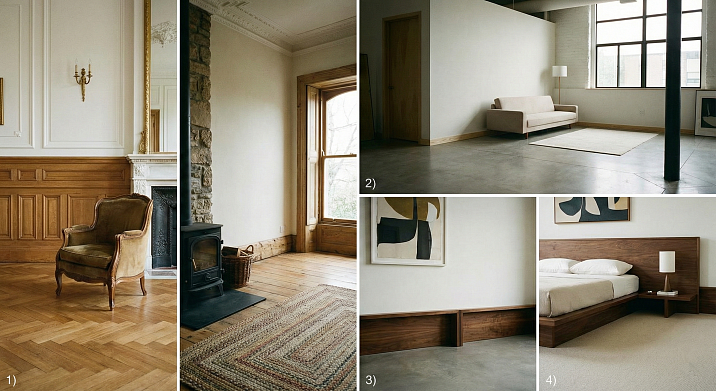
Why do some interiors look complete, assembled, noble, while others appear unfinished despite expensive furniture and quality finishes? The secret often lies in details that seem secondary.wooden baseboard— is one such detail that actually determines the perception of the entire space. It is not just a strip covering the gap between the floor and the wall. It is an architectural element that connects the horizontal and vertical planes of the room into a single composition, sets the scale, creates rhythm, and expresses style.
Wood as a material for skirting is a choice tested for centuries. When mass production offers plastic, MDF, polyurethane at low prices, why pay several times more for natural wood? Because wood is alive. It breathes, changes along with the space, ages nobly, not shabbily.with a classic profile creates a sense of solidity, reliability.looks even better after twenty years than on the day of installation—the patina of time adds character to it. Plastic starts to yellow after five years and begs for replacement.
Choosing the right skirting board is about understanding proportions, materials, and technologies. How does the height of the strip relate to the ceiling height? Which wood species can withstand kitchen humidity? How does a European profile differ from a classic one? Why does an oak skirting cost three times more than a pine one, and is this difference justified? This article is a detailed breakdown of all aspects of choosing wooden floor skirting for those building an interior for decades, not just a season.





Functions of Floor Skirting: More Than Just Decoration




Mechanical Protection of the Lower Part of the Wall
The wall near the floor area is subjected to constant mechanical impacts. Furniture leg impacts during rearrangement. Contact with mops and vacuum cleaners during cleaning. Shoe friction. Without a baseboard, wallpaper, paint, and decorative plaster in this area quickly become damaged—scratches, scuffs, chips. Repairs every 2-3 years become inevitable.
A wooden baseboard with a height of 80-120 mm creates a sturdy protective barrier. Solid oak with a density of 700-800 kg/m³ withstands impacts that would leave dents on a drywall wall. A scratch on the baseboard can be easily sanded and coated with a fresh layer of oil. A damaged wall requires puttying, priming, and repainting the entire surface.
In apartments with children and pets, the protective function of the baseboard is especially critical. Children's wheeled toys, ball impacts, dog claws—all leave marks. A tall, wide baseboard of 140-200 mm protects the wall up to a significant height, creating a zone resistant to everyday loads.
In wet areas—kitchens, bathrooms, hallways—the baseboard protects the wall from water splashes during floor washing. Moisture reaching the wall at the base causes wallpaper peeling and mold growth. A wooden baseboard made from moisture-resistant species with oil impregnation repels water, preventing it from penetrating the wall.
Our factory also produces:
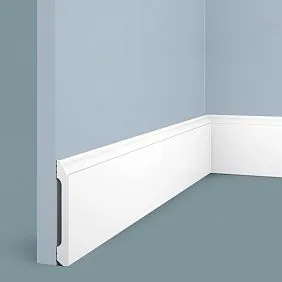
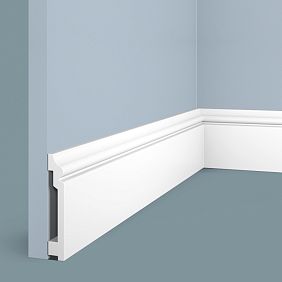
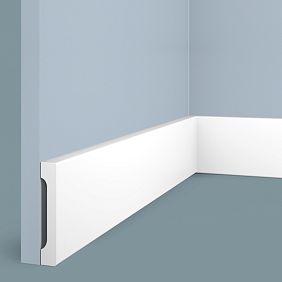
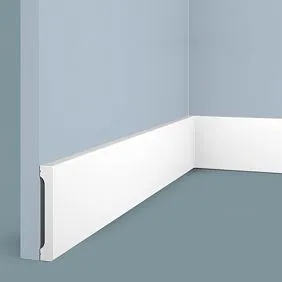

Covering technological gaps
Any flooring requires an expansion gap around the perimeter of the room. Parquet, solid wood, laminate expand and contract with changes in humidity and temperature. A 10-15 mm gap between the edge of the flooring and the wall is necessary to prevent floor buckling. However, an open gap looks untidy and collects dust and debris.
The baseboard covers this technological gap, creating visual continuity between the floor and wall. A plank width of 16-22 mm at the base is sufficient to cover the standard gap with a margin. The baseboard profile is designed so that the lower part fits tightly against the floor and the upper part against the wall, masking all irregularities at the junction.
With uneven walls—common in older housing—the gap between the wall and floor can vary from 5 to 25 mm in different sections. A rigid plastic baseboard does not fit such a wall, leaving gaps. A wooden baseboard can be individually trimmed in each section, ensuring a tight fit along the entire length.
Concealing joints between different floor coverings is another function. The transition from a hallway with tiles to a room with parquet creates an area of different levels and materials. A baseboard running continuously throughout the apartment visually unites spaces, making transitions unnoticeable.
Get Consultation
Cable channel for utilities
Modern apartments are saturated with electronics and communications. Cables for internet, television, audio systems, power for additional outlets—all need to be routed from source to consumer. Exposed wires along walls and baseboards look untidy and spoil the interior.
Some wooden baseboards are designed with a cable channel—a groove on the back or a removable front panel. Wires are laid in the channel before installation or afterward through the removable part. A channel width of 10-20 mm allows for 3-5 standard cables. Wires are hidden, and access to them is maintained for changes and repairs.
An alternative option—a wide baseboard of 140-200 mm, installed 5-10 mm away from the wall. Wires are routed in the gap between the baseboard and wall, completely hidden from view. This method works if the walls are perfectly even and the baseboard is mounted on brackets, not glued.
In office and commercial interiors, where the number of utilities is significant, specialized baseboard systems with increased cable channel capacity are used. However, for residential spaces, a standard solution—a 10-15 mm channel for main cables—is sufficient.
Decorative function: the finishing touch
The baseboard completes the interior, linking the floor with the walls into a unified composition. A baseboard correctly chosen in height, profile, and color creates a sense of completeness and cohesion in the space. A room without baseboards looks like unfinished construction, even if other interior elements are flawless.
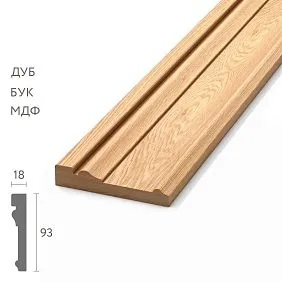
The baseboard profile sets the stylistic tone. A simple rectangular profile with a bevel—minimalist modernity. A figured profile with rolls and recesses—classical style. A carved ornamental baseboard—historical luxury. The profile choice aligns with the overall interior concept.
The color and texture of the wood contribute to the composition. A baseboard matching the floor color visually expands the horizontal plane, making the room wider. A baseboard matching the wall color increases height, raising the ceiling. A contrasting baseboard—an accent that draws attention to the quality of material and craftsmanship.
Baseboard height affects room proportions. A low baseboard of 60-70 mm in a room with 3.5-meter ceilings will get lost and fail to create the necessary visual weight. A high baseboard of 200 mm in a room with 2.4-meter ceilings will overwhelm the space. Maintaining proportions is key to harmony.
Classification of wooden baseboards: understanding the variety
By profile height: from compact to monumental
Low baseboards with a height of 60-70 mm—a minimalist solution for modern interiors and low-ceilinged spaces. This height does not overload the space, creating a delicate frame for the floor. Suitable for apartments with ceilings of 2.4-2.6 meters, where a higher baseboard would reduce visual height. In Scandinavian and Japanese interiors, low baseboards are the norm, emphasizing simplicity.
Medium baseboards of 80-100 mm—a universal standard suitable for most spaces. The height is sufficient for reliable wall protection, masking technological gaps, and accommodating cable channels. Proportions are balanced—the baseboard is noticeable but not dominant. For standard apartments with ceilings of 2.7-2.9 meters, this is the optimal choice.
High baseboards of 120-140 mm—a classic solution for spacious rooms. They create a sense of solidity and foundation. Often used in classical and neoclassical interiors, where high baseboards are paired with high doors, cornices, and moldings. Suitable for rooms with ceilings from 3 meters.
Wide wooden floor skirting board160-200 mm and above—a monumental solution for formal interiors. This height is characteristic of palace halls, where the baseboard protects the wall up to a significant height from furniture and creates an impression of luxury. In modern country homes with ceilings of 3.5-4 meters, a wide baseboard is necessary to maintain proportions.
By profile shape: from simple to complex
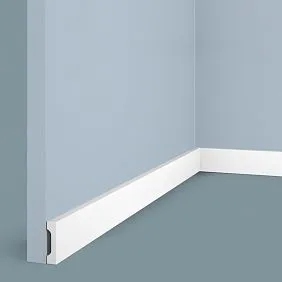
Straight profile—a minimalist rectangular-section plank without decorative elements. The simple form emphasizes the wood texture without distracting with unnecessary details. Used in modern, Scandinavian, and Japanese interiors. Production is simple, price is minimal among wooden baseboards.
Profile with a bevel—a rectangular plank with the top edge beveled at a 30-45° angle. The bevel creates minimal relief, a soft transition from baseboard to wall. A universal solution combining simplicity with subtle decorativeness. Suitable for most styles—from modern to restrained classic.
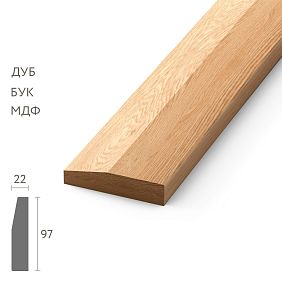
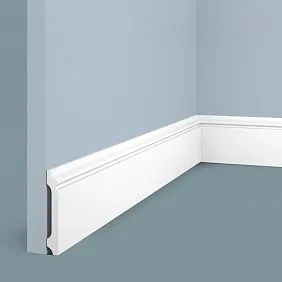
Figured profile—a plank with a complex cross-section, including rolls, recesses, and protrusions. Creates expressive light and shadow play, a rich visual effect. Characteristic of classical interiors—English, French, Italian styles. Produced by CNC milling, price is higher than simple profiles.
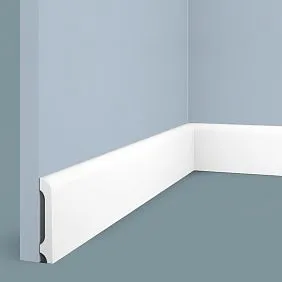
Europrofile—a specific form with a rounded top edge and a flat base, fitting tightly against the floor and wall. Designed for modern interiors where functionality combined with aesthetics is important. Effectively masks wall irregularities due to its flexible top.
Carved ornamental profile—an exclusive solution with hand or machine carving. The ornament can be geometric, floral, or narrative. Used in historical, palace, and premium interiors. Production is labor-intensive, price can reach 5000-8000 rubles per linear meter.
By wood species: character and properties
Oak is the benchmark for wooden skirting boards. Density of 700-800 kg/m³ provides exceptional hardness and wear resistance. Texture is expressive with clear annual rings and large pores. Color ranges from light honey to dark brown depending on treatment. Moisture resistance is high — oak contains tannins that protect against rot. Service life is 50-100 years without loss of properties.
Ash is a worthy alternative to oak. Density of 690-710 kg/m³, hardness is comparable. Texture is more contrasting than oak — pronounced dark annual ring stripes on a light background. Color ranges from whitish to creamy. Ash is more elastic than oak, better withstands impact loads, does not split. Moisture resistance is average, requires quality impregnation. Price is 20-30% lower than oak.
Beech has a uniform texture and light warm shade. Density of 650-680 kg/m³, hardness is sufficient for floor skirting. Texture is fine-pored, even, without a pronounced pattern. Color ranges from pinkish-cream to light brown. Beech is ideal for painting — absorbs paint evenly, does not cause stains. Moisture resistance is low — beech reacts strongly to humidity, not recommended for kitchens and bathrooms. Price is mid-range between pine and oak.
Pine is a budget option for undemanding conditions. Density of 480-520 kg/m³, wood is soft, easily damaged. Texture features characteristic annual rings and resin pockets. Color is yellowish with a pink tint. Moisture resistance is low, mandatory impregnation is required. Service life is 15-25 years. Price is 2-3 times lower than oak.
Larch is a compromise between strength and price. Density of 630-670 kg/m³, harder than pine but softer than oak. High resin content provides natural moisture resistance. Does not rot even in high humidity conditions. Color is reddish-brown. Texture is expressive. Price is 40-60% higher than pine, 30-40% lower than oak.
Height selection rules: proportions decide everything
Harmony mathematics: height ratios
Classical architectural rule: skirting board height should be 1/25 - 1/35 of the wall height. For a room with a 2.7-meter ceiling, optimal skirting height is 77-108 mm. This is not a strict norm but a guideline from which you can deviate depending on the style and function of the room.
For ceilings 2.4-2.6 meters — standard in most panel buildings — skirting of 60-80 mm is recommended. A higher skirting will visually lower an already low ceiling. A narrow profile creates a sense of lightness, does not weigh down the space. If you want a more massive skirting, compensate with a light color matching the walls.
For ceilings 2.7-2.9 meters — new buildings and improved layouts — skirting of 80-100 mm is optimal. This is the golden mean that works in most interiors. Noticeable enough to create architectural structure but not dominant. Complements standard doors 200-210 cm high.
For ceilings 3.0-3.5 meters — spacious apartments and country houses — skirting of 120-160 mm is required. A low skirting in a tall room will get lost, not creating the necessary visual weight. A wide skirting balances proportions, makes the space cohesive rather than empty.
For ceilings above 3.5 meters — historical buildings, mansions, lofts — skirting of 180-250 mm is appropriate. Monumental height matches the scale of the room. Combined with tall doors, cornices, and moldings, it creates an integrated architectural system of classical style.
Exceptions to the rules: when to break proportions
Minimalist interiors deliberately use low skirting even in tall rooms. A 60 mm skirting in a room with 3.2-meter ceilings creates a sense of airiness, weightlessness. The space appears even taller. This is a conscious technique that works in Scandinavian, Japanese, and contemporary interiors.
Historical and palace styles require high skirting even with medium ceilings. A 140-160 mm skirting in a room with a 2.8-meter ceiling creates theatricality, luxury, referencing classical palaces. Visually the room becomes lower but richer, more prestigious. The technique works in Baroque, Empire, and English classic styles.
Combining heights in different rooms of an apartment creates a hierarchy of spaces. Formal living room with 120 mm skirting, bedrooms with 80 mm, bathrooms with 60 mm. The difference emphasizes room status, creates variety. But transitions should be visually logical, not abrupt.
Wide skirting as furniture protection. In children's rooms where furniture is often moved, in living rooms with heavy cabinets, a 140-180 mm skirting protects the wall at a greater height. Function is more important than proportions. Visual weight is compensated by light coloring matching the walls.
Influence of color on height perception
Skirting matching the floor color visually expands the horizontal plane. A dark oak skirting under dark parquet merges with the floor, creating a single wide plane. The room appears wider but lower. The technique works in narrow rooms where width needs to be added.
Skirting matching the wall color increases height. A white skirting under white walls visually continues the vertical plane down to the floor. The wall appears taller, the room more spacious. Used in low rooms to visually raise the ceiling. The floor should contrast with the walls.
Contrasting skirting — an independent element. A dark skirting between a light floor and light walls draws attention to the base line. Creates a clear boundary, structures the space. Visually does not affect height — works as an accent, decorative element.
Gradient from dark floor to light walls with skirting in a transitional tone creates softness, smoothness. A medium-toned skirting between a dark floor and light walls serves as a visual bridge. The space is perceived as cohesive, without sharp boundaries. The technique is characteristic of classical interiors.
Wood Species: Comparative Analysis
| Characteristic | Oak | Ash | Beech | Larch | Pine |
|---|---|---|---|---|---|
| Density, kg/m³ | 700-800 | 690-710 | 650-680 | 630-670 | 480-520 |
| Brinell hardness | 3,7-4,2 | 4,0-4,1 | 3,6-3,8 | 2,6-3,1 | 1,6-2,2 |
| Moisture resistance | High | Medium | Low | High | Low |
| Geometry stability | Good | Good | Medium | Good | Medium |
| Service life, years | 50-100 | 40-70 | 25-50 | 30-60 | 15-30 |
| Price, rub/linear meter (approximate) | 1200-3500 | 900-2500 | 700-1800 | 600-1500 | 300-800 |
| Suitable for wet rooms | Yes | With impregnation | No | Yes | No |
| Processing difficulty | Medium | Medium | Easy | High | Easy |
| Texture | Expressive | Very expressive | Homogeneous | Noticeable | Moderate |
| Color palette | Light yellow to dark brown | Whitish to creamy | Pinkish-cream | Reddish-brown | Yellowish |
Oak: aristocracy among species
Baseboards made of solid oak— the benchmark of quality and durability. Oak wood has formed over decades, accumulating density and strength. Each annual ring is evidence of seasons, winters, and springs endured. This memory of time is revealed in the texture — large pores, expressive rings, a noble grain pattern.
Tannins in the wood's composition protect it from biological damage. Fungi, mold, and wood-boring insects avoid oak. Moisture does not cause rot — oak piles in the foundations of ancient buildings have served for centuries, being in constant contact with water.wooden skirting boards for floor purchasemade of oak means investing in a century-long perspective.
Oak hardness of 3.7-4.2 on the Brinell scale means resistance to mechanical damage. A chair leg hitting a pine baseboard will leave a dent. On an oak one — a barely noticeable mark. Scratches from pet claws that would mar soft wood are minimal on oak. A floor made of oak parquet and a baseboard made of the same oak form a unified system, equally resistant to loads.
Oak's color palette is variable. Natural oak has a light honey, straw shade. Thermal treatment yields dark brown, chocolate tones. Staining creates cool grays, wenge, black colors. Brushing — artificial aging — emphasizes the texture, creating a relief surface. There are hundreds of finishing options, suitable for any interior.
The cost of an oak baseboard is 1200-3500 rubles per linear meter depending on height, profile, and treatment. A simple straight profile 80 mm — 1200-1800 rubles. A figured profile 120 mm with brushing — 2500-3500 rubles. This is 3-5 times more expensive than pine. But oak's service life is 3-4 times longer. If calculating the cost of ownership over decades, oak is more economical than cheap species.
Ash: Northern Beauty
Ash visually resembles oak but has its own character. The texture is more contrasting — dark stripes of annual rings stand out sharply against a light background. The pattern is more dynamic, expressive. The color is cooler — whitish, creamy, gray-yellow tones without the honey warmth of oak. Ash is chosen for Scandinavian, northern, modern interiors where a light, cool palette is valued.
In mechanical properties, ash is comparable to oak. Density 690-710 kg/m³, hardness 4.0-4.1 on the Brinell scale — even slightly higher than oak. But there is a difference — ash is more elastic. It does not splinter under impact loads, it springs back, absorbing energy. This property makes ash preferable for sports floors, stairs, areas with high impact loads.
Ash's moisture resistance is average — lower than oak and larch. Without quality impregnation with oil or varnish, ash reacts to humidity changes and may deform.Price of wooden floor skirting boardmade of ash, costing 900-2500 rubles per meter, requires mandatory protective treatment before installation.
Geometric stability is good provided proper kiln drying. Ash must be dried to a moisture content of 8-10% and acclimatized in a room with normal humidity before processing. Under-dried ash will warp, over-dried will crack. The manufacturer must control moisture at every stage.
Ash takes stain and tint easily. The uniform structure absorbs paints without blotching. Any shade can be created — from white Scandinavian to dark wenge. Brushing ash yields a more expressive result than oak, thanks to the more contrasting texture. The relief after brushing is deep, tactilely pleasant.
Beech: Universal Classic
Beech is wood with a uniform texture and delicate color. A fine-pored structure without a large grain pattern creates a calm, unobtrusive surface. Color from pinkish-cream to light brown with a slight peach tint. Beech is chosen when a light wood without the bright texture of oak or ash is needed.
Density 650-680 kg/m³, hardness 3.6-3.8 on the Brinell scale — average indicators between oak and pine. Sufficient for floor baseboards under normal operating conditions. Beech is not suitable for areas with high mechanical load, but in living spaces it serves for decades.
Beech's main drawback is low moisture resistance. Beech reacts more strongly to humidity changes than other species. It swells in a humid environment, shrinks in a dry one. Without stable conditions, beech deforms, warps. It is categorically not recommended for kitchens, bathrooms, basements. Only for dry living spaces with controlled climate.
Beech's advantage is an ideal surface for painting. The uniform structure evenly absorbs paint, varnish, oil. Staining beech gives a predictable result without blotches or streaks. If a baseboard of a specific color, not found in natural species, is needed, beech is the best choice for painting.
The price of a beech baseboard is 700-1800 rubles per meter — 30-40% cheaper than oak, 2-2.5 times more expensive than pine. This is a compromise between quality and affordability. For bedrooms, living rooms, studies with normal humidity, beech is a reasonable choice, offering good quality for a moderate price.
Larch: Resistance to Moisture
Larch is a coniferous species with unique properties. High resin content makes the wood naturally moisture-resistant. Larch does not rot even in constant contact with water. Venetian piles, standing in water for centuries, are made of larch. For wet rooms — kitchens, bathrooms, saunas — this is the optimal species.
Density 630-670 kg/m³, hardness 2.6-3.1 on the Brinell scale — higher than pine, lower than oak. Sufficient strength for most applications. Resin content complicates processing — cutting tools dull faster, specialized equipment is required. But the result is worth the effort — a larch baseboard serves 30-60 years even in harsh conditions.
Larch color is reddish-brown, warm, with an amber tint. The texture is expressive with contrasting annual rings. Natural larch without staining creates a cozy, warm atmosphere. Thermal treatment yields darker tones, expanding the application palette.
Larch skirting board price 600-1500 rubles per meter — mid-range segment between pine and oak. Favorable price-to-properties ratio for wet rooms. If budget doesn't allow for oak but moisture resistance is needed — larch is optimal.
Pricing: what constitutes the cost
Basic cost factors
Wood species — the main pricing factor. Pine skirting starts from 300 rubles per meter. Oak — from 1200 rubles. The 4x difference is due to raw material cost, processing complexity, durability. Premium species — walnut, mahogany, wenge — can cost 4000-8000 rubles per meter.
Profile height affects cost proportionally to material consumption. 60 mm skirting requires half as much wood as 120 mm. Accordingly, cost differs approximately twofold. Wide 200 mm skirting can cost 3-3.5 times more than narrow 60 mm of same species and profile.
Profile complexity is determined by number of milling operations. Simple straight profile is made in one pass. Ornate profile with multiple curves requires 3-5 passes with different cutters. Each operation — time, tool wear, operator labor. Ornate profile costs 30-70% more than simple one with same species and height.
Raw material quality significantly influences price. Skirting from highest grade wood without knots, cracks, blue stain costs 40-60% more than same from AB grade with permissible defects. Finger-jointed skirting — glued from short segments lengthwise — is 25-35% cheaper than solid wood. Joints are visually noticeable, reducing value.
Additional processing and finishing
Brushing — mechanical removal of soft fibers to create textured grain — increases cost by 150-300 rubles per meter. Process is labor-intensive, requires manual finishing. Result — expressive tactile surface with emphasized wood structure.
Tinting with oils or stains adds 100-250 rubles per meter depending on number of coats and shade complexity. Even tinting requires quality surface preparation, multiple applications with intermediate drying. Complex effects — patination, two-tone tinting — cost more.
Varnishing protects surface and adds shine. One coat of varnish costs 80-150 rubles per meter. Quality varnishing — 3-4 coats with intermediate sanding — adds 300-500 rubles. Matte, semi-matte, gloss varnish provide different visual effects with same protection.
Oil impregnation — alternative to varnish for natural look. Oil penetrates wood structure, emphasizes grain, protects from moisture. Treatment cost 100-200 rubles per meter. Oil requires periodic renewal every 2-3 years, varnish lasts 5-7 years without maintenance.
Geographical price component
Moscow and Saint Petersburg have maximum concentration of manufacturers and suppliers. Competition is high, prices relatively low. Medium-profile oak skirting in Moscow costs 1500-2200 rubles per meter. In regions same product is 15-30% more expensive due to logistics.
Siberia and Far East — regions where coniferous species grow. Pine and larch skirtings there are 20-40% cheaper than in Moscow. But oak, which grows in European part, in Far East is 40-60% more expensive due to transportation costs.
Southern regions with humid climate require higher quality wood drying. Poorly dried skirting in humid climate deforms quickly. Manufacturers include additional drying cycles, increasing production cost by 10-15%. For buyers in such regions, drying quality is more important than minimum price.
Imported products — Italian, German, Scandinavian skirtings — are 2-4 times more expensive than Russian equivalents. Premium for brand, European quality, unique wood species unavailable in Russia. For exclusive interiors where budget is unlimited.
Wooden skirting installation: technology and nuances
Installation preparation: acclimatization
Wood is hygroscopic — absorbs and releases moisture depending on environmental conditions. Skirting brought from cold warehouse to heated apartment will begin to dry. Brought from dry warehouse to freshly renovated room with high humidity — will swell. Deformation is inevitable without acclimatization.
Correct sequence: skirting is unpacked and laid horizontally in room where it will be installed. Temperature should be 18-22°C, humidity 40-60%. Minimum acclimatization period 3-5 days, optimal — 7-10 days. Wood slowly reaches equilibrium with room climate.
During acclimatization each plank is checked. Straightness, absence of defects, color matching. Planks with defects — cracks, chips, loose knots — are set aside for return or use in inconspicuous areas. Color mismatch is resolved by redistribution — dark planks in one zone, light in another.
Layout calculation is done in advance. Room perimeter is measured, doorways where skirting isn't installed are considered. Joint placement is planned — preferably in inconspicuous areas, behind furniture. Corners are cut at 45° for neat connection. Calculation helps minimize waste, optimize material consumption.
Installation methods: glue, screws, clips
Adhesive installation — classic method for perfectly flat walls. Special polymer adhesive or liquid nails are used. Adhesive is applied to back of skirting in zigzag or dots at 30-40 cm intervals. Plank is pressed against wall and floor, held 30-60 seconds until adhesive sets. Advantage — no visible fasteners. Disadvantage — impossible to remove without damage.
Screw fastening — reliable method for any walls. Holes are pre-drilled in skirting at 50-70 cm intervals. Skirting is pressed against wall, wall is drilled through holes, dowels inserted, screws tightened. Screw heads are countersunk, filled with wood-colored putty or covered with decorative caps. Advantage — strength, possibility of removal. Disadvantage — labor-intensive, visible fasteners.
Clip system — modern solution for quick installation. Metal or plastic clips are attached to wall at 40-50 cm intervals. Skirting has groove on back that snaps onto clips. Installation takes minutes, removal is simple — plank is pulled off. Used mainly for MDF and plastic skirtings, rarely for wooden.
Combined method — adhesive plus screws — maximum reliability. Skirting is glued and additionally fixed with screws every 80-100 cm. Used for wide heavy skirtings 140-200 mm that may detach under own weight. Adhesive ensures even adhesion, screws provide insurance against detachment.
Corner and joint connections
Internal corners are joined by cutting each plank at 45°. Miter saw or miter box with handsaw is used. Cutting accuracy is critical — deviation even by 1-2° creates gap in joint. After cutting, planks are placed against corner, connection tightness checked. If gap exists, adjustment is made with plane or sandpaper.
External corners are more difficult than internal — they are visible, defects more noticeable. Cutting also at 45°, but on outer side. Requires perfect precision. Alternative — using ready-made corner elements sold separately. Corner piece covers joint, doesn't require precise cutting. But corner pieces aren't available in every skirting collection.
Lengthwise connections are inevitable — standard plank length 2.2-2.5 meters, walls often longer. Joint is made at right angle or 45° for less noticeable connection. Joint is placed in inconspicuous area — behind furniture, in corner. Joint edges are sanded for tight fit, glued with wood glue, fixed until dry.
Doorways require precise on-site skirting cutting. Plank is brought to door casing, cutting point marked, cut at right angle. Skirting end should fit tightly against casing without gap. If casing protrudes beyond wall plane, skirting is cut on back side to accommodate protrusion.
Wooden Skirting Board Care: Preserving Beauty
Regular cleaning
Dry cleaning is the primary method for maintaining cleanliness. A vacuum with a soft attachment or a dry soft cloth removes dust once a week. Wood does not like abrasives — stiff brushes and coarse sponges scratch the surface. Only soft materials and gentle handling.
Wet cleaning is permissible but must be done with caution. A well-wrung damp cloth wipes the skirting board as needed — once a month or for heavy soiling. Excess water is harmful — moisture penetrates the grain, causing swelling and deformation. A varnished skirting board is less sensitive to moisture than an oiled one.
Cleaning agents should be specialized for wood. pH-neutral formulations without aggressive chemicals. They are diluted according to instructions, applied with a damp cloth, rinsed with clean water, and the surface is wiped dry. Household all-purpose cleaners can damage the protective coating.
Stains should be removed immediately after they appear. Liquid spilled on the skirting board is wiped up immediately — do not let it soak in. Greasy stains are treated with a weak soap solution. Persistent stains — with specialized wood cleaners. Solvents, acetone, and alcohol are not used — they destroy the protective coating.
Updating protective coating
Oil finish requires periodic renewal. Every 2-3 years, the surface is cleaned, lightly sanded with fine sandpaper, and a fresh coat of oil is applied. The oil soaks in and dries in 12-24 hours. This procedure restores protection, refreshes the color, and removes minor scratches.
A varnished skirting board lasts longer without renewal — 5-7 years. But when the varnish wears off, renewal is more complex. The old varnish is removed by sanding, the surface is primed, and 2-3 coats of new varnish are applied with intermediate drying and sanding. The process is labor-intensive, requiring removal of the skirting board or careful on-site work with protection for the floor and walls.
Wax is used for additional protection and shine. It is applied in a thin layer to a clean, dry surface and polished with a soft cloth to a shine. Wax fills micro-cracks, creates a water-repellent layer, and imparts a noble satin sheen. Frequency — every 6-12 months.
Repairing local damage — scratches, dents — extends service life. Minor scratches are sanded with fine sandpaper and treated with oil or wax. Deep dents are filled with wood putty of a suitable shade, sanded, and coated with a protective compound. Professional restorers can restore even serious damage to invisibility.
Frequently asked questions about wooden skirting boards
Can a wooden skirting board be installed in a bathroom?
Yes, but with the selection of a moisture-resistant species and high-quality protective treatment. Oak and larch have natural moisture resistance and can withstand bathroom conditions. Impregnation with moisture-protective oil or coating with yacht varnish in 3-4 layers is mandatory. Beech, ash, and pine do not last long in damp rooms even with treatment — not recommended.
Installation is carried out after the room has completely dried out following renovation. The skirting board is attached so that the lower edge does not touch the floor — a 2-3 mm gap prevents capillary water suction during washing. The ends of the planks must be treated with a protective compound — an unprotected end absorbs moisture more intensively.
Why is wooden skirting board better than MDF or plastic?
Naturalness and eco-friendliness — wood does not emit harmful substances, unlike some types of MDF and plastic with formaldehydes. Durability — a quality wooden skirting board lasts 50-100 years, MDF and plastic — 15-30 years. Repairability — scratches on wood can be sanded out, on plastic they remain forever.
Prestige and status — natural wood is perceived as a premium material, increasing the value of the interior. Restorability — an old wooden skirting board can be sanded, repainted, and become like new. Plastic and MDF, once worn, can only be replaced.
Disadvantages of wood — high price, sensitivity to humidity, need for maintenance. If the budget is limited or the room is damp — MDF or plastic is more rational. But for a quality, durable interior, wood is unrivaled.
Which skirting board profile to choose — simple or figured?
Depends on the interior style. Modern, minimalist, Scandinavian styles require a simple straight profile or one with a slight bevel. Classical, neoclassical, historical styles — a figured profile with beads and recesses. Intermediate styles — Euro-profile, combining functionality with moderate decorativeness.
Simple profile is cheaper — fewer processing operations, lower cost. Price difference with figured is 30-50%. Simple profile is more versatile — easier to fit into any interior, does not impose a style. Figured is more finicky — requires appropriate surroundings, otherwise looks alien.
Room height also influences. In low rooms, a figured profile with an abundance of details can feel heavy. Simple gives lightness and airiness. In tall, formal rooms, a simple profile may seem insufficient — figured creates the necessary visual richness.
The practicality of a simple profile is higher — fewer recesses where dust accumulates. Cleaning is simpler and faster. Figured requires more thorough care — dust gets trapped in every groove, requiring a vacuum with narrow attachments or a brush.
Should a wooden skirting board be painted or is oil sufficient?
The choice between paint, varnish, and oil is determined by the desired effect and operating conditions. Oil preserves the natural wood texture, emphasizes the grain, and gives a matte, noble surface. Ideal for interiors where naturalness is valued. Requires renewal every 2-3 years, less resistant to moisture and soiling.
Varnish creates a durable protective coating, resistant to abrasion, moisture, and household chemicals. Lasts 5-7 years without renewal. Matte varnish retains the look of natural wood with a slight sheen. Glossy gives a mirror-like shine — impressive but not always appropriate. Varnish does not require frequent care but is more complex to renew.
Paint completely covers the wood texture, creating a uniform colored layer. Used when a specific color is needed, not available in natural wood — white, gray, black, colored. Paint is practical — easy to clean, resistant to damage, renewed by repainting.
Combination is possible — oil on the visible front part for beauty, varnish on the lower edge and back side for protection. Or oil with a final wax treatment — oil penetrates the structure, wax creates a protective film. The choice is individual, depends on priorities.
How to join a wooden skirting board with a skirting board made of another material?
The situation arises at the transition between rooms with different floor coverings. An entryway with porcelain stoneware has MDF or plastic skirting. A room with parquet — wooden. How to join at the boundary?
Direct joint in a doorway — the door casing serves as a visual boundary. On one side of the opening, the wooden skirting ends; on the other, the MDF begins. Both skirting boards are cut at a right angle, ends abut the casing. The joint is hidden by the door frame, visually logical.
Transition element — a special strip that joins skirting boards of different heights and profiles. Made individually for a specific pair of skirting boards. Attached at the joint, one end to the wooden skirting, the other to MDF. Creates a smooth transition, masks differences.
Uniform skirting board throughout the apartment — the ideal solution, avoiding joints. Wooden skirting board is installed in all rooms regardless of floor covering. Even in the bathroom with tiles — if a moisture-resistant species is chosen. Visual integrity, no joints, premium look.
Different skirting board heights are acceptable if the transition is not visible. In rooms closed off by doors, each room can have its own skirting. The main thing — within one visually connected space (living room-kitchen-entryway) the skirting should be uniform.
How much does professional wooden skirting board installation cost?
Installation rates vary depending on region, job complexity, and craftsman qualifications. In Moscow, the average price is 250-450 rubles per linear meter for simple installation on even walls. In regions — 150-300 rubles. Complex installation on uneven walls, with fitting, many corners — 400-700 rubles per meter.
Additional work is paid separately. Sanding and painting the skirting board after installation — 150-250 rubles per meter. Brushing — 200-300 rubles. Toning — 100-200 rubles. Multi-layer varnishing — 250-400 rubles. If the craftsman performs a full complex, the cost can reach 1000-1500 rubles per meter.
For an apartment with an 80-meter perimeter, simple installation will cost 20,000-36,000 rubles. Comprehensive with finishing — 50,000-80,000 rubles. This is comparable to the cost of mid-range skirting boards themselves. Savings from self-installation are significant but require tools, skills, and time.
Professional installation warranty — one to two years on installation quality. If the skirting board peels off, joints separate due to the craftsman's fault, they are obligated to fix it for free. With self-installation, the responsibility lies with you. Weigh your skills and risks.
Can wooden skirting board be used with underfloor heating?
Yes, wooden skirting board is compatible with underfloor heating systems provided technological requirements are met. The underfloor heating temperature should not exceed 27-28°C on the surface — this is safe for wood. Higher temperatures can cause drying out, cracking, and deformation of the skirting board.
During installation, the skirting board should not cover the gap between the underfloor heating and the wall. A 10-15 mm expansion gap is necessary for floor expansion when heated. The skirting board is attached to the wall, not the floor, not interfering with the floor covering's movement. The lower edge of the skirting board is 2-3 mm from the floor, not creating a rigid connection.
Acclimatization of the skirting board before installation is critical. A room with underfloor heating has reduced humidity — 30-40% versus standard 50-60%. The skirting board should lie in such a microclimate for 10-14 days, release excess moisture, and reach equilibrium. Otherwise, after installation, it will dry out, and gaps will appear in the joints.
Choose stable species — oak, ash, larch. They react less to humidity changes. Pine and beech in rooms with underfloor heating behave unpredictably — can deform, crack. High-quality impregnation with oil or varnish is mandatory for protection against drying out.
How to choose skirting board color — to match the floor or walls?
Classical design rules offer three strategies. Skirting board matching the floor creates a visual expansion of the horizontal plane. Dark oak skirting board under dark parquet blends in, the floor appears wider. The room visually expands but becomes lower. Suitable for narrow rooms with normal or high ceilings.
Skirting board matching the walls increases the room's height. White skirting board under white walls continues the vertical plane down to the floor. The gaze does not stop at the wall-floor boundary, slides down, creating an illusion of greater height. Used in rooms with low ceilings. The floor contrasts, clearly separated.
Contrasting skirting board — a third way. Dark skirting board between a light floor and light walls attracts attention, creates graphic quality, clarity of lines. Or vice versa — light skirting board between a dark floor and dark walls gives a framing effect. Contrast works in modern interiors where clarity of forms is valued.
Medium-toned skirting board between floor and wall color — a compromise solution. If the floor is dark, walls are light, a medium-toned skirting board serves as a transition. Visually softens contrast, creates harmony. Often used in classic interiors where sharp contrasts are avoided.
Does the direction of floor laying affect skirting board installation?
No, the direction of floorboards — along or across the room — does not affect skirting board installation technology. The skirting board is attached to the wall, not the floor, so the direction of floorboards is irrelevant. The expansion gap between floor and wall is covered by the skirting board in any case.
Visual effect may differ. With longitudinal floor laying (boards along the long wall) skirting board of the same color enhances directionality, elongates the room. With transverse laying, skirting board matching the floor creates a graphic pattern of transverse stripes, visually widens the room.
Diagonal floor laying — boards at a 45° angle — creates a dynamic pattern. The skirting board runs along the perimeter standardly, floorboards approach it at an angle. Triangular cuts of boards at walls are hidden by the skirting board. No technological installation features.
Modular parquet — squares laid in different directions — also does not require special skirting boards. Standard skirting board covers the gap, masks module ends at walls. The main thing is quality trimming of modules along the perimeter for a uniform gap.
STAVROS: quality tested by time
When it comes to choosingbuy wooden floor skirting boardwhich stands with a reliable manufacturer, the company STAVROS — a name worthy of trust. Over twenty years of work in the field of producing millwork from natural wood. Thousands of completed projects — from compact apartments to country residences. Reputation built on the quality of each product.
Wooden skirting boards from STAVROSare made from selected wood of the highest grades. Oak, ash, beech — species harvested in environmentally clean regions, having undergone multi-stage kiln drying to 8-10% moisture content. Each plank undergoes quality control — checking geometry, absence of defects, compliance with standards.
The assortment includes skirting boards of all popular heights — from compact 60 mm to monumental 200 mm. Variety of profiles — simple straight for modern interiors, classic shaped for traditional styles, carved ornamented for exclusive projects. The catalog has over 50 models, covering the entire spectrum of tasks.
Own production on modern European equipment guarantees stable quality. High-precision CNC milling machines ensure perfect profile geometry, repeatability of dimensions from batch to batch. Manual finishing and control at critical operations — brushing, toning, final sanding — guarantee individual attention to each product.
Final finishing is performed with professional compounds from European manufacturers. Osmo, Biofa oils penetrate deep into the wood structure, highlight the texture, protect from moisture and dirt. Sayerlack, Hesse varnishes create a durable, wear-resistant coating that retains properties for decades. Varathane, Minwax stains give an even, rich color without stains.
Custom manufacturing — a direction STAVROS is especially proud of. If the catalog does not have a skirting board of the required height, profile, species — it will be made to order. Technologists will develop a profile based on your sketches or select from an archive of historical samples. A minimum batch from 20 linear meters makes custom production accessible not only for palaces but also for ordinary apartments.
Delivery is organized throughout Russia and CIS countries. Own warehouse in Moscow ensures shipment within 1-2 days from the order. Regional delivery by transport companies — 5-14 days depending on distance. Packaging in shrink film and cardboard boxes protects skirting boards during transportation.
Consultation support is not a formality, but real assistance. STAVROS specialists will answer questions about selecting the species, height, and profile for a specific interior. They will calculate the exact amount of material, taking into account layout and waste. They will provide recommendations on installation, care, and operation. Phone, email, online chat — choose your preferred communication channel.
Environmental certificates confirm product safety. The wood is sourced from FSC-certified forests — the system guarantees sustainable forestry. The finishing compounds have EU conformity certificates and are approved for use in children's and medical institutions. Your health is more important than profit.
STAVROS is not just a baseboard manufacturer. It is a partner in creating your dream interior. A company that understands that a baseboard is not a trifle, but an important detail that shapes the character of a space. A company that invests experience, knowledge, and attention to detail into every product. A company that works for those who build a home for decades, choose natural over artificial, and value quality over cheapness.
ChoosingSTAVROS baseboards, you choose the reliability of a proven manufacturer. Quality confirmed by thousands of satisfied customers. An assortment that meets any need. Service that accompanies you from selection to installation. Guarantees that protect your investment. A reputation that cannot be bought — only earned through years of impeccable work.
Visit the STAVROS website, explore the catalog, and appreciate the variety of solutions. Order samples of the baseboards you like — receive them in hand, personally assess the texture, color, and quality of finishing. Consult with specialists — receive expert recommendations for your project. Make a choice that will last for generations.
Your home deserves the best materials. Natural wood, processed by masters of their craft. Baseboards that in twenty years will look more noble than they do today. Details that transform a room from a set of walls into a true Home. With STAVROS, this is not a dream — it is a reality, available here and now.


