Article Contents:
- What is a wide baseboard and why is it special
- History: from palaces to oblivion and back
- How a wide baseboard differs from a standard one
- For which interiors is a wide baseboard ideal
- Classic interiors: natural environment
- Modern neoclassical interiors: balance of tradition and current trends
- Spacious modern interiors: contrast and graphic design
- Country houses and cottages: space demands scale
- When a wide baseboard is NOT suitable
- Sizes of wide baseboards: from 100 to 200 millimeters
- 100-120 mm: wide, but balanced
- 130-150 mm: monumental classic
- 160-200+ mm: plinth panels
- Profiles of wide baseboards
- Rectangular (smooth)
- Rounded
- Classic ornamental
- Composite (multi-component)
- Materials for wide baseboards
- Solid oak: elite standard
- Solid ash: light alternative
- Solid beech: European classic
- Veneered baseboards: quality at reasonable prices
- Moisture-resistant MDF: for humid rooms
- Color and finish of wide baseboards
- Matching floor: classic approach
- Matching walls: visual blending
- Contrasting: graphic accent
- Patina and effects: palace luxury
- Installation of wide baseboards: features and nuances
- Wall Requirements
- Mounting methods
- Corner Joints
- Filling Gaps
- Wide Baseboards in Different Rooms
- Living Room: Formal Space
- Bedroom: Cozy Intimacy
- Office and Library: Classical Monumentality
- Hallway and Foyer: Practicality and Durability
- Bathroom and Kitchen: Moisture-Resistant Solutions
- Care for Wide Baseboards
- Regular Cleaning
- Protection against damage
- Renovation and Repair
- Prices and Where to Buy
- Prices for Wide Baseboards
- Where to Buy Wide Baseboards
- Frequently Asked Questions about Wide Baseboards
- Conclusion: Wide Baseboard as a Tool for Transformation

Enter a spacious living room with high ceilings. The dark oak parquet is laid perfectly. The walls are painted in noble gray. The furniture is classical and restrained. And along the walls — a wide dark strip 120 millimeters high. Not a standard thin baseboard, disappearing into space. A powerful, expressive element creating an architectural boundary between the floor and the wall.
wide wooden baseboardThis is not just closing a technological gap. It is a statement of style, a tool for changing the proportions of space, a classical architectural element in a modern home. A wide baseboard from 100 to 200 millimeters transforms a standard room into a space with character, adds monumentality, creates visual solidity.
This article is a professional analysis of wide baseboards by an expert with fifty years of experience working with wood, flooring, and classical interiors. We will explain why the wide baseboard is returning to fashion after decades of minimalist dominance, for which interiors it is ideal, how to correctly choose height, species, and finish, and show examples of application from classical palace-style to modern contrasting compositions.
Ready to learn how one detail can change the entire interior? Dive into the world of wide baseboards.




What is a wide baseboard and why is it special
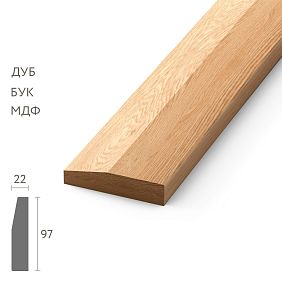
A wide baseboard is a baseboard with a height of 100 millimeters and above. Standard baseboards have a height of 50-90 millimeters, wide ones — 100-140 millimeters, very wide (skirting panels) — 150-200 millimeters and more.




History: From Palaces to Oblivion and Back
Wide baseboards are not an invention of modern designers. This is a return to the traditions of classical architecture. In European palaces of the 18th-19th centuries, Russian estates, aristocratic mansions, baseboards 120-200 millimeters high were standard. They created monumentality, emphasized ceiling height (which in historical buildings was 3.5-5 meters), protected walls from damage in the lower part.
The 20th century brought minimalism, functionalism, a fight against excess. Baseboards became thinner — 40-60 millimeters. In typical Soviet apartments with ceilings of 2.5-2.7 meters, wide baseboards looked bulky. The minimalist aesthetic of the 1990s-2010s continued this trend — the thinner the baseboard, the better, ideally without a baseboard (hidden baseboard, shadow gap).
But since 2015-2020, a reversal began. Designers grew tired of total minimalism. A return to classicism, neoclassicism, mixing styles began. And wide baseboards returned — as elements of classical interiors, as contrasting graphic elements in modern spaces, as a way to change the perception of proportions.
Our factory also produces:
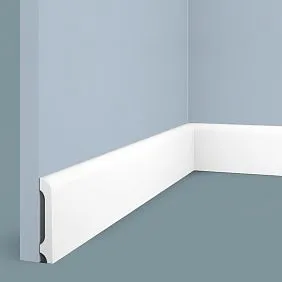
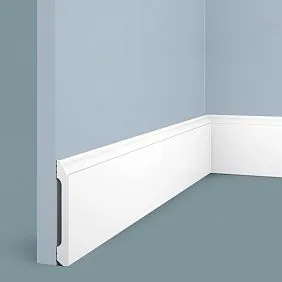
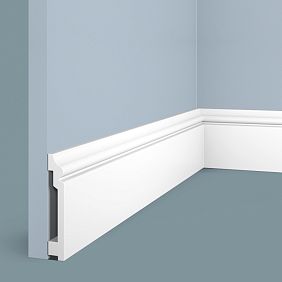
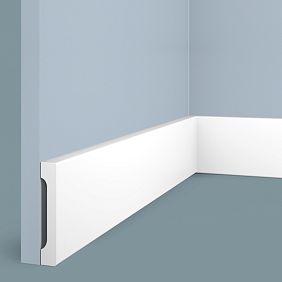
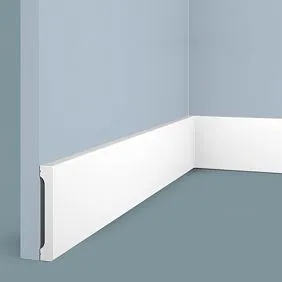
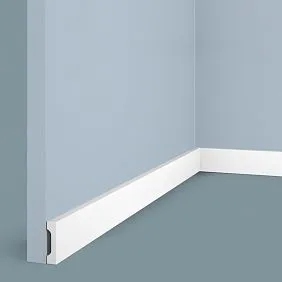
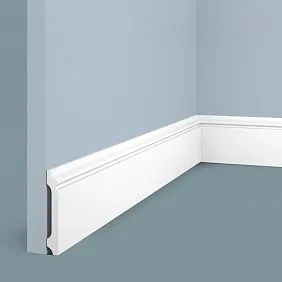

What distinguishes a wide baseboard from a standard one
Visual impact. A standard 70-millimeter baseboard is a technical detail performing a function but not attracting attention. A 120-millimeter wide baseboard is a noticeable interior element, creating a horizontal line, structuring space, influencing the perception of ceiling height and room proportions.
Architectural quality. A wide baseboard is an architectural element, almost a skirting panel. It creates a visual base on which walls "stand," adding weight and fundamentality.
Wall protection. A wide baseboard protects the wall from the floor up to 100-200 millimeters — much more effective than standard. Mops, vacuum cleaners, furniture do not reach the wall finish.
Stylistic marking. A wide baseboard is an unequivocal signal of classical or neoclassical style (or modern interiors with classical elements). A standard baseboard is stylistically neutral and suitable for any style.
Get Consultation
Ideal for which interiors?
Classic interiors: natural environment
Classic, neoclassic, Empire, Baroque — styles where wide skirting boards are not just appropriate, but necessary. They are part of the classical architectural system, like columns, cornices, moldings.
Classic living rooms and dining rooms. High ceilings (3-4 meters), spacious rooms (30-50 m²), parquet made of oak or ash, walls with molding frames or classic wallpaper, furniture in classic style. A wide skirting board 120-140 millimeters high, made of solid oak with decorative profile (ovals, scrolls, moldings), stained to match the floor or 1-2 tones darker, finished with matte lacquer — creates a monumental base for the interior.
Classic offices and libraries. Wooden wall panels 100-150 centimeters high (boiserie), above them wallpaper or paint, ceiling cornices, coffered ceiling. A wide skirting board 120-150 millimeters serves as a base for wall panels, creating a transition from the floor to vertical elements.
Historical interiors and restoration. When restoring buildings from the 19th to early 20th centuries, or recreating historical interiors, skirting boards matching the original ones — 120-200 millimeters high — are used. Without wide skirting boards, a historical interior appears incomplete and inauthentic.
Modern neoclassical interiors: balance of tradition and contemporaneity
Neoclassicism is the most popular style of luxury real estate in the 2020s. It takes classical elements (symmetry, proportions, moldings, skirting boards), but simplifies, lightens, and makes them current.
Neoclassical living rooms. Light walls (white, light gray, beige), light or medium-toned flooring (light oak, ash, bleached oak), minimalist furniture with classic lines, simple-form molding frames on walls. A wide skirting board 100-120 millimeters, white or light gray (not matching the floor, but matching the walls), creates a graphic line, adds structure without heaviness.
Neoclassical bedrooms. Headboard with carriage stretcher or simple soft, bedside tables in classic forms, minimal decor. A wide white skirting board 100-110 millimeters with a simple rounded profile creates an elegant boundary, adding completeness.
Spacious modern interiors: contrast and graphics
In modern minimalist or loft interiors, a wide skirting board can be used as a contrasting graphic element.
Contrasting skirting board. Dark walls (black, anthracite, dark blue) + wide white skirting board 120-140 millimeters. Or vice versa: white walls + wide black skirting board. Creates a strong graphic contrast, making the skirting board a striking element, almost an art object.
Monochromatic compositions. Everything in one color — walls, skirting boards, doors, ceiling cornices white. A wide skirting board 120 millimeters does not stand out by color, but creates relief, play of light and shadow, adding volume to the monochromatic space.
Country houses and cottages: space demands scale
In country houses, ceilings are usually higher than in city apartments (3-3.5 meters), rooms are more spacious (living rooms 40-60 m²). Such spaces require proportionally sized elements.
Spacious living rooms. High ceiling 3.5 meters, area 50 m², panoramic windows. A standard skirting board 70 millimeters will disappear in scale. A wide skirting board 140-160 millimeters is proportionate to the space, creating a visual base, balancing the height.
Halls and corridors. Entrance halls in country houses often have a height of 4-5 meters (two-story space). A wide skirting board 150-200 millimeters (effectively a baseboard panel) creates a powerful horizontal line, visually "grounding" the space, making proportions more comfortable.
When a wide skirting board is NOT suitable
Low ceilings. In rooms with ceilings 2.5-2.7 meters, a wide skirting board 120+ millimeters visually lowers the ceiling even further, creating a sense of confinement and pressure. Here, skirting boards 50-80 millimeters are optimal.
Small rooms. In rooms of 10-15 m², a wide skirting board will look bulky, overloading the space. Exception — if this is a deliberate design choice (creating coziness or intimacy in a small office or bedroom).
Minimalist interiors without decor. If the interior concept is absolute minimalism, absence of decorative elements, clean surfaces, a wide skirting board will be unnecessary, disrupting purity. Here, a hidden skirting board or shadow gap is better.
Budget interiors with cheap finishes. A wide skirting board requires quality wall and floor finishes. With cheap laminate at 500 rubles per square meter and wallpaper at 300 rubles per roll, a wide oak skirting board at 2000 rubles per linear meter will look out of place — like an expensive detail in a cheap interior.
Sizes of wide skirting boards: from 100 to 200 millimeters
100-120 mm: wide, but balanced
This is the lower boundary of "wide" skirting boards. Height 100-120 millimeters is noticeably larger than standard 70-80, but does not fall into the category of baseboard panels.
For which rooms: rooms with ceilings 2.9-3.2 meters, area 20-35 m²; neoclassical interiors where a wide skirting board is needed, but without excessive monumentality; modern interiors with classical elements.
Visual effect: creates a noticeable horizontal line, structures the space, but does not dominate or overload.
Species and finish: solid oak, ash, beech; veneered skirting boards; white or light paint (for neoclassicism), staining to match the floor (for classicism), black paint (for contrasting modern interiors).
Price: solid oak 100-120 mm — 1200-2200 rubles per linear meter; veneered oak — 600-1300 rubles per linear meter.
130-150 mm: Monumental Classic
A height of 130-150 millimeters is already a significant architectural element, characteristic of palace and museum interiors.
For which rooms: spacious living and dining rooms with ceilings 3.2-3.8 meters high, area 35-60 m²; classic interiors with high finishing levels; country houses and cottages; historical buildings and restoration projects.
Visual effect: creates a strong horizontal line, visually lowers the ceiling (use in high rooms), adds monumentality, solidity, luxury.
Species and finish: solid oak, ash, walnut (budget options — veneered on MDF base); decorative profiles with moldings, rounded edges, grooves (classic); toning in dark tones (walnut, wenge, stained oak) with gold patina (palace interiors); natural oak or ash tone with transparent oil (neoclassic).
Price: solid oak 130-150 mm — 1800-3200 rubles per linear meter; veneered oak on MDF — 900-1800 rubles per linear meter.
160-200+ mm: Base Panels
A height of 160-200 millimeters and above is no longer a skirting board, but a base panel, a wall element.
For which rooms: very high rooms with ceilings 4-5 meters (two-story living rooms, halls, atriums); palace and museum interiors; historical buildings (manors, 19th-century estates); modern spacious interiors with contrasting graphic elements.
Visual effect: creates a very strong horizontal line, visually divides the wall into two parts (base section + main wall), significantly reduces the visual height of the ceiling (use only in very high rooms).
Construction: such high elements are often not made from a single solid piece, but from glued laminated timber or MDF with veneer covering (a solid 200 mm oak beam weighs 3-4 kg per linear meter, expensive and difficult to process).
Mounting: base panels are mounted not only to the wall, but sometimes also to the floor (for rigidity, to prevent deformation).
Price: solid oak 160-200 mm — 2500-5000+ rubles per linear meter; veneered on MDF — 1500-3000 rubles per linear meter; often custom-made.
Profiles of wide skirting boards
Rectangular (smooth)
Rectangular-section skirting board without relief. Minimalist, modern.
For which interiors: modern neoclassical interiors, minimalism with classical elements, contrasting graphic compositions (wide black or white skirting board on contrasting walls).
Advantages: visual purity, simplicity, emphasizes the height of the skirting board (a wide smooth strip appears even wider), easy to paint, modern look.
Disadvantages: less expressive than profiled (no play of light and shadow on relief), less characteristic for classical interiors.
Rounded
The top part of the skirting board has a smooth rounded edge with a radius of 10-30 millimeters (the higher the skirting board, the larger the rounding radius).
For which interiors: neoclassicism, modern classicism, transitional styles between minimalism and classicism.
Advantages: softer than rectangular (rounding softens the line), creates a smooth transition from vertical to horizontal plane, less dust accumulates (rounded surface is easier to wipe).
Classic decorative
Skirting board with a relief profile, characteristic of classical architecture.
Elements of classic profile:
-
Mold (convex semicircular element at the top)
-
Oval (concave element creating smooth transition)
-
Cope (small horizontal platform at the top)
-
Vertical plane (main part of the skirting board)
-
Graff (smooth transition from vertical to floor)
For which interiors: classic, neoclassic, palace interiors, restoration of historical buildings.
Advantages: expressive relief creates play of light and shadow, adds volume and depth; conforms to classical canons (authentic for historical interiors); visually richer than smooth.
Disadvantages: 40-70% more expensive than smooth (complex milling), harder to paint (paint must reach all recesses), dust accumulates in relief recesses.
Composite (multi-component)
Very wide skirting boards (150-200+ mm) are sometimes manufactured not as single pieces, but as composite elements made of several parts.
Construction: main panel height 120-150 mm + overlay molding on top 30-50 mm. Total height becomes 150-200 mm, but elements can be varied to create unique compositions.
Advantages: design flexibility (different moldings can be combined), possibility to create complex multi-level profiles, easier transportation and installation (two elements of 120 and 50 mm are lighter than one 170 mm element).
Disadvantages: more complex installation (two elements instead of one), joints between elements must be perfect (otherwise the seam will be visible).
Materials for wide skirting boards
Solid oak: elite standard
Oak is the optimal species for wide skirting boards. Density 700-750 kg/m³, high hardness, strength, durability, expressive texture.
Advantages for wide skirting boards: a high oak solid skirting board weighs quite a bit (120 mm skirting board weighs 1.5-2 kg per linear meter), but the weight provides monumentality and solidity; oak does not deform when properly dried (humidity 8-12%); withstands any impacts or scratches; lasts for decades.
Texture: oak has an expressive texture with clear growth rings. On a wide skirting board surface of 120-150 mm, the texture is clearly visible, creating visual interest.
Staining: oak stains excellently — from light tones (bleached oak, Scandinavian light) to dark tones (walnut, wenge, stained oak, black).
Price: solid oak for wide skirting boards 100-120 mm — 1200-2200 rub/m; 130-150 mm — 1800-3200 rub/m; 160-200 mm — 2500-5000+ rub/m.
Solid beech: light alternative
Beech is similar in strength to oak, texture is similar but lighter, with a grayish tint.
Advantages: visually lighter than oak (lighter, softer texture), perfectly suits modern neoclassical interiors and Scandinavian style; stains excellently in light and medium tones; price is 15-25% lower than oak.
Price: solid beech 100-120 mm — 1000-1800 rub/m; 130-150 mm — 1500-2800 rub/m.
Beech wood: European classic
Birch — dense wood (density 650-700 kg/m³) with fine, uniform texture, pink or yellowish-white color.
Advantages: fine, uniform texture (on a wide skirting board surface, large growth rings won't appear, pattern is calm and even); stains excellently (uniform structure ensures even coloring); 30-40% cheaper than oak.
Disadvantages: hygroscopic (absorbs moisture, may deform in humid rooms — requires quality protective coating).
Price: solid birch 100-120 mm — 900-1600 rub/m; 130-150 mm — 1400-2400 rub/m.
Veneered skirting boards: quality at reasonable prices
Base made of MDF or pine solid wood, veneered with veneer of premium species (oak, beech, walnut) thickness 0.6-3 mm.
Advantages for wide skirting boards: price 50-70% lower than solid wood (veneered oak skirting board 120 mm — 600-1300 rub/m vs 1200-2200 for solid wood); geometric stability (MDF or glued pine solid wood reacts less to humidity, wide skirting board won't warp); visually indistinguishable from solid wood (quality natural veneer on a wide surface looks like solid wood).
Disadvantages: limited repairability (veneer is thin, deep scratches or sanding may expose the base); if base is MDF — afraid of water (swells when wet).
Application: optimal choice for quality wide skirting boards within a moderate budget.
Water-resistant MDF: for humid rooms
Wide skirting boards made of water-resistant MDF (with increased density and hydrophobic additives) with paint or veneer finish.
Advantages: water resistance (can be used in bathrooms, kitchens, hallways, where regular MDF or solid wood without protection may suffer from moisture); geometric stability (won't warp or twist); low price (water-resistant painted MDF 120 mm — 400-900 rub/m).
Disadvantages: artificial material (if painted — no wood texture); if the coating is damaged, MDF is visible (coating restoration is required).
Application: bathrooms, kitchens, hallways, basements, other humid rooms.
Color and finish of wide skirting boards
In floor tone: classic approach
Baseboard is selected to match the floor tone or 1-2 tones darker/lighter.
Visual effect: the baseboard visually blends with the floor, making the floor appear wider and higher (a wide dark strip of the floor continues up the wall by 120-150 mm). The room appears more spacious. Walls start higher (at the baseboard level, not from the floor).
Suitable for: classic interiors (traditional approach — baseboard as continuation of the floor), interiors where visual expansion of space is needed, rooms with dark floors (dark floor + dark baseboard create a powerful dark base).
How to choose the tone: take a floor sample to the baseboard store, place it against samples, and select the closest match; or order baseboard tinting to match your floor sample.
In wall tone: visual blending
Baseboard is painted the same color as the walls (usually white, light gray, beige).
Visual effect: the baseboard visually blends with the wall, becoming its continuation. A wide 120 mm white baseboard on white walls creates relief (play of light and shadow on the profile), but does not create a color boundary. The floor visually ends clearly, the wall starts from the floor, making the room appear higher (no horizontal dark strip reducing height).
Suitable for: neoclassicism (white or light gray walls + white or light gray baseboard — characteristic technique), Scandinavian style, minimalism with classic elements, interiors where visual height increase is needed.
Wood species: any (oak, beech, ash, pine), as natural texture will be hidden by paint. Can use budget species (pine, spruce) or MDF — after painting, no difference is visible.
Contrasting: graphic accent
Baseboard in contrasting color — black on white walls, white on black or dark blue, dark on light.
Visual effect: baseboard becomes a striking graphic element, a clear horizontal line drawing attention. Strong contrast is created, adding drama and expressiveness. Space is structured and gains graphic quality.
Suitable for: modern interiors with contrasting color schemes, minimalism, Scandinavian style (white walls + black baseboard), loft (dark walls + white baseboard or black walls + black baseboard as monochrome).
Baseboard height: contrasting baseboard must be sufficiently wide (100-140 mm) to ensure the contrast is noticeable and creates the desired effect. A thin contrasting baseboard 60 mm will appear as a thin line and will not achieve the desired effect.
Patina and effects: palace luxury
Wide baseboards in palace and baroque interiors are often patinated (artificial aging) with gold, silver, or bronze.
Technology: baseboard is tinted to a base color (white, cream, light gray) or dark (walnut, wenge). Then, dry brush is used to apply gold, silver, or bronze paint (patina) to raised elements (bosses, beads). This creates an effect of antique gilding.
Visual effect: luxury, palace-like, historic. The baseboard's relief is emphasized (gold on raised parts, base color in recesses — creating play of light, volume, depth).
Suitable for: baroque, rococo, empire, palace classic interiors, restoration of historic buildings.
Price: hand patination is an expensive service (plus 50-100% to baseboard cost).
Installation of Wide Baseboards: Features and Nuances
Wide baseboards are heavier than standard ones (oak baseboard 120 mm weighs 1.5-2 kg/m, 150 mm — 2-2.5 kg/m), have larger contact area with walls. This imposes specific requirements on installation.
Wall requirements
Flatness. The wall must be as flat as possible. If the wall is uneven (deviations over 3-5 mm over 2 meters), a wide baseboard will not fit tightly — gaps will form. A narrow 60 mm baseboard is flexible, bends, and covers minor unevenness. A wide 120+ mm baseboard is rigid, does not bend, and replicates wall unevenness.
Solution: before installing wide baseboards, level the walls (plastering, spackling) or use flexible sealants filling gaps between baseboard and wall.
Methods of mounting
Adhesive mounting. Suitable only for perfectly flat walls. A wide heavy baseboard requires strong adhesive (polyurethane, epoxy, "liquid nails" reinforced). Adhesive is applied in a continuous bead along the entire backside, baseboard is pressed against the wall, and secured with painter’s tape or clamps for 12-24 hours.
Screw mounting. Reliable method for wide baseboards. Screws are driven in at 40-50 cm intervals (more frequently than for standard baseboards). For wide baseboards, use screws 70-90 mm long (to penetrate through baseboard thickness of 15-20 mm and enter the wall 50-70 mm). Screw heads are countersunk and masked with wax pencil or spackle.
Combined mounting. Adhesive + screws. Most reliable method for heavy wide baseboards. Adhesive ensures tight fit along the entire length, screws provide strong attachment, preventing peeling.
Jointing corners
Wide baseboards are joined in corners at 45 degrees (like standard ones). But due to greater height and often complex profiles, joining is more difficult.
Tool: miter saw with extended blade (for baseboards 120+ mm high — standard miter saws may not reach the height — need a saw with a large 300-305 mm blade or extended blade).
Accuracy: even a slight angular error (1-2 degrees deviation) on a wide baseboard creates a noticeable gap at the joint. Use a quality miter gauge or miter saw, and check wall angles with a protractor (angles in real rooms rarely exactly 90 degrees).
Trimming: after preliminary cutting, align the baseboards to the corner, check the joint. If there is a gap, sand it down or re-cut with angle adjustment.
Filling gaps
Even with quality installation, small gaps may remain between wide baseboards and walls (due to wall unevenness).
Solution: fill the gaps with acrylic caulk (white or matching the baseboard color). Apply caulk into the gap, smooth it with a wet finger or putty knife, remove excess. After drying, the caulk can be painted to match the baseboard.
Wide baseboards in different rooms
Living Room: Formal Space
Living room — the main room in the house, where wide baseboards are most appropriate.
Classic living room: dark oak parquet, cream-colored walls with molding frames, ceiling cornices, chandelier. Baseboard made of solid oak 130 mm, stained to match the floor (dark walnut), with decorative profile (rounded edge + beveled edge), finished with matte lacquer. Creates a monumental base, harmonizes with classic wall and ceiling decor.
Neo-classic living room: light parquet (bleached oak, beech), white walls, simple molding frames, modern furniture with classic lines. Baseboard 110 mm white (solid wood or MDF), rounded profile. Creates a clear graphic line, adds structure, does not overwhelm.
Modern living room with contrast: light-gray walls, light floor (natural oak), minimalist furniture. Baseboard 120 mm black (stained oak or MDF), smooth rectangular profile. Creates a contrasting black line along walls, adds graphic appeal and modernity.
Bedroom: cozy intimacy
In the bedroom, wide baseboards create coziness, intimacy, and solidity.
Classic bedroom: parquet of medium-toned oak, walls in pastel shades (beige, light gray, lavender), classic furniture. Baseboard 100–110 mm matching the floor, decorative or rounded profile. Does not dominate, creates a soft base.
Neo-classic bedroom: light floor, white or light-gray walls. Baseboard 100 mm white, simple profile. Visually light and elegant.
Office and library: classic monumentality
Office and library — rooms where classic style and monumentality are especially appropriate.
Classic office: dark parquet, wall panels (boiserie) 120–150 cm high made of dark wood, wallpaper or paint above panels, wooden furniture, bookshelves. Baseboard 130–150 mm made of the same wood as panels (oak, walnut), serving as a base for panels. Creates a unified composition, monumentality, and dignity.
Hallway and entryway: practicality and durability
Hallway and entryway — high-traffic zones where walls are exposed to dirt and impacts.
Advantages of wide baseboards: protect walls over a greater height (120–150 mm from floor) from dirty shoes, umbrellas, bags, and mops during cleaning.
Material: for entryways, moisture-resistant MDF with paint finish or solid wood with durable lacquer coating (matte or semi-gloss lacquer is easier to clean than oil).
Color: dark tones (better hide dirt than light tones) or practical medium tones.
Bathroom and kitchen: moisture-resistant solutions
In humid rooms, wide baseboards made of standard solid wood or MDF may be damaged by moisture.
Solutions: moisture-resistant MDF with paint or veneer finish (increased density, hydrophobic additives); solid oak or larch (moisture-resistant species) with quality lacquer coating (lacquer creates a waterproof film); baseboard tile (ceramic granite, ceramic tiles 100–150 mm high, imitating baseboard — completely moisture-resistant, but cold and less cozy than wood).
Care for wide skirting boards
Wide baseboards have a larger surface area, where dust accumulates and dirt is more visible.
Regular cleaning
Weekly: wipe with a dry soft cloth or vacuum with a soft brush, removing dust. Dust is more visible on a wide surface than on a narrow one.
Monthly: wipe with a damp (well-wrung) cloth and mild cleaning agent (liquid soap, wood cleaner). Especially in areas of frequent contact (near doors, where furniture is moved).
Decorative profiles: dust accumulates in recesses of the relief. Use a soft brush or cloth to wipe recesses.
Protection against damage
Furniture: use soft pads (felt, silicone) on furniture legs to prevent scratching the baseboard when moving furniture close to walls.
Cleaning: when mopping the floor, the mop should not strike the baseboard forcefully. Wide baseboards can withstand impacts, but repeated impacts leave dents and scratches.
Pets: if you have dogs or cats, they may scratch the baseboard with their claws. Wide baseboards suffer more (larger surface area for scratches). Regularly trim pets’ claws or use protective pads.
Scratches on varnished baseboards: minor ones — cover with touch-up marker or wax pencil; deep ones — fill, sand, and locally apply varnish.
Scratches on painted baseboards: repaint with matching paint, blend edges.
Scratches on painted baseboards: repaint with matching paint, blend edges.
Renewal of finish: after 10-15 years (varnish) or 5-8 years (oil), the finish wears out. Sand lightly to remove the top layer, then reapply finish.
Prices and where to buy
Prices for wide baseboards
Solid oak:
-
100-120 mm — 1200-2200 rub/m
-
130-150 mm — 1800-3200 rub/m
-
160-200 mm — 2500-5000+ rub/m
Solid ash:
-
100-120 mm — 1000-1800 rub/m
-
130-150 mm — 1500-2800 rub/m
Solid beech:
-
100-120 mm — 900-1600 rub/m
-
130-150 mm — 1400-2400 rub/m
Veneered (oak):
-
100-120 mm — 600-1300 rub/m
-
130-150 mm — 900-1800 rub/m
Moisture-resistant painted MDF:
-
100-120 mm — 400-900 rub/m
-
130-150 mm — 600-1400 rub/m
Prices depend on region, manufacturer, profile complexity, and finish. Ornamental profiles cost 30-50% more than plain ones. Patina and complex staining increase price by 50-100%.
Where to buy wide baseboards
Specialized stores for flooring and parquet. Wide variety of baseboards in different species, heights, and profiles. Professional consultants will help you select a baseboard to match your floor. Sample staining services available.
Manufacturers of baseboard products. Buying directly from the factory-producer — lower price (no intermediaries), option to order non-standard sizes, profiles, or staining.
Online stores. Wide selection, convenient ordering, delivery. Downside — can't see in person. Order samples for home try-on.
Custom manufacturing. If you need a non-standard size (e.g., 135 mm or 175 mm), unique profile, or rare species — order from a furniture workshop or manufacturer. Lead time: 2-4 weeks, price 30-50% higher than ready-made items.
Frequently asked questions about wide baseboards
Will a wide baseboard look bulky?
In rooms with low ceilings (2.5–2.7 m) and small area (10–15 m²) — yes. In rooms with standard ceilings (2.8–3 m) and area 20+ m², a 100–120 mm skirting board looks harmonious. In high, spacious rooms (ceilings 3.2+ m, area 35+ m²), a 130–150 mm skirting board is optimal.
How to choose the height of the skirting board?
General rule: the higher the ceiling and the larger the area, the higher the skirting board. Ceiling 2.9–3.2 m → skirting board 100–120 mm. Ceiling 3.2–3.8 m → skirting board 130–150 mm. Ceiling 4+ m → skirting board 160–200+ mm.
Which profile to choose: smooth or decorative?
For classic interiors — decorative (matches the style). For neoclassicism and modern classicism — rounded or simple decorative. For modern minimalist — smooth rectangular.
Solid wood or veneer?
Solid wood — if budget allows, solid wood floor, value longevity. Veneer — if budget is medium, need good quality at a reasonable price. Visually, high-quality veneer is almost indistinguishable from solid wood.
What color to paint a wide skirting board?
For classic — match the floor tone (skirting board continues the floor). For neoclassicism — match wall tone (usually white, light gray). For modern contrasting interiors — contrasting color (black on white walls, white on dark walls).
How much does installation of wide skirting boards cost?
Professional installation — 200–400 rubles per linear meter (more expensive than standard due to weight and complexity of joints). Can be installed yourself if you have tools (circular saw, drill) and skills.
Conclusion: wide skirting board as a transformation tool
Wide skirting board — more than a detail. It is a tool for changing the perception of space, creating style, adding monumentality and luxury. One element — and a standard room transforms into a space with character.
A classic living room with wide oak skirting boards 130 mm acquires palace-like monumentality. A neoclassical bedroom with white 110 mm skirting boards — elegant completion. A modern space with contrasting black 120 mm skirting boards — graphic expressiveness.
Company STAVROS — leading manufacturer of wooden skirting boards with over 25 years of experience offers wide skirting boards for the most demanding interiors:wide wooden baseboardFrom solid oak — more than 30 models from 100 to 200 mm height in all classic profiles (smooth rectangular, rounded, decorative with beads, ovals, coves, grooves, carved with ornaments) for classic, neoclassical, modern interiors; from solid ash — 25 models 100–180 mm height in light natural tones for Scandinavian and modern interiors; from solid beech — 20 models 100–150 mm height with fine uniform texture ideal for painting; veneered skirting boards — 40 models 100–160 mm height with natural oak, ash, walnut veneer on moisture-resistant MDF or solid pine, providing solid wood quality at 50–60% of the price; skirting boards from moisture-resistant MDF — 100–150 mm height, paintable in any RAL color for humid areas such as bathrooms, kitchens, hallways; baseboard panels — 160–200 mm height for palace interiors, hallways with very high ceilings, museum spaces; custom-made skirting boards of any height and profile according to customer’s sketches, drawings, or photos (need a 125 mm or 175 mm skirting board with a unique profile? We will manufacture it in 3–4 weeks).
Each wide skirting board STAVROS is made from selective high-grade solid wood with 8–12% moisture content after long-term kiln drying, guaranteeing geometric stability, absence of deformation or cracking (wide skirting boards are especially demanding in drying quality — under-dried wood will cause a 120–150 mm skirting board to bow). Production is carried out on precision four-sided planer equipment Weinig (Germany), ensuring perfectly smooth surface, precise dimensions (tolerance no more than 0.2–0.3 mm per 2.5 meters of length), geometric accuracy (skirting board is perfectly straight, not curved or twisted). Decorative profiles are milled on CNC machines SCM (Italy) using digital models guaranteeing absolute profile consistency along the entire length of the board and between boards (each millimeter of wide decorative skirting board is identical in relief, clear, expressive). Wide skirting boards require special quality control — straightness of each board is checked on a control table (deviation no more than 1 mm per 2.5 meters), flatness of the front surface (no warping or waves allowed), clarity of decorative skirting board profiles (relief must match the standard).
Finishing of wide skirting boards is done with premium-grade professional compositions: German lacquers Hesse Lignal and Italian Sirca create durable, long-lasting coating (lasts 12–15 years without renewal) with even gloss (gloss, semi-gloss, matte — choice available) without streaks or pooling; natural oils Osmo (Germany) Biofa penetrate into the wood, highlighting the texture, creating a silk-like surface, environmentally safe (ideal for bedrooms and children’s rooms); staining with Sayerlack (Italy) stains in hundreds of shades from light bleached oak to black ebony, ensuring exact color match between skirting board and your floor (bring a floor sample — our colorist will select the perfect tone); painting with enamels in any RAL catalog color (over 200 colors — white, black, all shades of gray, colored) creates even opaque coating hiding wood texture; patination with gold, silver, bronze is done manually by experienced masters (patina is applied with dry brush to protruding elements of decorative profiles, creating an aged gilding effect characteristic of palace interiors).
STAVROS provides a full range of services for an ideal result: professional consultation from specialists with 20 years of experience helping to select optimal height, profile, species, and color of wide skirting board for your interior, floor, ceiling, style (all nuances are considered — ceiling height, room area, interior style, floor and wall color, budget); individual tone selection based on your floor sample (bring a piece of floor plank or photo taken in daylight — our colorist will match the tone perfectly); precise calculation of skirting board quantity considering room perimeter, door openings, and allowance for trimming (you won’t overpay for extras and won’t be left short by half a meter); selection of accessories (internal and external corners, plugs, connectors, glue, installation screws — everything needed for perfect installation); detailed installation instructions for wide skirting boards with photos of each stage and video clips (special features of installing heavy wide skirting boards, joining decorative profiles, filling gaps); professional installation on-site by experienced masters (cost 250–400 rubles per linear meter, depending on profile height and room complexity, 2-year warranty on installation quality); post-sale service, maintenance consultations, repair, and restoration if needed.
STAVROS official quality warranty — 2 years on wide skirting boards made of solid wood, guaranteeing absence of manufacturing defects, deformation, cracking, or coating delamination under proper use. In case of any factory defect (cracks, warping, unevenness, wood defects, poor processing, uneven coating) — free replacement with delivery compensation. Return within 14 days with full refund if product retains original condition and packaging.