












































































Article Contents:
- Moulding task: function and aesthetics
- Oak mouldings: standard of quality
- Oak moulding vs veneer: what's the difference
- Door trim: constructing a complete assembly
- Compatibility of moulding and skirting
- Size selection: proportions and scale
- Common mistakes in selecting mouldings
- How to buy a door trim set
- Conclusion: cohesive door assembly from STAVROS
- Frequently Asked Questions

A door is not just a rectangular panel in a frame. It is a complex architectural system where each element performs its function and affects the perception of the entire structure.Oak casingFrames the opening, creating a visual frame and concealing mounting gaps. The door frame sets the geometry and ensures secure panel attachment.Wooden baseboardCompletes the composition at the bottom, creating a transition from wall to floor. All these elements must be coordinated with each other — in material, color, profile, proportions. Only then is the door assembly perceived as cohesive, thoughtfully designed, and high-quality. Let's examine how to construct proper door trim architecture and whyDoor moldingMade from solid wood remains the standard for premium interiors.




Moulding task: function and aesthetics
The technological gap between the door frame and the wall is an inevitability of any installation. The width of this gap varies from 10 to 40 mm depending on the flatness of the opening, wall thickness, and installation method. Leaving it open is impossible: the edges of plaster, mounting foam, and fasteners are visible. The gap collects dust, looks careless, and destroys the impression of quality renovation.Oak door trimCloses this gap, transforming a technological necessity into a decorative element.
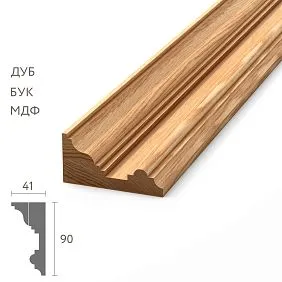
The width of the moulding is chosen based on the gap width plus allowance for covering the frame and wall. Minimum width 60 mm — for narrow openings in small rooms. Standard width 70-80 mm — universal solution for most interiors. Wide mouldings 90-120 mm — for spacious rooms with high ceilings, where a narrower moulding would 'disappear' and fail to create the desired scale. An overly wide moulding in a small room visually consumes space, making the opening heavy and cumbersome.
The thickness of the moulding determines its strength and visual weight. Thin mouldings 10-12 mm look elegant but require careful handling — easily chip under impact. Standard thickness 14-18 mm provides a balance between strength and elegance. Thick mouldings 20-25 mm create a substantial, robust appearance, characteristic of classic interiors with heavy doors and tall skirting.
The moulding profile sets the style of door trim. Flat rectangular profile — hallmark of minimalism and modern styles. Profile with one rounded edge or bevel — universal solution suitable for most interiors. Complex multi-level profile with grooves, curves, and protrusions — attribute of classic style, where the door becomes an architectural element echoing column and pilaster motifs.
Moulding installation requires precision and care. Traditional method — using finish nails 40-50 mm long, driven at 400-500 mm intervals. Nail heads are countersunk into wood by 1-2 mm, recesses are filled with wood-colored putty, then sanded after drying. Properly installed moulding is invisible even upon close inspection. Alternative method — using liquid nails with additional fixation using painter’s tape until the adhesive sets. This method leaves no visible marks but is less reliable during future disassembly.
Corner joints of mouldings are mitered at 45 degrees to create a neat joint. Mitering is done on a miter saw with precision to 0.5 degrees — even the slightest deviation results in a gap at the corner. Profiled mouldings require special precision: the relief must match at the joint, forming a continuous line. After assembly, the joint is sealed to prevent opening due to humidity fluctuations.
The protective finish of the moulding must withstand mechanical impacts — touch by hand, bag or object impacts, wiping during cleaning. Polyurethane-based varnishes create a hard, wear-resistant film. Oils and waxes penetrate the wood structure, preserving the tactile warmth of solid wood, but require periodic reapplication. Finish choice depends on usage intensity: lacquer is preferred for high-traffic areas and hallways, while oil is better for bedrooms and offices.




Oak mouldings: standard of quality
Oak solid casing— choice for those who do not accept compromises in quality. Oak possesses a unique combination of properties making it ideal for door trim. Density 700-800 kg/m³ ensures high strength and dimensional stability. Hardness 3.7-4.2 on Brinell scale guarantees resistance to mechanical damage — scratches, dents, chips. Tannin content imparts natural antiseptic properties and resistance to rot.
Oak texture is recognizable and noble. Prominent annual rings create a distinctive pattern, varying depending on the cutting method. Radial cutting yields straight parallel lines — restrained, formal texture typical of classic interiors. Tangential cutting forms curved lines — more dynamic, expressive appearance. Oak’s medullary rays, when cut radially, form 'mirrors' — light spots that gleam at certain angles of illumination and add depth to the texture.
Oak color ranges from light straw in young wood to dark brown in mature wood. The heartwood is always darker than the sapwood, creating a natural contrast valued in design. Staining oak with stains emphasizes the texture and allows achieving virtually any shade — from golden-brown to charcoal-black. Tannins in the wood react with stains, producing deep, rich color unattainable with other species.
Oak processing requires professional equipment. High density and hardness quickly wear cutting tools — bits, saws, blades require regular sharpening. Cutting speed is slower than for softwoods, increasing processing time. Sanding oak is a critical operation: after routing, the wood has a stiff grain that must be removed to achieve a smooth surface. Multi-stage sanding with grits from 80 to 220, with intermediate humidification to raise the grain.
Dimensional stability of oak mouldings is higher than that of softwood products. Properly dried oak with 8-10% moisture content reacts minimally to air humidity fluctuations.Buy oak door trimSuitable for rooms with unstable microclimate — hallways, corridors where drafts and temperature fluctuations are possible. Oak casings do not warp, crack, or lose their original geometry for decades.
Oak's repairability is an important advantage. Local damage is removed by sanding and reapplying finish. Deep scratches are filled with hard wax matching the wood tone. Dents are pressed out with a steam iron through a damp cloth — fibers swell and level the surface. Chips are restored by gluing in a wooden insert followed by profile matching.oak door casings for purchaseIt makes sense precisely due to the possibility of multiple repairs and restoration.
The ecological nature of natural oak is indisputable. Solid wood contains no formaldehyde, volatile organic compounds, or synthetic binders. Oak is hypoallergenic, emits no odors, and possesses natural antibacterial properties due to tannins. For living spaces where air quality matters, oak casings are a conscious choice for health and comfort.
Our factory also produces:


Solid oak vs. veneer: what's the difference
natural oak casingMade from solid wood — this is a product fully crafted from oak wood without glue joints, overlays, or laminates. Each plank is cut from a single board, routed, sanded, and coated with a protective finish. Such a casing has a through grain — the same wood structure is visible on the ends and edges as on the face surface.
A veneered casing consists of an MDF or cheaper wood species (pine, spruce) base, covered with a thin layer of oak veneer 0.5–2 mm thick. The face surface has an oak texture, but the ends reveal the construction — the base structure is visible. High-quality veneer, when properly applied and finished, is hard to distinguish from solid wood at a distance, but an experienced eye always detects the difference.
Solid wood is stronger. An oak casing made from solid wood withstands direct impacts, does not chip under point loads, and does not delaminate during use. Veneered casings are vulnerable at edges and ends: the veneer may delaminate from the base under mechanical stress or moisture penetration. Repairing delaminated veneer is difficult and often does not yield long-term results.
Solid wood's dimensional stability depends on the quality of wood drying. Properly dried oak casing reacts minimally to humidity. MDF-based veneered casings are more stable to humidity than solid wood, but when wet, they swell and deform irreversibly. Solid wood returns to original dimensions after drying, while MDF does not.
Solid wood's longevity is measured in decades.wooden oak casingIt will last 30–50 years without loss of functionality or appearance. Veneered casings degrade faster: veneer wears in contact areas, fades under UV light, and delaminates from the base. After 10–15 years of use, the difference becomes obvious.
Solid wood costs 2–3 times more than veneer. This is due to raw material cost, processing complexity, and higher material waste and shrinkage. Veneered casings are a compromise solution for budget-constrained projects. Solid wood is an investment in longevity, quality, and interior status.
Visual perception of solid wood and veneer differs. Solid wood has a volumetric, lively texture that changes with lighting. Veneer has a flat, photographic image lacking depth. Tactile sensations also differ: solid wood is warm, rough, and natural; veneer on MDF base is cold, smooth, and artificial. You feel the difference subconsciously, even without knowing the product's construction.
Solid wood's ecology is absolute. Veneer is glued to the base with synthetic adhesives that may contain formaldehyde. MDF base is also bonded with formaldehyde or urea resins. Emissions of these substances are minimal from quality manufacturers, but still present. For living spaces, especially children's rooms and bedrooms, solid wood is preferable.
Get Consultation
Door casing: constructing a complete node
Door TrimIncludes everything needed to finish the opening: door frame, casings, dados, stop strips, thresholds. All these elements must be coordinated in material, color, profile, forming a unified system.
The door frame is the structural foundation. It defines the opening geometry, provides mounting for hinges and lock, and distributes the door panel load to the walls.Profile made of woodThe frame has an L-shaped or U-shaped cross-section with grooves for seals and stop strips. Frame width 70–120 mm is chosen based on wall thickness. Thickness 30–40 mm ensures structural strength and rigidity.
Dados extend the frame to full wall thickness. If the wall is 200 mm and the frame is 100 mm, a 100 mm wide dado is required. Dados are made from the same wood species as the frame, with the same finish. They join the frame via groove or overlap, forming a single plane. A quality dado is invisible after installation — perceived as a continuation of the frame.
Casings frame the frame externally, hiding gaps and creating a decorative opening frame. The casing width must overlap the frame by at least 5–10 mm for secure joint closure. The casing profile matches the frame profile: if the frame has a rounded profile, the casing must have a similar motif. Unified profiles create visual continuity and a sense of thoughtful design.
Stop strips are mounted to the frame where it contacts the door panel. They seal the stop, reduce noise, and hide the gap between the panel and frame.Wooden profileThe stop strip has a shaped cross-section with a protrusion that fits into the frame groove. Installing stop strips enhances door functionality and improves its appearance.
Thresholds are rarely used for interior doors — mainly where height differences between floors need to be concealed or sound insulation is required. A solid oak or beech threshold withstands intensive mechanical loads — thousands of daily crossings without visible wear. Threshold height 10–20 mm is a compromise between functionality and ease of stepping over.
Coordinating all elementsdoor trimColor coordination is critical for visual unity. Even a slight tonal mismatch between frame and casing is noticeable and creates an impression of inconsistency. The best way to avoid tonal mismatch is to order all casing elements from one manufacturer, using the same batch of wood with a unified tinting and finishing process.
Installing door casing is a job for professionals. Frame installation requires precise vertical and horizontal alignment with a tolerance of no more than 1 mm per 2 meters. Mounting is done with anchors or mounting plates every 500–600 mm. Gaps between frame and wall are filled with foam, with foam expansion controlled — excess foam deforms the frame. Casings are mounted after foam fully dries — after 24 hours.
Casing and baseboard
Wooden skirting boardsCasing and door casings are elements found at the bottom of the opening and must be coordinated with each other. There are several approaches to this coordination, each creating its own visual effect.
First approach — full match. Baseboard and casing are made from the same wood species, have the same color, profile, and thickness. With this solution, the baseboard is perceived as a continuation of the casing, wrapping around the opening and extending along the wall. This technique creates maximum visual connection between the door and interior, emphasizing architectural unity. Particularly effective in monochromatic interiors where wall, door, casing, and baseboard colors are in the same tone.
Second approach — partial match. Color matches, but profiles differ: casing may be profiled while baseboard is rectangular, or vice versa. Or profiles match, but widths differ: casing 70 mm, baseboard 100 mm. This solution creates a balance between unity and variety. Overall color unifies elements, while profile differences add interest, avoiding monotony.
Third approach — contrast. The door casing and skirting board differ in color: light casings with dark skirting boards or vice versa. This technique visually separates vertical and horizontal interior elements, creating a graphic, modern effect. Contrasting solutions require precise color selection: colors must complement each other, not clash. Popular combinations: white casings with wenge-colored skirting boards, gray casings with light oak skirting boards, black casings with beige skirting boards.
Fourth approach — skirting board under the floor. The skirting board is chosen to match the floor covering, becoming its continuation. The casings may be in the color of the door or contrasting. This solution visually expands the floor, blurs its boundaries, and creates a sense of spaciousness. This approach is typical for Scandinavian and minimalist interiors, where clean lines and absence of excessive decoration are important.
The junction of the casing and skirting board is a technically complex joint. Several options for its finishing are possible. First — the skirting board fits the casing at a right angle, the end of the skirting board is milled perpendicular to the casing. Second — the skirting board is milled at 45 degrees, forming a bevel that visually lightens the joint. Third — an angular element is used — a decorative insert that hides the joint and creates a smooth transition. The choice of option depends on the profiles of the casing and skirting board, the thickness of the elements, and the overall interior style.
The height of the skirting board affects the perception of proportions of the door opening. A high skirting board 100-150 mm visually raises the casing, creating a sense of solidity and monumentality. A low skirting board 40-60 mm does not compete with the casing, leaving the opening visually light. To harmonize proportions, there is a rule: the height of the skirting board should be 70-100% of the casing width. If the casing is 80 mm, then a skirting board 60-80 mm will create a harmonious combination.
Material unity is critical for a high-quality result.wooden skirting board purchaseis made from the same species asOak skirting board for sale— then the texture, density, and reaction to light will be identical. Even mixing oak and beech under the same finish produces different textures that disrupt the perception of unity.
Size selection: proportions and scale
Widthdoor casing oakThe width of the casing is determined by several factors. First — the width of the technological gap. The casing must cover the gap with a 10-15 mm allowance on each side. If the gap is 30 mm, the minimum casing width is 60 mm. Second factor — room scale. In small rooms with low ceilings, narrow casings 60-70 mm are appropriate. In spacious rooms with ceilings over 3 meters — wide casings 90-120 mm, creating a prestigious appearance.
The height of the casing corresponds to the opening height plus allowance for trimming. Standard opening heights are 2000-2100 mm, casings are manufactured to 2200-2500 mm. The allowance is necessary for aligning the top cut and milled corner joints. Cutting corners on casing length is not allowed — missing millimeters cannot be compensated during installation.
The thickness of the casing affects strength and visual weight. Minimum thickness 10 mm is suitable for lightweight interior doors. Standard thickness 14-16 mm — a universal solution balancing strength and elegance. Increased thickness 18-22 mm is characteristic of classical interiors, where solidity and massiveness of details are valued.
The radii of profile rounding are chosen based on style. Sharp edges with 1-2 mm radius — a sign of minimalism. Soft rounded edges with 5-8 mm radius — typical for neoclassicism and Scandinavian style. Large radii 10-15 mm create smooth, streamlined forms, characteristic of modern and art deco. All radii in the profile must be coordinated: if one radius is 5 mm, the other should be 5 or 10 mm (multiples), but not 7 mm (random).
The profile protrusion — the distance the casing extends beyond the wall plane — affects the play of light and shadow. Minimum protrusion 3-5 mm creates a thin shadow line, emphasizing the opening contour. Medium protrusion 8-12 mm forms a pronounced light and shadow contrast, making the profile appear three-dimensional. Large protrusion 15-25 mm is characteristic of classical profiles, where sculptural form and relief are important.
The proportions of vertical and horizontal casing elements must correspond. If the vertical stiles of the casing are 80 mm wide, the top rail (header) should be the same width. Asymmetry is permissible only in special decorative solutions, where it is an intentional technique, not an error.
The number of casings for one opening depends on the door configuration. For a single-panel door, 5 pieces are required: 2 vertical and 1 horizontal piece on each side of the opening. For double-panel doors — 8 pieces. For arched openings, curved casings are manufactured to the arch radius — a technically complex and expensive solution requiring individual production.
Typical errors in selecting casings
First error — mismatch of wood species.Oak door trim for interior doorsis installed, and the skirting board is chosen from pine. Even with identical coloring, the texture differs, and this is noticeable upon close inspection. Solution — use one wood species for all trim elements or paint in a dense opaque color that hides the texture.
Second error — mismatched tones of elements. Casings are purchased in one batch, skirting boards — in another. Even from the same manufacturer, different batches may differ by 1-2 shades, which becomes critical at joints. Solution — order all trim elements simultaneously from one production batch with a single toning process.
Third error — mismatched profiles. Profiled casing with rounded edges, skirting board — rectangular. Such a combination creates dissonance: elements are visually disconnected and appear randomly selected. Solution — coordinate profiles or intentionally create contrast, but then it must be pronounced and justified by stylistic concept.
Fourth error — incorrect casing width. A narrow 50 mm casing is chosen, which does not fully cover the gap between the frame and the wall. Edges of mounting foam and plaster traces are visible. Solution — measure the gap width before purchasing casings and choose a width with at least 10 mm allowance on each side.
Fifth error — inappropriate thickness. A 10 mm thick casing is installed in a classical interior with heavy doors and high skirting boards. The thin casing appears disproportionate and disappears against the massive architecture. Solution — coordinate casing thickness with interior scale and proportions of other elements.
Sixth error — saving on quantity. Casings are ordered precisely to calculation, without allowance for trimming and defects. During installation, it is discovered that one casing is insufficient or a piece has a defect. Solution — always order 10-15% more than the calculated quantity. Leftover pieces can be used for future repairs.
Seventh error — mismatch with interior style. Classical profiled casings are installed in a minimalist interior or vice versa — flat modern casings in a classical space. Such mixing destroys stylistic unity and creates a sense of randomness and lack of planning. Solution — choose casings strictly according to interior style or intentionally work with eclecticism if there is a designer concept.
Eighth error — incorrect mounting. Casings are mounted on liquid nails without additional mechanical fixation. After several months, the adhesive loses its properties due to temperature and humidity fluctuations, and the casings detach. Solution — always combine adhesive mounting with mechanical (finishing nails, decorative-headed screws).
How to buy a door trim set
Purchasing a complete setdoor trimrequires careful planning. First step — precise calculation of quantity. For one opening with a single-panel door, you need: 5 casing pieces at 2.2 m each (11 linear meters), door frame (set of 3 elements), and if necessary — additional pieces. Add 10-15% allowance to the calculated quantity for trimming and possible defects.
The second step is selecting a manufacturer. Serious manufacturers guarantee quality stability, compatibility of components, presence of certificates and quality passports. The company STAVROS specializes in producing door trim from solid oak and beech, offering a complete set of elements from a single production batch with a unified processing and finishing process.
Third step — determining the configuration. The basic configuration includes the frame and thresholds. The extended configuration adds trim pieces, door stop strips, decorative corner elements, and thresholds. The full configuration accounts for all specifics of the opening and ensures a perfect result without additional purchases.
Fourth step — selecting the finish. Natural oak in transparent lacquer showcases the beauty of the grain but requires premium-grade wood without defects. Stained oak in wenge, walnut, or gray tones creates the desired color palette while preserving visible grain. Painted solid wood in solid colors (white, black, gray) hides the grain, allows use of second-grade wood, and is cheaper.
Fifth step — placing the order. Precise dimensions of the openings, number of doors, required configuration, and finish color are specified. Serious manufacturers provide material and color samples for approval before production begins. The standard manufacturing time for stock trim is 3–5 days. Custom production with non-standard sizes or profiles takes 2–3 weeks.
Sixth step — delivery and acceptance. Trim is delivered in protective packaging to prevent damage during transport. Upon receipt, the completeness (match to order quantity), absence of defects (scratches, cracks, uneven coating), and geometry (straightness, dimensions) are checked. Detected defects are documented in an act and subject to replacement.
Seventh step — acclimatization. Before installation, trim must remain in the installation room for a minimum of 48–72 hours. This allows the wood to stabilize, adapt to room humidity, and relieve internal stresses. Installation without acclimatization leads to warping and cracking of the components.
Eighth step — professional installation. Installing door trim requires skill and specialized tools. A miter saw for precise angled cuts, a pneumatic nailer for finishing nails, and a laser level for geometry control — the minimum required set. Professional installation costs 30–50% of material cost but guarantees a result that will delight for decades.
Conclusion: Integrity of the door unit from STAVROS
Quality door trim is a system of coordinated elements, where each detail contributes to the overall result. STAVROS offers a complete setdoor trimof solid oak and beech: frames,Oak skirting boards are an indispensable element of classic interior styles. In the English style, oak skirting boards with rich carving emphasize the aristocracy and solidity of the space. Dark wood tones harmonize beautifully with traditional materials — natural stone, leather, bronze.trim pieces, door stop strips,Wooden skirting boards. All elements are made from the same production batch of wood, undergo a unified processing and coating, ensuring full compatibility in color, texture, and geometry.
Profile made of woodfrom STAVROS features flawless geometry, perfect surface finish, and long-lasting protective coating. Modern equipment, strict quality control at every stage, and skilled personnel — all of this guarantees premium-class production for the most demanding projects.
oak door casings for purchasecan be ordered from the warehouse in Saint Petersburg and Moscow with delivery across Russia. A wide range of profiles, sizes, and finish options allows selecting a solution for any interior — from classic to modern minimalism. Custom manufacturing is possible based on individual drawings with development of unique profiles.
Frequently asked questions
What is the difference between solid oak threshold and veneered? Solid oak is whole, strong, repairable, and has a through grain. Veneer is a thin layer of oak on an MDF base, cheaper but less durable.
Can oak thresholds be combined with skirting boards from another species? Technically yes, but visually there will be a noticeable difference in texture. It is better to use one species or paint in a solid color.
What width of threshold is optimal for a standard apartment? 70–80 mm — a universal size suitable for most interiors with ceiling heights of 2.5–2.7 meters.
Is it necessary to additionally coat oak thresholds after installation? If thresholds are delivered with factory coating, additional treatment is not required. Uncoated solid wood requires priming and lacquering.
How to care for oak thresholds? Regular dry cleaning, periodic wiping with a damp cloth and mild cleaning agents. Re-coating every 7–10 years.
Can oak thresholds be installed by oneself? Technically possible with a miter saw and carpentry skills. For an ideal result, it is better to hire professionals.
How much does a set of door trim from oak cost? Depends on size, profile complexity, and finish type. On average, 8000–18000 rubles per set for one opening including installation.


