Article Contents:
- What is MDF and why it is not inferior to wood
- Technical advantages of MDF for casings
- Dimensional stability — no gaps
- Surface uniformity — perfect painting
- Resistance to warping — geometry for decades
- Price without loss of quality
- When MDF casing is preferable to solid wood
- Painted interiors — white, gray, colored
- Humid rooms — kitchens, bathrooms, toilets
- Budget projects — quality without overpayments
- Modern minimalist interiors
- Quick installation without additional processing
- When solid wood is irreplaceable
- Natural textured interiors
- Representative interiors — status through material
- Carved and complex relief casings
- Veneered MDF — compromise or the best of both worlds
- Installation of MDF casings — features and nuances
- Cutting Tool
- Casing fastening
- Filling joints and holes
- Final finishing
- Care and operation — durability in practice
- Comparison table: MDF vs solid wood
- STAVROS — quality casings for any tasks
- Answers to popular questions about MDF casings
- Does MDF casing look cheap?
- Can MDF casings be used in the bathroom?
- How long does an MDF casing last?
- Can MDF casing be repainted?
- What is the visual difference between veneered MDF and solid wood?
- Which profile should be chosen for the moulding?
- Are MDF casings eco-friendly?
- Can MDF and wooden architraves be combined in the same room?
- What to do if an MDF architrave cracks?

The stereotype is simple and categorical: natural wood is good, MDF is a compromise. But is that really the case? When you're choosing between an MDF door casing and solid oak or beech, you need to set aside prejudices and look at the facts. An MDF casing, when used correctly, surpasses wood in a number of parameters: dimensional stability, surface uniformity, price without loss of aesthetics. Yes, solid wood is irreplaceable in certain contexts—classic interiors with natural texture, prestigious spaces where every detail must demonstrate status. But there are situations where MDF is not just appropriate—it is rational, economical, and functional.
Why does this question even arise? Because door framing is a visible element that forms the first impression of a room. A poorly chosen architrave gives itself away immediately: misalignments, gaps, mismatch with the style of the door and walls. A correctly chosen architrave is one that does not draw attention to itself, but emphasizes the architecture of the opening, creates completeness, and logically integrates into the interior. And the material here is not an end in itself, but a means to achieve the result. The goal of the article is to understand when MDF handles this task no worse than solid wood, and sometimes even better.
We will examine the technical characteristics of both materials, their behavior under various operating conditions, cost aspects, and aesthetic possibilities. We will analyze specific scenarios: painted interiors, humid rooms, budget projects, modern minimalist spaces—and determine where MDF wins. We will get acquainted with the production technology of MDF architraves, installation features, and finishing. At the end—practical recommendations and answers to questions that arise when choosing.



What is MDF and why it is not inferior to wood
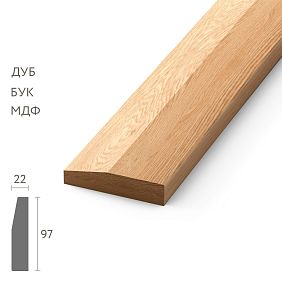
MDF stands for Medium Density Fiberboard. It is a composite material made from fine wood fibers, pressed under high pressure and temperature with the addition of binding resins. The density of MDF is 700–850 kg/m³, which is comparable to the density of oak (700–800 kg/m³) and exceeds the density of pine (500–550 kg/m³).
The fundamental difference between MDF and natural wood is isotropy. Wood is anisotropic: its properties depend on the direction of the grain. Across the grain, wood is weaker than along it, and the coefficient of expansion due to humidity also differs. MDF is isotropic: properties are the same in all directions. This provides dimensional stability—the board does not warp, bend, or crack from humidity fluctuations, as can happen with solid wood due to insufficient drying or improper use.
The surface of MDF is perfectly uniform. Solid wood has knots, resin pockets, density variations, and natural defects. For natural textured solutions, this is a plus—the individuality of each plank. For painted interiors, this is a minus—non-uniformity shows through under the paint, requiring additional preparation (filling knots, sanding unevenness). MDF does not have these problems: the surface is smooth without defects, ready for painting without additional processing.
Processing MDF is simpler than solid wood. Milling profiles on MDF produces clean edges without chipping (provided sharp tools are used). Wood, especially with pronounced grain, can chip along the annual rings. MDF is cut, sanded, and painted more easily and predictably.
Environmental concerns about MDF are often exaggerated. Modern MDF is produced using binders based on carbamide-formaldehyde resins of class E1 or E0, where formaldehyde emission does not exceed the natural background present even in natural wood. High-quality European MDF (exactly the kind used for architrave production) is safe for residential premises, as confirmed by certificates.




Technical advantages of MDF for architraves
Why do decorative MDF door architraves often outperform wooden ones in functional parameters? Let's examine specific advantages.
Our factory also produces:



Dimensional stability—no gaps
An architrave is installed at the junction of the door frame and the wall, covering the mounting gap. If the architrave deforms (warps, shrinks), gaps appear—between the architrave and the frame, between the architrave and the wall. This is not only an aesthetic defect but also a functional failure: cold air, dust, and noise penetrate through the gaps.
A wooden architrave made of solid wood, even properly dried (residual moisture 8–10%), reacts to changes in air humidity. In winter, when heating is on, humidity in the apartment drops to 20–30%, wood releases moisture and shrinks. In summer, humidity rises to 50–60%, wood absorbs moisture and swells. These cycles lead to micro-deformations: the architrave may bend slightly, and corner joints may open.
An MDF architrave practically does not react to humidity fluctuations within normal operating conditions (air humidity 30–70%). The linear expansion coefficient of MDF in all directions is about 0.05–0.08% with a 10% change in humidity, which is 2–3 times lower than that of wood across the grain. In practice, this means: an architrave 100 mm wide, with a humidity change from 30% to 60%, will change size by 0.05–0.08 mm—visually imperceptible. A wooden architrave will change by 0.15–0.25 mm—a small amount, but enough to form a micro-gap at the joint.
Get Consultation
Surface uniformity—perfect painting
If the interior involves painted architraves (white, gray, colored), MDF provides an advantage. The surface of MDF is uniform without pores, knots, or resin pockets. After priming and painting, you get a perfectly smooth, evenly painted surface without visible defects.
A wooden architrave requires thorough preparation before painting. Knots are filled with wood putty, resin pockets are scraped out and also puttied, the surface is sanded in several stages with gradually decreasing grit (from 120 to 220–320). Even after this, knots may show through under the paint, creating tonal non-uniformity. MDF lacks this—the surface is ready for final painting after priming without additional steps.
Resistance to warping—geometry for decades
An architrave is a long, narrow element (standard length 2200 mm, width 70–120 mm, thickness 10–16 mm). Such geometry is prone to warping: the architrave may bend into an arc along its length or twist like a propeller. In solid wood, this happens due to internal stresses in the wood, especially if the board is cut tangentially rather than radially.
MDF lacks internal stresses—fibers are oriented randomly, there is no growth direction. An MDF architrave maintains straightness throughout its service life. This is critical for visual neatness: a curved architrave cannot be tightly pressed against the wall, gaps are inevitable.
Price without loss of quality
The cost of an MDF architrave is 30–50% lower than that of beech wood, and 50–70% lower than oak. For an apartment where 8–10 door openings need to be framed (5–6 linear meters of architraves per opening, totaling 40–60 meters), the difference is significant: 15,000–25,000 rubles for MDF versus 30,000–50,000 rubles for beech or 50,000–80,000 rubles for oak. The saved funds can be directed to other interior elements.
At the same time, after painting, an MDF architrave is visually indistinguishable from a wooden one. The wood texture is not visible under the paint anyway, the profile can be identical, and the surface quality of MDF is higher. Overpaying for solid wood in painted interiors is irrational.
When an MDF architrave is preferable to solid wood
There are specific scenarios where choosing MDF is not just justified, but rational and well-founded.
Painted interiors—white, gray, colored
If the design project involves painted doors and architraves (classic white, Scandinavian light gray, modern graphite), the base material is secondary. The wood texture is hidden under the paint; what matters is the profile shape and surface quality.Door DecorationIn such interiors, it relies on clean lines, absence of defects, perfect geometry — here MDF surpasses solid wood.
A profiled MDF casing after priming and painting with 2–3 coats of acrylic paint creates a flawless surface: no knots, no unevenness, no visible defects. A wooden casing, even carefully prepared, may show knots under the paint (they absorb paint differently than the main wood), creating visual inconsistency.
For white interiors, where any defect is especially visible, MDF is the optimal choice. White paint does not forgive mistakes: the slightest unevenness, roughness, or tone mismatch between elements immediately catches the eye. MDF guarantees uniformity.
Wet rooms — kitchens, bathrooms, toilets
Wood and moisture are poor neighbors. Even with a protective coating (varnish, oil), wood in wet rooms absorbs moisture, swells, then shrinks when humidity decreases. Swelling-shrinking cycles lead to cracking of the finish and warping of elements.
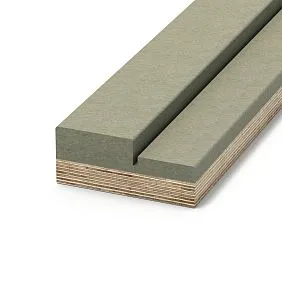
MDF is more stable in humid conditions (provided the casing ends are sealed — this is important). For kitchens and toilets, moisture-resistant MDF is used (marked with a green core or special packaging labeling), which contains water-repellent additives. Such MDF withstands humidity up to 80–85% without deformation.
Framing doors in a bathroom or kitchen with MDF casings is a practical solution. After painting with moisture-resistant enamel (acrylic or alkyd paint with antiseptic additives), the casing lasts for years unchanged. A wooden casing will require more thorough protection (multi-layer varnishing with intermediate sanding, end treatment with wax) and will still remain more vulnerable.
Budget projects — quality without overpaying
Renovating an apartment or house is an expensive undertaking. The budget is always limited, priorities must be set. Spending a significant portion of funds on oak casings that, after painting, are visually indistinguishable from MDF is irrational. It's better to save on casings and invest in what is truly visible and valuable: quality doors, good plumbing, nice tiles.
MDF casings allow you not to compromise on visual quality while saving on material. The profile can be complex, with classic motifs, and painting with quality paint creates a presentable look. None of the guests will guess that the casings are not solid wood — there is no difference.
Modern minimalist interiors
Minimalism requires clean lines, absence of visual noise, uniformity of surfaces. Here, the natural texture of wood may be excessive — it creates visual activity, attracts attention. A painted MDF casing with a simple rectangular profile or a concise bevel — an ideal choice for minimalist spaces.
Smooth matte surface, precise geometry, absence of decorative excess — MDF easily provides these qualities. Solid wood is also suitable for minimalism but requires painting that hides the texture — why pay for texture only to hide it later?
Quick installation without additional processing
MDF casings are often supplied primed or even fully painted white (factory-finish). Such casings are ready for installation immediately after purchase: just cut to the required length, miter corners at 45°, and fix to the wall. Time savings are significant — no need to prime, paint, or wait for drying between coats.
Wooden casings are supplied unfinished (raw) — requiring a full cycle of finishing. This adds 2–3 days for priming, painting, and drying. For professional crews working on tight schedules, MDF with factory finishing is a lifesaver.
When solid wood is irreplaceable
To be fair: there are situations where solid wood is the only correct choice, and MDF cannot replace it.
Natural textured interiors
If the design project involves natural wood finishing (varnish, oil, tinting with visible texture preserved), solid wood is irreplaceable. The texture of oak — annual rings, medullary rays, natural shade variations — creates a living organic surface that MDF cannot reproduce.Door casingsSolid oak or beech casings, coated with varnish, demonstrate the nobility of the material, its natural beauty.
MDF can be laminated with wood-imitation film or veneered (glued with a thin layer of natural veneer). Laminated MDF is an obvious imitation that does not deceive the eye up close. Veneered MDF is closer to solid wood, but the veneer is thin (0.6–1 mm), and if damaged (scratch, chip), the base shows through. Solid wood can be sanded, restored — veneer cannot.
Representative interiors — status through material
In premium interiors — private residences, representative offices, VIP zones — the material matters in itself. Oak casings are not just a functional element but a demonstration of status, commitment to quality, an investment in durability. MDF is inappropriate in such interiors, even if visually indistinguishable — the fact of using premium material is important.
The paradox is that distinguishing MDF from solid wood under paint is practically impossible, but psychologically, a client paying for premium renovation wants to know that premium materials were used. This is not rational, but it is market reality.
Carved and complex-relief casings
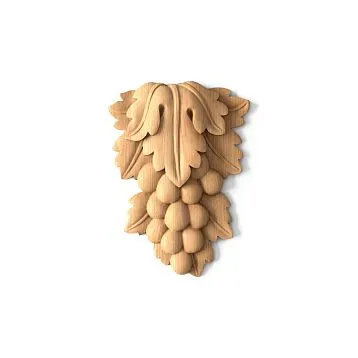
Carved decorative elements — overlays, rosettes, complex profiles with fine details — are traditionally made of wood. Wood carving allows creating minute details that retain strength. MDF in thin sections is fragile — a carved element with thin bridges may break.a decorative elementComplex-shaped casings are more rationally made from solid wood or polyurethane (casting), but not from MDF.
If a carved casing in Russian style with floral ornament, openwork cutouts, complex profiling is required — this is a task for solid wood. MDF for such tasks is technologically complex (requires high-precision CNC milling) and less reliable in operation.
Veneered MDF — compromise or the best of both worlds
Veneered MDF casing is an MDF base with a thin layer of natural wood veneer (typically 0.6–1 mm) glued onto it. Visually, such casing looks like solid wood: the wood grain, annual rings, and natural color variations are visible. Technically, it is MDF: dimensional stability, no warping, and a homogeneous base.
Advantages of veneered MDF: price is 30–40% lower than solid wood, but visually almost indistinguishable (with high-quality veneer). Stability is higher than solid wood—the MDF base does not warp. Suitable for natural finishes (varnish, oil)—the veneer showcases the wood grain.
Disadvantages: the veneer is thin; if damaged (deep scratch, chip), the MDF base becomes visible. Restoration is more complex than with solid wood—sanding is very limited (0.6 mm veneer allows only one or two sandings before reaching the base). Durability is lower than solid wood—after 10–15 years, the veneer may start to peel at the edges (if the bonding quality was insufficient).
Veneered MDF is a reasonable compromise for situations where natural wood grain is desired, but the budget is limited or operating conditions require MDF stability (humid environments, significant humidity fluctuations).
Installation of MDF Casings—Features and Nuances
The installation technology for MDF casings is similar to that for wooden ones, but there are nuances.
Cutting tool
MDF is cut with the same tools as wood: miter saw, jigsaw, hand saw. However, tool requirements are higher. MDF is an abrasive material that quickly dulls cutting edges. Use saw blades with carbide tips (for miter saws) or blades with fine teeth and tips (for jigsaws). Ordinary steel blades will dull quickly, resulting in rough cuts with torn fibers.
Cutting at a 45° angle for corner joints requires precision. Use a miter saw with accurate angle settings. Check the saw calibration before starting work: cut two test pieces and join them at an angle—if there is a gap, the angle is set inaccurately and requires adjustment.
Casing Attachment
MDF casing is attached using the same methods as wooden casing: headless finish nails (length 30–40 mm), liquid nails (construction adhesive), or a combination of both methods. For MDF, adhesive is preferred—it ensures even pressure along the entire length of the casing and avoids point loads.
Finish nails hold securely in MDF, but they must be driven carefully: MDF is dense, and the edge can split if the nail is driven too close to the end. The recommended distance from the end to the nail is at least 30 mm. Nail spacing is 30–40 cm.
Construction adhesive (liquid nails or acrylic construction adhesive) is applied to the back of the casing in a zigzag pattern or dots spaced 10–15 cm apart. The casing is pressed against the wall and tapped with a rubber mallet for even adhesion. Masking tape or temporary supports are used to hold it in place while the adhesive sets.
Filling joints and holes
Joints of casings in corners (where two casings cut at 45° meet) are filled with white acrylic sealant (or matching the casing color if not white). The sealant is applied in a thin line into the joint and smoothed with a wet finger or rubber spatula. Properly applied sealant creates a seamless transition, making the joint look like a monolithic line.
Holes from finish nails (if used) are filled with acrylic putty matching the casing color. After the putty dries (1–2 hours), the area is sanded with fine sandpaper (grit 220–320) and touched up if necessary.
Final finishing
If the MDF casing is primed but not painted (gray or white primer), final painting is required. Use acrylic paint (water-based or acrylate)—it is odorless, dries quickly, and creates a matte or semi-matte surface.
Painting is done with a brush (for profiled casings with relief) or a short-nap velour roller (for flat casings). Paint is applied in 2–3 thin coats with intermediate drying times of 2–4 hours. Do not attempt to cover the surface with one thick coat—this will cause drips and uneven tone. Three thin coats yield a smooth and even result.
If the casing has a factory finish, no additional treatment is needed. Simply attach it, fill the joints with sealant—and it's ready.
Care and Operation—Practical Durability
The service life of MDF casings with proper use is 15–25 years. This is less than solid oak (30–50 years) but comparable to most apartment finishing elements (wallpaper, tiles, laminate).
Care for MDF casings is simple: wipe with a damp cloth and a neutral detergent (soap solution). Do not use abrasive cleaners (powders, stiff sponges)—they scratch the paint surface. Avoid direct exposure to large amounts of water—MDF edges are vulnerable to moisture and may swell with prolonged water contact.
Painted MDF casings are resistant to UV (do not fade), mechanical damage (paint protects the base), and household chemicals (acrylic paint is resistant to alkalis and weak acids).
If the casing is damaged (scratch, chip), repair is simple: the damaged area is sanded with sandpaper, filled with acrylic putty, sanded after drying, primed, and painted to match the casing color. Local repair takes 1–2 hours, and the result is almost unnoticeable.
Comparison Table: MDF vs. Solid Wood
| Parameter | MDF Casing | Solid Wood Casing |
|---|---|---|
| Dimensional stability | High, does not react to humidity | Medium, reacts to humidity |
| Surface Uniformity | Perfect, without defects | Natural variations, knots |
| Suitable for painting | Excellent, smooth surface | Requires preparation (knot filling) |
| Natural texture | No (except veneered) | Yes, expressive wood grain |
| Warp resistance | High | Medium (depends on drying quality) |
| Price | Low (30–70% cheaper than solid wood) | High (solid oak, beech) |
| Durability | 15–25 years | 30–50 years (solid oak) |
| Suitability for wet areas | Good (moisture-resistant MDF) | Medium (requires protection) |
| Restoration possibility | Limited | High (sanding, refinishing) |
| Ecological | High (E1, E0 emission class) | Maximum (natural material) |
The table shows: there is no universally best material. The choice depends on the priorities of the specific project.
STAVROS — quality architraves for any task
When the task is to choosearchitraves for interior doors, not only the technical characteristics of the material are important, but also manufacturing quality, profile precision, and geometric stability. STAVROS offers a wide range of MDF and solid wood architraves, each meeting high quality standards.
MDF and solid wood moldingsSTAVROS are produced on modern European equipment with machining precision up to 0.1 mm. MDF architraves are made from boards with a density of 750–800 kg/m³, class E1 (formaldehyde emission no more than 8 mg per 100 g of dry substance — a safe level for residential spaces). Profiles are milled on CNC machines, ensuring identical geometry along the entire length of the strip and between different strips in the same batch.
STAVROS solid oak and beech architraves are made from wood that has undergone kiln drying to a residual moisture content of 8–10%. This guarantees dimensional stability, absence of cracking and warping during use. Each strip undergoes visual inspection: elements with large knots, cracks, blue stain, or other defects are rejected. Only first-grade architraves are sold.
Profiled architravesSTAVROS are available in a wide range of styles: from simple flat and rounded (for modern interiors) to classic with beads, coves, and astragals (for traditional spaces). Architrave widths range from 50 to 120 mm, thickness from 10 to 20 mm, allowing selection of elements for any door opening and interior style.
STAVROS veneered architraves — the optimal balance between MDF cost and solid wood aesthetics. The MDF base ensures stability, while 0.8–1 mm thick veneer of oak, ash, or walnut creates the visual impression of natural wood. Veneer is glued with waterproof adhesive under pressure, ensuring a strong bond without risk of delamination under normal use.
STAVROS factory finishing of architraves (priming or full painting in white) is performed in painting booths with controlled conditions (temperature, humidity, air purity). Primer is applied by spraying in two layers, each layer dried at 40–50°C, then sanded with fine sandpaper (320 grit). The result is a perfectly smooth surface, ready for final painting or (in the case of white architraves) for installation.
STAVROS product packaging ensures safe transportation. Architraves are packed in shrink film in bundles of 10–20 pieces (depending on width), protecting from dust, moisture, and mechanical damage. Ends are covered with cardboard corners to prevent chipping. Delivery is organized to any region of Russia and CIS countries by transport companies or STAVROS own transport (for Moscow, St. Petersburg, and surrounding regions).
STAVROS consultants will help select architraves for your specific project: determine the required width (depends on door frame width and wall thickness), profile (matching interior style), material (MDF, veneer, or solid wood depending on tasks and budget). You will receive a specification with exact linear meters and a list of additional materials (adhesive, nails, sealant).
STAVROS's pricing policy is transparent: the price depends on the material, size, and complexity of the profile. MDF architraves start from 150–200 rubles per linear meter (simple profiles), complex classical profiles — 300–400 rubles. Veneered architraves — 500–800 rubles per meter. Solid oak architraves — 800–1500 rubles per meter depending on width and profile. Discounts are provided for wholesale buyers.
The STAVROS online catalog allows you to explore the full range, view product photos, and study technical specifications. A convenient filter system enables you to select architraves by material, width, and style. The shopping cart and online payment make the ordering process fast.
By choosing STAVROS, you receive quality products, professional consultations, transparent prices, and reliable logistics. A company for which every finishing element is not just a product, but a detail that shapes the appearance of the interior.
Answers to frequently asked questions about MDF architraves
Does an MDF architrave look cheap?
No, if chosen correctly and painted with quality. After painting with 2–3 layers of acrylic paint, an MDF architrave is visually indistinguishable from a wooden one. The wood texture is not visible under the paint anyway; what matters is the profile shape and surface quality — here MDF surpasses solid wood due to its perfect smoothness.
Can MDF architraves be used in the bathroom?
Yes, if it is moisture-resistant MDF (green core color) and the ends are sealed. After painting with moisture-resistant paint, such an architrave withstands humidity up to 80–85% without deformation. This is better than a regular wooden architrave in humid conditions.
How long does an MDF architrave last?
15–25 years with proper use. This is less than solid oak (30–50 years), but comparable to most finishing elements. Considering that MDF is 2–3 times cheaper than oak, the price/lifespan ratio is more advantageous.
Can an MDF architrave be repainted?
Yes, multiple times. The surface is lightly sanded (grit 220–320), degreased, primed, and painted. MDF holds paint excellently, allowing you to change the color when updating the interior design.
How does veneered MDF differ visually from solid wood?
After finishing (varnish, oil), it is practically indistinguishable from a distance of more than a meter. Up close, you may notice that the texture is too uniform (veneer is matched by pattern), lacking the natural variations characteristic of solid wood. The layered structure (MDF + veneer) is visible on the end.
Which casing profile should be chosen?
Depends on the style of the door and interior. For modern smooth doors — a simple rectangular or rounded architrave. For classical paneled doors — a profiled one with coves and beads. The width of the architrave should be proportional to the width of the door opening: for standard openings 70–90 mm, for wide ones — 100–120 mm.
Are MDF architraves eco-friendly?
Yes, if it is quality MDF of class E1 or E0. Formaldehyde emission in such materials does not exceed the natural background present even in natural wood. European manufacturers strictly control this parameter.
Can MDF and wooden architraves be combined in the same room?
Technically yes, but visually it may create imbalance. If all architraves are painted the same color and have the same profile, the difference is unnoticeable. But it is better to use one material for all architraves in a room for uniformity.
What to do if an MDF architrave cracks?
Cracks in MDF are rare, usually a result of mechanical impact. Repair: the crack is filled with epoxy resin or acrylic putty, sanded after drying, and painted. If the crack is through, it is better to replace the element — restoring strength is problematic.