Article Contents:
- 1. Why pay attention to materials for upholstered furniture
- 2. Materials used in upholstered furniture
- 2.1. Frame and its components
- 2.2. Fillers (damping layers)
- 2.3. Upholstery (top material)
- 2.4. Hardware and mechanisms
- What to Pay Attention To
- Example 1: Living room sofa (mid-segment)
- Example 2: Classic style armchair (premium)
- Example 3: Office upholstered chairs
Upholstered furniture — sofas, armchairs, ottomans, chairs with upholstery — belongs to the most frequently used interior items. We sit, lie, and rest on these items daily, so their comfort and durability are extremely important. However, the main influence on the quality of a sofa or armchair is the materials from which they are made: this applies to the frame, filler, upholstery, and hardware. It is precisely the proper selection of raw materials that allows obtaining comfortable and reliable furniture. In this article, we will examine what furniture materials are used for upholstered furniture, what to consider when purchasing, and how to find the optimal place to buy everything needed — from frame components to upholstery fabrics and fillers.


1. Why pay attention to materials for upholstered furniture
- Comfort and support
The type of filler and frame determines how comfortable the furniture will be: will it sag, creak, or, conversely, provide the necessary elasticity and back support. - Durability
Poor-quality wood in the frame, cheap filler (low-density foam) or thin upholstery will quickly fail — the furniture will lose its shape, start creaking, tear, and require repair or replacement. - Appearance
Upholstery — the first thing we see. Texture, color, and finish directly affect aesthetics. But if the internal structure is also of poor quality, even the most beautiful fabric won’t save from rapid wear. - Safety and health
Some panels (MDF, particleboard) may emit formaldehyde if improperly manufactured, and upholstery fabrics — synthetic odors. When choosing, it is important to look at certification, especially if the furniture is intended for children’s rooms or bedrooms. - Financial justification
Expensive materials (solid wood, latex filler, natural leather) may cost significantly more, but will last longer, providing quality and comfort. Budget solutions (MDF, cheap foam, simple fabric) are better suited for temporary solutions.




2. Materials used in upholstered furniture
Our factory also produces:


2.1. Frame and its components
● Solid wood (oak, beech, birch, pine):
- Prestigious, long-lasting, but more expensive and heavier.
For premium furniture or classic styles.
● Plywood:
- Durable, relatively lightweight, resistant to moderate moisture with proper lacquer.
- Often used for seats and frame partitions.
● MDF / HDF:
- Budget option. May be less reliable under heavy loads and fears moisture at edges.
● Metal (steel/aluminum profiles):
- Used less often, provides loft style and high strength.
Get Consultation
2.2. Fillers (damping layers)
● Spring blocks (serpentine, Bonnel, independent springs):
- Provide elasticity; more expensive options (independent) enhance comfort and targeted support.
● Polyurethane foam (PU):
- Most common; density is crucial (at least 25–30 kg/m³ for seating). Higher density retains shape longer.
● Latex (natural or synthetic):
- Premium level, elastic, long-lasting, but expensive.
● Synthetics, hollofibre:
- Additional layer for softness, commonly used in cushions and backrests.
2.3. Upholstery (top material)
● Fabrics:
- Chenille, velour, jacquard, rush, microvelvet — each has unique tactile and wear-resistant properties.
- Abrasion resistance (Martindale) should be above 20–30 thousand cycles for home use.
● Leather (natural):
- Expensive, elegant, long-lasting, but requires maintenance.
● Eco-leather, faux leather:
- More affordable, imitate leather but less durable (may crack).
● Treatments: some fabrics have anti-graffiti coatings that repel water and dirt, convenient for families with children and pets.
2.4. Hardware and mechanisms
● Transformation mechanisms (convertible sofas: book, euro-book, pull-out, tick-tack, etc.). The more complex the mechanism, the higher the price.
● Hinges and fasteners (for armrests, rear supports). Quality fasteners extend service life.
● Furniture handles: if the sofa or chair has storage compartments, handles must be comfortable, reliable, and match the style.
3. How the cost of materials for soft furniture is determined
- Frame material
- Solid wood (oak, beech) is more expensive than plywood, which is more expensive than MDF. Metal may vary depending on the brand and profile thickness. - Fillers
- Independent springs + latex = top price segment.
- Medium-density polyurethane foam (25–30 kg/m³) — mid-range segment.
- Simple "cheap" low-density foam — economy segment, quickly "settles in". - Fabric or leather
- High-grade natural leather (Italian) — top range.
- Eco-leather, quality flock, jacquard, shenille — mid-range or above mid-range.
- Simple textile or economy faux leather — low range. - Hardware
- Bed frame mechanisms (especially multi-stage) significantly increase cost.
- Hardware brand (premium Blum, Hafele or more budget-friendly alternatives) also affects the final price.
4. Where to buy upholstery materials
● Construction hypermarkets: usually have plenty of MDF, plywood, foam, but limited selection of quality solid wood, hard to find professional fabrics.
● Specialized stores/warehouses: "furniture materials center", offering a narrower range — frame panels, upholstery fabrics, fillers, furniture hardware (bed frame mechanisms).
● Online platforms: some suppliers have online stores where you can order sheet materials, polyurethane foam in custom sizes, fabric by the meter. Important to check reputation and warranties.
What to pay attention to
- Brand assortment: are there known panel manufacturers (Egger, Kronospan) or fabric brands (unknown brands may wear out quickly).
- Services: sometimes you need to edge-join plywood, cut polyurethane foam to size, consult on foam density, etc.
- Certification: emission class E1/E0 for panels, hygiene certificates for textiles.
- Reviews and experience: if the store (online/offline) has been on the market for a long time, it increases the chances of good service.
5. Criteria for choosing materials
- Purpose and intensity of use
○ For guest "rarely used" furniture, you can save (MDF frame, medium-density foam).
○ For main home or office furniture, where people sit daily, better to choose a stronger frame (plywood/solid wood) and quality filler (high-density polyurethane foam, spring block).
- Style and design
○ Classic interiors prefer wood (solid wood, veneer) and rich fabrics (shenille, jacquard).
○ High-tech/minimalism pairs well with metal, solid velvet, eco-leather.
- Budget
○ If budget is limited, often compromise: simple frame from plywood/MDF + quality upholstery. Or vice versa, use solid wood in visible parts, rest — plywood.
- Ergonomics
○ Fillers: foam, springs, latex. The higher the density, the longer the comfort lasts.
○ Upholstery: choose fabric that feels pleasant to the touch, durable against wear, if the furniture is intended for regular use.
- Maintenance
Light fabric may be a brand and requires protective impregnation. Leather requires regular treatment with conditioners. Eco-leather requires care to avoid cracking.
6. Examples of soft furniture composition
Example 1: Living room sofa (mid-segment)
● Frame: plywood + pine beams.
● Filling: zigzag springs (serpentine) + PU foam density 30 kg/m³. Backs — slightly softer (25 kg/m³).
● Upholstery: shenille or flock (well-chosen color palette, high wear resistance).
● Hardware: if the sofa has a "European book" reclining mechanism, ensure the quality of hinges and rollers.
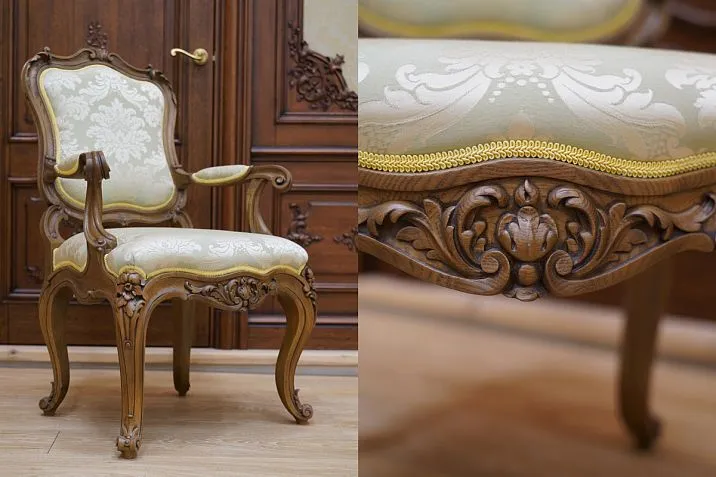
Example 2: Classic style armchair (premium)
● Frame: beech or birch solid wood (dried to 8–12% moisture).
● Spring block: independent springs + top layer of latex or high-quality foam.
● Upholstery: natural leather or jacquard with decorative stitching.
● Finishing: carved wooden armrests, lacquered to match.
Example 3: Office soft chairs
● Frame: metal or plywood.
● Filling: medium-density polyurethane foam.
● Upholstery: eco-leather or durable, abrasion-resistant flock.
● Hardware: casters, lift mechanism, rotation — all must be designed for intensive use.
7. What contributes to long service life
- Quality materials (plywood/beams without voids, dense foam, durable upholstery).
- Proper assembly: even joints, secure fasteners, absence of play.
- Correct placement: avoid humid corners, proximity to radiator/air conditioner.
- Regular cleaning: timely removal of dust and stains, use of appropriate fabric/leather cleaners.
- Careful use: avoid jumping on sofas, do not overload chairs beyond their intended use.
8. Conclusion
When considering where to buy soft furniture materials, it is important not only to find an affordable price or suitable fabric color, but also to ensure quality, ecological safety, and suitability for intended use. Modern "furniture material centers" and specialized stores offer a full range of products — from frame panels and beams to upholstery fabrics, fillers, and hardware.
The key point is understanding that the "best" material depends on budget, style, usage conditions, and personal priorities. If you want a living room sofa that will last a decade without losing its shape, invest in a reliable frame made of plywood or solid wood, quality springs (or high-density foam), and practical yet durable upholstery. If the furniture is needed for a dacha or temporary housing, you can save by choosing budget-friendly panels and simpler fabrics.
In any case, it is strongly recommended to consult professionals or thoroughly research information (certificates, brands, reviews) when purchasing materials. This way, you will get soft furniture that delights with its comfort, appearance, and longevity.