Article Contents:
- Facade architecture of cabinets: the top line as a dominant element
- Cabinet molding in classic, neoclassic, and country styles
- Cabinet molding for kitchen: usage and requirements
- Cabinet trim, panels, and decorative moldings
- Wooden and shaped paneling: decorating louvered facades
- System: molding + trim + panel + molding
- Oak and beech in cabinet moldings: advantages of solid wood
- How to buy cabinet moldings for a complete set
- Conclusion: cabinet architecture from STAVROS
- Frequently Asked Questions

When the eye glides along the flawless top edge of a kitchen set, along the precisely profiled profile of a sliding wardrobe, along the elegant frame of a louvered facade — few consider that behind this apparent simplicity lies an entire system of architectural solutions.Furniture corniceTrim profiles, decorative panels — these elements form not just the outline of furniture, they create its character, define its style affiliation, and establish the visual logic of the entire space. Why does one kitchen appear luxurious and dignified, while another, made of the same materials, seems mundane? The secret lies in the details, in those very millimeters of profile, in the precision of joints, in the quality of wood. Let’s examine how cabinet facade architecture is structured and whywooden cornices for furnitureremain a quality standard even in the era of MDF and plastic overlays.



Facade architecture of cabinets: the top line as a dominant element
The top boundary of the cabinet set — not just a place where the cabinet ends. It is an architectural dominant that either logically and convincingly completes the composition or leaves a sense of incompleteness and incompleteness. In classical furniture, this completion is performed bybuy cabinet moldingwhich protrudes above the facade plane, creates a line of light and shadow, visually lightens the structure, and simultaneously emphasizes its solidity.
Historically, cabinet moldings inherited the principles of architectural moldings from ancient temples and palaces. The same proportions, the same basic profiles — flutes, ovals, moldings, shelves — were transferred from building facades to cabinet and buffet facades. Furniture became micro-architecture, reproducing in miniature the laws of large-scale architecture. This tradition has been preserved to this day: quality classical furniture is designed with adherence to order proportions, where the height of the molding relates to the height of the entire unit according to the golden ratio or modular systems.
Modern furniture simplified profiles, but did not abandon the idea of a top finish. Even minimalist kitchens have either a surface-mounted molding, or a recessed shadow gap, or hidden backlighting — that is, an element that separates the furniture from the ceiling and creates a visual boundary. Without this element, furniture appears chopped off, unfinished, hanging in space without connection to the architecture of the room.
Functionof cabinet molding for kitchenis not only decorative. The molding conceals the upper technological gap between cabinets and the ceiling, masks ceiling irregularities, protects upper edges from dust and dirt, and creates additional structural rigidity when properly mounted. In some systems, an LED strip is installed inside the molding, creating contour lighting and visually separating the furniture from the ceiling.
The proportions of the molding are determined by the height of the room and the scale of the furniture. In a standard kitchen with 2.7-meter ceilings, the optimal molding height is 80-120 mm with a projection of 40-60 mm. In spacious rooms with ceilings of 3 meters or more, the molding can reach 150-200 mm in height and 80-100 mm in projection. A too small molding disappears, failing to create the necessary scale. An overly large molding suppresses the furniture, making it heavy and disproportionate.
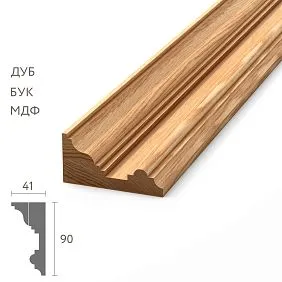
The molding profile determines the style of the entire set. A rectangular molding with sharp edges — a sign of minimalism and modern styles. A molding with soft curves and smooth transitions — characteristic of neoclassicism and Scandinavian design. A complex multi-tiered profile with carved elements, flutes, and dentils — an attribute of classicism, baroque, and empire. The correct choice of profile transforms standard furniture into status furniture, emphasizing the interior’s affiliation with a specific cultural tradition.
The material of the molding is critically important for durability and appearance.wooden cornices for furnitureMade from oak or beech, they withstand mechanical loads, do not deform over time, and retain their geometry for decades. MDF moldings are cheaper and easier to process, but less durable and more sensitive to humidity. Plastic moldings — a budget option that reveals its artificiality upon close inspection and does not create the impression of quality, expensive furniture.




Cabinet molding in classic, neoclassic, and country styles
In the classical styleFurniture cornice— an essential element, without which furniture loses its identity. A classical buffet, sideboard, or bookcase is unthinkable without a molding that repeats architectural orders. A crowning molding with ovals and dentils (toothed edges) completes the vertical composition, much like an entablature completes a colonnade. This element is not merely decorative — it carries symbolic function, referring to ancient culture, ideals of harmony and proportion.
The profile of a classical cornice is always complex: several tiers, each serving its own purpose. The lower tier is a wide shelf, forming the base for the upper part. The middle tier consists of a row of modillions or dentils, creating a rhythmic structure. The upper tier is a scroll or molding, providing a smooth transition to the top shelf. All elements are arranged according to classical proportions, where each dimension is a multiple of the basic module. This precision creates a sense of naturalness, correctness, and harmony.
Manufacturing a classical cornice requires high skill and precise tools. Each profile element is milled with a separate router bit, then all layers are assembled into a single structure. Carved dentils are cut manually or on CNC machines using individual programs. The finishing process includes multi-stage sanding, toning to even out color, and application of several layers of lacquer with intermediate polishing. Only in this way is achieved the quality level that corresponds to the status of classical furniture.
Neoclassicism simplifies classical canons, retaining the essence while removing excessive ornamentation. The cornice in a neoclassical set retains a multi-tiered structure, but without small details such as dentils. The profile becomes more minimalist: a wide lower shelf, soft rounding, a narrow top rail. Proportions are maintained, but the overall height of the cornice is less than in classical style — 80-100 mm versus 120-150 mm. This creates a more modern, restrained look, preserving a connection to tradition without copying it literally.
The color solution for neoclassical cornices tends toward neutral shades. White, cream, beige-gray — colors that do not draw attention to themselves but create a clear architectural structure. Contrasting solutions are allowed: dark facades with white cornices or vice versa. Such contrast emphasizes geometry, makes lines more expressive, and creates a graphic, modern effect.
in the country stylekitchen furniture cornicetakes on a simpler, rustic character. Here, profiles with deliberately handcrafted finishes are appropriate: minor irregularities, tool marks, intentional roughness. The cornice can be painted in pastel tones — blue, olive, lavender — with a worn effect, imitating the patina of time. Such treatment creates the feeling of a family heirloom, furniture with a history passed down from generation to generation.
The functionality of country-style cornices is complemented by decorative elements: carved rosettes at corners, applied figurines, wrought iron hinges and hooks. These details do not bear structural loads but contribute to creating an atmosphere of coziness, home warmth, and closeness to nature.buy wooden cornice for furniturein the country style — means choosing natural solid wood with preserved natural texture, minimal processing, eco-friendly finishes based on oils and waxes.
Mounting cornices in classical and country-style furniture implies concealed mounting, where elements are fixed from the inside, and only decorative surfaces are visible from the outside. This requires precise fitting of all parts, perfect corner joints, and careful sanding of joints. Only flawless execution creates the impression of monolithism, when the cornice is perceived as an organic part of the furniture, not as a glued-on overlay.
Our factory also produces:


Kitchen furniture cornice: operation and requirements
The kitchen is an area with special operating conditions: high humidity from cooking, temperature fluctuations near stoves and ovens, grease vapors settling on all surfaces, mechanical impacts during cleaning.Kitchen furniture cornicemust withstand these loads without deformation, color loss, or coating damage.
Humidity is the main enemy of wooden cornices. Wood is hygroscopic: it absorbs moisture from the air and swells, then shrinks back when humidity decreases. These cycles lead to warping, cracking, and joint separation. Protection is achieved through a multi-layer coating: a deep-penetration primer seals the wood pores, a base lacquer layer creates a water-repellent film, and finish layers provide mechanical strength and resistance to abrasion. Quality coating withstands humidity up to 70-75% without adverse effects on the wood.
Grease deposits are a specific problem for kitchen cornices. Cooking vapors condense on all surfaces, forming a sticky residue that attracts dust and creates dense stains. Removing these deposits requires cleaning agents that do not damage the cornice coating. Polyurethane-based lacquers are resistant to household chemicals and withstand regular wet cleaning. Oil-based wax coatings are less durable and require periodic renewal.
Temperature effects near stoves and ovens can reach 60-70°C at a distance of 50-60 cm from the source. Wood dries out more intensely at these temperatures, and protective coatings may soften and lose their properties. Cornices above stoves are recommended to be made of thermally treated wood or use high-density MDF with a heat-resistant coating. An alternative is increasing the distance between the cornice and cooking zone by installing an exhaust hood with a wide box.
Mechanical loads on kitchen cornices are minimal, but occasionally occur during installation or removal of decorative elements, or accidental impacts from heavy objects.wooden cornices for furnitureHardwood species withstand such impacts without scratches or dents. MDF is less durable: an impact leaves a dent that is difficult to repair without complete repainting.
The dust-repellent properties of the coating are important for reducing cleaning frequency. Glossy lacquers attract dust more than matte ones. The optimal gloss level is semi-matte or matte with a gloss rating of 20-40 units. Such a surface does not reflect light, does not highlight minor stains, and is easily wiped with a damp cloth.
UV resistance of the coating is critical for cornices located near windows. Ultraviolet radiation destroys pigments, causing fading and color changes. Lacquers with UV filters slow down this process, but do not completely stop it. Dark shades fade faster than light ones, becoming faded and unexpressive. Natural wood under transparent lacquer changes tone the slowest, acquiring a noble patina that is perceived as natural aging, not a defect.
Repairabilityfurniture moldingwooden furniture molding — advantage of wooden cornices over MDF and plastic. Local coating damage is repaired by sanding and repainting. Deep scratches are filled with hard wax matching the wood tone. Cracks are glued and masked with putty. Full repainting is possible after 5-7 years of use to refresh the appearance. MDF and plastic do not offer such possibilities — damaged elements must be replaced.
Get Consultation
Furniture molding, panels, and decorative moldings
Furniture moldingThis is a broad group of profiled items used for decorating and functional finishing of furniture. This includes not only cornices but also base profiles, frame rails, corner elements, applied moldings, decorative strips. All these elements share a common principle: they are added to the basic furniture structure, creating relief, divisions, and visual complexity.
Base profiles complete furniture at the bottom, creating a transition from the body to the floor. In classical furniture, the base often mirrors the cornice profile inverted, creating a symmetrical composition. Base height is 80-150 mm, overhang is 30-50 mm. Function — protection of the lower part of the furniture from mechanical damage, concealment of legs or adjustable supports, and creation of a visual base on which the entire unit "stands".
Frame rails form the perimeter of facades, creating the structure of the frame and panel. Rail width is 40-80 mm, thickness 16-22 mm. The profile can be simple rectangular or decorative with rounded edges, beveled edges, or grooves. Rails are cut at 45 degrees and joined at corners to form a frame, into which a panel — flat or three-dimensional — is inserted. This construction is characteristic of classical kitchens, where each door represents a framed-panel structure.
Appliedwooden furniture moldingsare attached to flat facades, creating an illusion of framed construction without actual division. This is a simpler and cheaper solution than a real frame, but it provides a similar visual effect. Moldings are glued to the facade, forming rectangular or more complex geometric shapes. After painting, the difference between a real frame and applied molding is barely noticeable, especially if high-quality materials are used.Decorative wooden moldingswith the correctly selected profile.
Corner elements — rose, cartouches, angles — are placed at the intersections of boards and moldings. They hide joints, add decorative elements, and create accents. Carved rose with plant motifs, heraldic symbols, geometric patterns transform a standard facade into a piece of applied art. Rose sizes 50-150 mm, thickness 10-25 mm. They are cut on CNC routers or manually with wood chisels.
All elements
All elementsfurniture moldingmust be made from the same wood species and have a uniform finish. Mixing oak and beech, even if painted the same color, gives different textures that the eye perceives and creates a sense of diversity. Material unity is the guarantee of a cohesive, thought-out look of furniture.
Manufacturing furniture molding requires high-precision equipment. Four-sided milling machines process the blank from all sides in one pass, ensuring ideal geometry. CNC centers cut complex profiles and three-dimensional elements according to digital models with accuracy to 0.1 mm. Grinding lines polish surfaces, removing tool marks and creating a base for finishing. Automatic painting complexes apply lacquer in an even layer, eliminating drips and uneven coverage.
Wooden and shaped: panel decoration
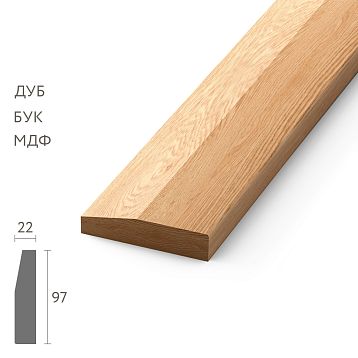
Wooden molding— a thin strip dividing panels or framing inserts within the frame. Width of the strip 15-40 mm, thickness 5-12 mm. It creates divisions within the facade, allowing to insert several small panels instead of one large. This makes the facade more scaled, detailed, and visually interesting.
Straight strip — the simplest variant, representing a rectangular-sectioned planed strip. It is mounted on the facade, dividing it into equal or proportional parts. Joints of the strip are milled at 45 or 90 degrees depending on configuration. Straight strip is suitable for minimalist and Scandinavian interiors, where clean lines and absence of unnecessary decoration are important.
wooden veneer with a decorative profileIt has a profiled cross-section: rounded edges, bevels, grooves, wavy lines. It creates volume, play of light and shadow, making the facade more expressive. Shaped strip is characteristic of classical, Provence, country-style interiors, where decorative elements are valued and welcomed. The profile of the strip should harmonize with the profile of frame strips and cornice, creating a unified stylistic ensemble.
The strip is mounted with glue and additional fixation using finishing nails or dowels. It is important to ensure tight fitting along the entire length to avoid gaps and steps. After installation, mounting points are spackled, sanded, and painted to match the main item. Properly installed strip is perceived as an integral part of the facade, not as an attached element.
The strip can be painted in the same tone as the facade, creating a monochromatic surface with relief structure. Or contrasting, when the strip stands out by color, emphasizing the geometry of divisions. Popular combinations: white strip on gray facade, dark brown on beige, black on white. Contrast makes the structure more graphic, modern, and visually complex.
Panels inside the frame and strips can be flat, recessed, or protruding. Flat panel lies in the same plane as the frame, creating a smooth surface. Recessed panel is located 3-10 mm below the frame level, forming a recess that emphasizes volume. Protruding panel extends beyond the frame, creating a convex structure characteristic of some historical styles.
The material of the panel does not necessarily match the material of the frame. Possible combinations: wooden frame with painted MDF, veneered particleboard, glass, metal, rattan. Such mixing creates interesting visual and tactile effects. For example, a solid oak frame with matte glass panel creates a combination of warm wood texture and cool glass smoothness, creating a balance between natural and industrial.
Care for strips and panels is similar to care for main furniture: regular dry cleaning, periodic wet wiping, reapplication of finish every few years. Special attention — recesses and joints, where dust and grease accumulate. Their cleaning requires soft brushes or toothpicks wrapped in cloth to avoid damaging the finish.
System: cornice + molding + strip + molding
Creating a harmonious furniture set requires coordinating all decorative elements into a single system.Furniture corniceBaseboard, frame strips, strips, moldings — all these elements must be designed as parts of a whole, where each detail complements the other and contributes to the overall composition.
The basic principle of coordination — profile unity. All elements have similar motifs: if the cornice has a 8 mm radius rounding, then frame strips and strips must have the same or multiple radius rounding. If the cornice is decorated with grooves, then other elements may contain this motif. Such repetition creates rhythm, recognizability, visual connection between different parts of furniture.
Second principle — proportionality. Height of cornice, width of frame strips, thickness of strips must relate to each other according to a certain module. For example, if the frame strip width is 60 mm, the strip may be 30 mm (half), and the baseboard 120 mm (double). Such modularity creates mathematical harmony, which is subconsciously perceived and accepted as correctness, beauty, order.
Third principle — color unity. All elements are painted in one color or in a coordinated color palette. Contrasts (light facades with dark frames) are allowed, but they must be thought out and repeated in different parts of the set. Chaotic color mixing destroys unity, makes furniture heterogeneous, visually cheap.
Fourth principle — material unity. All wooden elements are made from the same species. Mixing oak and beech even under the same lacquer gives different textures that disrupt the impression of monolithism. If different materials (wood + MDF) are used, MDF is painted in a dense color that hides its structure, while wood is coated with transparent lacquer that highlights the texture.
System design begins with developing a basic profile, from which all other elements are produced. The designer creates sketches, computer models, mockups, showing how different parts will combine. Samples are manufactured and assembled into a test furniture fragment. Visual effect, proportions, color combinations are evaluated. Adjustments are made until the ideal result is achieved. Only after the system is approved is mass production of all elements launched.
Ordering a complete system from one manufacturer guarantees compatibility of all elements.Wood TrimManufactured at the same facility, it has the same moisture content, processed with the same tools, coated with the same compositions. This eliminates problems of incompatibility, color mismatch, profile misalignment that occur when purchasing elements from different suppliers.
Installing the system requires professionalism. All elements must fit together without gaps, lie in one plane, form precise angles. Any carelessness — a gap at the joint, a step between parts, a curved angle — destroys the impression of quality. Experienced furniture makers use special fixtures for precise fitting, templates for angle control, laser levels for checking flatness.
and cornices made of solid oak or beech — the choice of those who value quality, durability, and aesthetics of natural material. Oak and beech are classic furniture species used for centuries and proven reliable under various conditions of use.
Wooden moldingand crown moldings made of solid oak or beech — chosen by those who value quality, durability, and the aesthetics of natural materials. Oak and beech are classic wood species used for centuries and have proven their reliability under various conditions of use.
Oak has the highest hardness among European hardwoods — 3.7-4.0 on the Brinell scale. This makes oak cornices extremely resistant to mechanical damage: they do not dent from impacts, do not form dents under point loads, do not wear down during regular cleaning. Oak density 650-750 kg/m³ ensures dimensional stability under humidity fluctuations — an oak cornice does not warp, does not crack, retains its geometry for decades.
Oak texture is expressive and recognizable: clearly visible annual rings, large medullary rays, creating a characteristic "mirror" pattern on radial cuts. Color varies from light straw in young wood to dark brown in mature wood. Tannins in oak composition give it natural antiseptic properties and allow toning in a wide range of shades — from golden to almost black.
Processing oak requires powerful equipment and sharp carbide tools. High density and hardness quickly wear out cutters, requiring regular sharpening or replacement. Processing speed is lower than for softwoods, but the result justifies the cost: an oak profile has sharp edges, smooth surface, and longevity measured in generations.
Beech is the second most popular wood for furniture moldings. Hardness of 3.2–3.5 units — slightly less than oak, but still high. Density of 650–680 kg/m³ is comparable to oak. The main difference is texture: beech is more uniform, without clearly visible growth rings or medullary rays. This makes it ideal for painting in solid colors, when wood texture should not show through the finish.
Beech color — pinkish-white when freshly sawn, pinkish-brown after drying. This warm tone makes beech moldings cozy and friendly, suitable for Scandinavian and modern interiors. Under transparent lacquer, beech creates a soft, unobtrusive texture. Under opaque paint — a perfectly smooth surface without textural interference.
Processing beech is easier than oak: less tool wear, higher feed rate, less prone to chipping. This makes beech products slightly cheaper than oak at comparable quality. For painted furniture moldings, beech is the optimal choice, combining solid wood strength with ease of processing.
Comparison with MDF shows the advantages of solid wood. MDF is cheaper, lighter, easier to process, but inferior in strength, durability, and repairability. An MDF crown lasts 10–15 years, while solid wood lasts 30–50 years. MDF is afraid of moisture — it swells and delaminates when wet. Solid wood is moisture-resistant with protective coating. MDF cannot be repaired — damaged sections must be replaced. Solid wood can be restored: sanded, spackled, repainted.
The ecological nature of solid wood is indisputable. Oak and beech are natural materials, free of synthetic resins, formaldehyde, and volatile organic compounds. MDF is bonded with urea or melamine resins, which may emit formaldehyde, especially at elevated temperatures. For kitchens, where food is prepared and spent a lot of time, material ecology is especially important.
The status and prestige of solid wood furniture are incomparable to MDF. Wooden moldings and trim — signs of quality, expensive premium furniture. This is an investment in longevity, beauty, and healthy home atmosphere. MDF — a compromise, justified in budget projects, but unable to compete with solid wood in overall characteristics.
How to buy furniture moldings for a complete set
Purchasingbuy furniture moldingsand trim for a complete kitchen set requires careful planning and precise calculations. Errors at the ordering stage lead to material shortages, profile mismatches, color variations between batches. How to avoid these problems?
First step — precise measurements. The total length of the top line of the set is measured, including all protrusions, niches, and angles. To this length, 10–15% allowance is added for trimming, defects, and possible installation errors. For frame rails and panels, the perimeter of each facade is calculated, all values are summed, and a similar allowance is added. It is better to have a small surplus than to face material shortage at the final installation stage.
Second step — profile selection. Manufacturer catalogs contain dozens of options with different cross-sections, sizes, and decorative levels. Selection is determined by interior style, ceiling height, and furniture scale. For a standard kitchen in neoclassical style, a crown 80–100 mm high with medium overhang and moderate relief is suitable. For a spacious kitchen-dining room in classic style, a 120–150 mm crown with rich profile and carved elements is appropriate.
Third step — determining wood species and finish. Oak or beech? Natural color or paint? Matte or glossy lacquer? These decisions affect appearance, cost, and production time. Natural solid wood under transparent lacquer is more expensive and requires premium-grade wood without defects. Painted solid wood is cheaper, as second-grade wood with small knots is acceptable, which will be covered by paint.
Fourth step — cost calculation. Crown pricing is indicated per linear meter. Multiply the length by price, add the cost of corner elements, sockets, and delivery. This gives the budget for crown elements. It usually constitutes 8–12% of the total set cost. Saving on crowns is not advisable: these are the details that determine the perceived quality of the entire furniture set.
Fifth step — placing the order. Serious manufacturers require a 30–50% advance payment to start production. Production time for standard profiles from stock — 3–5 days. Custom-made production — 2–3 weeks, including tool development. After production, crowns must undergo acclimatization under conditions close to operational — at least 48 hours. Only after this are they ready for installation.
Sixth step — material acceptance. Upon receipt, check completeness (match to order quantity), processing quality (absence of chips, cracks, coating defects), geometry (straightness, compliance with drawings). Detected defects are recorded in an act, and defective elements are returned for replacement. Inspection before installation is critical — after installation, complaints are not accepted.
Seventh step — proper storage until installation. Crowns are stored horizontally on a flat surface, with spacers between layers. The room must be dry, with humidity 50–60% and temperature 18–22°C. Material cannot be stored outdoors, in unheated rooms, or under high humidity. Violating storage conditions leads to warping, cracking, and loss of appearance.
Eighth step — installation. If you lack experience working with wooden trim, it is better to hire professionals. They ensure precise corner joints, correct fastening, and absence of visible defects. Installation cost is 30–50% of material cost, but guarantees quality results. Self-installation is justified only with carpentry skills and necessary tools.
Conclusion: Furniture Architecture from STAVROS
Furniture moldings, trim, panels — these are not just decorative overlays, but an architectural system that shapes the furniture’s appearance and determines interior quality. STAVROS specializes in producingwooden trimpremium-grade solid oak and beech wood. Modern equipment, strict quality control, wide range of profiles allow implementing projects of any complexity — from standard kitchens to exclusive sets based on individual sketches.
buy cabinet moldingAvailable from stock in Saint Petersburg and Moscow with delivery across Russia. Dozens of profiles of different heights, complexities, and styles are in stock. Custom manufacturing according to customer drawings with unique tool development is possible. STAVROS’s technological capabilities allow creating trim meeting the highest quality and aesthetic standards.
Furniture molding, Wooden molding, Decorative wooden moldingsFrom STAVROS — an investment in the longevity, beauty, and comfort of your home. Natural solid wood, flawless processing, thoughtfully designed elements — all this makes STAVROS a reliable partner in creating furniture that will delight generations.
Frequently asked questions
What is the difference between solid wood and MDF crown? Solid wood is stronger, more durable, repairable, and has natural texture. MDF is cheaper, lighter, easier to process, but less resistant to moisture and mechanical damage.
Can crowns be installed by oneself? Technically possible with tools and skills. But for flawless results with precise corner joints, it is better to hire professionals.
Which wood species is better for kitchen crowns? Oak — maximum strength and moisture resistance. Beech — optimal combination of strength and processability, ideal for painting.
How much does a complete set of crowns for a standard kitchen cost? Depends on length, profile, and wood species. On average, 15,000–35,000 rubles for a complete set in solid wood with installation.
How to care for wooden crowns? Regular dry cleaning, periodic wiping with soft wood-specific cleaners. Lacquer renewal every 5–7 years.
Can crowns be repainted in another color? Yes, solid wood can be repainted multiple times. Requires sanding the old finish, priming, painting, and lacquering.
How to choose a crown to match existing furniture? By style, size, and color. Crown samples can be requested from the manufacturer for fitting to furniture before ordering.