Article Contents:
- Features of Kitchen Furniture: When Function Dictates Form
- Facade Materials: Beauty with Protection
- Countertops: The Battleground
- Hardware: Invisible Reliability
- Kitchen Interior Decor: From Utilitarian to Aesthetic
- Cornices: Finishing the Top Line
- Plinths: The Base of Furniture
- Moldings on Facades: Frame Structure
- Carved Overlays: Decorative Accents
- Hardware as Decor
- Connecting Kitchen with Living Room: Creating a Unified Language
- Color Scheme: One or Two Main Colors
- Repetition of Decorative Elements
- Baseboards: Unified Line or Zoning
- Flooring: Continuation or Boundary
- Lighting: Different Scenarios, Unified Style
- Textiles: Soft Connection
- Modern Kitchen Furniture: Minimalism and Function
- Handleless Facades: Purity of Lines
- Built-in Appliances: Integration
- Hidden Storage Systems: Order from Within
- Minimalist Decor: Emphasis on Material
- Practical Scenarios: From Kitchen to Unified Space
- Scenario 1: Classic Studio 40 m²
- Scenario 2: 60 m² Loft with Open Kitchen
- Scenario 3: Family Apartment 80 m², Kitchen-Dining-Living Room
- Frequently Asked Questions
- Conclusion: Kitchen as Part of the Home

Today, the kitchen rarely exists in isolation. In studio apartments, lofts, and spacious homes, the kitchen flows into the living room and dining area, forming a unified space.Kitchen furnituremust not only withstand moisture, heat, grease, and intensive use but also visually harmonize with the rest of the interior. How can you make a practical, utilitarian kitchen not look like a foreign body against the backdrop of an elegant living room? Through decor—cornices, overlays, plinths, moldings, hardware—those elements that create a visual language uniting the space. This article is about transforming the kitchen from a technical zone into a full-fledged part of the interior composition, where practicality does not contradict beauty but complements it.


Features of kitchen furniture: when function dictates form
The kitchen is the most aggressive room in the house in terms of furniture use. High humidity from boiling pots and wet dishes, temperature fluctuations from the stove and oven, grease settling on surfaces, water splashes, aggressive cleaning agents, constant opening and closing of doors, pulling out drawers.Kitchen furnituremust withstand all this for years, preserving appearance and functionality.




Front materials: beauty with protection
Solid wood is a traditional, noble material that creates a warm, living atmosphere. Oak, beech, ash are cut into panels (panels inserted into frames), coated with oil, varnish, or enamel. Solid wood is beautiful, tactile, and repairable (scratches can be sanded, coating renewed). But it requires proper finishing: for the kitchen, solid wood must be coated with a moisture-resistant varnish (two-component polyurethane) or enamel, creating a sealed film. Oiled solid wood without varnish absorbs moisture, can swell, and deform.
Solid wood is expensive (an oak front is 40-60% more expensive than MDF), but creates a sense of status, substantial furniture that will last for decades.
MDF with coating is the optimal compromise of price, beauty, and practicality. MDF (fine wood fraction, pressed under pressure) is a dense, homogeneous, stable board. For kitchens, moisture-resistant MDF is used (with additives that increase moisture resistance, edges are greenish). MDF coatings:
-
PVC film: glued onto a milled MDF surface, imitates wood, stone, solid colors. The film is moisture-resistant, easy to clean, but fears high temperatures (film near the stove may peel from heat), scratches with sharp objects. Budget option.
-
Enamel: MDF is primed, painted in several layers (usually 4-6), coated with varnish. Creates a smooth, glossy or matte surface in any color. Enameled fronts are moisture-resistant, heat-resistant, look luxurious, but are more expensive than film, scratches are visible (especially on dark glossy).
-
Acrylic: a 2 mm thick acrylic sheet is glued onto MDF—glossy, impact-resistant, moisture-resistant, does not fade, easy to clean. More expensive than enamel, but more practical. Gloss is maximum, almost mirror-like.
-
HPL plastic: high-strength laminated plastic, glued onto MDF under pressure. Exceptionally resistant to scratches, moisture, high temperatures, chemicals. Matte or textured (imitation wood, stone, textile). Expensive, but eternal.
Laminated chipboard (LDSP) is the most budget option. Chipboard (particle board) is coated with melamine film. For kitchens, moisture-resistant LDSP is needed (edges are blue or green). Looks cheaper than MDF (edges are visible, even with edging), less resistant to moisture (if edging is damaged, chipboard swells). Suitable for carcasses (invisible from inside), but for fronts, it is inferior to MDF.
Our factory also produces:


Countertops: the battlefield
The countertop takes the maximum load: hot items are placed on it, cutting occurs (though not recommended), liquids are spilled, abrasives are used for cleaning. The countertop material is critical.
Engineered stone (quartz agglomerate) is a composite of 90-95% quartz chips + polymer resins + pigments. Hardness 7 on the Mohs scale (like granite), does not scratch with knives (though cutting on it is still not recommended), withstands temperatures up to 180°C (can place a hot pan, but better not risk it), does not absorb water, wine, coffee (dense non-porous structure), resistant to acids. Seamless joining allows creating L-shaped, U-shaped countertops without visible seams. Colors from white to black, imitations of marble, granite, solid colors.
Cons: heavy (a 3-meter slab weighs 80-100 kg), with a strong impact from a heavy object may crack (though stronger than natural marble), expensive (comparable to natural stone).
Natural stone (granite, marble) is luxury and eternity. Granite is hard (6-7 on Mohs), heat-resistant (up to 300°C), does not scratch, does not absorb (dense), resistant to acids. Marble is softer (3-4 on Mohs), scratches, absorbs (porous—wine, lemon juice leave stains, etch the surface), requires regular sealing (once a year). But marble is more beautiful—veins, color transitions, nobility.
Natural stone is expensive, heavy, requires professional installation (seams at joints are visible, though they try to minimize them).
Solid wood is a warm, tactile, living countertop. Oak, ash, larch (moisture-resistant) are glued into a panel 40-60 mm thick, coated with oil or varnish. Wood is beautiful but capricious: absorbs moisture (if coating is damaged), scratches, darkens from heat, leaves knife marks. Requires careful handling, regular coating renewal (once a year oil, once every 3-5 years varnish). Suitable for those ready to care, valuing naturalness over practicality.
LDSP with plastic coating is the budget standard. Moisture-resistant chipboard (38 mm thick) is coated with HPL plastic on top, edges are covered with PVC or ABS edging. Moisture resistance is average (if edging is damaged, chipboard swells), heat resistance is low (heat leaves marks), strength is average (scratches). But cheap (3-5 times cheaper than stone), lightweight (can be replaced without a lifter), accessible. Suitable for budget kitchens, rental housing, dachas.
Get Consultation
Hardware: invisible reliability
Hinges, drawer guides, lift mechanisms—hardware in the kitchen works more intensively than in any other room. A door opens 10-20 times a day, a drawer is pulled out even more often. Cheap hardware loosens, squeaks, breaks in a year or two. Quality hardware (Blum, Hettich, Grass) lasts 20-30 years, works silently, smoothly, with soft-close mechanisms (the door closes itself the last 5 cm of travel, softly, without slamming).
Investing in hardware is an investment in daily use comfort. The difference between cheap and premium hardware is felt every time you open a cabinet.
interior decorationkitchen: from utility to aesthetics
A basic kitchen consists of carcasses, fronts, countertop, appliances. Functional, but faceless.interior decorationtransforms it into part of the interior, adds style, character, visual richness.
Cornices: finishing the top line
The upper cabinets of the kitchen end with a horizontal line. If left as is (flat top of the cabinet), it looks unfinished, utilitarian, office-like. A cornice is a decorative molding attached along the upper perimeter of the cabinets, creating an architectural finish.
The cornice hides the technological gap between the cabinets and the ceiling (usually 5-10 cm, necessary for installation, leveling, running utilities), masks ceiling irregularities, creates a visual frame that makes the kitchen part of the architecture, not a set of boxes.
Types of cornices:
Simple rectangular — a strip 5-10 cm high with a straight cross-section. Minimalist, modern, suitable for kitchens in modern, Scandinavian, and loft styles. Painted to match the cabinet fronts or in a contrasting color.
Profiled classic — a cornice with a shaped cross-section (rounds, beads, shelves) that creates a play of light and shadow. Height 10-15 cm. Suitable for classic, neoclassical, and Provence styles. Can be made of wood (solid oak, beech) or MDF, painted with enamel, or stained.
Carved Baroque — a cornice with carved overlays, modillions (brackets imitating support), dentils (small teeth). Height 12-20 cm. Opulent, luxurious, for palatial, Baroque, or lavish interiors. Requires high ceilings (from 2.8 m), otherwise it feels oppressive.
The cornice is attached to the upper cabinets or to the wall above them. If an LED strip is installed inside the cornice (directed upwards towards the ceiling), it creates contour lighting that visually separates the kitchen from the ceiling, adding airiness and height.
Plinths: the base of the furniture
Lower cabinets stand on adjustable legs 10-15 cm high, concealed by a decorative plinth — a strip that covers the space from the floor to the bottom of the cabinet. The plinth protects the legs from dirt, moisture, and impacts, creating a visual sense of solidity (the kitchen stands on the floor, rather than floating above it).
Straight plinth — a flat strip 10-15 cm high, recessed 5-7 cm from the front line (so you can stand close without your toes hitting it). Painted to match the cabinet fronts (the kitchen looks monolithic) or to match the floor color (the plinth blends in, making the kitchen visually lighter).
Profiled plinth — with a decorative profile along the top edge (rounded, beveled, curved). Suitable for classic kitchens where details and transitions are important, not sharp corners.
The plinth can be removable (attached with clips, easy to remove for cleaning or accessing utilities) or fixed (screwed on with self-tapping screws, more secure but harder to remove).
Moldings on cabinet fronts: frame structure
Modern kitchen cabinet fronts are often flat (a smooth door without relief). Classic and neoclassical kitchens use a frame structure — moldings that frame the central panel (the field), creating depth, light play, and architectural character.
Moldings can be milled directly into the cabinet front (relief carved from solid wood or MDF with a router) or applied (separate strips glued onto a flat door). Applied moldings are cheaper (no milling required) and allow a flat front to be transformed into a framed one.
Molding width — 2-5 cm, profile — from simple rectangular to complex classic. Moldings are painted along with the cabinet front, creating a unified surface. A contrasting option — white cabinet front with gold or silver (patinated) moldings — creates luxury and Baroque opulence.
Carved overlays: decorative accents
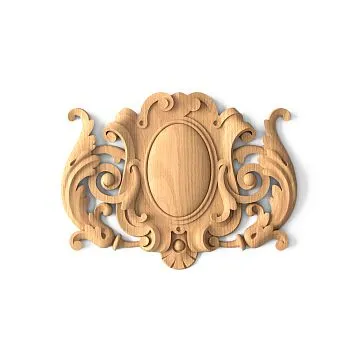
Carved overlays — central, corner, frieze — add individuality, exclusivity, and artistic value to a kitchen. A 10x15 cm overlay in the center of an upper cabinet front (cartouche, rosette, floral ornament) turns a standard door into a work of art.of furniture decor.
Corner overlays (on the corners of cabinet fronts, size 5x5 cm or 8x8 cm) create a framed composition, emphasize geometry, and add detail. Frieze overlays (horizontal, running along the top or bottom of a cabinet front) create a continuous ornament that visually elongates the kitchen.
Carved overlays should be made of the same material as the cabinet fronts (if the fronts are solid oak, the overlays should be oak) and painted to match or in contrast. A BaroqueSTAVROS kitchenwith white cabinet fronts and gold carved overlays is an example of maximum decorativeness, where each door is a canvas for ornament.
Hardware as decor
Handles, knobs, pulls — not just functional elements, but decorative accents that set the style. Classic brass pulls (gilded or patinated to resemble antique bronze) create a traditional, respectable look. Chrome minimalist rail handles — modern, industrial. Ceramic knobs with painting — Provence, country, vintage. Concealed profile handles (recessed into the top edge of the cabinet front, invisible, the door opens by gripping the profile) — ultra-modern, handle-less design.
Hardware should resonate with the overall style of the kitchen and interior. Gold handles on the kitchen + gold hardware on living room furniture (dressers, cabinets) creates unity. Chrome handles on the kitchen + chrome light fixtures, faucets in the living room — also unity, but in a different vein.
Connecting the kitchen with the living room: creating a unified language
In a studio apartment, open-space kitchen and living room are parts of one space, divided functionally but not physically (no walls, doors). Visual unity is critical — mismatched styles, colors, materials create chaos, discomfort, and destroy the feeling of home.
Color scheme: one or two main colors
The simplest way to connect the kitchen with the living room is to use one color scheme. If the living room is in a gray-white palette (gray walls, white furniture, gray sofa), the kitchen is also gray-white (white cabinet fronts, gray countertop or vice versa). This creates visual calm, unity, and the space is perceived as one room.
Contrast approach: the kitchen is dark (black or graphite cabinet fronts, dark countertop), the living room is light. Contrast emphasizes zoning but requires a third linking element — for example, a dark dining table in the living area that repeats the kitchen color, creating a bridge between the zones.
Accent approach: the main palette is neutral (white, gray, beige), an accent color (blue, green, burgundy) is present both in the kitchen (e.g., a blue tile backsplash) and in the living room (blue cushions, blue rug). The accent links the zones, creating a color rhyme.
Repeating decorative elements
If the kitchen has a cornice with a specific profile, the living room cornice (ceiling, framing the walls) should be of the same or similar profile. If there are moldings on the kitchen fronts, there should be moldings on the living room walls (panel system), creating a visual rhyme. If the kitchen has carved overlays with a floral ornament, the living room should have carved overlays on furniture (chests of drawers, consoles) with the same ornament.
This is not copying — it's variations on a theme. The kitchen cornice is 12 cm high, the ceiling one in the living room is 15 cm, but the profile is the same. The size is different (each element corresponds to its own scale), but the shape is recognizable. The eye subconsciously catches the connection, the space is perceived as designed, not randomly assembled.
Baseboards: a single line or zoning
A baseboard is a horizontal line framing the floor. In an open-space, it can be uniform (one color, one profile along the entire perimeter of the kitchen and living room), creating a visual union. Or it can be different (white baseboard in the kitchen to match white fronts, dark in the living room to match the floor color), creating zoning.
A uniform baseboard visually expands the space, making it cohesive. A different one emphasizes zone boundaries, creates clear separation. The choice depends on the task: do you want one large space or two clearly separated ones?
The height of the baseboard also matters. Low (5-7 cm) — modern, minimalist. High (12-18 cm) — classic, architectural. In a classic interior, a high baseboard in both the kitchen and living room creates stylistic unity.
Flooring: continuation or boundary
The floor is the foundation of the space. Uniform flooring (one tile, one parquet) throughout the open-space creates maximum unification. The floor flows from the kitchen to the living room without seams or boundaries, the space is perceived as one.
Different coverings (tile in the kitchen — practical, easy to clean; parquet in the living room — warm, cozy) creates a boundary. The joint is finished with a threshold (metal, wooden) or done without a threshold (tile and parquet are joined flush, the joint line is the zone boundary).
A compromise: tile in the kitchen, but the same tile or porcelain stoneware imitating parquet in the dining area (between the kitchen and living room), real parquet only in the relaxation area (sofa, armchairs). This creates three zones with smooth transitions.
Lighting: different scenarios, unified style
The kitchen requires bright functional lighting: task lighting for the work zone (LED strip under upper cabinets), general ceiling lighting (spotlights, track systems). The living room — soft, multi-level: ceiling (chandelier or spots), local (floor lamps, sconces, table lamps), decorative (niche lighting, picture lighting).
The style of the fixtures should resonate. If the kitchen has chrome track lights (modern industrial style), the living room should have chrome spots or a laconic chandelier in the same vein. If the kitchen has brass ceiling lights (classic style), the living room should have a brass chandelier, brass sconces.
Light temperature is also important: warm (2700-3000K) creates coziness, suitable for living areas; cool (4000-5000K) is invigorating, suitable for work areas. In an open-space, it's logical to use one range — either warm everywhere (cozier) or neutral everywhere (more modern). Mixing warm and cool in one space creates discomfort.
Textiles: a soft connection
Textiles are present both in the kitchen (curtains, less often tablecloths, napkins) and in the living room (curtains, pillows, throws, rugs). Repeating a color or texture creates a connection.
Kitchen curtains and living room curtains made from the same fabric or collection — an obvious rhyme. Kitchen towels and living room decorative pillows of the same color — more subtle. A rug in the living room and a mat in front of the kitchen sink of a similar style (though the kitchen one is more practical — washable, non-slip) — another point of contact.
Textiles are the most easily changeable element of the interior. If you want to refresh the space, change the textiles (new curtains, new pillows), keeping the color scheme — this will update the interior without renovation.
Modern Furniture for the kitchen: minimalism and function
Classic kitchens with carved fronts, cornices, overlays — one direction. The opposite — modern minimalist kitchens, where decor is minimized, emphasis is on materials, proportions, functionality.
Handleless fronts: purity of lines
Fronts without visible handles — the top edge of the front has an integrated profile (horizontal groove), which is used to open the door. Or a Push-to-Open system (press the door — it opens 2-3 cm, then open it further by hand). This creates an absolutely smooth surface where the fronts merge into a monolithic plane.
Suitable for modern, minimalist, Scandinavian, Japanese interiors. Requires perfect quality of fronts (any unevenness, color variation is visible, handles don't distract the eye). Practicality is debatable — Push-to-Open sometimes triggers accidentally, profiles get dirty (hands are greasy after cooking). But aesthetically — maximum purity.
Built-in appliances: integration
Modern kitchens hide appliances behind fronts. Refrigerator, dishwasher, oven are built into tall cabinets (floor-to-ceiling cabinets), covered with fronts indistinguishable from the rest. The appliances are invisible, the kitchen looks like a single furniture wall.
Advantage — visual calm, absence of technological chaos (blinking displays, chrome handles, different body colors). Disadvantage — built-in appliances are 20-40% more expensive than freestanding ones, require precise niche dimensions, are more difficult to repair (need to remove the front, dismantle the appliance).
Hidden storage systems: order from within
A modern kitchen maximizes space usage through smart storage systems: pull-out carousels (narrow 15-20 cm sections between cabinets, extend to full depth, hold jars, bottles, spices), pull-out drawers instead of doors (everything is visible from above, no need to bend down, rummage in the back of the cabinet), corner carousels (in corner lower cabinets — rotating shelves, utilize the dead corner zone), lift-up systems for upper cabinets (the front lifts up together with the shelf, all contents are at eye level).
These systems are expensive (quality hardware costs 50-150 euros per element), but radically improve ergonomics, make the kitchen more convenient, faster to use.
Minimalist decor: emphasis on material
In modern kitchens, decor is not carved but material. Facades made of natural veneer (oak, walnut, wenge) with a pronounced texture, coated with matte varnish — beauty lies in the wood itself, not in the ornament. A quartz countertop with veins imitating marble — beauty lies in the stone's pattern. A backsplash (the wall between the countertop and upper cabinets) made of large-format porcelain stoneware with textures of concrete, metal, rust — beauty lies in the texture, not in the pattern.
Minimalism does not mean emptiness. It means that every element works, nothing is superfluous, but what is there is of high quality and expressive.
Practical scenarios: from kitchen to unified space
Scenario 1: Classic studio 40 m²
Task: A studio apartment with a combined kitchen-living room. The style is neoclassical, light, airy. The kitchen should be practical but visually integrated.
Solution:
-
Kitchen: MDF facades painted with white matte enamel. Frame structure (moldings frame the panels). Cornice is profiled, white, height 12 cm. Plinth is white, profiled. Countertop is quartz, white with gray veins (imitation of Carrara marble). Backsplash — white subway tile 10x20 cm. Hardware — brass knob handles, matte gold.
-
Living room: Walls white. Sofa gray velour. Coffee table — marble tabletop (the same Carrara as the kitchen's) on metal legs (brass). Wall moldings white, create panels 100x150 cm. Ceiling cornice white, profile repeats the kitchen's but larger (15 cm).
-
Connection: White color of kitchen facades + white walls and living room moldings. Marble of kitchen countertop + marble of living room table. Brass hardware of kitchen + brass legs of table. Cornice profile repeats. Unified baseboard white, height 15 cm, along the entire perimeter. Floor — light oak, unified.
Result: A studio where the kitchen does not stand out as a separate block but dissolves into the overall light neoclassical interior. Practicality (quartz, enamel) does not interfere with beauty (resonance of forms and materials).
Scenario 2: Loft 60 m² with open kitchen
Task: A loft with brick walls, industrial elements (metal, concrete), high ceilings. The kitchen should be modern but rough, fitting into the industrial aesthetic.
Solution:
-
Kitchen: MDF facades with HPL plastic, color graphite (dark gray matte). Facades flat, without moldings. Handles — metal rails, stainless steel. Countertop — quartz black with white inclusions. Backsplash — glass panel with photographic print of concrete texture. No cornice (top of cabinets is flat, rests against the ceiling). Plinth black, straight.
-
Living room: Walls — red brick, partially painted white. Sofa black leather. Coffee table — massive wooden tabletop (old boards, brushed) on a metal frame (black steel). Open shelving — black metal + wood. Ceiling concrete, unfinished. Lighting track, black spotlights.
-
Connection: Graphite kitchen facades + black living room furniture. Metal rails of kitchen + metal frame of table. Concrete texture of backsplash + concrete ceiling. Absence of cornices in kitchen + absence of moldings in living room (industrial style versus classical decor). Floor — concrete screed, unified, polished.
Result: A loft where the kitchen is an organic part of the industrial space. Graphite, metal, concrete, black leather create a brutal, masculine atmosphere. Practicality (HPL plastic, quartz) is hidden behind the aesthetics.
Scenario 3: Family apartment 80 m², kitchen-dining-living room
Task: A spacious apartment where the kitchen smoothly transitions into the dining area (dining table for 8 people), then into the living room. Family with children, practicality is needed, but also coziness, warmth.
Solution:
-
Kitchen: Facades solid oak, stained walnut (dark brown), coated with matte varnish. Frame paneled facades. Cornice oak, carved, with modillions (brackets). Countertop quartz beige with brown veins. Backsplash — ceramic tile with Moroccan pattern (beige-brown). Hardware — antique brass (patinated to look aged).
-
Dining room: Dining table solid oak, stained walnut (same as kitchen facades), size 110x250 cm. Chairs with beige linen upholstery. Above the table — brass chandelier with three pendants.
-
Living room: Walls beige. Sofa beige linen, deep, with many pillows. Coffee table oak, same walnut. Built-in oak shelving. Wall panels oak (lower third of wall, height 120 cm), paneled, repeat the structure of kitchen facades. Ceiling cornice oak, like the kitchen's.
-
Connection: Oak walnut unites kitchen facades, dining table, living room furniture, wall panels. Beige color of countertop + beige walls + beige sofa. Brass hardware of kitchen + brass chandelier. Paneled structure of facades + paneled panels of living room. Unified baseboard oak walnut, height 18 cm. Floor — oak parquet, stained walnut, unified.
Result: An apartment where wood creates warmth, coziness, a family atmosphere. Kitchen, dining room, living room — parts of a single ensemble, where material (oak), color (walnut + beige), structure (panels) repeat, linking the space.
Frequently asked questions
Which facade material is the most practical for a kitchen?
MDF with HPL plastic — maximum resistance to moisture, scratches, temperature, chemicals. Or MDF with acrylic — almost as practical, but more beautiful (gloss). Solid wood requires more care, PVC film is afraid of heat.
Can a wooden countertop be used in a kitchen?
Yes, but with caveats. The wood must be of hard species (oak, ash, larch), coated with moisture-resistant varnish or oil-wax (not just oil). A cutting board is needed (do not cut on the countertop), trivets for hot items, regular treatment (renew the coating once a year). If you are willing to care for it — wood creates an incomparable warmth.
How to hide the boundary between the kitchen and living room in a studio?
Unified floor, unified baseboard, unified color scheme, repetition of decorative elements (moldings, cornices). The boundary is erased. If you want to emphasize it — different floors (tile/parquet), different baseboards, contrasting colors.
Is a backsplash needed if the countertop is made of stone up to the upper cabinets?
Technically not needed (stone is moisture-resistant), but practically desirable. Splashes from the sink, grease from the stove will settle on the stone and will need cleaning. A backsplash made of tile, glass, porcelain stoneware is easier to wash, cleans faster. The stone from the countertop can be raised by 10-15 cm (instead of the standard 60 cm backsplash), the rest — tile.
What is a convenient height for upper cabinets?
The bottom of upper cabinets is 135-150 cm from the floor (45-60 cm above a countertop 85-90 cm high). This provides a backsplash workspace where you don't need to bend your head, yet everything is within reach. The height of the cabinets themselves is 70-90 cm. So the top of the cabinets is 205-240 cm from the floor. If the ceilings are higher, the gap to the ceiling is covered with a cornice or additional storage cabinets.
Is it worth getting a custom kitchen or buying a ready-made one?
Ready-made (modular, from a store) is 30-50% cheaper, faster (bought — delivered — assembled in a day), but limited by module sizes, colors, configurations. Suitable for typical kitchens of standard sizes. Custom-made — more expensive, takes longer (production 4-8 weeks), but precisely fits your dimensions, layout, style, materials. Suitable for non-standard kitchens, special requirements, unique design.
How to care for glossy fronts?
Microfiber + glass cleaner (or a special one for glossy surfaces). Wipe daily (fingerprints, splashes are instantly visible). Do not use abrasives (they scratch). Gloss is beautiful but requires work.
Can I change the fronts while keeping the carcasses?
Yes, if the carcasses are in good condition (not swollen, hinges hold). This updates the kitchen for a third of the price of a new one. You order new fronts in the desired color/style, change the hinges (if the old ones are worn), and hang them. The countertop can also be replaced. You get an almost new kitchen for a moderate amount of money.
What kitchen color is more practical?
Medium shades (gray, beige, light brown) hide light dirt, dust. White shows every stain, requires frequent cleaning. Black/graphite shows dust, fingerprints (especially on gloss). But white visually expands, refreshes. Black is stylish, dramatic. A choice between practicality and aesthetics.
Conclusion: the kitchen as part of the home
Kitchen furniturehas ceased to be a utilitarian set of cabinets. It is a full-fledged part of the interior that influences the atmosphere of the entire home, especially in open-plan layouts. Practicality is the foundation (moisture-resistant materials, durable finishes, quality hardware), but beauty, harmony with the rest of the space — that's what makes the kitchen a place where you want to spend time, cook, gather with family.
Company STAVROS has been creatinginterior decorationandmodern furniturethat transform space into a home. For kitchens, STAVROS offers a full range of decorative elements made from solid oak and beech: cornices (over 50 profiles — from minimalist straight to carved classic), plinths (simple and profiled, any height), moldings (for fronts, walls, framed compositions), carved overlays (hundreds of patterns — floral, geometric, baroque, neoclassical), corner blocks, friezes, balusters.
All elements are made from dried solid wood (moisture content 8-10%), which guarantees stability, absence of deformation under kitchen humidity and temperature. Any finish is possible: natural wood with oil (for dining areas where humidity is lower), tinting in any color (walnut, wenge, gray, black), enamel with or without patina (white, cream, graphite, any RAL), matte or glossy lacquer.
STAVROS works with kitchen manufacturers, designers, private clients, providing elements for creating unique projects. You send a kitchen sketch, style requirements,STAVROS kitchena specialist selects cornices, moldings, overlays, calculates the quantity, suggests finishing options. STAVROS manufactures, delivers, and installs if necessary (or consults your furniture maker on installation).
With STAVROS, the kitchen ceases to be just a place for cooking and becomes part of a unified harmonious space, where practicality and beauty do not contradict but complement each other. Where every cornice, every overlay, every molding works to create an atmosphere, where the utilitarian transforms into the aesthetic, where function becomes form, and form becomes an adornment of life.