












































































Article Contents:
- The Eco-Friendliness of Solid Wood: Why Wood is Indispensable in a Child's Room
- Solid Wood vs. Composites: The Battle for Air Purity
- Tactile Experience: Touch as Learning
- Durability as Sustainability
- Structural Safety: Anticipating Children's Experiments
- Rounded Corners: Softness of Form
- Stability: Resistance to Toppling
- Absence of Small Parts: Protection from Swallowing
- Transformation and Growth: Furniture That Grows with the Child
- Height-Adjustable Tables and Chairs
- Beds That Grow in Length
- Modular storage systems
- Children's Room Interior Decor: Where Safety Meets Beauty
- Soft Wall Panels: Protection from Impacts
- Safe Bumpers and Corner Guards: Invisible Protection
- Developmental Elements on Walls
- Color and Light: An Environment for Psychological Development
- Pastel Tones: Calmness and Harmony
- Multi-Level Lighting: From Play to Sleep
- Frequently Asked Questions About Children's Furniture
- At What Age Does a Child Need a Separate Room?
- How Often Should Children's Furniture Be Replaced?
- Which Types of Wood Are Best for Children's Furniture?
- Are Wall Panels Needed in a Child's Room?
- How Much Does It Cost to Furnish a Child's Room with Solid Wood?
- Conclusion: Growing in Harmony from STAVROS
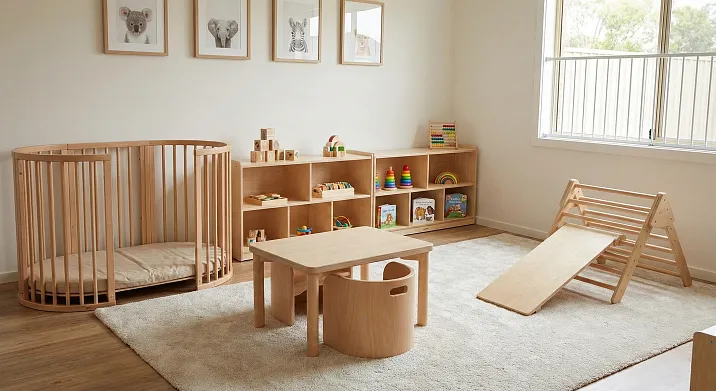
Open the door to a child's room — and before you lies a space where every item has dual significance. A bed is not just a place to sleep, but an island of safety where a child spends a third of their life. A table is not merely a horizontal surface, but a workbench for creativity where drawings are born, figures are molded, and first letters are formed. A shelf is not just a toy storage, but a system for organizing the world, where every item has its place, teaching order.Children's Furniturecreates an environment where safety is not a compromise with beauty, but their union, where the eco-friendliness of solid wood protects health, and where transformation allows furniture to grow alongside the child.
Why does a child's room require a special approach, different from adult rooms? Because a child is not a small adult, but a being with unique needs that change every month. What is safe for a one-year-old is dangerous for a three-year-old who has started climbing to heights. What is functional for a five-year-old is cramped for a ten-year-old. Children's furniture must anticipate changes, adapt, protect, and inspire simultaneously.Solid Wood Itemsof solid wood ensure environmental safety, which is critical for a developing organism sensitive to toxins from artificial materials.


The eco-friendliness of solid wood: why wood is indispensable in a child's room
The first and foremost requirement for children's furniture is absolute environmental safety. A child spends 10-14 hours daily in their room, breathing the air, touching surfaces, sometimes licking objects. Any toxic substances released by materials accumulate in the body, affecting development, immunity, and health.




Solid wood vs. composites: the battle for clean air
MDF, particleboard, plywood are composite materials glued together with synthetic resins containing formaldehyde. Even E1 class materials (low emission) release micro-doses of formaldehyde for years. E0 class (practically zero emission) is more expensive but still contains binders. Plastic furniture releases phthalates, bisphenol-A, and other substances recognized as endocrine disruptors.
Solid wood — oak, beech, ash, birch — contains no synthetic binders. Boards are glued into panels using water-based PVA glue, which becomes inert after drying and releases nothing. The finish — natural oil from flax, tung, carnauba wax — is without solvents, without volatile organic compounds. The result is furniture that does not poison the air in the child's room but enriches it with wood phytoncides, natural antiseptics.
Wood breathes — micropores in the wood allow air to pass through, regulating humidity. In dry air, wood releases stored moisture, humidifying the atmosphere. In humid air — it absorbs excess, preventing dampness. This natural buffer creates a comfortable microclimate, especially important for children with asthma, allergies, sensitive skin.
Our factory also produces:


Tactile experience: touch as learning
A child learns about the world through touch. The texture of a surface, the temperature of a material, the response to pressure shape sensory experience, develop tactile sensitivity. Solid wood is warm to the touch — its thermal conductivity is low, the surface does not cool the hand. The texture is alive — annual rings, pores, natural variations create complexity that is interesting to explore with fingers.
Plastic is cold, smooth to the point of monotony, causing rejection. Metal is even colder, sometimes frightening in its sharpness. Wood invites contact, calms, grounds. A child growing up surrounded by wooden furniture develops a connection with natural materials, which forms ecological awareness, respect for the organic world.
Get Consultation
Durability as sustainability
Children's furniture made of solid wood lasts for decades, surviving the child's growing up, sometimes passing to the next generation. An oak bed bought for a three-year-old becomes a teenager's bed fifteen years later, then a young adult's bed. A beech desk at which a first-grader learned letters serves a student writing their thesis.
This durability is an ecological choice. Instead of buying cheap particleboard furniture every five years, throwing the worn-out items into a landfill, a family invests in quality once. Less production, less waste, less burden on the planet.Light furnitureof solid light wood visually expands the space of the child's room, creates a feeling of freshness, cleanliness.
Structural safety: anticipating children's experiments
Children are unpredictable. They climb where it seems impossible to climb. They pull what should stand still. They stick fingers into gaps adults haven't thought of. A safe design for children's furniture anticipates these scenarios.
Rounded corners: softness of forms
Sharp corners of tabletops, dressers, cabinets are a source of injuries. A child, running, crashes into a corner, gets a bruise, a cut, a concussion. Rounded corners soften the impact, distributing force over a larger area. A rounding radius of 15-30 millimeters is sufficient for safety while preserving aesthetics.
Rounding is done with a router on a machine or manually with a plane and sandpaper. The edges of tabletops, fronts, shelves are processed along the perimeter. The result is furniture with no hard corners to get injured on. Soft transitions of forms are also psychologically more comfortable — sharp corners create visual aggression, rounded ones create softness.
Not only corners but also the edges of furniture should be rounded. A sharp edge of a shelf that a child accidentally runs their hand along leaves a splinter, a scratch. A 2-3 millimeter chamfer or full rounding of edges eliminates the danger. This requires additional processing, increases production costs, but children's safety is worth it.
Stability: resistance to tipping
A child pulls a dresser drawer towards themselves — the weight of the contents shifts forward, the center of gravity moves, the dresser tips over. Tragedies with children crushed by furniture are not uncommon. A stable construction prevents tipping.
A low center of gravity is a critical parameter. A dresser, cabinet, wardrobe should be wider and deeper at the base, creating a wide support. Heavy elements — a massive tabletop, shelves with books — are placed at the bottom. Upper zones are lighter. This creates pyramidal stability.
Wall mounting is a mandatory requirement for tall furniture. Shelving units, wardrobes, tall dressers are attached to the wall with metal brackets, anchors. Even if a child tries to climb, the furniture will not tip over. Modern safety standards require mounts that can withstand a load of 50-100 kilograms.
Anti-tip mechanisms in drawers prevent multiple drawers from being pulled out simultaneously. When one drawer is pulled out, the others are locked. This prevents a situation where a child, opening all drawers, creates a ladder that tips the dresser over along with themselves.
Absence of small parts: protection from swallowing
Children under three explore the world by putting objects in their mouths. Small hardware — screws, caps, decorative overlays, poorly secured — is a choking hazard. Children's furniture should be free of removable small parts or have them secured as reliably as possible.
Drawer and door handles are secured with through-bolts, tightened with nuts on the inside. An additional drop of thread-locking adhesive prevents self-loosening. Shelf mounting hole caps are not plastic inserts, but wooden ones, glued in. Decorative overlays are not just glued, but also nailed with thin headless nails.
The absence of glass elements in furniture for young children eliminates the risk of cuts. Glass cabinet doors, mirrors — only in furniture for children over eight years old, when coordination and awareness of danger are sufficient. For younger children, transparent polycarbonate panels are possible — safe but visually similar to glass.
Transformation and Growth: Furniture That Grows with Your Child
A child changes radically every two to three years. Furniture perfect for a three-year-old is inconvenient for a six-year-old and too small for a ten-year-old. Transformable furniture adapts, extending its lifespan and saving the family money.
Height-adjustable desks and chairs
A schoolchild's desk must fit their height—the tabletop height should allow elbows to rest on it at a right angle while writing, keeping the back straight. For a child 120 centimeters tall, the optimal desk height is 52 centimeters. For a height of 150 centimeters—62 centimeters. A fixed desk is suitable for only two to three years.
A desk with adjustable height grows with the child. The adjustment mechanism—screw, stepped, or gas lift—allows changing the tabletop height from 50 to 75 centimeters. This range covers heights from 115 to 180 centimeters—from a first-grader to a high school student. One desk lasts ten years.
A chair with adjustable seat and back height complements the desk. Seat height changes from 30 to 50 centimeters, seat depth is adjustable, and the backrest moves up and down. Proper seating is critical for posture formation—scoliosis, kyphosis, and other spinal deformities are often the result of improper furniture in childhood.
Adjustable solid wood furniture is more high-tech than it seems. The wooden table legs have metal inserts with threads or holes for fixing at different levels. The mechanism is hidden inside the legs; only wooden surfaces are visible from the outside. The aesthetics of solid wood combine with the functionality of transformation.
Beds that grow in length
A crib for an infant is 120 centimeters long. By age three, a child needs a bed 140-150 centimeters long. By age seven—160-180 centimeters. By age twelve—a full single bed 190-200 centimeters. Buying a new bed every three years is expensive and wasteful.
An extendable bed solves the problem. The base length of 140 centimeters suits a child aged three to five. When the child grows, an additional section extends, increasing the length to 170 centimeters. After a few more years—a second section, bringing the length to 200 centimeters. One bed from three to eighteen years.
The construction of an extendable bed is telescopic. The main frame contains guides along which additional sections slide. Fixing the sections with screws or pins ensures rigidity. The mattress is composite—a base module plus additional sections or a single mattress placed on the extended base.
The bed's headboard can also be adjustable—its height changes as the child grows. A high headboard creates a sense of security for a toddler and serves as a pillow support for reading for a teenager. The adjustment mechanism—grooves where the headboard is fixed at different levels.
Modular storage systems
Storage needs change dramatically. A three-year-old needs shelves for toys, baskets for blocks. A seven-year-old—drawers for stationery, shelves for books. A twelve-year-old—a wardrobe for clothes, shelves for collections. A modular system adapts.
The basic frame—vertical posts and horizontal shelves—is installed initially. The interior configuration changes. Removable dividers, pull-out baskets, hanging rods, and additional shelves are added, removed, or moved. The system grows horizontally—new modules are added—and vertically—height is utilized as the child grows.
Standardized module sizes—widths of 400, 600, 800, 1000 millimeters—allow combining elements. Start with two 600-millimeter modules. After a year, add a 400-millimeter module. Another year later—an 800-millimeter module. The system grows organically, without replacing previous elements.
Children's room interior decor: safety meets beauty
interior decorationA child's room requires a balance between aesthetics and protection. Walls, floor, ceiling—not just surfaces, but an environment influencing development.
Soft wall panels: protection from impacts
Small children fall, bump into walls, especially while learning to walk. Hard walls are a source of bruises and bumps. Soft wall panels cushion impacts, preventing injuries. Construction—a solid wood frame with soft filler (foam density 25-35 kg/m³) inside, covered with fabric.
The upholstery fabric is natural, hypoallergenic. Linen, cotton, blended fabrics with minimal synthetics. Color—pastel tones that calm the psyche. Soft pink, mint, peach, light blue. Bright contrasting colors overstimulate and interfere with falling asleep.
Soft panel height is 100-150 centimeters from the floor—the zone where a child might bump. Above—regular paint or wallpaper. Panels are attached to the wall with brackets, removable—can be taken off for cleaning the upholstery, replacing the fabric due to wear or interior change.
Soft panels also improve acoustics—absorb sound, reduce echo. The nursery becomes quieter, calmer. This is important for sleep, concentration during activities, and protecting hearing from excessive play noise.
Safe bumpers and corners: invisible protection
Corners of wall panels, protruding decorative elements must be protected. Silicone or rubber corner bumpers soften impacts, prevent injuries. Transparent bumpers are unnoticeable, don't spoil aesthetics. Colored ones can be part of the decor—bright accents in a neutral interior.
Furniture decorAll decor in a child's room must be securely fastened. Carved overlays on furniture fronts are attached with glue and nails, preventing detachment. Protruding elements that a child's clothing could catch on—hooks, handles—should be rounded, without sharp edges.
Protective furniture corners—silicone, fitting over table and dresser corners—are a temporary measure for the period when a child is just learning to walk. By age three, coordination improves, reducing the need for bumpers. But rounded corners on solid wood furniture remain a safe solution for years.
Developmental elements on walls
Children's room walls are not just enclosures, but a canvas for development. Magnetic panels allow attaching letters, numbers, creating compositions. Chalkboards for drawing with chalk develop fine motor skills and creativity. Cork panels for pinning drawings and photographs create a gallery of achievements.
A magnetic panel—a steel sheet painted a bright color or covered with a patterned film, fixed to the wall. Size 600×800 or 1000×1200 millimeters. Magnetic letters, numbers, shapes attach to the panel, are moved around, creating words, tasks, pictures. The child learns through play.
Chalkboard — an MDF or plywood panel coated with special paint that can be written on with chalk. Sizes range from a small 400×600 millimeters to an entire wall. A solid wood frame surrounds the board, creating a finished look. A shelf at the bottom holds chalk and a sponge. A child draws, erases, draws again — an endless process of creativity.
Cork panel — natural cork 3-5 millimeters thick, glued to a base. Drawings, photographs, and diplomas are attached with pins. The panel becomes an exhibition of the child's achievements, motivating new accomplishments. A solid wood frame gives the panel status, turning it into a decorative element.
Color and light: an environment for mental development
The color palette and lighting in a child's room affect mood, activity, ability to concentrate, and sleep quality.
Pastel tones: calm and harmony
Bright, saturated colors — red, orange, bright yellow — stimulate and excite the nervous system. In small doses as accents, they are acceptable, but dominance creates overstimulation, interferes with falling asleep, and can cause irritability in sensitive children.
Pastel tones — lightened, soft versions of colors — create a calm environment. Soft pink, peach, mint, blue, lavender, beige. These colors soothe, create a sense of security, and promote relaxation. Walls painted in pastel tones serve as a background for bright furniture, toys, and decor.
Natural light-colored wood — birch, ash, light oak — fits into the pastel palette, adding warmth and tactility. Furniture made from light solid wood visually expands the space, creates freshness, and does not overload the child's room with the massiveness of dark wood.
Multi-level lighting: from play to sleep
A child's room needs flexible lighting that adapts to various activities. Bright general light for play, directed light for reading and activities, and subdued light for preparing for sleep.
A ceiling chandelier or built-in fixtures create general lighting of 300-500 lux. For children, a dimmer is critical — the ability to smoothly adjust brightness. In the evening, the light gradually dims, preparing the child for sleep. Color temperature 3000-3500 kelvins — warm white, calming.
A desk lamp on the work surface provides 500-700 lux for reading, writing, and drawing. A lamp with a flexible bracket, adjustable in height and angle. The lampshade directs light downward, preventing glare. The lamp is LED — does not heat up, safe, economical.
Night light — a source of soft light at night. Many children are afraid of the dark; a night light creates a sense of security. Power 1-3 watts, warm orange light that does not disrupt melatonin production. Placement low — 20-40 centimeters from the floor, illuminating the path to the toilet without blinding the lying child.
Frequently asked questions about children's room furniture
At what age does a child need a separate room?
A newborn sleeps in the parents' room for the first months for convenience in feeding and monitoring. From six months to a year, the child can move to a separate room if the parents feel comfortable. By age three, a separate room is desirable for developing independence and personal boundaries.
But if the apartment area is limited, cohabitation of children of different ages in one room until adolescence is acceptable. Zoning is important — each child has their own bed, desk, and storage area. This teaches respect for others' space and cohabitation.
How often should children's furniture be replaced?
Solid wood furniture with transformation lasts 10-15 years — from preschool age until the end of school. A crib for an infant is replaced with a child's bed at age three. This bed, if extendable, lasts until adolescence. An adjustable-height desk is purchased for school and lasts until graduation.
Cheap particleboard furniture requires replacement every 3-5 years — it wears out, breaks, and no longer suits the age. Investing in quality solid wood furniture saves money long-term, is more eco-friendly, and creates a stable environment for the child.
Which wood species are best for children's furniture?
Birch — a light, durable, affordable species. Birch furniture is ideal for a child's room — eco-friendly, visually light, and takes pastel tones well. The texture is unobtrusive, color from white to cream.
Beech — medium hardness, pinkish hue, stable wood. Beech furniture is sturdy, withstands active play, and lasts long. Price is moderate, quality is high.
Ash — light wood with expressive texture, durable, elastic. Ash furniture is beautiful, durable, and suitable for modern children's room interiors.
Oak — the most durable, long-lasting, but expensive. Oak furniture lasts for generations and is passed down as an heirloom. Color ranges from light honey to dark brown. For a child's room, light oak is better — visually lighter and fresher.
Are wall panels needed in a child's room?
Soft wall panels in a child's room for toddlers are a reasonable safety measure, cushioning impacts from falls. Wooden panels without soft padding serve decorative and acoustic functions but do not protect from injuries.
An alternative — washable wallpaper or paint on the lower part of walls where children draw and get dirty. MDF panels painted with wear-resistant paint are easy to clean and protect walls from damage. Height 100-120 centimeters — within the child's reach.
How much does it cost to furnish a child's room with solid wood?
A basic child's room of 10-12 square meters with a bed, desk, shelving unit made of birch or beech, and simple wall finishing — 250,000-400,000 rubles.
A complete children's room with a sliding bed, adjustable desk and chair, modular storage system in ash or light oak, soft wall panels, developmental elements — 500,000-800,000 rubles.
Premium children's room with custom furniture, carved decor, comprehensive interior design — from 1,000,000 rubles.
Conclusion: Growing in harmony by STAVROS
A children's room is a space where personality is formed, where safety enables freedom of exploration, where beauty inspires, and functionality supports development. Furniture made from eco-friendly solid wood, thoughtful construction, transformation that grows with the child, interior decor combining protection and aesthetics — all this creates an environment where childhood unfolds in comfort, health, and joy.
STAVROS understands the responsibility of creating furniture for children. Over twenty years of experience, strictest control of material eco-friendliness, attention to safety details, the ability to create furniture that adapts to growing needs — all this makes STAVROS a reliable partner for families who care about their children.
The STAVROS catalog features furniture for children's rooms of various ages. Cribs for infants made of solid birch with safe sides, adjustable base. Children's beds for preschoolers and schoolchildren, including sliding, length-adjustable ones. Bunk beds for two children, saving space. Desks and chairs with height adjustment, ensuring proper posture.
Storage systems for children's rooms — modular shelving, dressers, wardrobes made of light wood species. Open shelves for toys and books, closed wardrobes for clothes, pull-out drawers for small items. All with rounded corners, safe hardware, stable construction. Wall-mounting to prevent tipping.
STAVROS interior decor for children's rooms — solid wood wall panels painted in pastel tones or retaining the natural wood texture. Soft panels with fabric upholstery for the bedside area. Solid wood frames for chalkboards and corkboards, magnetic panels. Moldings for creating decorative compositions on walls, dividing zones.
Custom design of children's rooms is a STAVROS specialty. Designers consider the child's age, interests, developmental characteristics, future plans. They develop layouts that maximize space usage, creating zones for sleep, study, play, and storage. They select color schemes that promote development and calmness.
STAVROS children's furniture production is carried out in their own factory in compliance with environmental standards. Chamber-dried solid wood with 8-10% moisture content, stable, non-warping. PVA glue on a water basis, without formaldehyde. Coating with natural oils and waxes, safe even upon contact with skin and mucous membranes.
Quality control is multi-stage. Each element is checked for dimensional accuracy, absence of defects, structural safety. Corner rounding is checked with templates. Stability is physically tested — furniture is loaded, tilted, checked for tipping. Only items that pass all checks are shipped to customers.
STAVROS furniture installation is performed by specialists experienced in children's rooms. Wall mounting with anchors ensuring maximum reliability. Installation of protective corner covers for the youngest. Briefing parents on safe operation, adjustment of transformable elements.
STAVROS works with families across Russia, helping create children's rooms where every element serves the child's development. Consultations at all stages — from furniture selection to operation. Warranty on all furniture, possibility to order additional modules as the child grows, service maintenance.
STAVROS showrooms in Moscow and St. Petersburg display samples of children's furniture. Visit with your child — let them sit at the desk, lie on the bed, touch the wood. Children's furniture should appeal to the child, spark a desire to spend time in their room. Get a specialist consultation, discuss the layout, begin creating a space where your child will grow healthy, happy, developing harmoniously.
Choosing STAVROS means choosing uncompromising safety, the eco-friendliness of solid wood, the beauty of natural wood, the functionality of transformation, the manufacturer's responsibility. Create children's rooms where every morning begins with joy, where learning happens in comfort, where sleep is peaceful, where childhood is filled with the warmth of wooden surfaces, the softness of protected space, the inspiration of surrounding beauty.


