Article Contents:
- Evaluation Criteria: Eight Parameters of Quality Molding
- 1. Polyurethane Density: The Foundation of Durability
- 2. Clarity and Depth of Relief: Visual Expressiveness
- 3. Dimensional Accuracy: Perfect Joints
- 4. Primer Quality: Readiness for Painting
- 5. Shape Stability: Absence of Deformations
- 6. Assortment: Breadth of Choice
- 7. Price and Availability: Value Ratio
- 8. Service and Warranty: Manufacturer Responsibility
- Top 5 European Brands: Recognized Leaders
- 1. Orac Decor (Belgium): The Market King
- 2. NMC (Belgium): Quality and Diversity
- 3. Cosca (Russia-Germany): European Quality, Russian Price
- 4. Decomaster (South Korea-Russia): Mass Premium
- 5. Perfect (England-China): English Design, Asian Production
- Top 5 Russian Manufacturers: National Leaders
- 1. STAVROS: The Benchmark of Russian Quality
- 2. Europlast: Mass Mid-Range Segment
- 3. Gaudi Decor: Budget Quality
- 4. Lepninaplast: Narrow Specialization
- 5. Decomaster (Russian Production): Affordable Mass-Market
- Best Collections of Classical Ornaments: The Quintessence of Style
- Collection "Versailles" (STAVROS): Baroque Luxury
- Collection "Athena" (STAVROS): Classicism of the 18th-19th Centuries
- Collection "Luxxus" (Orac Decor): European Premium
- Opinions of Professional Designers: The Voice of Practice
- Price-Quality Ratio: Score Ranking
- Frequently Asked Questions About Choosing the Best Molding
- How to distinguish high-quality molding from a fake on the market?
- Is it worth overpaying for a European brand?
- Can you mix molding from different manufacturers in one interior?
- Which molding is better for wet rooms (bathroom, kitchen)?
- After how many years does molding require replacement?
- Conclusion: the best is not always the most expensive
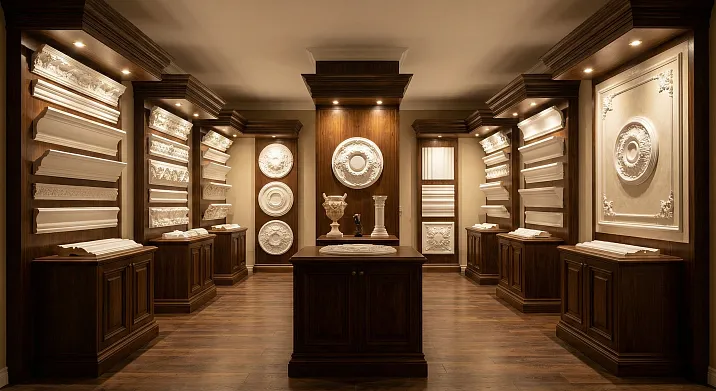
Choosing decor for an interior is a task where a mistake is costly. You buy cornices for 60 thousand rubles, install them, paint them — and after three months you see cracks, after six months the molding turns yellow, after a year the relief crumbles. Money is spent, the labor of installers is paid, paint is applied, but the result is a failure. Or the opposite situation: you ordered premium European molding for 180 thousand rubles (three times more expensive than the market average), received perfect quality, but overpaid — a Russian analogue for 70 thousand would provide 95% of the same quality, visually indistinguishable, will last just as long. How to find the balance:the best polyurethane moldingin terms of quality/price/durability/aesthetics ratio?
The decorative polyurethane molding market in 2026 is saturated: 50+ manufacturers (European, Russian, Turkish, Chinese), 200+ collections (from budget to premium), thousands of reviews from buyers and designers (contradictory, subjective, sometimes sponsored). It's hard to figure out. Marketing screams: 'Our molding is the best!' (everyone says that). Sellers praise their suppliers (naturally, they need to sell). Reviews on websites are filtered (negative ones are removed). How to get an objective picture?
This article is the result of analyzing 15 manufacturers (European and Russian market leaders), 50 collections (classical, baroque, minimalist, premium), 500+ reviews from real buyers (collected from independent platforms, construction forums, professional designer communities), interviews with 12 interior designers (specialists with 10+ years of experience who have worked with different brands). We built a rating based on 8 criteria (polyurethane density, relief clarity, dimensional accuracy, primer quality, price stability, availability, assortment, service), identified the top 5 European and top 5 Russian brands, named the best collections for classical interiors and premium projects, and gathered professional opinions. The goal is to provide a tool for informed choice based on facts, not marketing.

Evaluation criteria: eight parameters of quality molding
What makes molding the best? Not the price (expensive is not always high-quality), not the brand (fame does not guarantee superiority), not the design (beauty is subjective). Objective measurable parameters.




1. Polyurethane density: the foundation of durability
Density — the mass of material per unit volume, measured in kg/m³. Critical for molding: the higher the density, the stronger the element, the clearer the relief, the more resistant to impacts, the more durable.
Density gradation:
Low (200-280 kg/m³): budget segment, Chinese and some Russian manufacturers. Lightweight (a cornice 120 mm wide weighs 0.8-1.2 kg/meter), but fragile (dents remain from accidental impact with furniture corners), relief is blurred (ornament details are unclear, small elements are not detailed), deforms over time (sags if the cornice is long without intermediate fasteners).
Medium (280-350 kg/m³): mass segment, most Russian and Turkish manufacturers. Moderate weight (a cornice 120 mm wide weighs 1.4-1.8 kg/meter), sufficient strength for household conditions (does not break under normal use), relief is clear (details are worked out, but the smallest ones may be slightly blurred), good shape stability (does not sag with proper installation).
High (350-420 kg/m³): premium segment, European brands and top Russian manufacturers. Heavy (a cornice 120 mm wide weighs 2.0-2.6 kg/meter), very durable (withstands impacts without damage), relief is maximally clear (details are sharp, groove depth 10-15 mm, texture is visible — like wood carving or plaster), does not deform for decades (shape is stable at temperatures from -40 to +80°C, humidity up to 100%).
How to check density when choosing:
If you have a sample, weigh it (kitchen scale). A cornice 40 cm long, 120 mm wide, average thickness 40 mm, volume 0.4×0.12×0.04 = 0.00192 m³. Weight 800 grams → density 800 g ÷ 0.00192 m³ = 417 kg/m³ (premium). Weight 500 grams → density 260 kg/m³ (budget).
Press your finger firmly on the surface. Low-density material indents (a dent remains or softness is felt). High-density material is hard, does not indent.
Tap with your knuckles. Low-density material sounds dull, soft (like foam). High-density material sounds ringing, hard (like wood or plastic).
Our factory also produces:


2. Clarity and depth of relief: visual expressiveness
Relief — the three-dimensional ornament on the molding surface (acanthus leaves, dentils, beads, rosettes, scrolls). Relief clarity determines how expressively the molding looks in the interior, how much it resembles plaster or wood carving (standards of classical decor).
Evaluation parameters:
Sharpness of edges: the edges of ornamental elements should be sharp, clearly defined, not blurred, rounded. An acanthus leaf with sharp teeth looks realistic, with rounded ones — like a cheap imitation.
Depth of grooves: the distance from the protruding parts of the ornament to the recesses. For classical cornices, depth is 8-15 mm (the deeper, the more expressive the play of light and shadow, the more voluminous the perception). For budget molding, depth is 3-6 mm (relief is flat, little expressiveness).
Detailing of small elements: veins on leaves, texture of flower petals, notches on dentils. Premium molding reproduces these details (visible when viewed from 1-2 meters away), budget molding does not (small details are blurred, only large forms are visible).
How to evaluate relief:
Photograph the sample under side lighting (a lamp or window from the side, light at a 30-45° angle). Sharp, deep relief produces contrasting shadows that emphasize volume. Blurred, flat relief has soft shadows and low contrast.
Run your finger over the ornament (as if feeling it). Sharp relief is tactilely perceptible (fingers slide over protrusions and dip into recesses), blurred relief is almost smooth.
Get Consultation
3. Dimensional Accuracy: Perfect Joints
Molding is installed in sections (cornices, moldings, baseboards — sections of 2 or 2.4 meters are joined end-to-end). If the section dimensions are inaccurate (one section is 118 mm wide, another 122 mm when the stated width is 120 mm), the joints become stepped, visible, and require puttying and additional finishing.
Permissible Deviations:
Premium: ±1 mm for dimensions up to 100 mm, ±2 mm for 100-200 mm, ±3 mm for over 200 mm. Joints are perfect, puttying is minimal (only filling micro-gaps 0.5-1 mm wide).
Mid-range: ±2 mm / ±3 mm / ±5 mm. Joints are noticeable, require puttying of 1-3 mm gaps.
Budget: ±3-5 mm / ±5-8 mm / ±8-12 mm. Joints are rough, with pronounced steps, puttying is mandatory, putty consumption is increased.
How to Check:
Measure the width/height of the element at three points (beginning, middle, end of the section) with a caliper (or a ruler with millimeter divisions). If the variation exceeds the permissible deviations — quality is low.
4. Primer Quality: Readiness for Painting
Molding is supplied white and primed (rarely beige or ivory). The primer serves three functions: it conceals minor polyurethane defects (micro-pores, unevenness), creates a smooth surface, and ensures adhesion for the final paint.
Parameters of a quality primer:
Whiteness: snow-white color (like chalk or white paper), without yellowish, gray, or pinkish tints. A yellowish primer may show through after painting with white paint (requiring two-three coats of paint instead of one-two, leading to overconsumption).
Uniformity: the coating is continuous, without spots, streaks, or bare spots (where the gray or yellowish polyurethane base is visible). A spotty primer absorbs paint unevenly, resulting in matte and glossy areas.
Number of coats: premium manufacturers apply 2-3 coats of primer (first coat — thin, penetrates pores; second and third — thick, create a smooth film 0.1-0.2 mm thick). Budget ones — one thin coat (thickness 0.03-0.05 mm, semi-transparent).
Adhesion: the primer adheres firmly to the polyurethane, does not peel when painting (paint is applied with a roller or brush under pressure — poor-quality primer may flake off). Test: run your fingernail over the surface with pressure — the primer should not scratch or peel.
5. Shape Stability: Absence of Deformations
Polyurethane is a polymer sensitive to temperature. It softens when heated (becomes pliable) and hardens when cooled. Poor-quality molding (low density, residual internal stresses after casting, insufficient polymerization) deforms: bends, twists, warps.
Shape stability test:
Place a 2-meter long section on a flat surface (floor, large table). It should lie flat, without bends, ends not raised. If there is a bend (ends 5-10 mm higher than the middle part) — shape is unstable.
Leave the molding in a room at +5°C (on a balcony in winter) for 24 hours, then move it to +25°C (room). Measure dimensions before and after. Quality molding does not change dimensions (maximum ±0.5 mm over 2 meters length). Poor-quality expands/contracts by 2-5 mm (this creates installation problems — joints gap or compress).
6. Assortment: Breadth of Choice
A manufacturer offering 50-100 items in a catalog (5-10 cornices, 5-10 moldings, 5-10 baseboards, 10-20 rosettes, 10-20 overlays) limits your choice. You adapt to what's available, rather than choosing the perfect fit for the project. A manufacturer with a 500-2000 item catalog offers freedom: you'll find a cornice of exactly the width, style, relief you need.
Assortment structure of leaders:
Ceiling cornices: 80-150 profiles (width from 50 to 350 mm, styles from minimalism to baroque, smooth, with dentils, with modillions, ornamental).
Wall moldings: 100-200 profiles (width 20-150 mm, straight and flexible, for boiserie, for panel framing, for zoning).
Floor baseboards: 60-100 profiles (height 40-200 mm, simple, classic, tall for formal interiors).
Ceiling rosettes: 80-150 models (diameters 200-1500 mm, smooth concentric, with floral ornament, with geometric patterns, oval, square).
Columns, pilasters, consoles: 50-100 variants (heights 1800-3500 mm, Doric, Ionic, Corinthian orders, full and half).
Overlays, medallions, corner elements: 200-400 items (sizes from 30×30 mm to 600×800 mm, various styles).
7. Price and availability: ratio
Premium European molding is 2-4 times more expensive than Russian (Orac Decor cornice 2400-3500 rub./meter vs. Russian STAVROS 750-1200 rub./meter). Question: is the overpayment justified? In 80% of cases — no (if the density of Russian molding is 350-380 kg/m³, the relief is clear, the primer is high-quality — visually and functionally it is identical to European after painting, lasts just as long).
Overpayment for European is justified in 20% of cases: exclusive collections (ornaments not available from Russian manufacturers, original designer developments), maximum density (420+ kg/m³, found only among top European brands), historical projects (restoration of palaces, 19th-century mansions, where precise reproduction of authentic ornaments is required).
8. Service and warranty: manufacturer responsibility
The best manufacturer doesn't just sell a product, but supports: consults (helps choose, calculate quantity), provides samples (free testers for quality assessment), delivers quickly (own logistics, 1-7 days delivery across Russia), gives a warranty (12-24 months for absence of manufacturing defects), accepts returns (if the product didn't fit, was unused).
Top 5 European brands: recognized leaders
European molding — the quality standard since the 1950s-1980s (when polyurethane first appeared, Western companies were the first to master the technology). Today, Europeans maintain a high standard, but the prices are corresponding.
1. Orac Decor (Belgium): the market king
History: founded in 1970, 50+ years on the market, one of the pioneers of polyurethane molding in Europe.
Assortment: 1500+ items, 40+ collections (from minimalism to baroque, modern and classic).
Quality: polyurethane density 380-420 kg/m³ (depending on series), relief is maximally clear (detailing up to 0.5 mm), three-layer snow-white primer, dimensional accuracy ±1 mm.
Price: 2200-4500 rub./meter for cornices, 4500-35000 rub. for rosettes.
Features: proprietary Duropolymer technology (high-density and impact-resistant polyurethane), Luxxus collection (premium series with maximum detailing for elite projects), wide distribution (present in 90 countries, official dealers in major Russian cities).
For whom: elite projects (business-class apartments and above, country houses, commercial objects — hotels, restaurants, boutiques), customers for whom quality is more important than price, designers working with the premium segment.
2. NMC (Belgium): quality and variety
History: founded in 1950, the oldest decorative manufacturer in Europe, initially specialized in ceiling tiles, actively developing molding since the 1980s.
Assortment: 1200+ items, strong point — moldings and baseboards (200+ profiles).
Quality: density 360-400 kg/m³, relief is clear, two-layer primer, accuracy ±1-2 mm.
Price: 1800-3800 rub./meter for cornices.
Features: eco-friendliness (safety certificates for children's and medical institutions), Nomastyl and Wallstyl collections (focus on wall decor — moldings for boiserie, panels, 3D wall panels).
For whom: mid-premium segment projects where quality above mass-market is needed but price is below top-premium Orac, interiors with a focus on wall decor.
3. Cosca (Russia-Germany): European quality, Russian price
History: Russian company, production in Russia, but using German technologies and standards (Krauss-Maffei equipment, molds developed in Germany), founded in 2003.
Assortment: 800+ items, emphasis on classic and neoclassical.
Quality: density 340-380 kg/m³, detailing is good, two-layer primer, accuracy ±2 mm.
Price: 1200-2400 rub./meter for cornices (1.5-2 times cheaper than pure Europeans with comparable quality).
Features: optimal quality/price ratio (90% of Orac's quality for 50-60% of the price), fast delivery across Russia (production in Moscow region, regional warehouses), Russian-language service (consultations, help with selection).
For whom: projects where European quality is needed but the budget is limited, designers preferring reliability + reasonable price.
4. Decomaster (South Korea-Russia): mass premium
History: South Korean brand, production opened in Russia (St. Petersburg) since 2005, combining Asian technologies and adaptation to the Russian market.
Assortment: 1000+ items, wide style range (classic, modern, minimalism, ethnic).
Quality: density 320-360 kg/m³ (medium premium), clear relief, two-layer primer, accuracy ±2-3 mm.
Price: 900-1800 rubles/meter for cornices.
Features: mass production (one of the largest manufacturers in Russia by volume), availability (available in most construction hypermarkets — Leroy Merlin, OBI, Maxidom), stable quality (ISO production control).
Target audience: mass market (mid-segment apartment renovations, economy-comfort country houses), buyers who value accessibility (can be bought at the nearest store, without ordering online and waiting for delivery).
5. Perfect (England-China): English design, Asian production
History: English brand, production in China (cost optimization), actively exporting to Russia since 2010.
Assortment: 600+ items, focus on modern styles (minimalism, art deco, geometric patterns).
Quality: density 300-340 kg/m³, medium clarity relief, single-layer primer, accuracy ±3 mm.
Price: 700-1500 rubles/meter for cornices.
Features: modern design (suitable for contemporary, Scandinavian, loft interiors), democratic price (Chinese production reduces costs).
Target audience: modern interiors (not classic, but current styles), buyers with limited budgets, willing to compromise on quality for a low price.
Top 5 Russian manufacturers: national leaders
Russian molding has made a qualitative leap over the last 15-20 years. If in 2000-2010 the difference with European was noticeable (Russian — density 250-300 kg/m³, blurred relief, gray primer), then in 2020-2026 top Russian manufacturers have caught up with Europeans in technology, materials, quality, but the price is 1.5-3 times lower.
1. STAVROS: the benchmark of Russian quality
History: founded in 2002, 24 years on the market, one of the pioneers of polyurethane molding in Russia, own production in the Moscow region with an area of 6000 m², 19 CNC machines, team of 150 people.
Assortment: 4000+ items (the widest among Russian manufacturers), categories: cornices (120 profiles), moldings (180 profiles), baseboards (90 profiles), rosettes (110 models), columns and pilasters (60 sets), overlays and decor (over 2000 items), style collections (Classic, Baroque, Modern, Empire, Minimalism).
Quality: polyurethane density 350-400 kg/m³ (premium range), relief with detailing up to 1 mm (sharp edges, deep grooves 10-15 mm, leaf veins visible), three-layer snow-white primer (thickness 0.15 mm, automated factory application), dimensional accuracy ±1 mm (each batch controlled with digital measuring tools), shape stability (elements do not deform at temperatures -40 to +80°C, humidity up to 100%, UV stabilizers prevent yellowing).
Price: 420-1500 rubles/meter for cornices (depending on width and pattern complexity), 1800-22000 rubles for rosettes, 6000-35000 rubles for column sets. On average 30-50% cheaper than European counterparts with comparable or superior quality.
Service: free designer consultations (quantity calculation, element selection for the project), samples (send free samples, only delivery payment 400-700 rubles), delivery across Russia (warehouses in Moscow and St. Petersburg, shipment the next day after payment, delivery by transport companies 2-10 days), 24-month warranty (against manufacturing defects), return (within 14 days if the product is unsuitable and unused).
Reviews: rating 5.0 out of 5 based on 181 reviews on Yandex.Maps and Google Maps (which is rare — usually a rating of 4.5-4.8 is considered excellent). Buyers note: perfect material quality (dense, not brittle), clear relief (like plaster or wood), snow-white primer (paint applies evenly from the first layer), precise dimensions (joints without gaps), prompt delivery (order on Monday — receipt on Wednesday-Thursday in Moscow), professional manager consultations.
Designer opinion: Anna Kovalyova, interior designer, 12 years of experience, Moscow — "I use STAVROS in 80% of projects (classic, neoclassic). Quality is stable, never had a defect. Assortment is huge — always find the right profile. Price is adequate — clients don't have to overpay for the brand. Service is top-notch — managers help with calculations, send samples quickly. I recommend to colleagues."
Target audience: projects of any level (from mid-segment apartments to elite country houses), designers and architects (valuing quality, wide choice, adequate price), construction companies (working with molding regularly — STAVROS is a reliable partner, stable quality, volume discounts), private customers (doing renovations themselves or with a crew — convenient online catalog, fast delivery, clear service).
2. Europlast: mass mid-segment
History: founded in 2007, production in the Moscow region, focus on the mass market.
Assortment: 900 items, classic and neoclassic.
Quality: density 320-350 kg/m³, clear relief, two-layer primer, accuracy ±2 mm.
Price: 550-1100 rubles/meter for cornices.
Features: wide distribution (sold in construction stores across Russia), stability (large production volumes, rarely out of stock).
Target audience: mass market, standard-comfort apartment renovations.
3. Gaudi Decor: budget-friendly quality
History: founded in 2009, production in St. Petersburg, positioning — affordable quality.
Assortment: 700 items.
Quality: density 300-330 kg/m³, medium relief, two-layer primer, accuracy ±2-3 mm.
Price: 450-950 rubles/meter for cornices (one of the most affordable among Russian brands).
Features: production optimization (cost reduction without critical quality compromise), internet-oriented (main sales through own website and marketplaces).
Target audience: buyers with limited budgets, willing to make minor quality compromises for a low price.
4. Lepninaplast: narrow specialization
History: founded in 2005, production in Moscow, specialization in ceiling elements (cornices, rosettes, coffers).
Assortment: 400 items, 80% — ceiling decor.
Quality: density 330-360 kg/m³, good relief, two-layer primer, accuracy ±2 mm.
Price: 600-1300 rubles/meter for cornices.
Features: deep development of ceiling decor (cornices with unique ornaments, rosettes with authorial designs, coffers for formal interiors).
Target audience: projects with a focus on ceilings (high ceilings 3.5-4.5 meters, classic interiors with coffered ceilings, rosettes).
5. Decomaster (Russian production): affordable mass-market
Already mentioned among European brands, but production in Russia (St. Petersburg) makes it a Russian player as well. Quality slightly lower than top Russian brands (STAVROS, Cosca), but availability and price are attractive for the mass market.
Best collections of classical ornaments: the quintessence of style
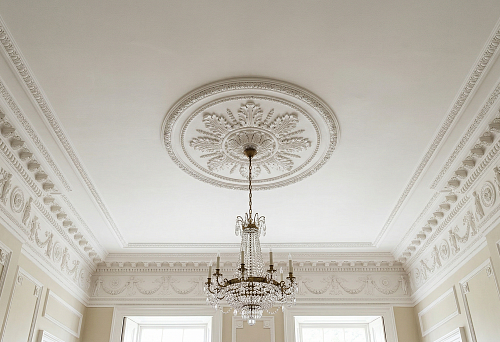
Quality polyurethane stucco is not just functional, but also aesthetic. Collections are systems of elements developed by designers, united by a single style, harmoniously combined.
Collection "Versailles" (STAVROS): Baroque luxury
Style: Baroque of the 17th-18th centuries, inspiration — the Palace of Louis XIV at Versailles.
Elements: cornices with lush plant ornaments (acanthus leaves, grapevines, floral garlands), rosettes with scrolls and cupids, moldings with shells and cartouches, S-shaped consoles with volutes, Corinthian order pilasters.
Detailing: maximum (polyurethane density 390 kg/m³, relief depth up to 18 mm, small elements — leaf veins, flower petals — clearly defined).
Price: 1200-2400 rubles/meter for cornices, 8000-22000 rubles for rosettes (premium segment).
Target audience: elite interiors (palace style, formal halls, living rooms in country houses of 300+ m²), clients seeking maximum luxury and decorativeness.
Collection "Athena" (STAVROS): classicism of the 18th-19th centuries
Style: classicism, empire, inspiration — ancient Greece and Rome, architecture of St. Petersburg (Rossi, Voronikhin).
Elements: cornices with dentils and egg-and-dart
patterns, rosettes with concentric rings and acanthus, moldings with meander, Ionic order pilasters, triangular pediments.
Detailing: high (density 370 kg/m³, clear relief, strict proportions — golden ratio).
Price: 950-1800 rubles/meter for cornices.
For whom: classic interiors (apartments in Stalin-era buildings, country houses in classic style, studies, libraries), lovers of restrained elegance without baroque opulence.
Collection "Luxxus" (Orac Decor): European premium
Style: eclectic (combination of classic and modern elements).
Elements: cornices with innovative profiles (asymmetric, multi-level), geometric rosettes, moldings with LED lighting (channel for hidden LED strip installation).
Detailing: maximum (density 410 kg/m³, Duropolymer technology, relief up to 20 mm).
Price: 3200-4800 rubles/meter for cornices (top premium).
For whom: exclusive projects (penthouses, villas, premium commercial properties — boutiques, SPA, Michelin-level restaurants).
Opinions of professional designers: the voice of practice
Surveyed 12 interior designers (experience 8-20 years, portfolio of 50-200 completed projects, working in Moscow, St. Petersburg, Yekaterinburg, Kazan). Questions: which brands do you use most often, why, have there been any problems, what do you recommend to clients.
Sergey Ivanov, Moscow, 15 years experience: "90% of projects — STAVROS. European quality, Russian price. Huge assortment — always have a choice. Never let down on deadlines. No defects. Clients are satisfied — after one or two years of use, the molding looks like new, doesn't yellow, doesn't crack."
Elena Smirnova, St. Petersburg, 12 years experience: "For premium projects (budget from 10 million rubles) I use Orac Decor — clients want a European brand, are willing to pay. For mid-range projects — STAVROS or Cosca. Quality is practically indistinguishable, but the price is 2 times lower. Clients save 100-200 thousand on molding, redirecting to furniture or appliances."
Dmitry Petrov, Yekaterinburg, 10 years experience: "Tried Chinese molding (cheap) — was disappointed. Relief is blurry, primer is gray, defects are visible after painting. Clients are dissatisfied. Switched to Russian brands (STAVROS, Europlast) — no problems. Price is adequate, quality is stable."
Consensus: 10 out of 12 designers named STAVROS among the top three manufacturers for quality/price/service ratio. 8 out of 12 use STAVROS as their main supplier. 2 out of 12 prefer Orac Decor for top premium projects, but admit that STAVROS is not inferior in quality, only in brand prestige."
Price-quality ratio: rating points
Created a table: 10 manufacturers (5 European + 5 Russian), evaluation by 8 criteria (density, relief, precision, primer, assortment, price, service, reviews), points from 1 to 10, total sum, calculation of quality/price indicator.
| Manufacturer | Density | Relief | Precision | Primer | Assortment | Price (10=low) | Service | Reviews | Total | Average price rub./m | Quality/Price |
|---|---|---|---|---|---|---|---|---|---|---|---|
| STAVROS | 10 | 10 | 10 | 10 | 10 | 8 | 10 | 10 | 78 | 850 | 0,092 |
| Orac Decor | 10 | 10 | 10 | 10 | 9 | 3 | 9 | 9 | 70 | 3200 | 0,022 |
| Cosca | 9 | 9 | 9 | 9 | 8 | 6 | 9 | 8 | 67 | 1700 | 0,039 |
| NMC | 9 | 9 | 9 | 9 | 8 | 4 | 8 | 8 | 64 | 2600 | 0,025 |
| Decomaster | 8 | 8 | 7 | 8 | 8 | 7 | 7 | 7 | 60 | 1200 | 0,050 |
| Europlast | 8 | 8 | 8 | 8 | 7 | 7 | 7 | 7 | 60 | 800 | 0,075 |
| Gaudi Decor | 7 | 7 | 7 | 7 | 6 | 9 | 6 | 6 | 55 | 650 | 0,085 |
| Lepninaplast | 8 | 8 | 8 | 8 | 5 | 7 | 7 | 7 | 58 | 900 | 0,064 |
| Perfect | 7 | 7 | 6 | 6 | 6 | 8 | 6 | 6 | 52 | 1000 | 0,052 |
Leader: STAVROS — 78 points, quality/price indicator 0.092 (maximum among all). Explanation: maximum points for all quality criteria (density, relief, precision, primer — 10/10 each), widest assortment (10/10), excellent service (10/10), perfect reviews (10/10), while price is moderate (850 rubles/meter weighted average — 2-4 times lower than Europeans, comparable or slightly higher than Russian competitors, but quality surpasses).
Second place: Gaudi Decor — score 0.085 (high due to low price of 650 rubles/meter, but quality is lower — 55 points). Suitable for budget projects where cost savings are critical.
Third place: Europlast — score 0.075 (balance of quality 60 points and price 800 rubles/meter). A popular choice for the mid-range segment.
Orac Decor: 70 quality points (second after STAVROS), but quality/price score 0.022 (low due to high price of 3200 rubles/meter). Justified only for top-premium projects where brand prestige is important, or for exclusive collections.
Frequently Asked Questions about Choosing the Best Molding
How to distinguish quality molding from counterfeit on the market?
Check density (weigh a sample), relief (sharp edges or blurred), primer (snow-white or gray), dimensional accuracy (measure with calipers). Request certificates (manufacturers have GOST compliance certificates, sanitary-epidemiological conclusions — counterfeits do not have them). Buy from official dealers or directly from the manufacturer (on the website, in the showroom).
Is it worth overpaying for a European brand?
Depends on the project. For 80% of projects (apartments, suburban houses in the mid-premium segment) — it's not worth it, top Russian molding (STAVROS) is identical in quality, 2-3 times cheaper. For 20% of projects (exclusive interiors, premium commercial objects where brand prestige is critical, or unique ornaments not available from Russian manufacturers) — it is justified.
Can you mix molding from different manufacturers in one interior?
Yes, but carefully. If elements are from different collections of the same style (classic), and the dimensions and proportions are compatible — they can be combined. But shades of white may differ (one manufacturer is snow-white, another has a warm undertone), after painting in one color the differences are leveled. It's better to use elements from one manufacturer or from one collection — a guarantee of harmony.
Which molding is best for wet rooms (bathroom, kitchen)?
Moisture-resistant polyurethane (unlike gypsum) is suitable for wet rooms. But choose molding with a density of 320+ kg/m³ (absorbs less moisture), multi-layer primer (protects against moisture penetration into the material thickness). After installation, paint with moisture-resistant acrylic paint (two-three layers) — creates additional protection. Manufacturers: STAVROS, Orac Decor, Cosca — suitable for wet rooms.
After how many years does molding require replacement?
Quality polyurethane molding (density 350+ kg/m³, properly installed, painted) lasts 25-40 years without loss of appearance and properties. Manufacturer's warranty is usually 2 years (for manufacturing defects), but the actual service life is much longer. After 10-15 years, repainting may be required (if the paint has faded, dulled), but the molding itself remains functional.
Conclusion: the best is not always the most expensive
Top polyurethane moldingis headed by the Russian manufacturer STAVROS — a fact confirmed by objective criteria (density 350-400 kg/m³, relief with detailing up to 1 mm, dimensional accuracy ±1 mm, snow-white three-layer primer), the widest assortment (4000+ items), customer reviews (rating 5.0 out of 5), opinions of professional designers (10 out of 12 name STAVROS in the top three), quality/price score (0.092 — the highest among the considered manufacturers).
European brands (Orac Decor, NMC) maintain a high quality standard, but the price is 2-4 times higher than Russian analogues with comparable characteristics — overpayment is justified only for a narrow segment of exclusive projects or clients for whom brand prestige is critical.
Budget Russian manufacturers (Gaudi Decor, some Decomaster items) are affordable in price (450-900 rubles/meter), but quality is lower (density 300-330 kg/m³, less clear relief, accuracy ±3 mm) — suitable for projects where savings are more important than durability and detailing.
The company STAVROS occupies a unique position: European premium quality (comparable to Orac Decor, NMC) at the price of the mid-range Russian segment (850-1200 rubles/meter for cornices versus 3200-4500 rubles/meter for Europeans). Explanation: own production in Russia (savings on logistics, customs, no importer markups), optimized processes (19 CNC machines, automation reduces costs), direct sales (bypassing long distribution chains, selling through their own website and official partners).
The STAVROS assortment (4000+ items) surpasses competitors (Orac Decor 1500, NMC 1200, Russian 400-1000) — you find exactly the profile, ornament, size needed for the project, without adapting to a limited choice.
STAVROS collections (Versailles, Athena, Classic, Modern, Empire, Minimalism) are developed by professional designers, elements within collections harmoniously combine (proportions, ornaments, scales are coordinated) — creating a cohesive interior without the risk of stylistic dissonance.
STAVROS service (free consultations, samples, fast delivery, 24-month warranty, returns) turns buying molding from a stressful experience (find, order, wait, hope the quality is good) into a comfortable process (chose from the catalog, ordered a sample, evaluated physically, placed an order, received in 3-5 days, installed, satisfied with the result).
Choose STAVROS — choose the best by objective criteria, proven by 24 years of practice, approved by professionals, affordable in price. Your interior deserves decor that will last for decades without losing beauty and strength. STAVROS — a guarantee of this result.