Article Contents:
- Material of the future: the polyurethane revolution in design
- Science at the service of beauty
- Chemical resistance and ecological safety
- Technological features of production
- Stylistic diversity: from classic to avant-garde
- Ancient heritage in modern interpretation
- Byzantine luxury and Gothic aspiration
- Renaissance harmony and Baroque dynamism
- Practical Aspects of Application
- Surface preparation: the foundation of quality results
- Assembly Technology: Step-by-Step Guide
- Final finishing and painting
- Design solutions and compositional techniques
- Vertical zoning of space
- Accentuating architectural elements
- Ceiling compositions
- Economic aspects and comparative analysis
- Cost comparison with alternative materials
- Operating costs and maintenance
- Impact on property value
- Technical characteristics and testing
- Mechanical properties of the material
- Climate resistance and durability
- Fire safety and eco-friendliness
- Modern Trends and Innovations
- Digital technologies in design
- New materials and compositions
- Ecological innovations
- Conclusion: choosing masters and connoisseurs of perfection
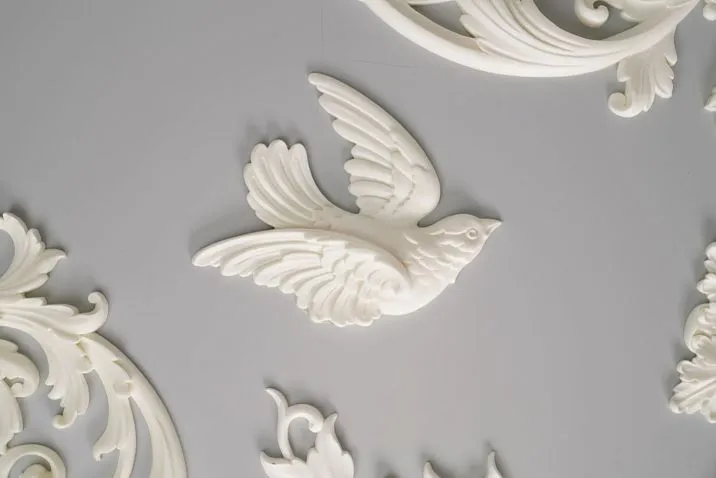
In an instant, an ordinary wall can transform into a work of art worthy of royal palaces. How is this possible? Polyurethane molding on walls has become a magical tool that allows everyone to become a creator of a unique space. This revolutionary material combines the beauty of classical architecture with the practicality of modern technologies, opening up boundless opportunities for creative self-expression.
Walls are not just enclosing structures; they are canvases for creating atmosphere, mood, and lifestyle. When the gaze glides along elegant molding lines, pauses at expressive rosettes, or follows the rhythm of pilasters, a special sense of harmony and completeness is born. It is precisely in this ability to transform space that the true value of decorative elements lies.
The modern era has granted us a unique opportunity — to obtain all the beauty and refinement of classical decor without its traditional drawbacks: excessive weight, high cost, and complex installation.




Material of the future: the polyurethane revolution in design




Science at the Service of Beauty
Behind the modern simplicity polyurethane molding on the wall Behind the simple molecular architecture. Polyurethane is a high-tech thermosetting polymer, whose structure resembles a three-dimensional web of intertwined macromolecules.
This unique structure provides the material with exceptional properties. Density is only 500-700 kg/m³, which is much less than traditional plaster, while compressive strength reaches 50-70 MPa. The material's modulus of elasticity allows it to withstand significant deformations without breaking and return to its original shape.
Polyurethane's coefficient of thermal expansion is extremely low — about 0.1 mm/m per 10°C, which practically eliminates the formation of cracks during temperature fluctuations. This characteristic is especially important in Russian climatic conditions, considering the significant seasonal temperature variations.
Our factory also produces:


Chemical Resistance and Ecological Safety
Modern polyurethane compositions demonstrate outstanding chemical inertness. The material does not react with acids, alkalis, alcohols, and other household chemicals. The pH of finished products is close to neutral, which prevents corrosion of metal fasteners.
Ecological safety is confirmed by the absence of formaldehyde, heavy metals, and volatile organic compounds in the composition. The material does not emit toxic substances even when heated to 150°C, which significantly exceeds the temperatures possible in residential spaces.
Polyurethane's hypoallergenic nature makes it an ideal choice for children's rooms, medical facilities, and spaces where people with heightened sensitivity to chemicals are present.
Get Consultation
Technological Features of Production
Creating quality items begins with designing a master model. Both traditional methods of hand sculpting and carving, as well as modern 3D technologies, are used. Each detail is carefully considered with regard to the molding technology and future operating conditions.
Silicone molds are made from high-quality two-component compounds with a hardness of 25-35 Shore A. This hardness ensures precise reproduction of the finest details while maintaining sufficient elasticity for easy removal of finished items.
The casting process occurs under strictly controlled parameters. Component temperatures are maintained at 18-22°C, and air humidity does not exceed 65%. Gelation time is 8-12 minutes, and full curing takes 16-24 hours depending on the item's thickness.
Stylistic diversity: from classic to avant-garde
Ancient Heritage in Modern Execution
Greek-Roman classicism remains an inexhaustible source of inspiration for creators polyurethane molding on the wallCorinthian capitals with their lush acanthus leaves, Doric triglyphs and metopes, Ionic volutes — all these elements find new embodiment in the modern material.
The mathematical precision of ancient proportions is fully preserved in polyurethane items. A modular system allows creating compositions of any complexity while maintaining canonical relationships between elements. The golden ratio, underlying classical orders, is naturally perceived by the eye as ideal harmony.
Ancient botanical motifs — grapevines, oak leaves, laurel branches — symbolize abundance, victory, and glory. Modern technologies allow reproducing these symbols with botanical accuracy while preserving artistic stylization.
Byzantine Luxury and Gothic Aspiration
Byzantine motifs are distinguished by particular solemnity and symbolic richness. Complex geometric ornaments, stylized crosses, interlacing arcades create a sense of spirituality and elevation. Polyurethane perfectly captures the delicate lines and intricate intersections of Byzantine patterns.
The Gothic style, with its aspiration upward and intricate forms, requires special skill to reproduce. Pointed arches, trefoils, quatrefoils, complex stone carvings — all these elements become accessible thanks to the plasticity of the modern material.
Gothic floral motifs — stylized roses, lilies, oak leaves — carry deep symbolic meaning. The rose symbolizes love and beauty, the lily — purity and innocence, the oak — strength and longevity.
Renaissance Harmony and Baroque Dynamism
The Renaissance gave the world an understanding of ideal proportions and harmony of forms. Cartouches, medallions, garlands create an atmosphere of refinement and education. Anthropomorphic elements — putti, mascarons, caryatids — introduce a human dimension into decoration.
Baroque exploded Renaissance harmony with dynamism and theatricality. Complex scrolls and counter-scrolls, playing on contrasts of light and shadow, create a sense of movement and emotional tension. Polyurethane allows realizing the boldest baroque fantasies without the risk of collapse under their own weight.
Rococo motifs — asymmetrical scrolls resembling seashells — create a playful and carefree mood. Pastel tones and gilding transform walls into precious boxes.
Practical Aspects of Application
Surface Preparation: The Foundation of Quality Result
Quality Installation polyurethane molding on the wall Directly depends on the correctness of preparatory work. The surface must be flat, dry, cleaned from dust, grease stains, and peeling coatings.
Permissible unevenness should not exceed 2 mm per linear meter for moldings and 1 mm for small decorative elements. More significant defects must be eliminated by spackling followed by sanding with P120-P180 grit abrasive.
Surface priming improves adhesion and prevents moisture absorption from the adhesive composition. Universal deep-penetration acrylic primers are used. The primer drying time should be at least 4 hours at 20°C and 60% humidity.
Assembly technology: step-by-step guide
Marking begins with defining the room's central axes and main compositional lines. Laser levels, providing accuracy up to ±1 mm per 10 m, are used. All dimensions are transferred from the project to walls using a tape measure and metal ruler.
Adhesive compositions are selected based on the base material and operating conditions. For interior work, polyurethane or acrylic adhesives are used; for exterior applications, frost-resistant MS-polymer-based compositions are used.
Adhesive is applied using a notched trowel with a tooth height of 3-6 mm depending on the element size. Even application is critically important — an uneven layer may cause element deformation or void formation.
Final finishing and painting
Joint sealing is performed using acrylic sealant matched to the base material's color. Excess sealant is removed with a damp cloth before full curing. Acrylic sealants cure in 2-4 hours under normal conditions.
Sanding is performed using fine-grit paper P240-P320 to remove minor defects and create a uniform surface. Dust is removed with a dry brush or vacuum cleaner with a soft attachment.
Priming before painting ensures color uniformity and paint savings. Water-based primers for polymer materials are used. Primer consumption is 80-120 g/m² depending on surface porosity.
Design solutions and compositional techniques
Vertical zoning of space
Using horizontal moldings allows visually altering the room's proportions. A high molding at 1/3 wall height visually lowers the ceiling, creating a cozy and intimate feeling. Placing the molding at 2/3 wall height, conversely, increases the perceived height of the room.
Panelled ceilings create a classic English atmosphere. Rectangular panels measuring 60×80 cm are considered most harmonious for standard 2.7 m high ceilings. For high ceilings, panel proportions increase to 80×120 cm.
Pilasters and half-columns create rhythmic wall organization. The distance between pilaster axes should be 1.5-2.5 times their diameter to create a harmonious rhythm. Too frequent placement creates a sense of fragmentation, while too sparse placement results in loss of compositional unity.
Accentuating architectural elements
Framing openings emphasizes their architectural significance. The classical scheme includes the architrave (horizontal beam above the opening), capitals (tops of vertical supports), and bases (bottoms of supports). The framing width should be 1/8-1/12 of the opening width.
Niche and alcove treatments gain special expressiveness with proper finishing. Arched finishes create a sense of grandeur, rectangular finishes convey strictness and modernity. Internal lighting of niches enhances the dramatic effect and allows displaying art objects.
Fireplace portals traditionally serve as the compositional center of the living room. Classical proportions imply that the portal's total height should be 1.3-1.5 times the fireplace opening height, and its width — 1.2-1.4 times the opening width.
Ceiling compositions
Coffered ceilings create a sense of monumentality and luxury. The size of coffers should correspond to the room's area: for rooms 20-30 m², 80×80 cm coffers are optimal; for larger halls — 120×120 cm or 100×150 cm.
Central chandelier rosettes require precise size calculation. The rosette diameter should be 1/7-1/9 of the room's width for square rooms and 1/10-1/12 of the longer side for rectangular rooms. Too large a rosette overwhelms the space, while too small a rosette becomes lost against the ceiling plane.
Crown molding solves both decorative and functional tasks. It conceals the junction between wall and ceiling, may contain hidden lighting, and creates a smooth transition between different finishing materials.
Economic aspects and comparative analysis
Cost comparison with alternative materials
Polyurethane molding on walls Demonstrates outstanding economic advantages compared to traditional materials. Gypsum molding, despite comparable detailing quality, costs 3-5 times more, requires highly skilled craftsmen and special installation technologies.
Natural stone surpasses polyurethane in prestige, but its cost may be 10-20 times higher. Additionally, stone elements require reinforcement of load-bearing structures due to their significant weight, creating additional expenses during the design and construction phases.
Wooden carving is comparable in cost to polyurethane only for simple profiles. Complex carved elements require work by highly skilled craftsmen, which significantly increases the cost. Moreover, wood requires regular maintenance and protection against moisture, insects, and fungal damage.
Operating expenses and maintenance
Minimal maintenance requirements make polyurethane molding economically advantageous in the long term. The material requires no special care — periodic wet cleaning with standard household cleaning agents is sufficient.
The ability to repaint multiple times allows updating the interior without replacing decorative elements. Modern water-based paints provide excellent adhesion to polyurethane and enable creating finishes of any color and texture.
Repairability of polyurethane eliminates the need to replace entire elements in case of localized damage. Scratches and chips are easily repaired using special repair compounds, while more serious damage is addressed by inserting patches made of the same material.
Impact on property value
Quality decorative finishing significantly increases the market value of real estate. According to real estate agents, properties with individual design sell 15-25% higher than comparable apartments with standard finishes.
The rental attractiveness of spaces with quality decor is significantly higher. Tenants are willing to pay 20-30% more for a beautiful and stylish space, especially in the premium real estate segment.
The liquidity of uniquely decorated properties is higher—they find buyers faster, even in unfavorable market conditions. This is especially important for investors viewing real estate as a financial instrument.
Technical Specifications and Testing
Mechanical Properties of the Material
The compressive strength of polyurethane is 50-70 MPa, comparable to high-quality concrete. Tensile strength reaches 25-35 MPa, significantly exceeding similar indicators of gypsum and most natural materials.
The impact toughness of the material ensures its resistance to accidental mechanical impacts. Polyurethane absorbs impact energy through elastic deformation, returning to its original shape after the load is removed.
Fatigue strength guarantees longevity under cyclic loads. Tests show the material withstands over a million load cycles without signs of failure, far exceeding actual operational loads.
Climate Resistance and Durability
The operational temperature range is from -60°C to +120°C, significantly exceeding possible temperature fluctuations in residential spaces. The linear expansion coefficient is extremely low, eliminating deformation due to seasonal temperature changes.
Freeze resistance is confirmed by tests showing no loss of mechanical properties after 300 freeze-thaw cycles. This guarantees the ability to use elements in unheated spaces and on building facades.
Resistance to ultraviolet radiation is ensured by special stabilizing additives. Accelerated aging chamber tests show retention of color and mechanical properties equivalent to 25 years of natural exposure.
Fire Safety and Ecological Safety
Polyurethane's fire rating of Class G1 (low flammability) allows its use in most building types without restrictions. The material does not support combustion and self-extinguishes when the fire source is removed.
Smoke emission is rated D2 (moderate smoke), and toxicity of combustion products is T2 (moderately hazardous). These indicators meet requirements for finishing materials in residential and public buildings.
Sanitary-hygienic certificates confirm the absence of harmful substance emissions under normal operating conditions. The material is recommended for use in children's and medical facilities.
Modern trends and innovations
Digital Technologies in Design
Virtual reality systems allow clients to "walk through" the future interior even during the design stage. This eliminates errors and disappointments, enabling adjustments before the manufacturing process begins.
Parametric design automates the adaptation of standard elements to specific room dimensions. The program automatically calculates necessary proportion changes to achieve optimal visual effects.
Artificial intelligence analyzes the client's preferences and suggests optimal stylistic solutions. A database of successful projects is continuously updated, improving the quality of recommendations.
New Materials and Composites
Nanocomposites with clay, titanium dioxide, and silver nanoparticles possess fundamentally new properties. Self-cleaning surfaces, antibacterial coatings, and photocatalytic activity expand the functional capabilities of decorative elements.
Thermochromic pigments allow creating surfaces that change color depending on temperature. This opens new possibilities for creating interactive interiors that respond to external condition changes.
Shape-memory composites can alter geometry under external factors. These materials are in development but already demonstrate impressive potential for creating adaptive architecture.
Ecological Innovations
Biodegradable polymers based on plant raw materials represent an ecologically clean alternative to traditional materials. Polylactic acid, derived from corn, is already used to manufacture temporary decorative elements.
Closed production cycles minimize waste and reduce environmental impact. Used items are recycled into raw materials for producing new materials.
Carbon-neutral production is achieved through the use of renewable energy sources and CO₂ emission compensation via forest planting.
Conclusion: Choosing Masters and Connoisseurs of Excellence
In a world where every day brings new technological discoveries and the pace of life relentlessly accelerates, the human need for beauty and harmony remains unchanged. Polyurethane molding on walls has become the bridge connecting the rich cultural heritage of the past with the boundless possibilities of the present.
Every project using decorative elements is not merely repair or finishing, but the creation of a unique space that will delight the eye and inspire the soul for many years. This is an investment in quality of life, emotional well-being, and that intangible sense of home which makes a space truly alive.
Choosing quality decor is choosing for those who understand the true value of beauty and are willing to invest in creating a space worthy of their dreams and ambitions. This is the choice of those who refuse to accept the dullness and anonymity of mass construction.
Modern technologies have made high art of architectural decoration accessible to everyone, without compromising its quality or expressiveness. The democratization of beauty has become one of the main achievements of our time, opening the opportunity for every person to live surrounded by beauty.
In an era of standardization and uniformity, things created with soul and professional craftsmanship acquire special value. Each decorative element is born with an understanding of its role in the overall symphony of the interior, where every note, every accent, every detail matters.
Investing in quality decorative finishing is an investment in the future. Beauty is not subject to inflation, does not become outdated morally, and brings dividends every day in the form of aesthetic pleasure and emotional comfort.
STAVROS embodies the finest traditions of craftsmanship, enriched by modern technologies and innovative materials. Over many years of operation in the architectural decoration market, STAVROS has earned a reputation as a reliable partner capable of bringing the most daring design ideas to life. STAVROS products are synonymous with quality, reliability, and beauty, proven by time and thousands of successfully implemented projects. Choosing STAVROS means choosing not just materials, but a philosophy of perfection that transforms ordinary space into a work of art. The STAVROS team of professionals is ready to be your guide into the world of beauty and harmony, ensuring flawless quality at every stage — from concept to final result.