Article Contents:
- Molding Comparison: Gypsum vs. Polyurethane
- Comparison Table: Gypsum vs. Polyurethane
- Conclusions from the Table
- When to Choose Gypsum Molding: Situations Where Gypsum is Indispensable
- Restoration of Historical Buildings
- Individual Author Projects
- Premium-Class Classic Interiors
- Ceiling Rosettes of Complex Shape
- Fireplaces with Molded Decor
- When to Choose Polyurethane Molding: Practicality and Economy
- Budget Projects
- Wet Areas
- Facade Molding
- Quick Installation
- DIY installation
- Wooden Skirting Boards: Types and Characteristics
- Solid Wood: Premium-Class Classic
- Veneered MDF: A Compromise Between Price and Quality
- Laminated MDF: Budget Option
- PVC Skirting Board Under Wood: The Cheapest
- Types of Wooden Skirting Boards: Ceiling and Floor
- Floor Skirting: Functions and Shapes
- Ceiling Skirting (Cove): Decor and Joining
- Material Selection Criteria: Style, Budget, Conditions
- Criterion 1: Interior Style
- Criterion 2: Budget
- Criterion 3: Room Conditions
- Recommendations for Combining: Molding + Skirting Boards
- Premium Classic Living Room
- Scandinavian Bedroom
- Modern Kitchen-Living Room
- Budget Studio
- Frequently Asked Questions: Addressing Doubts
- Conclusion: Choose Materials Wisely with STAVROS
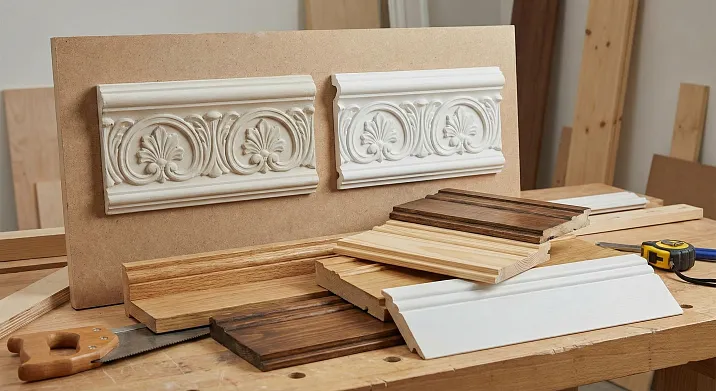
You are facing a choice. The interior is almost ready — walls painted, floors laid, furniture ordered. All that remains is to add the details that transform a set of rooms into a space with character, depth, and completeness. Ceiling molding — cornices, rosettes, moldings — creates classical grandeur or modern graphics. Floor and ceiling skirting boards — hide joints, frame the room, set the rhythm. But materials are different, each with its own pros and cons.Molding: Plaster or Polyurethane — Which is Better?— a question that divides opinions among designers, builders, and homeowners: some swear by plaster (tradition, nobility, eco-friendliness), others choose polyurethane (lightweight, moisture resistance, price).Which wooden skirting boards to choose— solid oak (expensive but eternal), veneered MDF (cheaper but less durable), or plastic wood-look (budget-friendly but a compromise on aesthetics)? The choice determines not only the budget but also the interior style, operating conditions (humidity, temperature), and your priorities (eco-friendliness or practicality).
This article is a complete practical guide for those who want to understand finishing materials, make an informed decision, and avoid mistakes, regrets, and overpayments. We will compareplaster molding and polyurethane moldingby key parameters (weight, price, installation, durability, moisture resistance, detailing) — a table showing when which material is justified. We will analyze situations where plaster is irreplaceable (restoration of historical buildings, individual custom work, premium classic interiors) and cases where polyurethane wins (budget projects, facades, wet rooms, quick installation). We will studyTypes of wooden baseboards(solid oak, ash, pine, MDF with veneer, laminated MDF, PVC with wood texture) — technical specifications, applications, price range. We'll provide selection criteria (interior style — classic, modern, eco; budget — economy, medium, premium; room conditions — dry, humid) and specific recommendations (for bedroom — solid oak, for bathroom — polyurethane skirting board with wood effect, for living room — plaster cornice with hand painting).


Molding Comparison: Plaster vs. Polyurethane
Molding: Plaster or Polyurethane — Which is Better?— a question with no single answer (just as there is no single best car — a compact hatchback for the city, an SUV for off-road, a premium sedan for prestige). The best material is the one that matches your tasks, conditions, and budget. Let's compare the parameters.




Comparison Table: Plaster vs. Polyurethane
| Parameter | Plaster molding | Polyurethane molding |
|---|---|---|
| Weight | Heavy (a 2m cornice, 150mm wide, weighs 15-25 kg) | Lightweight (the same cornice 2-4 kg) |
| Material Price | High (2m cornice — 3000-8000 rubles depending on complexity) | Medium (2m cornice — 800-2500 rubles) |
| Installation | Complex (requires skills, plaster adhesive, dowels, reinforcement for heavy elements) | Simple (adhesive foam, liquid nails, installation in 1-2 hours for a room) |
| Installation cost | High (craftsman's work 50-100% of material cost) | Low (can be DIY or craftsman's work 20-30% of material cost) |
| Durability | High (50-100+ years, 18th-century plaster moldings in perfect condition are known) | Medium-High (30-50 years, depends on polyurethane quality) |
| Moisture resistance | Low (plaster is hygroscopic, absorbs moisture, swells, molds) | High (polyurethane does not absorb water, water absorption coefficient <1%) |
| Relief detail | Maximum (plaster conveys the finest details, leaves, curls as thin as 1-2 mm) | Good (quality polyurethane with density 400+ kg/m³ is detailed, but small elements are less sharp) |
| Possibility of Custom Manufacturing | High (plaster is cast in molds, easy to create a unique element from a sketch) | Medium (requires a mold, mold production is expensive, not cost-effective for single items) |
| Repairability | High (chips are restored with gypsum mortar, indistinguishable from the original) | Medium (chips are filled with putty, but the texture of polyurethane differs from putty) |
| Ecological | Maximum (gypsum is a natural mineral, does not emit volatile substances, breathes) | Good (modern polyurethane without formaldehyde, but the material is synthetic) |
| Application on facades | Limited (gypsum on a facade requires protection from moisture, painting with facade paint) | Wide (polyurethane is ideal for facades — not afraid of rain, frost, sun) |
| Painting | Any (gypsum absorbs paint, holds it for decades) | Any (polyurethane is primed, painted with acrylic, latex) |
Our factory also produces:


Conclusions from the table
Gypsum wins in: detailing (for connoisseurs of handcrafted work, complex baroque ornaments), eco-friendliness (for those building eco-homes, avoiding synthetics), durability (for projects for centuries), prestige (gypsum stucco is a symbol of classicism, luxury). But loses in weight (difficult to install, requires strong floor structures), moisture resistance (not for bathrooms, kitchens, facades in rainy climates), price (material + installation is 2-3 times more expensive).
Polyurethane wins in: lightness (installation without assistants, attached with glue without dowels), moisture resistance (bathrooms, pools, facades — no problem), price (budget projects, economy-class renovation), installation speed (a room in a day). But loses in detailing (for baroque, rococo with the finest elements, gypsum is better), prestige (polyurethane is perceived as a budget alternative to gypsum, although high-quality polyurethane is visually indistinguishable).
Get Consultation
When to choose gypsum stucco: situations where gypsum is irreplaceable
Gypsum is a material with a thousand-year history (ancient Egyptian temples, Roman baths, European palaces are decorated with gypsum stucco). Modern craftsmen continue the tradition, creating works of art. When is gypsum justified?
Restoration of historical buildings
If you are the owner of an apartment in a historical building (pre-revolutionary mansion, Stalin-era building with stucco) and want to restore lost elements — gypsum is the only correct choice. Restorers take a cast from a preserved element (neighboring cornice, rosette in another room), cast a copy from gypsum, install it, tint it to look antique (patination, gilding). Polyurethane is unacceptable in restoration (violates authenticity, alters the cultural value of the building).
Individual authorial projects
You want unique stucco that does not exist in catalogs (family crest on a ceiling rosette, portrait in a wall medallion, ornament designed specifically for your home). The master sculpts the element by hand from gypsum (sculptural gypsum is plastic, allows sculpting any shape), makes a mold (silicone or gypsum), casts a run (if several copies are needed) or leaves a single specimen. The cost is high (handcrafted work, uniqueness — from 15,000 rubles for a rosette with a diameter of 600 mm with an individual pattern), but the result is exclusive.
Classical premium-class interiors
Interiors in the style of baroque, rococo, high-level classicism (apartment in central Moscow with an area of 200+ m², country mansion with enfilades of rooms) require real gypsum stucco — detailing of the finest curls, acanthus leaves, cherubs, draperies creates an atmosphere of a palace, museum. Polyurethane, even high-quality, in such an interior reads as an imitation, a compromise. Gypsum is a marker of authenticity, taste, investment.
Ceiling rosettes of complex shape
A rosette for a chandelier is the central element of a classic living room ceiling. Diameter 800-1500 mm, relief is multi-layered (central medallion, rings of ornaments, outer border), relief depth up to 30-50 mm. A gypsum rosette conveys all details (leaves, flowers, curls protrude, shadows are deep, volume is tangible). A polyurethane rosette of the same diameter is visually flatter (relief 10-20 mm, fine details are blurred). If the rosette is an accent of the interior, above which hangs a crystal chandelier costing 300,000 rubles — gypsum is justified.
Fireplaces with stucco decor
A fireplace portal (surround of the firebox) made of gypsum stucco — columns, pilasters, cornice, frieze with ornament — creates a classic hearth image. Gypsum withstands heat from the fireplace (temperature at a distance of 50 cm from the firebox does not exceed 40-50°C — gypsum does not deteriorate), does not emit odor when heated (polyurethane when heated above 60°C may soften, deform — for fireplaces, gypsum is safer).
When to choose polyurethane stucco: practicality and economy
Polyurethane is a 21st-century material, created by chemists for tasks where gypsum is inconvenient.Gypsum stucco and polyurethane stuccohave different areas of application. Polyurethane is justified in the following situations.
Budget projects
The budget for finishing is limited (a 40 m² studio apartment, DIY renovation, total finishing costs of 500,000 rubles, with 20,000-30,000 rubles allocated for moldings). A 20-meter long polyurethane cornice (room perimeter 4×5 meters) with a width of 100 mm costs 8,000-12,000 rubles (material), installation DIY or by a craftsman 2,000-3,000 rubles. Total 10,000-15,000 rubles. A gypsum cornice of the same length is 40,000-60,000 rubles (material + installation). Savings of 3-4 times. Visually (after painting white), a polyurethane cornice is indistinguishable from gypsum from a distance — budget preserved, effect achieved.
Wet rooms
Bathroom, swimming pool, sauna (relaxation area, not the steam room), kitchen (above the stove, where humidity is high) — polyurethane is ideal. Does not absorb moisture (water absorption coefficient less than 1% — can be held under running water), does not swell, does not mold, does not deteriorate. Gypsum in a bathroom without special treatment (moisture-resistant gypsum + facade paint in 3 layers + hydrophobic impregnation) will rot in 3-5 years. Polyurethane lasts 30-50 years in a bathroom without problems.
Facade moldings
House facade — cornice under the roof overhang, moldings between floors, window surrounds, entrance columns — exposed to rain, snow, frost (down to -30°C), sun (ultraviolet), temperature fluctuations (morning -10°C, daytime in the sun +20°C — a 30°C change within an hour). Gypsum on the facade (even painted) gradually deteriorates (moisture penetrates through micro-cracks in the paint, freezes, expands, cracks the gypsum — frost weathering). Service life of gypsum on a facade is 10-20 years with regular repainting. Polyurethane withstands 200+ freeze-thaw cycles, painted with facade paint lasts 30-50 years without repair. For facades, polyurethane is the only choice.
Quick installation
Tight renovation deadlines (apartment to be handed over in 2 weeks, need to install moldings in 4 rooms). Polyurethane cornices, moldings are cut with a handsaw, glued with foam adhesive or liquid nails in 1-2 hours per room (one craftsman can install moldings in an 80 m² apartment in a day). Gypsum moldings require 3-5 days (preparing adhesive, reinforcement, drying, joint puttying, sanding, painting — each stage dries for 12-24 hours). Polyurethane saves time by 3-5 times.
DIY installation
You want to do the renovation yourself (no budget for craftsmen, have time and desire). Installing polyurethane moldings is simple (instructions on the packaging, dozens of videos online): cut the element to size, apply adhesive, press to wall/ceiling, secure with painter's tape for 10 minutes. After 24 hours (adhesive dries) — paint. Over a weekend, you can install cornices, moldings, a ceiling rose in the living room. Installing gypsum moldings requires skills (preparing adhesive of the right consistency, knowing attachment points, reinforcing with mesh for heavy elements) — a beginner risks dropping a cornice (weighs 20 kg, adhesive didn't set), chipping a corner, gluing it crookedly. Polyurethane forgives mistakes, gypsum does not.
Wooden skirting boards: types and characteristics
Skirting board — an element covering the joint between wall and floor (floor skirting) or wall and ceiling (ceiling skirting, also called coving). Functions: aesthetic (framing the room, completeness), practical (hides gaps, uneven joints, protects the bottom of the wall from vacuum cleaner/mop impacts), utility (wires — internet, phone, low-voltage systems — are routed inside floor skirting).Which wooden skirting boards to choose— a question depending on floor material, interior style, budget.
Solid wood: premium-class classic
Solid wood skirting board — a solid board (width 60-120 mm, thickness 15-25 mm, length 2.0-2.5 meters), turned from a single piece of wood (oak, ash, beech, walnut, pine). Profile — from simple rounded to complex classical (beads, coves).
Wood species for skirting boards:
Oak: hard (density 700 kg/m³), durable (service life 50-100+ years), noble (expressive texture, color from light yellow to dark brown). Price 1200-2500 rub/linear meter. For classical, English, rustic interiors.
Ash: hard (density 680 kg/m³), light (almost white with a gray tint), contrasting texture. Price 900-1800 rub/linear meter. For Scandinavian, modern interiors.
Walnut: hard, dark (chocolate-brown), luxurious texture. Price 1500-3000 rub/linear meter. For premium classical interiors.
Beech: hard, pinkish, fine texture. Price 700-1500 rub/linear meter. Universal.
Pine: soft (density 500 kg/m³), cheap (price 300-700 rub/linear meter), texture with knots (if class AB, without knots — class A, more expensive). For budget projects, country houses.
Advantages of solid wood: eco-friendliness (100% natural wood, breathes, does not emit volatile substances), durability (oak skirting will outlast several floor changes), repairability (scratches can be sanded, skirting can be repainted, recoated with new oil — looks like new), prestige (solid wood is a marker of quality renovation).
Disadvantages: price (3-5 times more expensive than MDF), weight (a 2.5-meter long oak skirting weighs 3-5 kg — installation requires effort), sensitivity to humidity (wood expands/contracts with humidity changes — can warp in rooms with unstable microclimate).
Veneered MDF: a compromise of price and quality
MDF skirting board — base made of MDF board (medium-density fiberboard, compressed wood flour + binder), topped with veneer (thin slice of natural wood 0.5-2 mm thick) — oak, ash, walnut. Profile milled on a machine. Width 60-100 mm, thickness 15-20 mm, length 2.4 meters.
Advantages: appearance like solid wood (veneer is natural wood, texture, color identical), dimensional stability (MDF does not warp from humidity, does not dry out, does not swell — skirting remains straight), price 2-3 times lower than solid wood (veneer MDF oak — 400-900 rub/linear meter vs. 1200-2500 rub/linear meter solid oak).
Disadvantages: veneer is thin (with deep scratch, chip, MDF shows — gray, not wood), low repairability (veneer scratch cannot be sanded, only masked with wax, marker), medium service life (20-30 years, veneer can delaminate with prolonged humidity).
Application: apartments, houses with stable microclimate (heating, normal humidity 40-60%), mid-price range interiors.
Laminated MDF: budget option
MDF skirting board, covered with PVC film (lamination) with wood texture (imitation oak, walnut, wenge). Film glued to MDF under pressure, sealed. Width 60-80 mm, length 2.4 meters, price 150-400 rub/linear meter.
Advantages: low price (2-3 times cheaper than veneer, 5-10 times cheaper than solid wood), moisture resistance (film does not let water through — skirting withstands wet cleaning), variety of designs (imitation of any wood species, solid colors).
Disadvantages: artificial appearance (film does not convey the depth of wood texture, passable from a distance, imitation visible up close), low repairability (film scratches cannot be restored), service life 10-15 years (film wears out, fades in the sun).
Application: budget renovation, rental apartments, country houses, commercial premises (offices, shops).
PVC skirting board with wood effect: the cheapest
Skirting board made of polyvinyl chloride (plastic) with a wood texture (printed or embossed). Hollow inside (cable duct for wires), width 50-80 mm, length 2.5 meters, price 80-250 rubles/meter.
Advantages: low price (cheaper than all wooden analogues), absolute moisture resistance (plastic is not afraid of water - can be used in bathrooms, kitchens), ease of installation (flexible, attached with clips or glue).
Disadvantages: frankly plastic appearance (primitive texture, unnatural color), fragility (easily cracks upon impact), odor emission when heated (if near a heating radiator), low environmental friendliness (plastic does not breathe, releases toxins when burned).
Application: bathrooms, commercial premises, the most budget-friendly renovation.
Types of wooden skirting boards: ceiling and floor
Types of wooden baseboardsdiffer not only in material but also in purpose.
Floor skirting board: functions and shapes
Covers the joint between the floor and wall, height 60-120 mm (the higher the ceiling, the higher the skirting board - for ceilings 3.0-3.5 meters, skirting board 100-120 mm, for 2.5-2.7 meters - 60-80 mm). Shape: flat (modern interiors), rounded (classic), profiled (beads, coves - baroque, English style). Inside there can be a groove for a cable duct (wires are laid in the skirting board, covered with a decorative strip).
Mounting: with glue (liquid nails - for even walls), with finishing nails (galvanized, headless, driven into the skirting board, countersunk, filled with putty), with clips (plastic fasteners, screwed to the wall, skirting board snaps on - quick installation, removal without damage).
Ceiling skirting board (cove): decor and joining
Covers the joint between the wall and ceiling, visually raises the ceiling, creates a frame. Width 30-100 mm, profile from simple triangular (modern styles) to complex classical (molding with ornament). Wooden ceiling skirting boards are used less often (more often polyurethane, polystyrene - lighter, cheaper), but in wooden houses (log, timber), in interiors with wooden beams on the ceiling, wooden coves are harmonious.
Mounting: with glue (carpenter's PVA for wood on wood, if the ceiling is wooden), with finishing nails (if the wall is wooden), with foam adhesive (if the wall is concrete, drywall).
Material selection criteria: style, budget, conditions
How to decide,Molding: Plaster or Polyurethane — Which is Better?for your project,Which wooden skirting boards to choose? Let's apply the criteria.
Criterion 1: Interior style
Classical style (baroque, rococo, classicism, empire, English): plaster molding (detailing, prestige) or high-quality polyurethane (density 400+ kg/m³, complex profiles), skirting boards solid oak or walnut (wide 100-120 mm, profiled).
Neoclassical (modern classic, simplified): polyurethane molding (simple profiles, without excessive decor), skirting boards MDF veneered oak (balance of price and appearance).
Scandinavian style (minimalism, light tones, natural materials): minimal molding (narrow cornices 50-70 mm, without ornament) or without molding, skirting boards solid ash or pine (light, painted white or oiled).
Loft (industrial, brick, concrete, metal): molding is not used (contradicts the concept of roughness), skirting boards are absent or narrow metal, dark wooden (imitation of old boards).
Modern style (contemporary, hi-tech): polyurethane molding of simple forms (flat moldings, cornices for hidden lighting), skirting boards laminated MDF (solid colors, matching wall color - minimalism) or aluminum.
Eco-style, rustic, country: wooden molding (beams on the ceiling, carved elements) or absent, skirting boards solid wood (oak, larch, untreated or oiled).
Criterion 2: Budget
Economy (50,000-150,000 rubles for finishing a 50 m² apartment): budget polyurethane molding (polystyrene with coating, density 200 kg/m³, price 100-300 rubles/meter), skirting boards laminated MDF or PVC.
Medium (150,000-500,000 rubles for 50 m²): quality polyurethane molding (density 350-400 kg/m³, price 400-1200 rubles/meter), skirting boards veneered MDF or solid pine.
Premium (500,000+ rubles for 50 m²): plaster molding (including custom), skirting boards solid oak, walnut, ash.
Criterion 3: Room conditions
Dry room (bedroom, living room, study, humidity 40-60%): any materials (plaster, polyurethane, solid wood, MDF).
Humid room (bathroom, toilet, pool, humidity 70-90%): polyurethane molding, PVC or polyurethane skirting boards (wood, MDF, plaster are not suitable — they will deteriorate from moisture).
Room with temperature fluctuations (kitchen — from +15°C at night to +30°C during cooking, unheated cottage): polyurethane (stable at temperatures from -40°C to +80°C), MDF or PVC skirting boards (solid wood may warp).
Facade (outdoors, rain, frost, sun): facade polyurethane molding (with UV stabilizers), skirting boards are not used on facades (instead, use polyurethane or metal plinth moldings).
Recommendations for combining: molding + skirting boards
Interior harmony is achieved by combining elements. Examples of successful combinations.
Classic premium living room
Moldings: ceiling cornice plaster width 200 mm with ornament (dentils, acanthus leaves), ceiling rosette plaster diameter 1000 mm for chandelier, wall moldings forming panels (frames 1200×1800 mm).
Skirting boards: solid oak floor skirting board width 120 mm, classic profile, walnut-toned (dark), finished with matte varnish.
Result: solemnity, luxury, each element is substantial, premium materials.
Scandinavian bedroom
Molding: polyurethane ceiling cornice width 50 mm, flat profile (no ornament), painted with white matte paint. Moldings are absent (minimalism).
Skirting boards: solid ash floor skirting board width 70 mm, rounded profile, coated with white paint (wood grain visible through the paint — semi-transparent enamel).
Result: lightness, airiness, naturalness, medium budget.
Modern kitchen-living room
Molding: polyurethane ceiling cornice for hidden LED lighting (cornice width 80 mm mounted on the wall 10 cm below the ceiling, LED strip is placed inside, light reflects off the ceiling, creating soft perimeter glow).
Skirting boards: laminated MDF floor skirting board under wood decor (gray oak), width 60 mm, matching the floor color (laminate gray oak).
Result: modernity, technological feel (hidden lighting), budget economy-medium.
Budget studio
Molding: polystyrene ceiling cornice width 50 mm, painted with water-based paint to match the ceiling color (white).
Skirting boards: PVC under wood decor (light oak), width 60 mm, with cable channel.
Result: minimal investment (cornice 20 meters + skirting boards 30 meters = 6000-8000 rubles), neat appearance, functionality (cable channel).
Frequently asked questions: addressing doubts
Can polyurethane molding be painted to look like plaster, making it indistinguishable?
Yes. Polyurethane is primed after installation (acrylic primer fills pores, reduces paint consumption), painted with matte paint (latex, acrylic) in 2-3 coats. Matte paint hides the synthetic sheen of polyurethane. From a distance (2-3 meters — ceiling height), painted polyurethane cornice is visually indistinguishable from plaster. Up close (10-30 cm), differences are visible: plaster is slightly more porous (micro-texture), polyurethane is smooth. But no one examines the ceiling up close.
How long do solid oak skirting boards last?
50-100+ years. Oak skirting boards installed in the 1950s in Stalin-era apartments are still in excellent condition (if not subjected to flooding, mechanical damage). Oak is hard, dense, resistant to abrasion, rot. Periodic renewal of the finish (re-sanding, applying new varnish or oil — every 20-30 years) extends the lifespan indefinitely.
How to attach plaster molding to a drywall ceiling?
Combination of adhesive + mechanical fastening. Plaster adhesive (alabaster + PVA, or ready-made adhesive like Perflix) is applied to the back of the element, the element is pressed against the ceiling. For heavy elements (cornice wider than 150 mm, rosette diameter over 600 mm), screws are additionally driven (through the plaster element into the drywall, screws 50-70 mm long reach the drywall frame profile — secure fastening). Screw heads are countersunk, filled with plaster putty, sanded, painted — become invisible.
Which skirting board to choose for oak parquet?
Solid oak. Oak parquet is a premium flooring (price 3000-8000 rub/m²), lifespan 50+ years. The skirting board should match: solid oak with the same toning (if parquet is natural oak — skirting board natural oak, if parquet is stained wenge — skirting board stained wenge). MDF veneered oak is a compromise (cheaper, but will last less than the parquet). PVC, laminated MDF are inappropriate (visual mismatch).
Can MDF skirting board be used in a bathroom?
Highly undesirable. MDF is a wood fiberboard containing cellulose (wood fibers). Cellulose is hygroscopic (absorbs moisture). In a humid bathroom (80-90% humidity, water splashes on the floor), an MDF skirting board will swell (thickness will increase, the skirting board will deform), the veneer will peel off, and mold will appear. Service life in a bathroom is 2-5 years. For bathrooms, use PVC skirting boards (completely moisture-resistant) or polyurethane ones (wood imitation, moisture-resistant).
Where to buy high-quality moldings and skirting boards with delivery?
From specialized manufacturers and decor suppliers (online stores, showrooms in major cities). Selection criteria: availability of a full catalog (dozens of cornice, molding, rosette profiles, hundreds of skirting board models), specification of technical characteristics (for moldings - polyurethane density, dimensions, weight; for skirting boards - wood species, grade, moisture content), consultations (a manager will calculate the amount of material for your room, suggest combinations), delivery across Russia (by courier in major cities, by transport companies to regions), warranty (on material, possibility of return/exchange for defects).
Conclusion: choose materials wisely together with STAVROS
Molding: Plaster or Polyurethane — Which is Better?— depends on the tasks, budget, and room conditions. Plaster - for classic premium interiors, restoration, individual projects where detailing, eco-friendliness, and prestige are important. Polyurethane - for budget projects, wet rooms, facades, quick installation where practicality, moisture resistance, and economy are valued.Gypsum stucco and polyurethane stucco— can be combined in one interior (a plaster rosette on the ceiling as an accent, polyurethane cornices around the perimeter as framing - economy + effect).
Which wooden skirting boards to choose— solid oak, walnut, ash for premium interiors with parquet, classic furniture (durability, eco-friendliness, prestige). Veneered MDF - for the mid-price category (balance of appearance and price). Laminated MDF, PVC - for budget, commercial premises, wet areas.Types of wooden baseboards— are diverse - there is a choice for any style, budget, and conditions.
Company STAVROS is the largest Russian manufacturer and supplier of moldings (plaster, polyurethane), wooden skirting boards, moldings, decorative elements for interiors and facades, with 25 years of experience in the market.
STAVROS plaster moldings - made from high-strength architectural plaster (grade G-16, G-19 - density 1200-1400 kg/m³), maximum detailing (elements 2-3 mm thick do not break, retain clear relief), wide range (cornices, moldings, rosettes, brackets, columns, pilasters - 200+ models in the catalog), possibility of custom manufacturing (according to customer sketches, hand molding, casting, lead time 4-8 weeks). Price: plaster cornice width 150 mm - 1800-3500 rub/meter, rosette diameter 600 mm - 8500-15000 rub, custom rosette with coat of arms, portrait - from 35000 rub.
STAVROS polyurethane moldings - density 360-420 kg/m³ (high, clear relief, strength), moisture resistance (water absorption coefficient <0.5%), frost resistance for facade (200+ cycles), huge range (cornices width 40-400 mm - 80+ profiles from simple to Baroque, moldings, rosettes, columns, pilasters, consoles, corner elements - over 500 models), color white primed (ready for painting) or painted (white, beige, gray, gold, silver). Price: polyurethane cornice width 100 mm - 420-850 rub/meter, width 200 mm - 950-1800 rub/meter, rosette diameter 600 mm - 2500-5500 rub.
STAVROS wooden skirting boards - solid oak, ash, beech, walnut, pine (moisture content 8-10% - kiln-dried, does not warp after installation), profiles from simple to complex classic (20+ models), height 60-120 mm, length 2.0-2.5 meters, processing - sanding to 220 grit (smooth, ready for painting or oil coating), custom tinting (stains, tinting oils - 30+ shades from light oak to black ebony). Price: solid pine skirting board height 70 mm - 380 rub/meter, solid oak skirting board height 80 mm - 1450 rub/meter, solid walnut skirting board height 100 mm - 2200 rub/meter.
STAVROS MDF skirting boards - veneered with oak, ash, walnut (veneer thickness 1.5 mm - natural wood, expressive texture), MDF base density 750 kg/m³ (stable, does not warp), classic and modern profiles (15+ models), height 60-100 mm, length 2.4 meters. Price: oak-veneered MDF height 70 mm - 550 rub/meter, walnut-veneered MDF height 80 mm - 750 rub/meter.
Free consultations - STAVROS specialists will calculate the amount of material based on plans, photos of your apartment, house (cornices - linear meters along the ceiling perimeter, skirting boards - room perimeter minus door openings plus 5% for cutting), select profiles, styles (classic, modern, Scandinavian), prepare an estimate with prices. Call, write in the chat on the website, visit the showrooms (Moscow, St. Petersburg - addresses on the website) - see samples of moldings, skirting boards in person, touch them, assess weight, quality, detailing.
By choosing STAVROS, homeowners, designers, builders choose quality (materials of European level, production on modern equipment, control at every stage), variety (hundreds of molding models, dozens of skirting board profiles - you'll find for any style, budget), professional support (consultations, calculations, help in selection, installation training), reliability (warranties on material, exchange/return for defects, reviews from thousands of satisfied customers).
Complete your interior with details, create completeness, harmony, and character of the space. With STAVROS plaster, polyurethane moldings, and wooden skirting boards, your home will acquire classic solemnity or modern elegance, the naturalness of eco-materials or the practicality of modern technologies - the choice is yours, the materials are with us!