












































































Article Contents:
- Why round profile is becoming a choice for St. Petersburg interiors
- Round handrails for staircases: function and elegance
- Types and sizes of round balusters in the St. Petersburg assortment
- Balusters and round posts: architecture of verticals
- Materials: what to choose for round balusters
- Round handrails and their role in creating a safe space
- Production technology: how the ideal round profile is made
- Application of round balusters in interior design: from staircases to decor
- Installation of round balusters: subtleties and specifics
- Where to buy quality round balusters in St. Petersburg
- Price and factors affecting the cost of round balusters
- Modern trends in using round balusters in 2026
- Care for round wooden balusters: how to preserve beauty for a long time
- Round balusters in historical interiors of St. Petersburg
- Frequently asked questions about round balusters: answers from specialists
- Conclusion: round balusters as the foundation of quality interior design
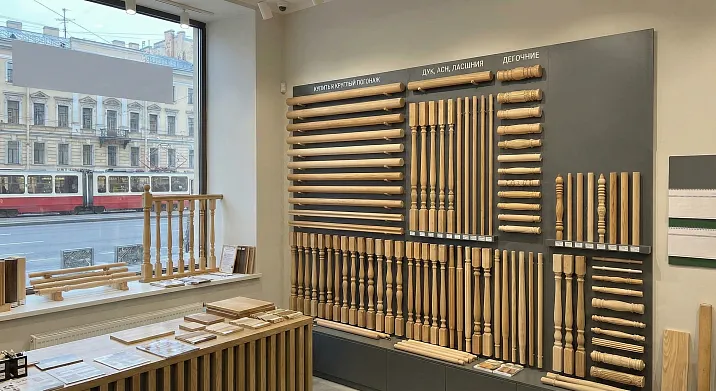
Round wooden molding remains one of the most popular solutions for creating expressive interiors in Saint Petersburg. Natural cylindrical wood is used in both classical and modern architecture, and the right choice of elements turns an ordinary space into a work of art.


Why round profile is becoming a choice for St. Petersburg interiors
Shape is not only aesthetics, but also function. A round cross-section of wood creates a unique perception of volume, plays with light and shadow differently than rectangular profiles. Each elementof round balustersis produced on high-precision equipment, ensuring a perfectly smooth surface and geometric accuracy. Turning solid oak or beech allows achieving diameters from several millimeters to dozens of centimeters with a tolerance of no more than 0.3 mm.
St. Petersburg restoration projects often require exactly round shapes — such elements are found in the city's historical architecture, where decorative rails, handrails, and staircase supports have cylindrical sections. Modern CNC milling technology reproduces classic dimensions and surfaces, preserving historical authenticity and ensuring the longevity of structures.
Geometric accuracy is critical for joining elements. Deviations in diameter or ovality of the profile result in noticeable gaps and unevenness during installation. Professionally executedwooden round balustershave a uniform cross-section along the entire length, simplifying installation and ensuring visual integrity of the composition.




Round handrails for staircases: function and elegance
Why is a round handrail needed? Because the hand naturally wraps around a cylinder without strain. This is not just convenience — it is safety.round handrails for stairswith a diameter of 50 mm are considered the optimal solution for most projects — they suit both children's and adult palms, provide a secure grip, and visually balance with standard-sized balusters.
Handrails are made from solid oak, beech, and ash. Oak is the king of hardness; its texture is expressive, and the wood darkens over time, acquiring a noble patina. Beech is lighter, with a more uniform structure, ideal for staining any color. Ash combines the strength of oak with the decorative qualities of beech, creating a dynamic grain pattern.
InstallationRound wooden handrail 50 mmRequires careful attention. Ends must be perfectly perpendicular to the axis; otherwise, joints will be noticeable. For corner connections, special transition pieces or beveled elements are used, matched to the specific angle of the staircase turn. Professional installers use guides and templates to avoid errors in marking and fastening.
Wall-mounted round handrails are installed using brackets spaced 80-100 cm apart. The bracket must withstand a vertical load of at least 100 kg to meet safety requirements. The wooden handrail is attached to the bracket via hidden fasteners or using decorative screws recessed into the wood and covered with wooden plugs matching the main material's tone.
Our factory also produces:


Types and sizes of round balustrade in St. Petersburg assortment
Round-section balustrade is used not only in stair constructions. Decorative rails with diameters of 10-30 mm are used for panel framing, creating lattice screens, and decorating furniture facades. Large elements with diameters of 60-80 mm become columns, supports, or bases for carved compositions.
Round balustrade 50 mm— universal size. It suits handrails, balustrades, decorative railings, and facade decoration elements. Production of such profiles requires a single-piece blank without joints, ensuring strength and absence of weak points in the structure.
Wooden cylindrical profile can be combined with carved elements.Round oak balustrade— combines with carved rosettes mounted on its surface, creating volumetric compositions in Baroque or Renaissance style. Such combinations are typical for classical interiors of St. Petersburg mansions, where wood plays a leading role in decorative design.
Solid round profile differs from jointed ones in structure and strength. Jointed elements are glued from short segments connected by micro-tenons — this technology reduces production cost but lowers load-bearing capacity and aesthetic value. Solidsolid round balustrade— has no joints; fibers run continuously along the entire length, ensuring maximum strength under bending and twisting.
Get Consultation
Balusters and round posts: architecture of verticals
— vertical elements of stair railingsWooden balustersthat support the handrail and create a visual rhythm in the structure. Round turned balusters with smooth curves, spheres, cylinders, and cones remain a classic solution for interiors of any style — from classicism to art deco.
Productionwooden balusters in St. Petersburgis performed on CNC lathes, allowing reproduction of complex profiles with high precision. Each baluster undergoes multi-stage sanding, ensuring smooth surface and absence of burrs. For minimalist-style interiors, simple cylindrical balusters without decoration are used — their strict geometry emphasizes the modernity of the space.
The distance between balusters is regulated by building codes — the gap should not exceed 15 cm to prevent the risk of children falling. In practice, balusters are installed at 15-20 cm intervals along the axis, creating a visually dense railing and ensuring structural rigidity.round balustersare attached to treads and the handrail via tenons inserted into mortises or using metal threaded bolts hidden within the wood.
Materials: what to choose for round balustrade
Oak — the standard of durability. Its density, hardness, resistance to moisture and mechanical impacts make oak round balustrade practically eternal. Oak withstands any treatment — staining, lacquering, waxing. Over time, oak wood naturally darkens, acquiring a rich brown tone, which gives products nobility and prestige.
Beech — light wood with uniform texture, ideal for staining.Round beech balustradehas a delicate pink or cream tone, easily stained to any color from white to black. Beech elements retain their shape well, do not crack, but require moisture protection — beech is hygroscopic and may deform without proper treatment due to humidity changes.
Ash combines expressive texture with high strength. Ash round profile shows a contrasting grain pattern, especially striking under transparent lacquer. Ash is elastic and easily bends, allowing creation of curved elements for spiral staircases and arched structures.
Spruce — an affordable option for garden and temporary structures. Spruce round balustrade is lighter and softer than oak or beech, easier to process, but also wears out faster. Spruce must be protected with antiseptics and lacquer coatings; otherwise, the wood darkens and loses appeal. Spruce is suitable for interior elements if no heavy loads or intensive use are expected.
Round railings and their role in creating a safe space
Handrails are a system consisting of a handrail, balusters, and a rail support.Round wooden handrailscreate a sense of lightness and elegance, especially if the balusters are finely turned with smooth transitions. Classic handrails with a 50 mm round handrail and finely turned balusters of 40-45 mm diameter harmoniously fit into any interior.
The height of handrails is regulated by standards — 90 cm for indoor staircases, 110 cm for outdoor ones. This height ensures safety for adults and children, preventing accidental falls. The handrail should be installed so that the hand slides over it freely, without obstacles such as protruding fasteners or uneven surfaces.
Round wooden handrails 50 mmare made from solid wood, eliminating structural weakening in glue joints. For curved sections of staircases, bent elements are used, produced by steaming and shaping wood in special molds. The bent handrail follows the curvature of the staircase, creating a continuous railing line.
Combining round handrails with elements of other shapes allows creating unique compositions. For example,round oak handrailcombines with square balusters, on which it rests at landings and turns. The contrast of geometries emphasizes the architectural expressiveness of the staircase, making it a focal element of the interior.
Production technology: how an ideal round profile is created
Production of round wooden trim begins with selecting wood. The blanks must be free of knots, cracks, rot, and insect damage. The wood moisture is brought to a standard of 8-12% in drying chambers with programmable control. Over-dried wood becomes brittle, under-dried wood deforms after processing.
Turning is performed on CNC machines, which turn the profile to the specified diameter with an accuracy of 0.1 mm. Cutters sequentially remove layers of wood, forming a smooth cylindrical surface. The speed of the blank rotation and tool feed are calculated to avoid leaving scratches or waviness.
Sanding is the final stage of processing. Multi-stage sanding with abrasives of different grits — from coarse to fine — is applied. The surfaceof round wooden trimbecomes velvety to the touch after sanding, free of any roughness. This is important for handrails that will constantly contact hands.
Protective treatment includes impregnating with antiseptics, applying primers, lacquering, or waxing. Lacquer coating protects wood from moisture, dirt, mechanical damage, and highlights the natural texture of the material. Oil-based wax compositions create a matte surface, pleasant to the touch, but require regular renewal.
Application of round trim in interior design: from staircases to decor
Round profiles are used in various interior elements. Decorative partitions with round rails create delicate screens that zone space without losing light and air. Lattice panels made of thin round rails are used for wall cladding, headboards, niches, and portals.
Furniture facades with round wooden inlays gain volume and expressiveness. Round trim of 15-25 mm diameter is glued onto flat cabinet doors, forming geometric or floral ornaments. Such decoration is characteristic of neoclassical furniture, where strict lines combine with delicate embellishments.
Curtain rods made ofround trim with a diameter of 30-50 mmlook solid and noble. Wooden round curtain rods support heavy drapes without sagging under their weight and serve for decades. Decorative brackets, styled to match the interior period, are used for mounting the rod.
Round posts and columns are made from large-diameter trim — 80-150 mm. These elements can be load-bearing or decorative. Decorative columns are installed in doorways, frame fireplace openings, and support arches. To enhance expressiveness, round column shafts are adorned with carved capitals and bases.
Installation of round trim: nuances and specifics
How to mount round elements to flat surfaces? Special holders — brackets, sockets, and covers with semi-circular recesses — are used. The bracket is mounted to the wall or base, the round element is inserted into the bracket’s socket and secured with a screw or adhesive. It is important that the bracket precisely matches the trim’s diameter — any play will cause the structure to loosen.
End-to-end joints of round elements in a straight line are made by butt joint with gluing the ends. To increase joint strength, internal bolts — metal rods of 6-8 mm diameter — are inserted into the ends of both elements, creating a rigid connection. The bolt is not visible from the outside, the joint area is sanded and stained, becoming practically invisible.
Angular joints of round trim require precise calculation of cut angles. For 90-degree joints, each element is cut at a 45-degree angle, and the ends are joined. For other angles, the calculation is done individually. Cutting is performed on a miter saw with a rotating table, ensuring precise angle setup.
Mountingof a 50 mm round wooden handrailto balusters is done through a rail support or directly into the ends of balusters. In the first case, balusters are mounted to a flat support plate, and the handrail is placed on top and secured with screws from below. In the second case, holes are drilled into the ends of balusters, into which dowels are glued, protruding upward. The handrail is slipped over the dowels and glued in place.
Where to buy quality round balusters in Saint Petersburg
Choosing a supplier determines the quality of the result. It is important to buyround balusters in SPbfrom verified manufacturers who control every stage of production — from wood selection to final finishing. Having warehouse stock allows promptly fulfilling orders with standard items, while production capacities enable manufacturing non-standard elements according to individual drawings.
Pay attention to product certification. Quality balusters come with documents confirming the wood species, moisture content, and quality class. The manufacturer must provide a warranty for their product, which indicates confidence in its durability.
The ability to order samples before purchasing a large batch allows assessing the quality of processing, accuracy of dimensions, and condition of the wood. A sample will show the actual color and texture of the material, which is important for selecting elements to match the existing interior. Some suppliers offer the service of trial staining or toning the sample to the desired shade.
Logistics plays an important role when purchasing long items.Round wooden balustersup to 2-3 meters in length require careful transportation, excluding damage to the surface and ends. The supplier must provide packaging protecting the items from moisture, impacts, and scratches during delivery.
Price and factors affecting the cost of round balusters
The cost of round wooden balusters depends on the wood species, profile diameter, processing quality, and order volume. Oak balusters are 2-3 times more expensive than pine ones, but they last much longer. Exotic species — teak, merbau, iroko — are even more expensive, but they have unique properties — resistance to moisture, insects, and decay.
Diameter affects material consumption and processing complexity. Large balusters with a diameter of 80-100 mm require thick blanks, which cost more. Thin balusters with a diameter of 10-15 mm are processed faster, but require care — thin elements are easily damaged during sanding or transportation.
Final finishing — varnishing, toning, patination — increases cost but extends the service life of items and enhances their aesthetic appeal. Purchasing balusters without finishing is cheaper, but will require additional time and expenses for self-finishing.
Wholesale purchases reduce the price per linear meter. When ordering a large batch, the manufacturer provides discounts that can reach 15-20% of the retail price. For large-scale projects — finishing several rooms, constructing a multi-step staircase — wholesale purchase ofround wooden balustersbecomes economically advantageous.
Modern trends in using round balusters in 2026
Minimalism dictates its rules. Simple cylindrical profiles without decoration are used to create minimalist interiors, where form is more important than ornament. Round wooden rails evenly arranged on walls or ceilings create rhythmic compositions, zone spaces without overloading them with details.
Combining materials — wood plus metal, wood plus glass — creates contrasts and dynamics. Round wooden handrails combine with glass panels of railings, creating light, transparent structures. Metal brackets contrast with warm wood, emphasizing the technological and modern aspects of the interior.
Ecological and natural materials are becoming a priority. Buyers choose solid wood, rejecting imitations and composite materials.Round wooden balustersembodies the idea of naturalness, creates a healthy microclimate in the room, fills the space with the aroma of wood.
Customizing projects requires non-standard solutions. Custom diameters, unique wood species, combinations of turning and carving allow creating exclusive elements that no one else has. Manufacturers offer services for manufacturing balusters according to individual sketches, realizing the most daring design ideas.
Care for round wooden balusters: how to preserve beauty for a long time
Regular cleaning with a soft cloth or brush prevents accumulation of dirt. Dust gets trapped in the wood texture, making the surface dull. Wet cleaning is allowed, but without excess water — wood does not like prolonged contact with moisture.
Updating protective coating is done every few years. Varnished handrails gradually wear down in areas of frequent contact with hands. Reapplying varnish restores protection and gloss. Oil-based wax coatings require more frequent updates — once a year or two, but are applied more easily, without sanding the previous layer.
Protection from direct sunlight extends the service life of wooden elements. Ultraviolet light destroys lignin in wood, causing fading and loss of strength. Curtains, blinds, and window films reduce sun exposure, preserving the original colorof round oak handrails.
Controlling humidity in the room prevents wood cracking and warping. Optimal air humidity — 40-60%. In winter, when heating dries the air, use humidifiers. In summer, during high humidity, ventilate rooms, avoiding stagnant moist air.
Round molding in the historical interiors of Saint Petersburg
Saint Petersburg architecture is rich in examples of circular forms. Columns, balustrades, and handrails of palaces and mansions are made of stone and wood. Restoring such objects requires precise reproduction of historical profiles. Modern technologies allow creating copies of elements indistinguishable from original 18th-19th century pieces.
Wooden staircases in old tenement houses often have round handrails, smooth from the touch of hundreds of hands. When restoring such staircases, it is important to preserve authenticity — use the same type of wood, the same profile diameter, and the same fastening technology.Buy round wooden handrailfor restoration, you can order from specialized manufacturers who work according to historical samples.
Interiors of museums, palaces, and historical buildings are maintained in their original state. Replacement of damaged elements is done with exact replicas. Round molding for such projects is crafted by hand or on special machines reproducing technologies of past centuries.
Frequently Asked Questions about Round Molding: Answers from the Expert
What diameter is optimal for a round handrail on a staircase?
For most projects, a 50 mm diameter is optimal. It is convenient for both adults and children, visually balanced, and corresponds to standard baluster sizes. For large staircases in mansions, a 60-70 mm diameter can be used; for compact staircases to the second floor, 40-45 mm is suitable.
Can round wooden molding be bent?
Yes, wood can be bent using steam bending. The blank is placed in a steam chamber, heated to 100°C, and saturated with moisture. Then it is placed into a mold of the required curvature and secured until fully dried. BentRound Handrailis used for spiral staircases and arched structures.
Why is a round profile better than a rectangular one?
A round profile is more pleasant to the touch — the hand naturally wraps around the cylinder. It has no sharp angles, making it safer for children. Visually, round shapes create a sense of softness and elegance, especially when combined with precisely crafted elements.
How to join round molding at corners?
For corner joints, elements are cut at a 45-degree angle (for right angles) or at a calculated angle (for other angles). Ends are glued and additionally reinforced with internal bolts. The joint area is sanded and stained, becoming barely noticeable.
What type of wood should be chosen for round molding?
Oak — for maximum strength and durability. Beech — for painting in any color. Ash — for expressive grain. Pine — for budget projects with low load. The choice depends on the element’s purpose, interior style, and project budget.
Is protective treatment necessary for round molding?
Yes, protective treatment is mandatory. Lacquer, oil, or wax protect wood from moisture, dirt, mechanical damage, and extend the lifespan of the product. Without protection, wood darkens quickly, gets dirty, and loses its appeal.
Can I order round molding with a non-standard diameter?
Yes, manufacturers produce molding of any diameter to individual order. Non-standard sizes require special saw blades and equipment adjustments, which increases production time and cost, but allows implementing unique projects.
How to transport long round molding?
Long elements are transported on special racks or in packaging protecting against impacts and scratches. Ends are covered with caps to prevent damage. During loading and unloading, sharp impacts and bends that could break or deform the product are avoided.
Conclusion: Round Molding as the Foundation of Quality Interior Design
Choosing round wooden molding is an investment in durability, safety, and the aesthetics of space. Properly selected elements serve for decades, preserving functionality and beauty. Natural wood creates an atmosphere of warmth, comfort, and elegance that cannot be replicated with synthetic materials.
STAVROS offers a full range ofround molding from solid wood— from thin decorative strips to large handrails and columns. Production on modern equipment while adhering to all technological standards guarantees high product quality. Individual approach to each order, possibility of manufacturing non-standard elements, professional consultations from specialists — STAVROS creates conditions for implementing projects of any complexity.
Choosing STAVROS, you get not just material, but a reliable partner who accompanies your project from idea to realization. Wide assortmentof wooden handrails for staircases, balusters, decorative molding allows comprehensively solving interior design tasks, creating harmonious ensembles where each element complements the other. STAVROS — synonymous with quality, reliability, craftsmanship, proven by time and trust of thousands of clients.


