Article Contents:
- 1. Introduction: what is a wooden door casing and why is it needed
- 2. Advantages of wooden door casings
- 2.1. Natural aesthetics
- 2.2. Ecological safety
- 2.3. Durability with proper care
- 2.4. Repairability and restorability
- 2.5. Wide variety of shapes and styles
- 3. Factors affecting price
- 3.1. Wood species
- 3.2. Grade
- 3.3. Profile type and carving complexity
- 3.4. Factory finish
- 3.5. Length, width, and thickness
- 3.6. Manufacturer and logistics
- 4.1. Flat
- 4.2. Decorative (profiled)
- 4.3. Carved
- 4.4. Telescopic
- 6.1. Define style
- 6.2. Proportion to doors or windows
- 6.3. Consider usage conditions
- 6.4. Consider dimensions
- 7.1. Surface Preparation
- 7.2. Measuring and cutting at an angle
- 7.3. Fastening
- 7.4. Final finishing
- 9. Care for wooden door casings
- 10. Usage examples
- 10.1. Classic Interior
- 10.2. Scandinavian style
- 10.3. Russian Carving
- 12. Why STAVROS?
- 13. Frequently Asked Questions
- 15. Conclusion


1. Introduction: What is a wooden casing and why is it needed
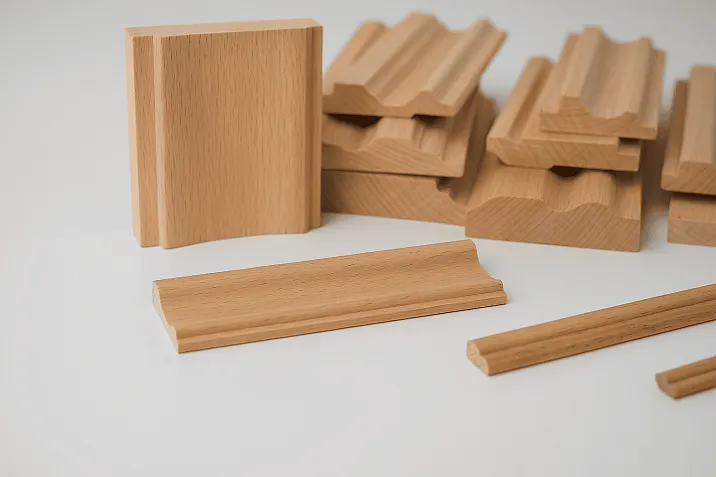
A wooden casing is a decorative element that frames door and window openings, covering the joints between the frame (jamb) and the wall. Its main function is to provide an aesthetic appearance and conceal possible irregularities in fitting. In addition to visual harmony, it also serves a protective role, preventing dust and moisture from penetrating, and in older (log or timber-framed) houses, it also reduces heat loss.
In our time, despite the abundance of modern synthetic materials (PVC, MDF, polyurethane), wood remains one of the most popular options. Why? Natural beauty, eco-friendliness, and durability make wooden products a truly universal solution for both classic and modern interiors. At the same time, when searching for "buy wooden casing price," it turns out to be one of the main criteria, as the cost range can be significant, depending on the type of wood, grade, design, finish, and brand.




2. Advantages of wooden casings
Our factory also produces:


2.1. Natural aesthetics
Nothing compares to the warmth that wood provides. Its unique texture, variety of shades, and the ability to stain or paint "to one's liking" allows this element to be adapted to any style: country, classic, scandinavian, eco, Provence, or even loft (when combined with other materials).
Get Consultation
2.2. Eco-friendliness
Wood is a renewable resource. When properly harvested and processed, wood does not cause significant harm to the environment. In addition, high-quality wooden products do not emit toxic substances, which positively affects the health of the home's occupants.
2.3. Longevity with proper care
If the wood is dried according to standards (8–12% moisture) and treated with protective impregnation, lacquer, or oil, the lifespan of wooden casings can be decades. They are resistant to low humidity, minor mechanical impacts, and temperature fluctuations.
2.4. Possibility of repair and restoration
In case of damage (scratches, minor chips), wooden surfaces can be sanded and re-coated with finishing compounds, restoring their original appearance. Synthetic materials are often only replaceable.
2.5. Wide range of shapes and styles
Casings can be simple and straight (rectangular plank), or they can include decorative profiles, carving, and complex decorative elements (especially in traditional Russian style). This gives designers and enthusiasts of individual solutions ample room for creativity.
3. Factors affecting the price
When you want tobuy wooden casing price becomes a key factor, but is composed of several components:
3.1. Wood Species
- Coniferous (pine, spruce): inexpensive, easy to process, but softer, requiring careful handling.
- Larch: stronger, more moisture-resistant, often used outdoors (window framing on facades). Significantly more expensive than pine.
- Broadleaf (birch, ash): medium hardness, pleasant texture. Price is also in the middle range.
- Hardwoods (beech, oak, walnut): premium quality, high wear resistance, impressive appearance. But the price is also higher.
- Exotic: used less frequently, significantly more expensive, emphasize the luxurious character of the interior (teak, mahogany).
3.2. Grade
● Extra: minimum knots, even structure, no defects. Most expensive.
● A, B: allow minor knots, slight color variations, often optimal in terms of price-to-appearance ratio.
● C: may have numerous knots, darkening, cracks, cheaper, but suitable if you plan to paint it yourself or do not have high aesthetic requirements.
Decorative profiles or three-dimensional patterns (especially Russian-style carving, Scandinavian ornamentation, etc.) increase production complexity, and consequently, the price rises. A simple straight casing is cheaper.
If the casing is already coated with varnish, paint, or oil, it is ready for installation immediately. This, of course, increases the cost (but saves time on self-finishing).
Factory finish
If the casing is already coated with varnish, paint, or oil, it is ready for installation immediately. This, of course, increases the cost (but saves time on self-finishing).
Length, width, and thickness
The larger the dimensions, the higher the wood consumption and stricter requirements for the quality of the blank (without defects along the entire length), which increases the final cost.
Manufacturer and logistics
Companies with a well-known name and strict quality standards include costs for quality control, certification, advertising, and, in some cases, transportation from remote regions or countries.
Types of wooden casings by shape
Flat
The simplest option — a rectangular-section plank without decoration. Suitable for modern interiors, minimalism, scandinavian, loft. Easy to install, inexpensive.
Profiled (ornamental)
They have one or several bevels, rounded edges, grooves, creating relief. Such casings give a distinctive look to door or window openings, often used in classical interiors.
Carved
Especially popular in traditional Russian architecture (log houses), as well as in ethnic styles. May include through carving (openwork), patterns, ornaments. Manufacturing a carved casing requires special hand (or CNC machine) work, so the price is higher.
Telescopic
In some door frame systems, so-called telescopic dados and casings are used, which are mounted by insertion into special grooves. This simplifies installation and allows adjustment for wall thickness.
Application areas
- Door openings: entrance and interior doors, sliding wardrobes, closets.
- Window frames: both inside and outside the house, where it is necessary to protect the junction of the sills and emphasize the facade style.
- Arches and openings without doors: decorative arched structures that require neat casing.
- Facades of wooden buildings: Russian houses, dachas, bathhouses. Carved casings can be a real highlight of the exterior.
How to choose the right casing
Determine the style
If you have a classical interior, it is advisable to prefer profiled options with smooth lines or carving. For minimalism or scandinavian style, a flat, simple plank is suitable. Traditional Russian style requires carved motifs, complemented with ornaments.
Proportion with doors or windows
The casing can match the door panel or contrast — it all depends on the designer's intent. If the window is made of pine, the casing is usually also coniferous. If the door is made of oak, the skirting (and casing) is selected from the same species or painted the same color.
Consider the operating conditions
● Outdoor installation: preferably larch, oak, or thermally treated species — more weather-resistant. Do not forget about impregnation with antiseptics and varnish with UV protection.
● Indoor humid areas (bathroom, sauna): birch, aspen, linden, or larch. Good ventilation and constant temperature are required.
6.4. Consider the dimensions
The width of the casing can range from 40–50 mm to 100–120 mm and more. Narrow strips are suitable for cramped conditions or when you want to emphasize doors rather than frames. Wider ones are more noticeable and create a monumental effect.
7. Installing wooden casings
7.1. Surface preparation
The wall near the door frame (or window frame) must be flat, without protruding elements, so the casing fits tightly. If the surface is uneven, use shims or sealant to compensate.
7.2. Measuring and cutting at an angle
To ensure joints fit without gaps, proper beveling at 45° (for rectangular profiles) or exact replication of the angle shape (for arched elements) is essential. A circular saw, miter gauge, or angle template is most convenient.
7.3. Fastening
● Nails without heads or self-tapping screws with recessed heads: the fastening points are spackled and sanded.
● Glue (e.g., "liquid nails"): a careful method, but harder to remove during disassembly.
● Special clamps: available for some systems where the casing is inserted into a groove in the door frame.
7.4. Final finishing
If the casing was not pre-treated with varnish or paint, it is treated with protective and decorative coatings after installation (or even before). It is important to apply these coatings evenly and in multiple layers (primer, base coat, finish) to ensure both aesthetics and durability.
8. Price: "buy wooden casing price" — ranges and examples
For example (data are approximate and vary by region and time):
● Pine, spruce (grade "C"): from 70 to 150 rubles per linear meter, depending on width and profile.
● Pine, spruce (grade "A"): 150–300 rubles per linear meter.
● Larch: 300–600 rubles per linear meter, may reach 800–1000 rubles for premium grades.
● Birch, aspen: 250–400 rubles per linear meter, sometimes higher for complex profiles.
● Oak, beech: 500–800 rubles per linear meter, premium carved models may exceed 1000 rubles.
● Walnut: 800–1500 rubles per linear meter and more, especially for figured profiles or exclusive carving.
Note that these are only approximate estimates. Also consider that the length of the item may affect the price (e.g., a log of required length without knots is harder to find).
9. Care for wooden casings
- Wipe dust regularly with a soft dry cloth. For heavy dirt, a slightly damp cloth may be used, but avoid excessive moisture.
- Avoid drastic changes in humidity. If the room is very humid or, conversely, too dry, the wood may warp.
- Reapply the paint/varnish coating every few years, especially if the casings are outdoors or in high-traffic areas (entryway, kitchen).
- Use cleaning agents carefully. Abrasive materials may damage the finish, and aggressive chemicals may cause discoloration.
10. Examples of use
10.1. Classic Interior
In a spacious living room with high ceilings and solid oak doors, figured casings 80 mm wide, also made of oak and coated with semi-matte varnish, were selected. Accents on cornices and baseboards support a unified concept of noble classicism.
10.2. Scandinavian style
Light pine casings with a simple bevel, treated with oil containing white pigment. As a result, they visually almost blend into pastel-colored walls, while emphasizing naturalness. The door may also be made of pine or MDF, but veneered with birch.
The facades of wooden cottages or bathhouses are decorated with delicate lintels featuring carved patterns characteristic of folk architecture. Material — larch or pine, with mandatory exterior impregnation. They are vividly painted with acrylic or oil paints to emphasize their fairy-tale charm.
The facades of wooden cottages or bathhouses are decorated with delicate lintels featuring carved patterns characteristic of folk architecture. Material — larch or pine, with mandatory exterior impregnation. They are vividly painted with acrylic or oil paints to emphasize their fairy-tale charm.
Tips for optimal selection
- Style compatibility. If your interior is modern, avoid overly ornate options: they may clash with the overall concept.
- Door coordination. Choose similar species, color, and tone; otherwise, the framing will look out of place.
- Consider your budget. With limited funds, opt for grade 'B' (more knots, but still attractive). If doors are expensive, logically choose equally high-quality (and costly) lintels.
- Installation. Consider pre-finished options from the factory if you don’t want to handle sanding and painting yourself.
- Choose a reliable supplier. Companies with experience: this minimizes the risk of purchasing low-quality wood with defects or insufficiently dried material.
Why exactly STAVROS?
STAVROS — one of the suppliers of high-quality wooden products. On their website you canbuy wooden casing price which depends on species, size, and grade. In this case, you receive:
- Proven assortment. Various profiles, grades, and species to ensure every detail matches your vision.
- Professional consultations. Specialists are ready to answer questions about wood moisture, mounting options, and finishing methods.
- Convenient delivery to various regions of Russia, which is important for saving time and logistics costs.
- Guaranteed quality due to strict control over the production and storage of timber materials.
13. Frequently Asked Questions
Question: How to properly join door casings at corners?
Answer: Usually, a circular saw or a miter gauge is used to cut at a 45° angle. At exterior corners (less often in interiors), other angles may be used, in which case fitting is done using a template method.
Question: Can a wooden casing be mounted using construction foam?
Answer: It is undesirable. Foam is used to fill voids, not to fix elements under load. Much more reliable are small nails, clips, or liquid nails (of the appropriate class).
Question: Is it necessary to treat the back side of the casing?
Answer: It is recommended, especially if referring to outdoor installation or rooms with possible humidity. Reduces the risk of swelling and warping.
14. Design Trends and the Future of Wooden Casing
On one hand, markets offer many alternatives: MDF, polyurethane, PVC. However, there is a growing trend toward naturalness and eco-friendliness. Wooden elements (including casings) are actively used in 'biophilic' design, aiming to integrate nature into living environments. Additionally, the emergence of modern CNC machines, innovative varnishes, and oils opens up new possibilities for creating complex shapes and durable finishes.
It can be expected that wooden casings will maintain their popularity in the future, remaining a choice for those who value tradition, coziness, and the reliability of solid wood.
15. Conclusion
Thus, choosing a wooden casing is a decision that can transform your home or apartment, adding a touch of natural charm and solidity. Wood is versatile: it harmonizes with various styles, from strict minimalism to ornate classicism, from Scandinavian simplicity to Russian carved architecture.
If you decide tobuy wooden casing price can vary significantly, so consider the species, grade, profile, finish, and supplier reputation. Do not forget about proper installation (precise cutting at angles, careful mounting), as this affects the appearance and longevity of the structure.
Natural wood requires slightly more attention and care than artificial alternatives, but the reward is natural beauty, durability, and the feeling of 'living warmth' emanating from solid wood. In interiors or on facades, a home acquires that very 'touch' — a sense of coziness and appropriateness that cannot be achieved with plastic or other synthetic materials.
We hope this article helped you understand the nuances of choosing and the features of wooden casings. All that remains is to select the right option, determine the design, and confidently proceed with installation. May your home become even more beautiful and pleasant to live in, with quality wooden elements occupying a worthy place, reflecting your taste, respect for tradition, and aspiration for the best.