Article Contents:
- Why round cross-section is an ergonomic classic
- Oak vs beech: choosing wood species for handrails
- Oak: expressive texture and historical durability
- Beech: uniformity and silky smoothness
- Handrail construction: solid wood or laminated blank
- Diameters and dimensions: how to choose the right handrail
- Treatment and coating: how to preserve beauty and durability
- Sanding: The Foundation of Smoothness
- Priming: preparation for coating
- Finish coating: protection and aesthetics
- Installation of round handrails: mounting methods and details
- Mounting on balusters
- Wall-Mounted Installation
- Mounting on Posts
- Stylistic solutions: how to integrate a round handrail into interior design
- Classic style
- Scandinavian Style
- Modern style
- Eco-style and biophilic design
- Ergonomics and safety: standards and regulations
- Height and continuity of handrail
- Strength and stability
- Gaps and distances
- Care and maintenance: how to keep handrail in perfect condition
- Regular Cleaning
- Recoating
- Humidity control
- Round handrail compared to other profiles
- Oval handrails
- Square and rectangular handrails
- Shaped handrails
- Production technologies: from timber to finished product
- Wood selection and drying
- Laminate gluing
- Milling and turning
- Sanding and finishing
- Round handrails in commercial and public buildings
- Eco-friendliness and sustainability: wooden handrail in green building context
- Round handrail as element of biophilic design
- Frequently asked questions about round handrails
- What diameter handrail to choose for a private house?
- What makes oak handrail better than beech?
- Can a Wooden Handrail Be Installed Outdoors?
- How often should the oil coating be renewed?
- What is the average cost of round handrail made of oak or beech?
- Can a round handrail be installed independently?
- Is a wooden handrail safe for children?
- What finish should be chosen for a handrail in the bathroom?
- Can a wooden handrail be stained a dark color?
- How to combine a wooden handrail with metal balusters?
- Conclusion: choosing the STAVROS company for quality handrails
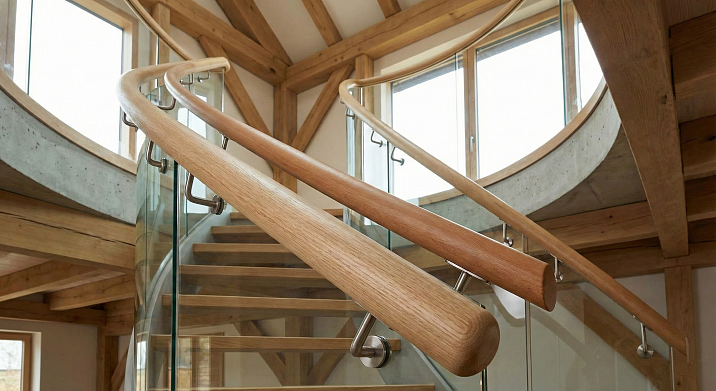
Imagine the feeling of warm wood under your palm as you descend the stairs in your home. This is not just convenience—it's a connection with nature that you feel every day. Choosing a round handrail made from noble wood species—beech or oak—is a decision that combines practicality, safety, and aesthetic value. In this article, we will explore all the nuances of selecting, installing, and applying round wooden handrails, discuss wood species, diameters, shapes, and stylistic possibilities. You will learn whyRound beech handrailsthey become the choice of those who value tradition and functionality, and you will also discover the advantages of oak elements in staircase architecture.




Why a round cross-section is an ergonomic classic
The round shape of a handrail is not accidental. It is dictated by the anatomy of the human hand and its ability to provide a secure grip. When fingers wrap around a cylindrical surface, an even distribution of force is created, without points of increased pressure or discomfort. Square or rectangular profiles have corners that can dig into the palm, especially during prolonged holding or sudden movement. Oval cross-sections are more comfortable but still fall short of round ones in versatility and ease of manufacture.
Round oak handrailwith a diameter of 50 millimeters allows an adult with an average hand size to grasp the railing so that the thumb and index finger almost touch. This is the ideal grip geometry—tight enough for reliable support but without excessive muscle tension. For young children and people with petite hands, handrails with a diameter of 40 millimeters are suitable, while for larger palms, a 60-millimeter cross-section can be considered.
An important point: a round handrail is equally comfortable when grasped from above, from the side, or from below. This is critical for elderly people and children, who may use various support methods depending on the direction of movement on the stairs. The ergonomic versatility of the round cross-section makes it a standard in residential, public, and commercial spaces worldwide.




Oak vs. beech: choosing the wood species for handrails
Choosing between oak and beech is a choice between character and smoothness, between expressive texture and uniform structure. Both materials belong to the category of hardwoods, have high density, strength, and durability. But their aesthetic and tactile characteristics differ.
Our factory also produces:


Oak: expressive texture and historical strength
Oak is a wood with a pronounced texture, large pores, and distinct annual rings. When you run your hand along around oak handrail, you feel a slight relief—this is the natural porosity of the wood. After high-quality sanding and coating with oil or varnish, this texture becomes pleasant to the touch, creating a sense of a living material.
Oak has exceptional strength and resistance to mechanical damage. It is practically unafraid of scratches, impacts, and abrasion. Its density is about 700 kilograms per cubic meter, which ensures shape stability even with fluctuations in humidity and temperature. Oak handrails do not deform over time, maintaining their original geometry for decades.
The color palette of oak ranges from light brown to rich golden-honey shades. With age, oak naturally darkens, acquiring a noble patina. This property is highly valued in classic and traditional interiors, where the material should 'live' and evolve along with the home.
Get Consultation
Beech: uniformity and silky smoothness
Beech has a fine-grained, uniform structure without large pores or pronounced texture. After thorough sanding, aRound wooden handrailhandrail made of beech becomes almost silky to the touch—an absolutely smooth surface without the slightest roughness. For people with sensitive skin or those who prefer maximum tactile comfort, beech handrails are the optimal solution.
Beech has a density of about 650 kilograms per cubic meter, which is only slightly less than oak. It is strong, durable, and resistant to loads. However, beech is more sensitive to moisture than oak, so it is more often used in spaces with a controlled microclimate. For use in bathrooms, saunas, or open terraces, oak is preferable.
The color of beech ranges from light pink to creamy beige, with a slight peach tint. This neutral and warm palette makes beech handrails versatile: they easily fit into Scandinavian, minimalist, modern, and even Provence-style interiors. Beech takes well to staining, allowing it to be given almost any shade—from whitewashed to dark chocolate.
Handrail construction: solid wood or laminated blank
Handrails made of solid wood can be of two construction types: solid and laminated. A solid handrail is turned from a single block of wood, and at any point in its cross-section, natural annual rings are visible. This is maximum authenticity, strength, and aesthetics. Solid handrails are more expensive, but they last for centuries without delamination or deformation.
Laminated construction is made by gluing several lamellas under pressure. This allows for the creation of handrails of great length without joints and also reduces the risk of cracking and warping of the wood. A high-quality laminated handrail is not inferior in strength to a solid one but is cheaper and easier to produce. It is important to choose products glued with moisture-resistant adhesive, especially if the handrail will be used in conditions of fluctuating humidity.
Diameters and sizes: how to choose the right handrail
The standard diameter of a round handrail for residential stairs is 50 millimeters. This is a universal size that suits most adults and teenagers. It provides a secure grip, is comfortable to use, and is visually harmonious in most interiors.
For children's staircases, play areas, and spaces where the primary users are young children, handrails with a diameter of 40 millimeters are recommended. This size allows small hands to fully grasp the handrail, ensuring safety and confidence during movement.
For people with large hands, as well as in commercial and public buildings where increased strength and massiveness are required, handrails with a diameter of 60 millimeters are used. They look more substantial and can withstand high loads.
The length of handrails also matters. Standard products are available in lengths of 2, 3, and 4 meters. For straight stair flights, choose a length that matches the flight length with a small margin. If the staircase has turns, corner elements and connectors will be required.
The installation height of the handrail is regulated by building codes and is typically 900 millimeters from the surface of the step. For children's staircases, an additional handrail can be installed at a height of 600–700 millimeters. It is important that the handrail is continuous along the entire length of the stair flight, including landings and turns.
Treatment and Coating: How to Preserve Beauty and Durability
A wooden handrail requires proper treatment and a protective coating. This affects not only its appearance but also its durability, resistance to moisture, dirt, and mechanical damage.
Sanding: the foundation of smoothness
The first stage is thorough sanding. Abrasive materials of various grits are used, from coarse to fine. Final sanding is done with sandpaper of 220–320 grit, which ensures a perfectly smooth surface without roughness or burrs. After sanding, the surface is dusted off using compressed air or a soft cloth.
Priming: Preparing for Coating
Priming the wood improves the adhesion of the final coating, evens out the absorbency, and reveals the grain. For oak and beech, water-based or alkyd primers are used. After applying the primer, the product is dried, then the surface is lightly sanded with a fine abrasive (320–400) to remove raised fibers and create a matte surface for the final coating.
Finish coating: protection and aesthetics
The choice of final coating depends on the interior style and operating conditions. The main types of coatings are:
Oil. An oil coating penetrates the wood structure, highlighting its grain and giving a matte or semi-matte sheen. Oil preserves the tactile naturalness of wood—the handrail remains warm and pleasant to the touch. The drawback is the need for periodic renewal of the coating every year or two.
Wax. A wax coating creates a soft, silky sheen and protects the wood from moisture and dirt. Wax also requires renewal but gives the handrail a special nobility and the aroma of natural wood.
Varnish. A varnish coating forms a hard protective film on the wood surface. Varnish can be matte, semi-matte, or glossy. It provides maximum protection against moisture, scratches, and dirt but makes the handrail less pleasant to the touch—creating a 'plastic' feel. Water-based varnishes are eco-friendly and have no strong odor.
Oil-Wax. A combined coating that combines the advantages of oil and wax. Provides deep impregnation, protection, and a pleasant silky sheen.
For interior staircases in residential spaces, oil and oil-wax coatings are optimal. They preserve the natural beauty and tactility of wood while providing sufficient protection.
Installation of Round Handrails: Mounting Methods and Details
Proper installation of a handrail ensures its reliability and durability. There are several methods for mounting round wooden handrails, depending on the staircase design and the type of railing.
Mounting on balusters
The classic method is installing the handrail on vertical balusters. Balusters can be wooden, metal, or combined. The top part of the baluster has a groove or mounting element into which the handrail is inserted or laid. Fastening is done using screws, self-tapping screws, or hidden metal pins.
Wooden balusters often have round or square cross-sections, carved or turned elements. They create a classic, traditional look for the staircase. Metal balusters are more modern and minimalist, pairing well with round wooden handrails, creating a contrast of materials and textures.
Wall-mounted installation
For staircases located along a wall, wall-mounted handrail attachment is used. The handrail is fixed to the wall using special brackets or holders. The distance from the wall to the center of the handrail is usually 50–60 millimeters, ensuring a comfortable grip and sufficient space for the hand.
Brackets can be metal or wooden, open or hidden. Open brackets are visible and can be decorative elements—forged, brass, chrome-plated. Hidden brackets are concealed inside the handrail, creating a visual effect of a 'floating' handrail.
Attachment to posts
At the starting and ending points of the stair flight, posts are installed—massive vertical supports on which balusters and handrails are mounted. Posts give the staircase visual completeness and serve as the main load-bearing elements of the railing.
The connection of the handrail to the post can be done in several ways: mortise with subsequent fixation using glue and screws, the use of decorative finials or balls, or the application of metal connecting elements.
Stylistic Solutions: How to Integrate a Round Handrail into the Interior
A round wooden handrail is versatile and easily adapts to various interior styles. Everything depends on the wood species, type of coating, color, and railing design.
Classic style
For classic interiors, oak handrails with dark staining—wenge, walnut, mahogany—are ideal. Combined with carved wooden balusters, posts with capitals, and decorative elements, they create an atmosphere of aristocracy and solidity. The staircase becomes the central element of the hall or living room.
Scandinavian style
Light beech handrails with an oil coating in natural or bleached shades fit perfectly into Scandinavian aesthetics. Simple, laconic forms, minimal decor, emphasis on texture and the natural beauty of the material. Balusters can be thin, with square or round cross-sections, also coated with light oil or white enamel.
Modern style
Modern interiors allow for bold combinations of materials. A round wooden handrail in a natural color contrasts excellently with metal balusters—stainless steel, black matte metal, or brass. The geometry is clear and laconic, without unnecessary details. This solution emphasizes the honesty of materials and the functionality of the structure.
Eco-style and biophilic design
A round handrail made of solid wood is the perfect element for eco-interiors, where connection with nature is important. Unprocessed or minimally processed wood, natural oil coating, preservation of grain and even small knots create a sense of authenticity and closeness to nature. Such a staircase becomes not just a functional element but part of the natural environment inside the home.
Ergonomics and Safety: Standards and Norms
Stair and railing safety is regulated by building codes and regulations. These requirements are mandatory for public buildings and recommended for private homes.
Height and continuity of handrails
The handrail must be installed at a height of 900 millimeters from the step surface for adult users. For children's institutions and stairs where the main users are children, an additional handrail is installed at a height of 600–700 millimeters.
The handrail must be continuous throughout the entire flight of stairs, including landings and turns. Breaks, protrusions, and sharp angles are not allowed.
Strength and stability
The handrail must withstand a horizontal load of at least 100 kilograms applied at any point. Fastenings must be reliable, without play or movement. Oak and beech wooden handrails, when properly installed, provide the necessary strength and stability.
Gaps and distances
The distance between balusters should not exceed 150 millimeters to prevent children from falling or getting their heads stuck. For families with small children, it is recommended to reduce this gap to 100 millimeters or use solid railing infill.
The distance from a wall-mounted handrail to the wall should be at least 40–50 millimeters to ensure a free grip without the hand touching the wall.
Care and maintenance: how to keep the handrail in perfect condition
A wooden handrail requires minimal but regular care. Proper maintenance extends its service life and preserves the aesthetic appeal of the product.
Regular cleaning
The surface of the handrail should be wiped with a soft, damp cloth once a week to remove dust and dirt. Do not use aggressive detergents, solvents, or abrasive materials—they can damage the finish.
Recoating
Oil and wax finishes require renewal every one to two years. The procedure is simple: the surface is lightly sanded with fine-grit abrasive, dusted off, then a fresh layer of oil or wax is applied. After drying, the handrail is polished with a soft cloth.
Varnish finishes are more durable, but if scratches or wear appear, they require local repair or complete re-varnishing, which is more complex and expensive.
Humidity control
Wood is sensitive to humidity fluctuations. Avoid installing wooden handrails in rooms with unstable microclimates—bathrooms without ventilation, unheated terraces, saunas. For such conditions, choose oak or use special moisture-resistant coatings.
Round handrail compared to other profiles
In addition to round ones, there are handrails of other shapes and profiles—oval, square, rectangular, shaped. Each type has its own characteristics and areas of application.
Oval handrails
An oval cross-section combines the comfort of a round handrail with visual elegance and conciseness. The oval protrudes less into space, which is important for narrow stairs. However, an oval handrail is more complex to manufacture and more expensive.
Square and rectangular handrails
Such profiles are characteristic of modern and minimalist interiors. They look strict and geometric, and pair well with metal and glass railings. However, ergonomics are inferior to round ones—corners dig into the palm, especially with a strong grip.
Shaped handrails
These are complex profiles with decorative recesses, roundings, and reliefs. Used in classical and palace interiors. Beautiful, but require special care and more complex installation.
The round profile remains the most universal, ergonomic, and practical solution for most stairs.
Production technologies: from timber to finished product
The production of a round wooden handrail includes several technological stages, each of which affects the quality of the final product.
Selection and drying of wood
Wood for handrails is selected from mature trees with dense, uniform structure. Logs are sawn into boards, which are then dried to a moisture content of 8–10 percent. Drying can be natural (over several months) or kiln-drying (in special drying chambers, faster and more controlled).
Gluing of lamellas
To manufacture laminated handrails, boards are sawn into lamellas—thin strips of wood. Lamellas are sorted by color and texture, glued under pressure using moisture-resistant adhesive. Lamination increases the stability of the product and reduces the risk of deformation.
Milling and turning
On lathes or milling machines, the workpiece is processed to a round profile of the required diameter. Modern equipment allows achieving high dimensional accuracy and ideal geometry.
Polishing and finishing
The final stages are multi-step grinding, priming, and application of a protective coating. Quality control at each stage ensures an impeccable result.
Round handrails in commercial and public buildings
Wooden handrails are used not only in private homes but also in public and commercial buildings — hotels, restaurants, offices, museums, libraries. Here, the requirements for strength, durability, and safety are even higher.
In public buildings, handrails experience intensive loads — hundreds of people pass by stairs daily, leaning on the handrails. Oak and beech withstand such loads without losing operational properties. The coating must be maximally resistant to abrasion — usually, high-hardness polyurethane varnishes are used.
The design of handrails in public spaces often reflects the style and concept of the establishment. Elegant oak handrails with dark tinting emphasize the status of a hotel or restaurant. Light beech handrails create an atmosphere of modernity and cleanliness in offices and medical institutions.
Eco-friendliness and sustainability: wooden handrail in the context of green building
In the era of ecological construction and the pursuit of carbon neutrality, natural materials acquire special value. Wood is a renewable resource that, with proper forest management, does not harm ecosystems.
The production of wooden handrails requires significantly less energy compared to metal or plastic counterparts. Wood accumulates carbon during growth, and this carbon remains sequestered in the structure throughout the product's service life.
The recycling and disposal of wooden products are also more environmentally friendly: wood can be recycled, composted, or used as fuel without releasing toxic substances.
By choosing wooden handrails, you make a choice in favor of eco-friendliness, sustainability, and responsible consumption.
Round handrail as an element of biophilic design
Biophilic design is an approach to designing spaces that enhances the connection between humans and nature. One of the key principles of biophilic design is the use of natural materials, especially wood, in interiors.
A round wooden handrail is an element you touch daily, every time you go up or down the stairs. Tactile contact with natural wood activates subconscious mechanisms of comfort and safety embedded in our evolutionary memory. The forest has always been a place of shelter and resources for humans, and touching wood evokes positive emotions and reduces stress.
The temperature of a wooden surface is close to human body temperature, unlike cold metal or plastic. This creates additional comfort during use. The natural smell of wood, especially freshly processed or oiled, also has a positive impact on psycho-emotional state.
The texture of wood, its color, and the pattern of annual rings are unique in each product. This creates a sense of individuality and connection with a specific tree that grew in a specific forest. In a world of mass production and standardization, such uniqueness is especially valuable.
Frequently asked questions about round handrails
What diameter handrail to choose for a private house?
For most private houses, a diameter of 50 millimeters is optimal. It is suitable for adults and teenagers, provides a reliable grip, and is comfortable to use. If there are small children in the house, you can install an additional handrail with a diameter of 40 millimeters at a lower height.
How is an oak handrail better than a beech one?
Oak is stronger, more resistant to moisture and mechanical damage. It has an expressive texture and darkens with age, acquiring a noble patina. Beech is smoother, silky to the touch, has a neutral light color that is easier to fit into modern interiors. The choice depends on the interior style and personal preferences.
Can a wooden handrail be installed outdoors?
Wooden handrails can be used on open terraces and porches provided that special moisture-resistant coatings are applied and regular maintenance is performed. Oak is more suitable for outdoor conditions than beech. However, for maximum durability in outdoor conditions, it is better to choose larch or thermally treated wood.
How often should the oil finish be renewed?
Oil coating is recommended to be renewed every one to two years depending on the intensity of use. If the handrail is actively used, the oil is renewed more often. The procedure is simple and can be performed independently.
What is the average cost of a round handrail made of oak or beech?
The cost depends on the wood species, type of construction (solid or laminated), product length, and type of coating. The approximate price per linear meter of a quality handrail with a diameter of 50 millimeters ranges from 1500 to 3000 rubles for beech and from 2000 to 4000 rubles for oak. Solid wood is more expensive than laminated.
Can a round handrail be installed independently?
Yes, installing a round handrail is quite accessible for independent execution if you have basic carpentry skills and tools. It is important to strictly adhere to dimensions, installation height, and securely fasten all elements. For complex structures with turns and radius elements, it is better to turn to professionals.
Is a wooden handrail safe for children?
Yes, a wooden handrail is safe provided it is of high-quality processing and free of burrs, cracks, and sharp elements. Wood does not heat up or cool down as much as metal and has no sharp edges. For maximum child safety, install an additional handrail at a comfortable height for them.
What coating to choose for a handrail in a bathroom?
For wet areas, it's better to choose moisture-resistant coatings — polyurethane varnishes or oils with enhanced water-repellent properties. Oak is preferable to beech for bathrooms. Good ventilation is essential to prevent moisture accumulation.
Can a wooden handrail be stained a dark color?
Yes, wooden handrails can be easily stained with wood stains or colored oils. Shades from light golden to almost black can be achieved. Staining highlights the wood grain and allows the handrail to fit into any interior color scheme.
How to combine a wooden handrail with metal balusters?
A round wooden handrail pairs excellently with metal balusters made of stainless steel, black metal, or brass. This contrast of materials creates a modern, stylish staircase appearance. It's important to use special fasteners that ensure a reliable connection between wood and metal.
Conclusion: choosing STAVROS company for quality handrails
A round handrail made of beech or oak is an investment in the safety, comfort, and aesthetics of your home. The correct choice of wood species, diameter, type of finish, and installation method will ensure the durability and functionality of an element you will use daily for decades.
STAVROS company is a recognized leader in the production ofstaircase components and elementsmade from solid valuable wood species. For over twenty years, STAVROS craftsmen have been creating products that combine traditions of woodworking art and modern wood processing technologies. Starting its journey in 2002 as a small creative workshop, the company participated in the reconstruction of the Konstantinovsky Palace in Strelna, worked with cultural heritage sites such as the Hermitage, Alexander Palace, and Trinity-Izmailovsky Cathedral.
Today, STAVROS offers a wide range ofof wooden handrails for staircases, balusters, posts, steps, and other elements made of beech, oak, ash, and other noble wood species. Each product undergoes rigorous quality control, detailed sanding, and professional treatment with protective coatings.
By choosing STAVROS products, you get not just a wooden element, but a piece of woodworking art that will serve your family for generations, preserving beauty, strength, and functionality. The company guarantees high product quality, fast production times, and delivery throughout Russia. In STAVROS showrooms in St. Petersburg and Moscow, you can see and evaluate the products in person, receive professional consultation, and select perfect elements for your staircase.
A round handrail made of solid oak or beech from STAVROS is the choice of those who value quality, safety, and the timeless beauty of natural wood. It is an element that combines functionality and aesthetics, tradition and innovation, nature and architecture. Invest in durability, comfort, and beauty — choose wooden handrails from STAVROS.