Article Contents:
- Bed as a royal throne
- Headboard: the calling card of a Baroque bed
- Legs and base: the foundation of grandeur
- Canopy: the crown above the royal bed
- Headboard wall: architectural context
- Moldings and frames: framing the throne
- Carved overlays and stucco: three-dimensional decor
- Wallpaper and textiles: soft luxury
- Color and light: the play of drama
- Bedside tables: symmetrical guardians
- Style and decor of tables
- Functionality and storage
- Console and dressing table: additional accents
- Console: elegant stand
- Dressing table: feminine corner
- Textiles: Baroque's Soft Luxury
- Bed linen and bedspread
- Curtains: dramatic window framing
- Rugs: softness underfoot
- Lighting: light as a tool of drama
- Central chandelier: the crown of the bedroom
- Local Lighting: Sconces, Floor Lamps, Table Lamps
- Hidden Lighting: Modern Magic
- Balance of luxury: how not to overload
- Signs of overload
- Balance rules
- Frequently Asked Questions
- Is it possible to create a Baroque bedroom in an ordinary apartment?
- How much does it cost to create a Baroque bedroom?
- How to care for Baroque furniture and textiles?
- Is it possible to combine Baroque with modern elements?
- Do you need a designer to create a Baroque bedroom?
- Is Baroque suitable for a small bedroom?
- Conclusion: create your royal legend

The morning begins in the bedroom. It is here, opening your eyes, that you greet the new day. And what do you see? A featureless ceiling, a bare wall, a standard bed from a furniture store? Or do you wake up in royal chambers, where every detail breathes luxury, wherebaroque bedreigns like a throne, and the entire bedroom is a theater where you are the main character? Does the second scenario seem like an unattainable dream? Not at all. It can be created if you understand the logic of Baroque aesthetics and work correctly withthe bedroom interior decor.
Baroque is a style without half-measures. It does not accept modesty and minimalism. Here, excess reigns, but it is organized excess, subordinate to composition and taste.Furniture in Baroque stylerequires an appropriate environment: without the support of architectural decor, proper textiles, and thoughtful lighting, even the most luxurious bed will turn into an absurd object that has accidentally strayed into someone else's interior. How to avoid this mistake? How to create aBaroque bedroomwhere luxury does not spill over into vulgarity, and grandeur does not weigh heavily?



Bed as a royal throne
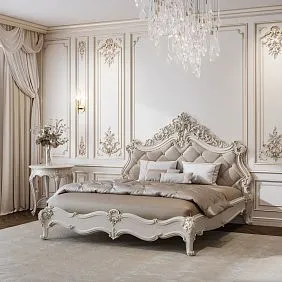
In a Baroque bedroom, the bed is the absolute center, the dominant feature around which everything else is built. It is not just a place to sleep, but a symbol of the owner's power, wealth, and significance. The beds of kings and aristocrats were huge, elevated on a podium, surrounded by canopies and curtains, adorned with carvings and gilding. This principle is still relevant today: the bed must make an impression, capture attention, and set the tone for the entire space.




Headboard: the calling card of a Baroque bed
The headboard is the main decorative element of the bed. In Baroque, it is tall, massive, and richly decorated. Carving covers the entire surface or accentuates the central and corner zones. Carving motifs are floral (acanthus leaves, grapevines, roses), zoomorphic (lion heads, griffins), and geometric (volutes, cartouches, rocaille). Symmetry is usually observed, but asymmetrical accents are allowed to enhance dynamism.
The height of the headboard varies from modest 120–140 centimeters to monumental 200–250 centimeters and above. A tall headboard visually raises the ceiling, creates a sense of grandeur, and serves as an architectural backdrop for pillows and textiles. But in apartments with 2.7-meter ceilings, such a headboard can look overwhelming. Here, a golden mean is needed: the headboard should dominate, but not push the sleeper under the ceiling.
The material of the headboard is solid wood (oak, beech, walnut) with hand or machine carving. The wood can be tinted in dark noble tones or painted in light colors with patina and gilding. An alternative to wooden is a soft headboard, upholstered in velvet, silk, or leather, with tufting (capitonné). The buttons are covered with the same fabric or a contrasting one, often with the addition of rhinestones. A soft headboard adds comfort but may be less formal than a wooden one.
Our factory also produces:


Legs and base: the foundation of grandeur
A Baroque bed rarely stands on inconspicuous legs. The supports are massive, carved or turned, often with gilding. The shape of the legs is baluster-like, conical, or in the form of lion's paws. They lift the bed off the floor, creating a sense of lightness despite the massiveness of the structure.
The bed base can be simple or include decorative elements — rails with carvings, overlays, profiled planks. In historical examples, beds were sometimes placed on a podium, elevating the sleeping area by 20–30 centimeters. Today, a podium is not mandatory, but it enhances theatricality, turning the bed into a throne.
The footboard in Baroque is often lower than the headboard but also decorated. Symmetrical carving, repeating the motifs of the headboard, ties the elements into a single composition. Some models do without a footboard, leaving the view of the bed linen and bedspread open.
Get Consultation
Canopy: the crown over the royal bed
The canopy is a cult element of a Baroque bed, turning it into a separate world, isolated from the rest of the space. The canopy creates coziness, protects from drafts, and adds drama and luxury. It can be full (with four columns supporting an upper frame and fabric surrounding the bed on all sides) or partial (a crown over the headboard with drapery descending along the sides).
The canopy fabric is heavy, noble materials: velvet, silk, brocade, damask. Colors are saturated: burgundy, emerald, sapphire, gold. The draperies are lush, with tiebacks, tassels, and fringe. The upper frame of the canopy is often adorned with carving and gilding, echoing the decor of the headboard.
In modern apartments, a full canopy can be impractical — it clutters the space, collects dust, and requires regular care. A compromise is a half-canopy or crown: a decorative element (a wooden or metal crown, a carved cartouche) is attached above the headboard, from which light fabrics descend along the sides of the bed. This creates the effect of a canopy without full enclosure.
Headboard wall: architectural context
A bed cannot exist in a void. The wall behind the headboard is the canvas on which the bed becomes a painting. A bare painted surface does not support Baroque aesthetics. Treatment is needed to create architectural depth and stylistic unity.
Moldings and frames: framing the throne
A classic technique is a frame made of moldings around the headboard area. The frame can be a simple rectangle or complex, with additional divisions. The width of the molding is 7–12 centimeters, the profile is with pronounced relief, characteristic of Baroque. The corners are cut at 45 degrees, joined perfectly, without gaps.
Frame size: in width, it is equal to the width of the bed or slightly wider (10–20 cm on each side); in height — from floor to ceiling or from mattress level to 2–2.5 meters. A tall frame visually raises the ceiling and creates monumentality. A low one is more intimate, suitable for small bedrooms.
Inside the frame, the wall can be treated with contrasting paint (darker or brighter than the main tone), wallpapered with a damask pattern, covered with fabric (velvet, silk, jacquard), or paneled with wood. The choice depends on the desired level of luxury and budget. Fabric is the most expensive and spectacular solution, paint is the most affordable.
Carved overlays and stucco: three-dimensional decor
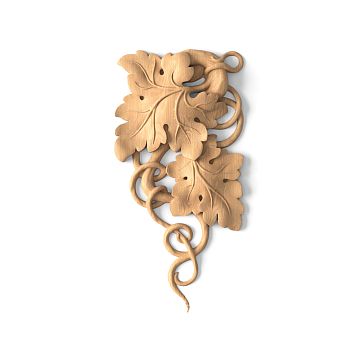
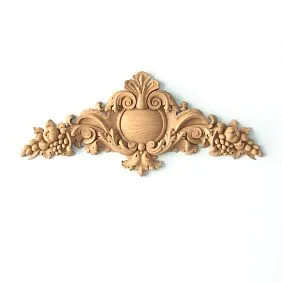
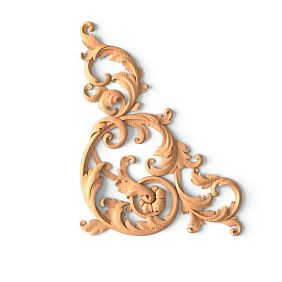
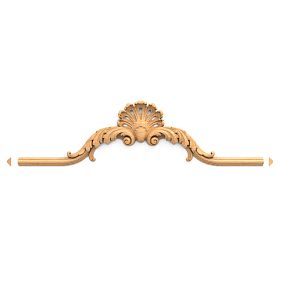
Wooden Furniture Decoror polyurethane — carved overlays, rosettes, cartouches — are placed on the wall, creating a three-dimensional composition. Overlays can be symmetrically positioned in the corners of a molding frame, centered above the headboard, or on either side of the bed. The motifs echo the carving on the bed's headboard, establishing stylistic unity.
The size of the overlays is chosen proportionally to the wall and bed. A large overlay 50–80 centimeters in diameter serves as a central accent. Small overlays 15–25 centimeters are grouped in several pieces, creating a rhythmic composition. It's easy to overdo it with overlays: too much decor turns the wall into a cluttered jumble. Less is more, but larger and more expressive.
Ceiling molding above the bed enhances the impression. A ceiling rosette from which a chandelier descends, or a molded cornice along the ceiling perimeter, connects the walls with the top, creating architectural integrity. Baroque loves abundant molding, but in modern apartments, moderation is key: one or two expressive elements instead of full coverage.
Wallpaper and textiles: soft luxury
Wallpaper in a Baroque bedroom is not just a simple background but an active participant in the composition. Damask pattern is the king of Baroque wallpapers: a large floral pattern on a contrasting background, symmetrical and repeating. Colors are noble: gold on burgundy, silver on blue, white on cream.
Textile wallpapers (flocked, velour) add tactility and acoustic comfort. They are pleasant to the touch, absorb sound, and create a sense of warmth and coziness. The downside is high cost and difficult maintenance. A budget alternative is vinyl wallpaper with embossing that mimics fabric.
Fabric wall upholstery is the pinnacle of Baroque luxury. Velvet or silk is stretched over the wall within a molding frame, creating a soft panel effect. The fabric can be smooth or with tufting (buttons recessed into a soft base create relief). Such a wall becomes an extension of the soft headboard, forming a unified textile ensemble.
Color and light: a play of drama
The color of the wall behind the bed should highlight this zone but not clash with the overall palette. If the bedroom is in light tones, the accent wall can be rich: emerald, sapphire, burgundy. If the entire room is dark, the accent wall can be lighter or metallic (gold, silver).
Lighting the headboard wall is a mandatory element. Sconces on either side of the bed provide functional light for reading and accentuate the wall decor. Hidden lighting (LED strip behind a cornice or moldings) creates a soft glow, turning the wall into a luminous panel. Accent spotlights directed at the carved overlays highlight them from the shadows, enhancing the drama.
Bedside tables: symmetrical guardians
Baroque adores symmetry. Two identical bedside tables on either side of the bed are not just a functional necessity but a compositional rule. They create balance, frame the bed, and complete the composition.
Style and decor of bedside tables
Bedside tables should stylistically match the bed. If the bed is made of dark carved wood, the tables should be from the same wood with similar carving. If the bed is painted in a light tone with gilding, the tables should replicate this finish. A mismatch in style will disrupt the composition.
Dimensions of bedside tables: height is usually at mattress level or slightly lower (50–65 cm), width 40–60 cm, depth 35–50 cm. Too small tables will get lost next to a massive bed. Too large ones will clutter the walkways. Tables should be proportionate to the bed and the room.
Decor of bedside tables: carved fronts, legs (matching the bed legs), overlays, hardware (bronze or brass handles with carving or chasing). The tabletop can be made of the same wood, marble (real or artificial), or glass with a beveled edge. A marble tabletop adds luxury and practicality — it is not afraid of water from a glass or vase.
Functionality and storage
Bedside tables are not just decor but also storage. Drawers for small items (phone, book, glasses, medicine), open shelves for magazines or decorative objects, closed doors for things that shouldn't be on display. Internal drawers can be equipped with dividers, soft lining (for jewelry), and lighting.
On the tabletop of the bedside table, place a nightlight or table lamp, alarm clock, a small vase with flowers, a photo frame, a decorative box. The composition on the table should be balanced: one large item (lamp) and one or two small ones (frame, box). A cluttered table will ruin the impression.
Console and dressing table: additional accents
If the bedroom area allows, additional furniture pieces enrich the interior and expand functionality. A console against the wall opposite the bed or under the window, a dressing table against a side wall — these elements transform the bedroom from a sleeping place into a full-fledged personal space.
Console: an elegant stand
A console is a narrow table on high legs, placed against a wall. In a Baroque bedroom, it serves both decorative and functional roles. Decorative items (vases, sculptures, boxes, candlesticks), books, and a tray for small items are placed on the console. Traditionally, a mirror in a luxurious frame is hung above the console, complementing the composition.
The console should echo the other bedroom furniture: the same materials, the same decorative motifs, the same finish. The console legs can match the bed legs, the overlays on the front can echo the carving on the headboard. This creates stylistic unity.
Console dimensions: width 80–120 cm (depends on wall width and items placed), depth 30–45 cm (consoles are narrow and shouldn't obstruct passage), height 75–85 cm (standard tabletop height). The console may have drawers or a lower shelf for additional storage.
Dressing table: a feminine corner
A dressing table is an essential element of a feminine Baroque-style bedroom. It is a place for morning and evening rituals, storing cosmetics and jewelry, and moments of solitude. The dressing table is usually small, elegant, adorned with carving, with a mirror and many small drawers.
The dressing table mirror can be built-in (attached to the tabletop) or separate (hanging on the wall). A built-in mirror is mobile — the table can be moved. A wall-mounted mirror is more monumental, can be larger and more luxurious. The mirror frame in Baroque style is carved, gilded, with scrolls and floral motifs.
Lighting for the dressing table is critical. A lamp on the tabletop or sconces on either side of the mirror should provide even, diffused light without shadows on the face. Daylight is ideal for makeup, but in the evening, quality artificial light is needed. LED lighting around the mirror perimeter is a modern solution that ensures uniform illumination.
The chair or pouf at the dressing table should be comfortable and beautiful. A low, soft pouf with velvet or silk upholstery, possibly with carved legs and tassels at the corners, is a classic choice. A backrest is optional, but if present, it should be elegant, not bulky.
Textiles: The Soft Luxury of Baroque
Textiles in a Baroque bedroom are not merely functional (curtains for blocking light, bedding for sleep), but a crucial decorative element. Fabrics should be rich, textured, and in saturated colors. Cheap synthetics will instantly ruin the style.
Bedding and bedspread
The bed in a Baroque bedroom is a work of art. A bedspread made of heavy jacquard, velvet, or silk with gold-thread embroidery covers the bed. The bedspread color is saturated (burgundy, emerald, sapphire, gold) or a contrasting light shade (cream, silver) against dark furniture.
Pillows — many of them, in various sizes, with luxurious pillowcases. Large Euro pillows (65x65 cm) at the headboard create a soft wall. Standard pillows (50x70 cm) for sleeping are stacked in front of them. Decorative bolsters and small pillows (30x30 cm, 40x40 cm) are arranged in front. Pillowcases made of velvet, silk, brocade, possibly with tassels, fringe, embroidery.
Bedding (sheets, duvet covers, sleeping pillowcases) may be hidden under the bedspread during the day, but if visible, it must be of high quality. Sateen, percale, silk — natural fabrics with high thread count. Color — matching the bedspread or contrasting, but harmonious. Embroidery, lace edging, monograms — details that add individuality.
Curtains: dramatic window framing
Curtains in Baroque style are multi-layered compositions. The first layer — heavy drapes made of velvet, silk, or brocade, protecting from light and prying eyes. The second layer — light tulle or organza, softening the window outline and diffusing daylight. The third layer — a valance (hard or soft), completing the composition at the top.
A valance is a decorative drapery that conceals the curtain rod and the top part of the curtains. A soft valance consists of swags (semi-circular drapes), jabots (side vertical elements), and cascades. A hard valance is a shaped fabric panel on a rigid base, often with a carved lower edge.
Curtain color — saturated, matching the overall bedroom palette or contrasting. Gold, bronze, silver threads in the fabric, embroidery, appliqués add luxury. Tiebacks — made of the same fabric, with tassels, cords, fringe — hold the drapes at the sides of the window, creating beautiful folds.
Curtain rod for Baroque curtains — massive, wooden or metal with gilding, with carved finials. It should be visible and beautiful on its own if a soft valance is used, or concealed behind a hard valance.
Rugs: softness underfoot
A rug in a Baroque bedroom is not just floor insulation, but a decorative accent. The classic choice is a Persian or Turkish hand-woven rug with a floral pattern. Colors are deep: burgundy, blue, green, gold. The rug size depends on the bedroom area: it can lie only by the bed (a bedside rug 60–80 cm wide, 150–200 cm long) or cover most of the floor, leaving 30–50 cm exposed around the perimeter.
An alternative to an Oriental rug is a European one with a Baroque pattern: rosettes, cartouches, acanthus scrolls. Such rugs are machine-made, cheaper than hand-woven ones, but with quality execution, they look dignified.
Lighting: light as a tool of drama
Baroque is a theatrical style, and theater is impossible without light. Lighting in a Baroque bedroom should be multi-level, controllable, creating different scenarios — from bright morning to intimate evening.
Central chandelier: the crown of the bedroom
A chandelier is a mandatory element. It hangs in the center of the ceiling (or off-center if the bed is not in the center of the room but against a wall) and serves as the main light source and a decorative object. A Baroque chandelier features crystal, bronze, multiple arms with candle imitation, pendants creating light play.
The chandelier size should correspond to the bedroom area. For a room of 15–18 sq.m, a chandelier with a diameter of 50–70 cm is suitable. For spacious bedrooms of 25–30 sq.m — 80–100 cm. A too-small chandelier will get lost, a too-large one will overwhelm. Hanging height: the lower edge of the chandelier should be at least 2 meters from the floor to avoid hitting one's head while walking.
Chandelier color: gold, bronze, silver patina on metal, clear or colored crystal. The chandelier may have fabric shades on the arms, softening the light. A dimmer (brightness regulator) is mandatory — it allows changing the light intensity from bright to subdued.
Local lighting: sconces, floor lamps, table lamps
Besides central lighting, local sources are needed. Sconces by the bed headboard — for reading before sleep. A lamp on the dressing table or console — for detailed tasks. A floor lamp by the armchair (if there is a seating area) — for evening reading.
Sconces in Baroque style — with candle imitation, crystal pendants, fabric shades, bronze or gilded brackets. They should stylistically echo the chandelier but not necessarily be identical. Mounting height for bed sconces: 120–140 cm from the floor (slightly above the headboard), symmetrically on both sides.
Table lamps — on bedside tables, dressing table, console. The lamp base — ceramic, bronze, wood — with carving or molded decor. The shade — fabric (silk, velvet), possibly with fringe. The lamp should provide enough light for reading but not be blinding.
Hidden lighting: modern magic
Modern technology allows for hidden lighting that works on atmosphere while remaining invisible. LED strips behind the curtain rod, moldings, under the bed create soft glow, visually expand the space, add a futuristic touch even to a classic interior.
Headboard wall lighting highlights this zone, making the carving and overlays play with volume. Under-bed lighting creates a levitation effect — the bed seems to float above the floor. Lighting inside the wardrobe, closet, or drawers — a practical addition simplifying the search for items.
Color temperature of hidden lighting: warm white (2700–3000K) for a cozy atmosphere, RGB (multicolor) — for those who like to change the mood of the space with color. Controlling the lighting via remote or smartphone adds convenience.
Balance of luxury: how not to overload
Baroque tends towards excess, and the line between luxury and bad taste is thin. How to know if you've crossed the line?
Signs of overload
Too much gold. If everything is gilded — the bed, nightstands, mirror frames, chandelier, wall overlays, curtains with gold thread — the interior becomes garish. Gold should be an accent, not the background.
Excess of carving and molding. When every surface is covered with ornament, the eye has nowhere to rest. The carving loses expressiveness, turning into a motley mess.
Color chaos. Baroque loves saturated colors, but that doesn't mean you need to use every shade of the rainbow. The palette should be limited: 2–3 main colors + accents.
Disproportion of elements. A huge chandelier in a small bedroom, or tiny nightstands next to a massive bed — disproportions destroy harmony.
Rules of balance
Choose focal elements. Let the bed with a headboard be richly decorated, while the nightstands are simpler. Or the headboard wall is a complex composition of moldings and overlays, while the other walls are neutral.
Alternate complexity and simplicity. If the furniture is lavishly adorned, let the walls be more restrained. If the walls are richly decorated, the furniture can be more laconic.
Use pauses. Areas of smooth surfaces without decor are not emptiness, but a visual respite. They emphasize the complexity of decorated zones.
Observe proportions. The sizes of elements should correspond to the dimensions of the room and to each other. Use the golden ratio rule: the smaller element relates to the larger one as the larger one relates to the sum of both (approximately 1:1.618).
Limit the palette. Choose a main color (background of walls and large surfaces), a complementary color (furniture, textiles), and an accent color (decorative elements, pillows, accessories). Plus neutrals (white, cream, gold) for balance.
Frequently asked questions
Can you create a Baroque bedroom in a regular apartment?
Yes, but with adaptation. Full-scale Baroque requires high ceilings and large areas. In a standard apartment, use a lighter version: a bed with a moderately decorated headboard (not reaching the ceiling), moldings on the headboard wall, textiles in saturated colors, but without excessive lushness. Opt for a crown instead of a full canopy. Choose medium-sized furniture.
How much does it cost to create a Baroque bedroom?
Depends on the scale and choice of materials. A solid wood bed with carving — from 100 thousand rubles, nightstands — from 30 thousand each. Moldings and overlays for the wall — from 10–20 thousand (materials + labor). Textiles (curtains, bedspread, pillows) — from 50 thousand. Chandelier and lighting — from 30 thousand. Total budget starts from 300–400 thousand for a medium-sized bedroom. A luxury version with antique furniture, hand carving, natural silk can cost millions.
How to care for Baroque furniture and textiles?
Wooden furniture: wipe with a dry or slightly damp cloth, avoid abrasives and aggressive chemicals, treat with wood polish every six months. Clean carving with a soft brush to remove dust. Textiles: velvet and silk should be dry-cleaned, do not wash at home. Vacuum curtains and bedspreads once a month on low power. Moldings and overlays: dust with a soft brush or feather duster, do not wash with water.
Can Baroque be combined with modern elements?
Yes, such eclecticism is popular. A Baroque bed surrounded by minimalist nightstands made of glass and metal. Classic moldings on the walls and modern built-in appliances. The main thing is that one style dominates (usually Baroque), and modern elements are accents that do not destroy the overall atmosphere.
Do you need a designer to create a Baroque bedroom?
It is advisable, but not mandatory. Baroque is complex; it's easy to make mistakes with proportions, color, and the amount of decor. An experienced designer will create a project, select materials, and supervise the work. If doing it yourself, study examples, collect references, consult in furniture and decor salons, and don't rush. It's better to add decor later than to overload it immediately.
Is Baroque suitable for a small bedroom?
Full-fledged Baroque — no. But elements of the style can be adapted: a small bed with an elegant carved headboard, moldings on the wall, quality textiles in a saturated color, one or two overlays, a small chandelier. Avoid massive furniture, dark tones, an abundance of decor — they will visually eat up space. Choose a light palette with gold accents.
Conclusion: create your royal legend
CreationBaroque bedrooms— are a journey into the era of kings, aristocrats, and palace intrigues. It's an opportunity to wake up every morning in a work of art, to surround yourself with beauty that inspires and elevates.baroque bed— the heart of this space, the throne around which the entire composition unfolds. But without competentbedroom interior decor, supporting walls, textiles, lighting, even the most luxurious bed will remain an island in emptiness.
and plasterwork, selection of nightstands and additional furniture, choice of textiles and lighting — every step requires attention, taste, and understanding of the style. Baroque does not forgive carelessness and cheapness. But when all elements are assembled correctly, the result is breathtaking.wooden furniture decorWorking with the headboard wall, using moldings,
The main rule is balance. Luxury should be generous but not cross into kitsch. Decor should be abundant but not chaotic. Colors should be saturated but harmonious. Gold, carving, velvet, crystal — all these attributes of Baroque work when used wisely and in moderation.
For many years, STAVROS has been creatingFurniture in Baroque style, worthy of royal chambers. Beds made of solid oak and beech with hand carving, nightstands with elegant fronts, consoles and dressing tables embodying the spirit of the era — each piece is created by craftsmen who understand the essence of the classical style. STAVROS architectural decor — moldings, cornices, carved overlays, plaster elements — allows you to create an architectural context for the furniture, turning the bedroom into a unified ensemble. Natural materials, precise processing on modern equipment, the possibility of custom tinting and finishing — STAVROS offers everything needed to realize the Baroque dream. Professional consultants will help you select elements, create a harmonious composition, and consider the features of your space. With STAVROS, a Baroque bedroom is not an unattainable fantasy, but a real project that can be implemented, creating a space where every morning begins with a sense of grandeur and beauty.
Live like kings. Create your legend. Let the bedroom become your palace.