Article Contents:
- Philosophy of Classic Furniture: More Than Function
- Proportions: The Mathematics of Beauty
- Materials: Honesty and Durability
- Decor: The Language of Symbols
- Wood Species: The Foundation of Classicism
- Oak: king among trees
- Beech: Strength and Uniformity
- Walnut: Dark Nobility
- Ash: Light Elegance
- Types of Classic Furniture: Function and Aesthetics
- Tables: From Dining to Writing Desks
- Chairs and Armchairs: The Art of Seating
- Chests and Wardrobes: Storage as Art
- Beds: Palaces of Sleep
- Styles of Classic Furniture: From Baroque to Neoclassicism
- Baroque: Theatrical Grandeur
- Rococo: Light Playfulness
- Empire: Imperial Strictness
- Neoclassicism: Rational Harmony
- Decorative Elements: Layers of Luxury
- Carving: Sculpture in Wood
- Inlay: Mosaic in Wood
- Gilding: The Radiance of Nobility
- Patina: The Mark of Time
- Custom Furniture: The Embodiment of Individuality
- Design: From Idea to Sketch
- Production: From Blank to Finished Product
- Timeline and Cost
- Frequently Asked Questions About Classic Furniture
- How to Care for Classic Wooden Furniture?
- Can Classic Furniture Be Used in a Modern Interior?
- How Long Does Solid Wood Classic Furniture Last?
- What's the Difference Between Solid Wood and Veneer in Classic Furniture?
- Which style of classic furniture to choose for the living room?
- Can you combine classic furniture with modern?
- How to choose wood species for classic furniture?
- Is gilding necessary on classic furniture?
- Where to buy quality classic furniture?
- How much does solid wood classic furniture cost?
- Conclusion: when furniture becomes heritage
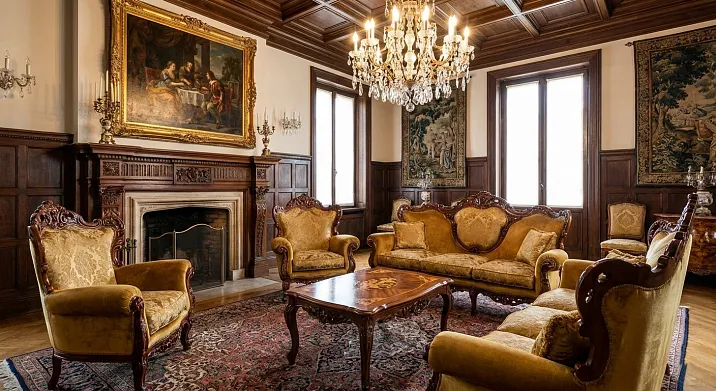
Fashion passes. Trends change. But there is something that remains.Classic Furniture— it's not a temporary hobby, but a choice for decades, for generations. This is furniture that isn't discarded when it goes out of fashion. Because it was never in fashion — it has always been beyond fashion, in eternity.
Why do the palaces of Versailles and the Winter Palace look as relevant today as they did three hundred years ago? Because classic doesn't depend on momentary trends. It's based on proportions refined over millennia. On forms that correspond to human perception of beauty. On materials that don't age
but patinate nobly.
Solid oak or beech, hand-carved details, gilding on protruding elements, upholstery from natural fabrics. This isn't an attempt to impress. It's a way to create a space where you want to live. Where every item speaks of taste, of understanding the value of quality, of connection with cultural tradition.
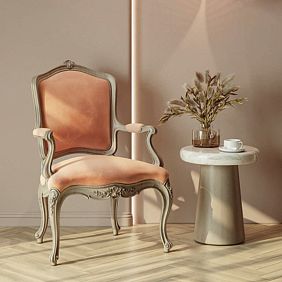


Philosophy of classic furniture: more than function
Classic Furniture— it's not just a place for sitting, storage, sleeping. These are architectural objects shaping the interior. They create rhythm, scale, hierarchy of space.




Proportions: the mathematics of beauty
Classic furniture follows strict proportional systems. The golden ratio, modular systems, classical orders — all this manifests in the ratio of height to width, in dividing the facade into parts, in the size of decorative elements relative to the overall mass.
Why does a classic table look balanced? Because the height of the legs relates to the size of the tabletop by a specific coefficient. Why doesn't a carved chest look overloaded, even though it has much carving? Because the carving is distributed according to visual weights, considering focal points of the gaze.
Modern furniture often ignores proportions, placing function above form. Classic doesn't make this compromise. Form and function are equal, interconnected. A chair must be comfortable, but also beautiful. A wardrobe must hold things, but also be the visual center of the room.
Our factory also produces:


Materials: honesty and durability
In classic furniture, there are no imitations. If it's wood — it's solid wood, not veneer on particleboard. If it's marble — it's natural stone, not marble-look plastic. If it's gold — it's real gilding, not gold-colored paint.
This honesty determines durability. Solid oak lasts for centuries. Carving on solid wood doesn't fall off like applied plastic elements. Gilding on wood lasts for decades, doesn't tarnish, doesn't peel. Natural upholstery fabric ages nobly, acquiring patina, rather than tearing after three years.
Classical furniture made of wood— it's an investment. Yes, it's more expensive than mass-produced counterparts. But if you calculate the cost of ownership over 20-30 years, it turns out cheaper. Because it doesn't need to be replaced. It doesn't break down. It doesn't become tiresome. It becomes part of the family.
Get Consultation
Decor: the language of symbols
Carving on classic furniture isn't just decoration. It's a system of symbols conveying meanings. Acanthus leaves — a symbol of immortality, triumph over death. Grapevines — abundance, fertility. Lion heads — strength, power. Laurel wreaths — victory, glory.
Every carving element is chosen consciously. It tells a story, creates a mood. Baroque carved furniture with putti and draperies speaks of luxury, theatricality, celebration of life. Restrained neoclassical furniture with meanders and rosettes speaks of rationality, enlightenment, the classical ideal.
Modern people often don't read these symbols. But they feel them. Subconsciously perceive the energy of forms, the meaning embedded by craftsmen centuries ago. And this energy works, creating atmosphere, influencing mood, the feeling of space.
Wood species: the foundation of classic
Classic Furnitureis made from noble wood species. The choice of species determines not only aesthetics but also functionality, durability.
Oak: king among trees
Oak furniture — the pinnacle of classic. Oak is dense, hard, practically eternal. Density of about 700 kg/m³ makes it resistant to mechanical damage. Oak furniture withstands intensive use for centuries.
Oak's texture is expressive: large pores, medullary rays creating a characteristic shine on radial cut. Annual rings form a contrasting pattern. Under transparent oil or varnish, this texture reveals itself in all its glory.
Oak color varies from light golden in young wood to gray-brown in old wood. Staining allows achieving almost any shade: from light honey to black ebony. Brushing — removing soft fibers with a brush — enhances the texture even more, creating a tactile relief.
Carving oak requires powerful tools and experience. Oak is hard, and carving tools dull quickly. But the result is worth the effort: oak carving holds the finest details, does not crumble, and does not break.Carved oak furniture— are works of art capable of lasting for centuries.
Beech: strength and uniformity
Beech furniture is a rational choice for classic styles. Beech is slightly less dense than oak — about 650 kg/m³, but this is more than sufficient for furniture. It is strong, load-resistant, and does not deform.
Beech texture is fine-pored, uniform, without a pronounced pattern. This is both an advantage and a disadvantage. The disadvantage — less decorative appeal compared to oak. The advantage — an ideal base for painting, tinting, and imitating other wood species. Beech furniture can be tinted to resemble walnut, mahogany, or rosewood.
Beech is excellent for turned elements — chair legs, table legs, balusters. The uniform structure allows for turning complex profiles without chipping. Turned beech legs with flutes, beads, and collars are classics of furniture design.
Forof carved elementsFor carving, beech is also good. Its uniformity allows carving the finest details — flower petals 2-3 mm thick, intricate scrolls, openwork carving. After tinting and patination, beech carving is not inferior to oak.
The disadvantage of beech is its hygroscopicity. Beech actively absorbs and releases moisture. In a damp room, beech furniture can swell; in a dry one, it can shrink. Stable humidity of 40-60% and a high-quality protective coating are required.
Walnut: dark nobility
Walnut furniture is a symbol of luxury. Walnut has a dark chocolate-brown color with lighter veins. The texture is wavy, creating shimmer and light play. Density 600-650 kg/m³, the wood is strong and works well.
Walnut was traditionally used for office furniture — writing desks, library cabinets, armchairs. Its dark color creates a serious, business-like atmosphere. Walnut furniture is associated with scholarship, intellectuality, and masculinity.
The price of walnut is high — higher than oak. This makes walnut furniture elite, not accessible to everyone. But those who choose walnut get a unique aesthetic that cannot be replicated with other wood species.
Ash: light elegance
Ash furniture is a compromise between aesthetics and price. Ash is light — creamy, yellowish. The texture is contrasting: dark late growth rings alternate with light early ones. Density about 700 kg/m³, like oak. Mechanical properties are excellent.
Ash is good for classic furniture in light interiors. An ash chest of drawers or table adds air and light to a space, without weighing it down. At the same time, it retains the nobility of solid wood and the expressiveness of the texture.
Ash is easily tinted. Shades from natural light to dark brown can be achieved. Ash takes patina well — patina settles in the pores, creating an antique effect.
Types of classic furniture: function and aesthetics
Classic Furniturecovers all types of interior items. Each type has its own features of construction, decoration, and application.
Tables: from dining to writing
A classic dining table is the centerpiece of a dining room or kitchen. A massive solid oak tabletop 40-60 mm thick, turned or carved legs, an under-table structure with carved overlays. Size depends on the number of people: a table for 6 persons — 160×90 cm, for 8 persons — 200×100 cm, for 12 persons — 260×110 cm.
The shape of the tabletop influences the atmosphere. A rectangular table is formal, strict, suitable for ceremonial dinners. An oval table is softer, friendlier, conducive to confidential conversation. A round table is the most democratic — all seated are equal, no one is at the head.
Extendable tables with additional inserts are practical for small spaces. The table in its folded state is designed for 6 persons, when extended — for 10. The extension mechanism must be reliable, designed for thousands of cycles. Quality mechanisms last for decades.
A writing desk in classic style is a study piece. Rectangular tabletop 140-180 cm long, 70-80 cm deep. Under the tabletop — three drawers on one or both sides. Drawers with carved fronts, brass or bronze hardware. The tabletop can be upholstered in leather — natural, embossed, with gold edging.
Console tables — narrow tables 100-120 cm long, 35-45 cm deep, placed against a wall. Used in hallways, corridors, living rooms as a stand for decorative objects, lamps, flowers. The legs of console tables are often especially decorative — carved, gilded, with curves.
Chairs and armchairs: the art of seating
Classic chairs— is a balance between comfort and aesthetics. Frame made of solid oak or beech, turned or carved legs, backrest with carved decor, seat with upholstery.
Seat height is standard — 45-47 cm from the floor. This is an ergonomic constant for most people. Seat depth 45-50 cm, width 45-55 cm. Backrest height 40-50 cm above the seat provides lumbar support.
The shape of the backrest defines the style. A straight vertical backrest with a carved top rail — strict classic. A curved backrest, following the body's shape — comfortable neoclassic. A high backrest with 'ears' — formal style, throne-like armchairs.
Chair upholstery is done with natural fabrics: linen, cotton, wool, silk for luxurious options. Or leather — natural, smooth, or embossed. Filling — high-density polyurethane foam or natural horsehair for authenticity.
Armchairs differ from chairs by having armrests. A classic armchair features a soft, deep seat, a high back, wide armrests, often with carved overlays. An armchair for reading, for conversation, for relaxation.
Throne armchairs with high backs, abundant carving, gilding — an element of formal interiors. They are placed in halls, living rooms as an accent, as a symbol of status. Sitting in such an armchair daily is uncomfortable, but it looks monumental.
Chests of drawers and cabinets: storage as an art
A classic chest of drawers is a piece for the bedroom or living room. Solid wood body, three-four drawers, carved fronts, wooden or marble top. Height 90-110 cm, width 100-140 cm, depth 50-60 cm.
Drawer fronts are decorated with carved overlays — floral ornaments, geometric patterns, rocaille. Handles are brass or bronze, cast, with patina. Each drawer slides smoothly on quality runners or traditional wooden slides.
The chest of drawers top is a place for decorative objects. A mirror in a carved frame, a pair of vases, boxes, a lamp. A marble top adds luxury, a wooden one — warmth.
Classic cabinets come as wardrobes and display cabinets. A wardrobe — two-three doors, inside a rod for hangers, shelves. Height 200-220 cm, width 120-180 cm. Fronts are carved or with panels, hardware is massive.
Display cabinets — cabinets with glass doors for displaying tableware, collections, books. Inside, shelves are made of glass or wood, the back wall is often mirrored to enhance the effect. The display cabinet becomes part of the decor, its contents — an exhibition.
Sideboards — a combination of a closed lower tier and an open or glazed upper one. A sideboard in the dining room stores tableware, tablecloths, cutlery. Height 180-200 cm, width 140-180 cm. Massive, dominant piece of furniture.
Beds: palaces of sleep
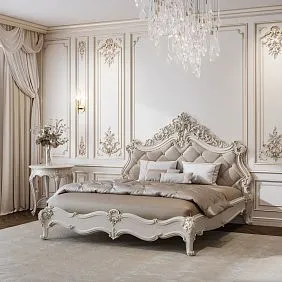
A classic bed features a high headboard, often carved or upholstered in fabric, a massive frame of oak or beech. King Size — 180×200 cm or 200×200 cm for truly luxurious options.
The headboard is the main decorative element of the bed. It can be wooden carved — with floral ornaments, volutes, cartouches. Or soft upholstered — tufted, with button or rhinestone detailing creating a diamond relief.
A headboard height of 120-160 cm from the floor creates a vertical accent, monumentality. The bed becomes an architectural object, the center of the bedroom. Textiles — bedspreads, pillows, a canopy — enhance this effect.
Bed legs are turned or carved, 20-30 cm high. This is not only aesthetic but also practical — you can clean under the bed, air circulates freely. Low beds without legs are a modernist fashion, not classic.
Styles of classic furniture: from Baroque to Neoclassicism
Classic FurnitureClassic furniture is not monolithic. Within classicism, there are many stylistic directions, each with its own aesthetic.
Baroque: Theatrical Opulence
Baroque furniture is maximum decoration. Carving covers the entire surface. Forms are dynamic, curved. Legs are bowed, backs are curved, even tabletops can have a wavy edge. Gilding is abundant, often solid.
Baroque carving features putti (winged infants), draperies, floral garlands, shells, volutes. The relief depth reaches 50-80 mm, creating dramatic shadows. Every element is detailed, every detail is a sculpture.
Baroque colors are saturated: gold, burgundy, cobalt blue, emerald green. Upholstery of velvet, brocade, damask. Shine, luxury, excess — the motto of Baroque.
Baroque furniture requires a corresponding interior. High ceilings from 3.5 meters, large areas, stucco, frescoes. In an ordinary apartment, Baroque furniture would overwhelm the space. But in a mansion, in a palace — that is its place.
Rococo: light playfulness
Rococo is a lighter Baroque. Forms are curved, but more delicate. Carving is openwork, not massive. Gilding is present but not dominant. Colors are pastel: pink, blue, mint, cream.
Characteristic elements of Rococo — rocaille (asymmetrical scrolls resembling shells), floral garlands, cupids. Furniture legs are curved in an S-shape. Chair backs are oval or violin-shaped.
Rococo furniture is feminine, intimate. It is created for boudoirs, salons, private spaces. For conversations, flirtation, tea parties. Not for formal receptions, but for friendly gatherings.
Rococo upholstery — silk with floral print, tapestry with pastoral scenes. Gilding is patinated, muted. Everything in Rococo strives for lightness, elegance, charm.
Empire: imperial severity
Empire — the style of Napoleon's empire. Furniture is monumental, symmetrical, with antique motifs. Forms are rectilinear, angles are sharp. Decoration is strictly dosed, placed at key points.
Characteristic elements of Empire — laurel wreaths, eagles, bundles of arrows, torches, sphinxes, caryatids. Symbolism of military glory, triumph, power. Empire furniture speaks the language of empire.
Empire colors are contrasting: dark mahogany wood with gilded bronze overlays. Or black lacquer with gold. Upholstery of heavy silk or velvet in deep colors: burgundy, blue, green.
Empire furniture is massive, heavy visually and physically. It requires space, high ceilings. This is furniture for halls, studies, formal bedrooms. Not for cozy living rooms.
Neoclassicism: Rational Harmony
Neoclassicism — the revival of ancient principles through the lens of the 18th century. Furniture is proportional, symmetrical, restrained. Forms are simple geometric shapes: rectangles, ovals, circles. Decoration is minimal, pinpoint.
Characteristic elements of neoclassicism — fluting (vertical grooves on columns and legs), meanders, egg-and-dart motifs, rosettes, stylized acanthus leaves. Carving is shallow, contour-like.
Neoclassical furniture colors are light: bleached oak, ash, maple. Or contrasting: white with gold, gray with silver. Upholstery is made of natural fabrics in pastel shades.
Neoclassical furniture is universal. It fits into any interior: from formal to intimate. It does not overload the space, creates calmness, harmony. This is classic for people who value rationality and aesthetics simultaneously.
Decorative elements: layers of luxury
Classic Furniturewould not be classic without decoration. Carving, inlay, gilding, patination — these techniques turn a functional object into a work of art.
Carving: sculpture in wood
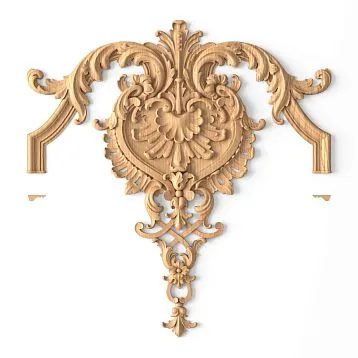
Wood carving is the oldest technique for decorating furniture.Carved appliqués for furniture, carved fronts, carved legs and backs create volume, depth, play of light and shadow.
Carving techniques vary. Bas-relief carving — the pattern protrudes 5-10 mm above the background. Low-relief carving — the pattern protrudes 20-40 mm, elements have volume but are not separated from the background. High-relief carving — elements are almost sculptural, protrude 50-80 mm.
Openwork carving — cutting all the way through, creating a lace-like pattern. The technique is complex, requires precision. Openwork carving is used for chair backs, decorative overlays, friezes.
Carving themes are diverse. Floral motifs — acanthus leaves, oak branches, grapevines, roses. Geometric — meanders, braids, rosettes. Figurative — putti, mascaron, lion heads, caryatids.
Modern production combines machine and hand carving. The basic relief is cut on CNC 3D machines according to a given program. This ensures accuracy, repeatability. Then the carver manually works out the details, creates subtle transitions, individuality.
Inlay: mosaic in wood
Inlay — the technique of setting plates of another material into the surface of wood: precious woods, mother-of-pearl, metal, bone. A flat pattern, mosaic is created.
Marquetry — inlay with wood on wood. Thin veneer plates of different species are selected by color, cut according to the pattern, glued onto the base. The result is a picture, landscape, ornament from the natural shades of wood.
Intarsia — setting pieces of wood, stone, metal into recesses of the base. A more volumetric technique, elements protrude or are recessed by 1-2 mm, creating relief.
Mother-of-pearl inlay is characteristic of Eastern and Oriental styles. Mother-of-pearl plates are set into dark wood — ebony, black walnut. Contrast, shine, iridescence are created.
Metal inlay — brass, bronze, tin are set into wood in the form of lines, patterns. The Boulle technique (named after the 17th-century French master) — symmetrical ornament of brass and tortoiseshell on a black background.
Gilding: the radiance of nobility
Gilding — applying the thinnest layer of gold to the surface of wood. The thickness of gold leaf is 0.0001 mm. The gold leaf is so thin that it is translucent in light, yet covers the surface with a durable shiny layer.
Gilding techniques vary. Oil gilding — gold is glued onto drying oil varnish. Gives a bright glossy shine. Water gilding — gold is applied onto water-based glue, then polished with agate. Gives a deep matte shine.
Gilding can be solid — the entire surface is covered with gold. Or partial — gold only on the protruding elements of carving, on overlays, on edges. Partial gilding creates contrast with natural wood, emphasizes carving.
Aged gilding — patination. The gold is partially worn away, revealing the gesso (primer) or wood underneath. An effect of noble antiquity is created, as if the furniture has served for centuries.
Modern gilding often uses imitation gold leaf — an imitation of gold leaf made of brass or bronze. Imitation gold leaf is 50-100 times cheaper than gold, but visually similar. For mid-price segment furniture — an adequate solution.
Patina: The Stamp of Time
Patina — a noble film that forms on the surface of wood, metal over time. In furniture production, patina is applied artificially, imitating natural aging.
Dark patina — tinted wax or diluted paint is applied to the surface, rubbed into the recesses of carving, wood pores. Protruding parts are wiped, remain light. Recesses are dark. Contrast, depth, volume arise.
Light patina — on the contrary, light wax or paint is applied to dark wood, rubbed into the pores. Creates an effect of grayness, antiquity, fading.
Colored patina — green, blue, silver — creates artistic effects. Green patina on bronze overlays imitates oxidation. Silver patina on carving creates a cold shine.
Patination requires skill. Patina is applied unevenly, with accents. The master decides where the patina should be more intense, where lighter. This is manual work that adds individuality to the furniture.
Custom furniture: the embodiment of individuality
StandardClassic Furniturecatalog items suit most needs. But sometimes something unique is required. Furniture that perfectly matches the room's dimensions, personal taste, and functional requirements. Then the path is a custom order.
Design: from idea to sketch
The process begins with a discussion. What is needed — a table, a chest of drawers, a bed, a suite? Where will it be located — in which room, against which wall? What are the space dimensions, ceiling height, interior style?
The designer proposes concepts. Sketches and 3D visualizations show how the furniture will look. Details are discussed: shape, proportions, type of carving, material, finish. Iterations are possible — changing elements until the perfect result is achieved.
It is important to understand technological capabilities and limitations. Some shapes are complex to implement. Too thin elements are fragile. An experienced designer knows these boundaries and offers solutions that combine aesthetics and feasibility.
Production: from blank to product
After project approval, production begins. Wood is selected for quality — without knots, cracks, with straight grain. Blanks are cut, milled, turned, sawn.
Carving is done in combination: machines cut the basic relief, carvers refine the details. For complex carving, this can take weeks. Each element is sanded, fitted.
Assembly is done with tenons and glue. Modern adhesives create a bond stronger than the wood itself. The structure is clamped until the glue dries completely. Then final sanding of the entire surface.
Finishing is the final stage. Staining, priming, applying patina, gilding. Varnishing or oiling in several layers with intermediate sanding. Installation of hardware — handles, hinges, locks. Upholstery of soft elements.
Timing and cost
A custom order requires time. From design to finished product takes 6-12 weeks depending on complexity. A simple table without carving — 6 weeks. A complex carved sideboard with gilding — 12 weeks.
Cost is determined by size, material, complexity. A simple beech dining table 180×90 cm without carving — from 80,000-120,000 rubles. A carved oak chest of drawers with gilding and marble top — from 350,000-500,000 rubles. Exclusive projects are calculated individually.
But it is an investment in uniqueness. Furniture created for your project, for your interior, for your taste. Furniture that no one else has. This is valued.
Frequently asked questions about classic furniture
How to care for classic wooden furniture?
Wipe dust with a soft dry cloth weekly. Wet cleaning — once a month with a slightly damp cloth. Refresh oil finish every 2-3 years. Lacquer finish does not require refreshing. Avoid direct sunlight, heating appliances near the furniture. Maintain humidity at 40-60%.
Can classic furniture be used in a modern interior?
Yes,Classic Furnitureworks excellently in eclectic interiors. A classic table in a minimalist dining room creates contrast, adds warmth. It is important to maintain moderation — one or two classic pieces as accents, not a full set.
How long does classic solid wood furniture last?
With proper care — decades, centuries. Oak and beech furniture lasts 50-100+ years. Restoration is possible multiple times. Antique classic furniture from the 18th-19th centuries is still functional, proving its durability.
What is the difference between solid wood and veneer in classic furniture?
Solid wood — solid timber cut from a log. Veneer — a thin sheet of wood 0.5-3 mm, glued to a base (MDF, plywood). Solid wood is stronger, more durable, can be restored multiple times. Veneer is cheaper, more dimensionally stable, but less durable.
Which style of classic furniture to choose for a living room?
Depends on room size and personal preferences. For large living rooms with high ceilings — Baroque or Empire. For medium — Neoclassical. For small — light Rococo or restrained classicism. Consider the overall interior style.
Can classic furniture be combined with modern furniture?
Yes, this is called eclecticism. A classic dining table with modern chairs, a classic chest of drawers next to a modern sofa. The main thing is to maintain color scheme, proportions, and avoid creating chaos.
How to choose wood species for classic furniture?
For maximum durability and prestige — oak. For a balance of price and quality — beech. For a dark noble color — walnut. For light interiors — ash. Also considerdecorative elements— oak is better for carving, beech — for turned parts.
Is gilding necessary on classic furniture?
Gilding is a matter of taste and style. In Baroque, Rococo, and Empire styles, gilding is authentic and emphasizes luxury. In Neoclassicism and modern classicism, it can be omitted. Partial gilding on carved elements is a compromise between luxury and restraint.
Where to buy quality classic furniture?
Choose manufacturers with experience, portfolio, and reviews. The company STAVROS has been creatingclassic solid wood furniture. Tables, chairs, armchairs, dressers, beds in various styles. Possibility of custom orders. Showrooms in Moscow and St. Petersburg.
How much does classic solid wood furniture cost?
Prices depend on size, material, and complexity. A classic beech chair — from 25,000-40,000 rubles. An oak dining table for 8 persons — from 150,000-250,000 rubles. A carved dresser with gilding — from 300,000-500,000 rubles. Custom orders are calculated separately.
Conclusion: when furniture becomes a legacy
Classic Furniture— it is not a purchase, but an acquisition. Not an expense, but an investment. An investment in quality of life, in the beauty of the surrounding space, in a connection with cultural tradition.
Furniture made of solid oak or beech, created according to classical canons, with carving, gilding, patina — is an item that will serve your children and grandchildren. Which will not be thrown away when it goes out of fashion, because it is beyond fashion. Which will be valued in 50 years more than today, as an antique.
This is furniture that turns a house into a place with history. Even if you are the first owner, classic furniture creates a feeling as if it has always been here. As if it is part of the family legacy. And over time, it truly will become one.
The company STAVROS has been creatingclassic furniture from solid oak, beech, ash. Dining and writing tables.Chairs and armchairs with carved backs. Dressers withcarved inlays. Beds with high headboards. Cabinets and display cases. All in a unified classic style, from Neoclassicism to Baroque.
All wood undergoes chamber drying to 8-10% moisture content. This guarantees stability and absence of deformation. Processing on European equipment ensures geometric precision and surface quality. Each joint is mortise and tenon with glue, ensuring strength for decades.
Carved Elementsare created using a combined method. 3D machines carve the basic relief according to a program, ensuring repeatability. Master carvers manually refine details — leaf veins, flower petals, volume transitions. Each piece is unique.
Finishing with natural compositions. Linseed-based oils enhance the texture and protect the wood. Stains create a palette from light honey to black ebony. Patination adds noble antiquity. Gilding with gold leaf or imitation gold leaf — for luxurious projects.
Upholstery of soft furniture is done by hand. Solid wood frame, spring block, natural filler, fabric of choice — linen, cotton, velour, jacquard, genuine leather. Channel tufting, capitonné creates a classic relief.
STAVROS fulfills custom orders. If standard sizes do not fit — we will manufacture furniture to your specifications. If a unique design is needed — we will develop a sketch, coordinate, and implement it. Production time is 6-12 weeks depending on complexity.
Classic Collectionunites furniture andinterior decorationinto a unified stylistic solution. The furniture matchesmoldings, baseboards, cornicesmade from the same wood, with the same profile. This creates interior integrity.
Specialist consultations will help you choose the optimal configuration. Tell us about the room dimensions, interior style, and functional needs. Specialists will recommend furniture, calculate the cost, and agree on timelines.
Delivery to Moscow, St. Petersburg, and all of Russia. Furniture is professionally packaged — cardboard boxes, stretch film, corner protection. Large furniture is disassembled for convenient transportation, assembly instructions are included.
STAVROS showrooms in Moscow and St. Petersburg. Here you can see furniture in person, sit on chairs, assess the quality of carving, touch the wood, compare finish options. Consultants will assist with selection and process your order.
Create an interior whereClassical furniture made of wooddoes not merely fill the space, but shapes its character. Where every item is a piece of furniture art, created with respect for tradition. Choose STAVROS — and your home will gain that nobility which cannot be bought with money. Nobility born from material quality, craftsmanship, and connection to the great tradition of classical style.