Article Contents:
- Proportions as hidden geometry of comfort
- Golden ratio and sleeping zone
- Nightstand: synchronicity and scale
- Commode and wardrobe: verticals and horizontals
- Distances and freedom of movement
- Headboard as a textural accent
- Wood: classic in its purest form
- Soft upholstery: tactile comfort
- Combined headboard: wood and fabric
- Textiles: layers of coziness and visual luxury
- Blanket: completeness and decorativeness
- Curtains: verticals and light filtration
- Rug: tactile base and acoustics
- Skirting board and cornice: architectural framing
- Skirting board: base of verticality
- Ceiling cornice: crown of verticality
- Wall moldings: structure and rhythm
- Light: three levels and mood by the hour
- General lighting: chandelier as sculpture
- Night lighting: functionality and intimacy
- Accent lighting: depth and drama
- Light color temperature: warmth and coolness
- Silence: acoustic comfort and materials
- Solid furniture: damping and absence of resonance
- Textile as sound absorber
- Parquet and rug: balance of aesthetics and acoustics
- Doors: sound barrier
- Windows: protection from street noise
- Common Mistakes: When Classic Design Fails
- Error 1: Disrupting Furniture Proportions
- Error 2: Inharmonious Furniture
- Error 3: Excessive Decoration
- Error 4: Poor Lighting
- Error 5: Ignoring Acoustics
- Conclusion: Bedroom as a System of Rest
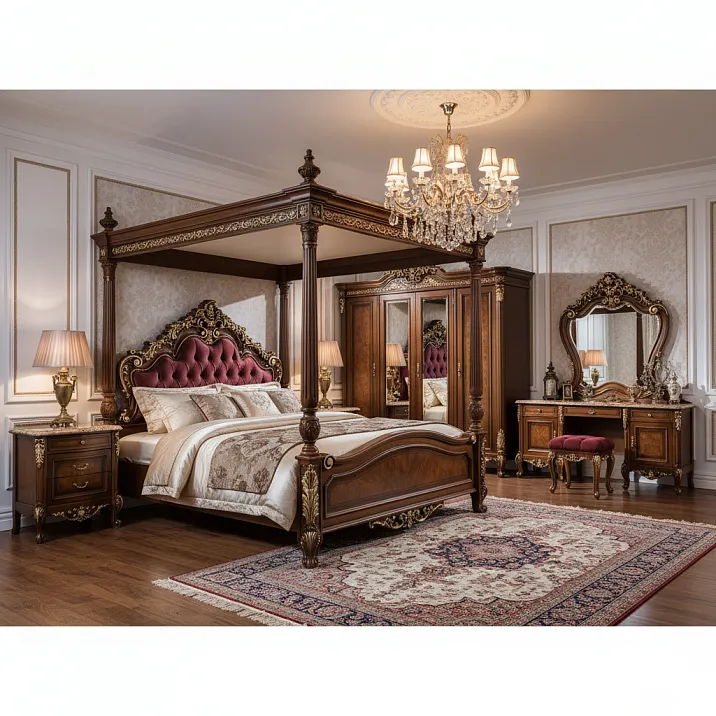
When you open the door to a classic bedroom, the first sensation is calmness. Not the stiff stillness of a museum, but the living calm of a space where everything is in its place, where nothing is random, and every element obeys the logic of harmony.Furniture for bedrooms in classic styleThis harmony is not declared—it is created by the mathematics of proportions, the tactile quality of textures, thoughtfully designed lighting, and acoustic comfort. This is not merely a set of items—a bed, nightstands, dresser. It is a system where dimensions follow the golden ratio, where wood and fabric serve tactile pleasure, where lighting is arranged in three levels, and silence is achieved not only by thick walls but also by the right choice of materials. In this article, we will examine not the stylistic clichés of classicism, but its inner mechanics: how proportions work in furniture placement, why headboard texture defines the room’s atmosphere, how light shapes mood from morning to night, and where that very silence comes from, transforming the bedroom into a true place of rest.


Proportions as the Hidden Geometry of Comfort
Classic interiors are not held up by decoration, but by mathematics. When you enter a well-designed bedroom, you may not always understand why it feels so comfortable. You simply feel: everything is right. The secret lies in proportions—the invisible relationships of sizes that the human eye reads subconsciously, either accepting or rejecting them.




Golden Ratio and Sleep Zone
The bed is the bedroom’s dominant feature, its geometric and conceptual center. In classicism, it is placed according to symmetry: headboard against the wall, centered or slightly offset, but so that the side passages are equal. This symmetry is not formality, but a necessity for visual calmness. An asymmetrically placed bed creates tension—one passage narrow, the other wide, the eye stumbling over this unevenness.
The optimal width of the passage from the edge of the bed to the wall or other furniture is 70–90 centimeters. This is the space where a person can walk freely, without touching corners or feeling cramped. Less than 60 centimeters—already cramped, requiring sideways maneuvering. More than one meter—loses intimacy; the bedroom begins to feel like a passageway rather than an intimate sanctuary.
The height of the bed headboard inclassic furnituretraditionally measures 120–160 centimeters from the floor. This is not caprice, but the result of calculation: a high headboard creates a sense of protection, forms a vertical dominant that balances the horizontal bed. A too-low headboard (80–100 cm) makes the bed appear grounded, visually lowering the status of this piece. A too-high headboard (above 180 cm) suppresses, especially in rooms with 2.7–3.0 meter ceilings.
In classicism, the ratio of bed length to width is usually close to 1.6:1—the golden ratio. A double bed 180 centimeters wide has a length of 200 centimeters. This ratio is perceived by the eye as harmonious, neither elongated nor low.
Our factory also produces:


Nightstands: Synchronicity and Scale
Nightstands in a classic bedroom are always paired. This is not a tribute to tradition, but a requirement of symmetry. Two identical nightstands at the sides of the bed create visual balance, emphasizing the centrality of the sleeping area.
The height of the nightstand is determined by the mattress height. The classic rule: the top surface of the nightstand is at the level of the mattress or slightly below (minus 5–10 cm). This is functionally convenient—no need to stretch up or down to reach a book or turn off a lamp. And visually correct—the nightstand does not appear as a low cube or an elongated tower; it harmoniously integrates into the bedroom group composition.
The width of the nightstand is usually 50–60 centimeters. Already—functional capacity is lost (cannot place a lamp and several items). Wider—the nightstand begins to compete with the bed in scale, disrupting the hierarchy where the bed is primary and nightstands are secondary elements.
The distance from the edge of the bed to the nightstand—touching or with a minimal gap of 1–2 centimeters. The nightstand is perceived as an extension of the bed, part of a single bedroom group. If a gap of 10–15 cm is left, the nightstand visually 'detaches' from the bed, and the composition’s integrity is broken.
Get Consultation
Dresser and Wardrobe: Verticals and Horizontals
In a classic bedroom, the dresser is usually placed opposite the bed or along a free wall. Its function is dual: storing linens and clothing, and visually counterbalancing the bed. If the bed is horizontal (long and low), then a tall wardrobe or vertical dresser is the vertical element that balances the composition.
A classic dresser has a height of 90–120 centimeters and a width of 100–150 centimeters. These proportions are close to a square or slightly elongated horizontally. The dresser should not be too tall (like a wardrobe)—it is an intermediate element between the low bed and the tall wardrobe, if present in the bedroom.
If a wardrobe is present, it is placed so as not to visually dominate. In classicism, built-in wardrobes or wardrobe cabinets with facades resolved as minimally as possible are preferred, so as not to compete with the bed. If the wardrobe is freestanding (standalone), it is placed along a wall with a door or in a niche, i.e., not in view upon entering the bedroom.
Distances and Freedom of Movement
A classic bedroom does not tolerate clutter. There must be sufficient space between furniture pieces not only for passage, but also for visual 'breathing.' If the room is packed with furniture tightly, even perfect proportions of each item will not save it—the feeling of clutter arises.
Minimum distances: from the edge of the bed to a wardrobe with hinged doors—door width plus 35–40 cm. If the wardrobe door is 60 cm, you need at least 1 meter of free space. To the dresser—minimum 70 cm (to open drawers without hitting the bed). To the window—preferably leave at least 50 cm of free space, to approach, open/close the window, and hang/remove curtains.
Headboard as a Textural Accent
The headboard is not just a backrest; it is the main vertical surface of the bedroom, setting the tone for the entire space. The material, texture, color, and shape of the headboard determine whether the bedroom will feel cold or warm, strict or cozy, formal or intimate.
Wood: classic in its purest form
A wooden headboard is a tradition dating back to furniture from the 18th-19th centuries. Solid oak, beech, walnut, handcrafted with carving or smooth, with patina or lacquered finish. Wood provides visual solidity and tactile warmth. Even without touching the headboard, we perceive its materiality — density, texture, nobility.
inclassic bedroom furnitureA solid wood headboard often has a complex profile: a cornice, a central panel with latticework, side pilasters. This is miniature architectural structure. Carving may be minimal (simple rolls, frames) or abundant (vegetal ornamentation, scrolls, rosettes) — depending on whether the interior leans toward restrained neoclassicism or lavish baroque classicism.
The color of the wood determines the temperature of the interior. Light woods (white oak, ash, maple) create a sense of freshness, lightness, visually expanding the space. Medium tones (natural oak, beech, cherry) provide balance — neither cold nor hot, universally versatile. Dark woods (walnut, wenge, mahogany) add drama, solidity, intimacy, but require ample space and good lighting; otherwise, the bedroom becomes gloomy.
Soft upholstery: tactile comfort
A soft headboard is a solution that adds coziness and intimacy to the bedroom. Button-tufted (cushioned), smooth upholstery, vertical or horizontal sections — many options, but the essence is one: the headboard becomes not just a visual, but also a tactile element. You can lean against it while sitting in bed with a book or tablet, feeling not a rigid board, but soft support.
Fabrics for upholstery in classic style — velvet, velour, shenille, jacquard, linen. Velvet provides luxury and depth of color; its nap creates light play — the shade shifts from light to dark as the viewing angle changes. Velour is similar but less formal, more homey. Shenille is dense, durable, with a matte texture. Jacquard with woven patterns adds decorative appeal. Linen — restraint and naturalness, suitable for modern classicism.
Button-tufted (cushioned) — a technique where upholstery is stitched with buttons covered in the same fabric, creating a relief of diamonds or squares. This is a formal option associated with bedchambers and palace interiors. Button-tufting enhances the headboard’s volume, making it sculptural. But it requires careful maintenance — dust accumulates in the folds.
Smooth upholstery without tufting — a more minimalist solution, suitable for neoclassicism. The headboard is covered evenly with fabric, possibly with a trim along the perimeter or decorative tacks. Looks restrained, elegant, easier to maintain.
Upholstery color: in classic style, neutral tones (beige, gray, cream, gray-blue) are often chosen, which do not compete with bedding textiles (covers, pillows) or the overall room palette. A contrasting headboard (e.g., dark blue in a light bedroom) — a technique for accentuation, but requires caution to avoid overloading the interior.
Combined headboard: wood and fabric
Often encountered combination: wooden frame (side posts, top cornice, bottom plinth), while the central panel is soft and upholstered. This offers the best of both worlds: the structure and nobility of wood plus the tactile comfort of fabric. The wooden frame may be carved, gilded, or patinated, adding decorative appeal. The soft panel — button-tufted or smooth.
Such a headboard visually is more complex, richer, and simultaneously more functional — you can lean on the soft part without touching the hard wood.
Textile: layers of coziness and visual luxury
If furniture is the skeleton of the bedroom, then textiles are its flesh. Fabrics soften rigid geometry, add color, pattern, tactile variety. In a classic bedroom, textiles are layered: bedding, coverlet, decorative pillows, curtains, possibly a canopy, rug. Each layer serves its purpose, and together they create an atmosphere.
Coverlet: completion and decoration
A coverlet in a classic bedroom — not just protection for the bed from dust, but a decorative element visible all day (until you go to sleep). A classic coverlet is large, fully covering the bed, including the sides, often draping to the floor. This creates a sense of monolithic unity — the bed appears as a single whole, not as a collection of pillows and blankets.
Coverlet material: in classic style, dense, noble fabrics are used. Jacquard with woven patterns (damask, botanical motifs) — a formal option, shiny surface reflecting light. Velvet or velour — luxury and softness, deep color. Quilted coverlets (stitched in diamond or square patterns) — coziness and volume. Silk or satin — smoothness and sheen, but require delicate handling.
Coverlet color: often chosen to match wall color or headboard upholstery. A monochromatic bedroom (walls, coverlet, curtains in one palette) looks calm, refined. A contrasting coverlet (e.g., burgundy against beige walls) — an accent, drawing attention to the bed, making it even more dominant.
Decorative pillows — a layer over the coverlet. In classic style, there may be many (from 4 to 8), different sizes, textures, and patterns. Pillows add volume, color, and the opportunity to play with textures (velvet next to silk, embroidered next to smooth). But it’s important not to overdo it — too many pillows look like decoration, not a lived-in space.
Curtains: verticals and light filtration
Curtains in a classic bedroom — not just fabric on the window, but vertical accents that shape the perception of room height and control light. Classic style implies multi-layered curtains: sheer (transparent fabric for daytime light) plus heavy drapes (for darkening and privacy).
Sheer fabric softly diffuses daylight, creating a half-light in the bedroom even during the day — important for rest. Sheer fabric may be plain white or with a subtle pattern (embroidery, jacquard weave). In classic style, avoid synthetic sheers with sharp sheen — better to use natural or blended fabrics with matte or light satin finish.
Drapes — heavy, dense curtains that completely block light. Fabrics: velvet, velour, jacquard, blackout (special light-blocking fabric with noble front side). Drapery color often matches the coverlet or upholstery — this creates visual unity. Drapes on a lining (double-layered fabric) appear more voluminous, drape more beautifully, and hold their shape better.
Curtain length in classic style — to the floor or with a slight "drop" (fabric lying 5–10 cm on the floor). This creates a sense of luxury and visually raises the ceiling. Short curtains (to the windowsill) are not used in classic style — this disrupts proportions.
Curtain rod — an important element often underestimated. In classic style,Wooden corniceor metallic (brass, bronze) with decorative finials. The rod must be sufficiently substantial to match heavy drapes. A thin rod under heavy curtains looks disproportionate. The rod is mounted 10–15 cm above the top edge of the window — this visually raises the window, and thus, the ceiling.
Carpet: Tactile Base and Acoustics
The rug in the bedroom serves several functions. Tactile: it's pleasant to get out of bed in the morning barefoot on soft pile, rather than on cold parquet. Visual: the rug unifies the bedroom group (bed, nightstands), defining the resting zone. Acoustic: the rug absorbs the sound of footsteps, making the room quieter.
Rug size in a classic bedroom: either small bedside rugs (along the edges of the bed, to step on when getting up), or a large rug that partially extends under the bed and protrudes beyond its edges by 50-80 cm. A large rug visually unifies the bedroom group, creating a "soft island" in the room.
Rug material: wool (classic, warm, durable), silk (luxury, shine, but requires careful care), viscose (imitates silk, cheaper, but less wear-resistant). The pile can be short (easier to maintain, more graphic) or long (softer, cozier).
Rug pattern in classic style: often floral ornaments, medallions, borders around the perimeter. Persian and Turkish rugs with traditional patterns — a natural choice for classic interiors. Solid-colored rug (without pattern) — a more restrained option, suitable for modern classic styles.
Baseboard and ceiling cornice: architectural framing
A classic bedroom is not just a room with furniture — it is an architectural space where walls, floor, and ceiling have finished detailing.Wooden baseboardand ceiling cornice — elements that create this architectural framing, form visual boundaries, add scale and elegance.
Baseboard: foundation of verticality
Baseboard in a classic interior — not a narrow plastic strip, but a full architectural element 10-15 cm high (up to 20 cm in tall rooms). Made of solid wood, it matches the wood species and finish of furniture or parquet, creating visual unity.
Classic baseboard profile: high upper part with a rounded edge, middle flat surface, lower rounded edge. This shape visually lightens the top of the baseboard, creating the impression that the wall rests on a slender, elegant base, even though the baseboard is substantial.
Baseboard color: traditionally matches the furniture. If the furniture is dark walnut, the baseboard is also dark. If the furniture is light, the baseboard is light. This creates material unity. Less often, the baseboard is painted to match the wall color — a more modern approach that visually increases wall height, as the boundary between wall and floor becomes blurred.
A wide baseboard in the bedroom serves not only a decorative but also a practical function: it protects the lower part of the wall from damage (from vacuum cleaner impacts, furniture legs), hides the gap between wall and floor (which may occur due to uneven walls), and can conceal wiring.
Ceiling cornice: crown of verticality
Ceiling cornice (or ceiling baseboard) — an element that finishes the transition from wall to ceiling. In classic style, it is not a narrow molding, but an expressive cornice 12-20 cm wide (up to 30 cm in tall rooms), with profiled surfaces: rounded edges, curved edges, shelves, creating play of light and shadow.
The cornice makes the ceiling appear higher, creating a "crown" at the top of the wall. Classic proportion: the cornice is 20-30% wider than the baseboard. If the baseboard is 12 cm, the cornice is 15-18 cm. This creates visual balance — the crowning element dominates over the base, which corresponds to the tectonic logic of architecture.
Cornice material: in classic style, this iswooden corniceorpolyurethane moldingshigh-density material, imitating plaster. Wood provides elegance and connection to furniture. Polyurethane is lighter, cheaper, easier to install, but requires quality painting to avoid looking like cheap imitation.
Cornice color: usually white or matching the ceiling (if the ceiling is not white). A white cornice on colored walls creates a clear boundary, graphic effect. A cornice matching the wall color blurs the boundary, visually raising the ceiling.
Cornice with hidden lighting — a modern trick in classic style. Behind the cornice, an LED strip is concealed, with light directed upward toward the ceiling. The ceiling glows, appearing to float, visually increasing room height. This is soft, diffused light, suitable for evening illumination.
Wall moldings: structure and rhythm
In classic bedrooms, walls are often finished with moldings — decorative strips that create frames, panels, vertical and horizontal divisions on the wall. This adds structure, rhythm, and depth to the walls.
Classic approach — three-part wall division: lower section (panel) 90-100 cm high from the floor, framed by molding; middle section (main wall field); upper section (cornice) between molding and ceiling cornice. The lower panel may be darker than the main wall, creating visual stability.
Moldings behind the bed headboard — a technique that highlights the bedroom zone. A frame of moldings is created around the headboard perimeter or around it (if the headboard doesn't reach the ceiling). This frame emphasizes the main bedroom item, making the wall behind the bed architectural, not just a painted surface.
Lighting: three levels and mood by the clock
Lighting in the bedroom — not just a technical question (how many lumens per square meter), but a tool for creating mood, which changes from morning to evening, from activity to relaxation. A classic bedroom uses multi-level lighting: general (ceiling), local (bedside lamps, mirror lights), accent (backlighting niches, paintings, architectural elements).
General lighting: chandelier as sculpture
A ceiling chandelier in the center of the bedroom — a classic tradition. It is not just a light source, but a decorative element, often large and expressive. A crystal chandelier with pendants — a formal option, suitable for high-ceiling bedrooms (ceiling height from 3 meters). A chandelier with fabric shades — a more intimate, cozy option. A chandelier with candle imitation (candelabra) — classic, evoking the pre-electricity era.
But general lighting from a chandelier in the bedroom is rarely used. Bright overhead lighting in the bedroom is uncomfortable, it creates harsh shadows, highlights every detail, and doesn't allow relaxation. The chandelier is turned on only when bright lighting is needed (cleaning, searching for something in a closet), but for daily life in the bedroom, other light sources are used.
Alternative to chandelier — recessed ceiling lights (spotlights, downlights) placed around the perimeter of the ceiling. They provide diffused light, less directional than a chandelier, more comfortable. But in classic style, spotlights are used cautiously to avoid disrupting the style — either they are fully concealed, or classic-design models (brass, bronze, glass) are used.
Bedside lighting: functionality and intimacy
Bedside lamps are the most important light source in the bedroom. This is the light used most often: in the evening before bed (for reading, for using a phone), at night (if you need to get up). Bedside lighting should be soft, directional, and controllable (easy to turn on/off without getting out of bed).
Bedside lighting options:
Table lamps on nightstands. Classic option: two identical lamps on two nightstands, symmetrically. A lamp with a fabric shade emits soft, diffused light, pleasant for the eyes. The shade can match the room’s textile (bedspread, curtains) or contrast. Lamp height: shade at eye level of a person sitting in bed (about 60-70 cm from the nightstand surface).
Wall sconces. Mounted on the wall above the nightstands or slightly above the headboard. They free up space on the nightstand and provide directional light (if the sconce has an adjustable shade). Mounting height: 120-140 cm from the floor (or 40-60 cm from the mattress surface). Two sconces at the sides of the bed — symmetry, each controls its own light.
Pendant lights. Instead of table lamps or sconces — pendant lights on long cords or rods, hanging from the ceiling to the bedside area. This is a more modern, but acceptable in neoclassical style, solution. Provides freedom: doesn’t occupy space on the nightstand, doesn’t require wall holes.
Important: each bedside lamp must have a convenient switch — on the cord, on the lamp itself, or best — a wall switch next to the bed, to control the light without getting out of bed.
Dimmer (brightness regulator) — a useful option for bedside lighting. In the evening, you want bright light for reading; before bed, you want dim light for relaxation. A dimmer allows you to smoothly adjust brightness according to your mood.
Accent lighting: depth and drama
Accent lighting in the bedroom — not mandatory, but an expressive element. It’s hidden backlighting that highlights architectural details, creates depth, and adds drama.
Backlighting behind the headboard. An LED strip hidden behind the headboard (if it slightly protrudes from the wall) creates a glowing outline. The headboard appears to float and have volume. The light is soft and diffused, creating an intimate atmosphere. Color of backlighting: warm white (2700-3000K) for coziness, or adjustable RGB for experimenting with mood.
Backlighting of niches and shelves. If the bedroom has niches (built-in wall recesses) or open shelves, they can be lit from within. An LED strip around the niche highlights objects inside (vases, books, decor), creating depth in the wall.
Floor backlighting. An LED strip under the bed (if the bed is on legs, with space between the frame and floor) creates a floating bed effect. The light is soft, doesn’t irritate eyes at night, can serve as a nightlight. Relevant for modern classic style.
Backlighting of artwork. If a painting hangs above the headboard or on the wall opposite the bed, it can be highlighted with a special lamp (gallery backlighting). This highlights the artwork, making it the focal point of the interior.
Light color temperature: warmth and coolness
Light color temperature is measured in Kelvins and determines whether the light is warm (yellowish) or cool (bluish). For the bedroom, the optimal temperature is warm 2700-3000K — this light is close to candlelight or incandescent bulb light, it creates coziness, relaxes, and doesn’t strain the eyes.
Cool light (4000K and above) in the bedroom is undesirable — it energizes, activates, and is suitable for work zones, but not for rest. If the bedroom has a work corner (desk), you can use cooler light (3500-4000K) for concentration, but the main lighting in the bedroom area should be warm.
Silence: acoustic comfort and materials
The bedroom is a place where silence is critically important. External sounds (street noise, neighbors, elevator) and internal sounds (furniture creaking, footstep resonance) disrupt peace, interfere with falling asleep, and reduce sleep quality. A classic bedroom achieves silence not only through wall sound insulation but also through the proper selection of materials and furniture construction.
Solid wood furniture: damping and no resonance
Solid wood furniture, used in classic style, has significant weight and density. This is not just aesthetics — it’s an acoustic advantage. Solid furniture doesn’t resonate, doesn’t rattle, doesn’t creak upon contact. Cheap furniture made of particleboard with thin walls produces a hollow, dull sound upon contact, may rattle if music is playing in the room or a truck passes by outside. Solid wood furniture dampens vibrations and acts as a damper.
Quality hardware — hinges, drawer guides — in classic furniture is equipped with soft-close mechanisms. Cabinet doors close smoothly, without slamming. Drawer slides out and slides back in silently. This is not luxury — it’s necessary for silence. A sharp door slam or loud drawer slam in the bedroom, especially at night — is a disruption of peace.
Textiles as sound absorbers
Fabrics absorb sound. The more textiles in the bedroom, the quieter it is. Heavy curtains made of velvet or jacquard absorb outdoor sounds (especially high-frequency ones — voices, car signals). A rug on the floor absorbs footsteps, making movement around the room silent. A soft headboard acts as a sound-absorbing panel — if noisy neighbors are behind the bedroom wall, the headboard partially dampens that noise.
A bedspread, decorative pillows, upholstered chair (if present in the bedroom) — all these textile surfaces together create acoustic comfort. In a bedroom without textiles (bare walls, blinds instead of curtains, minimal furniture), sound reflects off hard surfaces, creating echo, and the acoustics are harsh and uncomfortable.
Canopy over the bed — an element now used less frequently, but in classic style it has not only decorative but also acoustic function. The canopy fabric creates a sound cocoon around the sleeping area, isolating sounds from the rest of the room and from behind the walls. This is an additional layer of privacy and silence.
Parquet and rug: balance of aesthetics and acoustics
Solid wood parquet — classic floor covering in the bedroom. It is beautiful, durable, and pleasant to the touch. But parquet makes noise: footsteps echo loudly, especially if the boards creak (which happens in old houses or with poor installation). Solution — a rug over the parquet. The rug not only absorbs footstep sounds but also dampens the resonance of the wooden floor, making the bedroom’s acoustics softer.
The size and density of the rug affect the effect. A large, dense rug with short pile provides maximum sound absorption. A small, thin rug has almost no effect on acoustics — it’s more decorative.
Alternative to parquet — cork flooring. Cork is warm, soft, and sound-absorbing. Steps on cork are nearly silent. But cork is less visually noble than parquet and is rarely used in classic style. Compromise — parquet with cork underlayment (a layer of cork is placed between the parquet and concrete floor), which improves sound insulation from neighbors below and dampens parquet resonance.
Doors: sound barrier
A quality door to the bedroom is an important element of silence. An inexpensive hollow door almost does not isolate sound: conversations from the adjacent room, TV noise from the living room penetrate into the bedroom. A solid wood door or one with panels, with a tight door seal (rubber seals around the perimeter) provides good sound insulation.
Door threshold: the gap between the door and the floor — a path for sound. An automatic threshold (which rises when the door opens and lowers when it closes, covering the gap) or a brush seal solves the problem.
Door mechanism: hinges must be silent (with a door closer or simply high-quality, without squeaking), the lock or latch must close softly, without a click. A sharp click from the lock — destruction of silence.
Windows: protection from street noise
Windows are the most vulnerable element in terms of sound insulation. Glass poorly dampens sound, especially low-frequency (truck rumble, construction equipment). Solutions:
Double or triple-glazed windows with different glass thicknesses and different chamber widths between them — this reduces resonance, improving sound insulation by 10–15 decibels compared to standard single-glazed windows.
Laminated glass (triple glazing) — two layers of glass with a polymer film between them. Provides better sound insulation than ordinary glass of the same thickness.
Heavy, dense curtains — an additional sound barrier. Draped at night, velvet or jacquard drapes dampen sound penetrating through the window.
Common mistakes: when classic doesn't work
Even following all rules, you can make mistakes that destroy the harmony of a classic bedroom. Let's examine typical ones.
Error 1: Violation of furniture proportions
Bought a huge bed for a small bedroom. The bed takes up all the space, the passages are narrow, and it overwhelms the scale. Or, conversely — in a spacious bedroom, placed a small bed, which disappears and looks disproportionate.
How to avoid: measure the room, draw a plan, calculate which bed will fit with at least 70 cm passages. Do not buy furniture 'by eye'.
Error 2: Inconsistent furniture
A bed in dark walnut, nightstands in light oak, a chest in wenge. Each item is good on its own, but together they do not form a cohesive ensemble. Classicism requires unity of materials.
How to avoid: buy furniture from one collection or at least from one type of wood with the same finish. If impossible — choose neutral tones (white, beige) that match anything.
Error 3: Excessive decoration
Carved headboard, carved nightstands, canopy over the bed, abundance of decorative pillows, heavy valances on curtains, gilding on picture frames. All this in one bedroom — overload, classicism turns into kitsch.
How to avoid: observe moderation. Choose one or two decorative accents (e.g., an elegant headboard and refined curtains), the rest should be restrained.
Error 4: Poor lighting
One chandelier in the center of the ceiling — the only light source. In the evening, either bright (chandelier on, uncomfortable) or dark (chandelier off, nothing visible). No bedside light for reading.
How to avoid: plan lighting during renovation. Minimum: chandelier (or spotlights) for general lighting + bedside lamps (lamps or wall sconces). Preferred: dimmers, accent lighting.
Error 5: Ignoring acoustics
Wooden floor without carpet, thin sheer curtains, minimal textiles. The bedroom sounds like a hall: footsteps are loud, the slightest sound reflects off the walls. Uncomfortable.
How to avoid: add textiles. Carpet on the floor, heavy curtains on windows, soft headboard. Check furniture hardware quality — doors and drawers must close quietly.
Conclusion: bedroom as a system of rest
A classic bedroom is not a style imposed by fashion, but a system developed over centuries, where each element performs its function. Proportions of furniture create visual harmony, which the eye interprets as correctness and calm. Textures — wood of the headboard, fabric upholstery, softness of the carpet — provide tactile variety, a tangible pleasure. Multi-level lighting allows controlling mood from a brisk morning to an intimate evening. Silence achieved through solid furniture, textiles, quality doors and windows creates an acoustic cocoon necessary for deep rest.
classical bedroom furniture— these are not just beautiful catalog items, but tools for creating a space where you want to be, where body and mind relax, where sleep comes easily. A high headboard bed — not decoration, but visual and psychological protection, a symbol of refuge. Nightstands — not just storage, but elements of symmetry creating balance. A chest opposite the bed — not just furniture, but a vertical counterweight to the horizontal bed, a compositional element.
Textiles in a classic bedroom — layers of coziness: a bedspread as a decorative cover, pillows as a play of textures, curtains as verticals and light filters, a carpet as a tactile base and acoustic damper. Each layer can be changed, updated, adjusted to the season or mood, and the interior will look fresh without major renovations.
Wooden baseboardceiling and wall moldingsWooden cornicearchitectural framing that transforms a room into an interior. Without them, a bedroom is simply a box with furniture. With them — a space with a beginning (baseboard), middle (walls), and crown (cornice), a space with structure, hierarchy, and completion.
Light in a classical bedroom is not a technical function, but a mood that changes throughout the day. In the morning — bright natural light through sheer curtains, alertness. During the day — half-darkness behind heavy drapes, the possibility to rest. In the evening — soft warm light from bedside lamps, intimacy, relaxation before sleep. At night — minimal lighting (nightlight, corridor light through a slightly ajar door), so you can get up without turning on bright light.
Silence — the most intangible, yet most important parameter of a bedroom. You cannot see it, but you immediately feel it. A bedroom where every sound echoes, where you can hear everything from neighboring rooms and outside, where the floor creaks and doors slam — this is not a place for rest, it is a source of tension. A classical bedroom with solid furniture, textiles, quality doors and windows creates acoustic comfort, where the outside world is muffled, where the body and psyche can disconnect from irritants and drift into sleep.
STAVROS has been craftingclassic furniturehandmade from solid wood of precious species. Each piece is the result of skilled craftsmen combining traditional artisan techniques with modern requirements for functionality and durability. Beds with carved headboards, bedside tables with smooth lines, chests with thoughtfully proportioned designs — all of this is not just furniture, but elements of a system creating an interior where you want to live.
STAVROS collections offer solutions for bedrooms of different scales and styles: from restrained neoclassicism to luxurious Baroque classicism. Light furniture for visual space expansion, dark for creating intimacy and drama, mixed (wood and fabric) for maximum comfort. The option for custom orders allows adapting dimensions, finishes, upholstery to specific projects and client needs.
Besides furniture, STAVROS offers architectural elements made from solid wood:Wooden skirting boards, Wooden cornicesmoldings that complete the interior, create architectural framing, integrate furniture into the space. When baseboards, cornices, and furniture are made from the same wood species, with identical finishes, a visual unity emerges, transforming a set of items into an interior.
When working with professionals who understand that a classical bedroom is not just a set of beautiful items, but a system where everything is connected through proportions, textures, light, and silence, the result exceeds expectations. The bedroom becomes not just a place for sleep, but a space where the body and soul find peace, where the outside world remains behind the door, where reigns the very atmosphere for which classical interiors are created — the atmosphere of timeless values, nobility, silence, and light.