












































































Article Contents:
- Why an Interior Needs an Architectural Framework
- Three Levels of the Framework: Bottom, Middle, Top
- Bottom Level: Baseboard as the Foundation
- Middle Level: Moldings and Panels
- Upper level: cornices and ceiling framing
- How to Choose Profiles Without Excessive Decor
- Geometry Instead of Ornament
- Thickness and Proportions
- Material as Part of the Concept
- Color Strategies: Monochrome, Contrast, Accents
- Monochrome Scheme: Dissolving Boundaries
- Contrast Scheme: Emphasizing Structure
- Natural wood as a neutral base
- Installation as Part of the Concept: Precision Instead of Decor
- Corners: 45 Degrees or Precise Fitting
- Fastening: Invisible and Reliable
- Joining and connections
- Functionality Without Compromising Aesthetics
- Protection and durability
- Concealing Engineering and Compensating for Irregularities
- Acoustics and Comfort
- Scenarios for Different Spaces
- Living Room: Balance of Openness and Structure
- Bedroom: Intimacy and Coziness
- Kitchen and Dining Room: Practicality and Clarity
- Entryway and Hallway: Protection and Visual Expansion
- Mistakes to avoid
- Inconsistent profiles
- Incorrect scale
- Ignoring Color Logic
- Careless Installation
- Care and Durability of the Architectural Framework
- Regular Cleaning
- Recoating
- Repair and restoration
- STAVROS: A Systematic Approach to the Architectural Framework
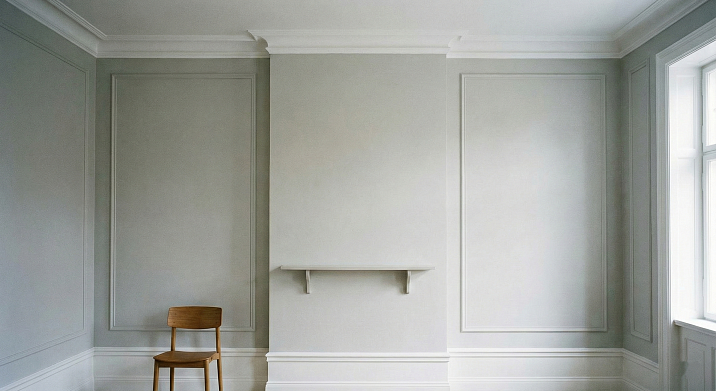
A modern interior is built not on decorative excesses, but on strict architectural logic, where every element functions as part of a unified structure. Cornices, moldings, and baseboards are no longer mere decorations—they have become the load-bearing framework of a space, defining its character even before furniture and textiles appear. This is not classicism in the usual sense with gilding and carvings, but precise geometry, calculated proportions, and purity of lines, where nothing is superfluous, yet every detail is in its place.


Why an Interior Needs an Architectural Framework
An empty room with smooth painted walls and a ceiling seems bland, even if the finish is executed perfectly. It doesn't hold the gaze, doesn't create scale, doesn't form a sense of completeness. It's like a sheet of paper without any markings—technically it's clean and flawless, but there's nothing for the eye to catch onto. An architectural framework made of cornices, moldings, and baseboards solves this problem fundamentally: it creates a structure within which the interior unfolds.
Imagine the skeleton of a building—a framework of beams, columns, floors. Without it, the walls would simply collapse. In an interior, this framework role is performed precisely by trim elements: they establish verticals and horizontals, mark transitions between planes, create rhythm and proportions. At the same time, they themselves can be extremely laconic—without carvings, without ornaments, without classical scrolls. A correctly chosen profile, precisely calculated height and thickness, and a skillfully selected color are sufficient.




Three levels of the framework: bottom, middle, top
Any room can be broken down into three architectural tiers, each solving its own tasks and connected to the others by a common logic.
Our factory also produces:


Lower level: baseboard as the foundation
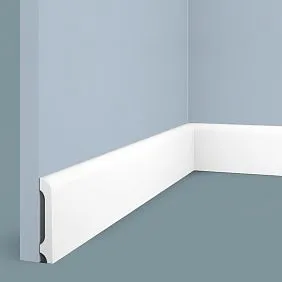
Wooden baseboard— is not a technical detail for covering gaps, but a fundamental horizontal line that 'grounds' the walls and creates a transition from the vertical to the floor. In laconic interiors without complex panel systems and multi-layered compositions, it is the baseboard that bears the entire load of creating the lower boundary of the space. If chosen correctly — in height, profile, color — the room immediately gains architectural definition. If not — even an expensive renovation will look unfinished.
The height of the baseboard directly affects the perception of scale. A thin profile of 50–60 millimeters is suitable for compact spaces with low ceilings or minimalist aesthetics where visual lightness is important.Wide Wooden Skirting BoardA baseboard 90–120 millimeters high creates a sense of monumentality and status, appropriate in spacious rooms with high ceilings, in neoclassical and transitional styles. It's important to understand: baseboard height is not a designer's whim, but a matter of proportional mathematics. A baseboard that is too low in a tall room will get lost and make the room visually 'cold'; one that is too high in a small room will 'eat up' the space.
The baseboard profile can be extremely simple — a straight plank with a micro-bevel or none at all, sharp edges, clear geometry. This works in modern interiors where decorativeness is replaced by precision of execution: when corners are perfectly mitered, joints are invisible, the surface is flawless — a laconic profile looks expensive precisely due to quality. One can choose a slightly rounded profile with a soft radius — a compromise between minimalism and classic, a universal solution for transitional styles.
The color of the baseboard determines whether it will 'dissolve' into the space or, conversely, emphasize the contour. A monochrome scheme, whenWhite Wooden Baseboardthe baseboard is painted to match the wall color, creates visual unity — the wall and baseboard merge, the boundary softens, the space is perceived as whole. A contrasting scheme — a dark baseboard on light walls or vice versa — clearly marks boundaries, creates a 'frame' for the room, pulls the space together. Both approaches are correct, but they work differently.
Get Consultation
Middle level: moldings and panels
The middle tier of the wall is the most complex and variable. Wall panels, horizontal borders, vertical battens, frame compositions made of moldings can be located here — or nothing at all, if the interior concept requires clean planes. But even in the most minimalist space, walls rarely remain completely empty: windows, doors, niches, radiators, switches appear — elements that break the monolithic plane. And here moldings become a tool for ordering: they unite disparate objects into a composition, set axes of symmetry, create visual connections.
A classic technique is a horizontal molding-border at a height of about one-third from the floor (usually 80–100 centimeters). This line was historically called a 'dado rail' or 'chair rail' — it protected walls from damage by chair backs. In a modern interior, the function has changed, but the logic remains: the horizontal divides the wall into two tiers, the lower of which can be painted in a darker or contrasting shade, covered with dense wallpaper, clad in wood — while the upper one is left light. This visually lowers the ceiling (good for overly tall rooms), creates a sense of coziness and intimacy, adds architectural complexity without excessive decor.
Vertical moldings work differently: they 'lift' the space, stretching it upward. Narrow slats, evenly spaced across the entire wall or on an accent section, create a rhythmic pattern that replaces wallpaper and murals. This looks especially effective in monochromatic interiors: white slats on a white wall, gray on gray—seemingly all one color, but the play of light and shadow on the relief creates volume and texture.MDF Interior StripHigh-density MDF is ideal for such solutions: it is geometrically stable, easy to paint, and does not warp with humidity fluctuations.
Frame compositions are when moldings form rectangular or square fields on the wall. Inside the fields, there can be contrasting paint, wallpaper, fabric, a mirror, a light fixture — or simply the same finish as the surroundings, but the frame itself already creates an architectural accent. In classicism, such compositions are called 'boiserie,' but the modern interpretation is much freer: asymmetrical fields, different sizes, offset axes. The main thing is that the frames rest on the baseboard and are supported by a cornice at the top, then the entire space is perceived as a single structure.
Upper level: Cornices and ceiling framings
The upper tier closes the architectural vertical and creates a transition from the wall to the ceiling.Ceiling baseboard woodenA ceiling cornice or a classic cornice performs several functions simultaneously: it conceals the junction of a stretch or suspended ceiling, masks hidden LED lighting, and visually 'lowers' or 'raises' the room's height depending on the chosen profile and color.
In laconic interiors, the ceiling cornice is often made as simple as possible — a thin plank with a straight or slightly slanted profile, painted the color of the ceiling. It is almost unnoticeable but creates a clear line that 'gathers' the walls under the ceiling. A more expressive cornice with several levels or soft relief is suitable for neoclassicism and transitional styles: it is not overloaded with decor but has sufficient plasticity to create a play of light and shadow.
An important detail: the profile of the ceiling cornice should echo the profile of the floor baseboard. It is not necessary to copy it literally, but the radii of roundings, bevel angles, and the ratio of thickness to height should be coordinated. When the top and bottom of the room 'speak' the same language, the space is perceived as harmonious, even if no one consciously notices it.
How to choose profiles without unnecessary decor
The main principle of a laconic architectural framework is that form follows function, and decorativeness arises from precision of execution, not from an abundance of details. This does not mean you need to choose the most primitive profiles — simply every curve, every bevel, every plane should be meaningful, not random.
Geometry Instead of Ornament
A classic carved molding with plant motifs, acanthus leaves, rosettes, and volutes — is beautiful, but that is a completely different aesthetic, requiring an appropriate environment. In a modern interior built on clean planes and laconic forms, such decor will look alien. Instead, profiles built on geometry work: a combination of straight planes and soft radii, stepped transitions, diagonal bevels, thin grooves.
For example, a molding with a simple cross-section — a flat base plus a thin protruding plank with a micro-bevel — creates a delicate relief that is visible in side light and completely disappears when viewed head-on. This is that very 'hidden decor,' where the wall seems absolutely smooth, but as you move through the room, subtle lines appear on it. Or a cornice with two levels — a wide lower plane and a narrow upper projection — creates architectural complexity without a single curl.
Thickness and proportions
Thin profiles (10–15 millimeters thick) are suitable for small rooms and minimalist interiors: they do not overload the space, create graphic lines. More massive ones (20–30 millimeters) work in spacious rooms with high ceilings: they form a pronounced relief, cast clear shadows, create a sense of solidity.
The proportion between height and thickness is also important. A tall and thin profile looks elegant, almost graphic — suitable for vertical elements, door frames, narrow inserts. A low and thick one — massive and monumental, good for horizontal borders, cornices, plinth panels. A square cross-section (height equals thickness) — universal and neutral, easily combines with any other elements.
Material as part of the concept
with a classic profile creates a sense of solidity, reliability.Solid oak or beech molding — is not just a beautiful natural material, but also tactile, tangible architecture. Wood has weight, density, texture — qualities that cannot be faked by imitation. In laconic interiors, where there is no abundance of decor, it is these tactile properties that create a sense of quality and durability. When a guest runs their hand over a wooden molding, they feel the coolness of the solid wood, the slight roughness of natural wood under oil, the density of the material — this works on a subconscious level.
High-density MDF — a material for perfect geometry and monochrome solutions.MDF railHigh-density MDF is stable, does not warp with humidity fluctuations, and provides a flawless surface for painting. When the concept requires absolutely flat white or gray planes, MDF is the optimal choice. It can be coated with enamel so that the surface becomes like porcelain: smooth, dense, without pores or texture.
Combining materials also works:wooden baseboardfrom solid wood (where strength and tactile feel are needed) plus MDF wall panels (where geometric stability is important) plus lightweight polyurethane ceiling cornice (for complex curved sections) — if all elements are coordinated in profile and color, only a specialist will notice the difference in materials, and visually the system will be perceived as a whole.
Color strategies: monochrome, contrast, accents
The color of the architectural frame determines whether it will be 'read' as an independent element or dissolve into the space, becoming part of the walls and ceiling.
Monochrome scheme: dissolving boundaries
When all frame elements — baseboards, moldings, cornices — are painted the same color as the walls and ceiling, the boundaries between planes soften. The room is perceived as a single architectural shell, inside which there is subtle relief but no obvious dividing lines. This visually enlarges the space, making it more cohesive and calm.
Monochrome does not mean 'boring' — on the contrary, with proper work with light and texture, such an interior possesses complexity and depth. White on white, gray on gray, beige on beige — but due to the relief of moldings, play of light and shadow, differences in textures (e.g., matte wall plus semi-matte baseboard), visual richness emerges. The main condition for success is flawless execution: when corners are precisely mitered, joints are invisible, surfaces are impeccable, monochrome looks expensive and refined.
Contrast scheme: emphasizing structure
A contrasting frame — dark baseboards and cornices on light walls or, less often, light on dark — clearly delineates the architectural structure of the room. This creates a sense of a 'frame' within which the interior unfolds, visually organizes the space, making it more graphic and defined.
Contrast does not have to be sharp: black on white has become a cliché. More interesting are complex combinations — dark graphite on warm gray, deep blue on dusty pink, dark walnut on milky beige. Such pairs create visual depth without shouting for attention. It is important that the contrasting element is supported in the interior: if the baseboard is dark, then doors, window frames, and part of the furniture should be in the same tonal range — otherwise it will look like a random spot.
Natural wood as a neutral base
When the architectural frame is left in the natural color of wood — light beech, honey oak, silver ash — it works as a universal base that pairs with any shades of walls and furniture. The warm tone of wood adds coziness even to a strict minimalist interior, creates a tactile note, and compensates for the coldness of concrete or glass.
Natural wood works especially well in monochrome spaces: when walls are white or light gray, and all wooden elements — baseboards, trims, battens, furniture — are made from the same species and finished with the same oil, a sense of Scandinavian purity and eco-friendliness arises. However, wood does not necessarily have to be left completely natural — light tinting can be used to emphasize the texture without completely covering it.
Installation as part of the concept: precision over decoration
In minimalist interiors, where there is no carving or ornamentation to distract the eye, the quality of installation becomes critical. Any inaccuracy, any noticeable joint, any gap immediately catches the eye and ruins the impression. Here, you cannot 'mask' flaws with decorative elements—only flawless execution remains.
Corners: 45 degrees or precise fitting
Installation of wooden baseboardsIn corners requires precise cutting. Internal corners are usually cut at a 45-degree angle and joined in a miter—when done correctly, the seam becomes almost invisible. External corners are even more critical: any gap will be visible under side lighting, so jewel-like precision is needed here. Professionals use miter saws with laser guides, set the angle to within tenths of a degree, and after cutting, refine the ends with fine sandpaper.
In monochromatic interiors, where the baseboard is painted the same color as the wall, joints can be additionally filled with acrylic compound and touched up—then they become completely invisible, creating the impression that the baseboard is not slats but a monolithic part of the wall. This requires time and skill, but the result is worth it.
Fastening: invisible and reliable
Installation of Wooden Skirting BoardCan be done in several ways. Adhesive installation—when the baseboard is glued to the wall with polyurethane adhesive—provides a clean surface without visible fasteners but requires perfectly flat walls. Mechanical fastening with screws or finishing nails is more reliable but leaves fastener points that need to be filled and painted over. A combined method—adhesive along the entire length plus mechanical fastening at key points—is optimal for most cases.
It is important that the fastener is recessed flush or even slightly deeper, filled with a high-quality acrylic compound, and sanded to perfect smoothness. In a minimalist interior, any visible fastener point is visual noise that disrupts the purity of the lines.
Joining and connections
On long walls, baseboards have to be joined. A straight 90-degree joint is the simplest but visually noticeable. A 45-degree miter joint (as in corners) looks more elegant, especially on baseboards with wood grain—the seam is less noticeable. On painted baseboards, the joint can be filled and painted over, making it practically invisible.
Wall moldings also require precise joining: when creating framed compositions, all corners must meet perfectly, without gaps or misalignments. Preliminary marking on the wall (laser level, pencil, painter's tape) and patience help here—it's better to spend time on precise fitting than to later try to mask flaws.
Functionality without compromising aesthetics
An architectural framework is not just about beauty but also practical benefit. Each element solves specific tasks that make living in the interior more comfortable.
Protection and durability
with a classic profile creates a sense of solidity, reliability.Protects the lower part of walls from vacuum cleaner bumps, mop hits, furniture legs, and water splashes during wet cleaning. This is especially important in hallways, corridors, kitchens—areas with high traffic and intensive use. A high-quality solid wood baseboard with a durable finish lasts for decades, protecting wall finishes and eliminating the need for frequent cosmetic repairs.
Wall moldings can also serve a protective function: a horizontal border at chair-back height protects the wall from damage in the dining area; vertical slats protect corners and protrusions. At the same time, the protection does not look utilitarian—it is integrated into the architectural composition.
Concealing engineering and compensating for unevenness
The baseboard conceals expansion gaps for parquet and laminate (5–10 millimeters around the room perimeter), masks unevenness where the floor meets the wall, and allows for neatly hiding cables. Some profiles have a special channel for wiring, which is especially convenient in modern interiors saturated with electronics.
The ceiling cornice conceals the junction of a stretch ceiling, masks LED strips for contour lighting, and compensates for unevenness in the upper part of walls. Moldings can cover joints between different finishing materials—for example, the transition from a painted wall to a wooden panel, from tile to wallpaper. All this is done neatly and inconspicuously, without disrupting the overall aesthetics.
Acoustics and comfort
Wooden elements on walls—slats, panels, moldings—improve room acoustics by breaking up sound waves and reducing reverberation. This is especially noticeable in rooms with hard surfaces—concrete walls, stone floors, large windows.Decorative MDF railsMounted on an accent wall, they not only create a visual rhythm but also make the sound in the room softer and more pleasant.
Scenarios for different spaces
The architectural framework is selected individually for each room, taking into account its function, dimensions, proportions, and style.
Living room: balance of openness and structure
In the living room, the architectural framework should create a sense of spaciousness while providing structure. Here, the following work well: a talland paint it to the desired shade — standard practice in modern design. It is important to use special wood finishes that allow the material to breathe.Baseboard can be in the range of 90–120 millimeters, an expressive ceiling cornice, an accent wall with vertical slats behind the TV or sofa. The color scheme—monochrome or soft contrast, without sharp transitions.
If the living room is combined with the kitchen or dining area, moldings help visually zone the space: for example, a horizontal border at the level of the bar counter runs along the entire perimeter, creating a visual connection between different functional zones.
Bedroom: Intimacy and Coziness
In the bedroom, the architectural framework creates a sense of privacy and security. Here, the following are appropriate: a panel system behind the bed headboard (vertical or horizontal moldings forming a frame), soft warm shades, matte finishes. The baseboard can be slightly lower than in the living room (70–90 millimeters) to avoid overwhelming the space.
An interesting technique is to use moldings to create a 'headboard' from architectural elements: a rectangular frame on the wall, inside which there is contrasting paint or wallpaper, and above it—built-in lighting. This is functional (replacing a traditional bed headboard) and visually striking.
Kitchen and dining room: practicality and clarity
In the kitchen, the architectural framework must be not only beautiful but also practical. Baseboards made of solid wood with a durable polyurethane coating or painted with moisture-resistant enamel, moldings that are easy to clean and do not absorb odors. Clear geometric profiles, contrasting schemes (dark bottom, light top), horizontal borders at the level of the work zone work well here.
In the dining area, moldings can create a panel system that visually separates the dining group from the kitchen block, giving this part of the room a more formal, 'guest' character.
Entryway and hallway: protection and visual expansion
The entryway is the most heavily used space in terms of wear and tear. Here, sturdy solid wood baseboards are needed, possibly tall ones (100–120 millimeters), to protect the walls from shoes, bags, and strollers. Moldings can help visually expand a narrow corridor: a horizontal border at a height of 80–100 centimeters, painted a darker shade than the upper part of the wall, 'lowers' the ceiling and makes the proportions more comfortable.
Vertical slats in the entryway are a controversial solution; they can visually narrow an already tight space. Horizontal lines or framed compositions work better, creating visual accents without compressing the space.
First mistake - unstructured mixing. A classic chair, loft table, Scandinavian chest, and minimalist cabinet in one room is not eclecticism, but visual chaos. Each item draws attention to itself, not creating cohesion. A system, logic, unifying idea is needed. Choose one dominant style, add a second as an addition, and possibly a third as an accent. But no more than three, and all should have something in common - color, material, era, or functionality.
Even with the correct choice of architectural frame elements, the result can be ruined by errors in design or installation.
Inconsistent profiles
When baseboards, casings, moldings, and cornices are chosen from different catalogs without considering the overall logic, they do not form a cohesive system. A baseboard with sharp edges plus a casing with a soft radius plus a cornice with complex relief—this is visual chaos, even if each element is good on its own. Profiles from the same 'family' should be chosen—either all angular, all rounded, or combined, but according to a single logic.
Incorrect scale
A baseboard that is too thin in a large room will get lost; one that is too massive in a small room will overwhelm it. A molding that is too wide on low walls will eat up space; one that is too narrow on high walls will not be noticeable. The sizes of the elements must be correlated with the proportions of the room, and remember: it's better to be slightly larger than small and indistinct.
Ignoring color logic
Random color solutions destroy the system. If the baseboard is contrasting and the cornice matches the walls, the logic is broken, and the space looks unfinished. Either the entire frame is monochromatic, or the entire frame is contrasting, or there is a clear rule (for example, the bottom is dark, the top is light, and the moldings support both shades).
Careless installation
In minimalist interiors, sloppy installation kills the entire concept. Gaps in corners, visible fastening points, crooked joints, uneven painting—all of this immediately catches the eye and downgrades the interior from the category of 'expensive and high-quality' to 'cheap and rushed.' If you are not confident in your skills, it is better to hire a professional than to ruin expensive materials.
Care and durability of the architectural frame
A properly installed architectural frame made of quality materials lasts for decades without requiring complex maintenance.
Regular cleaning
Baseboards and moldings collect dust, especially if they have a relief profile. Regular dry cleaning with a soft brush or a vacuum cleaner with an attachment, and wet wiping with a well-wrung cloth once a week—this is enough to maintain cleanliness. Avoid abrasive agents and hard sponges—they scratch the finish.
Recoating
Wooden elements with an oil finish require periodic renewal: every 1–2 years in high-contact areas (baseboards in the entryway, moldings in the dining room), a thin layer of oil can be applied to refresh the color and restore protective properties. Enamel finishes are more durable, but scratches on them are more noticeable—they can be locally touched up with special markers or a brush.
Repair and Restoration
One of the advantages of a wooden frame is the possibility of restoration. Scratches, chips, and darkened areas can be sanded and refinished. This is impossible with plastic or polyurethane elements—they can only be replaced. Wood lasts a long time if cared for and acquires a noble patina over the years.
STAVROS: a systematic approach to the architectural frame
Creating an architectural frame for a room without excessive decor is not just about buying a few strips and sticking them on the walls. It is thoughtful design where each element is coordinated with the others in terms of profile, proportions, material, and color. This requires an understanding of architectural principles, knowledge of materials, and experience working with space.
The company STAVROS has been specializing in systemic interior solutions for over twenty years. When you choosecornices, moldings and baseboardsfrom the STAVROS catalog, you get not a set of disparate parts, but a coordinated system where profiles complement each other, thicknesses and heights are selected in harmonious proportions, and the quality of processing allows for flawless joints and perfect geometry.
The STAVROS production base works with both solid noble woods (oak, beech, ash) and high-density European MDF—this makes it possible to select the optimal solution for any task. For minimalist interiors where the purity of lines and stability of geometry are important, MDF becomes the ideal material. For spaces where the tactility and nobility of natural wood are needed, solid wood is the only correct choice.
Particular attention in production is paid to precision: tolerances on profiles are ±0.1 millimeters per linear meter, which is critically important when creating panel systems and joining corners. When two pieces of baseboard from different batches join perfectly without adjustment—this is the result of strict quality control at every stage.
A wide range of profiles allows solving tasks of any complexity: from simple minimalist interiors with a minimal set of elements to complex architectural compositions with multi-level panels and hidden lighting. At the same time, each profile is thought out not only in terms of aesthetics but also in terms of installation technology—they join easily, hold fasteners well, and are stable during use.
By choosing STAVROS, you choose a partner who understands that the architectural frame is not an interior decoration, but its load-bearing structure, which must be thought out to the smallest detail and executed flawlessly. Because an interior without excessive decor requires not less, but more professionalism—there is nowhere to hide here; only quality, precision, and an understanding of architectural logic work. And this is exactly what STAVROS offers its clients: not just beautiful strips, but tools for creating a space that will serve for decades and not lose relevance because it is built on fundamental architectural principles, not on fleeting fashion.


