Article Contents:
- Introduction
- Main norms and standards
- International and national norms
- Recommendations for calculation
- Functional significance of the distance between balusters
- Load calculation and force distribution
- Strength characteristics of materials
- 1. Determining the optimal spacing
- Calculation formula
- 2. Considering the staircase construction features
- 3. Practical tips for marking and installation
- Accurate marking
- Correct fastening
- Quality Control
- Visual perception
- Balance between functionality and decor
- Integration with other railing elements
- Normative documents and recommendations
- Load calculation
- Examples of calculation formulas
- 1. Measure the space carefully
- 2. Create a detailed plan
- 3. Consider construction features
- 4. Pay attention to regulations
- 5. Consult with specialists
- 6. Conduct testing
- Example 1: Straight staircase
- Example 2: Curved staircase
- Visual perception
- Harmony with other elements
- Balance between safety and design
- Preparation for Installation
- Precise installation
- Quality control after installation
- Regular Maintenance
- Programmatic modeling
- Use of specialized applications
- Integration with automated installation technologies
- Combination with other staircase railing elements
- Aesthetic balance and proportions
- Cost savings and optimization
- Case 1: Straight staircase with evenly spaced balusters
- Case 2: Curved staircase
- Case 3: Adjusting distance for narrow staircases
- Prevention of injuries
- Even load distribution
- Strength characteristics and durability
- Visual balance and harmony
- Combination with other railing elements
- Proportional effect
- Use of construction levels and tape measures
- Programmatic modeling
- Specialized online tools
- Step 1. Preparation of measurement data
- Step 2. Applying the calculation formula
- Step 3. Adjustment according to regulatory requirements
- Step 4. Visual modeling
- Step 5. Conducting testing
- Enhancing safety level
- Aesthetic aspect
- Even load distribution
- Accurate marking
- Quality mounting
- Regular inspection
- Harmony with stair post elements
- Compatibility with stair handrail elements
- Finishing elements: caps
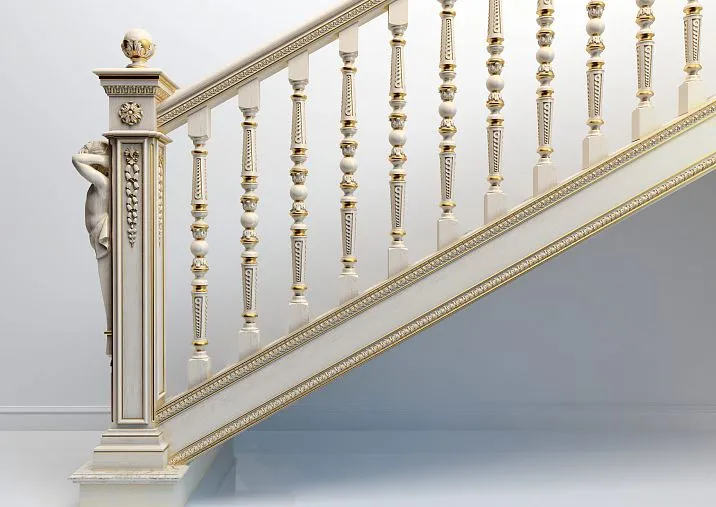
railings, as well as decorative caps andPosts for staircase stair railings.balusters for staircasesThis article is intended for homeowners, designers, builders, and anyone who wants to understand the nuances of correctly calculating the distance between balusters to create a safe and attractive stair railing.


Introduction
A staircase is not just a connection between floors, but an important element of the architectural ensemble that sets the tone of the interior. The staircase railing, particularly balusters, serves a dual role: it ensures safety during ascent and descent, and also gives the staircase an elegant appearance. The distance between balusters directly affects the structural stability and user comfort. Too large a distance may lead to injury risk, while too small a distance may visually overload the space and create a sense of confinement.
When calculating the distance between balusters, both technical norms and standards, as well as aesthetic features of the interior, must be considered. In this article, we will examine recommendations for optimal baluster spacing, review regulatory documents, analyze the experience of specialists, and share practical tips for self-calculation.




Main norms and standards
Our factory also produces:


International and national norms
Different countries have their own regulatory documents governing the safety and technical characteristics of stair railings. In Russia, GOSTs play an important role, establishing minimum requirements for baluster spacing, strength, and stability. International standards, such as ISO and ASTM, also influence the design of stair railings, especially in projects implemented by international companies.
Main parameters that regulatory documents focus on:
● Minimum distance between balusters. Usually, the norm sets that the gap between balusters should not exceed a certain value to prevent children from crawling through or clothing from getting caught.
● Height of balusters. The height affects not only safety but also the convenience of using the staircase.
● Strength characteristics. Balusters must withstand specified loads, distribute them evenly, and be resistant to mechanical impacts.
Get Consultation
Calculation recommendations
Standard spacing between balusters in residential buildings is about 10–12 cm, but depending on the project specifics and client requirements, this parameter may vary. If the staircase is intended for children’s use, regulations may be stricter. However, it is important not only to comply with minimum requirements but also to consider the aesthetic aspect: even distribution of balusters creates a harmonious and finished appearance of the staircase.
Technical aspects of safety
Functional significance of baluster spacing
Spacing between balusters directly affects:
● Safety. Properly selected spacing ensures protection against accidental falls and prevents children from passing through the railing.
● Structural stability. Even distribution of balusters helps better distribute loads and prevents deformation of the railing.
● Ergonomics. Optimal spacing ensures comfort when using the staircase, allowing the user to hold onto the railing easily.
Load calculation and force distribution
When designing a staircase railing, it is necessary to consider the load distributed between balusters. If the spacing between balusters is too large, the load on each component increases, which may lead to premature wear or even failure. Therefore, engineers conduct careful load calculations, taking into account not only the weight of a person but also dynamic loads arising from active use of the staircase.
Material strength characteristics
The material from which balusters are made plays a key role in staircase safety. Natural wood, metal, or composites have different strength characteristics, and material selection depends on operating conditions and required durability. For example:
● Oak balusters provide high strength and durability but require careful processing and regular maintenance.
● Metal balusters have high resistance to mechanical damage, but may require anti-corrosion treatment.
● Composite materials are often a compromise solution, combining the advantages of natural wood and metal.
When calculating the spacing between balusters, consider not only geometric parameters but also the strength characteristics of the selected material. This will ensure the long-term durability of the railing and safe operation.
Practical recommendations for calculating baluster spacing
1. Determining optimal spacing
Start by determining the optimal spacing between balusters, considering regulatory recommendations. Typically, the minimum spacing should not exceed 10–12 cm to prevent children from slipping through. However, depending on the design and style of the staircase, this parameter may be adjusted. It is important that the spacing between balusters is uniform along the entire length of the railing, ensuring not only safety but also a harmonious visual appearance.
Calculation formula
To calculate spacing, you can use the following formula:
R = (L - (n × W)) / (n - 1),
Where:
● R – spacing between balusters,
● L – total length of the railing,
● n – total number of balusters,
● W – width of one baluster.
This formula allows determining even distribution of balusters along the entire length of the staircase. At the same time, it is necessary to consider additional tolerances provided by regulations.
2. Considering staircase construction specifics
When calculating spacing between balusters, it is necessary to consider the specific construction of the staircase:
● Straight staircases. For straight staircases, calculation is performed using the standard formula, and accurate marking is crucial.
● Curved staircases. For curved staircases, spacing between balusters may vary, and a more complex calculation considering the curvature of the railing is required. In such cases, it is optimal to use computer modeling to determine the most safe and aesthetically pleasing placement of balusters.
● Narrow and compact staircases. In limited space conditions, gaps may be reduced, but it is important not to violate safety regulations. Special solutions allow optimizing the design without compromising structural strength.
3. Practical tips for marking and installation
Accurate marking
Before installing balusters, accurate marking is required:
● Use a level, tape measure, and square for measurements.
● Mark the installation positions of balusters along the entire length of the railing, considering the calculated spacing.
● Check the uniformity of distances and compliance with all tolerances.
Correct mounting
Baluster mounting must be performed using reliable fasteners. This ensures not only safety, but also the longevity of the railing.
● Use certified anchors and screws.
● Use adhesive or other means for additional reinforcement of mounting.
● Check the stability of each connection after installation.
Quality control
After installation, mandatory inspection must be conducted:
● Check that the distances between balusters correspond to calculations.
● Ensure there is no play or misalignment.
● If necessary, make adjustments to achieve the optimal result.
Influence of baluster spacing on staircase aesthetics
Visual perception
Uniform and correct spacing between balusters creates a harmonious and complete appearance of the railing. If the gap is too large, the staircase may appear untidy and 'blurry', while if too small, it may create an impression of being overly detailed. Optimal spacing highlights the geometric forms and style of the structure, making it visually appealing.
Balance between functionality and decor
Properly selected spacing ensures not only an aesthetic effect, but also functionality:
● The baluster should be positioned close enough to ensure safety (especially in homes with children), but not so close as to hinder the perception of the railing.
● The effect of evenly distributed balusters helps better distribute load and contributes to the overall stability of the structure.
Coordination with other railing elements
Baluster spacing must harmoniously match other railing elements, such asPosts for staircase, stair railings and decorative finials. Compatibility of all these elements allows creating a unified, balanced ensemble that will be not only functional but also a true work of art in the interior.
Technical aspects: calculation and regulations
Regulatory documents and recommendations
In Russia, there are regulatory documents for stair railings that regulate not only the strength characteristics of the products, but also the spacing between balusters. For example, GOSTs and construction norms require that the gap between balusters does not exceed a certain value to prevent children from slipping through. These norms are mandatory and must be strictly followed during the design and installation of the staircase.
Load calculation
When calculating the distance between balusters, it is necessary to consider the loads acting on the railing:
● Static load. This is the weight borne by the balusters during normal operation.
● Dynamic load. This occurs during active use of the staircase (during falls, impacts, etc.).
● Load distribution. The more evenly the load is distributed, the more reliable the structure.
Using computer modeling can significantly simplify the calculation process. Programs allow simulating the staircase taking into account all loads and determining the optimal distance between balusters, ensuring the safety of the structure.
Examples of calculation formulas
One of the popular formulas for calculating the even distribution of balusters is the following:
R = (L – (n × W)) / (n – 1),
Where:
● R – spacing between balusters,
● L – total length of the railing,
● n – number of balusters,
● W – width of one baluster.
This formula allows determining the even distance between balusters, taking into account the dimensions of each element. It is important to consider the tolerances established by regulatory documents.
Practical recommendations and tips
1. Measure the space carefully
Before starting calculations, it is necessary to accurately measure the total length of the staircase railing, the width of the balusters, and other important parameters. Use quality measuring tools – tape measure, construction level, and laser distance meter. Accurate measurements will help avoid errors in calculation and ensure proper baluster distribution.
2. Prepare a detailed plan
Prepare a drawing or diagram of the future staircase indicating all dimensions and distances. This will help visualize the final result, understand how many balusters will be needed, and determine the optimal distance between them for your project.
3. Consider the construction features
If your staircase has a curved shape or is located in a narrow space, calculating the distance between balusters may require additional adjustments. In such cases, it is recommended to use specialized software for staircase modeling, which will allow accurately calculating distances taking into account curvature and other features.
4. Pay attention to regulations
Be sure to study the current building codes and standards regulating staircase safety. Regulatory documents establish minimum requirements for the distance between balusters, which is especially important for child protection. Compliance with these norms is the guarantee of safety and reliability of the structure.
5. Consult with specialists
If you have doubts about the calculations or wish to obtain professional advice, do not hesitate to consult specialists – engineers, designers, or experienced builders. Professional consultation will help avoid errors and provide valuable recommendations for optimizing the structure.
6. Conduct testing
After installing the balusters, be sure to test the railing. Check its stability, absence of play, and even load distribution. If possible, conduct load tests to ensure the structure meets all safety requirements.
Examples of distance calculations: case study
Example 1: Straight staircase
Suppose you have a straight staircase with a railing 300 cm long. If the width of each baluster is 5 cm, and you plan to install 10 balusters, calculate the distance between them using the formula:
● Total baluster width: 10 × 5 = 50 cm.
● Distance between balusters:
R = (300 – 50) / (10 – 1) = 250 / 9 ≈ 27.8 cm.
This distance is approximate and can be adjusted according to aesthetic considerations and additional regulatory requirements.
Example 2: Curved staircase
For a curved staircase, the calculation becomes more complex, as the railing has a curved shape. In this case, it is recommended:
● Divide the railing into several sections.
● Calculate the distance between balusters for each straight segment.
● Take into account that at bends, the distance may slightly vary to ensure optimal stability and safety.
Programmatic modeling will help simulate the curved railing and accurately calculate distances to maintain harmony and safety of the structure.
Influence of baluster spacing on staircase aesthetics
Visual perception
Even distribution of balusters significantly affects the visual perception of the staircase railing. If the distance between balusters is too large, the staircase may appear "broken"; if too small, it may appear overloaded with details. The optimal distance creates a sense of neatness and thoughtful design, emphasizing its style and architectural completeness.
Harmony with other elements
The distance between balusters should be coordinated with the size and style of other components. For example,Posts for staircase andstair railings they should also harmoniously match the balusters. Consistency of all elements in style and proportions creates a unified ensemble that becomes the focal point of the interior.
Balance between safety and design
Regulations governing the distance between balusters are primarily aimed at ensuring safety. However, designers may adjust these parameters to achieve a better aesthetic effect, without compromising safety requirements. The optimal balance ensures ease of use, prevents injury risks, and makes the structure visually appealing.
Practical recommendations for installation and checking distances
Preparation for installation
Before installing balusters, it is important to carefully prepare the work area:
● Conduct precise measurements of the total railing length.
● Mark the locations for baluster mounting, taking into account the calculated distance.
● Ensure that the surface to which the balusters will be mounted is flat and clean.
Accurate installation
When installing balusters, follow these recommendations:
● Use high-quality measuring tools (tape measure, level, laser distance meter).
● Secure each baluster at the pre-marked location to maintain even spacing.
● Use guides or templates if necessary to ensure precise installation.
Quality control after installation
After installation, conduct a thorough inspection:
● Measure the distance between balusters along the entire length of the railing to ensure even distribution.
● Check the stability and reliability of the fasteners. Absence of play or misalignment indicates quality installation.
● If discrepancies are found, make corrections immediately to avoid potential risks during staircase use.
Regular maintenance
Even after successful installation, it is important to regularly inspect the railing:
● Conduct periodic inspections of fasteners and baluster condition.
● Renew protective coatings (varnish, oil, or antiseptic) to maintain aesthetics and protect against external influences.
Monitor the wear of parts and perform repair work in a timely manner.
Modern technologies and innovations in distance calculation
Programmatic modeling
Modern CAD systems allow modeling of stair runs taking into account all construction nuances. Using programmatic modeling, you can:
● Calculate the optimal distance between balusters, taking into account all loads.
● Take into account the characteristics of curved railings and adjust the calculation for each segment.
● Create a 3D model that will help visually assess the final result and make necessary adjustments before installation begins.
Use of specialized applications
There are applications and online tools that will help calculate the distance between balusters. These tools take into account standard norms and allow you to quickly obtain approximate values, which is especially useful when planning renovation or construction.
Integration with automated installation technologies
Modern installation technologies allow for precise adherence to calculated parameters. Using laser levels, digital tape measures, and automated control systems helps achieve maximum accuracy when installing balusters. This not only preserves the calculated distance but also ensures even load distribution across the entire staircase structure.
Recommendations for selecting components for optimal spacing
Combination with other elements of the stair railing
The distance between balusters should be coordinated with the dimensions of other railing elements, such asPosts for staircase, stair railings and decorative finials. Harmonious combination of all elements creates a unified ensemble that looks cohesive and aesthetically pleasing. When selecting balusters, pay attention to their style, shape, and finish to ensure they not only meet safety requirements but also complement the overall staircase design.
Aesthetic balance and proportions
Optimal distance between balusters plays an important role in forming the visual balance of the stair railing. Too large a distance may make the railing look unattractive, while too small a distance may overload it with details. Experts recommend the following guidelines:
● In residential homes, the distance between balusters is usually 10 to 12 cm.
● In public and commercial buildings, a slightly greater distance may be allowed, provided it does not violate safety norms.
● When designing individually, always consider the interior features and overall design concept.
Cost savings and optimization
Correct calculation of the distance between balusters also allows for cost optimization. If the product is manufactured using modern technologies, accurate calculation helps avoid unnecessary expenses for adjustments and corrections. Cost optimization is achieved through:
● Accurate calculation and planning, which allows minimizing material waste.
● Use of standard baluster models, which are mass-produced and cheaper than custom-made items.
● Use of bulk purchases, which allows reducing the price per unit when ordering large quantities.
Practical cases and calculation examples
Case 1: Straight staircase with evenly distributed balusters
Suppose you have a straight staircase with a railing 300 cm long, and you plan to install 10 balusters, each 5 cm wide. Calculate the distance between balusters using the formula:
● Total baluster width: 10 × 5 = 50 cm.
● Distance between balusters:
R = (300 – 50) / (10 – 1) = 250 / 9 ≈ 27.8 cm.
This result complies with regulations and ensures both safety and aesthetic appeal of the structure.
Case 2: Curved staircase
For a curved staircase, the calculation becomes more complex. It is recommended:
● Divide the railing into several straight segments.
● Calculate the distance for each segment separately.
● Apply a correction factor accounting for the railing's curvature.
Software modeling will help accurately determine the optimal distance between balusters, which is especially important for complex architectural solutions.
Case 3: Adjusting distance for narrow staircases
In narrow staircases, where space is limited, the distance between balusters can be reduced. However, it is necessary to remember that the minimum distance must not allow children to crawl through. For example, if the standard distance is 10–12 cm, in narrow spaces balusters can be installed with a 10 cm gap, but it is essential to verify compliance with safety norms and conduct structural testing.
Impact of correct distance calculation on safety
Prevention of injuries
One of the main goals of installing balusters is to ensure user safety. If the distance between balusters exceeds allowable norms, it may pose a risk to young children who could crawl through the railing. Correct calculated distance guarantees that the staircase will be safe for all users, especially for families with children.
Even load distribution
Correct placement of balusters promotes even load distribution across the entire railing structure. This helps avoid overloads and deformations, which is especially important for the staircase's longevity. If the load is unevenly distributed, it may lead to rapid wear of components and require additional repair work.
Strength characteristics and durability
Optimal distance between balusters ensures not only safety but also the durability of the structure. Balusters installed according to calculated parameters withstand mechanical impacts, retain their strength and aesthetic appearance for many years.
Impact of distance on staircase aesthetics
Visual balance and harmony
Even distribution of balusters creates visual unity and harmony in the interior. If balusters are placed out of proportion, the staircase may appear untidy or overloaded. Optimal distance between balusters allows achieving a sense of completion and refinement, which is especially important for the design of modern interiors.
Coordination with other railing elements
The distance between balusters should be coordinated with the size and style of other staircase railing elements, such asPosts for staircase, stair railings and decorative finials. Only a balanced combination of all these elements allows creating a cohesive ensemble that will be not only safe but also serve as an interior decoration.
Effect of proportions
Optimal distance between balusters affects the perception of the staircase's size and shape. Proper distribution of details can visually increase the height and width of the staircase, which is especially relevant for small rooms. The balance between functionality and decor is key to achieving aesthetic completeness of the structure.
Technical tools for calculating distance
Using construction levels and tape measures
For accurate calculation of the distance between balusters, high-quality measuring tools are required:
● Tape measure for precise measurement of the railing length.
● Construction level for checking vertical and horizontal alignment.
● Laser distance meter, which helps obtain accurate measurements even in complex conditions.
Programmatic modeling
Modern CAD systems allow modeling of the staircase considering all technical characteristics and loads. This is especially important when designing curved staircases or structures with non-standard dimensions. Software modeling helps:
● Create a 3D model of the railing.
Calculate the optimal distance between balusters.
Visually assess the final result and make adjustments before starting installation.
Specialized online tools
There are several online calculators that will help you quickly calculate the distance between balusters based on your input parameters. These tools are useful both for professionals and those encountering staircase design for the first time.
Practical recommendations and tips for self-calculation
Step 1. Preparation of measurement data
Before starting calculations, you must:
● Accurately measure the total length of the staircase railing.
● Determine the dimensions of each baluster (width, thickness).
● Take into account additional elements, such as fasteners and decorative inserts.
These data will serve as the basis for subsequent calculations and will allow you to calculate the optimal distance between balusters.
Step 2. Applying the calculation formula
To evenly distribute balusters along the length of the railing, use the following formula:
R = (L – (n × W)) / (n – 1),
Where:
● R – spacing between balusters,
● L – total length of the railing,
● n – number of balusters,
● W – width of one baluster.
Apply this formula by substituting your measured data and obtain an approximate distance value.
Step 3. Adjustment according to regulatory requirements
After the initial calculation, compare the obtained value with regulations. If the calculated distance exceeds allowable values, adjust the number of balusters or their dimensions to comply with safety requirements. Remember that regulations are aimed at protecting children and ensuring structural stability.
Step 4. Visual modeling
After calculating the optimal distance, it is useful to create a visual model of the staircase railing. Use 3D modeling programs to see how the final structure will look. This will help evaluate not only technical aspects but also the aesthetic appeal of the product.
Step 5. Conducting testing
If possible, conduct a test of the structure. Install temporary balusters and check how convenient and safe their use will be. This will allow you to make final adjustments and ensure the correctness of the calculations.
Impact of correct calculation on safety and aesthetics
Increased safety level
The correct distance between balusters ensures that the staircase railing will be reliable and safe. If the gaps are too wide, there is a risk that small children may crawl through the railing. On the other hand, too narrow a distance may overload the structure and cause problems during operation. The optimal distance helps ensure safety and prevent injuries.
Aesthetic aspect
Even distribution of balusters improves the visual perception of the staircase. Harmonious proportions make the railing aesthetically appealing, contributing to creating a finished and stylish interior. If balusters are installed with disrupted proportions, the staircase may appear untidy, negatively affecting the overall room design.
Even load distribution
The correct distance between balusters contributes to even distribution of mechanical load across the entire railing, increasing its strength and durability. This is especially important for staircases with heavy usage, where each component must operate without failure.
Installation and distance checking tips
Accurate marking
Before installing balusters, it is important to conduct careful marking:
● Use a level, tape measure, and square.
● Mark the positions for baluster installation along the entire length of the railing.
● Ensure the gaps between balusters are evenly spaced and match the calculated values.
Quality Fixing
Baluster mounting must be performed using reliable fasteners:
● Use anchors, screws, and adhesive to ensure structural stability.
● Ensure fastening is precisely according to the layout and matches the calculated parameters.
● Check the strength of each connection after installation.
Regular Inspection
After installing balusters, conduct periodic inspections:
● Inspect the railing for loosening of fasteners.
● Conduct measurements to confirm the maintenance of even spacing.
● Immediately take action to address any defects or play detected.
Recommendations for Integration with Other Elements of the Stair Railing
Harmony with {name}staircase posts
The distance between balusters should be coordinated with the size and placement of posts. Harmonious combination of these elements creates a cohesive and stable structure that is visually pleasing and ensures high safety standards.
Compatibility with {name}staircase handrails
Handrails are an essential part of stair railings, and the distance between balusters should ensure convenient use of the handrail. Optimal baluster placement will create a comfortable grip area and ensure even load distribution across the railing.
Finishing Elements: Caps
Caps complete the appearance of the railing, protecting the ends of balusters and posts from mechanical damage. The correct calculated distance between balusters also affects the aesthetic harmony of the entire structure, and mounted caps become a finishing accent that highlights the neatness and thoughtful design.