












































































Article Contents:
- Wood philosophy: the material that changed the world
- Technological revolution in woodworking
- Aesthetics of wooden items: beauty tested by time
- Functionality and practicality: wood in the modern world
- Variety of species and forms
- Architectural elements
- Furniture elements
- Finishing elements
- Functional items
- Stylistic directions
- Classical styles
- Modern styles
- Ethnic Styles
- Production technologies and quality control
- Raw Material Preparation
- Mechanical processing
- Assembly and finishing
- Quality Control
- Innovations and the future of woodworking
- Digital technologies
- New Materials
- Ecological innovations
- Frequently asked questions about wooden items
- Conclusion: STAVROS — traditions of quality in the modern world
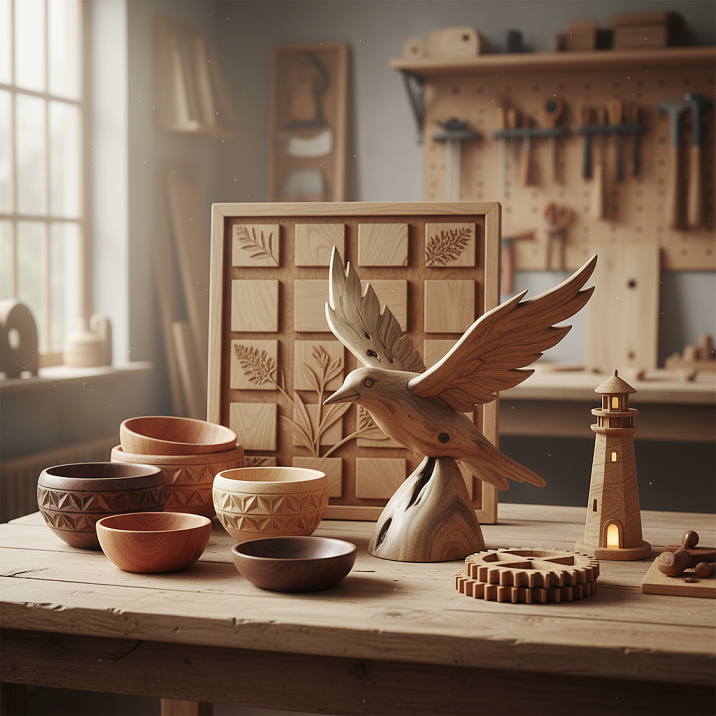
Is there anything more captivating than touching living wood? When your fingers glide over its texture, feeling each growth ring, every unique grain, time seems to stop. In this moment, you touch eternity — wood that grew for decades, absorbing sun and rain, wind and snow.Wooden itemsThese are not just interior items — they are embodiments of nature’s life force in your home.
In our fast-paced world of plastic and metal, glass and concrete, wood remains an island of authenticity. It breathes with us, changes over time, ages gracefully, like fine wine. Every scratch, every wear tells a story, becomes part of your family’s history. Isn’t it remarkable to have items in your home that live their own lives?
But what makes wooden items so attractive in the age of high technology? Why, despite having dozens of modern materials at our disposal, do we continually turn to this ancient companion of humanity? The answer lies in the very nature of humanity, in its genetic memory, in the need to be part of a living world.
Modern wooden items are a symphony of tradition and innovation, where centuries-old craftsmanship meets cutting-edge technology. This is an art perfected to perfection, where every detail is thought out, every line is precise, every surface polished to ideal condition.


Wood philosophy: the material that changed the world
Have you ever thought about the fact that wood is the only building material that reproduces itself? While we extract metals from the earth’s depths, melt glass from sand, wood grows, reaches for the sun, accumulates carbon, purifies the air. This is a material that gives back to nature, rather than taking from it.
Human history is inseparably linked to wood. The first tools, the first dwellings, the first boats — all were created from this remarkable material. Wood warmed our ancestors, protected them from the elements, fed them with fruit. It’s no coincidence that in many cultures trees were considered sacred, and their felling required a special ritual.
What happens to wood when it becomes an item? Does its life end, or does it continue in a new form? Modern science gives an astonishing answer: wood continues to 'breathe', absorbing and releasing moisture, reacting to changes in temperature and humidity. This is a living material in every sense of the word.
Each wood species has its own character, its own energy. Oak — symbol of strength and wisdom, birch — purity and gentleness, pine — resilience and vitality. Choosing items made from a specific species is not just a design decision — we invite a certain energy into our home, creating a unique atmosphere.
ModernFurniture HandlesWooden handles — a bright example of how an ancient material regains new life in modern interiors. Every touch of such a handle is an instant connection with nature, a charge of positive energy, a moment of harmony in a busy day.
The uniqueness of wood lies not only in its aesthetic qualities, but also in its ability to create a healthy microclimate in a room. Wood naturally regulates air humidity, absorbs unpleasant odors, releases phytoncides — natural antiseptics. A home with many wooden items is a home where it’s easy to breathe and pleasant to be.




Technological Revolution in Woodworking
Modern wood product manufacturing differs fundamentally from traditional methods used by our ancestors. Whereas previously the craftsman relied solely on his experience and intuition, today he has access to precise measuring instruments, computer programs, and robotic systems.
The introduction of CNC machines revolutionized woodworking. Now,balustersany complexity can be manufactured with precision down to hundredths of a millimeter. The computer controls every movement of the cutting tool, ensuring perfect repeatability and surface quality.
But does this mean that humans have lost their role in creating wooden items? Absolutely not! Technologies have freed craftsmen from routine operations, allowing them to focus on creativity. Programming the machine, selecting optimal processing modes, quality control — all of this requires deep knowledge and experience.
Laser technologies have opened previously unseen possibilities for decorating wooden items. Delicate patterns, complex ornaments, photorealistic images — all of this can now be applied to wood with jewel-like precision.decorative elementsThey acquire a new level of detail and expressiveness.
Innovative wood drying methods allow complete control over the moisture removal process. Vacuum drying, microwave treatment, infrared exposure — each method has its advantages and area of application. The result — stable wood that does not deform or crack during use.
Computer modeling helps optimize product design even at the design stage. Stress analysis, deformation calculation, material usage optimization — all of this occurs in virtual space, saving time and resources.
Production automation does not mean loss of individuality in products. Modern robots can perform complex operations according to a program created by a craftsman. This allows reproducing unique items in series while maintaining the highest quality.
Our factory also produces:


Aesthetics of wooden items: beauty, time-tested
What makes wooden items so aesthetically appealing? Why, looking at a beautifully craftedwooden handle, do we feel admiration? The secret lies in the unique combination of natural beauty and human craftsmanship.
Wood grain is a natural work of art created without human intervention. Annual rings tell the story of the tree’s life: wide rings indicate favorable years, narrow rings — drought or frost. Knots, swirls, fiber interweaving create unique patterns that cannot be artificially reproduced.
The color palette of wood is astonishingly diverse. From nearly white birch to black ebony, from golden pine to dark brown walnut — nature provides designers with a rich selection of shades. And each color is alive, with numerous mid-tones and transitions.
Modern surface finishing methods allow the full expression of wood’s beauty. Sanding with different grits creates a perfectly smooth surface that is pleasant to the touch. Brushing highlights the texture, creating a relief surface. Thermal treatment changes the wood’s color, giving it noble tones.
Finish coatings not only protect wood from external influences but also affect its appearance. Oil finishes highlight the natural beauty of wood, varnishes create a glossy sheen, wax imparts a silky finish. Each type of coating creates its own aesthetic effect.
The play of light on wooden surfaces is captivating. Depending on the angle of light incidence, the wood’s texture reveals itself differently. In the morning it may appear golden, in the evening — warm honey-colored, under artificial lighting — noble amber. This variability makes wooden items alive and dynamic.
Proportions and shapes of wooden items conform to harmony laws developed over millennia. The golden ratio, classical orders, folk traditions — all of this is reflected in modern items.CapitalA classical column’s proportions still impress with their perfection today.
Get Consultation
Functionality and practicality: wood in the modern world
Beauty is beauty, but modern wooden items must meet strict functional requirements. How does this ancient material cope with the challenges of the 21st century? Surprisingly, in many aspects, wood surpasses synthetic analogs.
The strength of quality wood can rival modern composite materials.Wooden baseboardWood from oak or ash can serve for decades without losing its original properties. At the same time, it retains the ability to be repaired — scratches and dents can be removed by sanding and re-finishing.
The thermal insulation properties of wood make it an ideal material for creating a comfortable microclimate. Wooden surfaces are always warm to the touch, unlike metal or stone, which feel cold. This is especially important forwooden handles, which are in constant contact with hands.
The acoustic properties of wood are used not only in musical instruments but also in interiors. Wooden surfaces absorb sound, creating a more comfortable acoustic environment. A room with many wooden elements sounds warmer and softer.
The anti-static properties of wood prevent dust accumulation on its surface. Unlike plastic, wooden items do not become electrified, which is especially important in modern interiors saturated with electronic equipment.
Repairability is a unique property of wooden items. Minor damage can be easily removed by sanding and re-finishing. Serious defects can be corrected using inserts and restorative compounds. An item can be completely renewed by changing its color or type of finish.
The ecological nature of wood is undeniable. It is a renewable resource that absorbs carbon dioxide from the atmosphere during growth. After the end of its service life, wooden items are fully recycled, leaving no harmful waste.
The adaptability of wood to changes in humidity and temperature allows products to 'breathe' along with the house. Minor deformations are compensated by the natural properties of the material, preventing cracks and gaps.
Variety of species and forms
The world of wooden items is astonishing in its diversity. From miniature decorative elements to massive architectural structures — wood finds application everywhere where beauty, functionality, and eco-friendliness are required.
Architectural elements
pilastersand wooden columns create a sense of monumentality and classical beauty in interiors. Modern technologies allow manufacturing these elements of any size and complexity. Grooves, capitals, bases — each detail is executed with jewel-like precision.
Wooden arches and vaults add plasticity and expressiveness to interiors. Thanks to the flexibility of wood, it is possible to create structures of complex geometry that would be impossible with stone or metal.
Wooden beamsperform not only decorative, but also functional roles, concealing joints between walls and ceilings, masking engineering utilities. The variety of profiles allows selecting a cornice for any interior style.
Furniture elements
Modern furniture is unthinkable without wooden components.furniture legsmade of wood not only provide reliable support, but also define the style of the entire item. Turned legs for classic furniture, geometric forms for modern styles — each variant has its purpose.
furniture legsrequire special attention to strength and stability. Properly calculated proportions, quality joints, reliable fasteners — all this ensures the longevity of furniture.
decor for furnituretransform simple items into works of art. Carved appliqués, moldings, rosettes create complex compositions on furniture surfaces, highlighting the craftsmanship of the maker.
Finishing elements
wooden skirting boardscomplete floor finishing, creating a neat transition between floor and wall. The variety of profiles and sizes allows selecting a skirting board for any interior.
Wooden casings create a frame around the opening, visually highlighting it from the wall plane. A classic casing has a profiled section that corresponds to the profiles of baseboards and moldings.frame door and window openings, creating a finished look. Carved casings in folk style can turn an ordinary opening into a work of art.
Frames for paintingsnot only protect artworks, but also emphasize their beauty. A properly chosen frame can radically change the perception of a painting.
Functional items
Modern wooden items often combine beauty with practicality. Skirting boards with cable channels hide wires, preserving interior aesthetics. Moldings with built-in lighting create dramatic illumination.
Modular systems allow creating complex compositions from standard elements. This is especially relevant for commercial projects, where a combination of individuality and economic efficiency is required.
Stylistic directions
Wood is universal — it fits organically into any interior style, from classic to ultra-modern. The secret lies in the proper selection of species, surface treatment, and item shapes.
Classic styles
Classic Furniturerequire appropriate surroundings. Wooden elements in classical style feature complex profiles, rich decoration, noble proportions. Premium wood species — oak, walnut, mahogany — are used.
Baroque and Rococo imply abundance of carving, gilding, complex forms. Each element is a small work of art requiring the highest level of craftsmanship from the maker.
Neoclassicism adds symbols of grandeur — eagles, laurel wreaths, military insignia — to classical forms. Massive forms, solemnity, parade-like qualities — characteristic features of the style.
Modern Styles
Minimalism requires extreme simplicity of forms. Wooden elements in this style lack decoration; their beauty lies in perfect proportions and surface quality. Light-colored wood species with natural finish are used.
Scandinavian style prefers natural materials and simple forms. Light wood, matte finishes, functionality — core principles of the style.
Loft combines rough and refined elements. Wooden items may have deliberately rough finishes, emphasizing the industrial character of the style.
Ethnic styles
Russian style is rich in carved elements, uses traditional motifs of folk art.Door Decorationin Russian style is distinguished by particular expressiveness and originality.
Eastern styles use specific wood species and processing techniques. Japanese aesthetics of simplicity, Chinese opulence, Indian exoticism — each direction has its own characteristics.
Country and Provence prefer aged surfaces, natural colors, simple shapes. The patina effect, wear, and traces of time create the atmosphere of an old house.
Manufacturing technologies and quality control
Creating high-quality wooden products is a complex technological process requiring professional equipment and highly skilled specialists. Each production stage affects the final product's quality.
Raw material preparation
The process begins with careful selection of timber. Only healthy sections of the trunk without defects — knots, rot, cracks — are used. The wood's moisture content must meet technological requirements.
Drying is a critically important stage determining the stability of finished products. Modern drying chambers allow precise control of moisture removal, preventing cracking and deformation.
Sorting timber by quality, size, and color ensures uniformity of the batch. This is especially important when manufacturing sets of products that must have a consistent appearance.
Mechanical processing
Wood cutting is performed considering the direction of fibers and texture characteristics. Proper fiber orientation ensures maximum product strength.
Milling creates precise geometry of products. Modern CNC machines allow processing parts of any complexity with high accuracy and repeatability.
Turning is used to manufacture rotational bodies — balusters, furniture legs, decorative elements. An experienced turner can create unique items by varying processing parameters.
Assembly and finishing
Assembling products requires precision and care. Quality joints ensure strength and durability. Various types of joints — dowel, screw, adhesive — are used.
Sanding is the final mechanical finishing operation. Multi-stage sanding with gradually decreasing abrasive grit creates a perfectly smooth surface.
Finishing protects the wood and gives it its final appearance. Priming, staining, varnishing — each stage requires a professional approach and quality materials.
Quality control
Incoming raw material inspection verifies compliance with technical requirements. Moisture content, density, absence of defects — all parameters are documented.
Operational control is performed at each production stage. Dimensions, surface quality, assembly accuracy — all are checked according to technological cards.
Final product inspection — the last stage of verification. Each item is inspected, measured, and tested for compliance with technical specifications.
Innovations and the future of wood processing
The wood processing industry is not standing still — new technologies, materials, and design solutions are constantly emerging. What innovations will define the industry's future?
Digital technologies
3D modeling allows creating virtual prototypes of products, testing their characteristics, and optimizing the design. This saves time and materials during the development stage.
Virtual reality allows customers to see the future product in the interior even before production begins. This eliminates errors and misunderstandings.
Artificial intelligence optimizes production processes, predicts equipment failures, and controls product quality. Machine learning allows systems to become smarter over time.
New materials
Composite materials based on wood combine natural beauty with improved performance characteristics. Thermowood, acetylated wood, polymer-wood composites — each material has its advantages.
Nanomaterials open new possibilities for modifying wood properties. Nanocomposite coatings provide self-cleaning surfaces, antibacterial properties, and UV resistance.
Biotechnology allows growing wood with desired properties. Genetically modified trees can have increased density, unusual color, or resistance to pests.
Ecological Innovations
Closed production cycle minimizes waste. All wood processing waste is used to produce fuel, fertilizers, and composite materials.
Forest restoration using drones accelerates reforestation. Automatic seed planting, growth monitoring, pest control — all can be performed by autonomous systems.
Certification of sustainable forestry guarantees that wood is sourced from properly managed forests. Consumers increasingly value environmentally responsible products.
Frequently Asked Questions about wooden products
Which wood species are most popular for manufacturing products?
The most popular species are oak, beech, ash, birch, and pine. Oak is valued for its strength and beautiful texture, beech for its elasticity and light color, ash for its uniform structure and good workability. Birch is popular due to its availability and versatility, while pine is an economical option with a pleasant aroma.
How to determine the quality of wooden products?
Quality is determined by several factors: absence of visible defects (cracks, knots, warping), accuracy of geometric dimensions, surface quality, correct assembly. Good products have uniform color, smooth surface without scratches, tight joints without gaps. It is also important to have quality certificates and manufacturer warranties.
Do wooden items require special care?
Wooden items require regular but simple care. Main rules: protection from direct sunlight and excessive humidity, regular cleaning with soft cloth, periodic renewal of protective coating. With proper care, wooden items serve for decades, preserving beauty and functionality.
Can damaged wooden items be restored?
Yes, this is one of the main advantages of wooden products. Minor damages can be fixed by sanding and re-finishing. Serious defects can be corrected using inserts, restorative compounds, or replacing individual components. The possibility of restoration makes wooden items practically eternal.
How do wooden items affect the microclimate of a room?
Wooden items positively affect the microclimate. Wood naturally regulates air humidity, absorbing excess moisture and releasing it when needed. Many wood species emit phytoncides — natural antiseptics that purify air from harmful microorganisms. This creates a healthier atmosphere in the room.
Are wooden items suitable for modern interiors?
Absolutely yes! Modern design increasingly turns to natural materials as a counterbalance to technology. Wooden items can be made in any style — from classic to ultra-modern. The key is to properly select the wood species, surface treatment, and item shapes to match the interior concept.
Are wooden items eco-friendly?
Wood is one of the most eco-friendly materials. It is a renewable resource that absorbs carbon dioxide from the atmosphere during growth. Modern processing technologies minimize the use of harmful substances. After the end of their service life, wooden items are fully recycled, leaving no harmful waste. When choosing items, it is important to pay attention to certificates of sustainable forestry.
Conclusion: STAVROS — traditions of quality in the modern world
In an era of rapid technological changes, when new materials appear almost every day, the company STAVROS remains faithful to time-tested values: quality, craftsmanship, respect for traditions. Our wood product manufacturing is a unique synthesis of centuries-old Russian craftsmanship traditions and modern innovative technologies.
STAVROS is not just a manufacturer, but a guardian of woodworking culture. Each of our items carries a part of the master’s soul, the warmth of human hands, the energy of living wood. We create not just interior items, but works of art that will delight several generations of owners.
STAVROS production facilities are equipped with the most modern equipment from leading European manufacturers. High-precision CNC machines, automated finishing lines, robotic quality control systems — all this ensures consistently high product quality while preserving the individual character of each item.
Our team consists of professionals of the highest level, passionate about their work. Engineers, master carpenters, artist-designers, quality control specialists — each contributes to creating perfect items. Many of our masters have worked in the company for decades, passing on their experience to the younger generation.
Ecological responsibility is an integral part of STAVROS philosophy. We use only wood from sustainably managed forests, apply environmentally friendly production technologies, minimize waste. Our production is certified according to international ecological standards.
STAVROS assortment impresses with its diversity. Thousands of item names for any styles and budgets — from classic carved elements to modern minimalist forms. We constantly expand our collection, following global trends in interior design.
Individual approach to each client is the foundation of our work. We are ready to manufacture items according to your sketches, adapt standard elements to specific tasks, offer optimal solutions for any project. Our designers will help create a harmonious interior where every detail is in its place.
STAVROS quality control system meets the strictest international standards. Each item undergoes multi-stage inspection, starting from raw material incoming control and ending with final acceptance of finished products. We guarantee the quality of our products and take full responsibility for each item.
STAVROS logistics network covers the entire territory of Russia and neighboring countries. Own fleet, agreements with transport companies, professional packaging ensure fast and safe delivery of products to any point in the region.
Choosing STAVROS wooden items, you invest in beauty, quality, and longevity. Our items will become a decoration of your home for many years, creating an atmosphere of warmth and coziness, highlighting your refined taste and status. Entrust the creation of a perfect interior to professionals — choose STAVROS!


