












































































Article Contents:
- What is Interior Furniture and Why a Custom Approach Changes Everything
- Who Needs Custom Furniture
- Classic Furniture: Timeless Forms from Noble Materials
- Interior Armchair: A Symbol of Comfort and Status
- Interior Chair: Function and Beauty
- Interior Table: The Centerpiece of Composition
- Interior Wardrobe: The Architecture of Storage
- Custom Furniture: From Concept to Realization
- Stages of Creating an Individual Project
- Timelines and Cost of a Custom Order
- Interior Sets: Harmony and Integrity
- Why a Set Approach is More Effective
- Modular Systems and Their Advantages
- Premium-Class Materials: Solid Oak and Beech
- Oak: the standard of strength and prestige
- Beech: Elegance and Plasticity
- Styles of Interior Furniture: From Classic to Neoclassical
- Classic: Symmetry, Proportions, Decor
- Neoclassical: Restraint and Modernity
- Art Nouveau: Fluidity of Lines and Organicity
- Frequently Asked Questions About Custom Interior Furniture
- About STAVROS Company: Craftsmanship, Tradition, Individual Approach
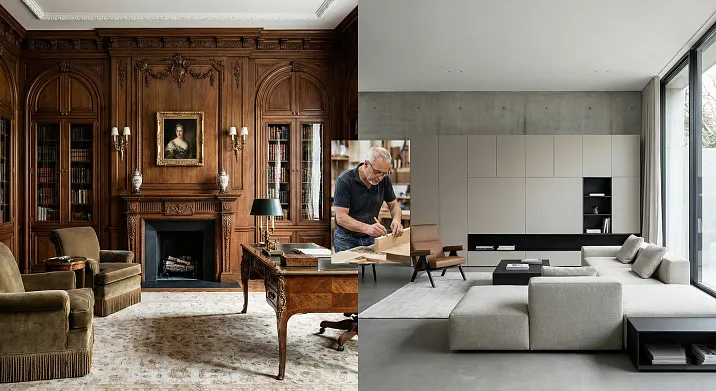
Can you right now imagine the perfect interior of your home? Not the one that accidentally came together from disparate purchases, but the one that reflects precisely your personality, your lifestyle, your understanding of beauty?Custom interior furnitureturns this dream into reality. When space is shaped not around the standard dimensions of factory-made items, but around your needs, when each piece is created considering a specific room, a specific spot, a specific person — the interior ceases to be just furnishings and becomes an environment in which it is comfortable to live.
Interior designis composed of many elements, but it is furniture that determines the functionality and character of a space. A sofa sets the arrangement in the living room, a dining table dictates the scenario for family evenings, an armchair forms a reading nook, a wardrobe organizes storage. Standard furniture requires adapting the space to itself, while custom furniture adapts to the space. The difference is colossal — like between a ready-made suit and one tailored to order.


What is Interior Furniture and Why a Custom Approach Changes Everything
Interior furniture is not utilitarian items for sitting, storing, or dining. These are elements that form the visual and functional environment of a room. Unlike office or outdoor furniture, interior furniture is created considering the aesthetic, psychological, and cultural parameters of a specific space. It must not only perform a function but also match the style, scale, color palette, and mood of the interior.
When we talk about custom furniture, we mean designing each piece from scratch or adapting an existing model to specific requirements. Height, width, and depth are determined not by a factory standard, but by the actual dimensions of the room. Color and finish are chosen not from a limited palette but are created specifically for your project. Structural details — the number of shelves, drawers, sections — are calculated based on actual storage needs, not average indicators.
Why is this fundamental? Because typical apartments in Russia have many architectural features — niches, protrusions, non-standard ceiling heights, asymmetrical layouts. Standard furniture either doesn't fit or leaves unused gaps that accumulate dust and create visual chaos. Custom furniture fills the space precisely, down to the millimeter. A floor-to-ceiling wardrobe uses the full vertical volume. A non-standard length sofa fits perfectly between two architectural elements. A table is calculated for the specific number of family members, not for an average family of four.




Who Needs Custom Furniture
The first category is owners of non-standard spaces. Apartments in historical buildings with high ceilings and enfilade layouts, country houses with custom architecture, lofts in former industrial buildings—all these spaces require an individual approach. Mass-market ready-made furniture looks lost in them, not matching the scale.
The second category is people with a clear vision for their interior. If you know exactly what your living room should be like, if you have references, sketches, an understanding of color and form—standard furniture will become a compromise you'll suffer from. Custom orders allow you to realize your concept without distortion.
The third category is connoisseurs of quality and durability. Mass production inevitably uses simplified technologies, composite materials, and standard solutions. Custom-made furniture from solid wood, with handcrafted details and traditional joinery, lasts for decades, becoming a family heirloom.
Our factory also produces:


Classic furniture: timeless forms from noble materials
Get Consultation
Interior armchair: a symbol of comfort and status
Interior armchair in a classic style is not just seating furniture; it is an artistic object expressing the cultural code of an era. A frame made of solid oak or beech ensures structural strength for decades. Hand-carved details on the armrests, back, and legs transform a functional item into a work of applied art.
The typology of classic armchairs is diverse. A high-back armchair with a straight back 90-100 cm tall is intended for a study or library—it supports proper posture during long hours of working with documents. An armchair with an inclined back and a wide seat 55-60 cm deep is designed for relaxation—comfortable for reading, watching TV, or conversation. A bergère armchair with fully upholstered armrests and a high back creates a cozy, enclosed space, a kind of armchair-cocoon.
The upholstery for a classic armchair is chosen from premium natural materials. Velvet creates a velvety surface with a noble sheen, pleasant to the touch. Jacquard with geometric or floral patterns adds decorative appeal. Genuine leather is the choice for studies and libraries, emphasizing solidity. Linen with its natural texture is organic in neoclassical interiors where restraint is valued.
The color palette of classic armchairs is built on noble shades. Deep emerald, sapphire, and burgundy create a luxurious atmosphere. Beige, cream, and light gray are universal, fitting into any color scheme. Graphite and anthracite are modern, suitable for neoclassical interiors. A combination of two colors—for example, dark upholstery and light wooden armrests—creates visual complexity.
The placement of an armchair in an interior is determined by its function. A pair of armchairs opposite a sofa forms a conversation area in the living room. A single armchair by a window with a floor lamp creates a reading nook. An armchair by the fireplace is a classic composition symbolizing domestic coziness.Buy interior chair makes sense as a set—two or four identical armchairs create a symmetrical composition characteristic of classic interiors.
Interior chair: function and beauty
Interior chair solves a utilitarian task, but in a classic execution becomes a decorative element. A high back 95-105 cm from the floor provides back support while creating a vertical rhythm in the dining room interior. Carved elements on the back—from simple vertical slats to complex ornaments—add decorativeness without compromising functionality.
The seat of a classic chair can be hard or soft. A hard seat made of solid wood is more durable, does not deform over time, and is easy to clean. A soft seat with polyurethane foam filler of 30-35 kg/m³ density ensures comfort during prolonged sitting. The seat upholstery is made from wear-resistant fabrics—jacquard, burlap, or artificial leather with increased abrasion resistance.
The legs of a chair determine its stylistic affiliation. Straight tapered legs are strict, characteristic of English classicism. Curved cabriole legs with an expansion in the middle and tapering at the bottom are typical of French Rococo. Turned legs with alternating thickenings and narrowings create a rhythmic pattern, organic in classicism.
For a dining set, chairs are ordered as a set of 4, 6, 8, or 12 pieces. It is important that all chairs are made from the same batch of wood—then the match of grain and shade will be perfect. A combination is possible: two chairs with armrests for the ends of the table, the rest without armrests for the sides. Chairs with armrests 60-65 cm wide take up more space but create a more representative look.
Interior table: the center of the composition
Interior table is the compositional and functional center of a dining room or living room. A dining table defines the scenario for family meals, festive dinners, and friendly gatherings. The table size is calculated based on the number of people: each person requires 60 cm of width and 40 cm of depth. A table for four has minimum dimensions of 120×80 cm, for six—160×90 cm, for eight—200×100 cm.
The shape of the table is determined by the room configuration. A rectangular table is universal, suitable for elongated dining rooms. A square table 120×120 cm is compact, creating an intimate atmosphere. A round table 120-150 cm in diameter fosters communication; there is no 'head of the table,' all seated are equal. An oval table combines the advantages of rectangular and round—it accommodates many people, but thanks to the absence of corners, retains a soft form.
A tabletop made of solid oak 40-50 mm thick withstands significant loads without deformation. Oak wood acquires a noble patina over time, darkens, and becomes even more beautiful. The tabletop is coated with oil or varnish—oil preserves the tactile quality of the wood, emphasizing the grain; varnish creates a protective film that simplifies maintenance.
The understructure determines the visual massiveness of the table. Four legs at the corners is a classic solution ensuring stability. Two massive supports at the ends create monumentality, characteristic of Empire-style tables. A central support with splayed legs is suitable for round tables, freeing up legroom.
An extension mechanism increases the table's functionality. In the folded state, the table is compact for daily use; when extended, it accommodates guests. An additional leaf is stored under the tabletop or separately. The extension mechanism is synchronous, designed for hundreds of open-close cycles.
Interior wardrobe: the architecture of storage
Interior wardrobe made of solid wood is not just a place for clothes; it is an architectural structure within a room. A classic wardrobe from floor to ceiling, 2.4-2.7 meters tall, maximizes vertical space. The wardrobe width of 120-180 cm depends on the number of sections—two-door, three-door, four-door. A depth of 60 cm is standard for storing clothes on hangers.
The facades of a classic wardrobe are decorated with panels, carved overlays, and cornices. A panel—a recessed or protruding panel framed by a molding—creates relief and visual complexity. Carved rosettes, wreaths, and acanthus leaves are placed on the upper panels, adding decorativeness. A cornice with a profiled edge crowns the wardrobe, creating a finishing touch to the composition.
The internal layout of the wardrobe is designed for real storage needs. An upper top shelf section for seasonal items, a main section with a hanging rod, a lower section with drawers for linens and accessories. Drawers on telescopic runners extend fully, providing access to all contents. Shelves are adjustable in height, adapting to stored items.
Display cabinet — a type of cupboard with glass doors for showcasing tableware, collections, and decorative items. The glass can be transparent or faceted, creating a play of light. Internal LED strip lighting transforms the cabinet into a luminous object. Shelves made of tempered glass, 8-10 mm thick, support the weight of crystal and porcelain.
Bookcase with open shelves forms a home library. Shelf depth of 25-30 cm is designed for standard book formats. Shelf height of 30-35 cm accommodates most publications. Upper and lower sections may be closed, while the central part is open — this combination creates visual lightness.
Custom furniture: from concept to realization
Stages of creating an individual project
First stage — consultation and needs assessment. A designer or technologist visits the site, takes room measurements, records architectural features — placement of windows, doors, sockets, switches, radiators. Interior style, functional requirements, and project budget are discussed. The client provides references — photos, sketches, examples of furniture they like.
Second stage — design. Based on the collected information, a 3D model of the furniture is created to scale within the room. The client sees how chairs, tables, and cabinets will look in the specific room, assessing proportions and color combinations. Adjustments are made — size, shape, and decor are changed until the perfect result is achieved. Drawings with precise dimensions of each element are approved.
Third stage — material selection. The client decides on the wood species — oak, beech, ash. Wood samples with various tinting options allow viewing the actual color and texture. Upholstery fabric for soft furniture is chosen — plush, smooth, textured options in a wide color palette. Hardware is approved — handles, hinges, transformation mechanisms.
Fourth stage — production. The wood undergoes additional acclimatization at the production facility for at least 7-10 days to equalize moisture content. Cutting is done considering grain direction for maximum joint strength. Milling, carving, and turning are performed on high-precision equipment. Frame assembly is done using mortise and tenon joints with glue — a traditional technology ensuring maximum strength.
Fifth stage — finishing. Surface sanding with abrasives of increasing grit from 120 to 320 creates a perfectly smooth surface. Tinting with stains or aniline dyes imparts the desired shade. Final coating with oil, wax, or lacquer protects the wood and highlights the grain. Upholstery of soft elements is done manually with careful fabric fixation.
Sixth stage — delivery and installation. Furniture is packed in multi-layer protection — stretch film, cardboard, wooden crates for particularly large elements. Delivery occurs at the agreed time. Installation is performed by specialists familiar with the structural features of the items. Adjustment of doors, drawers, and mechanisms ensures perfect operation.
Timelines and cost of a custom order
Custom furniture production timelines depend on project complexity. Simple items — chairs, small tables — are made in 4-6 weeks. Complex furniture with carving, inlay, multi-component mechanisms requires 8-12 weeks. A full furniture set for a bedroom or living room is produced in 10-14 weeks.
Cost consists of several components. Materials — solid wood, upholstery fabrics, hardware — constitute 40-50% of the price. Labor — design, manufacturing, finishing — 35-45%. Overhead and manufacturer's margin — 10-15%. Custom furniture is 50-100% more expensive than mass-produced, but it is an investment in quality, durability, and individuality.
Interior sets: harmony and integrity
Why the set approach is more effective
Interior setssolve the problem of stylistic consistency. When furniture is selected separately from different collections or manufacturers, achieving complete harmony is difficult. Wood tones don't match, proportions conflict, decorative elements are stylistically mismatched. A set is initially designed as a unified system — all pieces are executed in the same style, from the same wood batch, with repeating decorative motifs.
A living room set includes a sofa, armchairs, a coffee table, a console, a display cabinet or bookcase. If the living room is combined with a dining area, a dining group is added — a table and chairs. All elements are coordinated in height, rhythm of verticals and horizontals, and color scheme. Carved details on the sofa back echo the carving on the chairs. Armchair legs repeat the shape of the table legs.
A bedroom set consists of a bed, nightstands, a chest of drawers, a wardrobe, a dressing table with a mirror. The bed headboard sets the decorative theme, which is developed in other pieces. Nightstand height matches the mattress height for convenience. The chest of drawers and wardrobe are executed in a unified facade style.
A study set includes a writing desk, a chair, a bookcase or shelving unit, and a visitor's chair. The workspace is organized ergonomically — desk height 75 cm, tabletop depth 70-80 cm for accommodating a computer and work materials. The bookcase is placed within reach from the workspace.
Modular systems and their advantages
Modular furniture allows assembling a set like a constructor. The base collection includes dozens of elements of different types and sizes. The client selects the needed modules for a specific room. Need a bed 180×200 cm, two nightstands, a five-drawer chest, a three-door wardrobe — all these elements are available in the collection.
The advantage of a modular system is flexibility. If a standard size doesn't fit, the manufacturer adapts the module to the required dimensions. If a non-standard configuration is needed — for example, a corner wardrobe — it is created based on standard elements with the addition of custom ones. Stylistic unity is preserved.
A modular system allows for phased acquisition. First, the client buys the most necessary items — a bed, a wardrobe. A year later, they add a chest of drawers and a dressing table. Two years later — an armchair and an ottoman. All new elements perfectly match previously purchased ones, as they are made with the same technology and finish.
Premium-class materials: solid oak and beech
Oak: the standard of strength and prestige
Oak — the king among wood species for producing classic furniture. Density of 700-800 kg/m³ ensures exceptional hardness and resistance to mechanical damage. Oak furniture withstands intensive use for decades without losing strength. Moreover, oak becomes stronger over time — the wood densifies, gaining additional durability.
The texture of oak, with its pronounced annual rings and medullary rays, creates a rich decorative pattern. Each piece of furniture is unique due to the one-of-a-kind natural grain. The color palette of oak is diverse—ranging from light golden to deep brown. Staining with wood dyes expands the range—from bleached Scandinavian oak to dark wenge.
Oak has natural resistance to rot and biological infestation due to high tannin content. Oak furniture does not require aggressive chemical protection. Oak wood is minimally hygroscopic — it absorbs moisture poorly, minimizing deformation with changes in air humidity.
Processing oak requires professional equipment and skill. High density complicates cutting, milling, and sanding. But the result is worth it — the surface of oak furniture is perfectly smooth, carved details are crisp, joints are strong. A final oil coating emphasizes the depth of the grain, creating a matte surface with tactile warmth.
Beech: Elegance and Plasticity
Beech ranks second in popularity after oak. Density of 650-700 kg/m³ provides good strength with less weight. Beech furniture is 10-15% lighter than oak, easing transportation and rearrangement. At the same time, strength characteristics are sufficient for producing any furniture items — from light chairs to massive cabinets.
Beech wood has a uniform, fine-pored texture without pronounced annual rings. This creates a calm matte surface, ideal for modern classic and neoclassical styles. The natural color of beech—light pinkish or yellowish—adds warmth without aggression. Beech takes staining excellently, allowing for any shade from white to dark brown.
Beech possesses a unique ability to bend after steaming. Curvilinear elements—curved legs, arched backs, radius armrests—are made from beech with minimal defect rates. For furniture in Rococo, Art Nouveau, and Art Deco styles with characteristic smooth lines, beech is indispensable.
A drawback of beech is its high hygroscopicity. Without protective treatment, beech wood actively absorbs moisture, leading to warping. Impregnation with antiseptics and a final coating of varnish or oil is mandatory. When technology is followed, beech furniture lasts for decades, preserving its original appearance.
Styles of interior furniture: from classic to neoclassical
Classic: symmetry, proportions, decor
Classical furniture embodies traditions tested by centuries. Symmetry is the fundamental principle. Armchairs are identical, placed in pairs. Chairs around a table are identical. Cabinets on either side of a fireplace or door mirror each other. This symmetry creates a sense of order, stability, harmony.
Proportions are verified according to canons—the golden ratio, modular ratios. The height of an armchair's back relates to the seat height as 3:2. The width of a table to its length is as 1:1.6. These mathematical ratios create visual harmony, pleasing to the eye.
Decor is rich but orderly. Carving is placed in strictly defined locations—the upper part of the back, pediments, cornices. Ornaments are symmetrical—acanthus leaves, palmettes, rosettes form mirror compositions. Gilding or patination emphasizes the relief of the carving.
The color palette of classical furniture is built on contrasts. Dark wood—walnut, mahogany, stained oak—contrasts with light upholstery. Or vice versa—light wood with dark upholstery. Monochromatic solutions are rare; classic style loves the interplay of light and dark.
Neoclassical: restraint and modernity
Neoclassicism takes form and proportions from classicism but simplifies the decor. Symmetry is preserved but becomes more free. Absolute mirror repetition is not necessary; variations are allowed. Proportions remain classical—verified, harmonious. But decor is minimized.
Carving is either completely absent or reduced to a minimum. Instead of lush acanthus leaves—simple fluting. Instead of complex cartouches—geometric overlays. Gilding gives way to matte lacquering or painting. The result—lightness, visual purity.
The color palette of neoclassicism is restrained. White, gray, beige—basic colors. Dark wood is used as an accent, not dominant. Upholstery of soft furniture in neutral tones—light gray, cream, pale blue. Bright colors are minimal—cushions, small accents.
Neoclassical furniture is functional. Cabinets are equipped with modern storage systems. Tables have practical transformation mechanisms. Armchairs are ergonomic, with proper back support. Beauty not at the expense of comfort—the motto of neoclassicism.
Art Nouveau: fluidity of lines and organic forms
Art Nouveau rejects straight lines and sharp angles. Furniture in the Art Nouveau style is characterized by smooth curves, asymmetrical forms, and plant motifs. Chair legs bend like plant stems. Armchair backs have wavy contours. Decorative elements imitate leaves, flowers, and climbing shoots.
The material for Art Nouveau furniture is beech due to its bending ability. Curved elements are created by steaming and molding. Carving is shallow, soft, with smooth transitions. Hardware—handles, hinges—also has organic forms, often with floral motifs.
Colors of Art Nouveau furniture are natural—wood shades from light to dark, upholstery in green, brown, terracotta tones. Combinations of wood and textiles with plant patterns are popular. Stained glass inserts in cabinet doors, colored glass in display cases enhance decorativeness.
Frequently asked questions about custom interior furniture
How long does it take to manufacture custom furniture?
Simple items are made in 4-6 weeks. Complex furniture with carving requires 8-12 weeks. A full set for a room is produced in 10-14 weeks. Timelines depend on production workload and order complexity.
How much more expensive is custom furniture than ready-made?
Custom solid wood furniture is 50-100% more expensive than mass-produced. The difference is due to individual design, manual labor, and quality materials. But it is an investment in durability—quality furniture lasts 30-50 years.
Can furniture be ordered based on a photo from the internet?
Yes, a reference image is an excellent starting point. The designer adapts the liked sample to your dimensions, room proportions, and budget. Changes to decor, materials, and finish are possible.
Which material is better—oak or beech?
Oak is stronger, more prestigious, and has an expressive texture. Beech is lighter, bends better, and is more uniform. For representative furniture, choose oak. For elegant forms with curves—beech. Both materials are durable with proper treatment.
How to care for solid wood furniture?
Weekly dry wiping with a soft cloth removes dust. Once a month, wet cleaning with a slightly damp cloth. Avoid direct sunlight and proximity to heating appliances. Renew the oil coating once a year.
Can upholstery be changed on soft furniture?
Yes, upholstery can be changed when worn out. Quality furniture with a solid wood frame can withstand several reupholstery cycles. Replacing upholstery costs 30-40% of the price of a new item.
What is included in the cost of custom furniture?
Design, materials, manufacturing, finishing, delivery, assembly. Some manufacturers charge separately for 3D visualization. Clarify the total cost including all stages.
About STAVROS: craftsmanship, traditions, individual approach
STAVROS specializes in manufacturing classic furniture and interior items from solid oak and beech. Over twenty years of experience in creating furniture according to individual projects has allowed us to develop a system that guarantees high quality and precise alignment with customer expectations.
The STAVROS production facility is equipped with modern woodworking equipment. CNC milling machines perform precise part processing. Wood carving combines machine milling and manual finishing by master carvers. Furniture assembly is done using traditional mortise and tenon joints with gluing—a technology tested for centuries.
Materials undergo strict selection. Solid oak and beech are sourced from trusted suppliers, with wood undergoing chamber drying to 8-12% moisture content. Premium upholstery fabrics from European manufacturers. Hardware—hinges, guides, handles—from leading global brands.
The STAVROS range includes ready-made collections and custom production. The Classic collection unites dozens of bed, wardrobe, table, chair, and armchair models in a unified style. The client selects needed elements and combines them into a set. If standard dimensions don't fit, production adapts the model to specific measurements.
Custom design allows creating furniture from scratch based on client or designer sketches. The STAVROS team includes technologists, engineers, and designers capable of realizing the most complex ideas. 3D visualization shows how the furniture will look in the interior before production begins.
Delivery is available throughout Russia. Furniture is professionally packaged, with large items in wooden crates. Installation is performed by experienced assemblers. The warranty on STAVROS furniture is 12 months, confirming confidence in quality.
Consultation support helps at all stages—from furniture selection to care. STAVROS specialists understand styles, proportions, and ergonomics. They will help assemble a harmonious set, calculate the number of items, and select colors and finishes.
STAVROS is not just a furniture manufacturer, but a partner in creating your dream interior.Furniture and interior itemsSTAVROS furniture transforms a house into a space reflecting your individuality, your values, your understanding of beauty.


