












































































Article Contents:
- What are flexible slatted panels: construction and flexibility principle
- Why the flexibility of slatted panels is an architectural revolution
- Technical parameters of flexible slatted panels
- How to calculate the minimum radius for notches
- Materials for flexible slatted panels: wood and its alternatives
- Solid oak with notches
- Ash
- Birch and beech
- MDF base with decorative coating
- Application of flexible slat panels: where and how
- Column cladding
- Radius walls and niches
- Arched vaults and ceilings
- Reception desks and bar counters
- Partitions with curved geometry
- Staircase flight
- Furniture facades
- Stylistic solutions with flexible slat panels
- Organic and biophilic design
- Neoclassicism with radius volumes
- Modern minimalism with organic forms
- Loft with organic inclusions
- Restaurant and public space
- Tints and coatings for flexible slat panels
- Light tints for flexible slat panels
- Medium toning
- Dark toning
- Oil vs varnish for flexible slat panels
- How to install flexible slat panels: step-by-step instructions
- Surface Preparation
- Acclimatization
- Flexibility check
- Applying adhesive
- Clamping and fixation
- Finishing the Perimeter
- Combining flexible slat panels with other natural elements
- Common mistakes when working with flexible slat panels
- Material calculation for flexible slat panels
- Care for flexible slatted panels
- Frequently Asked Questions
- Can regular wooden slats be bent instead of buying flexible ones?
- What minimum bending radius is achievable?
- Can flexible slat panels be used on ceilings?
- How do flexible slats differ visually from regular ones?
- How much do flexible slat panels cost?
- Can flexible slats be mounted vertically and horizontally?
- Is special base preparation needed for columns?
- Conclusion
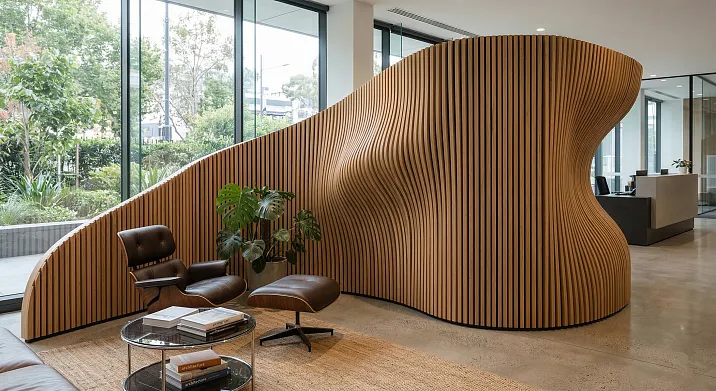
Imagine a wall that bends. Not metaphorically — literally. A smooth arc along a rounded column, a wavy surface in a curved niche, a soft radius transition between two planes — all made of wooden slats that preserve the natural texture, warm tone, and live wood grain pattern.
This is exactly what flexible slat panels do — a material that combines the plasticity of form with the organic nature of natural wood. Where a regular wooden slat would break, a flexible one will smoothly follow the curve. Where a traditional panel would require complex carpentry fitting, a flexible one will lay on a curved surface without special tools and without extra effort.
The keyword of our time in interior design is radius. Straight lines are giving way to curves. Rectangular volumes are giving way to organic forms. And flexible slat panels have turned out to be precisely the material that allows this architectural demand to be realized with natural warmth and the highest aesthetics.
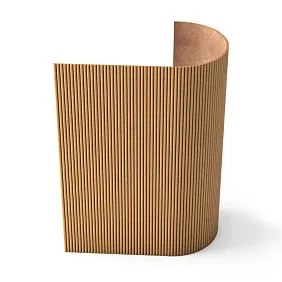
What are flexible slat panels: construction and the principle of flexibility
A regular wooden slat is a rigid element. An attempt to bend it along a radius leads to a break. This is physics: the stiffness of wood across the grain is high, and under bending load, the material fails along the outer tensile layer.
Flexibility is achieved through construction. There are several fundamentally different approaches:
Kerfs on the back of the slat. Crosscuts with a depth of 2/3 of the slat's thickness at a certain pitch — the slat acquires 'hinged' flexibility. Each segment between the kerfs is rigid. The transitions between them are movable. The slat bends along an arc determined by the kerf pitch: the smaller the pitch, the smaller the achievable bending radius.
Thin slats of small cross-section. A slat with a thickness of 5–8 mm and a width of 20–30 mm made from properly selected wood with straight grain is flexible by nature. With sufficient length and the correct bending direction (along the grain), such a slat can accept a bend with a radius from 300–500 mm without kerfs.
Combined constructions — slats on a flexible backing (fabric or rubber), which ensures the panel's cohesion during bending. Each slat remains rigid in itself, but the system as a whole bends due to the elasticity of the backing.
Flexible slatted panelsDuring installation, they are fixed to a curved substrate — the surface of a column, a rounded wall, an arched vault, a niche with a radius. After fixing with adhesive or fasteners — the slats permanently retain the shape given to them.




Why the flexibility of a slat panel is an architectural revolution
Straight lines in architecture are for the builder's convenience, not the architect's desire. Straight walls, right angles, rectangular niches—because they're easy to build, not because they're beautiful. When an architect gains freedom of form, they invariably gravitate toward curves: soft transitions, rounded volumes, organic silhouettes.
The problem with traditional finishing materials is that they don't allow this freedom. Tiling on a curved surface means complex cutting and visible seams. Rigid panels only allow angular connections. Plaster provides shape but not materiality. Wood in its traditional format simply doesn't bend.
Flexible wooden slat panels resolve this contradiction. They give the architect and designer a natural material in a free form. Wood on a curved surface. Slat rhythm on a column. Natural texture on an arch.
Exactly thereforeFlexible slatted panelshave become one of the key materials for working with non-standard architectural volumes—from elite residential interiors to public spaces with custom design.
Our factory also produces:
Technical parameters of flexible slat panels
Before moving on to application and aesthetics, it's essential to clearly understand the material's technical capabilities. These are the parameters that determine whether flexible slats are suitable for a specific task.
| Parameter | Value |
|---|---|
| Minimum bending radius | from 150–200 mm (with notches), from 300–500 mm (thin without notches) |
| Slat width | 20–60 mm |
| Slat thickness | 5–15 mm |
| Slat length | 2400–3000 mm (custom non-standard sizes available) |
| Notch spacing (if present) | 10–25 mm (defines the minimum radius) |
| Wood Species | Oak, ash, birch, pine, MDF base |
| Material Moisture Content | 8–12% (kiln-dried) |
| Finish | Oil / lacquer / tinting + oil or lacquer |
| Bending direction | Plane of the slat (most common) |
Get Consultation
How to calculate the minimum radius for kerfs
Kerf spacing directly determines the minimum bending radius: the smaller the spacing, the smaller the achievable radius. Approximate relationship:
-
Kerf spacing 10 mm → minimum bending radius ~150–200 mm
-
Kerf spacing 15 mm → minimum bending radius ~250–350 mm
-
Kerf spacing 20 mm → minimum bending radius ~400–500 mm
-
Notch spacing 25 mm → minimum bending radius ~600–800 mm
For a specific task: measure the bending radius of the surface where installation is planned, and choose slats with the corresponding notch spacing. Allow a margin of at least 20%: the slat's bending radius must be smaller than the surface radius.
Materials for flexible slatted panels: wood and its alternatives
Solid oak with notches
Oak is the best material for flexible slatted panels with high requirements for quality and durability. Density of 700–750 kg/m³ ensures rigidity of the segments between notches and resistance to mechanical impact after fixation. The natural grain pattern of oak on a curved surface is lively, variable, and tactilely rich.
Important nuance: notches on the back side of an oak slat must be even and uniform—only then will the slat bend without 'breaks' or unevenness. Notch quality is one of the main indicators of flexible slat quality.
Ash
Ash is somewhat lighter than oak, with a more active, contrasting grain pattern. The elasticity of ash is its feature: when bent, elastic ash slats create a slight 'springy' resistance that must be considered during installation—fixation must be reliable.
Birch and beech
Birch and beech are dense, homogeneous species with straight grain. For flexible slats, straight grain is particularly valued: it ensures uniform bending without unpredictable deformations. Birch is light, neutral. Beech has a characteristic fine grain pattern.
MDF base with decorative coating
MDF slats with notches are the most affordable and technologically predictable option. The homogeneous structure of MDF ensures a perfectly even bend. The surface is ready for painting — any color. For decorative applications with high demands on color and geometry — the optimal choice.
Limitation: MDF lacks a natural wood grain pattern and does not possess the tactile richness of solid wood. Visually — a uniform painted surface. For natural and biophilic interiors — it is inferior to solid wood.
Application of flexible slat panels: where and how
Column cladding
This is perhaps the most obvious and common application of flexible slat panels. A round or semi-circular column is a surface that is practically impossible to clad with rigid materials without visible angular joints. Flexible slats wrap around the column without a single seam, creating a continuous slatted pattern.
What it looks like: a round load-bearing column with a diameter of 400–600 mm, completely covered with vertical oak slats 30 mm wide with a 20 mm gap. The slats are curved to the column's radius, the natural oak grain is continuous around the entire circumference. With directional lighting — shadows in the gaps between the slats emphasize the column's cylindrical form. This is no longer a structural element that goes unnoticed — it is an architectural accent around which the space is organized.
Flexible wooden slatsfor column cladding are used in restaurants, hotels, office lobbies, shopping malls, residential buildings with exposed load-bearing structures.
Radius walls and niches
Rounded walls in halls, semi-circular niches in living rooms and bedrooms, arched openings with wooden slats on the reveals — all of this is realized using flexible slat panels.
Example: a living room with a semicircular niche of 800 mm radius in the wall behind the sofa. The niche is clad with vertical ash slats—flexible, continuously wrapping the inner surface of the niche. An LED strip along the top perimeter of the niche creates a soft glow that falls along the slats from top to bottom. The result—the niche transforms from a decorative recess into the architectural 'heart' of the living room.
Arched vaults and ceilings
An arched vault over an entryway or corridor with flexible slat panels on the inner surface—this is an image that immediately creates a sense of solemnity and architectural completeness. The slats run along the axis of the arch, following its shape. The wooden pattern on the curved surface is lively, three-dimensional, expressive.
For ceiling applications, the issue of weight is important: flexible slats on a flexible fabric backing are a lightweight material that does not create a significant load on the suspended structure.
Reception desks and bar counters
Curved surfaces of counters—hotel receptions, office administrative desks, restaurant bar counters—are one of the most in-demand applications. The slats wrap around the end surface of the counter, creating a natural wooden look without visible seams or corner joints. A continuous slat pattern on the rounded end—professional, expensive, architecturally sound.
Partitions with curved geometry
Non-load-bearing partitions in open-plan layouts—kitchen-living room, office space, hotel lobby—are often designed with a curvilinear plan. Flexible wooden slat panels allow such a partition to be realized with a natural texture and without structural compromises.
Staircase flight
A stair stringer has an inclined line, and the railing often has a curved plan. Cladding the walls of a stair flight with flexible slats that follow the curvilinear railing or rounded corners of the landing—this is a detail that transforms the staircase from a functional element into an architectural one. In combination withbalusters for staircasessolid wood matching the slats—a unified natural system.
Furniture facades
Flexible slats on curved fronts of built-in furniture represent another niche application. A rounded cabinet corner, a curved front of a cabinet, a radius door — wooden flexible slats transform furniture from a 'box' into a volume with natural organic quality.wooden furniture handlesin the tone of the slatted panels complete the look as a final accent.
Stylistic solutions with flexible slatted panels
Organic and biophilic design
This is the main 'home' for flexible slatted panels. Biophilic design is an architectural concept based on the human physiological need for a natural environment. Organic curves, natural materials, the absence of rigid rectangular forms — this is the language of biophilic space. Flexible wooden slats on rounded surfaces are a direct embodiment of this language.
In a biophilic interior with flexible slats: curved walls with continuous slatted cladding, live plants in niches between the slats, natural stone on the floor, directed lighting that emphasizes the curved surfaces. This is a space that 'breathes' nature — because there is not a single rigid angle or synthetic material in the foreground.
Neoclassicism with radius volumes
In neoclassical interiors, columns are a historically obligatory element. Flexible slatted panels on columns in a neoclassical context are a modern interpretation of fluting. Warm oak slats with a 'walnut' or 'cognac' tint, vertical, with a small pitch — on a round column they create a pattern reminiscent of classical vertical fluting, but in a natural wooden material.
In combination withpolyurethane cornices and moldingsaround the perimeter of the ceiling — this is a full-fledged classical architectural language, in which wooden slats occupy their organic place.
Modern minimalism with organic forms
In a minimalist interior, flexible slats are the only 'decorative' element allowed. One rounded wall with white or light gray slats. Zero ornaments, zero moldings, zero color accents—only form and material. Monochrome slats on a curved surface are minimalist sculptures integrated into the space.
Loft with organic inclusions
In a loft with industrial surfaces—concrete, metal, brick—a curved wooden slatted surface creates a 'living island' of natural warmth in a cold industrial space. A semicircular niche with dark oak slats in a concrete loft wall is a contrast that leaves an impression.
Restaurant and public space
In restaurants, hotels, and SPA centers, flexible slatted panels open up possibilities unavailable with other materials. Curved peninsula partitions that zone restaurant space while creating intimacy in each area. Wood-clad columns in hotel lobbies. An arched SPA entrance with wooden slats on the inner surface. These are images that create the 'character' of an establishment—what guests remember and return for.
Tints and coatings for flexible slatted panels
Flexible slats are tinted and coated following the same principles as regular ones. The only nuance: the notches on the back of the slat must not be covered by the coating on the front side—this could reduce flexibility. Professional coating is applied either before or after notching, but only to the front side.
Light tints for flexible slatted panels
-
Bleaching: Scandinavian bleached tone, light, neutral
-
Natural oak: golden natural tone without altering the base color
-
Light gray: neutral cool tone for modern interiors
Medium Tones
-
Cognac: rich amber-gold — a 'classic' oak tone
-
Tobacco: warm dark brown with a reddish undertone
-
Walnut: dark brown rich tone
Dark Tones
-
Graphite: dark gray neutral
-
Anthracite: almost black with a warm undertone
-
Wenge: deep dark chocolate
Oil vs lacquer for flexible slatted panels
Oil penetrates the fibers, does not create a film, preserves the natural look and tactile feel. For residential spaces — an ideal coating. For commercial areas with high traffic — consider a hard matte lacquer: more resistant to mechanical impact.
How to install flexible slat panels: step-by-step instructions
Surface preparation
The curved surface for installation must be prepared. For columns: the surface must be even, without protrusions or depressions. Irregularities exceeding 3–5 mm require puttying or leveling. For rounded walls: a frame following the radius made from bent metal profile is the standard solution that ensures precise surface geometry for installation.
Acclimatization
Wooden flexible slats require acclimatization for 48–72 hours indoors at 18–22°C and 45–65% humidity. Only after acclimatization do the slats acquire stable dimensions and become ready for installation.
Flexibility check
Before installation, check the bending radius of the slat: bend several slats according to the radius template of your surface. The kerfs should open evenly, without distortion. The slat should lay on the surface without force, which could lead to cracking.
Applying adhesive
MS-polymer-based mounting adhesive is applied to the back of the slat in zigzag strips. For kerfed slats, the adhesive is applied to the bridges between the kerfs. Adhesive should not get into the kerfs: this will reduce flexibility during installation.
Pressing and fixation
The slat is pressed against the surface and held in the bent state until the adhesive polymerizes. For columns: elastic bands or clamps that hold the slats along their entire length for 24–48 hours. For walls: finishing nails at an angle. Mechanical fixation is not removed until the adhesive has fully cured.
Perimeter Completion
As with conventional slat panels, a flexible slat field requires finishing elements.Wooden baseboard along the bottom edge.a polyurethane cornicealong the top edge. For columns — horizontal ring rails along the top and bottom of the cladding. Completing the perimeter transforms a set of bent rails into an architecturally finished structure.
Combination of flexible rail panels with other natural elements
Flexible rails work most expressively in a system where natural material is present not only on the walls. The unity of natural language is always a holistic image.
Rails + wooden floor.the wooden floor baseboardmatching the rail panels — a unified natural transition from vertical surface to horizontal. For rounded volumes — flexible wooden skirting along the radius of a column or niche.
Rails + staircase. Wooden rails on the wall of a stair flight +balusters for staircasesmade of solid wood to match — a unified natural ensemble that turns the staircase into an architectural event of the house.
Rails + furniture details.Furniture wooden handlesmatching the rail panels — a detail that completes the natural system. A small element with a big influence on the perception of the image's integrity.
Rails + classic furniture. Warm oak flexible rails on rounded columns combined withclassic furniture— is a dialogue between natural material and architectural tradition, creating an image that is both rich and harmonious.
Common mistakes when working with flexible slat panels
Incorrect choice of notch radius. Slats with notches spaced 20 mm apart, mounted on a 150 mm radius, will inevitably crack when bent. Rule: always check the bending radius of the surface and compare it with the minimum radius of the slat before ordering.
Installation without acclimatization. Wooden slats installed without acclimatization continue to change dimensions after fixation. On a flat surface, this results in minor gaps. On a curved surface, slats may partially 'pull away' from the surface when drying.
Glue only on notched segments. Glue must be applied evenly to all bridges between notches. Skipping areas reduces the strength of the fastening; the slat may 'delaminate' from the surface after the retaining elements are removed.
Notches 'outward'. Notches should always be on the back side of the slat—on the surface facing the base. Notches 'outward' not only ruin the visual appearance but also reduce the strength of the curved structure.
Lack of perimeter finishing. Flexible slat panels without finishing horizontal elements look incomplete.Wooden baseboardand cornice are mandatory elements of any professional slat finishing, including curved surfaces.
Incorrect lighting of a curved surface. Flexible slats on a column or curved wall reveal their full potential with directional lighting: side light emphasizes the curvature of the surface and creates 'moving' shadows in the gaps between the slats. Uniform diffuse lighting flattens the form—this loses the main visual advantage of the material.
Material calculation for flexible slat panels
Calculation of flexible slat panels for curved surfaces has its own specifics.
For columns: column perimeter (for round = π × diameter) × cladding height + 15% margin. Important: with tight slat spacing and narrow gaps — column perimeter is divided by (slat width + gap width) to calculate the number of slats.
For niches and arches: developed length of the curved surface (for a semicircle = π × radius) × niche height + 15% margin.
For rounded walls: surface area by development + 15–20% margin.
Always order material from the same batch: different batches may slightly vary in tint tone.
Care for flexible slatted panels
Installed and fixed flexible slats are maintained the same way as regular wooden slat panels.
Daily care: soft damp cloth, neutral cleaning agent. No abrasives, stiff brushes, acidic or alkaline products.
Oil coating renewal: every 1–3 years — light sanding with fine grit (240–320), dust removal, oil application along the grain, excess removal.
Replacement of damaged slats: in case of significant mechanical damage — individual slat replacement is possible. On curved surfaces, this is more complex than on flat ones — requires careful removal of the damaged slat without disturbing adjacent ones.
Frequently asked questions
Can regular wooden slats be bent instead of purchasing flexible ones?
Theoretically — yes, if the wood is soft (pine) and the slat is thin (5–8 mm). In practice — high risk of cracking, unpredictable bending radius, significant installation effort. Specially made flexible slats with kerfs — predictable radius, uniform bend, professional result.
What is the minimum achievable bending radius?
With kerfs spaced 10 mm apart — from 150–200 mm. This allows cladding columns with a diameter from 300 mm (radius 150 mm).
Can flexible slat panels be used on the ceiling?
Yes, for arched and vaulted ceilings. Important: for ceiling installation, mechanical fastening (screws or nails) is mandatory — adhesive alone is not sufficiently reliable under constant downward load.
How do flexible slats differ visually from regular ones?
After installation and fixing — no difference. The kerfs on the back side are not visible. The front surface of the flexible slat is identical to a regular one — the same grain pattern, the same coating tone.
How much do flexible slat panels cost?
More expensive than regular ones — by 20–40% depending on wood species, width, kerf spacing, and order volume. Non-standard lengths and complex configurations — additional cost.
Can flexible slats be installed vertically and horizontally?
Yes. Vertical installation is standard for columns and vertical surfaces. Horizontal installation is for arched and vaulted surfaces, where the slats follow the curve of the vault.
Is special surface preparation required for columns?
Yes. The column surface must be level, clean, and primed. Concrete or brick columns often have irregularities — puttying is mandatory. To achieve a perfectly even cylinder — drywall sheathing on a metal profile.
Conclusion
Flexible slat panels are not a niche product for complex architectural projects. This is a material that opens up possibilities unavailable to any other finishing solution: wooden slat decor on curved surfaces without compromise. A column with natural oak texture. A niche with a continuous slat pattern. An arch with a living wooden image. A reception desk without visible seams.
This is a solution for those who don't want to stop at right angles. For those who understand that architectural freedom of form and the natural beauty of the material are not mutually exclusive categories, but complementary ones. This is precisely the synthesis offered by flexible wooden slats.
Full rangesolid oak slat panels and flexible slat solutionsfor straight and curved surfaces,wooden baseboards, polyurethane cornices and moldings, balusters for staircasesandof furniture wooden handles— in the STAVROS company catalog.
STAVROS — production of decorative interior solutions with European quality standard. Slat panels for any geometric task — from strict rectilinear planes to complex organic forms. For architects and designers who do not recognize limitations. For interiors that are memorable.


