Article Contents:
- Purity of Lines: Minimalism as the Art of Proper Accents
- Natural Textures vs. Monotony
- The Role of Color in a Minimalist Wooden Palette
- Geometry as the Foundation of Minimalist Composition
- Rhythm on the Wall: Wooden Slats as a Tool for Dynamics
- Vertical Slats: Elongating Space
- Horizontal Slats: Expansion and Calm
- Combined Solutions: Grids and Frames
- Practical Aspects: Installation and Treatment
- Functional Aesthetics: Wooden Hardware in Minimalist Furniture
- Why Wooden Handles in Minimalist Furniture
- Handle Shapes for Minimalism
- Color and Texture: Matching the Overall Concept
- Replacing Handles: Simple Furniture Update
- Floor Border: Wooden Baseboard as an Element of Completion
- Why Wood, Not Plastic or MDF
- Baseboard Profile for Minimalism
- Baseboard Color: Matching Floor, Wall, or Contrast
- Installation: Precision as the Foundation of Aesthetics
- Zoning with Light: Slatted Partitions in Minimalist Space
- The Principle of a Slatted Partition
- Application in Different Apartment Zones
- Structural Solutions
- Lighting Slatted Structures
- Practical Aspects: Caring for Wooden Decor in Minimalism
- Regular Cleaning
- Protection against damage
- Room microclimate
- Frequently Asked Questions About Wooden Decor in Minimalism
- Won't Wood Look Too Warm for Cold Minimalism?
- How Much Does Implementing Wooden Decor in an Apartment Cost?
- Can You Do Slatted Finishing Yourself?
- Which Wood Species Are Best for a Minimalist Interior?
- Does wood need to be treated with special compounds?
- How does slatted paneling affect room acoustics?
- Is wood paneling eco-friendly?
- Can wood decor work in small apartments?
- Conclusion: eco-friendliness as the main trend of the decade
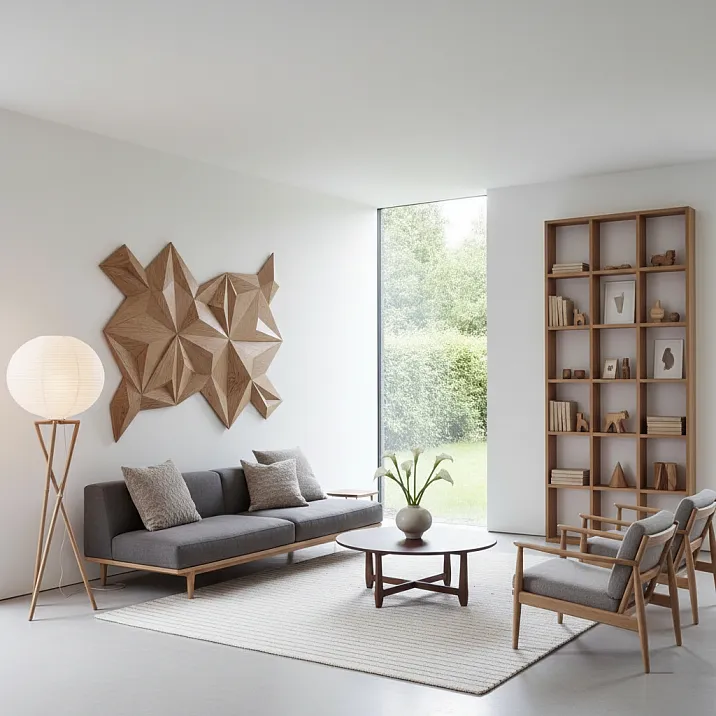
Minimalism is often misunderstood. Many see it as synonymous with emptiness, a rejection of decor, a cold space without soul. But true minimalism is not absence, but curation. It's the ability to keep only what truly matters, what serves both function and beauty simultaneously. And in this philosophy, wood finds its perfect place: warm, living, natural, it compensates for geometric austerity and returns humanity to space. How to properly integrate wood decor into a minimalist interior while preserving clean lines and creating coziness? That's what we'll discuss.
Why wood? In a world of synthetic materials and high-tech surfaces, natural wood serves as a link between humans and nature. The texture of wood, its grain, its tactile qualities—all affect us on a subconscious level, creating a sense of security, stability, belonging to something greater than four apartment walls. In a minimalist interior, where every detail is visible, material quality becomes critically important. You can't hide cheap imitation behind an abundance of decor—here everything is exposed, honest, direct. And that's precisely whyBuy wooden skirting boardsolid wood is not just a material purchase, but an investment in the philosophy of space.




Clean lines: minimalism as the art of proper accents
Let's be clear from the start: minimalism is not a poverty of expression, but a concentration of meaning. Every element in a minimalist interior must serve the overall idea. There's no place for random objects, chaotic colors, meaningless decor. The rule 'less is more' applies here, but only if that 'less' is of the highest quality.




Natural textures against monotony
One of the main problems with poorly executed minimalism is a sense of sterility. White walls, white ceilings, smooth surfaces without texture create the impression of an operating room rather than a living space. People feel uncomfortable in such an environment—it lacks visual anchors that give the eye a point of focus.
Natural textures solve this problem elegantly. Wood with its texture, stone with its veining, textiles with their thread weave—all add visual interest without creating chaos. The eye finds something to rest on but isn't overloaded with excessive information.
In the context of wood, we're not talking about carved patterns or complex shapes, but about the material's very structure. Oak's annual rings, beech's soft lines, ash's contrasting grain—nature has already created the decor; we just need to present it properly. And here, treatment matters: quality sanding that preserves texture but makes the surface pleasant to touch. A finish that protects the wood but doesn't hide its natural beauty under a thick layer of varnish.
Our factory also produces:




The role of color in a minimalist wood palette
Minimalism gravitates toward neutral colors: white, gray, beige, black. Wood fits naturally into this palette, but it's important to choose the right wood tone. Light species (bleached oak, light ash, birch) create airiness, expand space, and maintain a sense of light. Dark species (wenge, stained oak, walnut) add depth, contrast, and graphic quality but require caution—excess dark wood can make a minimalist interior feel heavy.
The golden rule: if the walls are light (as they usually are in minimalism), wood can be either light or dark—both options work. Light wood creates a monochromatic palette with smooth, calming transitions between shades. Dark wood against a light background creates contrast, graphics, and clarity of lines. But if you choose dark wood, there should be little of it—accent elements, not dominance throughout the space.
Get Consultation
Geometry as the foundation of minimalist composition
Minimalism loves geometry: straight lines, right angles, clear proportions. Wood decor should support this geometric quality, not contradict it. That's why in minimalist interiors we see slats installed with mathematical precision at equal intervals, baseboards with clear straight lines, furniture handles of simple geometric shapes.
No room for randomness. If slats are installed vertically, they must all be strictly parallel, with identical spacing. Any deviation, any inaccuracy stands out in a minimalist space where there are no other elements to distract attention from the mistake. That's why manufacturing and installation quality are critically more important in minimalism than in other styles.
Rhythm on the wall: wooden slats as a tool for dynamics
One of the most popular and effective techniques for using wood in a minimalist interior is slatted wall constructions. This isn't just paneling, but a way to create visual rhythm, structure space, add depth and texture without violating the principles of the style.
Vertical slats: elongating space
Vertically installed wooden slats create a powerful visual effect of increasing room height. The eye automatically follows the vertical lines from bottom to top, and the ceiling appears higher than it actually is. This technique is especially valuable in standard apartments with 2.5-2.7 meter ceilings, where every visual centimeter of height counts.
For vertical installation, thin slats are optimal: 20×40 mm, 20×50 mm, maximum 30×60 mm cross-section. More massive planks create visual weight that contradicts the idea of minimalism's lightness. A thin slat draws a line, not a shape. A line is airy, a shape is material. In minimalism, airiness is valued.
The spacing between slats determines the character of the surface. Close spacing (50-80 mm between slat centers) creates an almost continuous rhythmic surface where gaps between slats are perceived as thin dark lines. This creates an effect of density, solidity. Wide spacing (150-200 mm) emphasizes individual lines, with the space between them perceived as background. This creates an effect of lightness, transparency.
Horizontal slats: expansion and calm
Horizontal slats work differently: they visually expand space, making it more elongated. This is useful in narrow spaces—hallways, elongated rooms where proportions need adjustment. Horizontal lines also create a sense of calm, stability—unlike dynamic verticals, horizontals soothe, ground.
Decorative wall panelingHorizontal orientation requires greater caution in choosing installation height. Horizontal lines at eye level (140-160 cm) cut the space in half, which can visually lower the ceiling. It's better to install horizontal slats either in the lower part of the wall (from floor to 100-120 cm height) or in the upper part (from 200 cm height to ceiling), leaving the middle zone free.
The cross-section for horizontal slats can be slightly larger than for vertical ones: 30×50 mm, 40×60 mm. Horizontal orientation makes the plank appear visually thinner, so it can actually be more substantial without compromising perceived lightness.
Combined solutions: grids and frames
Advanced technique — combination of vertical and horizontal slats creating a geometric grid on the wall. This can be a regular lattice with square or rectangular cells, or an asymmetrical composition where vertical and horizontal elements intersect at specific points, creating an abstract pattern.
Such compositions require impeccable planning and execution. All intersections must be precise, all angles — right, all distances — verified. The slightest carelessness ruins the effect. But with quality execution, the result is impressive: the wall transforms into an architectural element that is both functional (hides irregularities of the base surface, creates a frame for hidden lighting) and decorative.
Practical aspects: installation and finishing
Slat structures are installed in two main ways. Adhesive method — slats are glued directly to the wall. This requires a perfectly flat surface, but the result is maximally thin, slats add only 20-40 mm thickness to the wall. Frame method — first, a system of guides (wooden batten or metal profile) is mounted on the wall, to which decorative slats are then attached. This allows leveling wall irregularities, creating a ventilated gap, hiding utilities behind the slats.
Slat finishing is critical. In minimalism, the surface must be perfectly smooth — any splinter, any roughness is unacceptable. Sanding is performed in several stages, starting with coarse grit (120-150) and ending with fine grit (220-320). After sanding, the surface is coated with a protective finish: oil, wax, or varnish. Oil preserves the natural look of wood, emphasizes texture, creates a matte surface. Varnish creates a more durable coating, can be matte or glossy.
Functional aesthetics: wooden hardware in minimalist furniture
Furniture in a minimalist interior is usually laconic: simple shapes, absence of excessive decor, functionality comes first. But that's precisely why details become critically important. And one such detail isFurniture Handles, which in minimalism is not just a functional element, but an important part of the visual composition.
Why wooden handles in minimalist furniture
Standard furniture often comes with metal handles — chrome-plated, nickel-plated, stainless steel. They are cold to the touch, shiny, functional, but lacking soulful warmth. In a minimalist interior, where rigid materials (concrete, glass, metal) already predominate, wood becomes a necessary counterbalance, returning humanity to the space.
Wooden handles made of solid oak, beech, or ash are warm tactilely — pleasant to grasp with your hand. They are visually soft — do not create glare, do not hurt the eyes, calmly fit into the overall palette. They are eco-friendly — natural material that does not emit harmful substances, smells pleasant, lives together with you.
Handle shapes for minimalism
In minimalist aesthetics, a handle should be a simple geometric shape. No curls, carvings, complex profiles. Main options:
Cylindrical button handle — a simple wooden cylinder or hemisphere that attaches to the front. Diameter usually 30-40 mm, height protruding above the front 15-25 mm. This is the most minimalist option: maximum simplicity, minimum visual noise.
Rectangular bar — a wooden slat of rectangular cross-section (e.g., 20×40 mm, length 100-150 mm), fixed horizontally on the front. It's convenient to grasp with the whole palm. Such handles are especially good on large fronts — cabinets, dressers.
Hidden profile handle — when the top or bottom edge of the front has a rounded profile that fingers can hook onto. There is no handle as a separate element, but the function is performed. This is the most minimalist solution, but it requires precision manufacturing of the front.
Wooden bracket handle — U-shaped form made of wooden block. The ends of the bracket attach to the front, the middle part remains free, grasped by hand. Classic shape, adapted to minimalism through simplicity of execution and absence of decor.
Color and texture: matching the overall concept
Wooden handles can be in the natural color of wood or painted. In a minimalist interior, preference is usually given to natural color — this emphasizes the naturalness of the material. But the color needs to be selected in accordance with the overall palette.
If light tones predominate in the interior, handles made of bleached oak or light ash will create a harmonious continuation of this line. If contrast is needed, handles made of dark wood (wenge, stained oak) on light fronts will create graphic accents.
Texture should be tactilely pleasant. Perfectly smooth sanded surface with a matte coating — optimal option. Glossy varnish creates glare, which contradicts minimalist aesthetics. Oil or matte varnish preserve the natural look of wood and are pleasant to the touch.
Replacing handles: simple furniture update
One of the most budget-friendly ways to adapt standard furniture to a minimalist style is to replace standard handles with wooden ones. An IKEA cabinet with plastic handles looks cheap. The same fronts, but with handles made of solid oak — and perception changes dramatically. The furniture seems more expensive, more thoughtful, more individual.
Replacing handles is a simple operation, accessible to everyone. You need a screwdriver and five minutes of time for each handle. The main thing is to select handles with the same center-to-center distance of mounting holes as the original ones, or be ready to drill new holes.
Floor boundary: wooden baseboard as an element of completeness
Baseboard is a detail often underestimated. It seems: well, what's a baseboard, screwed on any — and done. But in a minimalist interior, where every detail is visible, the baseboard plays a critically important role. It creates a boundary between wall and floor, completes the composition, sets a horizontal line along which the eye reads the space.
Why wooden, not plastic or MDF
and paint it to the desired shade — standard practice in modern design. It is important to use special wood finishes that allow the material to breathe. made of solid wood — is the choice of those who value naturalness and durability. Plastic baseboard is cheap, but looks cheap. It is fragile, changes color over time, deforms from temperature fluctuations. In a minimalist interior, where materials should be honest and high-quality, plastic looks alien.
MDF baseboard for painting — a compromise option. It is cheaper than solid wood, but looks decent after quality painting. However, MDF does not tolerate moisture as well as solid wood, and in case of leakage or wet cleaning, it may swell.
Solid oak or beech skirting boards are an investment for decades. They are not afraid of moisture (with proper protective coating), do not deform, and withstand mechanical impacts. A scratch on a wooden skirting board can be restored — sanded and re-oiled. This trick won't work with plastic.
Skirting board profile for minimalism
In a minimalist interior, the skirting board should be laconic. Forget about complex profiles with multiple protrusions and grooves — that's an attribute of classic styles. Minimalism demands simplicity: a rectangle with minimal relief or none at all.
Rectangular skirting board — the simplest form. It's a rectangular-section block, usually with a slight rounding of the top edge for a soft line. Height 60-80 mm, thickness 15-20 mm. Such a skirting board practically dissolves into the space, doesn't draw attention to itself, yet performs its function — protects the wall from damage and creates a clear boundary.
Flat wide skirting board (Euro skirting) — a modern trend. It's a wide (100-150 mm high) flat plank with a minimal profile. Such a skirting board creates a panel-like effect, visually raises the wall. This is a bold solution that works in spacious rooms with high ceilings.
Skirting board with hidden fastening — a technological solution where the fasteners are not visible on the front surface. The skirting board has a special groove on the back side into which a mounting strip, pre-fixed to the wall, is inserted. Such a skirting board looks like a single surface without visible screw or nail heads.
Skirting board color: matching the floor, wall, or contrast
There are three main approaches to choosing skirting board color in a minimalist interior:
Skirting board matching the floor color — a classic approach. The skirting board is perceived as an extension of the floor, visually rising up the wall. This creates unity, a smooth transition. If the floor is light oak, the skirting board is also light oak.
Skirting board matching the wall color — a modern approach. The skirting board is painted the color of the wall (usually white or light gray) and visually becomes part of the wall, not the floor. This creates the effect of a wall smoothly descending to the floor. The floor then appears to float.
Contrast skirting board — a bold approach. For example, white walls, light floor, black skirting board. This creates a clear graphic line around the perimeter of the room, emphasizes the geometry of the space. But this technique requires precision execution — any curvature, any gap will be glaring.
Installation: precision as the foundation of aesthetics
In a minimalist interior, the quality of skirting board installation is critical. All joints must be perfect, corners — precise, gaps between the skirting board and floor — absent. This requires professionalism or great care during DIY installation.
Corners are cut at 45 degrees using a miter box or miter saw. The joint must be tight, without gaps. After installation, joints can be lightly filled and sanded for absolute invisibility. Fastening is done with adhesive (liquid nails, polyurethane adhesive) or with screws followed by filling the holes.
Zoning with light: slatted partitions in minimalist space
One of the tasks often addressed in modern apartments is zoning space without building solid walls. Studios, open-plan apartments, combined kitchen-living rooms — in all these cases, zones need to be visually separated while preserving a sense of openness and light. Slatted partitions are the perfect tool for this task.
Principle of a slatted partition
A slatted partition is a structure of vertical or horizontal wooden slats installed at a certain interval. It is not a solid wall; light and air pass through it, yet it creates a visual boundary, marking the division between zones.
The key advantage of such a structure is transparency. You simultaneously divide the space and preserve its integrity. A person in one zone partially sees the other zone through the gaps between the slats, yet feels they are in a distinct space.
Application in different apartment zones
Separating the sleeping area in a studio. The bed behind a slatted partition gains visual privacy, yet the studio doesn't lose its sense of spaciousness. Light from the window penetrates through the slats into the depth of the room.
Dividing the kitchen and living room. The slatted structure marks the boundary of functional zones but allows people on either side of the partition to communicate. This is important when one person is cooking and others are in the living room — visual contact is not lost.
Zoning a workspace. A home office in a corner of the living room can be separated with a slatted partition. This creates a psychological boundary between work and rest but doesn't turn the office into a dark closet.
Decorative zoning of the hallway. A slatted structure between the entry zone and living room creates a buffer space without eating up precious meters in a small hallway.
Constructive Solutions
Slatted partitions can be stationary and mobile. A stationary partition is a full-height structure from floor to ceiling, rigidly fixed. It has a frame (usually metal profile or wooden beam) to which decorative slats are attached. Such a partition can bear load — you can hang light shelves, a mirror, or lights on it.
A mobile partition is a freestanding structure that can be moved. It has a stable base and doesn't require attachment to the ceiling or walls. This option is suitable for rental housing where structural modifications are not allowed, or for those who like to change the space configuration.
Lighting for Lattice Structures
A slatted partition becomes even more impressive if lighting is integrated into it. LED strips hidden behind the slats or between them create soft glow that emphasizes the rhythm of the structure and creates atmospheric lighting in the evening.
Lighting options:
-
Bottom lighting — LED strip at the base of the partition, light directed upward along the slats. Creates a floating structure effect.
-
Top lighting — light directed downward, creates long shadows from the slats on the floor.
-
Internal lighting — LEDs are placed inside the slatted structure, with light seeping through the gaps between the slats. The most impressive, but technically complex option.
Practical aspects: caring for wooden decor in minimalism
Wood is a living material that requires attention. But caring for properly treated wood is not difficult and does not require much time.
Regular cleaning
Wooden surfaces should be wiped with a dry or slightly damp soft cloth once a week. This removes dust and surface dirt. Do not use excess water — wood does not like prolonged contact with moisture. A well-wrung cloth is the optimal choice.
For wooden elements coated with oil, the oil coating can be refreshed periodically (every 6-12 months). The surface is lightly wiped with special wood oil, and excess is removed with a dry cloth. This nourishes the wood, maintains its color, and protects it from drying out.
Protection against damage
Wooden decor in a minimalist interior is usually not subjected to intense mechanical stress (unlike flooring), but reasonable precautions are advisable. Do not place furniture flush against slatted wall structures — leave a 2-3 cm gap. This prevents slat abrasion when moving furniture.
Baseboards are more at risk — they get bumped during cleaning, hit by vacuum cleaners, and cleaned with mops. A high-quality protective coating (varnish or oil) creates a barrier that protects the wood from moisture and minor impacts.
Room microclimate
Wood is sensitive to humidity. The optimal humidity for wooden products is 40-60%. If the humidity is too low (a common problem during the heating season), the wood dries out and cracks may appear. If it is too high (poor ventilation, humid climate), the wood can swell and mold may develop.
Maintain comfortable humidity using humidifiers in winter (when heating dries the air) and ensure good ventilation (airing, exhaust) year-round. This is beneficial not only for the wood but also for your health.
Frequently asked questions about wooden decor in minimalism
Won't wood look too warm for cold minimalism?
Minimalism doesn't have to be cold. Scandinavian minimalism, for example, actively uses light wood and creates a warm, cozy atmosphere while maintaining clean lines. It's important to choose the right wood shade: light species (bleached oak, light ash) are universal and suit any minimalist aesthetic. If you want a cooler effect, choose wood with a gray undertone (gray oak, bleached ash) or paint wooden elements gray.
How much does it cost to implement wooden decor in an apartment?
The cost depends on the scope of work and material choice. Solid oak slats are more expensive than pine ones but last longer and look more noble. Approximately: slatted finishing for one wall with an area of 10 sq.m will cost 30-60 thousand rubles (materials plus labor). Replacing furniture handles — 500-2000 rubles per piece depending on wood species and shape complexity. Solid wood baseboard — 800-1500 rubles per linear meter with installation. This is more expensive than budget alternatives, but it's an investment in quality and durability.
Can slatted finishing be done independently?
Yes, if you have basic woodworking skills and tools (or the ability to rent them). You will need: a saw (preferably a miter saw for precise cuts), a screwdriver, a level, a tape measure, a pencil. Process: mark the wall, attach guides (if using a frame method), cut slats to size, attach them to the guides with screws or glue. The most difficult part is ensuring uniform spacing between slats and their strict vertical or horizontal alignment. Any inaccuracy will be visible.
Which wood species are best for a minimalist interior?
The best species for minimalism are light-colored with not too contrasting grain. Bleached oak — a classic choice, noble color, pronounced but not aggressive grain. Light ash — slightly warmer than oak, soft grain, pleasant creamy hue. Beech — light pinkish hue, fine uniform grain, very hard and wear-resistant. Pine — a budget option, light, but the grain is more pronounced with dark resin knots (which may not suit strict minimalism). Use dark species (wenge, stained oak) as accents, in small quantities.
Is it necessary to treat wood with special compounds?
Absolutely. Untreated wood quickly gets dirty, absorbs moisture, and can deform. Protective coating options: Oil — emphasizes the grain, creates a matte surface, requires periodic renewal. Wax — creates a soft semi-matte surface, protects from moisture, pleasant to the touch. Varnish — creates a durable coating, can be matte or glossy, does not require renewal for many years. For minimalism, matte coatings (oil, wax, matte varnish) are better — they don't create glare and preserve the natural look of wood.
How does slatted finishing affect room acoustics?
Slatted structures on walls improve room acoustics, but only slightly. They create an uneven surface that scatters sound waves, reducing echo. The effect is noticeable in rooms with many hard reflective surfaces (concrete walls, large windows, minimal textiles). If serious sound insulation is needed, sound-absorbing material (mineral wool, acoustic foam) can be placed behind the slats — the slats will hide it, and the effect will be significant.
Is wooden finishing eco-friendly?
Wood is one of the most eco-friendly materials. It is renewable (unlike petroleum products used to make plastic), biodegradable, and does not emit harmful substances. Moreover, wood even after being cut continues to perform a useful function — it can regulate humidity in a room, absorbing excess moisture and releasing it when the air is dry. Wood from some species (cedar, pine) releases phytoncides — substances with antibacterial effects. One point: pay attention to coatings. Choose oils, waxes, and water-based varnishes without aggressive chemicals.
Can wooden decor suit small apartments?
Not only can it, but it should. In small spaces, it's especially important to create a sense of warmth and coziness to compensate for limited square footage. But moderation is needed: don't overload the space, use light wood species that don't visually consume space. Vertical slats on one accent wall will stretch the ceiling, a light wooden baseboard will create completeness, wooden handles on furniture will add individuality — all this works even in a 25 sq.m studio.
Conclusion: eco-friendliness as the main trend of the decade
We live in an era of conscious consumption. People are increasingly thinking about what they buy, what it's made of, and how it affects the environment. Synthetic materials, plastic, chemical coatings — all of this raises questions and concerns. Wood in this context is a material that meets all the requirements of the new era: eco-friendly, renewable, safe, durable.
A minimalist interior with wooden decor is not just a design solution, it's a life philosophy. A philosophy that asserts: you can live beautifully and comfortably without harming the planet. You can surround yourself with quality, durable things that won't need to be thrown away in a couple of years. You can create a space that is simultaneously functional, aesthetic, and eco-friendly.
The geometry of coziness — this is the balance between strict forms and warm materials, between minimalism of means and maximalism of quality, between modernity of approach and eternity of natural materials. Wooden slats on walls, wooden handles on furniture, wooden baseboards at the floor — all these are elements of a single system that turns a house into a place where you want to live.
For over two decades, STAVROS has been crafting solid wood products for those who appreciate the value of natural materials. The range includes all necessary elements for creating a minimalist interior with wooden decor: oak, beech, and ash slats of various cross-sections; baseboards in classic and modern profiles; furniture handles with clean, simple forms; and components for building partitions and decorative structures.
Every STAVROS product undergoes strict quality control. Wood is hand-selected, kiln-dried to an optimal moisture content of 8-12%, and processed on high-precision European equipment. The result is perfect geometry, a smooth surface free of defects, and dimensional stability throughout its service life.
STAVROS professional consultants will help you select materials for your project, calculate the required quantities, and recommend optimal solutions. The company's website features a complete product catalog with detailed technical specifications, photos, and information on availability and pricing.
Choosing STAVROS means choosing quality that has stood the test of time. Quality of materials, quality of craftsmanship, and quality of life in a space created with natural wood. Wood that breathes, lives, and ages gracefully, preserving its beauty and functionality for decades. This is true minimalism—not a rejection of materials, but a choice of the best.