












































































Article Contents:
- Evolution of window decoration: from functionality to aesthetics
- Historical journey through styles
- Functional tasks of window decoration
- Materials for window decoration: traditions and innovations
- Polyurethane — revolutionary material of the new era
- Wooden framing — living classic
- Stylistic solutions for window decoration
- Classicism: eternal proportions of perfection
- Baroque: theatricality of architectural spectacle
- Modern: natural organic forms
- Modern trends: minimalism and high-tech
- Regional characteristics of window decoration application
- Northern regions: combating extreme climate
- Southern areas: protection from ultraviolet and high temperatures
- Coastal regions: aggressive marine environment
- Manufacturing and installation technologies
- Modern Manufacturing Processes
- Innovative Processing Methods
- Installation of window decoration: the art of precision
- Preparatory work
- Joining technologies
- Economic aspects of window decoration
- Lifecycle Cost Analysis
- Impact on property value
- Modern Trends and Innovations
- Integration with smart technologies
- Ecological innovations
- Individual approach to window decoration
- Design tailored to a specific object
- Adaptation to local traditions
- Frequently asked questions about facade decoration for exterior windows
- Which material is better to choose for window decoration?
- How long does window decoration made of modern materials last?
- Can decoration be installed on an already built house?
- Does window decoration require special maintenance?
- Does decoration affect window insulation?
- Can decoration be changed when the facade style changes?
- How to calculate the cost of window decoration?
- Is decoration compatible with modern energy-saving windows?
- Can decorative elements be used in multi-story construction?
- How to choose the color of window trim?
- Conclusion: windows as a showcase of architectural craftsmanship
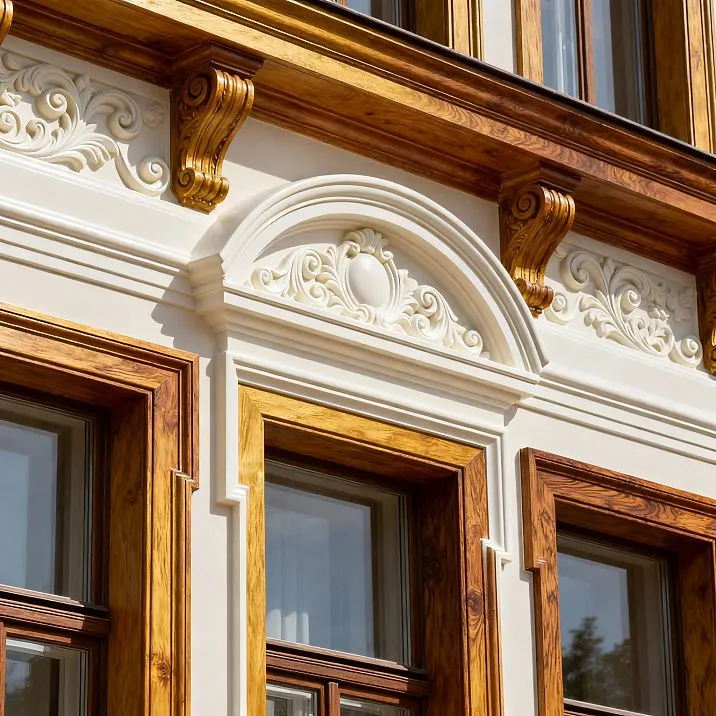
Windows are the eyes of a house, through which the building looks at the world, and the world looks back at it. But what transforms an ordinary window opening into an exquisite architectural detail? Exactlyfacade decoration for exterior windowscan radically change the perception of the entire building, giving it nobility, status, and unique individuality.
In the modern world of architecture, where every detail matters, window framing has ceased to be merely a functional element—it has become a means of artistic expression. A properly selected and professionally installed decorative trim for exterior windows can visually alter the proportions of a building, emphasize its stylistic affiliation, and create a sense of luxury and refinement—even in the most modest structure.

Evolution of window decoration: from practicality to aesthetics




Historical journey through styles
Have you ever wondered why windows were decorated so differently in various eras? The history of window decoration is a chronicle of human civilization's development, reflected in architectural forms. Ancient Romans created massive marble sills, demonstrating the power and grandeur of their empire. Gothic masters of the Middle Ages transformed windows into stone lace, reaching toward the heavens. Baroque architects surrounded window openings with lavish ornamentation, creating theatrical effects of light and shadow.
Each era brought its own adjustments to the understanding of what the idealfacade decoration for exterior windowsshould be. Classicism dictated strict proportions and canonical forms, modernism introduced natural motifs and flowing lines, while contemporary architecture strives for minimalism and functionality. Yet one thing remains unchanged—the desire to make a window not merely an opening in a wall, but a fully-fledged element of architectural composition.
Our factory also produces:

Functional tasks of window decoration
Beauty is beauty, but practicality is not forgotten. High-quality window trim performs numerous important functions, many of which people are unaware of. Sills and window sills protect the junction between the window frame and the wall from moisture penetration, preventing mold formation and structural damage. Overhangs above windows divert rainwater, protecting window sills from constant dampness.
ModernPolyurethane Itemsare capable of integrating various engineering systems. Lighting elements can be embedded into window sills, creating an eye-catching facade illumination at night. Special profiles allow concealing wiring for security systems, air conditioning, and "smart home" systems. Thus, decorative elements become multifunctional components of modern buildings.
Get Consultation
Materials for window decoration: traditions and innovations
Polyurethane — revolutionary material of the new era
polyurethaneMoldings, cornices, pilasterscombine the lightness of polystyrene, the strength of wood, and the durability of stone. The density of quality polyurethane is 500-700 kg/m³, which is several times less than traditional materials while maintaining comparable strength.
What makes polyurethane an ideal material for window decoration? Primarily, its ability to reproduce the most complex shapes with the highest level of detail. The casting technology allows conveying the finest nuances of ornamentation, creating elements with thin walls and deep recesses, unattainable when working with traditional materials.
Polyurethane's frost resistance exceeds 500 freeze-thaw cycles, which is critically important for Russian climatic conditions. The water absorption coefficient is less than 1.5%, excluding damage from water freezing within the material's pores. UV stabilizers in the polyurethane composition prevent fading and degradation due to solar radiation.
Wooden framing — living classic
Despite the emergence of modern alternatives,Solid Wood Itemscontinue to enjoy unwavering popularity among admirers of natural materials. Wooden sills possess unique warmth, the ability to "breathe," and create a cozy atmosphere. Modern wood processing technologies have significantly increased the durability of wooden decoration.
Deep impregnation with protective compounds penetrates the wood structure to a depth of 10-15 mm, creating a reliable barrier against moisture, insects, and fungal damage. Thermotreatment at 160-200°C alters the molecular structure of wood, enhancing its dimensional stability and biostability. Such treatment allows using even inexpensive wood species in the most severe climatic conditions.
Stylistic solutions for window decoration
Classicism: eternal proportions of perfection
Classic style in window decoration is a triumph of mathematical harmony and artistic perfection. Strict proportions, century-tested ratios, canonical profiles create a sense of stability and nobility. Classic sills always have a clear structure: base (lower part), body of the sill, and finishing cornice.
Each element of a classic sill has its purpose and symbolism. The base part symbolizes solidity and reliability. The central part may be adorned with pilasters, creating the impression of a colonnade. The finishing cornice not only protects against atmospheric precipitation but also creates a play of light and shadow, adding depth to the composition.
Baroque: theatricality of architectural spectacle
Baroque window frames are true architectural spectacles, where each element plays its role in creating an overall impression of opulence and grandeur. Curvilinear forms, vegetal ornamentation, cartouches with coats of arms or monograms transform a simple window into a work of art.
Modern technologies allow reproducing the most complex baroque compositions with exceptional accuracy.Decor collectionsinclude elements of varying degrees of complexity — from simple profiled casings to luxurious compositions with numerous decorative details. Polyurethane elements are significantly lighter than stone prototypes, simplifying installation and reducing load on building structures.
Modern: natural organic forms
The modern style introduced a fundamentally new approach to window decoration in architecture. Rejecting the strict geometric forms of classicism, modernism turned to living nature for inspiration. Vegetal ornamentation, flowing lines, asymmetrical compositions create a sense of naturalness and organicity.
Window frames in the modern style often have unique, one-of-a-kind shapes. Standard solutions have no place here — each element is created individually, based on the overall concept of the building and the surrounding landscape.Decorative Insertscan imitate tree branches, flower buds, sea waves.
Modern styles: minimalism and high-tech
Modern architecture imposes special requirements on window decoration. Minimalism tends toward concise, geometrically clear forms. Here, decorativeness is less important than perfection of proportions, quality of surfaces, precision of detail execution. Each element must be functionally justified and aesthetically perfect.
The high-tech style demonstrates the beauty of modern technologies and materials. Metallic surfaces, glass inserts, distinctly technological forms create an image of a building of the future. Window decoration in this style is often integrated with engineering systems, becoming part of the building's overall technological concept.
Regional characteristics of window decoration application
Northern regions: fighting extreme climate
Severe climatic conditions in northern regions of Russia impose special requirements on materials and window decoration construction. Temperatures down to -50°C, heavy snow loads, sharp temperature fluctuations create extreme operating conditions. In such conditions, frost resistance of materials and reliability of fasteners are critically important.
Polyurethane elements for northern regions contain special additives — plasticizers that maintain material elasticity at low temperatures. Antioxidants prevent oxidation processes that accelerate under sharp temperature fluctuations. Reinforced fastening systems are designed to withstand additional loads from snow and ice.
Southern areas: protection from UV radiation and high temperatures
Hot climate in southern regions creates another set of problems for window decoration. Intense solar radiation, temperatures up to +50°C in shade, sharp daily fluctuations require special material resistance to thermal effects.
UV stabilizers become critically important components of polyurethane compositions. Modern stabilizers based on benzotriazoles absorb ultraviolet radiation, preventing polymer photodegradation. Light colors are preferable to dark ones, as they heat up less in sunlight, reducing thermal stress in the material.
Coastal areas: aggressive marine environment
Proximity to the sea creates special operating conditions. Sea salts, carried by the wind, settle on building surfaces, causing corrosion of metallic elements and degradation of porous materials. High humidity accelerates all degradation processes.
For coastal areas, material chemical inertness is especially important. Polyurethane does not react with salts, preserving its properties in aggressive marine environments. Special coatings provide additional protection against salt deposits and impart self-cleaning properties to surfaces.
Manufacturing and Installation Technologies
Modern manufacturing processes
Manufacturing of qualityfacade decoration for exterior windowsThe process begins with creating high-precision master models. This process requires the skill of experienced sculptors and carvers, capable of realizing the designer's concept in the material. Every detail of the master model must be meticulously crafted with jewel-like precision.
Molds for casting are made from special silicone compounds capable of withstanding 500–1000 casting cycles without losing surface quality. The casting process occurs under strictly controlled temperature and pressure conditions. Automated dosing systems ensure precise adherence to component proportions.
Innovative Processing Methods
3D scanning and computer modeling open new possibilities in creating window decoration. Historical elements can be scanned with precision down to fractions of a millimeter and reproduced in any quantity. Parametric modeling allows quickly generating variations of basic forms, adapting them to specific window dimensions.
CNC milling ensures ideal precision in processing master models and finished products. Modern milling centers can process parts of the most complex geometry with precision ±0.1 mm. This is especially important for elements that must fit together precisely.
Window decoration installation: the art of precision
Preparation Work
Quality installation begins with careful preparation of the base. Walls around window openings must be flat, dry, and free of dust and contaminants. Irregularities exceeding 3 mm must be leveled with plaster. Special attention is paid to junction zones with window frames — here, gaps and voids are unacceptable.
Marking is a critically important stage of work. All elements must be positioned strictly symmetrically relative to the window’s axis. Laser levels and high-precision measuring tools are used. Even minor deviations will be noticeable and spoil the entire facade appearance.
Mounting technologies
Light polyurethane elements can be attached using special adhesive without additional mechanical fastening. Adhesive compositions must have high adhesion to various materials — concrete, brick, plaster. The adhesive’s elasticity ensures compensation for thermal deformations.
For heavy elements, a combined fastening is used — adhesive plus mechanical fasteners. Hidden fastening with anchor bolts ensures reliability without compromising aesthetics. Fastening elements are designed to withstand not only the weight of structures but also additional loads — wind, seismic, and thermal.
Economic aspects of window decoration
Life Cycle Cost Analysis
When selecting materials for window decoration, it is important to consider the total cost of ownership over the entire building's service life. Cheap materials often turn out to be more expensive in the long run due to high maintenance costs and frequent replacement.
High-quality polyurethane elements have a higher initial cost but last 30-50 years practically without maintenance. The ability to repaint multiple times allows updating the facade's appearance without replacing decorative elements. Savings on operational expenses far exceed initial investments.
Impact on property value
Quality architectural detailing significantly affects the market value of real estate. Buildings with striking facades enjoy higher demand from buyers. Studies show that investments in facade decoration can increase the property's value by 15-25%.
This is especially important for commercial buildings, where an attractive exterior directly affects foot traffic and profitability. Office centers with quality architectural detailing can set higher rental rates.
Modern trends and innovations
Integration with smart technologies
The future of window decoration is linked to the integration of 'smart' technologies. Framing elements may include sensors for light, temperature, and humidity, transmitting data to the building management system. Built-in LED lighting can adjust according to time of day or weather conditions.
Adaptive systems can automatically regulate lighting and ventilation depending on external conditions. Solar panels integrated into decorative elements can power lighting or sensor systems.
Ecological Innovations
Growing demands for eco-friendliness are driving the development of new materials and technologies. Biopolymers based on renewable resources may replace traditional polyurethanes. Recycled materials reduce the environmental footprint of production.
Self-cleaning coatings with photocatalytic properties break down pollutants under sunlight. Antibacterial additives prevent microbial growth on element surfaces.
Individual approach to window decoration
Design tailored to a specific object
Every building is unique, and window decoration should highlight this uniqueness. Individual design begins with a detailed analysis of the building's architecture, proportions, stylistic features, and surrounding development.
Modern 3D modeling programs allow creating photorealistic images of future decoration, evaluating various options, and making adjustments before production begins. Virtual reality enables walking around the building and assessing results from different perspectives.
Adaptation to local traditions
Regional architectural traditions must be considered when designing window decoration. In historic city districts, new elements must harmonize with existing buildings. This does not mean mechanical copying of historical forms but requires a deep understanding of local architectural features.
Product catalogModern manufacturers include elements adapted to various regional styles. From Nordic modernism to southern classicism — each region can find suitable solutions.
Frequently asked questions about facade decoration for exterior windows
Which material is better to choose for window decoration?
Material selection depends on climatic conditions, building architectural style, project budget, and personal preferences. Polyurethane is optimal for most cases due to the combination of strength, durability, and affordable cost. Wood suits traditional styles and eco-oriented projects. Composite materials provide maximum durability in aggressive conditions.
How long does modern window decoration last?
High-quality polyurethane decoration can last 30-50 years without losing operational properties. Wooden elements, with proper care, last 20-30 years. Composite materials are designed for 50-75 years of service. Most manufacturers' warranty periods are 15-25 years.
Can decoration be installed on an already built house?
Yes, window decoration can be installed at any stage — during new construction or renovation. It is important to properly prepare the base and choose the appropriate fastening method. Installation on an existing building may require additional work to level walls in the mounting zones.
Does window decoration require special maintenance?
Polyurethane elements require almost no maintenance. It is sufficient to periodically wash them with water and a mild detergent. Wooden elements require periodic renewal of protective coating — every 3-5 years depending on operating conditions. Annual visual inspection of all elements is recommended.
Does decoration affect window insulation?
When properly installed, window decoration can improve thermal insulation by sealing cold bridges at the junctions between frame and wall. Some decoration systems integrate with insulation materials. It is important to correctly resolve junctions to prevent condensation.
Can the decoration be changed when switching the facade style?
Polyurethane and wooden elements are easily dismantled and replaced. This allows for a radical change in the building's appearance without significant costs. When planning, it is recommended to consider future changes by using universal mounting systems.
How to calculate the cost of window decoration?
The cost depends on the material, complexity of elements, number of windows, and method of mounting. On average, decoration accounts for 10-20% of window cost. For an accurate calculation, measurements of the object and selection of specific elements are required. Most manufacturers provide free consultations and calculations.
Is decoration compatible with modern energy-saving windows?
Modern window decoration is fully compatible with any type of windows — from wooden to plastic and aluminum. When designing, the characteristics of window profiles, opening systems, and presence of additional equipment are taken into account. Decoration can be integrated with ventilation and air conditioning systems.
Can decoration be used in multi-story construction?
Yes, modern materials and mounting technologies allow using window decoration in buildings of any height. It is important to consider wind loads, fire safety requirements, and maintenance convenience. For high-rise buildings, reinforced mounting systems and special materials may be used.
How to choose the color of window decoration?
The color should harmonize with the overall facade color scheme. A classic approach is decoration in a tone lighter or darker than the main wall color. Contrasting solutions create a more striking effect but require professional color coordination. It is important to consider facade lighting and surrounding buildings.
Conclusion: windows as a showcase of architectural craftsmanship
Window decoration is not just facade embellishment — it is a way to give a building individuality, highlight its architectural merits, and create a unique atmosphere. In a world where standardization often deprives architecture of soul, quality window decoration becomes a means to express the architect’s creative vision and the owner’s individuality.
Modern materials and technologies open up boundless opportunities for creativity. What was once available only for elite projects can now be used in mass construction. Polyurethane elements do not fall short of stone or wooden analogs in beauty and surpass them in many operational characteristics.
Investments in quality window decoration pay off many times over. They not only increase property value but also create a comfortable visual environment that affects people’s mood and quality of life. Beautiful buildings shape the appearance of cities, become a source of pride for residents, attract tourists and investors.
Choosing window decoration is a responsible decision that affects the building’s perception for decades to come. It is important to consider numerous factors — from climatic conditions to aesthetic preferences. A professional approach at all stages — from design to installation — guarantees a result that will delight the eye and serve faithfully for many years.
The STAVROS company represents a synthesis of the best architectural craftsmanship traditions and the most modern production technologies. Decades of experience in facade decoration industry, deep understanding of the Russian market needs, continuous investments in production and technology development enable STAVROS to create products of the highest quality. Own production facilities ensure full quality control at all stages — from raw materials to finished products. A team of experienced designers, technologists, and craftsmen work as a single organism, focused on creating architectural masterpieces. The wide product range includes solutions for all architectural styles and price categories. Individual approach to each project, professional technical support, flexible pricing system, and reliable warranty obligations make cooperation with STAVROS maximally comfortable and effective. Choosing STAVROS, clients receive not just quality products, but a partner in creating architectural beauty that will inspire and delight for generations.


