Article Contents:
- Architectonics of Furniture Decor: A Systematic Approach to Design
- Furniture Legs: The Foundation of Form and Style
- Wooden Balusters: Rhythm and Vertical Dynamics
- Overlay Elements: The Art of Surface Decoration
- Decorative Rosettes: Composition Centers
- Corner Elements: Designing Junctions
- Friezes and Borders: Horizontal Rhythms
- Cornices and Moldings: The Architecture of Edges
- Functional and Aesthetic Roles of Cornices
- Types of Profiles and Their Application
- Rules for Installation and Joining of Cornices
- Comprehensive Approach: Combining Elements into a Unified Composition
- Principle of Stylistic Unity
- Scalar Subordination of Elements
- Rhythmic Organization of Decor
- Color and Tonal Harmony
- Common Mistakes When Selecting Decorative Elements
- Over-decorating
- Stylistic Eclecticism
- Mismatched Scale
- Incorrect Placement of Elements
- Ignoring Material Compatibility
- Specifics of Applying Decor in Different Types of Furniture
- Case furniture: wardrobes, chests of drawers, sideboards
- Tables and Consoles: The Play of Supports and Tabletops
- Seating: Chairs, Armchairs, Sofas
- Beds: Headboards and Bases
- Practical Recommendations for Selection and Installation
- Assessing Element Quality
- Preparation for Installation
- Installation Technology
- Finishing
- Modern Trends in Furniture Decoration
- Minimization of Decor
- Mixing Traditions and Modernity
- Individualization and customization
- Ecological and natural properties
- Questions and Answers: Analyzing Practical Situations
- How to Determine Which Type of Decorative Elements Suits Specific Furniture?
- Can decorative elements from different collections be used?
- What mistakes are most commonly made when installing decorative elements yourself?
- How to care for furniture with decorative elements?
- Can damaged decorative elements be restored?
- Which decorative elements are the most versatile and suitable for different styles?
- Decorative elements in the context of interior styles
- Classicism: strictness and order logic
- Baroque: dynamics and abundance
- Ceiling Molding: Framing the Upper Surface
- Scandinavian style: conciseness and functionality
- Technologies for Manufacturing Decorative Elements
- Hand carving: the pinnacle of craftsmanship
- CNC milling: precision and reproducibility
- Lathe processing: creating balusters and legs
- Molding and pressing: budget alternatives
- Conclusion: Implementation of the concept with STAVROS
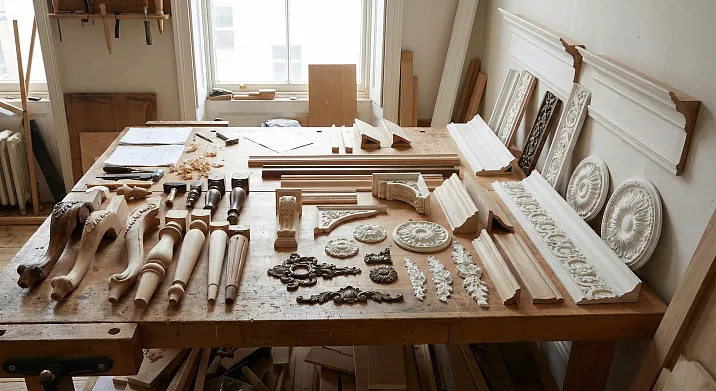
Decorative space design is an art that requires not only artistic taste but also a deep understanding of the functional logic of each element. Wooden details can radically transform the appearance of a room, endowing it with character and nobility. However, chaotic use of carved details without understanding their purpose leads to visual dissonance and destruction of the composition. Proper selection and combination of decorative components turns an ordinary dwelling into a work of architectural art, where each detail plays its irreplaceable role.


Architectonics of furniture decor: a systematic approach to design
Furniture decorative elements represent a complex hierarchical system where each component performs a specific visual and constructive function. Understanding this structure helps avoid typical design mistakes and create a harmonious composition. Decorative details are divided into several categories depending on their location, scale, and artistic role in the overall ensemble.
The first level consists of supporting elements — legs and balusters, which form the silhouette of the furniture and set the rhythmic foundation of the composition. These components carry not only aesthetic but also structural load, determining the stability and proportions of the entire product.Furniture decorshould harmonize with the architecture of the supports, creating a unified visual statement.
The second level is represented by applied elements — rosettes, corner details, friezes, and cornices, which enrich the planes and give volume to the forms. These components work as accents, drawing attention to certain zones and emphasizing important structural nodes. It is the applied details that allow transforming simple furniture into an exclusive piece endowed with character and stylistic definition.




Furniture legs: the foundation of form and style
Furniture supports represent a basic element on which the entire appearance of the item depends. The shape, proportions, and decorative detailing of the legs determine the stylistic affiliation of the product and its visual mass. Massive straight supports create a sense of monumentality and reliability, curved cabriole legs add lightness and dynamics, turned balusters bring classical elegance.
The choice of material is critically important for durability and aesthetic qualities. Oak provides maximum strength and expressive texture, beech is distinguished by uniform structure and light warm tone, ash demonstrates a contrasting pattern of annual rings.furniture legsmade from solid hardwood are capable of withstanding significant loads without deformation for decades, preserving the original geometry and decorative qualities.
The height of the supports affects the perception of the furniture and functionality of use. Low legs up to 100 mm create a squat, stable silhouette suitable for massive chests of drawers and sofas. Medium height of 150-250 mm is universal for tables, armchairs, and cabinets, providing comfortable ergonomics. High supports over 300 mm give airiness and are used in console tables, bar counters, and elegant classic furniture.
The cross-section and profile of the supports should correspond to the dimensions and mass of the furniture. A square section of 50×50 mm is suitable for light tables and chairs, rectangular 60×80 mm is used in larger items, a round section with a diameter of 70-100 mm is characteristic of turned balusters. Too thin legs under a heavy tabletop look fragile and create visual discomfort, excessively massive supports under a light product produce an impression of roughness.
Decorative detailing varies from minimalist smooth surfaces to complex multi-tiered carving. Simple conical supports with a smooth taper upward are suitable for modern interiors, turned balusters with flutes and collars are characteristic of classical styles, carved legs with plant motifs adorn furniture in Baroque and Rococo styles. The choice of the degree of decorativeness should consider the overall saturation of the interior with details.
Our factory also produces:


Wooden balusters: rhythm and vertical dynamics
Wooden balusters are traditionally associated with stair railings, but their application in furniture opens wide possibilities for creating original solutions. Vertical posts form rhythmic compositions, structure space, and give products architectural expressiveness.Wooden balustersvary in profile shape, height, diameter, and nature of decorative processing.
A classic turned baluster consists of several functional zones — the base, central part, and finial. The base provides stability and transitions from the horizontal surface to the vertical, the central part carries the main decorative load, and the finial completes the composition and serves as a support for a handrail or tabletop. Harmonious proportions between these zones create a visually balanced form.
In furniture, balusters are used in the backs of chairs and armchairs, where vertical posts provide back support and form a characteristic silhouette. The number of balusters in a back varies from three in simple chairs to seven or more in formal armchairs. Uniform spacing between the posts creates a calm rhythm, while variable spacing with emphasis on a central baluster of larger diameter introduces dynamism.
The sides of beds and sofas are decorated with balusters, creating an openwork railing and visual lightness for a massive structure. The height of balusters in a headboard can reach 600-800 mm, forming an expressive architectural accent in the bedroom. Wooden posts are painted to match the main furniture or in a contrasting color, emphasizing the rhythmic structure.
Sideboards and display cabinets are often equipped with balusters as front posts framing the glazed sections. The verticals create a division of the facade and emphasize the height of the piece. This solution is characteristic of classic buffets, where balusters work together with cornices and plinths, forming an architectural composition in miniature.
Tables with underframes often use balusters as connecting elements between the legs. Four balusters installed between the supports around the perimeter of the table create a spatial frame that strengthens the structure and gives the piece visual completeness.furniture framesTables with balusters are characteristic of classic dining tables and writing bureaus.
Get Consultation
Overlay elements: The art of surface decoration
Carved overlays are planar or three-dimensional decor mounted on the main surface of furniture. These elements do not serve a structural function but play a decisive role in artistic design, creating accents and enriching visual perception.interior decorationThe range includes many types of overlays, differing in shape, size, and ornamentation.
Decorative rosettes: Composition centers
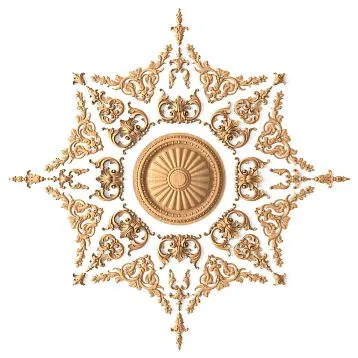
Rosettes are round or oval overlay elements with a centric composition of ornament. Sizes vary from miniature 40 mm to large 300 mm and more. Small rosettes are used as accents on cabinet doors, medium ones decorate the centers of panels and drawer fronts, large ones form visual centers on pediments and facade compositions.
The ornamentation of rosettes is diverse — plant motifs with acanthus leaves, roses, grapevines; geometric patterns with concentric circles, stars, spirals; antique motifs with Ionic scrolls and palmettes. The choice of ornament is determined by the interior style and the overall decorative concept.
The placement of rosettes follows compositional logic. A central rosette on a door or panel creates a symmetrical composition, drawing the eye to the geometric center of the plane. Corner placement of four small rosettes frames a rectangular panel, emphasizing its boundaries. Rosettes can be placed at the intersections of decorative muntins, enhancing the rhythmic structure.
Mounting is done with glue and additional fixation with small nails or screws in inconspicuous places. The surface under the rosette must be flat and clean to ensure a tight fit. After installation, the joints are filled and sanded before the final finish, creating the illusion of a monolithic relief.
Corner elements: Decorating junctions
Corner overlays serve to decorate the joints of planes and create a visually finished framing. These elements have a right-angle shape with various ornament configurations on both sides. Sizes vary from compact 30×30 mm to large 150×150 mm, determining the scale of decorative impact.
The simplest corner elements are smooth triangular overlays that create clear framing without additional ornament. Such details are suitable for minimalist interiors and modern furniture, where neat finishing of junctions is required without excessive decorativeness.
Carved corner elements with plant scrolls, volutes, and rosettes create rich framing for frame compositions. Four identical corner elements installed at the corners of a rectangular panel form a symmetrical frame, inside which a panel, mirror, or painting can be placed.
A special category consists of corner elements for furniture tabletops, which have a three-dimensional shape and cover the corner joint of edges. Such parts prevent corner chipping and give the tabletop a finished look. The material of the corner element must match the material of the tabletop to ensure uniformity of texture and color.
Installing corner elements requires positioning accuracy — both sides of the part must be placed strictly symmetrically relative to the corner. A shift of even a few millimeters creates a visual imbalance and disrupts the harmony of the composition. Using guides and markings ensures installation accuracy.
Friezes and borders: Horizontal rhythms
A frieze is an extended horizontal decorative element with a repeating ornament. Unlike a cornice, a frieze is not located at the edge of a plane but in the central zone, dividing the surface into horizontal tiers. The height of a frieze varies from 30 to 150 mm, and its length corresponds to the width of the decorated surface.
The ornament of a frieze is built on the principle of rapport repetition of a basic motif. A meander creates a continuous geometric band with rectangular scrolls, a plant tendril forms a wavy line with leaves and flowers, a pearl motif presents a row of round elements imitating strung beads. The choice of ornament is determined by the interior style.
Friezes are used in the design of tall cabinets and buffets, where a horizontal band divides the facade into upper and lower zones, creating a visual pause and improving proportions. A frieze can be placed at the level of the tabletop, separating the plinth part and the main body.
In bed headboards, a frieze creates a horizontal accent that emphasizes the width and balances the verticals of balusters or pilasters. Placing the frieze in the upper third of the headboard visually lifts the composition, in the lower third — creates a stable base.
The frieze is mounted along the entire length of the decorated surface without breaks. If the frieze length is insufficient, the joints of the elements should be placed at the points of rapport repetition of the ornament, ensuring visual continuity of the pattern. The joints are carefully fitted and sanded to make the connection invisible.
Cornices and moldings: The architecture of edges
A cornice is a profiled element that crowns the upper edge of furniture and creates an expressive finishing of the form. Unlike planar overlays, a cornice has a complex cross-section with alternating projections and recesses, creating a play of light and shadow. The width of a cornice varies from thin 20 mm to massive 200 mm, determining the visual weight of the crowning part.
Functional and aesthetic roles of the cornice
The cornice performs several important functions in furniture composition. Visual completion of the form — the cornice creates a clear upper boundary of the piece, separating it from the wall and ceiling. Without a cornice, furniture looks unfinished, cut off. The profiled projection forms an architectural logic characteristic of classic order systems.
Dust protection — the horizontal shelf of the cornice prevents dust from settling on the top end of the body and serves for placing decorative items. The protruding cornice protects the joint of the furniture with the wall from contamination and mechanical damage.
Changing proportions — a wide, massive cornice visually weighs down the upper part of the furniture, creating a stable composition. A narrow, elegant cornice lightens the form, giving it an airy feel. By varying the width of the cornice, one can adjust the perception of the product's height and massiveness.
Stylistic characteristic — the shape of the cornice profile is one of the main style markers. A simple rectangular cornice with minimal profiling is characteristic of Modern and Minimalism; a complex multi-tiered profile with flutes and Ionic volutes is typical of Classicism; an asymmetrical curved cornice with rocaille ornamentation indicates Rococo.
Types of profiles and their application
A straight cornice with a simple bevel or rounding of the upper edge is suitable for modern furniture in Minimalist, Scandinavian, and Loft styles. The absence of complex curves simplifies manufacturing and installation, reducing cost. Such a cornice does not attract attention and works as a neutral finishing element of the form.
A stepped cornice with several horizontal projections creates a classical architectural composition, reminiscent of a column's entablature. The alternation of projecting and receding bands forms a rhythmic structure and a play of light and shadow. Stepped cornices are characteristic of classical and neoclassical furniture.
A profiled cornice with complex curvilinear elements — ogees, beads, cavettos — creates rich plasticity and is suitable for ceremonial furniture in palace styles. Such profiles require high manufacturing skill and careful finishing to reveal all the nuances of the form.
A carved cornice complements the profiled cross-section with three-dimensional ornamentation — dentils (teeth), Ionic volutes, acanthus leaves, rosettes. Carving can cover the entire surface of the cornice or be placed locally as accents. A carved cornice is the pinnacle of decorative finishing and is used in exclusive, top-category furniture.
Rules for installation and joining of cornices
The cornice is mounted on the top end of the furniture body using glue and mechanical fasteners. The end surface must be level and horizontal; any unevenness will lead to gaps between the cornice and the body. Checking for level is performed with a level before installation.
Corner joints of cornices are made at a 45-degree angle to ensure visual continuity of the profile. Cutting accuracy is critical — an error of even one degree creates a noticeable gap or overlap. Using a miter box or a miter saw with precise angle setting ensures a high-quality joint.
When joining cornices with different profiles, it is important to ensure the alignment of the main lines — the top shelf, the bottom edge, the central projections. The transition from one profile to another should be smooth and logical; abrupt jumps disrupt the composition.
Painting and gilding of the cornice is performed after installation to ensure uniformity of color and coating, including the joints. Preliminary puttying and sanding of the joints creates a perfectly smooth surface without visible connections.
Comprehensive approach: combining elements into a unified composition
Harmonious furniture design requires a systematic selection of all decorative elements, taking into account their interaction and subordination to the overall stylistic concept. Chaotic use of elements from different styles destroys the integrity of perception and creates visual chaos. A well-thought-out composition is built on the principles of unity, subordination, and proportionality.
Principle of stylistic unity
All decorative elements should belong to one style or closely related stylistic directions. Mixing Baroque carved rosettes with minimalist straight legs creates stylistic cacophony. Classical turned balusters require corresponding profiled cornices and carved overlays with traditional ornaments.
Stylistic unity does not mean monotony — within one style, there is a rich variety of forms and ornaments. Classicism includes both strict Doric forms and elegant Corinthian motifs. It is important to choose a specific stylistic line and consistently adhere to it in all elements.
Transitional styles allow for freer combinations but require subtle artistic taste. The Eclecticism of the 19th century consciously combined elements from different eras but did so according to certain rules, ensuring visual coherence. Art Nouveau introduced natural forms into classical architectural structures while preserving the logic of composition.
Scalar subordination of elements
The sizes of decorative details must correspond to the dimensions of the furniture and be proportionally related to each other. A large rosette with a diameter of 200 mm on a door leaf 300 mm wide will occupy most of the surface, overwhelming the form. On the same door leaf, a rosette of 80-100 mm is appropriate, creating an accent without dominance.
The cornice must be proportional to the height of the furniture. For a wardrobe 2000 mm high, a cornice 100-150 mm wide is suitable; for a cabinet 800 mm high, a cornice of 40-60 mm is sufficient. A too massive cornice on low furniture creates visual instability; a too thin one on a tall wardrobe appears insufficient.
Legs should harmonize in thickness and height with the mass and dimensions of the furniture. A dining table with a massive solid wood top requires sturdy legs with a cross-section of at least 80×80 mm; a light console table can rest on elegant balusters with a diameter of 50 mm.
Overlay elements of different types are sized in relation to each other — a frieze should not be wider than the cornice, corner elements are proportional to the size of the framed panel, rosettes are scaled depending on the surface area.
Rhythmic organization of decoration
Repeating identical elements creates a rhythm that structures the composition. A row of balusters in a chair back, a sequence of rosettes on a wardrobe frieze, an alternation of pilasters on a buffet facade — all these are examples of rhythmic organization. A uniform step creates a calm, monotonous rhythm; a variable step with accents introduces dynamism.
Symmetry is the basis of classical compositions. The central axis of symmetry runs through the middle of the facade; all elements are arranged mirror-like relative to it. Paired rosettes, symmetrical overlays, a central baluster of larger size — typical techniques of symmetrical construction.
Asymmetry is characteristic of Art Nouveau, Art Deco, and modern styles. Shifting the compositional center, different heights of supports, asymmetrical placement of overlays create a dynamic, expressive form. However, asymmetry must be deliberate and balanced; chaotic placement of elements is perceived as an error.
Color and tonal harmony
Unity of color scheme unites all elements into an integral composition. All wooden parts can have the same tone, achieved by using wood of the same species and uniform finishing. Oak, tinted dark brown, creates a monochrome, noble palette.
A contrasting solution juxtaposes the main body and decorative elements. A light birch body with dark wenge overlays creates an expressive, graphic composition. The reverse option—a dark body with light carved details—highlights the ornament and creates accents.
Gilding is used to highlight the most important decorative elements. Gilded rosettes and cornices against a white background create a formal, palatial atmosphere. Partial gilding of protruding parts of the carving while maintaining the main color of the recesses creates a volumetric interplay.
Patination and brushing of the surface emphasize the wood texture and create an effect of noble antiquity. Light patina in the recesses of the carving enhances the relief, while dark patina in oak pores reveals the structure of the annual rings. All elements must undergo the same treatment for textural unity.
Typical mistakes when selecting decorative elements
The practice of furniture decoration reveals recurring mistakes that disrupt the harmony of the composition and reduce the aesthetic value of the piece. Knowing these mistakes allows one to avoid them and achieve a professional result.
Excessive decoration
The most common mistake is the desire to use the maximum number of decorative elements, filling every centimeter of the surface with carvings and overlays. This approach creates visual noise, tires the eye, and gives an impression of bad taste. The principle 'more is better' does not work in decorative art.
A harmonious composition is built on a balance of filled and empty zones. Empty planes create a visual pause, allowing the eye to rest and drawing attention to the decorated areas. The ratio of decorated to neutral surface should be approximately 30% to 70% for classical styles and 10% to 90% for contemporary ones.
Multiple diverse elements placed without a system create chaos. If a single door features a rosette, corner elements, a frieze, and additional overlays, the composition is overloaded. It is sufficient to choose one or two types of elements and arrange them thoughtfully.
Stylistic eclecticism
Mixing elements from different styles without understanding their compatibility leads to visual dissonance. Baroque volutes on a strict Art Nouveau cabinet, antique rosettes on loft-style furniture, Rococo carved legs under a minimalist tabletop—such combinations destroy stylistic integrity.
Each style possesses its own system of forms, proportions, and ornaments, developed historically. Arbitrary borrowing of elements without considering stylistic logic creates kitsch. Correctly mixing styles requires a deep understanding of their nature and professional artistic taste.
Modern eclecticism allows for the combination of different eras but does so consciously, creating controlled contrasts or finding common formal features. For example, Art Deco geometric ornaments can be combined with contemporary minimalist forms due to shared conciseness and graphic quality.
Mismatch in scale
Using overly large elements on small-scale furniture or small details on massive pieces disrupts proportionality. A huge rosette on a narrow door looks out of place; a miniature cornice on a tall cabinet gets lost and fails to fulfill its compositional role.
The scale of the decor must correspond to the overall dimensions of the furniture and the viewing distance. Small details are appropriate on items viewed up close—such as boxes, dressing tables. Large elements are necessary for furniture perceived from a distance—cabinets, buffets, portals.
Incorrect placement of elements
Placing decorative details without considering structural logic and compositional centers creates visual confusion. A rosette offset from the center of a panel looks like a mounting error. A cornice not parallel to the top edge of the furniture disrupts the horizontal line. Asymmetrically placed corner elements create a sense of imbalance.
Each element has a logical place in the composition, determined by functional nodes and the geometry of the form. Central elements are placed on axes of symmetry, corner elements at the junctions of planes, and elongated elements along structural lines.
Ignoring material compatibility
Using decorative elements made from a material incompatible with the main body creates technical problems and visual inconsistency. MDF overlays on solid wood differ in texture and behavior under humidity changes. Polyurethane parts on wooden furniture have different light-reflective properties and do not accept traditional finishing methods.
The ideal solution is to use elements made from the same wood species as the main body. This ensures unity of texture, color, and physical properties. When using other materials is necessary, careful finishing is required to conceal the differences.
Specifics of applying decor in different types of furniture
Each type of furniture has its own logic for placing decorative elements, dictated by function, construction, and traditional form-making. Understanding this specificity allows for the creation of functional and aesthetically perfect pieces.
Case furniture: cabinets, chests of drawers, sideboards
Cabinets and buffets are vertical dominants in the interior, requiring an expressive architectural solution. The decorative system is built on the principle of tripartite division—plinth, main body, crowning part—similar to a classical column.
The plinth part is decorated with a profiled baseboard or carved base, creating a transition from the floor to the body. The plinth height is typically 100-150 mm, ensuring visual stability. The plinth can be smooth or decorated with a simple geometric profile.
The main body is divided by pilasters or applied verticals, separating the facade into sections. Doors are adorned with frame compositions with central rosettes and corner elements. Horizontal friezes separate the upper and lower tiers of multi-tiered cabinets.
The crowning part is resolved with a massive profiled cornice, completing the composition. The cornice can be complemented by a pediment—a triangular or segmental completion of the central part of the facade. The pediment is adorned with carved overlays and rosettes, creating a formal accent.
Chests of drawers have a horizontal orientation and require emphasis on length. Drawer fronts are framed with compositions featuring perimeter overlays. Corner elements anchor the corners, while central rosettes or horizontal overlays decorate the center of the facade.
Tables and consoles: interplay of supports and tabletops
Tables are a combination of a horizontal plane and vertical supports, requiring harmonious proportion. The shape and decor of the legs determine the character of the entire piece. Massive carved legs create the representativeness of a dining table; elegant balusters lend lightness to a console.
The apron—the structure connecting the legs—can include rails, stretchers, and decorative balusters. Rails frame the tabletop around the perimeter, creating a visual frame. Stretchers connect the legs at the bottom, reinforcing the structure. A central rosette at the intersection of stretchers creates an accent.
The tabletop edge is finished with profiling or an applied molding, creating a completion of the plane. Simple rounding suits everyday tables; a complex profile with several curves is characteristic of formal pieces. Corner elements on the tabletop protect vulnerable corners and create decorative accents.
Console tables placed against a wall have only the front facade decorated. The front legs can be more massive and carved, while the rear ones are simple supports. The front apron is adorned with carved overlays and friezes, creating an expressive frontal view.
Seating: chairs, armchairs, sofas
The backs of chairs and armchairs are vertical planes visible from the rear and require decorative treatment. Balusters form an openwork structure that provides back support and creates a characteristic silhouette. The number and shape of the balusters determine the style of the piece.
The central insert of the back can be decorated with a carved overlay featuring an ornament that matches the overall style. An oval or rectangular overlay with a floral motif creates a focal point in the center of the back. The top rail of the back is profiled or adorned with carving.
The front legs of chairs and armchairs are often made more decorative than the rear ones, as they are viewed from the front. Turned or carved front legs contrast with simple rear supports. The armrests of armchairs are decorated with carved overlays and finished with volutes or other decorative elements.
Sofas and couches have extended sides and backs that require rhythmic organization of decoration. Repeating balusters or pilasters create a division of the facade. Overlay elements are placed at uniform intervals, forming an orderly composition.
Beds: headboards and bases
The headboard of a bed is the main decorative element of a bedroom, requiring expressive design. A tall headboard with carved pilasters, balusters, and overlays creates an architectural focal point. The central part can be adorned with a large rosette or carved composition.
The sides of the bed are decorated with balusters or overlay panels, creating a visual enclosure. The bed legs can be either simple supports hidden under the frame or expressive decorative elements that continue the stylistic theme of the headboard.
The bed aprons—side and end panels connecting the legs—are decorated with profiling and overlays. The lower apron may have a shaped cutout to lighten the massive form. The corner posts of a canopy bed are powerful vertical accents, adorned with carving and finials.
Practical Recommendations for Selection and Installation
Successful use of decorative elements requires not only artistic taste but also practical knowledge of materials, technologies, and installation methods. A professional result is achieved by attention to detail at all stages of work.
Quality assessment of elements
Before purchasing decorative elements, their quality must be thoroughly evaluated. Clarity of carving—all elements of the ornament should be clearly defined without smudged areas or chips. The depth of relief should be sufficient to create an expressive play of light and shadow.
Geometric precision—symmetrical elements should have a perfectly symmetrical shape; paired parts should have identical dimensions. Checking is done by comparing mirror halves and superimposing paired elements on each other.
Quality of wood—the material should not have knots, cracks, or resin pockets in decoratively significant areas. The wood's moisture content should correspond to the operating conditions (8-12% for furniture) to avoid deformation after installation.
Quality of surface treatment—elements should be thoroughly sanded, without fuzz or roughness. A poorly sanded surface will require additional treatment after installation, which is difficult for already installed parts.
Preparation for Installation
Acclimatization of elements—before installation, decorative parts should be left for several days in the room where the furniture will be used. This allows the wood to adapt to the humidity and temperature, preventing subsequent deformations.
Size fitting—if necessary, elements are trimmed and fitted to the dimensions of the surface being decorated. Fitting accuracy is critical for cornices and friezes where joints are visible. Using sharp tools and precise measurements ensures a quality result.
Trial layout—before final installation, it is recommended to lay out all elements on the surface without gluing, evaluate the composition, and adjust the placement if necessary. This prevents errors that are difficult to correct after gluing.
Installation technology
Choice of adhesive—for mounting wooden elements, PVA wood glue or polyurethane glue is used. PVA is suitable for elements without significant load; polyurethane provides a stronger bond and moisture resistance. The adhesive is applied in a thin, even layer to both surfaces to be bonded.
Fixation during drying—after applying the adhesive, the element is pressed firmly against the base and secured with clamps, weights, or painter's tape. The curing time depends on the type of adhesive and ranges from 30 minutes to several hours. Excess adhesive that squeezes out from under the element is immediately removed with a damp cloth.
Additional mechanical fastening—large and heavy elements are additionally secured with thin headless nails or furniture screws, which are countersunk into the wood and filled with putty. Fasteners are placed in the least noticeable areas—recesses of the carving, end zones.
Sealing joints and fasteners—after the adhesive dries, all joints between elements and fastener holes are filled with wood putty, matched to the wood tone. After the putty dries, the surface is carefully sanded with fine sandpaper until completely smooth.
Final finishing
Toning—to even out the color of the elements and the base, toning with stain or special compounds is applied. The stain is applied with a brush or pad in an even layer. The depth of tone is adjusted by the concentration of the stain and the number of coats.
Patination—to create an effect of noble aging, patina is used—a special compound that accumulates in the recesses of the carving and emphasizes the relief. Patina is applied with a brush; excess is removed from the raised parts with a rag, creating a contrast between light raised areas and dark recesses.
Varnishing—the final varnish coating protects the wood from moisture, dirt, and mechanical damage. Oil-based, nitrocellulose, or polyurethane varnishes are used depending on the required properties. The varnish is applied in several thin coats with intermediate sanding using fine sandpaper.
Waxing—an alternative to varnish, creating a matte, silky surface. Wax is applied with a pad, rubbed into the wood, and polished with a soft cloth. Waxing highlights the natural wood grain and provides pleasant tactile sensations.
Modern trends in furniture decoration
The development of technology and changing aesthetic preferences influence the nature of decorative element use in modern furniture. Several distinct trends are observed, defining current directions.
Minimization of decoration
Modern furniture tends towards laconic forms and restraint in decorative means. Instead of an abundance of carving and overlays, simple geometric shapes are used, emphasizing the beauty of the material and construction. Decorative elements are applied selectively, creating accents rather than full coverage.
Smooth facades with minimal relief are characteristic of Scandinavian style, minimalism, and Japanese aesthetics. Decorative effects are achieved not through carving, but through the play of wood texture, material contrast, and precision of proportions. Elements, if used, have simple geometric shapes without complex ornamentation.
Blending tradition and modernity
Neoclassical and contemporary classic styles combine traditional forms of decorative elements with a laconic interpretation. Classical cornices and rosettes are simplified, retaining their recognizable silhouette but losing detail. Balusters acquire a more geometric form while preserving the principle of vertical division.
This approach allows classical decorative elements to be incorporated into a modern interior without creating a stylistic conflict. Simplified forms retain the architectural logic and nobility of classicism but look fresh and relevant.
Individualization and customization
Growing demand for unique furniture stimulates the use of custom decorative elements created from individual sketches. Carvers create original ornaments reflecting the client's personal preferences or the interior's specifics. These can be stylized images of plants, animals, geometric patterns, or monograms.
CNC milling technology makes creating complex reliefs from digital models accessible. The designer creates a three-dimensional model of the element in a computer program, which is then realized in wood using a milling machine. This expands shaping possibilities and reduces the cost of custom elements.
Ecological and natural
Increasing attention to ecology and a healthy lifestyle enhances interest in natural materials and traditional technologies. Decorative elements made from solid valuable wood species are perceived as a sign of quality and environmental care. Hand carving is valued higher than machine carving as a manifestation of craftsmanship and uniqueness.
Natural oil and wax finishes, instead of synthetic varnishes, emphasize the wood texture and preserve the wood's ability to 'breathe.' Such coatings are safe for health and create a pleasant tactile surface.
Questions and Answers: Analyzing Practical Situations
How to determine which type of decorative elements suits specific furniture?
The choice of element type depends on the furniture style, its dimensions, and function. For classic cabinets and buffets, carved rosettes, profiled cornices, and pilasters are suitable. Modern furniture requires laconic geometric forms or a complete absence of applied decoration. Tables are primarily decorated with decorative legs and edge profiling of the tabletop.
Dimensions determine the scale of elements — large furniture requires correspondingly large details, compact furniture requires miniature ones. Function influences the choice of material and fastening strength — furniture subject to mechanical stress requires reliable element mounting.
Can decorative elements from different collections be used?
Using elements from different collections is possible if they belong to the same style and have similar characteristics — scale, material, ornamentation character. Mixing elements from classical and modern collections will create a stylistic conflict.
It is recommended to choose elements from one manufacturer within one stylistic line. This ensures compatibility in dimensions, profiles, and carving character. If elements from different manufacturers are used, their compatibility must be carefully checked.
What mistakes are most often made during independent installation of decorative elements?
The most common mistake is insufficient surface preparation. Installation on an uneven or dirty base leads to poor adhesion, gaps, and subsequent detachment of elements. The surface must be level, clean, and degreased.
Incorrect glue choice or insufficient curing time leads to unreliable bonding. Using glue incompatible with the material reduces bonding strength. It is necessary to strictly follow the glue manufacturer's instructions regarding curing time.
Lack of a trial layout leads to compositional errors discovered only after gluing. Correction requires element removal, which may damage them. Always lay out all parts without glue first and evaluate the result, making adjustments if necessary.
Rushing when cutting miter joints for cornices creates gaps and profile misalignments. A precise 45-degree angle is critical — even a half-degree deviation creates a noticeable defect. Using a quality miter box or miter saw with precise adjustment is essential.
How to care for furniture with decorative elements?
Regular dust removal is performed with a soft dry cloth or a brush with natural bristles. Carving recesses require special attention — dust accumulates in the relief and spoils the appearance. A vacuum with a soft attachment effectively removes dirt from hard-to-reach places.
Wet cleaning is permissible only for varnished surfaces. The cloth must be well-wrung; excess moisture is harmful to wood. Waxed and oiled finishes are wiped only with a dry cloth, as moisture destroys the protective layer.
Periodic renewal of the protective coating extends service life. Waxed furniture requires reapplication of wax every 6-12 months. Oil finishes are renewed when dry areas appear. Varnished surfaces require professional restoration if damaged.
Protection from direct sunlight prevents fading and drying of the wood. Windows should be equipped with curtains or blinds to regulate light exposure. Optimal air humidity of 40-60% prevents cracking and deformation of decorative elements.
Can damaged decorative elements be restored?
Minor chips and scratches are eliminated with wood filler followed by tinting and varnishing. The filler is selected to exactly match the wood tone or mixed from several shades. After drying and sanding, the repair area becomes almost invisible.
Serious carving damage — loss of ornament fragments — requires professional restoration. A carver recreates the lost parts based on preserved fragments or similar elements. The new carving is tinted and patinated to match the overall tone.
Detached elements are re-glued after thorough cleaning of the bonding surfaces from old glue residue. Surfaces are sanded with sandpaper, degreased, and fresh glue is applied. The element is fixed until completely dry.
Replacement of completely destroyed elements is done by selecting similar parts or making copies. Modern 3D scanning and CNC milling technologies allow creating an exact copy of a lost element from preserved samples.
Which decorative elements are the most versatile and suitable for different styles?
Simple geometric cornice profiles without intricate carving adapt to a wide range of styles. A cornice with a simple bevel or rounding works in both classical and contemporary interiors, changing its character depending on the surroundings.
Smooth, turned balusters with minimal decoration are versatile due to their concise form. Smooth transitions in diameter without excessive constrictions and protrusions allow such balusters to be used in furniture of different stylistic directions.
Simple corner elements and small rosettes with geometric ornamentation combine with various design directions. A round rosette with concentric circles, a square overlay with a simple frame work as neutral accents.
Straight legs of square or rectangular cross-section with a conical taper towards the top are suitable for classical, contemporary, and transitional furniture. Changing the proportions and the character of the finish adapts the same form to different styles.
Decorative elements in the context of interior styles
Each historical and contemporary interior style imposes specific requirements on the character of furniture decorative elements. Understanding these requirements allows for creating stylistically correct compositions.
Classicism: Strictness and Order Logic
Classicism is oriented towards ancient architecture with its system of orders and strict proportions. Decorative elements borrow the forms of columns, capitals, and entablatures. Pilasters with fluting divide cabinet facades, cornices reproduce the profiles of ancient temples, rosettes contain palmettes and Ionic volutes.
Symmetry is absolute—all elements are arranged mirror-symmetrically relative to the central axis. Proportions obey the mathematical ratios of the golden section. Ornamentation is restrained and rhythmic—meander, beads, laurel wreaths, acanthus leaf in a stylized form.
The color palette is built on the contrast of white and gold or on a monochromatic solution in warm tones of natural wood. Gilding is used to highlight the most important elements—pilaster capitals, central rosettes, crowning cornices.
Baroque: Dynamism and Abundance
Baroque is characterized by opulent decoration, complex curvilinear forms, and an abundance of carving. All surfaces are covered with ornamentation—plant scrolls, putti, shells, garlands. Straight lines are avoided, preferring curved profiles and undulating contours.
Furniture legs have a curved cabriole form, ending in a carved paw or scroll. Cornices are complex and multi-tiered, projecting far forward, creating deep shadows. Rosettes are large, voluminous, often including sculptural elements—angel heads, masks.
Gilding is abundant, covering most of the carved elements. The background can be dark or colored—red, green, blue—emphasizing the gold. Inlay with colored wood species, mother-of-pearl, and ivory creates rich decorative effects.
Modern: natural forms and asymmetry
Art Nouveau rejects the classical order system, drawing inspiration from natural forms. Decorative elements imitate plants—stems, leaves, flowers—rendered in smooth, curved lines. Favorite motifs—irises, lilies, climbing vines.
Asymmetry becomes a compositional principle. Legs can have different shapes, elements are arranged asymmetrically, creating a dynamic composition. Cornices are curved in waves, following organic lines.
The color palette is soft, muted—grey-green, lilac, brown tones. The finish emphasizes the wood grain, often using light-toned staining. Carving is low, smooth, without sharp transitions, creating flowing forms.
Scandinavian Style: Laconicism and Functionality
Scandinavian style minimizes decoration, focusing on purity of form and material quality. Decorative elements, if used, have a simple geometric shape without ornamentation. Legs are straight or slightly conical, smooth, without carving.
The texture of natural wood is the main decorative means. Light species—birch, ash, pine—retain their natural color, emphasized by transparent oil or varnish. Carved elements are practically absent, replaced by milled roundings and bevels.
Proportions are light, furniture is visually weightless thanks to thin details and open constructions. If balusters are used, they are in the form of simple round posts of minimal diameter. Cornices are either absent or represent a simple plank.
Technologies for Manufacturing Decorative Elements
The quality and artistic value of decorative elements are determined by the manufacturing technology. Different methods provide varying degrees of detail, uniqueness, and cost.
Hand Carving: The Pinnacle of Craftsmanship
Hand carving is a traditional technology for creating decorative elements using chisels, gouges, and other hand tools. The carver works directly with the wood, creating a unique relief. Each element is individual, bearing the imprint of the master's hand.
The process begins with creating a sketch—a drawing of the future ornament. The sketch is transferred to the workpiece, after which the carver sequentially forms the relief by removing excess wood. The depth of carving, the character of detail elaboration, and the smoothness of transitions depend on the skill of the craftsman.
Hand carving allows for creating the most complex compositions with high detail, subtle transitions, and delicate openwork. Adjustments are possible during the work, adapting the ornament to the grain characteristics of a specific piece of wood. The artistic value of such elements is maximal.
Disadvantages—high cost, lengthy production time, impossibility of exact copying. Two elements carved by the same master from the same sketch will differ in details. Creating paired or serial elements requires special skill.
CNC Milling: Precision and Reproducibility
Computer Numerical Control (CNC) technology uses milling machines controlled by a computer program. A three-dimensional model of the element is created in specialized software, then the machine reproduces it in the material with high precision.
Advantages — absolute identity of all instances in the series, fast production speed, ability to create complex shapes inaccessible to hand carving. Symmetrical elements turn out perfectly symmetrical, repeating ornament — absolutely rhythmic.
Limitations are related to tool capabilities — the cutter has a specific diameter, which prevents creating sharp internal corners and ultra-thin details. Milling depth is limited by tool overhang. Creating a fully three-dimensional sculpture is difficult; the technology is better suited for reliefs.
Result quality depends on 3D model detailing and processing parameters. High model detail and small cutter step ensure fine detailing but increase production time. After milling, manual finishing is required — sanding, removal of technological marks.
Turning: creation of balusters and legs
Turning on a lathe is the primary method for manufacturing round elements — balusters, legs, posts. The workpiece is secured in the machine and rotates, the cutter forms the profile by removing material. The turner works according to a template or drawing, controlling dimensions with a caliper.
Manual turning allows creating complex profiles with smooth transitions and fine details. An experienced turner feels the wood, adapts cutting to its properties, obtaining a clean surface without fuzz. Each baluster is unique in small details.
CNC lathes reproduce a digital model of the profile with high precision and complete identity of instances. Copying lathes repeat the profile of a sample using a tracing system. Both technologies ensure serial production while maintaining quality.
Decorative processing of turned elements is complemented by longitudinal flutes, spiral threading, carving on the finished turned profile. Such operations are performed on special machines or manually after removing the workpiece from the lathe.
Molding and pressing: budget alternatives
Decorative elements made of composite materials — MDF, pressed sawdust, polymers — are manufactured by pressure molding. The material is placed in a mold and pressed, taking on the specified relief. Such elements are significantly cheaper than carved wooden ones.
Advantages — low cost, perfect repeatability, resistance to moisture and temperature changes (for polymer elements). A large selection of ready-made molds allows selecting elements for any style. Ease of installation — many elements have a self-adhesive base.
Disadvantages — artificial appearance, different from natural wood. Upon closer inspection, imitation texture is noticeable. Inability to tint and restore is characteristic of polymer elements. Limited strength of composite materials requires careful handling.
Conclusion: bringing the concept to life with STAVROS
Creating a harmonious interior using decorative elements requires a professional approach combining artistic vision and technical skill. From style selection to final installation, each stage is important for achieving a perfect result. Understanding the function, character, and rules of combinationdecor elements for furnitureallows avoiding typical mistakes and creating a composition that will delight for decades.
Wooden decorative elements are an investment in the beauty and durability of the interior. Quality details made from solid hardwoods, with proper installation and care, retain their original appearance for generations, becoming part of family history. Carved furniture is passed down as heirlooms, preserving artistic and material value.
The company STAVROS specializes in the production of high-quality decorative elements from natural wood for furniture and interiors. The assortment includes thousands of items — from classic carved rosettes to modern minimalist profiles, from miniature overlays to massive cornices and columns. Years of experience working with hardwoods — oak, beech, ash — ensures exceptional product quality.
STAVROS production combines traditional hand carving methods with modern CNC processing technologies, allowing the creation of both exclusive author's elements and high-quality serial products. Strict control at all stages — from wood selection to final sanding — guarantees the flawlessness of each item.
STAVROS consultants will help select elements that match the interior style, furniture dimensions, and project budget. The catalog presents ready-made collections united by a common stylistic theme, simplifying the creation of harmonious compositions. Custom manufacturing of elements based on individual sketches is possible for realizing unique designer concepts.
Turning to the professionals at STAVROS is a guarantee of obtaining decorative elements that will transform furniture and interiors, endowing them with the nobility of natural wood and the artistic expressiveness of carving. Quality decor creates an atmosphere that is pleasant to live, work, and receive guests in, demonstrating the taste and status of the owner.