Article Contents:
- Anatomy of door framing: from simple casing to architectural portal
- Casing — the classic frame of a door opening
- Door portal — architectural framing of an opening
- Arch framing — a curvilinear alternative
- Capitals and consoles — decorative accents
- Frieze and ornamental inserts
- Door decor styles: from classic to avant-garde
- Classicism: Symmetry and Antique Proportions
- Baroque: opulence and dynamic decorativeness
- Empire: imperial monumentality
- Neoclassicism: modern interpretation of traditions
- Minimalism: decor with minimal means
- Art Deco: Geometric Luxury
- Provence and country: the warmth of naturalness
- Why polyurethane became the material of choice for door decor
- Moisture resistance: no swelling in damp rooms
- Dimensional stability: no seasonal deformation
- Lightweight: installation without effort or special tools
- Detailing: casting preserves the finest nuances of carving
- Paintability: any color, any texture
- Trends 2026: new directions in door decor
- Invisible doors and hidden casings
- High portals up to the ceiling: verticals elongate the space
- Contrasting colors: moving away from traditional combinations
- Wide casings: bigger means more noticeable
- Asymmetry and individuality: moving away from standards
- Installation of polyurethane door decor: error-free technology
- Opening preparation
- Marking the position of elements
- Cutting and fitting elements
- Adhesive bonding and additional fastening
- Sealing Joints and Preparing for Painting
- STAVROS: 23 years of creating architectural beauty
- Conclusion: doors as architectural statements
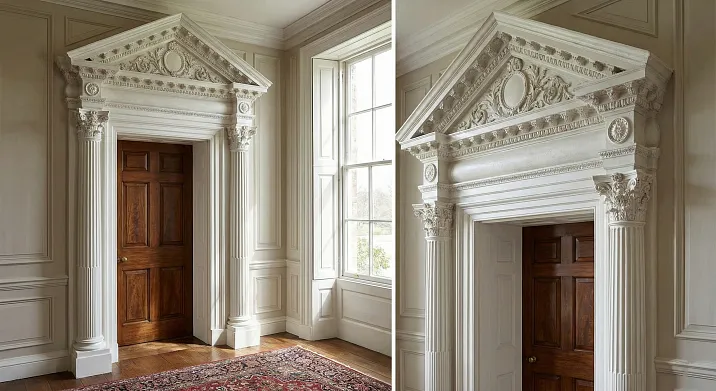
A door is not merely a technological opening in a wall connecting rooms. It is a boundary between spaces, a place of transition, a frame through which you enter a new atmosphere. And the first impression of a room depends on how this frame is designed. A bare rectangular opening with a door leaf screwed onto hinges is the construction minimum, which says: functionality and economy live here. A door framed with classic casings, a portal with pilasters, capitals, and cornices is an architectural statement that communicates: here, beauty is valued, the significance of details is understood, and space is created for a dignified life.
Historically, door frames were carved from solid wood—oak, walnut, mahogany. Richly carved casings required weeks of a carver's work, cost a fortune, served for generations, but gradually dried out, cracked, and darkened with time. A budget option was gypsum molding, but it crumbled from impacts, deteriorated in damp rooms, and required careful handling. The 21st century offered a revolutionary solution that combines the beauty of classic carving with the practicality of modern materials.Polyurethane door decorationweighs five times less than wood, is not afraid of moisture and temperature fluctuations, does not crack or warp, is installed in two hours, costs like quality hardware instead of the price of exclusive furniture, and reproduces the finest carving details with the precision of industrial casting.



Anatomy of a Door Frame: From Simple Casing to Architectural Portal




Casing — the classic frame of a door opening
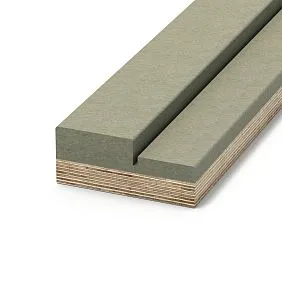
A casing is an overlay strip framing a door opening around its perimeter. In its simplest form, it consists of three strips: two vertical ones on the sides of the door and one horizontal one at the top. The width of a classic casing is 7-12 centimeters for interior doors, 10-15 centimeters for entrance doors. The thickness is 1-2 centimeters, with a projection from the wall plane of 0.5-1.5 centimeters.
The profile of the casing defines the style. A flat casing with a rectangular cross-section is a minimalist solution for modern interiors. A shaped casing with a complex profile (alternating protrusions, recesses, roundings) is a classic solution for traditional interiors. A carved casing with floral or geometric ornamentation is a luxurious option for historical styles.
The color of the casing is traditionally tied to the color of the door—they form a single set. But modern trends allow for contrasting combinations: white casings on a colored wall with a door matching the wall color create a graphic frame for the opening. Dark casings with a dark door on a light wall create an expressive contrast.
Our factory also produces:

Door Portal — architectural framing of an opening
A portal is an expanded framing of a door opening that transforms it into an architectural element. While a casing simply borders the opening, a portal creates an architectural structure around it with columns, a cornice, and a plinth.
The side elements of a portal are pilasters (flat vertical projections) or half-columns, imitating load-bearing architectural elements. They have a base (expanded foundation), a shaft (central vertical), and a capital (upper decorative finish). The height of pilasters equals the height of the opening plus the plinth at the bottom and the cornice at the top.
The upper part of a portal is an entablature, consisting of an architrave (the lower beam resting on the capitals), a frieze (the middle decorative strip), and a cornice (the upper protruding element). The frieze is often adorned with relief ornamentation, creating a decorative accent above the door.
Portals are characteristic of spacious rooms—halls, living rooms, studies. They visually increase the significance of the opening, create solemnity, and emphasize the status of the room into which the door leads.
Get Consultation
Arched Framing — a curvilinear alternative
Arched openings require special framing that follows the curvature of the arch. A semicircular arch is framed by a casing bent along the radius. A pointed Gothic arch—by a casing with a sharp finish. A shallow segmental arch—by a casing with a slight curve.
For arched openingsdecorative polyurethane elementsare especially convenient. Flexible polyurethane moldings bend to the required radius, creating a smooth curve without seams. Rigid wooden casings would have to be steamed, bent, and fixed—a labor-intensive process with unpredictable results.
Keystone — a decorative element at the center of an arch, imitating the central stone of arched masonry. It is larger than the surrounding casing, protrudes more strongly, and is often adorned with carving, a mascaron (decorative mask), or a cartouche (a shield with scrolls). The keystone creates a focal point, attracts the eye, and emphasizes the central axis of the opening.
Capitals and Consoles — decorative accents
A capital is the upper finish of a pilaster or half-column. Classical orders offer ready-made types of capitals: Doric (simple, with a circular cushion), Ionic (with side scrolls—volutes), Corinthian (with acanthus leaves). The choice of order defines the style of the portal: Doric—strict, powerful; Ionic—elegant, balanced; Corinthian—luxurious, decorative.
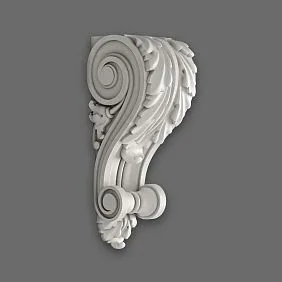
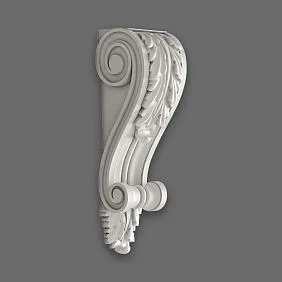
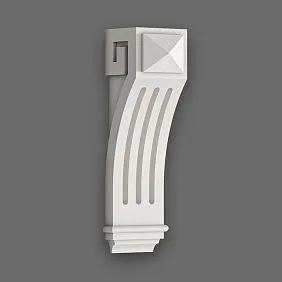
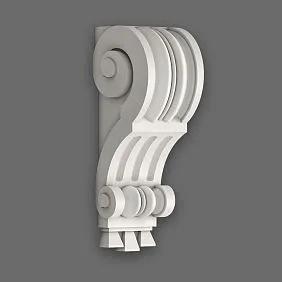
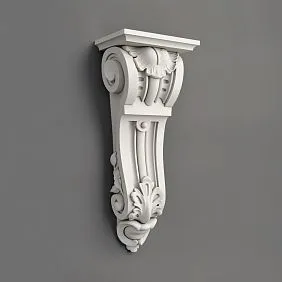
Consoles are protruding support elements under the cornice of a portal, creating visual support for the upper part. The shape of a console is an S-shaped curve or a rectangular bracket. Consoles can be smooth (simple geometric volume) or carved (adorned with acanthus leaves, volutes, floral ornamentation).
Frieze and Ornamental Inserts
A frieze is a horizontal strip above a door opening between the architrave and the cornice. This is a field for decoration: floral garlands, geometric patterns, rosettes, meanders (continuous broken lines), putti (chubby baby angels), antique motifs.
For entrance doors, the frieze can include the owner's initials or coat of arms, creating personalized framing. This emphasizes status, creates a sense of a family home, and a connection to traditions.
Corner elements — decorative overlays at the corners of a casing, which mask the joints of vertical and horizontal strips and create accents. These can be rosettes (circular elements with ornamentation radiating from the center), corner blocks (square overlays with carving), brackets (protruding elements supporting the top casing).
Styles of Door Decor: From Classic to Avant-Garde
Classicism: symmetry and antique proportions
Classicist framing is strictly symmetrical, proportional, and laconic. Casings are straight, 10-12 centimeters wide, with a simple profile—one or two steps, without excessive ornamentation. A portal consists of two pilasters of Ionic or Doric order, a horizontal entablature with a simple frieze (meander or garlands), and a cornice with several protruding shelves.
Color—white on colored walls or matching the wall color to create soft relief. Classicism avoids color diversity, preferring monochrome or restrained contrasts (white on beige, gray on light gray).
Example: a door to a living room. A portal of two Ionic pilasters 15 centimeters wide, an entablature 25 centimeters high with a frieze adorned with a meander. The entire portal is white, the walls are beige. A calm, balanced, elegant composition is created without flashy decorativeness.
Baroque: opulence and dynamic decorativeness
Baroque framing is maximally decorative. The architraves are wide (15-20 centimeters), with a complex multi-step profile. Portals include twisted or fluted half-columns with Corinthian capitals, a richly decorated frieze with garlands, putti, and mascaron. The cornice is massive, multi-stepped, projecting 15-20 centimeters.
Colors are white with gilding. Capitals, protruding carved elements, and central parts of the frieze are covered with gold paint, creating a luxurious impression. Sometimes the entire portal is gold on a white wall or white on a wall of emerald, burgundy, or sapphire color.
Asymmetry in details is permissible: a broken pediment above the door (triangular completion with a break in the center), consoles of different shapes along the edges of the cornice, a cartouche on the frieze offset from the center. This creates Baroque dynamism, a sense of movement in frozen forms.
Example: entrance door to a mansion. Portal with twisted half-columns, Corinthian capitals with abundant carving. Frieze with garlands of flowers and fruits, a central cartouche with the owner's initials. Cornice is multi-stepped, with carved consoles at the edges. The entire portal is white, capitals and cartouche are covered with gold.
Empire: imperial monumentality
Empire style is classicism brought to an imperial scale. Portals are massive, with large Doric or Tuscan pilasters. Decoration includes imperial symbolism: eagles, laurel wreaths, military trophies, lion masks.
Frieze with bas-reliefs on military or antique themes. Colors are white, gold, dark green, black with golden accents. Characterized by horizontal orientation—the portal is wide but not tall, creating an impression of stability and power.
Example: door to a study. Portal with massive Doric pilasters. Frieze with relief—laurel wreaths and eagles. Cornice—a thick projecting slab. Portal is white, frieze is covered with gold, creating a solemn, official impression.
Neoclassicism: modern interpretation of traditions
Neoclassicism takes the proportions of classicism but simplifies details and modernizes colors. Architraves retain their profiled form, but carving is minimized or absent. Portals have pilasters with simplified capitals, a smooth or minimally decorated frieze, and a simple cornice.
Colors are gray shades (from light gray to graphite), beige, taupe (gray-brown), black, white. Monochrome solutions are popular—framing in the same tone as the wall to create soft relief instead of contrasting highlighting.
Example: bedroom door. Architrave 10 centimeters wide, smooth, medium gray color (RAL 7038). Walls are light gray. Soft tonal contrast, modern elegance without historical pathos.
Minimalism: decoration with minimal means
Minimalist framing is extremely laconic. The architrave is a flat plank 5-7 centimeters wide, without a profile, without projections. Thickness 0.5-1 centimeter, projection from the wall plane is minimal or zero (architrave flush with the wall).
Color is monochrome. Either tone-on-tone with the wall (the architrave merges with the plane, only a thin graphic line is visible) or contrasting (black on white, white on black, graphite on beige).
Portals in minimalism are rare. If used, they are maximally simplified: two vertical planks on the sides of the opening without capitals, a horizontal plank on top without a cornice. Simply a geometric frame denoting the opening.
Example: door in a modern apartment. Opening without a door (open passage). Framing—black matte planks 6 centimeters wide, flat. Walls are white. Clear black frame on a white background, graphic quality, minimalist severity.
Art Deco: geometric luxury
Art Deco combines classical proportions with geometric ornaments. Architraves are wide, with a profile of alternating steps creating a graphic rhythm. Portals include pilasters with simplified geometric capitals (instead of acanthus leaves—stylized triangles, trapezoids, zigzags).
The frieze is decorated with geometric ornament: chevron (zigzag), sun rays, concentric circles, stylized plant motifs transformed into geometric shapes. Colors are contrasting: black and gold, white and black, dark blue and silver.
Materials imitate luxury: glossy finishes, metallic paints (bronze, brass, chrome), black lacquer.Polyurethane door decorationis painted in these colors, creating the impression of expensive materials without their weight and cost.
Example: living room door in Art Deco style. Portal with pilasters decorated with vertical fluting. Capitals are geometric—stylized trapezoids. Frieze with an ornament in the form of sun rays. Portal is covered with black glossy lacquer, the frieze ornament is gold. On a black wall with golden accents, a luxurious Art Deco atmosphere is created.
Provence and Country: the warmth of naturalness
Provence and Country use framings that imitate natural wood.decorative polyurethane elementsare painted to look like wood—light oak, bleached ash, aged pine with cracks and wear.
Architraves are simple, 8-10 centimeters wide, with a light profile or flat. No lavish carving, no portals with columns. Simplicity, rustic naturalness, connection with nature.
Colors are natural wood tones from bleached to medium brown. Artificial aging techniques are popular: patination (darkening the recesses of the profile to emphasize texture), brushing (highlighting the wood grain), creating wear and cracks for an aged effect.
Example: kitchen door in Provence style. Architrave 9 centimeters wide made of polyurethane, painted to look like bleached oak. Texture imitates wood grain, visible "knots," "cracks," signs of time. Walls are light beige. A warm, cozy, rustic atmosphere is created.
Why polyurethane became the material of choice for door decor
Moisture resistance: no swelling in damp rooms
Doorways in bathrooms, toilets, and kitchens are in areas of high humidity. Wooden architraves in a damp environment absorb water, swell, warp, and require replacement after a few years. Plaster molding in damp rooms is generally not durable—it absorbs water, becomes soggy, and crumbles.
Polyurethane is hydrophobic at the molecular level. The closed-cell structure has no through pores, water does not penetrate the material. Relative air humidity does not affect dimensions and shape—a polyurethane architrave does not swell at 100% humidity and does not dry out at 0%. This makes it an ideal choice for framing doors in bathrooms, showers, pools, saunas (at temperatures up to 80°C).
After painting with moisture-resistant paints (acrylic, alkyd enamels), polyurethane decor is fully protected from water. It can be washed, wiped with a damp cloth, and treated with cleaning agents without risk of damage.
Dimensional stability: no seasonal deformation
Solid wood is a living material that breathes and changes dimensions depending on humidity and temperature. In winter with heating on, the air is dry, wood releases moisture, dries out — gaps appear between the casing and the wall. In summer, humidity is higher, wood absorbs water, expands — the casing presses against the wall and may deform. Annual cycles of drying and swelling gradually destroy the wood, leading to cracks and warping.
Polyurethane is a thermally stable material; its dimensions do not depend on humidity and temperature (within the operating range from -40°C to +80°C). An installed casing retains its shape and dimensions for decades without gaps, deformations, or shifts. Joints remain tight, geometry impeccable.
This is critical for perfectionists who are annoyed by seasonal gaps appearing in wooden casings in winter. Polyurethane provides stability — install once, forget forever.
Lightweight: installation without effort or special tools
A carved wooden casing 15 centimeters wide, 2 centimeters thick, 2.2 meters long (standard door opening height) made of solid oak weighs 8-10 kilograms. Two side casings plus the top one — 25-30 kilograms per door. Installation requires an assistant, a powerful hammer drill, long screws, and physical strength.
A polyurethane casing of the same dimensions weighs 1.5-2 kilograms. A set for one door — 5-6 kilograms. One person can easily lift, fit, and install all elements in 2-3 hours. Fastening — special polyurethane adhesive plus several plastic dowels for security. No heavy tools, no assistants, no effort.
Cutting to the required size is done with a regular miter saw or even a fine-toothed handsaw. Polyurethane cuts easily, does not require powerful tools like hard wood. The cut is clean and does not require additional processing.
Detailing: casting preserves the finest nuances of carving
Hand carving wood is an art requiring years of learning and practice. A master carver carves one casing in a week of work. The cost of such work is measured in tens of thousands of rubles per element. At the same time, there is always a human factor — inaccuracy, deviation from symmetry, differences between elements.
Industrial polyurethane casting in silicone molds transfers every detail of the master model with micron precision. The liquid composition flows into the smallest recesses of the mold, hardens, is extracted — and here is an element where every petal of an acanthus leaf, every vein, every curl is reproduced with jewelry precision.
Serial production guarantees identity. All elements of one article are absolutely identical — symmetrical capitals, identical ornaments, matching profiles. This is impossible to achieve with hand carving.
After painting in wood color or patination, polyurethane carved decor is indistinguishable from wooden even from half a meter away. Only weight and touch reveal the different nature of the material.
Paintability: any color, any texture
Polyurethane is supplied in white primed form — a universal base for any painting. Want classic white — two coats of white acrylic paint. Want a color matching the wall — tint the paint to the desired shade. Want a contrasting dark — graphite or black enamel.
Special techniques create effects unattainable for natural materials. Wood imitation — paints with wood texture effects or painting with grain and knot detailing. Patination — rubbing dark patina into profile recesses to emphasize relief, creating an aged effect. Gilding — coating protruding elements with gold paint for accentuation.
Metallic effects — paints with bronze, copper, iron, chrome effects turn a polyurethane casing into an imitation metal trim. Concrete effect — special paints create an industrial loft aesthetic.
Repainting is possible at any time. If after five years you want to change the interior color, polyurethane decor is repainted without dismantling — light sanding of old paint, a new primer coat, two coats of new paint. Over a weekend, all door casings in the apartment change color.
Trends 2026: new directions in door decor
Invisible doors and hidden casings
The main trend in modern design — doors that are almost invisible. Hidden doors flush with the wall, painted the same color as the wall, without protruding casings. The door merges with the wall plane, becomes invisible when closed.
But even hidden doors require framing — technological gaps are unavoidable. The solution — a hidden casing of minimal width (2-3 centimeters), recessed flush into the wall, painted the same color as the wall. It covers the gap between the door block and the opening but remains practically unnoticeable.
Polyurethane thin profiles are ideal for hidden framing — lightweight, dimensionally precise, easy to install, paintable in any color, creating a perfectly flush fit to the wall.
High portals up to the ceiling: verticals elongate space
Standard door opening height of 2-2.1 meters with ceiling height of 2.7-3 meters leaves a blank wall above the door. The modern trend — extending the portal to the ceiling. Pilasters run from floor to ceiling, creating powerful verticals. Above the door leaf remains a transom (upper part of the opening), which is filled with glass, a panel, or left open.
High portals visually increase room height, create monumentality, emphasize the architectural significance of the opening. This works in rooms with high ceilings (from 3 meters) — there a standard 2.3-meter-high portal looks squat, while a portal to the ceiling creates a harmonious vertical.
Polyurethane door decorationPolyurethane allows creating high portals without weighing down the structure. A 3-meter-high pilaster made of polyurethane weighs 5-7 kilograms, made of solid wood 30-40 kilograms. The difference is critical for mounting on drywall walls.
Contrasting colors: abandoning traditional combinations
Tradition demands: door and casing in the same color or similar tones. White door — white casing. Walnut-colored door — walnut-colored casing. Modern designers break this rule, creating contrasting combinations.
A white door — a black casing on a gray wall. A dark door — a white casing on a dark wall. A door matching the wall color — a contrasting casing that highlights the opening as a graphic frame.
These combinations create graphic quality, modernity, a departure from traditional canons. They work in modern interiors — minimalism, Scandinavian style, loft, where contrast is valued more than color harmony.
Wide casings: more means more noticeable
Standard casing width is 7-9 centimeters. The 2026 trend — increasing to 12-18 centimeters. Wide casings create expressive framing, turning the door into an architectural accent.
Wide casings look especially effective with contrasting coloring. A white wall — a graphite casing 15 centimeters wide — a white door. A thick dark frame on a light background creates graphic quality, attracts attention, structures the space.
Wide casings visually enlarge the opening, making it more significant. A narrow, modest opening with a wide casing appears larger than a spacious opening with a narrow casing.
Asymmetry and individuality: moving away from standards
Standard framing is symmetrical: identical side casings, a centered top one. The trend toward individuality allows for asymmetry: different side casings, an off-center decorative element, an asymmetrical portal with a pilaster on only one side.
Asymmetry creates uniqueness, distinguishes the opening from a row of standard ones. This requires design flair — careless asymmetry looks like a mistake, thoughtful asymmetry looks like a bold design decision.
decorative polyurethane elementsallow experimenting with asymmetry without great expense. Tried it, didn't like it — redid it. You can't experiment like that with expensive custom-made wooden carved elements.
Installation of polyurethane door decor: error-free technology
Opening preparation
Walls around the opening must be level, strong, clean. Checking levelness with a straightedge — gaps between the straightedge and the wall no more than 3-5 millimeters per meter. Large irregularities are leveled with plaster or filler.
Base strength is checked by tapping. A dull sound — solid plaster. A ringing sound — delaminated, it is removed and restored. Weak, loose areas are reinforced with deep-penetration primers.
Dust, dirt, grease stains, old adhesive residues are removed. The surface is washed and dried. Before installation, the base is primed — this improves adhesive adhesion and ensures reliable fastening.
Marking the position of elements
Precise marking is half the success. The position of casings is marked with a pencil on the wall. Verticals are checked with a plumb line or laser level, horizontals — with a bubble level.
For portals, symmetry is important — side pilasters must be at the same distance from the edges of the opening, the top entablature is strictly horizontal. A deviation of a millimeter is noticeable to the eye, creating an impression of crookedness.
If there are several doors on a wall, it is important that the casings are at the same height. Even a minimal discrepancy catches the eye. A common horizontal line is marked, from which the positions of all top casings are laid off.
Cutting and fitting elements
Casings are supplied in standard lengths — usually 2.2 or 2.4 meters. For a specific opening, they are cut. Cutting is done with a miter saw with a fine-toothed blade at low speeds — a clean cut without chips or melting.
Corner joints of casings (top one joins with side ones) are made at a 45-degree angle — a miter cut. Precision is critical — a gap of more than 0.5 millimeters will be noticeable. Use a miter saw with precise angle setting or a miter box.
Fitting before installation is mandatory. Elements are applied to the opening, dimensions, joint tightness, verticality, and horizontality are checked. Discovered discrepancies are corrected by cutting or sanding contact surfaces.
Adhesive bonding and additional fixation
Installation is combined — adhesive plus mechanical fasteners. Adhesive — a special polyurethane or MS-polymer compound for interior work. Regular construction adhesive (liquid nails) can be used, but specialized adhesive holds more reliably.
Adhesive is applied in a zigzag pattern to the back of the casing. For wide elements (more than 12 centimeters), adhesive is applied around the perimeter and in a zigzag in the center. The element is pressed against the wall, aligned with the markings, and held for 30-60 seconds for initial setting.
Long elements (side casings over 2 meters high) require an assistant or temporary fixation with painter's tape until the adhesive sets.
After the adhesive sets (after 10-15 minutes), the element is additionally secured with dowels or finishing nails. For polyurethane, plastic dowels 40-60 millimeters long (depending on plaster thickness) with a diameter of 6-8 millimeters are used. Dowels are installed every 50-60 centimeters of the element's length.
Holes for dowels are drilled with a drill and a concrete bit through the casing into the wall. The hole diameter equals the dowel diameter. The dowel is hammered in, the head is countersunk 2-3 millimeters below the surface. After installation, the recesses are filled, sanded, and become invisible after painting.
Sealing joints and preparation for painting
Joints between elements (casing corners, wall abutment, door frame abutment) are sealed with acrylic sealant for interior work. Sealant is applied from a gun in a thin strip, smoothed with a wet spatula or a gloved finger.
Painter's tape applied along the edges of the seam helps achieve a neat line. After applying the sealant, the tape is immediately removed, leaving a clear boundary.
Dowel indentations are filled with acrylic putty, sanded flush with the surface using fine sandpaper (grit 180-240) after drying.
If architraves are supplied pre-painted in the desired color, only touch-ups at joints and dowel points are required after installation. If supplied primed in white, full painting is required. Use acrylic paints or alkyd enamels depending on the desired effect. Acrylic provides a matte or semi-matte surface, alkyd enamel provides a glossy one.
Paint is applied with a brush or roller in two coats with intermediate drying. The first coat is the base, the second is the finishing coat, evening out the color and texture.
STAVROS: 23 Years of Creating Architectural Beauty
Polyurethane door decoration from STAVROS is the experience accumulated over 23 years of working with wood, moldings, and architectural elements. The company started with wood carving, creating elements for the restoration of historical interiors. Participation in the restoration of the Konstantinovsky Palace, the Hermitage, and the Alexander Palace provided a deep understanding of classical proportions, historical styles, and quality requirements.
This experience is transferred to the production of polyurethane decor. Every architrave, every capital, every decorative element is created based on historical samples or original designs by the company's designers, taking architectural canons into account. Master models are made by carvers or on CNC milling machines with an accuracy of up to tenths of a millimeter.
The range of door decor includes architraves of all profiles and sizes — from minimalist flat strips 5 centimeters wide to classic carved ones 15-18 centimeters wide. Portal elements — pilasters of all orders, Doric, Ionic, Corinthian capitals. Friezes with ornaments. Consoles, corner elements, keystones.
Material quality is confirmed by 23 years of practice. Polyurethane density 350-400 kg/m³, closed-cell structure, moisture resistance, thermal stability. Each batch undergoes quality control — checking geometry, carving detail, absence of defects.
The stock program ensures fast shipment of popular items. Ordered — the product is with you in 1-3 days. Non-standard sizes are custom-made in 7-14 working days. Delivery across all of Russia — from Moscow to Vladivostok.
Consultations at all stages. STAVROS managers will help you choose decor to fit the opening size and interior style, calculate the required number of elements, and provide recommendations for installation and painting. Call, describe your task — get professional advice from experts with 23 years of experience.
Conclusion: Doors as Architectural Statements
Door openings cease to be mere technological holes when they are framed by polyurethane door decor. They turn into architectural elements that structure space, create style, and speak of the owners' taste. A classic frame with a portal communicates: here they value traditions, understand the language of architecture. A minimalist frame says: modernity and purity of form live here. A contrasting color solution declares: here they are not afraid of bold decisions, they create an individual space.
Modern materials have made quality door decor accessible. decorative polyurethane elements weigh five times less than wood, are not afraid of moisture and temperature fluctuations, are installed in hours, and cost like good hardware. At the same time, detailing, beauty, and variety of styles are not inferior to traditional materials.
2026 trends expand possibilities. Hidden frames for invisible doors. Tall portals reaching the ceiling, creating monumentality. Contrasting color solutions, breaking traditional canons. Wide architraves, turning the opening into a graphic accent. Asymmetry and individuality instead of standard symmetrical solutions.
Create interiors where every detail is thought out. Turn door openings from a technological necessity into architectural accents. Use Polyurethane door decoration from STAVROS as a tool for creating harmonious space, where 23 years of experience working with classics combines with the advantages of modern materials and technologies.
Your home is a space that tells your story. Let every door opening be a chapter of that story — stylish, expressive, memorable.