Article Contents:
- Natural Perfection of Oak Wood
- Unique Structure and Texture
- Technical Advantages: Science Serving Tradition
- Biological Durability
- Workability and Universality of Application
- Application Areas: From Foundation to Finishing
- Structural Use
- Decorative Elements and Finishing
- Size range and technical specifications
- Economic Justification of Investment
- Ownership Cost Over the Long Term
- Investment attractiveness
- Production Technologies and Processing Methods
- Raw Material Preparation and Preparation
- Modern processing methods
- Comparative Analysis with Alternative Materials
- Competition Among Coniferous Species
- Advantages over coniferous species
- Criteria for selection and quality assessment
- Visual material inspection
- Technical requirements for the material
- Installation and Operation: Practical Aspects
- Preparation stage
- Long-term durability
- Ecological Aspects and Safety
- Natural eco-friendliness
- Secondary Use and Disposal
- Modern trends and innovative solutions
- Technological innovations
- Design Trends
- Regional Characteristics and Standards
- Russian Requirements for Quality
- International standards
- Practical Buyer Guidelines
- How to Choose a Reliable Supplier
- Cost optimization when purchasing
- Market development prospects
- Growing demand for eco-friendly materials
- Innovations in production
When it comes to premium construction materials, one question inevitably arises: where to find true quality in the ocean of offerings? Oak — this noble wood species — has served as a benchmark of strength and elegance for centuries. Today, when Buy oak beams it has become possible with just a few clicks, it is important to understand: what to pay attention to in order to obtain material worthy of your projects.

Natural Perfection of Oak Wood
Every tree tells a story. Oak is a chronicle of centuries, captured in its growth rings and fibers. The density of oak wood reaches 700 kilograms per cubic meter, making it one of the most reliable species among available materials. But numbers are only part of the story.
Imagine a tree that grew on harsh northern soils, battling winds and cold. It is precisely such conditions that form wood of exceptional quality — dense, elastic, resistant to any test of time. The elasticity coefficient of oak is 12.3 GPa — a figure that many modern composite materials would envy.




Unique Structure and Texture
Oak wood has a porous structure with clearly defined radial rays. This natural architecture not only gives the material unique beauty but also ensures its exceptional performance characteristics. The wood fibers form a complex network that withstands tremendous loads — up to 87 MPa under static bending.
The moisture content of freshly cut oak is about 60%, but due to the peculiarities of its structure, the wood easily undergoes proper drying. After processing, the material acquires dimensional stability while retaining all its valuable properties.
Our factory also produces:




Technical Advantages: Science Serving Tradition
Get Consultation
Biological Durability
Oak contains natural tannins, which serve as a natural protection against fungal damage and insects. This means that oak structures do not require aggressive chemical treatment, remaining environmentally safe.
Historical examples are impressive: oak piles on which Venice stands have been serving for over a thousand years. Oak structures in ancient cathedrals and palaces continue to bear loads centuries after installation.
Workability and versatility of application
Despite its high density, oak is excellently suited for all types of mechanical processing. Planing, milling, turning — all these operations are performed without difficulty. The material does not release resins, making it ideal for interior finishing of residential spaces.
Application areas: from foundation to finishing
Structural use
Oak beams are used in the most critical structural joints. They are used for the first row of log cabins, where maximum resistance to moisture and loads is required. In industrial construction, oak is used to manufacture under-shaft gaskets for heavy equipment and crane brake pads.
In the construction of hydraulic structures, oak beams are used for locks, dams, and quay structures. The material demonstrates exceptional resistance to water exposure, becoming even stronger over time.
Decorative elements and finishing
In interior design, oak beams are valued for their combination of functionality and aesthetics. They are used to make fireplace mantels, staircase elements, decorative beams. The material is ideal for creating interiors in country, classic, and modern loft styles.
Landscape designers actively use oak beams for small architectural forms: gazebos, bridges, fences. Such structures harmoniously blend into the natural environment and remain attractive for decades without losing appeal.
Size Range and Technical Specifications
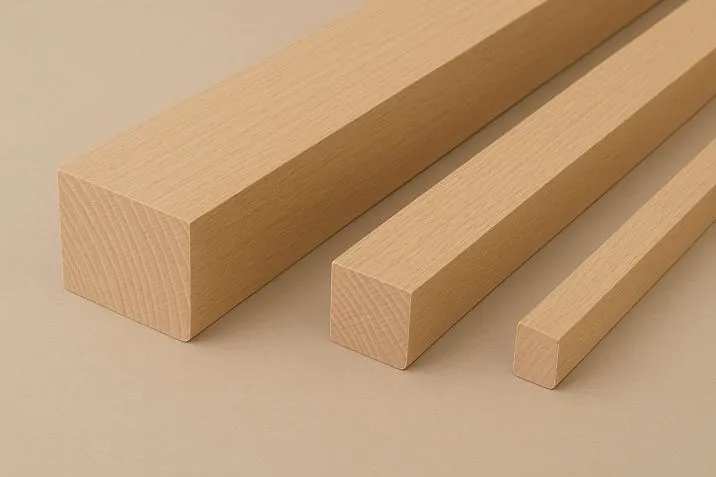
The modern market offers oak beams in a wide range of sizes. Standard cross-sections vary from compact 50×50 mm to massive 300×300 mm. The length of the products can reach 6 meters, although the most popular options are from 2 to 4 meters.
The moisture content of the finished beam is 12±2% — this is the optimal indicator for most applications. Such moisture ensures dimensional stability and eliminates deformations during operation.
The density of the processed material varies within 650-800 kg/m³ depending on residual moisture and processing method. Dimensional tolerances do not exceed ±2 mm, allowing the beam to be used in precise constructions.
Economic justification of investment
Long-term ownership cost
Solution Buy oak beams Requires significant initial investment. The cost of oak material significantly exceeds the price of coniferous species. However, if considering the project's economics over the long term, the advantages become obvious.
The service life of oak structures is measured in centuries. The material practically requires no maintenance — there is no need for regular replacement of elements, expensive repairs, or frequent application of protective coatings.
Investment Appeal
Using oak beams significantly increases the value of real estate. Houses and spaces finished with oak are always priced higher than comparable alternatives. This makes investments in quality materials not only practical but also financially justified.
Production technologies and processing methods
Raw material preparation and preparation
The quality of the finished product is established during raw material preparation. Trees over 80-100 years old, grown in harsh climatic conditions, have the best characteristics. Such wood is characterized by high density and durability.
The drying process requires a special approach. Oak wood is dried in special chambers with controlled temperature and humidity regimes. This allows reducing moisture to the required level without forming cracks or deformations.
Modern processing methods
Oak beams are rarely painted — the natural beauty of the material does not require enhancement. The main methods of final finishing are:
- Impregnation with natural oils to highlight the texture
- Lacquering to create a protective coating
- Staining to change the wood's color
- Brushing to create an aged effect
Each method allows preserving the natural beauty of the material while simultaneously improving its operational characteristics.
Comparative analysis with alternative materials
Competition among hardwood species
Among hardwoods, oak competes with beech, walnut, and hornbeam. Beech surpasses oak in hardness (4.0 HB vs 3.8 HB), but lags behind in biological and moisture resistance. Hornbeam is practically equal to oak in hardness, but is more difficult to process.
Beech has an attractive texture and is easy to process, but significantly lags behind oak in resistance to moisture and biological damage. This limits its application in critical structures.
Advantages over coniferous species
When compared to traditional coniferous species — pine and spruce — the advantages of oak become obvious. The hardness of oak (3.8 HB) significantly exceeds that of pine (1.6 HB) and spruce (1.4 HB).
Coniferous species release essential oils, giving rooms a distinctive aroma. Oak does not fall short of them in ecological safety, while providing significantly greater durability and resistance to damage.
Criteria for selection and quality assessment
Visual material diagnostics
When selecting oak timber, attention should be paid to several key parameters. Quality wood has an even color without dark spots indicating the onset of decay. The surface should be smooth, without deep cracks or chips.
Annual rings should be clearly visible and aligned parallel to the edges of the timber. Diagonal fiber orientation indicates cutting defects or low-quality raw material.
Technical Requirements for the Material
The moisture content of the finished product should not exceed 15% for interior applications and 18% for exterior use. Exceeding these values may lead to material deformation during operation.
Geometric parameters must match specifications with a tolerance of no more than ±3 mm. Large deviations will complicate installation and may reduce the final result’s quality.
Installation and Operation: Practical Aspects
Preparation Stage
Before installation, oak timber must undergo acclimatization under the expected operating conditions. The material must remain on-site for at least one week to equalize moisture and temperature levels.
Fasteners used are special screws or stainless steel bolts. Ordinary fasteners may cause dark spots due to reaction with tannins in the wood.
Long-term operation
A properly installed oak timber requires almost no maintenance. The only recommended procedure is periodic renewal of protective coating — every 5-10 years depending on operating conditions.
Minor damage can be easily repaired by sanding and re-treatment. Serious defects are extremely rare due to the natural durability of the material.
Ecological aspects and safety
Natural eco-friendliness
Oak timber is an absolutely eco-friendly material. It contains no toxic substances, does not emit harmful compounds, and is safe for human health. Unlike artificial materials, oak creates a healthy microclimate in rooms.
Scientific studies confirm that natural wood positively affects human psycho-emotional state. Oak belongs to donor trees capable of transmitting positive energy.
Secondary use and disposal
At the end of their service life, oak products do not create ecological problems. Wood decomposes naturally. Moreover, old oak structures often find secondary use — aged wood is especially valued by designers.
Modern trends and innovative solutions
Technological innovations
Modern processing technologies allow creating oak materials with improved properties. Thermal treatment increases dimensional stability and biostability. Special impregnations provide additional properties — fire resistance, water repellency.
Glued oak timber combines the advantages of solid wood with enhanced dimensional stability. The technology allows creating large-sized elements without length restrictions.
Design trends
Modern designers actively use oak's contrasting properties — combination of strength and elegance. Oak timber becomes a central element in loft, eco-design, and modern classic styles.
Combining oak elements with metal, glass, and stone creates unique interior solutions, where the natural beauty of wood is accentuated by modern materials.
Regional characteristics and standards
Russian quality requirements
In Russia, the quality of oak timber is regulated by state standards defining requirements for moisture content, geometric parameters, and allowable wood defects. Compliance with these standards guarantees receipt of quality products.
Domestic manufacturers actively develop production technologies, introducing modern equipment and quality control methods. This enables offering products meeting the best global standards.
International Standards
European quality standards are particularly strict. Oak timber meeting European requirements undergoes multi-stage control at all production stages — from raw material preparation to packaging of finished products.
Practical recommendations for buyers
How to choose a reliable supplier
When selecting a supplier of oak timber, attention should be paid to the company's reputation, presence of quality certificates, and ability to provide samples. It is important to ensure compliance with production technology and material storage conditions.
A reliable supplier is always ready to provide detailed information about the origin of the wood, processing methods, transportation, and storage conditions. Quality oak timber is the result of compliance with all technological requirements at every stage.
Cost optimization when purchasing
Solution Buy oak beams Requires careful budget planning. Cost can be optimized by ordering material in bulk, selecting standard sizes, and planning purchases in advance.
It is important to consider not only the cost of the material itself, but also transportation, unloading, and storage expenses. Quality logistics helps avoid damage and additional costs.
Market Development Prospects
Growing Demand for Eco-Friendly Materials
Modern trends in construction and design indicate growing interest in natural, eco-friendly materials. Oak timber fully meets these requirements, offering a combination of natural beauty and high performance characteristics.
Advancements in wood processing technology enable the creation of new types of oak materials with improved properties. This expands application areas and makes oak even more attractive for various projects.
Production innovations
The adoption of modern drying, processing, and quality control technologies allows manufacturers to offer oak timber with guaranteed characteristics. Automation of production processes increases quality stability and reduces cost.
The development of logistics networks makes high-quality oak timber accessible in any region. Modern packaging and transportation systems ensure material integrity during delivery.
STAVROS, a company operating in the construction materials market for many years, offers a wide range of oak timber in various sizes and applications. Rich experience and deep understanding of customer needs enable the company to guarantee top-quality products and professional service at every stage of cooperation.
Choosing oak timber from STAVROS means investing in durability, reliability, and beauty of your projects. Oak wood is not just a construction material — it is a philosophy of quality, proven over centuries and confirmed by modern technologies.