












































































Article Contents:
- Functional Anatomy: Why Is Baseboard Needed
- Acoustic and Thermal Insulation
- Profiles: Geometry of Style
- European and American Profiles
- Material and Species: What Matters Inside
- Exotic Species: Wenge, Teak, Merbau
- Dimensions and Proportions: The Mathematics of Harmony
- Material quantity calculation
- Wear Resistance: Tested by Time
- Impact of Operating Conditions
- Installation: Technology of Perfect Mounting
- Corners, Joints, Accessories
- Color Solutions: Harmony or Contrast
- Tinting and Coloring
- Combining with Interior: Systemic Approach
- Care and maintenance: extending lifespan
- Restoration: When Baseboard Ages
- Ecology and Health: Why Solid Wood Is the Right Choice
- Frequently Asked Questions: Dispelling Doubts
- Conclusion: An Indispensable Detail of a Perfect Interior

When the floor is laid, walls are aligned, doors are installed, it seems the renovation is complete. But look at the junction between the floor and the wall — it is here that the feeling of incompleteness or, conversely, flawless completion is born.Wooden baseboardThis is not just a decorative strip — it is an architectural element that connects horizontal and vertical planes of space, creates a visual frame, protects the most vulnerable zones of the interior from damage. Within its modest geometry lies the engineering wisdom of centuries: it compensates for thermal expansion of flooring, masks inevitable construction errors, conceals utilities, serves as a barrier between furniture and walls. This is a story about how a small detail determines the perception of the entire space, how the profile shape changes room proportions, and why solid wood remains the unrivaled material for those who value durability, beauty, and eco-friendliness.


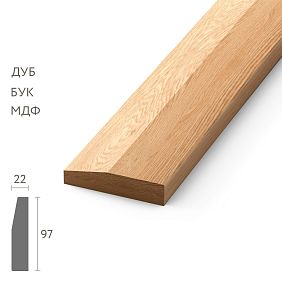


Functional Anatomy: Why Is Baseboard Needed
Let’s start with the obvious: baseboard covers the gap between the floor and the wall. This gap is not accidental — it is technologically necessary. Any flooring made of natural materials (parquet, solid wood planks, laminate) is subject to thermal and moisture deformation. Wood breathes, expands in summer with increased humidity, contracts in winter during heating season. If you lay the flooring flush against the walls, it will hit them upon expansion, forming waves, bulges, and cracks. The compensatory gap (usually 10–15 millimeters around the perimeter of the room) solves this problem, allowing the material to move freely.
But a bare gap looks untidy, collects dust, becomes a haven for insects.Wooden baseboardIt elegantly solves this problem: it covers the gap, creating a visually continuous line, while not hindering the natural movement of the material. Baseboard is mounted exclusively to the wall, not to the floor, allowing the flooring to move freely beneath the strip.
Wall protection — the second critically important function. The lower part of the wall is the most vulnerable zone in the interior. Here, walls come into contact with the floor, are subjected to impacts from furniture, vacuum cleaners, mops, children’s toys. Without protection, paint or wallpaper quickly wears out, plaster flakes off, scratches and stains appear. Baseboard takes on these impacts, creating a strong barrier between vertical and horizontal planes. Solid wood baseboard (oak, beech, ash) is especially effective: it withstands significant mechanical loads, does not deform, and easily recovers from damage.
Cable concealment — a function that has become especially relevant in the age of digital technology. In a modern home, dozens of wires: internet cables, TV antennas, speaker wires, charging devices, smart control systems. Running them through walls is expensive and not always possible, especially in already renovated rooms. Baseboards with cable channels solve this problem elegantly: a cavity forms inside the strip, into which wires are laid, and a removable front panel provides access for adding or replacing communications.Wooden baseboardWith an integrated cable channel, it combines the aesthetics of natural material with modern functionality.




Acoustic and Thermal Insulation
Less obvious, but important function — improving acoustic and thermal insulation properties of the room. The gap between the floor and the wall is not only a visual defect, but also an acoustic bridge through which sound propagates between rooms. A tightly installed baseboard closes this gap, reducing noise penetration. In wooden houses, where gaps may form between beams, baseboard additionally prevents cold air infiltration, improving thermal insulation.
Wood itself has low thermal conductivity — it does not chill like metal or stone, creating a feeling of warmth and coziness. Solid woodwith a classic profile creates a sense of solidity, reliability.serves as an additional insulating layer, especially noticeable in cold seasons when the temperature difference between the floor and the wall is maximal.
Visual function is no less important than technical. The skirting board is a frame surrounding the floor, defining the visual boundaries of space. Correctly chosen in height, profile, and color, it can visually enlarge or reduce a room, raise or lower the ceiling, emphasize or soften architectural features.wooden baseboardFrom noble wood species, it becomes a standalone decorative element, attracting attention with its texture, color, and profile shape.
Our factory also produces:
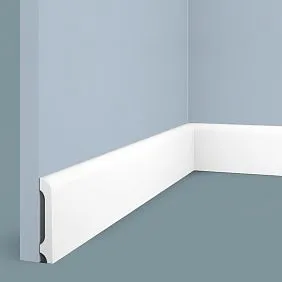
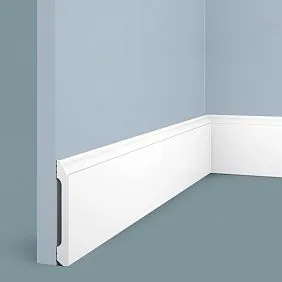
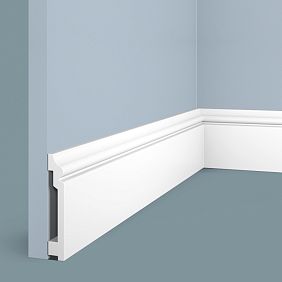
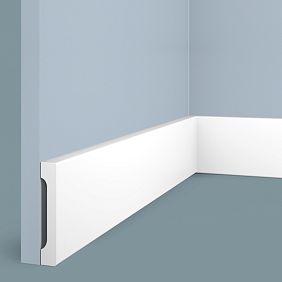
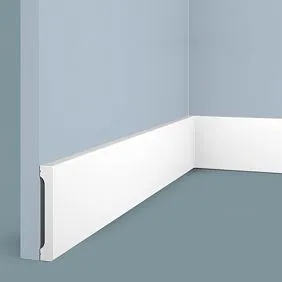
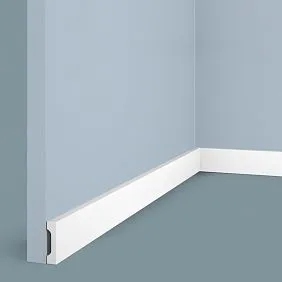
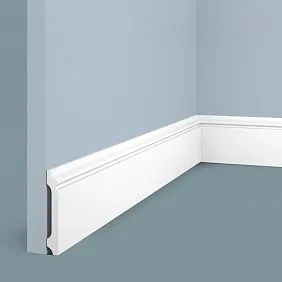

Profiles: Geometry of Style
The profile of the skirting board is its cross-section, determining the shape of the front surface. The choice of profile affects not only aesthetics but also functionality: the ability to fit tightly against uneven walls, ease of installation, possibility of cable channel placement, compatibility with interior style.
Straight profile — manifesto of minimalism. It is a plank with a flat or slightly rounded front surface, without decorative protrusions, recesses, or ornamental elements. The straight profile fits perfectly into modern interiors: Scandinavian style, minimalism, high-tech, loft. Its simplicity emphasizes clean lines, creating a sense of space and light. StraightWooden baseboardfrom light oak or ash — classic of Scandinavian design, where functionality and naturalness of materials are valued.
Technically, a straight profile is simpler to produce and install. It does not require complex milling, easily fits corners, and adheres well to walls. However, there is a nuance: on uneven surfaces, gaps may form between the flat plank and the wall, requiring additional sealing. Modern straight skirting boards often have a rounded back edge, which compensates for minor irregularities, ensuring tight fitting.
Classic profile — a complex figured shape with protrusions, recesses, and smooth transitions, creating play of light and shadow. The classic profile is characterized by an upper rounding or bevel, a central convex part, and a lower base, often with an additional protrusion. Such geometry adds volume, creating a sense of solidity and respectability. ClassicWooden baseboardfrom dark oak or walnut — an indispensable element of traditional interiors: English classic, French Provence, American colonial style.
Figured profile is more complex to produce — requires multi-pass milling, precise equipment setup, and high-quality grinding of all edges. But the result is impressive: the skirting board becomes not just a functional element, but a decorative detail that attracts attention. When installing, a classic profile requires more precise corner fitting, especially internal ones, where complex geometry must match perfectly.
High profile — a trend of recent years, originating from historical interiors. In the 19th century, high skirting boards (from 100 to 200 millimeters) were standard in aristocratic and bourgeois homes — they emphasized ceiling height, creating a sense of grandeur and spaciousness. Today, high skirting boards are returning to fashion, but in a modern interpretation: often they are straight or slightly profiled planks, painted in wall color, creating an effect of elongated space.wide wooden baseboardvisually raises the ceiling, making the room more proportionate, especially if ceilings are indeed high (from 3 meters).
High profile has practical advantages: it better protects walls from damage, can accommodate more cables, creates a softer visual transition between floor and wall. But proportions must be observed: in rooms with low ceilings (2.5 meters and below), a high skirting board may visually 'press down,' creating a sense of confinement. The rule is simple: for ceilings 2.5–2.7 meters, optimal height is 70–100 millimeters; for 2.8–3.2 meters — 100–150 millimeters; for 3.3 meters and above, skirting boards 150–200 millimeters can be used.
Get Consultation
European and American profiles
Geography also influences skirting board shape. European profile traditionally is more restrained, with moderate height (50–80 millimeters) and classic figured form. Europeanwooden baseboards for flooroften have upper rounding and one central convexity, creating an elegant silhouette without excessive ornamentation.
American profile tends toward greater height (80–120 millimeters) and more complex geometry with multiple tiers, protrusions, and recesses. In American homes, skirting boards often match door casings of the same profile, creating a unified system of architectural moldings framing the space. Such an approach requires careful planning: all elements must harmonize in height, profile, and color.
Scandinavian profile — a modern interpretation where height is medium (60–90 millimeters), shape is maximally simple (straight or with slight top rounding), finish is matte, color is light or white. Scandinavians value functionality and naturalness, so their skirting boards are inconspicuous, blending into the interior, quietly and effectively performing their function.
Material and species: what’s inside matters
When they say “Wooden baseboard”, they mean a product made from solid wood, not from MDF, veneered panels, or plastic with wood decor. Solid wood is a single piece of wood preserving its structure, texture, and all natural properties of the material. Species choice determines not only appearance but also longevity, wear resistance, and ability to resist deformation.
Oak — king among species for skirting boards. Its hardness (3.7–3.9 on Brinell scale) ensures exceptional resistance to mechanical damage. Oak does not deform from humidity, does not crack with temperature changes, retains its shape for decades. Oak’s texture is expressive: large pores, clear wood grain pattern, natural variation in shades from light golden to dark brown. Over time, oak darkens, acquiring a noble patina, which only enhances its aesthetic value.wooden skirting board purchasefrom oak — an investment in longevity: with proper installation and minimal maintenance, it lasts 50–70 years.
Ash — a close relative of oak in characteristics, but with a lighter shade and less pronounced texture. Ash is slightly less hard (3.4–3.6 on Brinell), but more elastic, making it easier to work with. Light ash skirting boards are ideal for Scandinavian and modern interiors, where lightness, airiness, and abundance of light are valued. Ash is easily tinted, allowing a wide range of shades — from bleached to silver.
Beech — another hard species (3.8 on Brinell) with uniform fine-grained structure. Beech has a warm pinkish hue, creating a cozy atmosphere. It is dense, heavy, holds its shape well, but is more sensitive to humidity than oak. In rooms with normal humidity (40–60%), beech lasts as long as oak, but in bathrooms, kitchens, and hallways, oak or larch is preferable.
Larch — coniferous species with remarkable moisture resistance due to high resin content. Larch is denser than most conifers (hardness comparable to oak), does not rot, does not suffer from fungi or insects. Its amber-gold hue with distinct annual rings creates a warm, natural atmosphere. Larch is an excellent choice for humid spaces, country homes, verandas, where operating conditions are more demanding.
Spruce — the most affordable species, soft (2.5 on Brinell), easy to process, but less resistant to damage. Spruce skirting boards are suitable for bedrooms, living rooms, children’s rooms — spaces with low load. Light, almost cream-colored spruce with a slight yellowish undertone is universal, compatible with most floor coverings. The main advantage of spruce — price: it is 2–3 times cheaper than oak, making qualityWooden baseboardaccessible to a wide range of buyers.
Exotic species: wenge, teak, merbau
For exclusive interiors, exotic species are used. Wenge — African wood of dark chocolate, almost black color with contrasting veins. Wenge is exceptionally hard (4.2 on Brinell), dense, resistant to any impact. Skirting boards from wenge — choice for luxurious interiors in art deco, modern, and contemporary classic styles.
Teak is an Asian wood species with a high oil content that makes the wood water-resistant. Teak does not fear moisture, temperature fluctuations, or ultraviolet rays. Its golden-brown hue with dark streaks creates a feeling of warmth and luxury. Teak skirting boards are ideal for bathrooms, saunas, and swimming pools.
Merbau is Indonesian wood with a reddish-brown color and golden streaks. Merbau is hard, stable, does not warp, and has a natural gloss. Merbau skirting boards emphasize the dignity of the interior and pair well with parquet and solid boards of the same species.
— a critically important parameter determining comfort of use. Standard dining table height — 75 cm from floor to top of tabletop. The base, with a tabletop thickness of 3–4 cm, should be 71–72 cm high.
Skirting board height is not an arbitrary value, but the result of a balance between functionality and aesthetics. A too-low skirting board (30–40 mm) looks insignificant, does not provide sufficient wall protection, and poorly covers the expansion gap. A too-high one (more than 150 mm) may visually 'eat' the ceiling height, especially in small rooms.
The standard height for most residential rooms is 50–80 mm. This is the golden middle ground suitable for ceilings 2.5–2.8 meters high, providing adequate protection and visual balance. For rooms with ceilings 2.7–3.0 meters, a height of 80–120 mm is recommended. For high ceilings (3.0–3.5 meters), skirting boards 120–150 mm are optimal, and for historical interiors with ceilings over 3.5 meters, skirting boards 150–200 mm can be used.
The formula is simple: the skirting board height should be approximately 3–4% of the ceiling height. For a 2.7-meter ceiling: 2700 × 0.03 = 81 mm — perfectly fits within the 70–90 mm range. For a 3.2-meter ceiling: 3200 × 0.03 = 96 mm — skirting boards 90–110 mm will work.
The thickness of the skirting board (distance from the wall to the front surface) is usually 15–22 mm for profiled models and 10–18 mm for straight ones. Thickness affects the perception of mass: a thicker skirting board looks more substantial and suits classical interiors. A thin skirting board appears more elegant and matches modern aesthetics.
Plank length is standard — 2000, 2200, 2500 mm. The choice depends on the room's geometry: for long walls, 2500 mm planks are preferable to minimize joints. For small rooms, 2000 mm planks are suitable — they are easier to work with and produce less waste during fitting.
Material quantity calculation
Before purchasing, it is important to accurately calculate the required amount of skirting board. Measure the room's perimeter, subtract the width of doorways (skirting boards are usually not installed in doorways). Add a 10% allowance for cutting angles, correcting errors, and possible damage during installation. Example: a 4×5 meter room, perimeter 18 meters, doorway 0.9 meters. 18 − 0.9 = 17.1 meters. Add 10%: 17.1 × 1.1 = 18.8 meters. Using 2.5-meter planks, you will need 18.8 / 2.5 = 7.52, rounded up to 8 planks.
Don't forget about accessories: internal and external angles, connectors, caps. For each angle (internal or external), you need the corresponding element. Count the angles in the room and add 1–2 spares in case of defects or installation errors.
Wear resistance: tested over time
Durabilitywooden baseboardIt is determined by three factors: wood hardness, coating quality, and usage conditions. Hardness we have already discussed — oak, beech, and ash lead in this indicator. Coating is the second critically important factor.
Varnish coating creates a hard protective film on the wood surface. Modern acrylic or polyurethane varnishes have high wear resistance, do not yellow over time, are resistant to scratches, moisture, and household chemicals. Multi-layer varnishing (3–5 layers) provides maximum protection: each layer fills the micropores of the previous one, creating a dense barrier. Between layers, intermediate sanding with fine abrasive (320–400) is performed to remove raised fibers and ensure ideal adhesion.
The gloss level of the varnish affects not only aesthetics but also practicality. Glossy varnishes (80–90% gloss) highlight the wood texture, creating a luxurious look, but scratches and dust are more noticeable on them. Matte varnishes (5–10% gloss) are more practical: the micro-relief of the surface masks minor damage, and dust is less noticeable. Semi-matte varnishes (30–50% gloss) are a compromise, combining the advantages of both options.
Oil coating penetrates the wood, highlighting the texture, creating a silk-like surface. Oil does not form a surface film, so the wood remains 'alive,' able to breathe and regulate humidity. However, oil coating is less resistant to abrasion and moisture, requiring periodic renewal (every 1–3 years depending on usage intensity). Oil-wax is an improved variant, where oil is supplemented with hard wax, creating a more durable protection.
Enamel coating completely hides the wood texture, creating a dense colored layer. Water-based enamels are eco-friendly, odorless, dry quickly, and have good coverage. They are ideal when you need to paint the skirting board to match wall color, create contrast, or mask visual wood defects.Wooden baseboardUnder enamel, it lasts as long as varnished, but requires more careful preliminary preparation: filling knots, sanding, priming.
Influence of Operating Conditions
Even the strongest oak skirting board with multi-layer varnishing is not eternal if the usage conditions are extreme. The main enemies of wood are sharp changes in humidity and temperature, direct contact with water, aggressive household chemicals, and mechanical damage.
In rooms with normal humidity (40–60%) and stable temperature (18–25°C), wooden skirting boards serve for decades without visible changes. In hallways, where humidity fluctuates due to door openings and mechanical loads are higher (shoes, umbrellas, bags), it is important to choose hard species with reinforced coating. In bathrooms and kitchens, where humidity is higher, species with natural moisture resistance (larch, teak) or skirting boards with water-repellent coating are preferred.
Direct sunlight causes wood to fade and dry out. If the skirting board is placed along a wall with a large window, use curtains or blinds to protect from direct rays during midday. Ultraviolet light is especially aggressive toward light-colored species — beech, pine, birch may yellow within a few years of active exposure. Darker species (oak, walnut, wenge) are more stable, but they also darken over time.
Installation: flawless installation technology
The quality of installation determines how long the skirting board will last and how it will look. Incorrect installation leads to gaps, misaligned joints, and deformations. Correct installation creates a sense of monolithism, where the skirting board appears an organic part of the architecture.
Surface preparation — the first stage. Walls must be flat, clean, and dry. Check wall verticality with a level or plumb bob: if deviation exceeds 3–5 mm per meter, the skirting board will not fit tightly. In this case, either plaster the wall, or use flexible skirting boards (usually made of MDF or plastic), or seal gaps with sealant after installation.
The floor must also be ready: the floor covering is fully laid, and skirting boards are installed last. It is important that there is a 10–15 mm expansion gap between the covering and the wall — the skirting board will cover it, but should not press the covering against the wall.
Marking and cutting — the second stage. Start installation from the corner farthest from the entrance — this minimizes the visibility of possible errors. Measure the wall length, transfer the dimension to the plank, accounting for angles. For internal corners, skirting boards are cut at 45 degrees (if using corner elements, cutting is not required). For external corners, also 45 degrees, but in the opposite direction.
Cutting at 45 degrees requires precision. Use a mitre gauge (a device for precise cutting at a given angle) or a miter saw. If walls are not perfectly flat, the angle may differ from 45 degrees — you will need to manually adjust, periodically testing the planks. Professionals use copy saws, cutting the profile of one plank along the contour of another — this method is more complex but ensures perfect fit even on uneven walls.
Mounting — the third stage. There are several methods: using nails, screws, adhesive, or clips (for skirting boards with cable channels). The choice depends on wall type, skirting board weight, and aesthetic requirements.
Mounting with nails (finishing, thin, with small heads) — a traditional method for wooden walls. Nails are driven in at a slight angle from top to bottom, with a spacing of 40–60 cm. Nail heads are pressed down with a nail set, and holes are filled with wood-colored putty. The method is simple but requires skill: an inaccurate strike may split the skirting board.
Mounting with screws (thin, with concealed heads) is more reliable and suitable for any walls (pre-drill holes, insert plastic anchors). Mounting spacing is 50–70 cm. Screw holes are pre-drilled with a smaller diameter drill bit to avoid splitting. Screw heads are pressed down and filled with putty. This method ensures maximum strength and is suitable for heavy skirting boards made of hardwood.
Mounting with adhesive (liquid nails, construction adhesive) is suitable for flat walls and light skirting boards. Adhesive is applied to the back of the skirting board in a zigzag or dot pattern, the plank is pressed against the wall, and fixed with painter’s tape or clamps until the adhesive sets (usually 12–24 hours). The method is aesthetic (no visible fasteners), but less reliable: due to building settlement or deformation, the skirting board may detach.
Angles, joints, accessories
Corners are the most difficult place to install. Internal corners (in 90% of cases) are finished either by cutting planks at 45 degrees and joining them, or by installing pre-made corner elements. The second method is simpler but less aesthetic: the corner element visually stands out, breaking the continuity of the line. Professionals prefer cutting and fitting — the result looks monolithic.
External corners (corners protruding into the room) are more noticeable and require special care. Here, two options are also possible: cutting at 45 degrees or using corner elements. External corners are more susceptible to impacts, so the mounting must be especially secure.
Joints on long walls (when one plank is insufficient) are finished either by direct connection (plank ends are cut precisely at 90 degrees and fitted tightly) or by using connecting elements. Direct connection is more aesthetic but requires perfectly flat ends. Joints are better placed in less noticeable areas — behind furniture, in recesses.
Color solutions: harmony or contrast
Colorwooden baseboard— a powerful tool for visual space correction. The right choice can make a room appear larger, raise the ceiling, create coziness, or, conversely, disrupt the balance, visually reduce the space, and create dissonance.
In the tone of the floor — a classic solution creating visual continuity of the horizontal plane. The skirting board blends with the floor, visually increasing its area, making the room appear more spacious. This approach is ideal for small rooms where it’s important to preserve the feeling of space as much as possible.wooden baseboards for floorMade from the same species and shade as the parquet or solid board, they create a harmonious, calm interior.
In the tone of the walls — a modern solution popular in minimalist and Scandinavian interiors. The skirting board is painted to match the wall color (usually white or light gray), creating an effect of an elongated vertical plane. This technique visually raises the ceiling, especially effective in rooms with low ceilings. Important nuance: the skirting board must be sufficiently high (80–120 mm) for the effect to be noticeable.
Contrasting color — a bold solution emphasizing the room’s geometry and creating visual frames. A dark skirting board on a light background (dark oak with white walls and light flooring) creates a graphic look suitable for modern interiors. A light skirting board on a dark background (bleached oak with dark walls) softens the space and adds light.
Nuanced combinations — when the skirting board’s color is close to the floor or walls but not identical. For example, light oak flooring, medium-toned oak skirting, cream-colored walls. Or dark flooring, skirting two shades lighter, light walls. Such combinations create soft transitions, visually unify the space, and suit classic and traditional interiors.
Staining and painting
Natural wood color is beautiful, but not always matches the design concept. Staining with stains or oils allows changing the shade while preserving the texture. Water-based stains give cooler tones, while alcohol-based stains give warmer tones. Staining oils deepen the color, emphasize wood grain, and create a natural look.
Painting with enamel completely hides the texture, creating a dense colored layer. This solution is for those who want skirting boards of a specific color (white, gray, black, colored), not tied to natural wood shades. Under enamel, cheaper species (pine, spruce) can be used, reducing cost while retaining all advantages of solid wood.
Combining with interior: systematic approach
Wooden baseboard— does not exist in isolation — it is part of the architectural molding system, includingDoor casings are an essential part of the trim system. Their profile must match the profiles of cornices and moldings. The width of the casing is usually 1.5–2 times wider than the wall molding. The wood species and color are identical to all other elements., Crown Molding, decorative elementsSystematic approach requires all elements to harmonize by species, color, profile, and height.
If doors have wooden casings, it is logical to choose skirting boards of the same species and similar finish. Material unity creates visual continuity, emphasizing thoughtful design. If the interior includesWooden cornicesorMoldingsSkirting boards must match them in profile and color.
In classic interiors, the principle of 'trinity' is often used: skirting boards, casings, and cornices are made from the same species, have similar profiles, creating an architectural frame for the space. Skirting boards frame the floor, casings frame doors and windows, cornices frame the ceiling. Together, they form a cohesive image, where each detail is in its place.
In modern interiors, the approach is more flexible: mixing materials, contrasts, unexpected combinations are allowed. Wooden skirting boards can coexist with metal doors, glass partitions, concrete walls. The key is to maintain visual balance, avoiding cluttering the space with disparate elements.
Care and Maintenance: Extending Lifespan
Wooden skirting boards do not require complex maintenance, but regular care helps preserve their beauty for decades. The main rule — gentleness. Avoid abrasive materials, aggressive chemicals, excessive moisture.
Daily cleaning consists of wiping with a soft cloth or mop with a microfiber attachment, either dry or damp. When using a damp cloth, ensure it is well wrung out — excess water is harmful to wood. If stains (grease, dirt) appear on the skirting board, use a neutral cleaning agent diluted in water, apply it to the cloth (not directly on the skirting board!), wipe, then dry thoroughly.
Periodic cleaning (every few months) is more thorough. For lacquered skirting boards, use special furniture polishes that not only clean but also create an additional protective layer. For skirting boards with oil finish, use oil or oil-based wax: apply a thin layer, let it absorb for 15–20 minutes, wipe off excess with a dry cloth, polish to a soft sheen.
Repairing damage depends on its nature. Minor scratches on lacquered skirting boards are masked with wax pencils or retouching markers in the wood tone. Deep scratches require more serious intervention: sand the damaged area with fine-grit sandpaper (220–320), remove dust, apply lacquer with a brush or pad, let dry, and repeat if necessary. After drying, polish to an even sheen.
Dents and chips on skirting boards made from soft species can be filled with wood putty, matching the shade. Apply the putty, let dry, sand flush, and cover with lacquer or oil. On hard species, dents are rare, but if they occur, the procedure is the same.
Restoration: when the skirting board has aged
Even high-qualityWooden baseboard— over time may lose its appearance: the finish wears off, scratches appear, color fades. Full restoration returns the skirting board to its original beauty.
The process begins with disassembly (if full access to all surfaces is needed) or on-site treatment. The old finish is removed by sanding or chemical strippers. Sanding is done in several stages, gradually reducing the grit size of the abrasive. After sanding, the wood is cleaned of dust and degreased.
If the color needs to be changed, apply a stain or toning oil. After absorption and drying, apply a protective finish: lacquer, oil, or enamel — depending on the desired result. Each finish layer is applied with intermediate drying and sanding. The final layer is polished to the desired sheen.
After restoration, the skirting board looks new, yet retains its noble patina of time. This is eco-friendly and economical: instead of buying and installing a new skirting board, you renew the existing one, extending its life for decades.
Ecology and Health: Why Solid Wood — the Right Choice
In an era of growing ecological awareness, choosing materials for the home is no longer just about aesthetics and functionality, but also ethics.Wooden baseboardSolid wood — one of the most eco-friendly finishing options.
Naturalness: Solid wood is a renewable resource, provided sustainable forestry practices are followed. FSC or PEFC certification guarantees that the wood comes from responsibly managed forests, where tree harvesting is offset by replanting. Choosing skirting boards with such certification supports sustainable forestry.
Safety: Wood does not emit toxic substances, contains no formaldehyde, phenols, or other hazardous compounds found in composite materials. This is especially important for children’s rooms, bedrooms, and spaces where we spend a lot of time. Natural finishes (oils, waxes, water-based varnishes) are also safe, odorless, and do not cause allergies.
Bioregulation: Wood can absorb and release moisture, regulating the room’s microclimate. When humidity rises, the wood absorbs excess moisture; when it drops, it releases it, creating a comfortable atmosphere.wooden baseboards for flooringPorous species (pine, spruce) also contribute to this regulation.
Durability: A quality wooden skirting board lasts for decades without needing replacement. This reduces the overall ecological footprint: fewer waste materials, less resource consumption for producing and transporting new materials.
Secondary Use: At the end of its life cycle, a wooden skirting board can be recycled (ground into sawdust, used as fuel) or composted. Unlike plastic or composite alternatives, it leaves no non-biodegradable waste.
Frequently Asked Questions: Addressing Doubts
What height of skirting board should be chosen for a room with a 2.7-meter ceiling?
For 2.7-meter ceilings, the optimal height is 70–90 millimeters. This ensures visual balance, adequate wall protection, and aligns with modern aesthetic standards.
Is a skirting board with a cable channel needed if I do not plan to run wires?
Even if there is no immediate need to run cables, having a cable channel is a future-proofing measure. Technology changes, new devices appear, and additional wiring may be required. A skirting board with a cable channel offers flexibility without requiring dismantling.
Can a wooden skirting board be installed in a bathroom?
Yes, provided you choose moisture-resistant species (larch, teak, oak) and a quality water-repellent finish (multi-layer varnish or oil-wax). Good room ventilation is essential to avoid prolonged exposure to high humidity.
How to choose the skirting board color: to match the floor or walls?
It depends on the desired effect. Matching the floor visually increases the floor area and creates harmony. Matching the walls visually raises the ceiling, suitable for small rooms. Contrasting color emphasizes geometry and creates a graphic effect.
Why is a wooden skirting board more expensive than plastic or MDF?
Solid wood is a natural material requiring quality drying, precise processing, and multi-layer finishing. Production is labor-intensive, but the result justifies the cost: durability, eco-friendliness, aesthetics, and tactile comfort. In the long run, a quality wooden skirting board is more economical, as it does not require replacement for decades.
Can a skirting board be installed by oneself, or are professionals required?
With basic skills in using tools (saw, drill, level), installation can be done independently. The key is accurate marking, careful beveling of corners, and secure fastening. If you are unsure of your abilities or the room has complex geometry, it is better to consult professionals.
How often should the finish on wooden skirting boards be renewed?
Lacquered skirting boards in rooms with normal load do not require renewal every 10–15 years. Skirting boards with oil finish require renewal every 2–3 years (more frequently in high-traffic areas). The procedure is simple: cleaning, applying a fresh layer of oil, polishing.
Which wood species is better for skirting boards: oak, beech, or pine?
For high-load areas (hallways, living rooms, kitchens), hardwoods — oak, beech, walnut — are preferred. For bedrooms, offices, and children’s rooms, pine is suitable — it is cheaper, but with careful handling, it lasts just as long. The choice also depends on color preferences and compatibility with flooring.
Should a wooden skirting board be painted, or is it better to keep its natural color?
The decision is individual. Natural color highlights the texture, creates a warm atmosphere, and suits classic and traditional interiors. Painting to match walls or using a contrasting color — a modern technique that visually alters space proportions, suitable for minimalist and contemporary styles.
Which fastening method is more reliable: nails, screws, or glue?
Screws with anchors — the most reliable option for any wall. Nails are suitable for wooden walls but require skill. Glue is good for flat surfaces and lightweight skirting boards, but less reliable during building settlement or temperature deformations. Combined fastening (glue + screws) ensures maximum strength.
Conclusion: an indispensable detail of a perfect interior
Wooden baseboardIt is not just a strip covering the gap between the floor and the wall. It is an architectural element that completes the space, creates visual harmony, and protects the most vulnerable zones of the interior. Correctly selected by height, profile, color, and wood species, it can visually alter the proportions of the room, emphasize the style, create a sense of completion and perfection.
Functions such as wall protection, cable concealment, and compensation for floor covering thermal expansion make the skirting board indispensable. Profiles — straight, classic, high — respond to different aesthetic and functional requirements. Resistance to wear, determined by wood hardness and coating quality, ensures longevity for decades.
Solid wood — a material combining strength, beauty, eco-friendliness, and tactile comfort. Oak, ash, beech, larch, pine — each species has its own advantages, suitable for different usage conditions and stylistic solutions.wooden skirting board purchaseMade from quality solid wood — it is an investment in longevity, beauty, and a healthy home atmosphere.
STAVROS specializes in producing skirting boards from solid natural wood, applying advanced processing technologies and eco-friendly coatings. The STAVROS catalog features skirting boards of various profiles — from classic decorative to modern straight profiles, ranging from 50 to 150 millimeters in height, made from different wood species. Each product undergoes a multi-stage quality control, guaranteeing ideal geometry, flawless finish, and durability under real usage conditions.
In STAVROS’s assortment, you will find not only skirting boards but also all necessary accessories: internal and external corners, connectors, plugs. The company’s specialists will help calculate the required amount of material, select the optimal profile and wood species, and provide recommendations for installation and maintenance.wooden baseboards for floorSTAVROS — it is a combination of traditional carpentry craftsmanship and modern technologies, creating products of exceptional quality.
Choosing STAVROS means choosing quality proven over time, design meeting global standards, and customer-oriented service.buy furniture legs, wooden planks on the wall, Moldings, Balusters for staircase, Furniture HandlesWooden skirting boards, and of course, solid wood skirting boards — all of this is available at STAVROS, where every interior detail is crafted with love for wood, respect for traditions, and attention to your needs.Wooden baseboardSTAVROS’s skirting board — it is the finishing touch, transforming renovation into a work of art, and your home into a place where it’s pleasant to live.


